

Qutub Minar is not hard to notice. It is hard to read well.
Most visitors see the height first. The tower rises about 72.5 meters above the Qutb Complex in Delhi, with a wide base, a narrow top, five storeys, projecting balconies, carved bands, and alternating flutes. That is the obvious part.
The better lesson is lower down, closer to the ground. Qutub Minar belongs to a larger architectural setting: the Quwwat-ul-Islam Mosque, the Iron Pillar, the Alai Darwaza, the unfinished Alai Minar, tombs, fragments, repairs, and centuries of political change. The minar is not just a tall object. It is the vertical marker of a site where conquest, worship, reuse, craft, and urban memory all meet.
The name is also written as Qutb Minar or Qutab Minar. This article uses Qutub Minar because that is the common search spelling, but the monument is often listed officially as Qutb Minar.

What Qutub Minar Is
Qutub Minar is a Delhi Sultanate tower in the Qutb Complex at Mehrauli, Delhi. It was begun under Qutb-ud-din Aibak around the end of the 12th century and expanded by later rulers, especially Iltutmish and Firoz Shah Tughlaq.
It is usually described as both a minaret and a victory tower. That dual reading matters. It was connected to the nearby Quwwat-ul-Islam Mosque and the call to prayer, but it also announced the authority of early Muslim rule in North India. Its size, visibility, inscriptions, and position all contribute to that message.
For the broader tradition behind the tower, start with Islamic architecture. For the longer regional sequence, use Islamic architecture history.
Why the Tower Still Feels Powerful
The tower is narrow, but it does not feel fragile.
That strength comes from the taper. The base is broad, the shaft narrows as it rises, and each storey is separated by a projecting balcony. The eye does not travel up one flat cylinder. It moves through bands, flutes, shadows, inscriptions, and balcony rings.
The design gives the tower vertical force without making it visually dead. The fluting catches light. The stone bands slow the eye. The balconies divide the height into readable stages. The inscriptions make the surface carry text as well as structure.

The Main Architectural Moves
Qutub Minar works through a few clear design moves. None of them is decorative only.
| Feature | What It Does | Why It Matters |
|---|---|---|
| Tapering shaft | Reduces the diameter as the tower rises. | Gives height without making the form feel unstable. |
| Fluting | Alternates rounded and angular vertical surfaces. | Catches light and breaks the mass into rhythm. |
| Projecting balconies | Mark each storey with a ring of stone brackets. | Turns the tower into readable levels. |
| Inscriptions | Wrap the shaft with carved Arabic text and decorative bands. | Connects political authority, religious meaning, and surface design. |
| Material change | Uses red sandstone below, with sandstone and marble in the upper repairs. | Makes the building’s construction and repair history visible. |
Who Built Qutub Minar?
The tower was not built by one ruler in one clean campaign.
Qutb-ud-din Aibak began the minar around 1199. He completed the first storey. Iltutmish, his successor and son-in-law, added more storeys in the early 13th century. Firoz Shah Tughlaq later repaired and rebuilt the upper portion after damage, adding the final upper storey.
That layered construction matters. The minar is not only a single founding statement. It became a long-running political and architectural object that later rulers repaired, completed, and reinterpreted.
| Figure | Role | Architectural Impact |
|---|---|---|
| Qutb-ud-din Aibak | Started the minar | Established the tower as part of the early Sultanate complex. |
| Iltutmish | Expanded the tower | Added major height and helped make the minar a completed vertical monument. |
| Firoz Shah Tughlaq | Repaired and rebuilt damaged upper portions | Made the repair history visible through material and upper-storey changes. |
For a tighter chronological account, use Qutub Minar history.
Power, Faith, and Reused Stone
Qutub Minar should not be softened into a pretty tower.
It was built in the charged political world of the early Delhi Sultanate. It marked the arrival of new rule, new religious authority, and new architectural ambitions in North India. The nearby Quwwat-ul-Islam Mosque also contains reused columns and carved fragments from earlier Hindu and Jain building traditions.
That reuse is not a minor detail. It is one of the hardest parts of the complex to read honestly. On one level, it shows practical construction with available material and skilled local carving. On another level, it records conquest, replacement, and a new religious-political order. The architecture carries both craft and power.
Why the Surface Matters
The surface of Qutub Minar is not blank masonry.
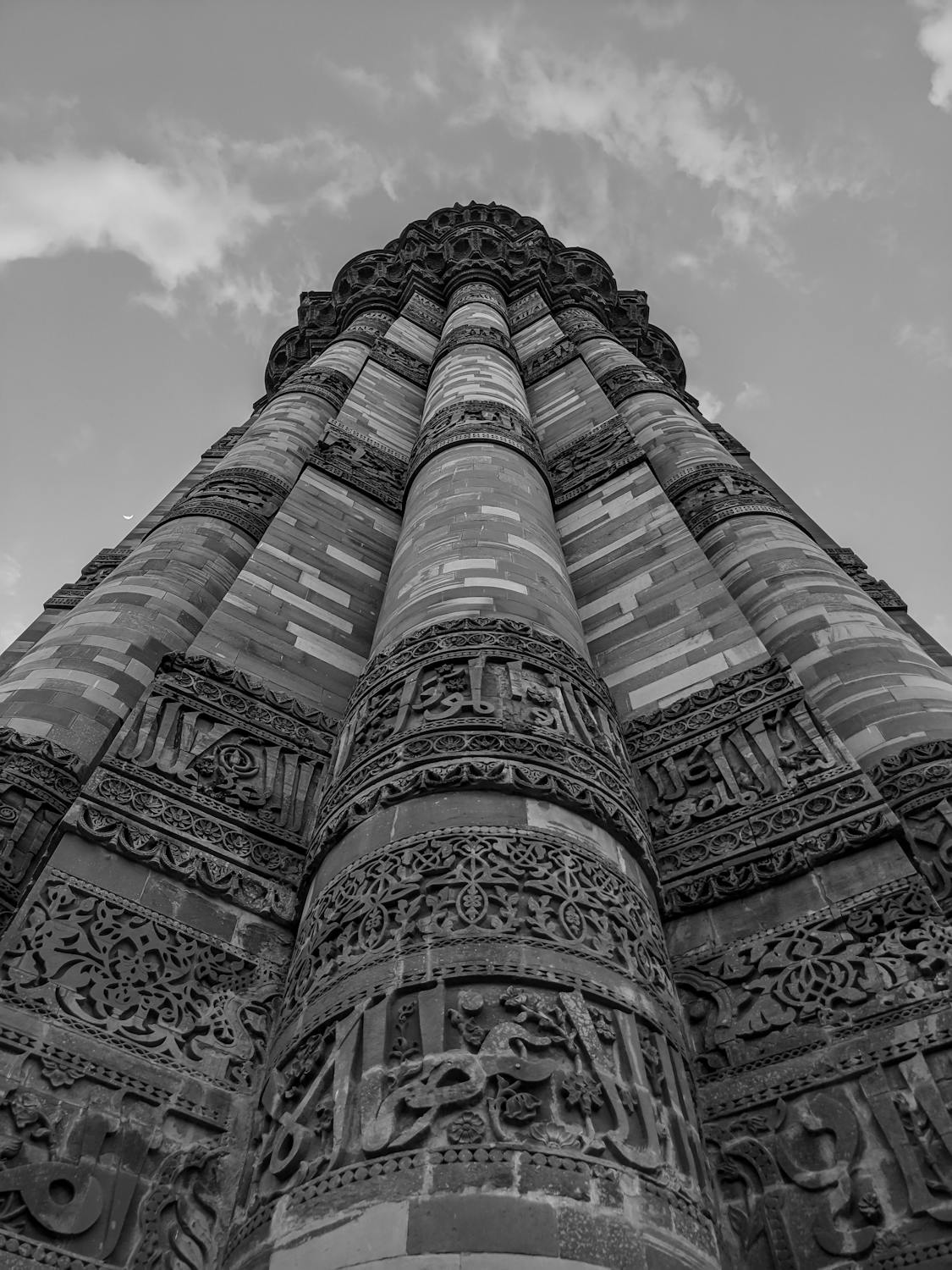
Carved inscriptions, decorative bands, fluted shafts, and balcony brackets turn the exterior into a readable skin. The stone does not only enclose the tower. It announces rule, religion, repair, and craft.
The inscriptions are especially important. In Islamic architecture, calligraphy often becomes architecture, not just writing on architecture. Here, text wraps the surface and becomes part of the tower’s public identity.
For related surface systems, continue with Islamic geometric patterns, arabesque patterns, and muqarnas architecture.

The Qutb Complex Is the Real Subject
The tower is famous, but the complex explains it.
The Qutb Complex includes Qutub Minar, Quwwat-ul-Islam Mosque, the Iron Pillar, Alai Darwaza, Alai Minar, Iltutmish’s tomb, Imam Zamin’s tomb, and other remains. These pieces do not all belong to one period. That is the point. The site records additions, ambitions, repairs, unfinished projects, and shifting architectural language.
Read the complex as a field of relationships:
- the tower as vertical marker;
- the mosque as religious and political ground plane;
- the Iron Pillar as an older object absorbed into a new setting;
- Alai Darwaza as a later, more refined gateway;
- Alai Minar as an unfinished attempt to exceed the existing tower;
- the tombs as later sacred and memorial layers.

The Quwwat-ul-Islam Mosque
The Quwwat-ul-Islam Mosque is one of the key buildings beside the minar. It is often described as one of the earliest surviving mosque complexes in India.
Architecturally, it is difficult and important. The mosque uses columns and fragments connected to earlier Hindu and Jain building traditions. That creates a visual tension: Islamic planning and inscription meet local carving, spolia, corbelled forms, and older craft systems.
This is where the Qutb Complex becomes more than a monument. It becomes a record of architectural transfer under pressure. New religious use did not arrive with a completely new building industry. It worked through available builders, fragments, materials, and symbolic acts.
For a broader mosque-reading method, see characteristics of Islamic architecture and courtyards in Islamic architecture.
Alai Darwaza Shows a Different Level of Control
Alai Darwaza, built under Alauddin Khalji, is one of the most important later additions in the complex.
It shows a more controlled use of arches, dome geometry, red sandstone, white marble inlay, and proportion. If Qutub Minar gives the site its vertical force, Alai Darwaza shows how later Sultanate architecture could handle the gateway as a precise architectural object.
The gateway is useful because it makes the complex feel less like one moment in time. You can see early conquest architecture, reused material, later refinement, unfinished ambition, and repair history within the same site.

Alai Minar: The Unfinished Rival
Alai Minar is the unfinished tower north of Qutub Minar. Alauddin Khalji planned it as a much larger minar, but only the first storey was completed.
That unfinished mass is one of the most useful things on the site. It shows ambition without completion. It also helps explain why Qutub Minar still dominates the complex: not because no one tried to surpass it, but because the rival tower remained incomplete.
Students should look at Alai Minar before leaving the site. Its rough mass makes Qutub Minar’s finished taper, rhythm, and surface control easier to appreciate.
The Iron Pillar Changes the Timeline
The Iron Pillar is older than the Sultanate monuments around it.
Its presence makes the complex historically deeper and more complicated. It reminds the reader that Mehrauli was not an empty site waiting for Islamic architecture to appear. Older political, religious, and material histories were already present.
That is why the Iron Pillar should not be treated as a random curiosity. It changes the time scale of the place. It also helps explain why the Qutb Complex is useful for studying reuse, memory, and architectural layering.
For related Indian engineering context, read ancient Indian engineering.
How to Walk the Site Like an Architecture Student
Do not start by taking the same front-facing tower photo everyone takes.
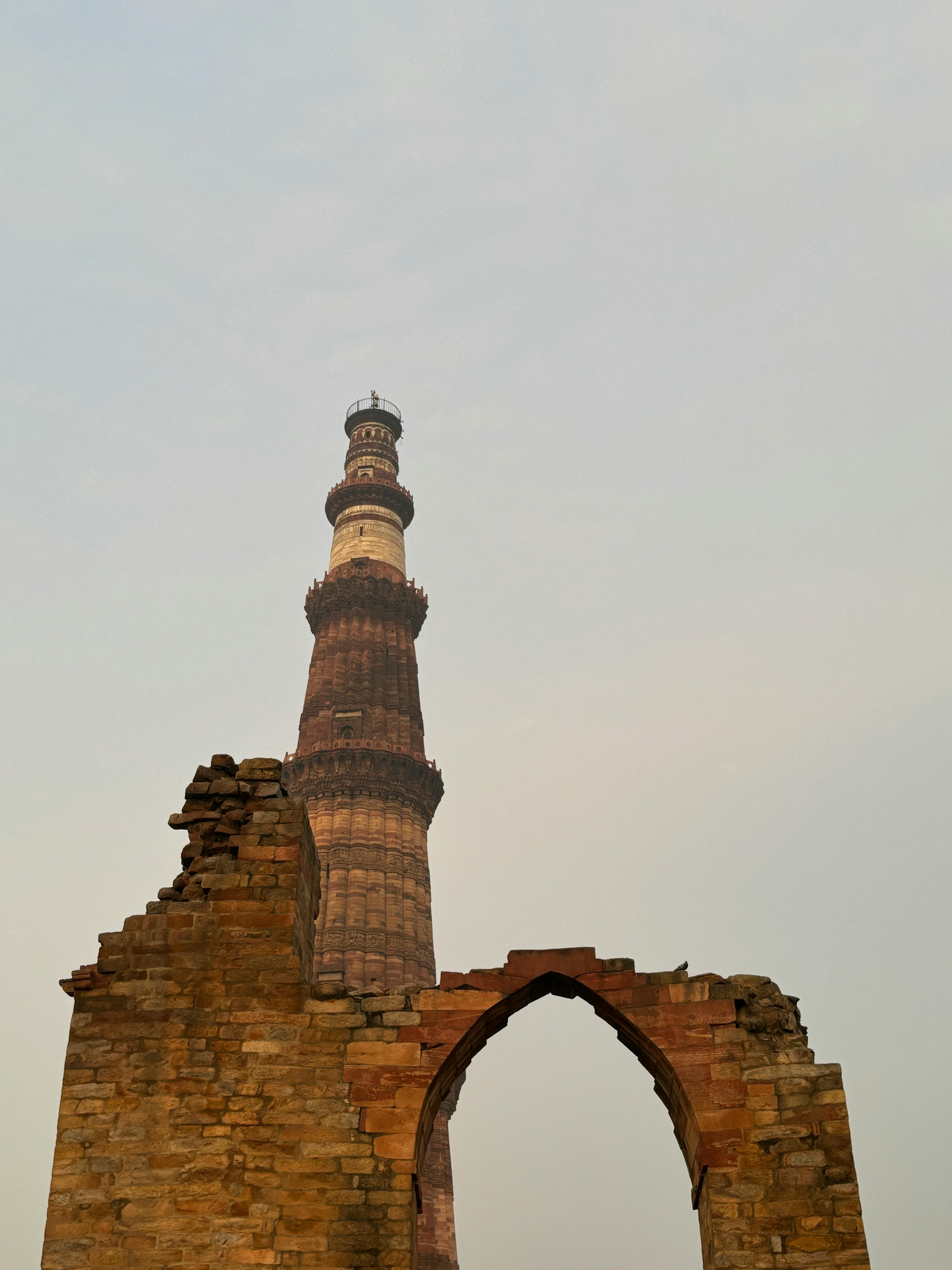
Start at the ground. Look at how the tower meets its base, how the mosque ruins frame it, and how the tower changes when seen through broken colonnades and screens. Then move outward. Study Alai Darwaza, the Iron Pillar, Alai Minar, and the tombs as part of the same architectural field.
A better walking order:
- Start with the full tower from a distance so you understand the taper.
- Move closer and study the balcony rings and fluted shaft.
- Read the inscriptions and carved bands as part of the architecture.
- Walk through the mosque remains and look at reused columns and fragments.
- Use Alai Darwaza to compare later arch and dome control.
- Visit Alai Minar to understand unfinished ambition.
- End by looking back at the tower through the ruins, not from an open postcard angle.
Visual Reading: Site, Shaft, Surface
Qutub Minar is useful because it can be read at three scales: site, shaft, and surface.
At site scale, it anchors a complex. The tower is not alone; it sits in relation to mosque ruins, Alai Darwaza, Alai Minar, the Iron Pillar, tombs, and walking paths.
At building scale, the tower depends on taper, storeys, balcony rings, and visible material changes. Those moves keep the height readable.

From above or at an oblique angle, the minar’s role becomes clearer. It acts as the vertical anchor inside a wider archaeological field.

At detail scale, the surface carries much of the meaning. Calligraphy, carved bands, stone texture, and shadow are not secondary decoration.


Qutub Minar and Charminar Are Not the Same Kind of Monument
Qutub Minar and Charminar are often compared because both are famous Indian Islamic monuments with towers. Architecturally, they do different jobs.
Qutub Minar is a tall, narrow Sultanate minar in Delhi, tied to conquest, mosque use, and early Indo-Islamic architecture in North India. Charminar, built later in Hyderabad, is a four-minaret urban monument with a square plan, strong arches, and a different Deccan setting.
The comparison is useful only if it shows how purpose shapes form. Qutub Minar is vertical and singular. Charminar is urban, square, and four-sided. One dominates as a tower. The other works as a gateway-like civic marker.


Visitor Information Without Letting It Take Over
Qutub Minar is a protected monument, so tickets, time slots, and opening arrangements can change.
For current entry details, use the official ASI ticketing portal or ASI monument information before visiting. Do not rely on old blog prices or copied ticket tables. The stable information is the location: Mehrauli, Delhi, close to Qutub Minar station on the Delhi Metro Yellow Line.
For architecture study, the best time is usually early or late in the day, when the flutes, balcony brackets, and carved bands have stronger shadows. Midday light can flatten the stone and make the tower harder to read.
Student Notes: What to Remember
For students, Qutub Minar is useful because it combines several themes in one site.
| Theme | What to Remember |
|---|---|
| Delhi Sultanate | The tower belongs to the early phase of Islamic rule in North India. |
| Indo-Islamic architecture | The complex shows Islamic forms meeting local craft, reused material, and Indian building traditions. |
| Vertical symbolism | The minar works as a skyline marker, religious tower, and political statement. |
| Material history | Red sandstone, marble, repairs, carved inscriptions, and reused fragments all matter. |
| Complex planning | The minar should be studied with the mosque, Alai Darwaza, Iron Pillar, Alai Minar, and tombs. |
| UNESCO listing | The Qutb Minar and its monuments are part of a UNESCO World Heritage Site. |
Where Qutub Minar Gets Misread
Qutub Minar gets flattened when it becomes only a height fact.
The 72.5-meter number is useful, but it is not the architecture. The tower works because of the taper, the alternating flutes, the balcony rings, the inscription bands, the repairs, and the way the shaft keeps changing as it rises.
The second mistake is separating the minar from the ground around it. The tower belongs to the Quwwat-ul-Islam Mosque, the reused columns, the Iron Pillar, Alai Darwaza, Alai Minar, tombs, and broken edges of the wider complex. Read it alone and it becomes a monument photo. Read it with the complex and it becomes a record of power, reuse, repair, and architectural change.
The reused stone is the hardest part to handle well. It should not be ignored, softened, or turned into a simple craft note. The material speaks about available builders and stonework, but also about conquest and replacement. That tension is part of the site.
The Charminar comparison also needs care. Both monuments are famous, but they do not do the same architectural job. Qutub Minar is a singular vertical marker tied to early Sultanate Delhi. Charminar is a later Deccan urban monument with a square plan and four minarets. Comparing them only because both have towers misses the point.
A stronger reading names the period, site, material, and role before judging the style. Qutub Minar is not just “Indo-Islamic architecture” in a general sense. It is an early Delhi Sultanate tower inside a layered complex, built through height, surface, inscription, reused material, and later repair.
FAQ
What is Qutub Minar?
Qutub Minar is a Delhi Sultanate minar in the Qutb Complex at Mehrauli, Delhi. It is part of a UNESCO World Heritage Site and is known for its height, tapering shaft, carved inscriptions, fluted surfaces, balcony rings, and relationship to the nearby Quwwat-ul-Islam Mosque.
How tall is Qutub Minar?
The tower is about 72.5 meters high. Its base is much wider than its top, which helps give the minar its strong tapering form.
Who built Qutub Minar?
Qutb-ud-din Aibak began the tower. Iltutmish added major upper storeys. Firoz Shah Tughlaq later repaired and rebuilt damaged upper portions.
Why was Qutub Minar built?
It is usually read as both a minaret connected to the nearby mosque and a victory tower marking early Delhi Sultanate power. Its architecture carries religious, political, and urban meaning at the same time.
What style is Qutub Minar?
Qutub Minar is usually discussed within early Indo-Islamic or Delhi Sultanate architecture. Its design combines Islamic inscriptions, minaret form, and Sultanate ambition with local stone craft and the complex history of reused material.
What buildings are in the Qutb Complex?
The complex includes Qutub Minar, Quwwat-ul-Islam Mosque, the Iron Pillar, Alai Darwaza, Alai Minar, Iltutmish’s tomb, Imam Zamin’s tomb, and other remains.
Is Qutub Minar the same as Qutb Minar?
Yes. Qutub Minar, Qutb Minar, and Qutab Minar are spelling variants used for the same monument. Qutb Minar is common in official heritage listings, while Qutub Minar is common in search and travel use.
Can visitors climb Qutub Minar?
No. Public access to the interior stair is closed. The tower is studied and visited from the surrounding complex.
Read This Next
For the parent topic, start with Islamic architecture. For the longer historical sequence, continue with Islamic architecture history. For the main design features, read characteristics of Islamic architecture.
For related systems, use minarets, Islamic arches, courtyards in Islamic architecture, Islamic geometric patterns, and muqarnas architecture.
For other major Islamic architecture case studies, read Dome of the Rock, Al-Azhar Mosque, Blue Mosque, Süleymaniye Mosque, Taj Mahal, and Badshahi Mosque.
What Stays Useful
Qutub Minar is easiest to misunderstand when it is treated as a height record.
Its architecture is in the taper, the fluting, the balcony rings, the inscriptions, the repairs, the reused stonework nearby, and the way the tower anchors the Qutb Complex. The tower is impressive from far away. It becomes more important when you read the ground around it.