
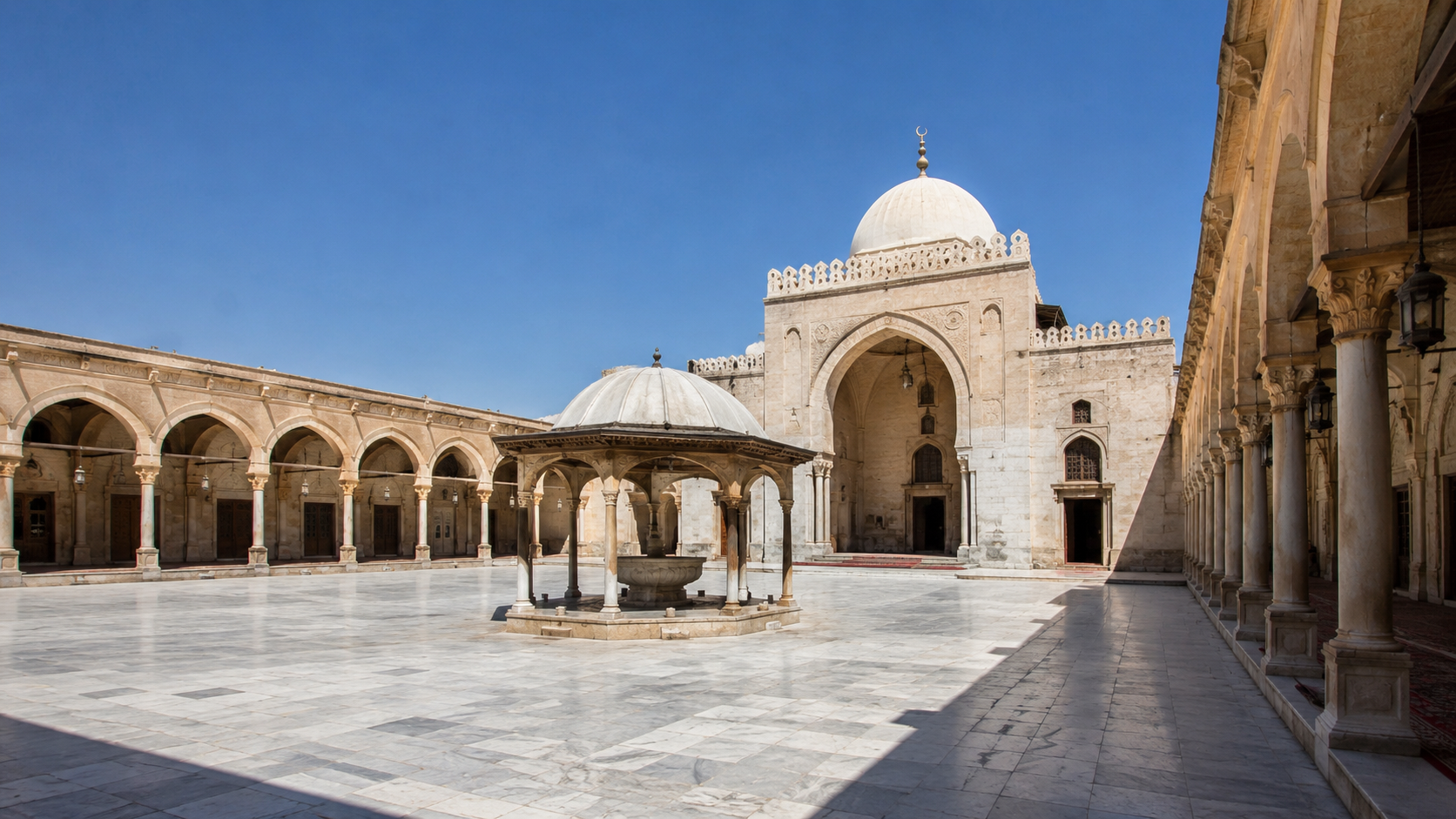
Sahn Courtyard
A sahn looks simple because it is open.
But the open space is doing real work. It brings in light, moves air, cools the building, gives people a place to gather, and separates the street from the quieter space inside.
In a mosque, it often leads toward the prayer hall. In a house, it can become a private outdoor room. In a madrasa or palace, it helps organize movement, shade, water, and status.
The courtyard is not empty space. It is the part that helps the rest of the building work.
For the broader parent topic, start with Islamic architecture. This page focuses on the courtyard itself: what it does, why it appears so often, and how to read it without reducing it to decoration.
What Is a Sahn?
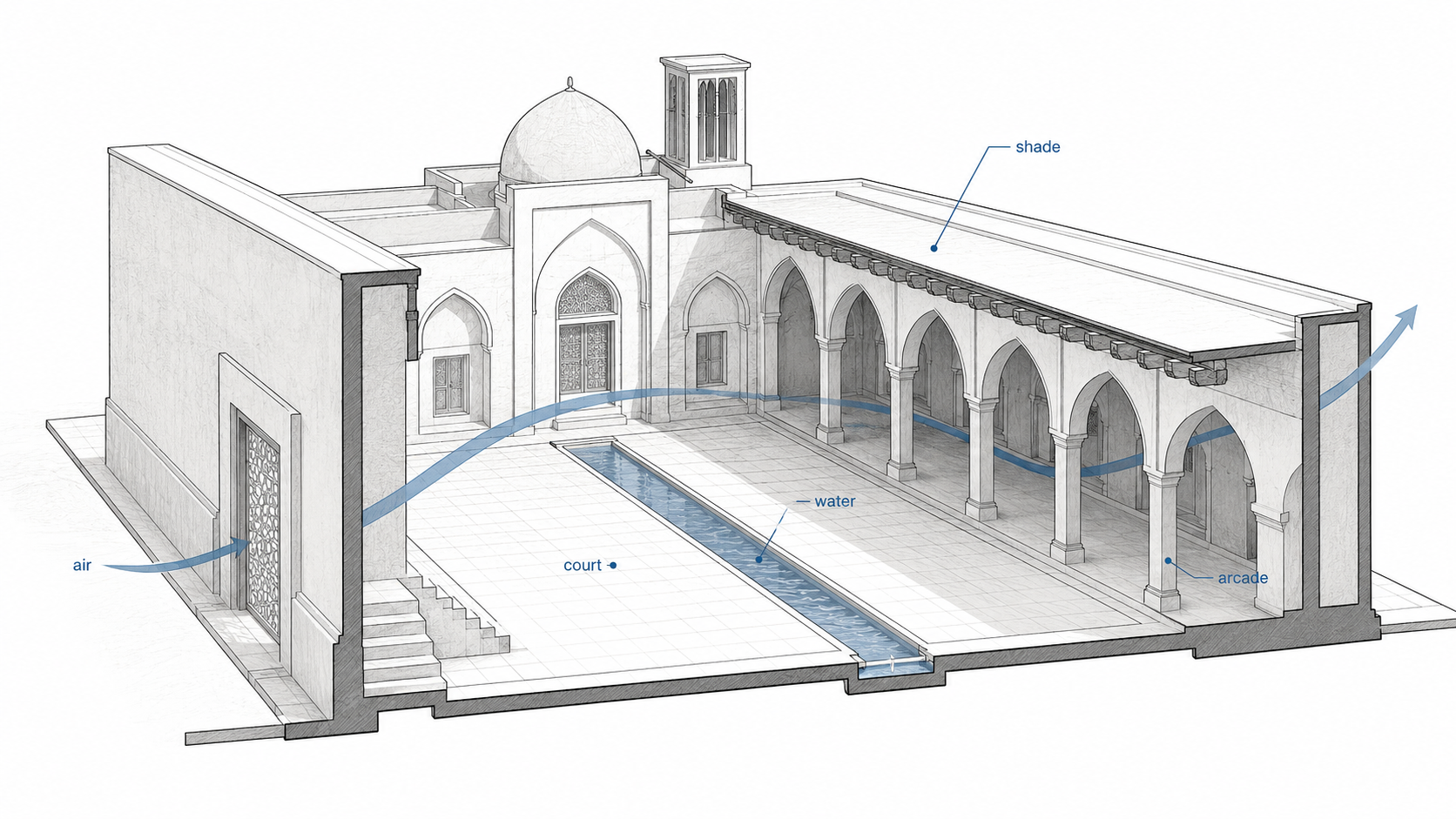
A sahn is an open courtyard, usually enclosed or partly enclosed by walls, arcades, rooms, or prayer spaces. In mosque architecture, the word usually refers to the main courtyard, often placed before the prayer hall.
The sahn is not empty leftover space. It is planned space. It can hold worshippers before prayer, create a cooler center, organize movement, and give the building a pause between street and interior.
In many historic mosques, the sahn is surrounded by arcades. Those shaded edges matter. The open center gives light and air. The arcades give shelter, rhythm, and transition. Together, they let the courtyard work in heat, crowding, and ritual movement.
The Courtyard Comes Before the Decoration
The easiest mistake is to study Islamic courtyards as beautiful places first.
They are often beautiful. That is not the point to start with. The sahn belongs to a building system. It deals with climate, threshold, gathering, visibility, privacy, water, and religious orientation. The tiles, arches, fountains, and calligraphy make more sense after those basic jobs are clear.
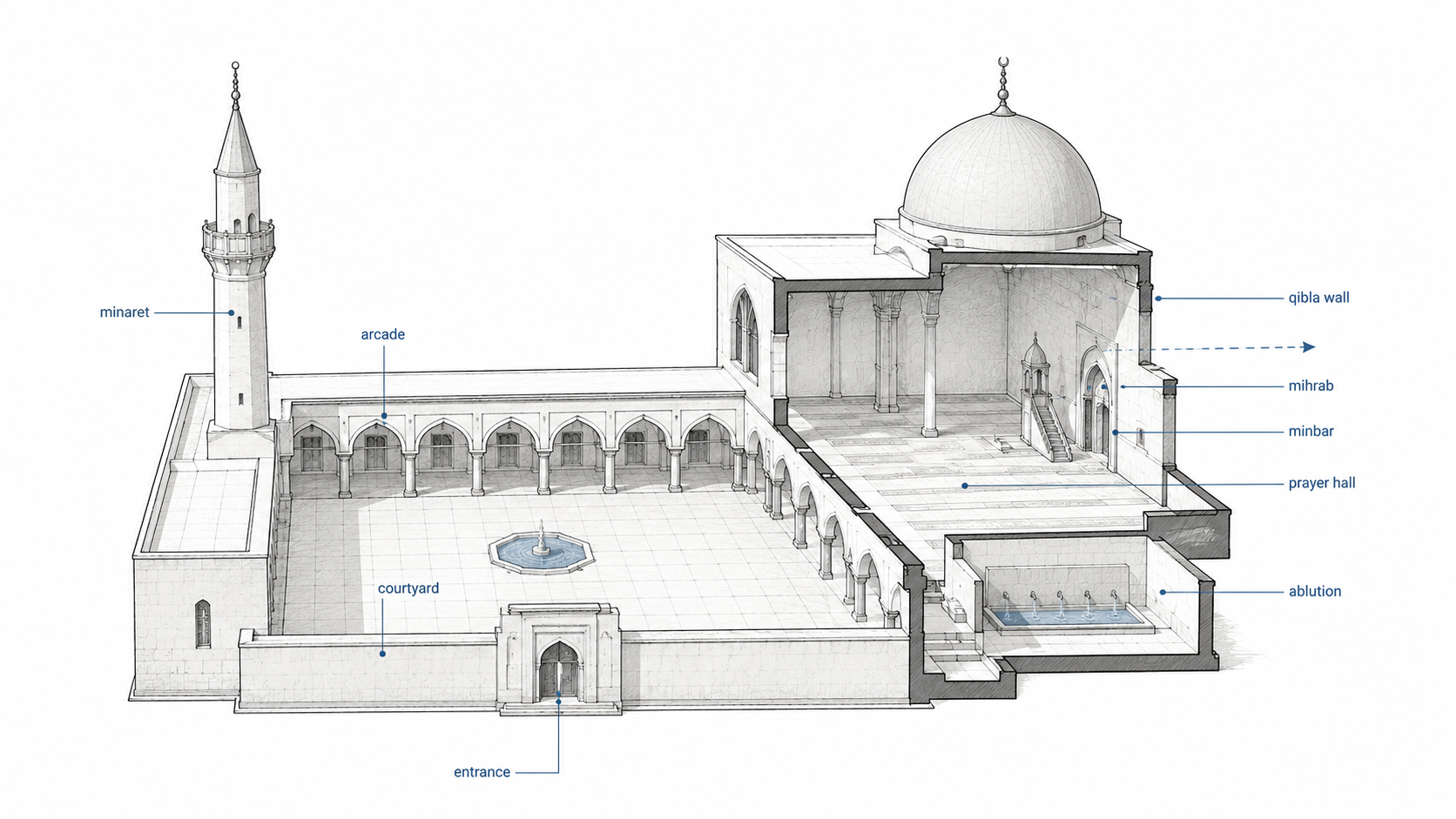
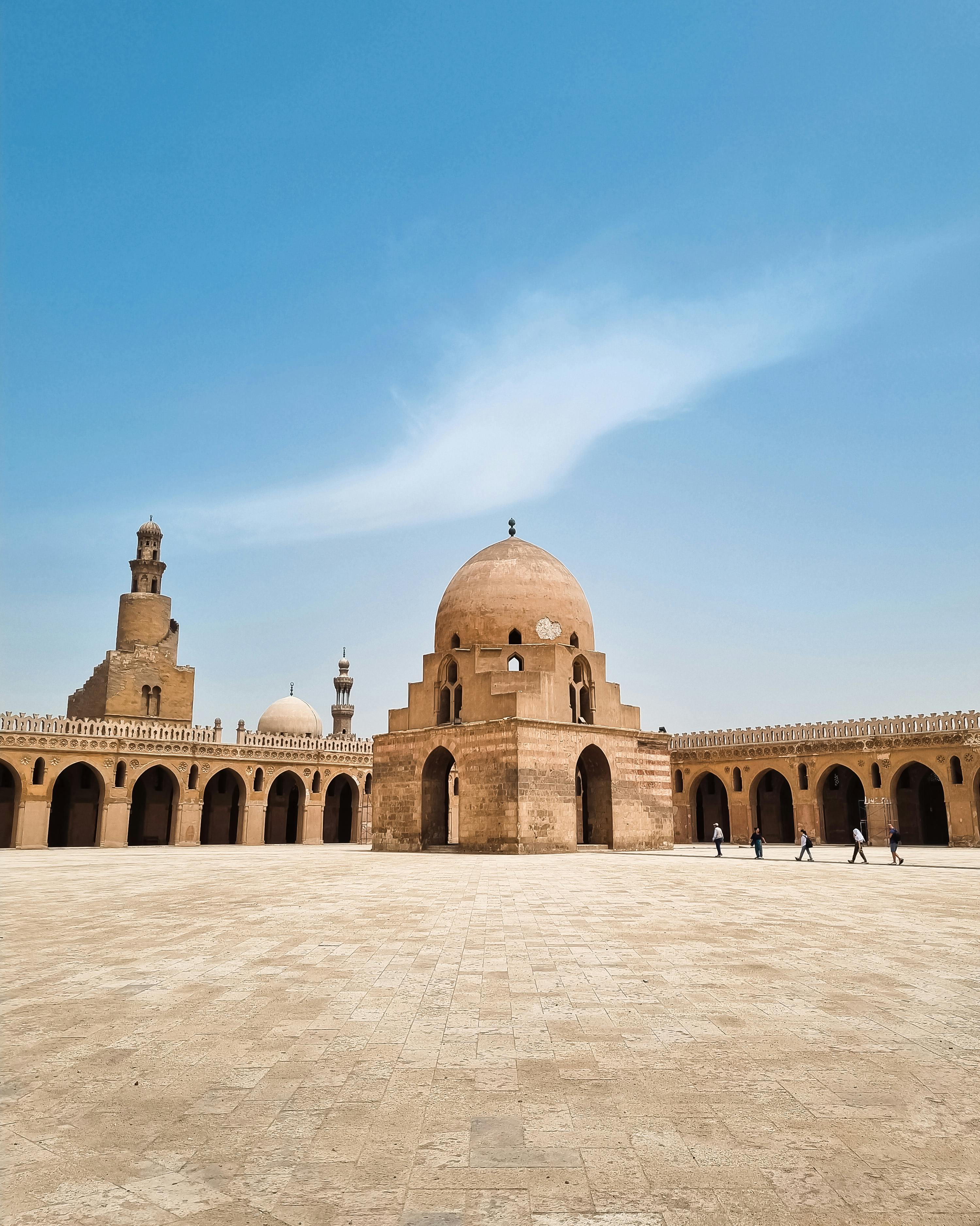
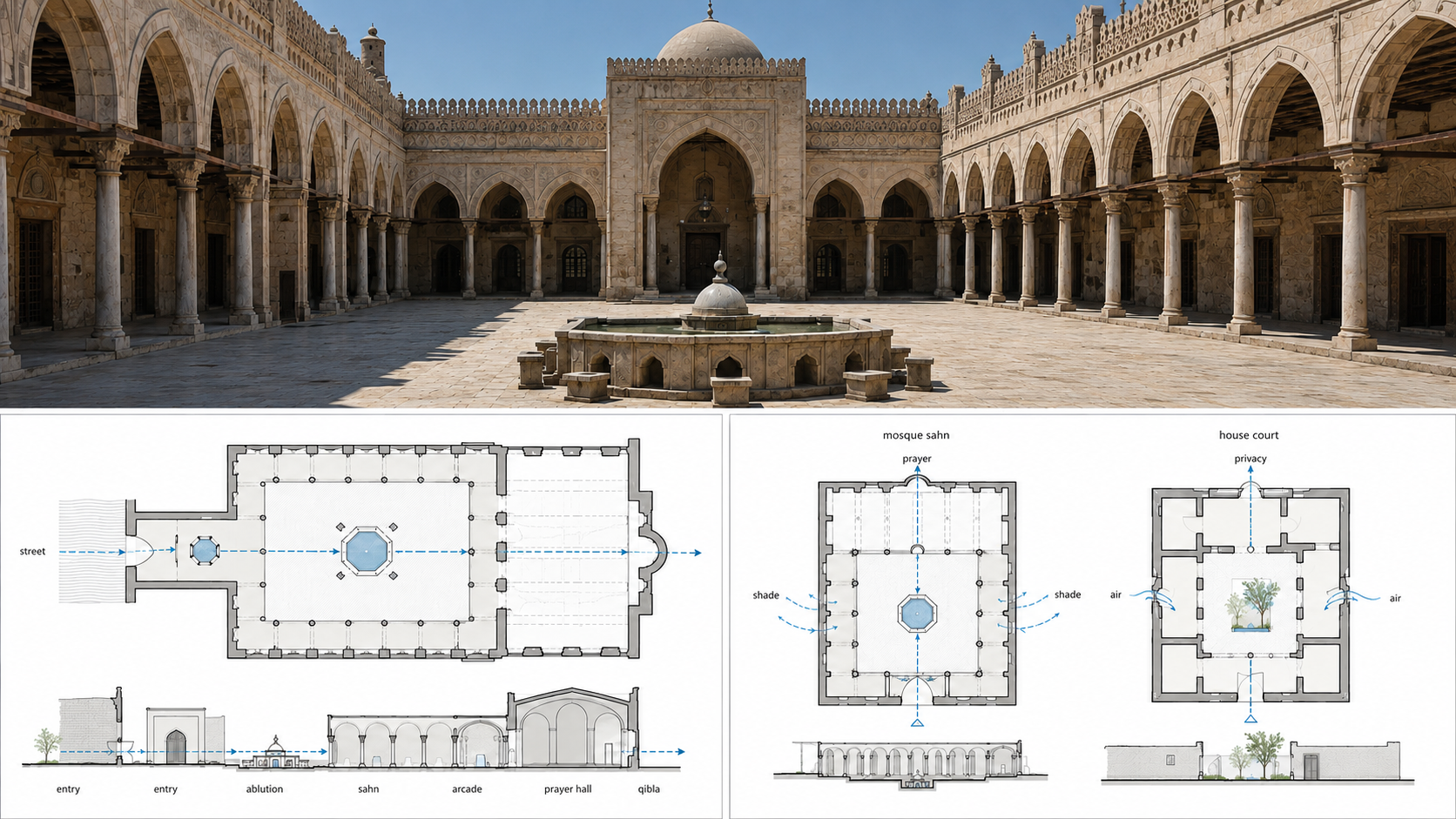
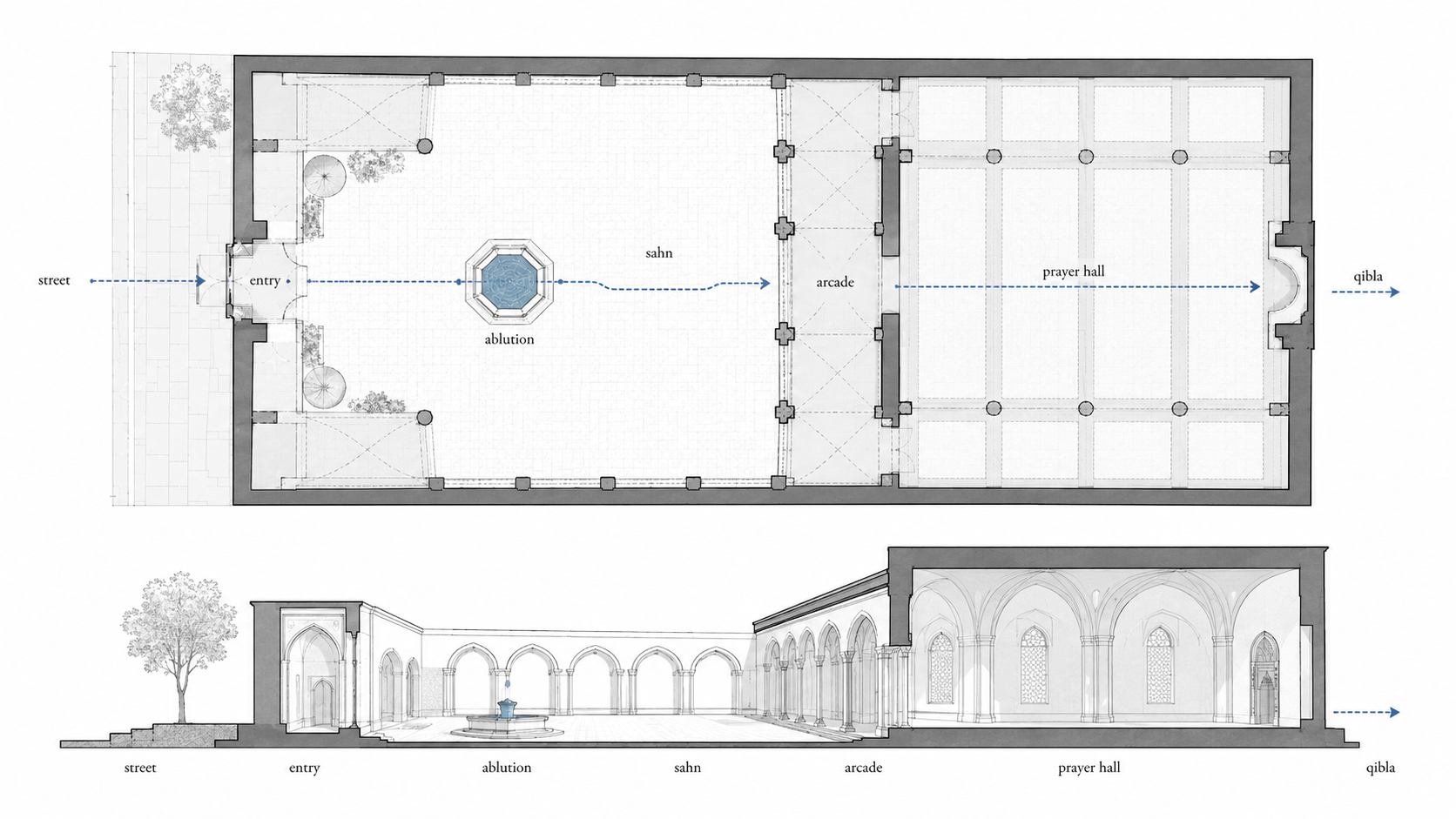
A mosque courtyard does not work alone. It belongs to the entrance sequence, the ablution area, the arcades, the prayer hall, and the qibla wall. It is the open part of a larger order.
What the Sahn Does
A good courtyard solves several problems at once. That is why it survived across so many regions and building types.
| Courtyard role | What it does | What to look for |
|---|---|---|
| Climate | Brings air and daylight into a dense building. | Open sky, shaded edges, water, wall height, and airflow paths. |
| Movement | Gives people room to enter, gather, cross, pause, and disperse. | Gateways, arcades, paths, and the route to the prayer hall. |
| Prayer preparation | Creates a transition from street noise to religious space. | Ablution area, fountain, shaded waiting areas, and qibla orientation. |
| Privacy | Lets homes and institutions open inward instead of exposing rooms to the street. | Blank outer walls, inward-facing rooms, screens, and layered entrances. |
| Social use | Supports teaching, family life, rest, gathering, and ceremony. | Benches, arcades, planted areas, room edges, and circulation zones. |
| Symbolic order | Uses water, garden, light, and geometry to give the space meaning. | Central basins, axial paths, planting, framed views, and repeated modules. |
A Short History of the Sahn
Courtyard architecture is older than Islam. Houses, temples, palaces, and civic buildings across hot regions used open courts long before the first mosques.
Islamic architecture adapted that older courtyard logic to new religious, social, and urban needs. The early mosque model used open space, shade, direction, and gathering before later architecture added more elaborate domes, minarets, tilework, and monumental gateways.
The Prophet’s Mosque in Medina is often treated as the early reference point: a practical open court with shaded areas and a direct relationship between community, prayer, teaching, and leadership. Later mosque courtyards became larger and more formal, but the core idea remained practical.
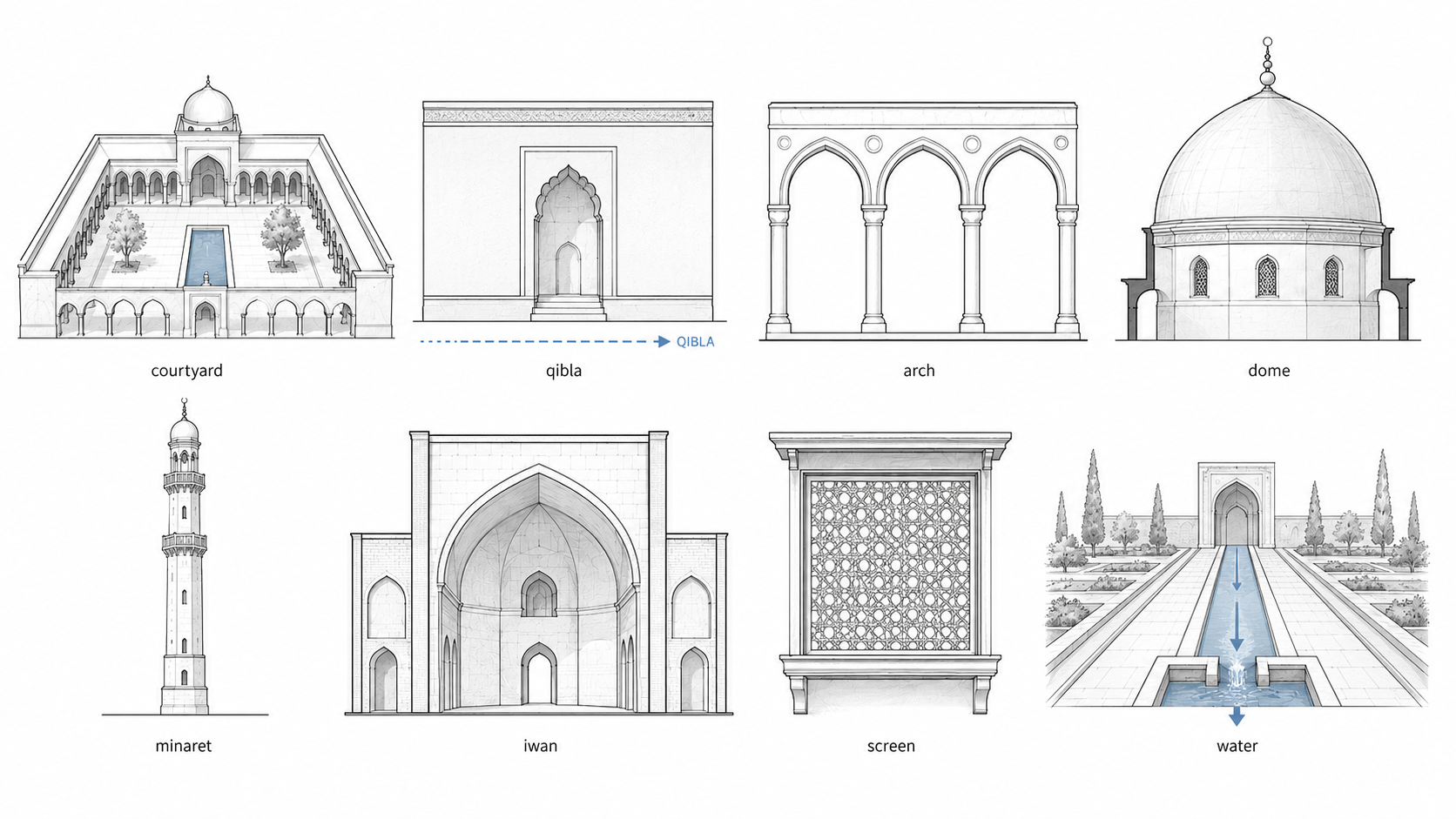
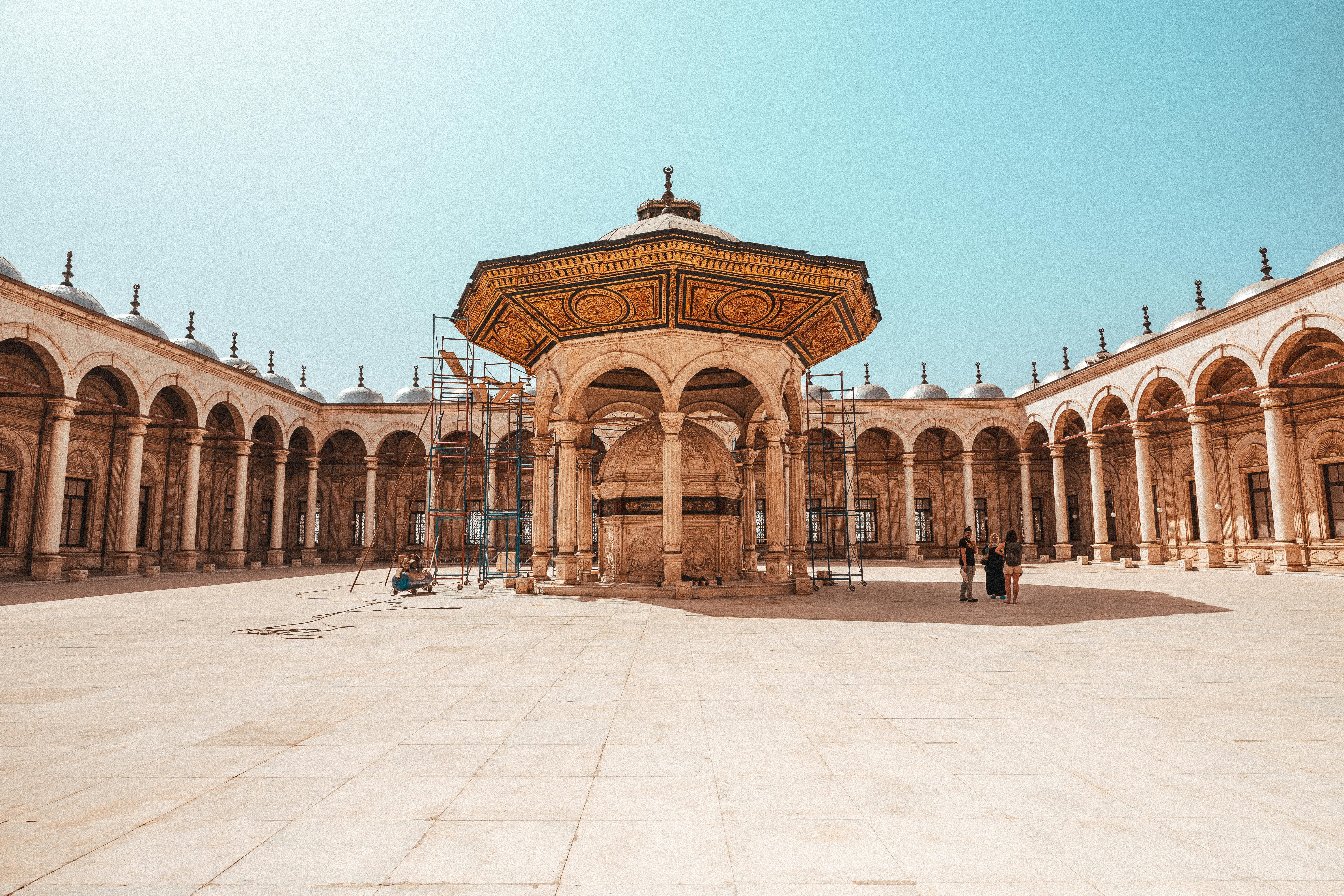
Umayyad, Abbasid, Fatimid, Mamluk, Persian, Ottoman, Moorish, Mughal, and regional Islamic buildings all used courtyards differently. A mosque courtyard in Cairo, a palace court in Granada, a madrasa court in Iran, and a house court in Damascus do not have the same scale or mood. They share a spatial idea, not one fixed design.
Mosque Courtyards: From Entry to Prayer
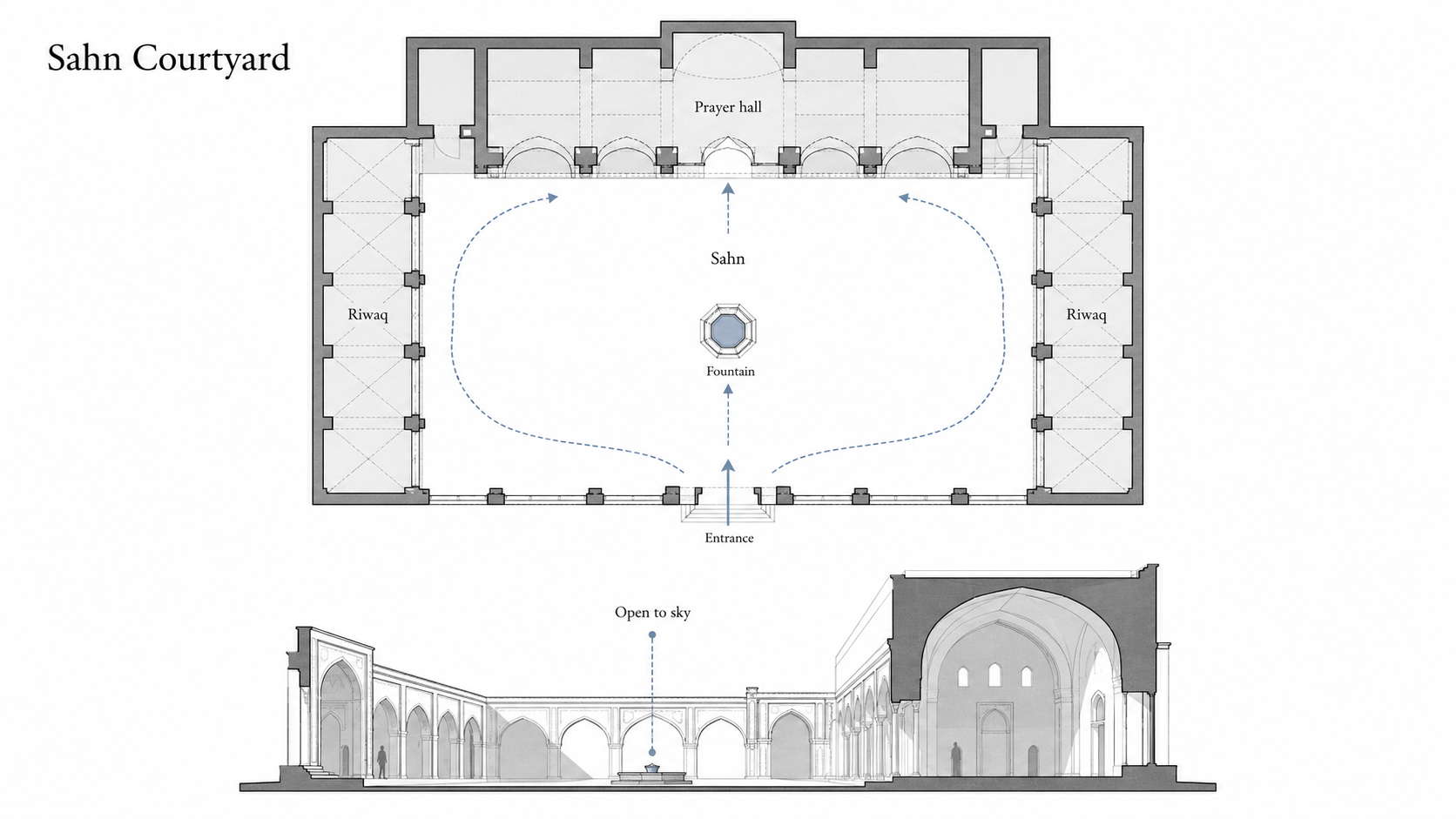
In a mosque, the sahn usually helps manage the shift from daily life to prayer.
The visitor enters from the street, crosses a threshold, enters the open court, moves past water or shade, then approaches the prayer hall. That sequence matters. The courtyard gives the building a pause. It lets the body slow down before the interior focus of the qibla wall and mihrab.
The sahn also handles crowds. Before and after prayer, the open court can hold people without forcing every movement into narrow interior bays. Arcades around the court give shade and allow people to gather at the edges.
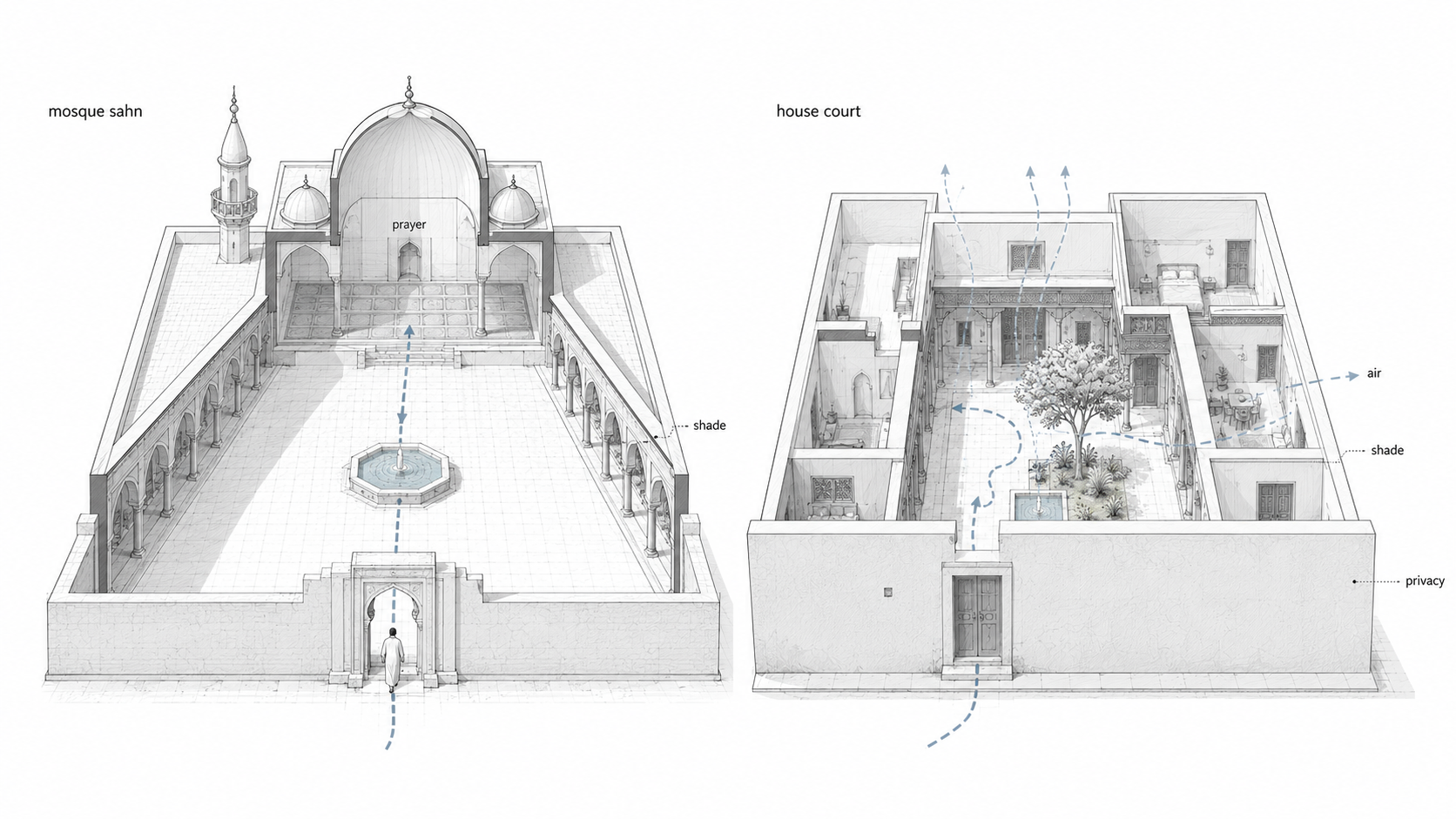
How the Sahn Changes Between Mosque and House
The same open-court idea changes when the building type changes.
In a mosque, the sahn helps organize entry, gathering, ablution, shade, and movement toward the prayer hall. In a house, the courtyard usually turns inward. It gives the family privacy, light, air, planting, and a protected outdoor room away from the public street.
That difference matters because “Islamic courtyard” is not one fixed plan. The mosque courtyard is often public or semi-public. The house courtyard is usually more private. Both can use water, shade, airflow, and inward-facing rooms, but the social purpose is different.
Arcades Make the Courtyard Work
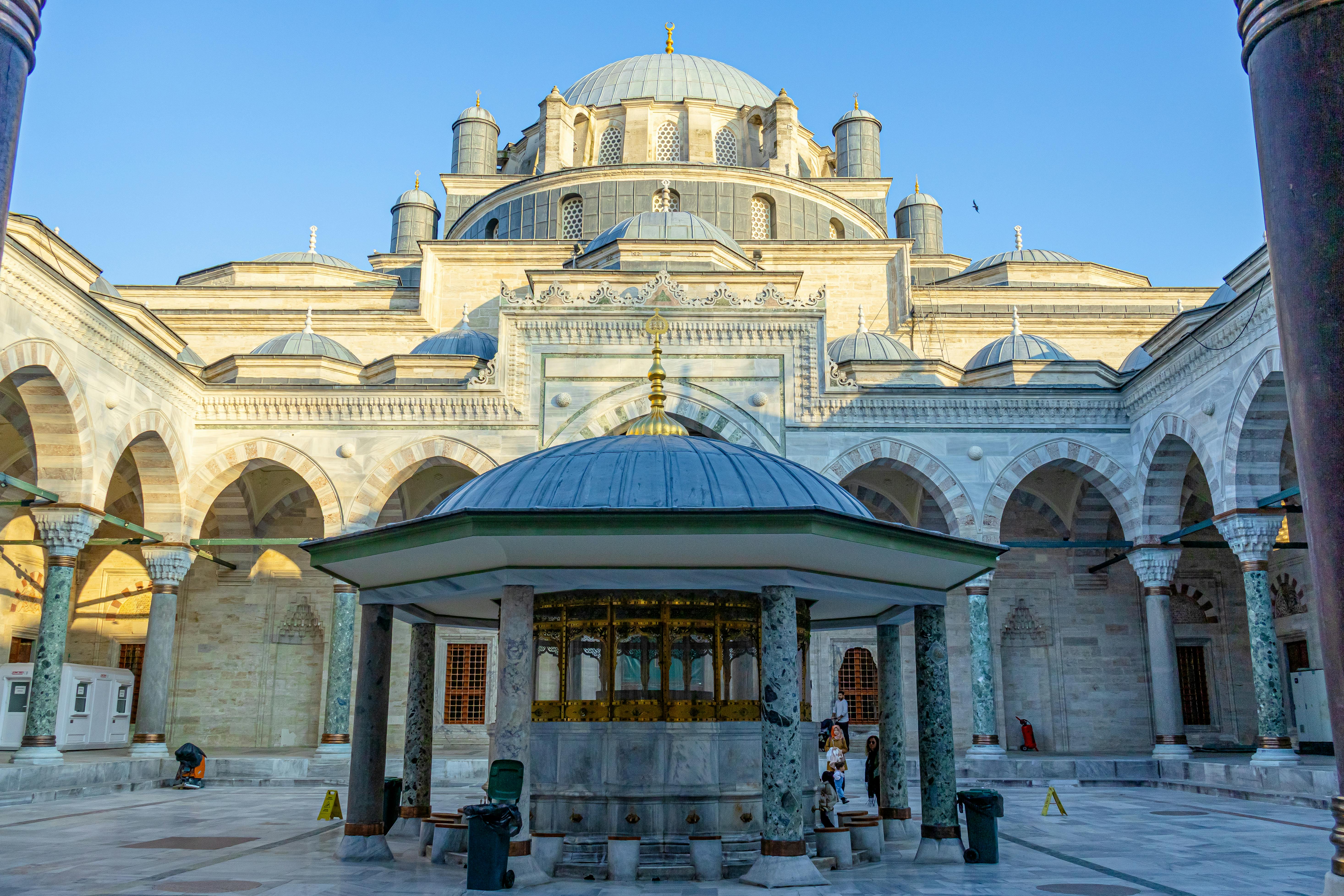
A sahn without shade can become harsh. The arcade is what often makes the courtyard usable.
Arcades create a protected edge between open sky and enclosed rooms. They let people circulate without standing in direct sun. They also give the courtyard rhythm. Repeated arches or columns turn the open space into an ordered architectural room.
That shaded edge is one of the best things to study. It shows how structure, climate, movement, and image can work together. The arcade is not just a border. It is the part that lets the open center stay useful.
For the arch forms behind many courtyard edges, use arches in Islamic architecture.
Water Changes the Courtyard
Water in a sahn is often symbolic, but it is never only symbolic.
A fountain or basin changes sound, light, movement, and temperature. It can support ablution in mosque settings. It can mark the center of the court. It can reflect surrounding arcades, domes, trees, and sky. In hot climates, water can also help cool the immediate microclimate, especially when combined with shade and airflow.
The important point is that water gives the courtyard a center. A dry court can work, but a basin or fountain changes how people move and pause.
Gardens, Planting, and Paradise Imagery
Some Islamic courtyards are paved and spare. Others are planted, shaded, and closely tied to garden planning.
In palace and house settings, planting can soften heat, add privacy, and create a more intimate center. In Persian and Mughal traditions, gardens and water channels often carry stronger symbolic weight, connecting geometry, refreshment, and paradise imagery.
The problem comes when every courtyard is described as a “paradise garden.” Some are. Many are not. Some are practical courts for circulation, prayer, washing, heat control, or family life. The first question should be what the court is doing in that building.

Moorish Courtyards: Water, Light, and Close Control
Moorish architecture gives some of the clearest courtyard examples because the spaces are intimate, controlled, and heavily shaped by water and surface detail.
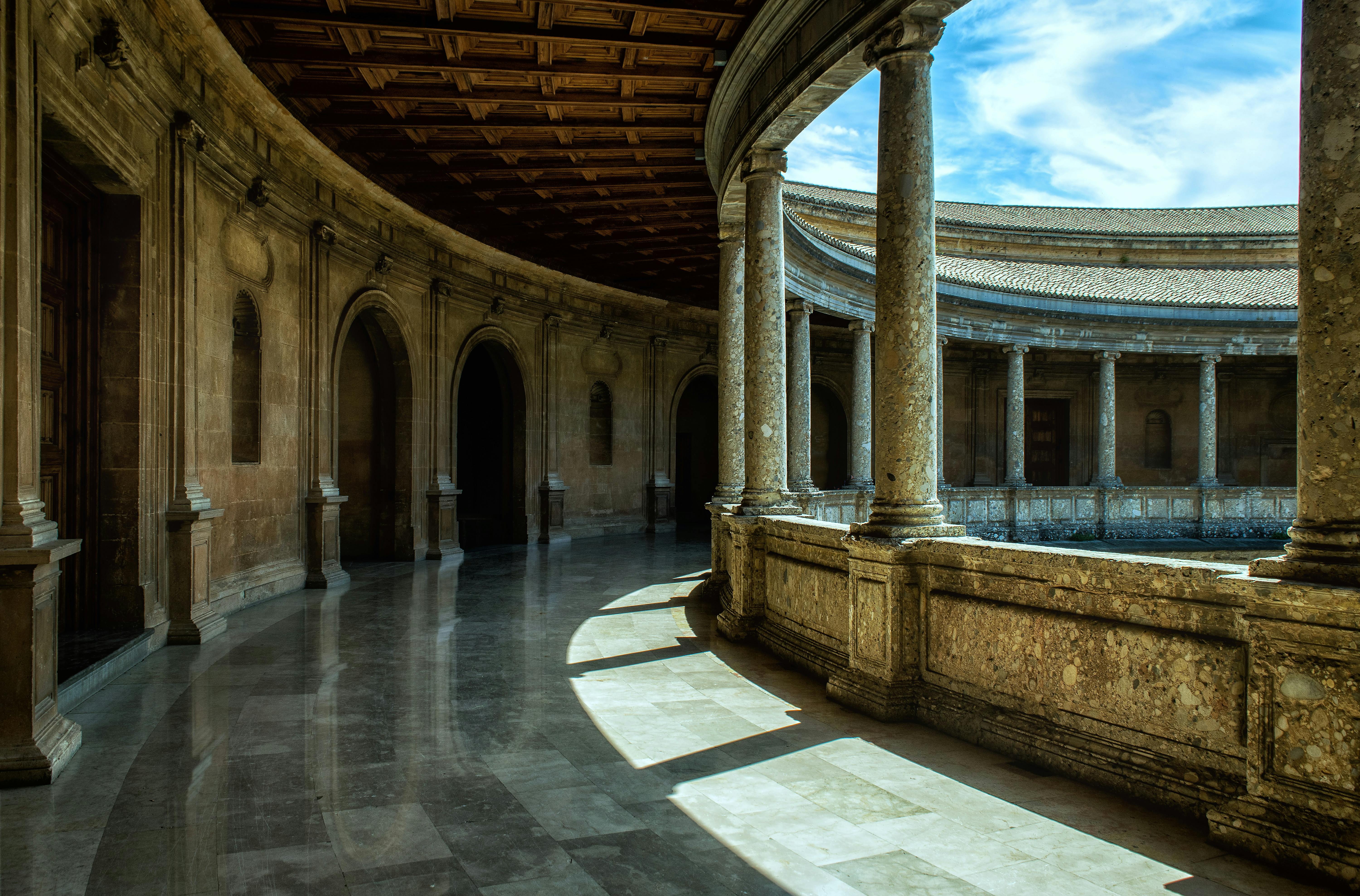
At the Alhambra, courtyards are not just open rectangles. They control view, sound, reflection, approach, and temperature. Water channels pull the eye along an axis. Arcades frame the edge. Carved plaster and tile make the walls feel lighter and more detailed than their mass suggests.
For the regional branch, read Islamic and Moorish architecture in Spain and Alhambra Palace architecture.
Courtyards in Islamic Homes
The domestic sahn is different from the mosque courtyard.
In a house, the courtyard often becomes the private outdoor room. The street face can stay plain or guarded, while the life of the house turns inward. Rooms open toward the court. Children, meals, rest, shade, plants, and family rituals can gather around the center without exposing the household to the street.

This is where the courtyard becomes especially useful for modern readers. It solves privacy and climate together. Instead of putting every window on the public street, the house opens to its own controlled center.
The Climate Logic of the Sahn
Courtyards are often described as “peaceful,” but the more useful word is controlled.
The sahn controls heat, light, privacy, noise, air, and movement through simple architectural means. Walls block the street. The open center releases hot air. Arcades shade the edges. Water and planting can cool the immediate space. Rooms around the court receive light without needing full exposure to the outside.
| Problem | Courtyard response | What can go wrong |
|---|---|---|
| Heat | Shade, airflow, water, planting, and thick surrounding walls. | A bare paved court with no shade can become a heat trap. |
| Glare | Arcades and filtered edges soften direct sunlight. | Highly reflective paving can make the court uncomfortable. |
| Privacy | The building opens inward instead of exposing rooms to the street. | Poorly placed upper windows can break the privacy logic. |
| Air movement | The open center and shaded edges can support passive ventilation. | A court that is too narrow or blocked may not ventilate well. |
| Noise | Outer walls and inward-facing rooms buffer the street. | Hard surfaces can amplify sound if the court is too bare. |
Modern Courtyards Inspired by the Sahn
Modern architects keep returning to the sahn because it solves problems that have not gone away.
Hot cities still need shade. Dense housing still needs privacy. Public buildings still need transition space. Mosques, schools, museums, cultural centers, and homes still need ways to bring light and air inside without making every room depend on glass and mechanical cooling.

A modern courtyard does not need to copy historic ornament. The useful lessons are more basic: orient rooms inward, shade the edges, control glare, use planting and water carefully, and treat the courtyard as an environmental system instead of a leftover void.
When a Courtyard Fails
Not every courtyard works.
A bad courtyard is just an exposed hole in the plan. It overheats, reflects glare, traps noise, gives no privacy, and gets crossed quickly instead of used. That failure usually comes from treating the courtyard as an image rather than a working space.
The sahn works when its proportions, shade, edges, water, rooms, and entrances support each other. The open center needs a reason. The edges need protection. The path through the court needs to feel natural. The surrounding rooms need to benefit from the air and light without losing comfort.
This is the practical lesson that many courtyard articles skip: the empty center is not enough. The section, edge, and climate strategy decide whether the courtyard becomes useful or only photogenic.
Sahn, Mosque Courtyard, and Islamic Courtyard: Small Differences
These terms overlap, but they are not always identical.
| Term | Best use | Important distinction |
|---|---|---|
| Sahn | The courtyard of a mosque or Islamic building, especially in Arabic architectural vocabulary. | Often tied to prayer, ablution, arcades, and mosque sequence. |
| Mosque courtyard | The open court in a mosque complex. | Usually read with the prayer hall, qibla wall, mihrab, arcades, and ablution area. |
| Islamic courtyard | A broader term for courtyard traditions in mosques, homes, madrasas, palaces, and gardens. | Can include domestic, religious, educational, and palace settings across many regions. |
| Courtyard house | A house organized around an open center. | Not always Islamic, but many Islamic urban houses use inward-facing courtyard logic. |
How to Study a Sahn
Do not start with the fountain.
Start with the plan. Ask where people enter, where they pause, where the shade is, how the court connects to the prayer hall or rooms, and whether the building opens inward or outward.
- Draw the courtyard as the open center.
- Mark the entrances and main movement paths.
- Locate the prayer hall, qibla wall, or main rooms around the court.
- Mark shaded arcades and covered edges.
- Note water, planting, and ablution areas.
- Check whether the court solves climate and privacy, or only creates an image.
For the larger method, continue with characteristics of Islamic architecture.
Examples Worth Studying
A short list is more useful than a monument dump. These examples show different courtyard roles.
| Example | Where | What the courtyard teaches |
|---|---|---|
| Ibn Tulun Mosque | Cairo | Large open sahn, arcades, ablution center, and early mosque spatial order. |
| Alhambra | Granada | Water, reflection, view control, carved surfaces, and palace courtyard sequence. |
| Blue Mosque | Istanbul | Ottoman courtyard, domed prayer hall sequence, and monumental mosque approach. |
| Great Mosque of Central Java | Semarang | Modern reinterpretation of sahn scale, shade structures, and civic gathering. |
| Traditional courtyard houses | Damascus, Cairo, Fez, and other historic cities | Inward privacy, passive cooling, family life, and protected outdoor space. |

FAQ
What is a sahn in Islamic architecture?
A sahn is an open courtyard in a mosque or Islamic building. In mosque architecture, it often helps organize entry, gathering, ablution, shade, movement, and the approach to the prayer hall.
Why do mosques have courtyards?
Mosque courtyards provide space for gathering, help manage crowds, bring light and air into the building, and create a transition between the street and the prayer hall.
Is a sahn always in the center?
Not always. Many mosque and house courtyards are central, but site limits, additions, and regional traditions can shift the court’s position. The important question is how it organizes movement and surrounding rooms.
What is usually found in a sahn?
A sahn may include arcades, paving, a fountain or ablution basin, planted areas, shaded edges, entrances, and access to the prayer hall or surrounding rooms.
What is the difference between a sahn and a courtyard?
A sahn is a courtyard, but the word is usually used in Islamic architectural contexts, especially mosque architecture. “Courtyard” is broader and can describe many building traditions.
Are Islamic courtyards only religious spaces?
No. Courtyards appear in mosques, homes, madrasas, palaces, caravanserais, and gardens. Their role changes by building type.
Why is water common in Islamic courtyards?
Water can support ablution, cool the space, reflect light, soften sound, mark the center, and carry symbolic meaning. Its role depends on the building.