

Characteristics of Islamic Architecture: 20 Features That Shape the Buildings
Islamic architecture is easy to reduce to domes, arches, tile, and pattern.
Those features matter, but they are not random decoration. The strongest Islamic buildings use form to solve problems: prayer direction, shade, privacy, airflow, gathering, water, structure, sound, light, and public presence.
A mosque in Cairo, a courtyard palace in Granada, a timber mosque in China, and a Mughal tomb in India can look very different. The shared language is not one fixed style. It is a set of architectural moves that kept changing by region, climate, material, and building type.
Start with the building system. The surface will make more sense after that.
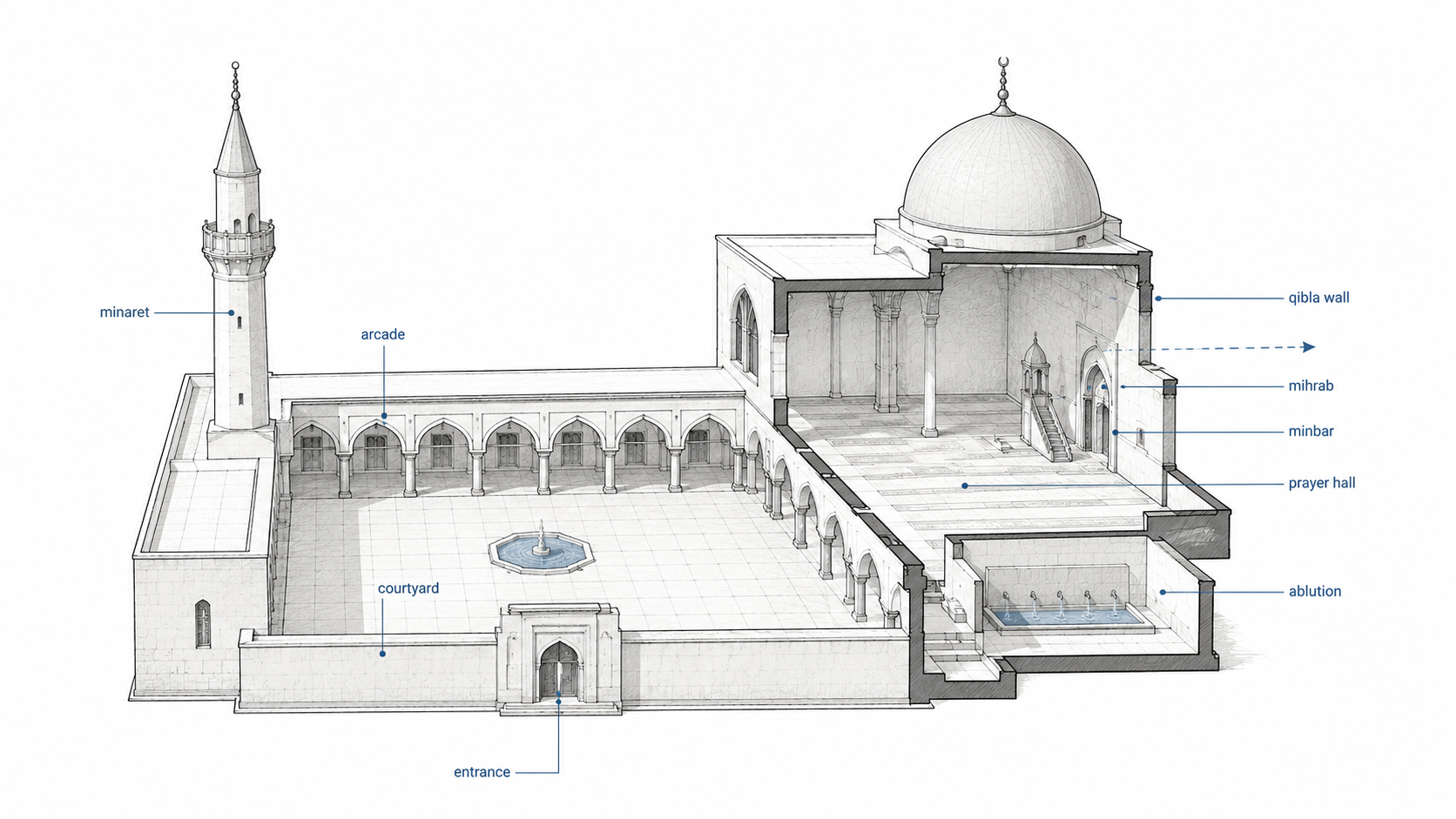
Illustration by ArchitectureCourses.org. A mosque is easier to understand when the parts are read as a working system: courtyard, prayer hall, qibla wall, mihrab, minbar, arcade, entrance, minaret, and ablution area.
How Islamic Architecture Grew and Spread
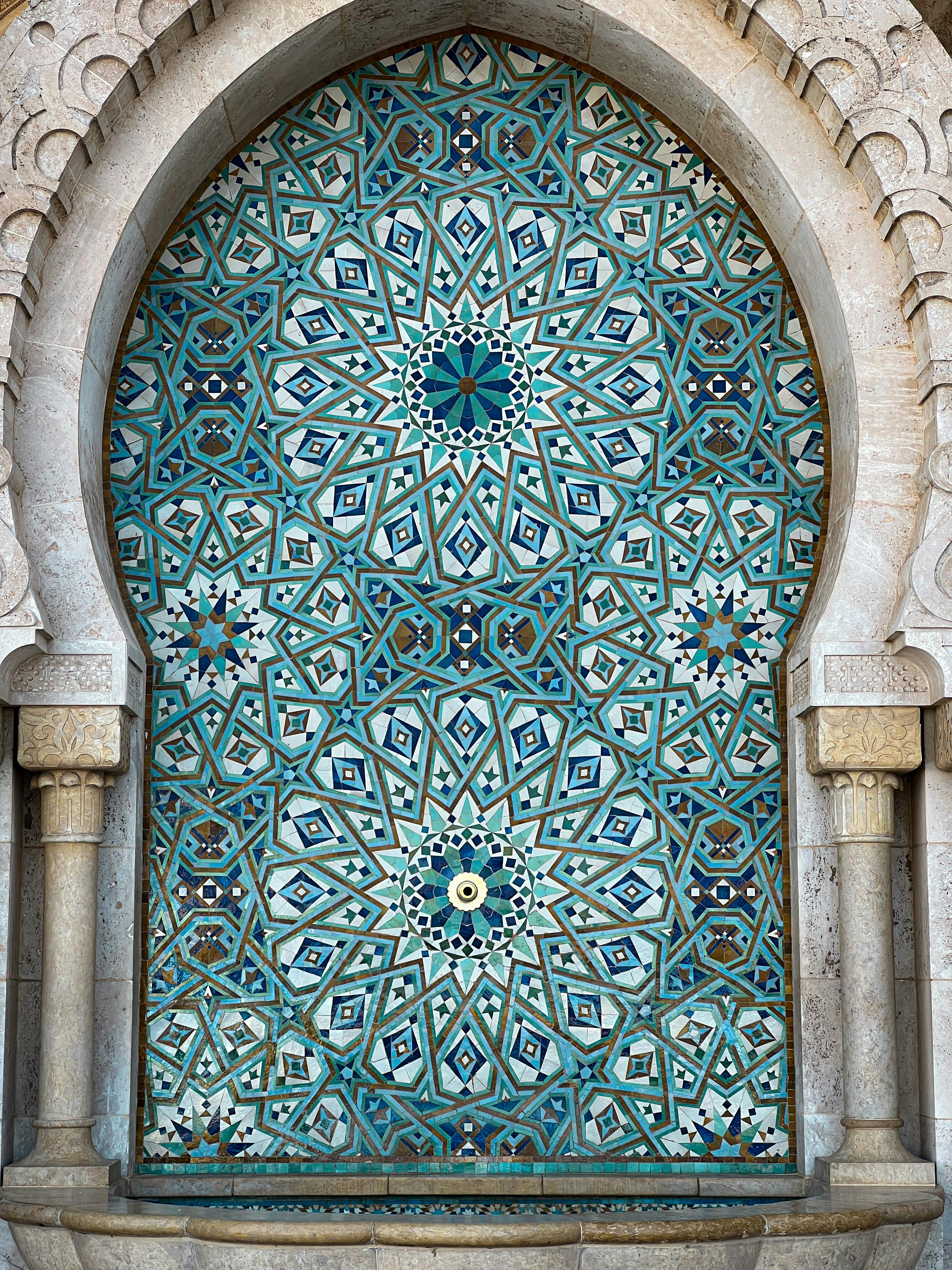
A Moroccan archway decorated with traditional Islamic tile mosaic patterns.
Islamic architecture did not begin as a finished style. It began with use: build a mosque, orient prayer, make shade, gather people, manage water, and give the city a public religious center.
As Islamic rule and culture moved across regions, builders absorbed older Roman, Byzantine, Persian, African, Indian, Chinese, and local traditions. The result was not one look. It was a flexible architectural language.
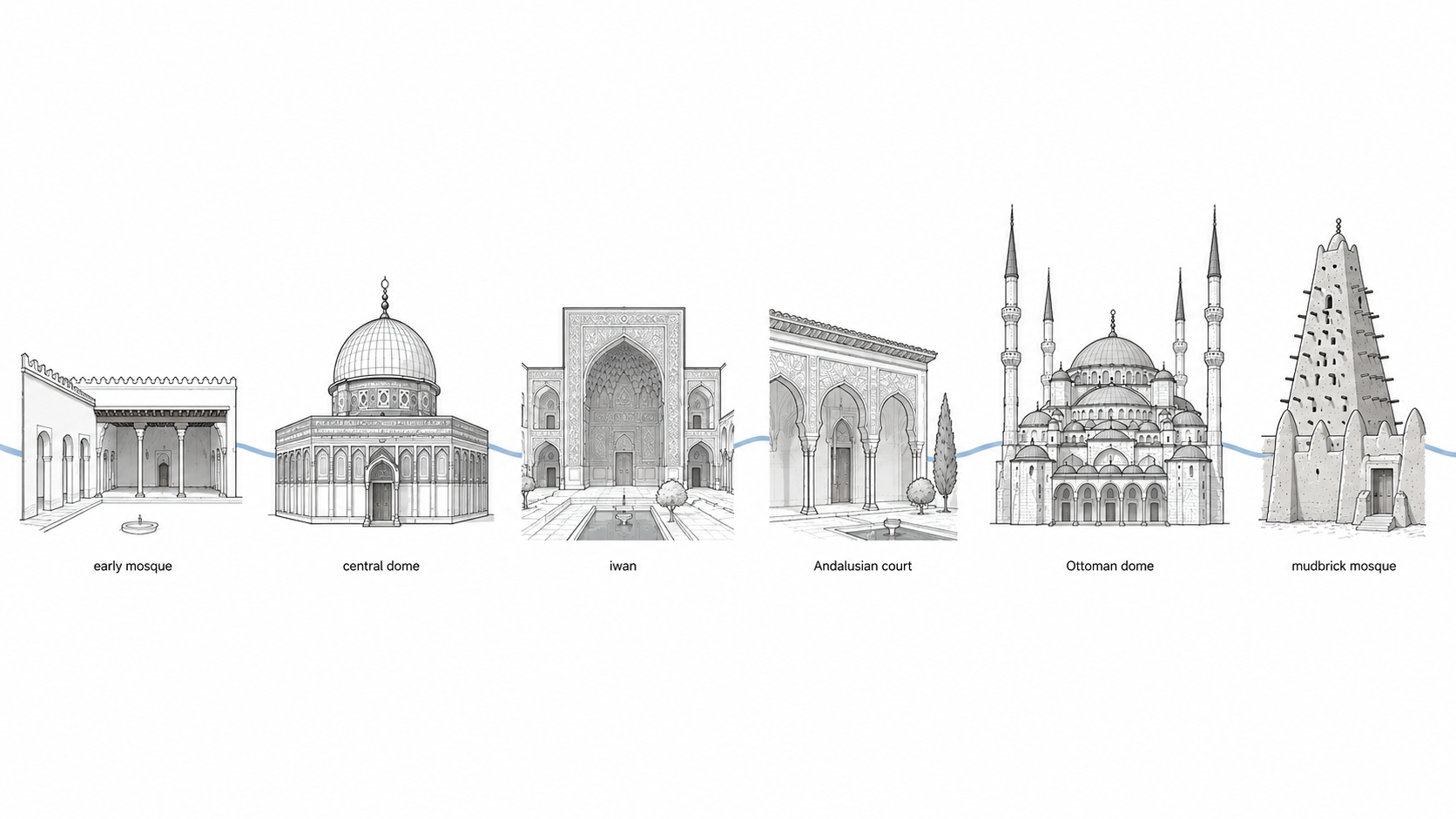
Illustration by ArchitectureCourses.org. Islamic mosque architecture did not develop as one single style. It moved through different structural ideas, court layouts, dome systems, iwans, regional materials, and local building traditions.
The forms changed by place. Iran developed tile, iwans, and large courtyard compositions. Ottoman builders tested central domes and slender minarets. North African and Andalusian buildings worked with horseshoe arches, water courts, and deep shade. South Asian Islamic architecture brought gardens, marble, red sandstone, inlay, and monumental axes.
For the broader overview, start with Islamic architecture. For the longer sequence, use Islamic architecture history.
Start With Systems, Not Surface
The easiest mistake is to start with the pretty parts.
A dome is not automatically meaningful. An arch is not just a shape. A courtyard is not empty space. A screen is not only pattern. In Islamic architecture, the strongest features usually do more than one job.
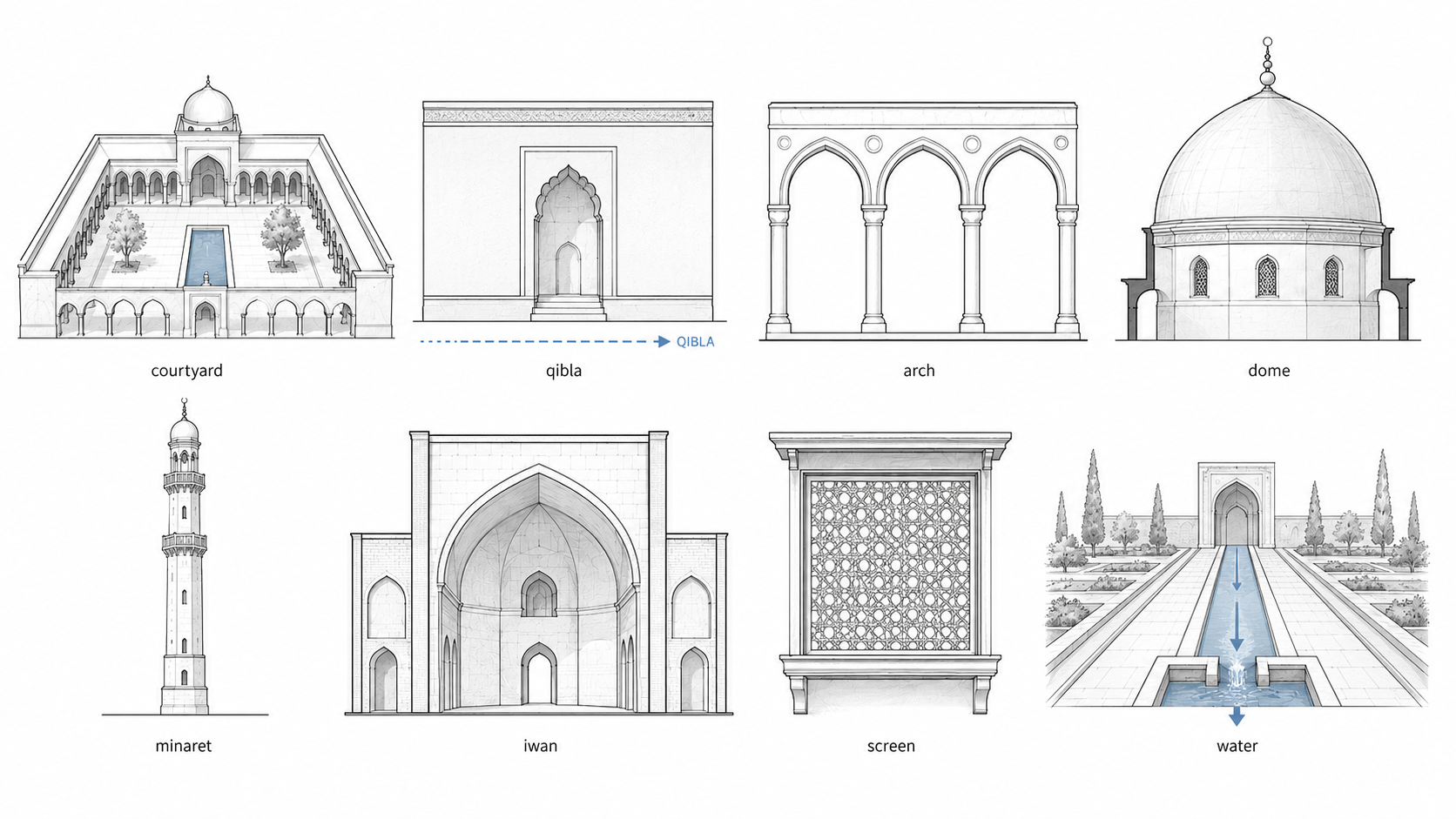
Illustration by ArchitectureCourses.org. The strongest Islamic architectural systems travelled across regions, but each one changed with climate, material, and building type.
| Feature | What It Does | What to Notice First |
|---|---|---|
| Courtyard | Handles light, air, gathering, and movement. | Shade, water, entries, and the edge between public and private space. |
| Qibla wall | Sets the prayer direction. | How the whole plan turns toward one wall. |
| Mihrab | Marks the direction of prayer. | Its position, depth, ornament, and relationship to the prayer hall. |
| Minaret | Marks the mosque in the city. | Shape, height, skyline role, and regional type. |
| Arch | Frames openings, carries load, and creates rhythm. | Arch type, spacing, thickness, and how it shapes movement. |
| Screen | Filters light, air, privacy, and views. | Whether it is doing environmental work or only decoration. |
20 Defining Characteristics of Islamic Architecture
These characteristics do not appear in every building. A mudbrick mosque in Mali and a marble tomb in India will not share the same material language. But these are the recurring moves that help readers recognize how Islamic architecture works.
1. Arches Create Structure, Rhythm, and Thresholds
Arches are one of the most recognizable features of Islamic architecture, but they should not be treated as decorative outlines.
They frame entrances, carry loads, shape shaded edges, repeat across prayer halls, and create rhythm in arcades. Horseshoe, pointed, ogee, multifoil, keel, and cusped arches belong to different regions and periods. The arch type tells you something about structure, ornament, and local tradition.

Illustration by ArchitectureCourses.org. Islamic arches changed through structure, ornament, region, and building type, from early horseshoe forms to pointed, vaulted, layered, and contemporary arch profiles.
For a focused guide, continue with arches in Islamic architecture.
2. Domes Give Volume, Focus, and Skyline Presence
Domes can mark sacred space, cover a tomb, organize a prayer hall, or give a building a public silhouette.
The dome at the Dome of the Rock does not work the same way as an Ottoman central dome or a Mughal tomb dome. Each one solves a different spatial and symbolic problem.
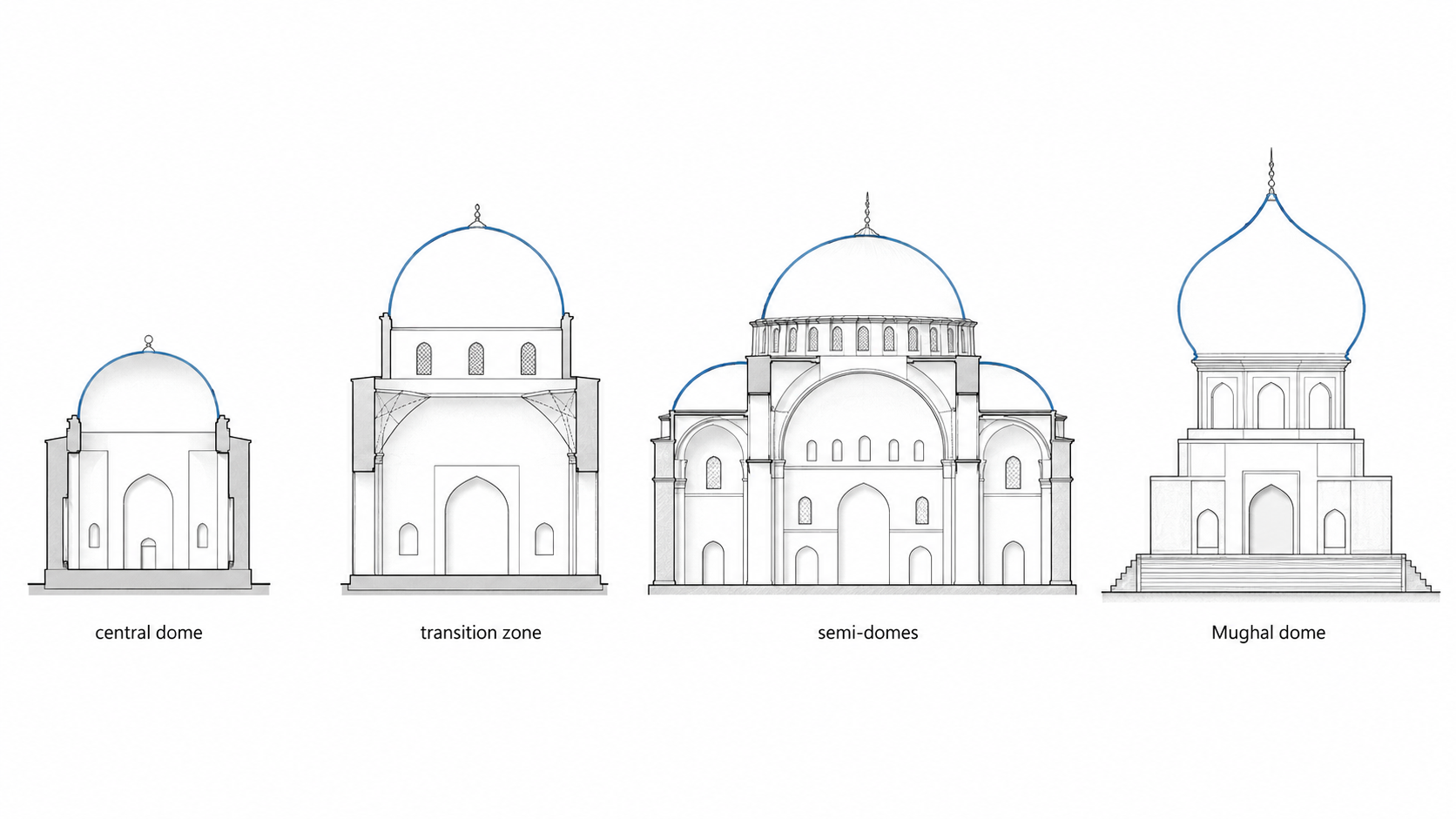
Illustration by ArchitectureCourses.org. Domes in Islamic architecture changed by region, structure, and building type, from early centralized monuments to Ottoman mosque volumes and Mughal tombs.
3. Minarets Mark the City
A minaret is a tower, but that definition is too thin.
Minarets mark the mosque from a distance, give a building vertical identity, and often reveal region and period. Ottoman pencil minarets, Maghrebi square minarets, spiral minarets, and heavily carved Mamluk minarets do not say the same thing.
For the full support page, read minarets.
4. Courtyards Handle Climate and Gathering
The courtyard, or sahn, is one of the most useful systems in Islamic architecture.
It brings light into dense buildings, creates a cooler center, gives people a place to gather, and separates the street from the prayer hall or inner rooms. In mosques, the courtyard often becomes the pause before prayer. In palaces and houses, it can control privacy, air, and movement.

The open courtyard of Sheikh Zayed Grand Mosque in Abu Dhabi, with floral marble inlay and white domes.
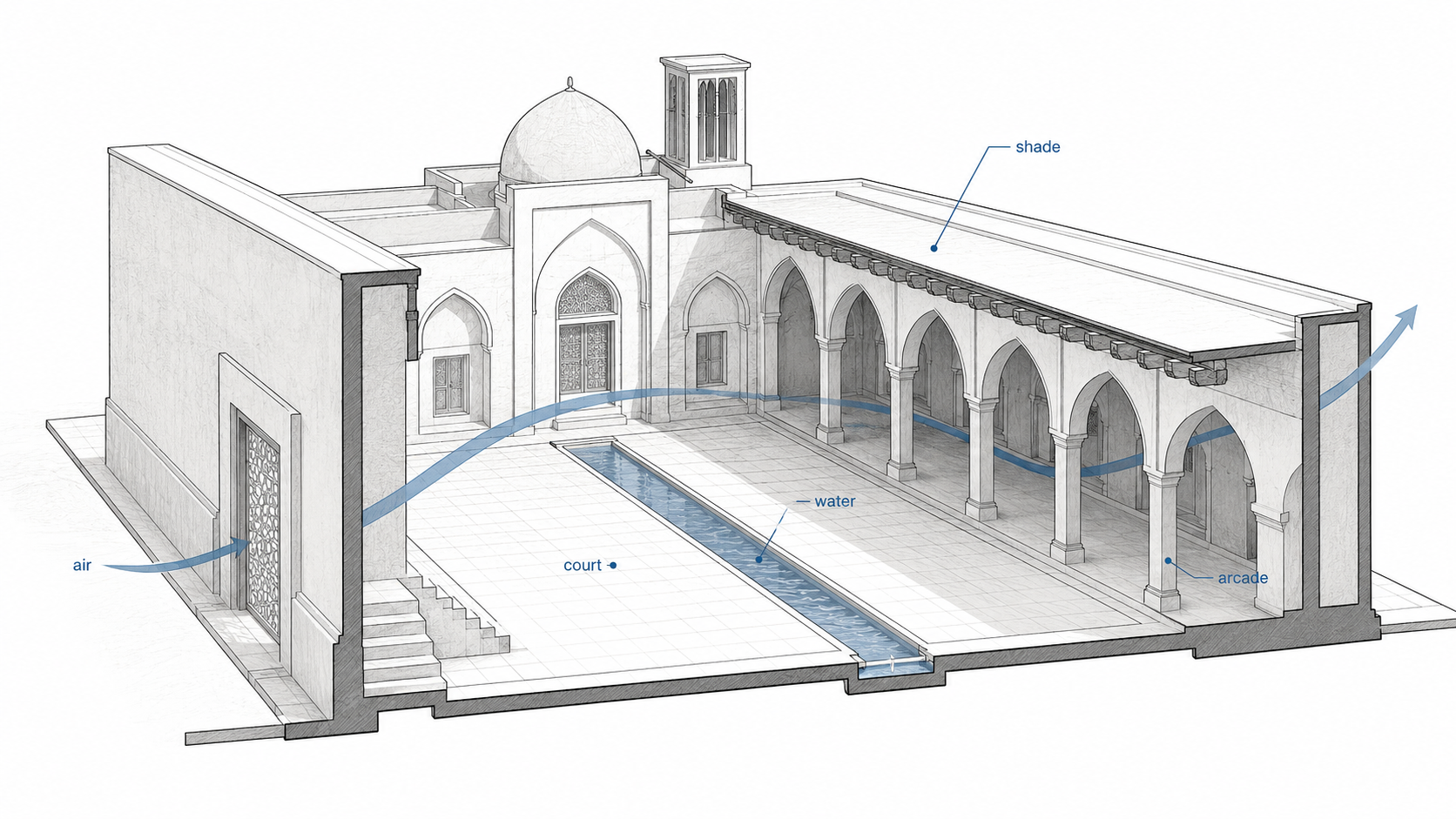
Illustration by ArchitectureCourses.org. Courtyards in Islamic architecture often handled shade, air, water, reflection, privacy, and movement at the same time.
For more detail, use courtyards in Islamic architecture.
5. Axial Symmetry Gives Order
Many Islamic buildings use strong axes, especially palaces, gardens, tombs, and large mosque complexes.
Symmetry can make movement clearer. It can frame gateways, water channels, gardens, and central halls. In Mughal architecture, axial order becomes especially important because the garden, platform, gateway, and tomb are read together.
6. Qibla Orientation Anchors the Plan
A mosque plan is not neutral. It turns toward the qibla.
The qibla wall gives prayer direction. The mihrab marks that direction inside the wall. This is one reason mosque plans should be studied before ornament. The plan tells the body where to face before the surface tells the eye where to look.
7. The Mihrab Turns Direction Into Architecture
The mihrab is a niche in the qibla wall. It is often one of the most carefully treated surfaces in a mosque.
Its job is simple: mark the direction of prayer. Its architectural treatment can be complex: tile, stone, calligraphy, muqarnas, carved plaster, or marble. The mihrab is where direction, belief, and surface detail come together.
8. The Minbar Adds Ritual Furniture
The minbar is the pulpit used for sermons.
It is often made from wood or stone and can become a major piece of craftsmanship. It also reminds readers that mosque architecture is not only walls and domes. Furniture, thresholds, screens, carpets, and small fittings help complete the religious space.
9. Iwans Create Deep Thresholds
An iwan is a vaulted hall or large arched space open on one side.
Persian and Central Asian architecture developed the iwan into a major planning tool. In four-iwan mosque plans, each side of the courtyard can be shaped by one large vaulted opening. The iwan turns the courtyard edge into a deep spatial event.
10. Privacy Is Built Through Layers
Islamic architecture often handles privacy through gradual movement rather than a single locked boundary.
A visitor may move from street to entry, from entry to courtyard, from courtyard to shaded edge, and then into more private rooms. This layering matters in houses, madrasas, palaces, hammams, and religious buildings.
11. Water Cools, Marks, and Slows Space
Water is symbolic, but it also changes how a place feels.
Pools, fountains, and channels cool surfaces, reflect light, soften sound, mark axes, and slow movement. In the Alhambra, Persian gardens, Mughal charbagh layouts, and mosque courtyards, water is both practical and spatial.
12. Geometric Patterns Give Surfaces Rules
Geometry is not filler.
It gives walls, screens, domes, tiles, and ceilings a system. Repetition can make a large surface readable. Pattern can reduce the scale of a massive wall down to the hand. It can also avoid figural imagery while still giving the surface depth and movement.
For deeper pattern study, continue with Islamic geometric patterns.
13. Arabesque and Floral Patterns Add Movement
Arabesque ornament uses plant-like forms, scrolling lines, and repeated curves.
It can soften hard geometry, fill borders, frame panels, and create a sense of continuous growth. In strong buildings, it does not sit apart from the architecture. It works with tile, plaster, calligraphy, and surface proportion.
For a focused support article, use arabesque patterns.
14. Calligraphy Turns Text Into Architecture
Calligraphy can frame a portal, circle a dome, run along a wall, or mark a sacred surface.
In many Islamic buildings, text is not a caption. It is part of the architecture. It gives meaning, rhythm, scale, and direction to walls and openings.
15. Muqarnas Handles Transitions
Muqarnas is often described as honeycomb or stalactite-like ornament. That description is visual, but incomplete.
Muqarnas can mediate transitions between surfaces, soften corners, turn a structural change into a shadowed field, and give depth to domes, portals, and niches. It is ornament, but it often appears exactly where the building has to manage a difficult transition.
16. Mashrabiya and Jali Screens Filter the World
Screens are one of the clearest examples of beauty doing work.
A mashrabiya or jali can filter sun, admit air, protect privacy, soften the street edge, and create patterned light. In hot climates, that matters. A screen that only decorates a glass building is not doing the same job.
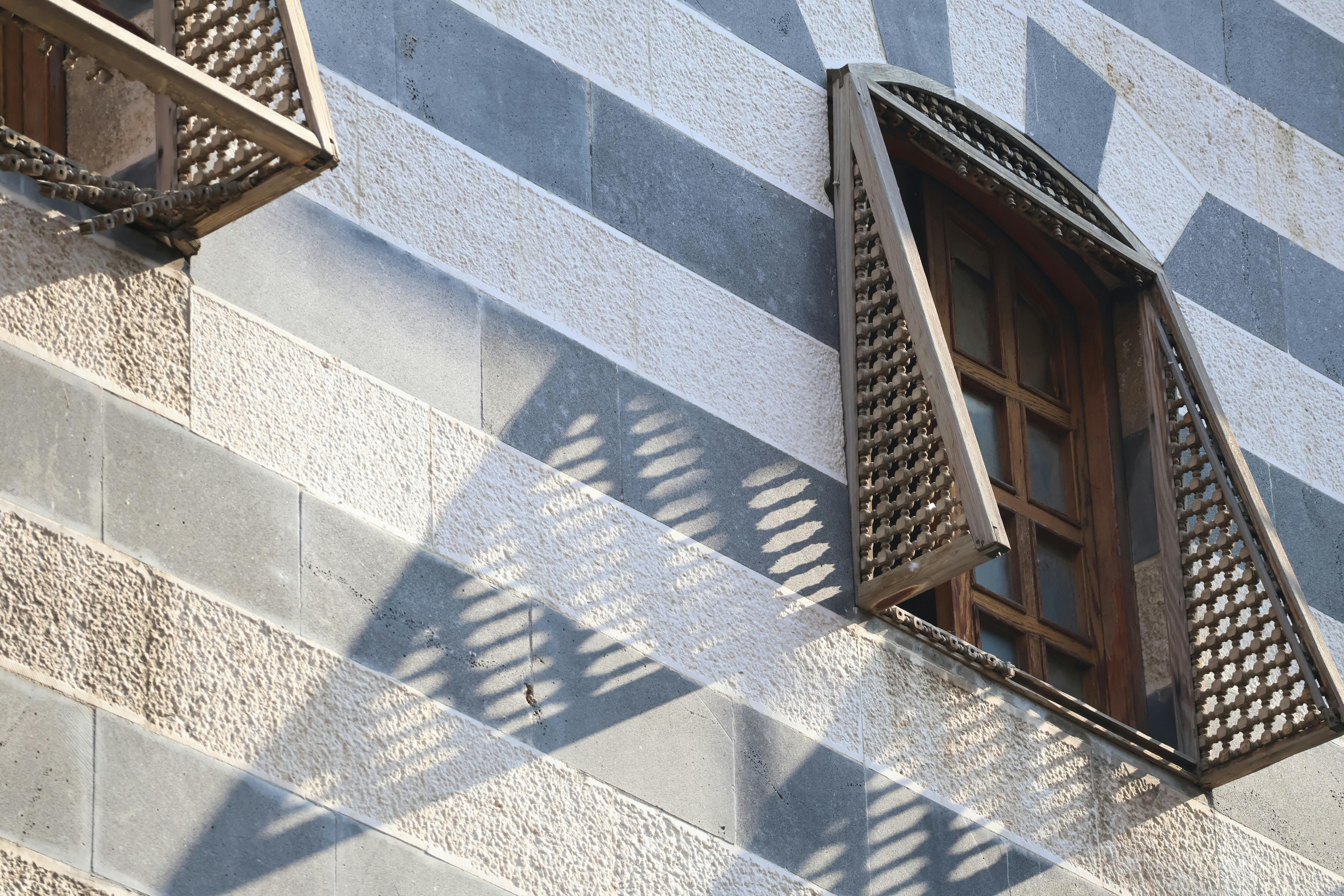
A traditional mashrabiya window in Damascus, Syria, with intricate wooden latticework.
For more, read mashrabiya designs.
17. Local Materials Change the Architecture
Islamic architecture changes sharply by material.
Brick and stucco behave differently from marble. Mudbrick needs maintenance in a different way than stone. Timber roofs create different mosque forms from Ottoman domes. Regional material is one reason Islamic architecture never became one fixed look.
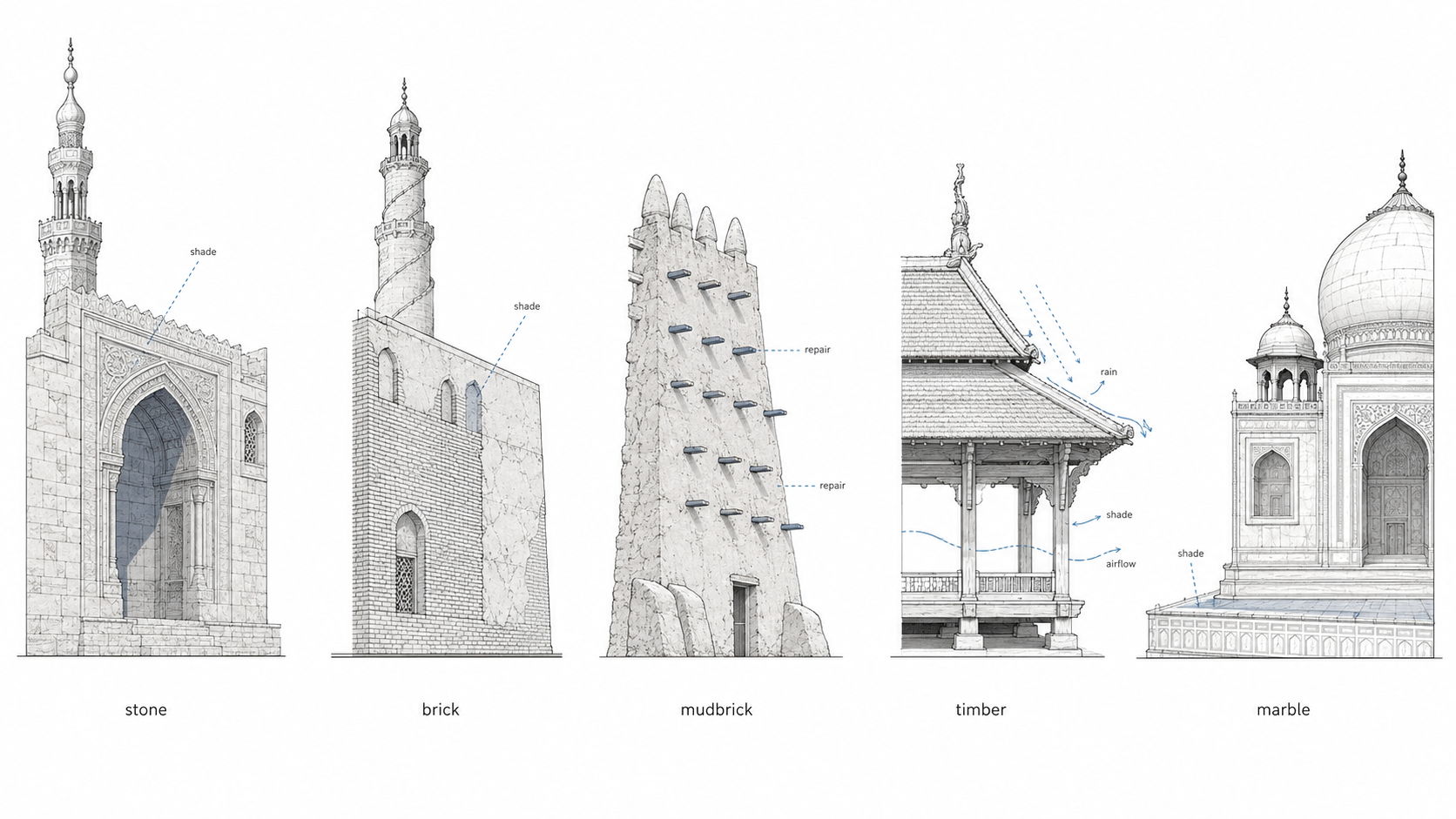
Illustration by ArchitectureCourses.org. Islamic architecture changed because local materials and climate changed. Stone, brick, mudbrick, timber, marble, heat, shade, rain, and repair all shaped the buildings.
18. Light Is Controlled, Not Just Added
Light in Islamic architecture is often filtered, reflected, bounced, or broken into pattern.
Courtyards bring daylight from above. Screens soften glare. Domes and clerestories can lift light into the prayer hall. Water reflects it. Tile and plaster catch it. The result is not simply brightness. It is controlled atmosphere.
19. Repetition Makes Space Scalable
Many Islamic buildings rely on repeated bays, columns, arches, tiles, modules, or garden divisions.
That repetition is practical. A hypostyle prayer hall can expand. A tile field can cover a large surface without losing order. A courtyard building can repeat rooms around an open center. Modular planning is one reason the tradition adapted so well across building types.
20. Ornament and Structure Often Work Together
The best Islamic ornament does not feel pasted on.
It follows the arch, wraps the dome, frames the mihrab, marks the entrance, fills the screen, or clarifies the courtyard edge. The surface is often beautiful, but it is also teaching the eye how the building is organized.
Moorish Characteristics Are a Regional Branch, Not the Whole Story
Moorish architecture developed in al-Andalus under Muslim rule in Spain and North Africa’s wider influence. It shares many Islamic architectural systems, but its local expression is distinct.
Look for horseshoe arches, carved plaster, zellij tile, water courts, slender columns, framed views, and careful control of light. The Alhambra is the clearest example because it joins fortress, palace, garden, water, surface, and view into one architectural experience.
Do not use Moorish architecture as a shortcut for all Islamic architecture. It is one strong regional branch.
Buildings That Show the Characteristics Clearly
A short list works better than a giant monument directory. These buildings show the main characteristics without turning the page into travel content.
| Building | Where | What It Teaches |
|---|---|---|
| Great Mosque of Córdoba | Spain | Hypostyle rhythm, horseshoe arches, layered expansion, and interior field space. |
| Dome of the Rock | Jerusalem | Centralized form, dome presence, inscription, and early monumentality. |
| Al-Azhar Mosque | Cairo | Layered mosque architecture, teaching use, minarets, and urban fabric. |
| Blue Mosque | Istanbul | Ottoman dome hierarchy, minarets, light, and skyline composition. |
| Taj Mahal | Agra | Mughal symmetry, garden order, marble, platform, and tomb composition. |
| Great Mosque of Djenné | Mali | Mudbrick, maintenance, community labor, climate, and regional adaptation. |
What Modern Designers Can Still Use
The modern value of Islamic architecture is not copying a dome or pasting a pattern onto a façade.
The better lessons are quieter:
- Use courtyards to control light, air, gathering, and privacy.
- Use shade as an architectural system, not an afterthought.
- Let screens handle privacy, glare, airflow, and street edges.
- Use repeated modules to keep large spaces legible.
- Treat water as climate, sound, reflection, and movement.
- Use local materials honestly instead of forcing one global image of “Islamic style.”
A contemporary mosque, school, home, cultural center, or garden can learn from Islamic architectural history without pretending to be medieval. The useful part is not imitation. It is knowing which design system solved which problem.
How to Study the Characteristics Without Getting Lost
Do not start by memorizing every feature.
Start with the plan. Ask where people enter, where they gather, how they face the qibla, how shade is made, how the building meets the street, and what material is doing the work.
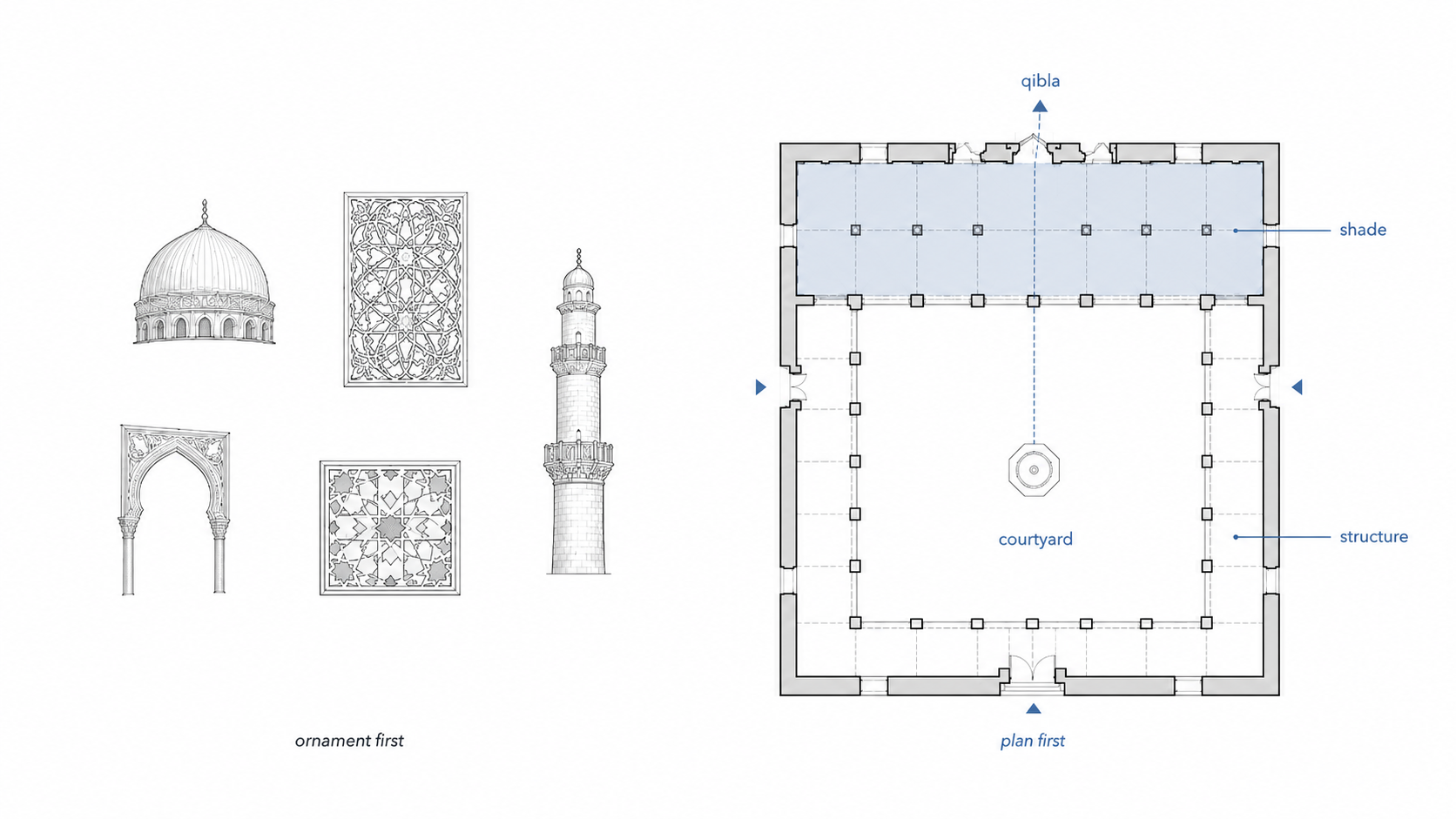
Illustration by ArchitectureCourses.org. Islamic architecture is easier to study when the plan, climate, structure, and building type come before ornament.
Then study the surface. Pattern, calligraphy, muqarnas, tile, carving, and inlay will make more sense once the plan and building type are clear.
A simple study order works best:
- Draw the plan shape.
- Mark the courtyard, qibla wall, entrances, and main movement path.
- Identify the climate response: shade, air, water, wall thickness, roof form, or screen.
- Look at the structure: columns, arches, vaults, domes, iwans, timber, mudbrick, or masonry.
- Add the historical period and region.
- Study the surface last.
Recommended reference: Robert Hillenbrand’s Islamic Architecture: Form, Function and Meaning is a serious architecture-focused book for readers who want building types, plans, regional differences, and design meaning in one place.
Common Mistakes When Reading Islamic Architecture
| Mistake | Why It Fails | Better Reading |
|---|---|---|
| Starting with ornament | The building becomes a pattern collection. | Start with plan, use, climate, and structure. |
| Calling every dome Islamic | A dome is a form, not a full architectural identity. | Ask what the dome does in that building type and region. |
| Using one region as the whole story | It cuts out Africa, South Asia, Southeast Asia, China, and Europe. | Study Islamic architecture as a global tradition with local forms. |
| Calling every old mosque “Arab architecture” | Many major works are Persian, Turkish, Indian, African, Andalusian, or local hybrids. | Name the region, dynasty, material, and building type more carefully. |
| Copying motifs into modern buildings | The result becomes surface styling. | Study what the older feature solved before borrowing its form. |
FAQ
What are the main characteristics of Islamic architecture?
The main characteristics include courtyards, qibla walls, mihrabs, arches, domes, minarets, geometric patterns, calligraphy, water, screens, iwans, muqarnas, local materials, shade, and careful transitions between public and private space.
Why are courtyards common in Islamic architecture?
Courtyards bring light and air into dense buildings, create shaded gathering space, help with cooling, and separate public street life from more private or sacred interiors.
Why are geometric patterns so important?
Geometry gives surfaces order, rhythm, scale, and visual continuity. It also creates a strong abstract language in religious spaces without relying on human or animal imagery.
What is the difference between Islamic and Moorish architecture?
Islamic architecture is the broader tradition. Moorish architecture is a regional branch associated mainly with al-Andalus and North Africa, known for horseshoe arches, carved plaster, zellij tile, water courts, and layered interior spaces.
Are all Islamic buildings symmetrical?
No. Symmetry is common in many formal buildings, especially gardens, tombs, and some mosque complexes, but dense urban buildings can be irregular because of streets, additions, repairs, and site limits.
What should students study first?
Start with plan, building type, climate, structure, and material. Study ornament after you understand how the building works.
Read This Next
For the broader overview, start with Islamic architecture. For the historical sequence, read Islamic architecture history. For regional differences, continue with Islamic architecture styles.
For specific design systems, use Islamic arches, minarets, courtyards in Islamic architecture, Islamic geometric patterns, arabesque patterns, and mashrabiya designs.
What Stays Useful
The best way to read Islamic architecture is not by counting features.
Start with what the building has to solve: heat, prayer direction, gathering, privacy, movement, water, structure, and public presence. The arches, domes, courtyards, screens, patterns, and towers make more sense after that.
The surface is often beautiful. The plan usually explains more.