
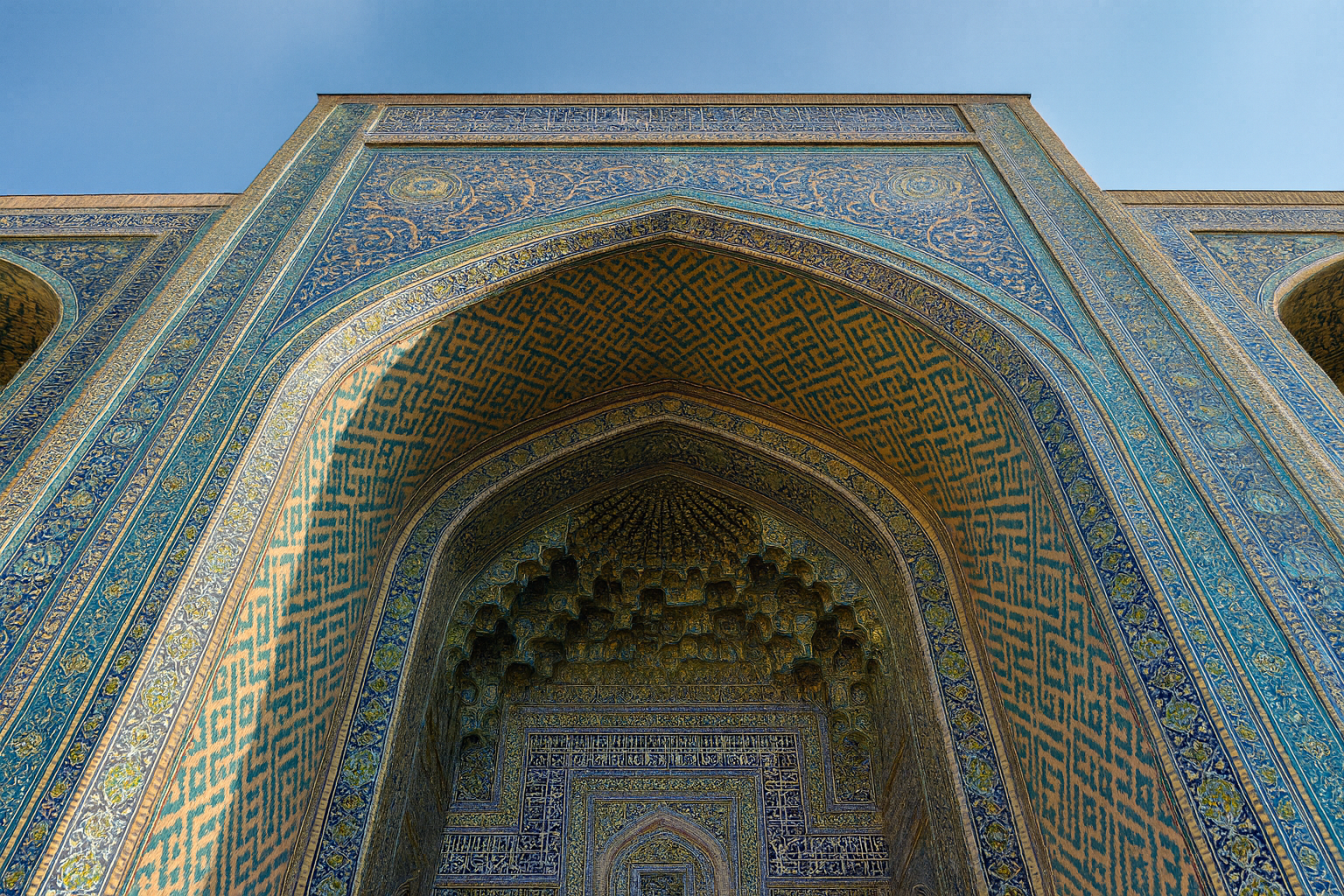
Islamic architecture began with use before ornament.
The first mosques needed direction, shade, a place to gather, and a clear edge between daily life and prayer. The domes, tilework, minarets, iwans, gardens, and carved surfaces came later, after Muslim builders met older Roman, Byzantine, Persian, Indian, African, Chinese, and local building traditions.
Read the history as a set of regional answers, not one decorative style. A mosque in Cairo, a palace in Granada, a mudbrick mosque in Mali, and a Mughal tomb in India may all belong to Islamic architectural history, but they do not solve the same problem in the same way.
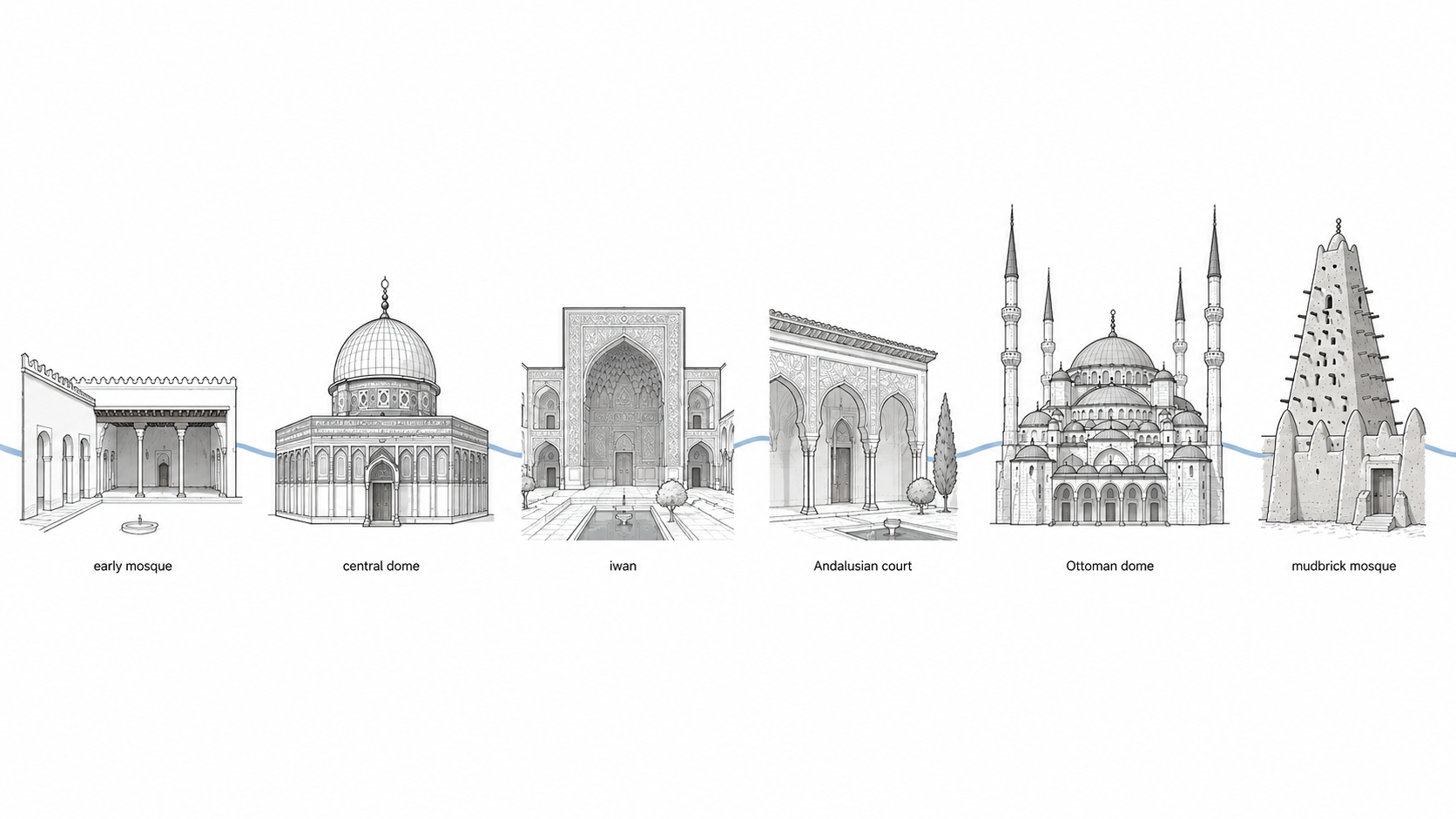
Illustration by ArchitectureCourses.org. Islamic mosque architecture did not develop as one single style. It moved through different structural ideas, court layouts, dome systems, iwans, regional materials, and local building traditions.
Start With the Use of the Building
The easiest mistake is to start with the surface: pattern, calligraphy, tile, color, dome, arch. Those parts matter, but they come after the building’s job.
Early Islamic buildings had to organize prayer, teaching, washing, gathering, shade, movement, and public life. A mosque needed a qibla direction. A courtyard helped with climate and crowd movement. Arcades made shaded edges. A minaret could mark the building in the city. A dome could focus space, improve presence, or signal importance.
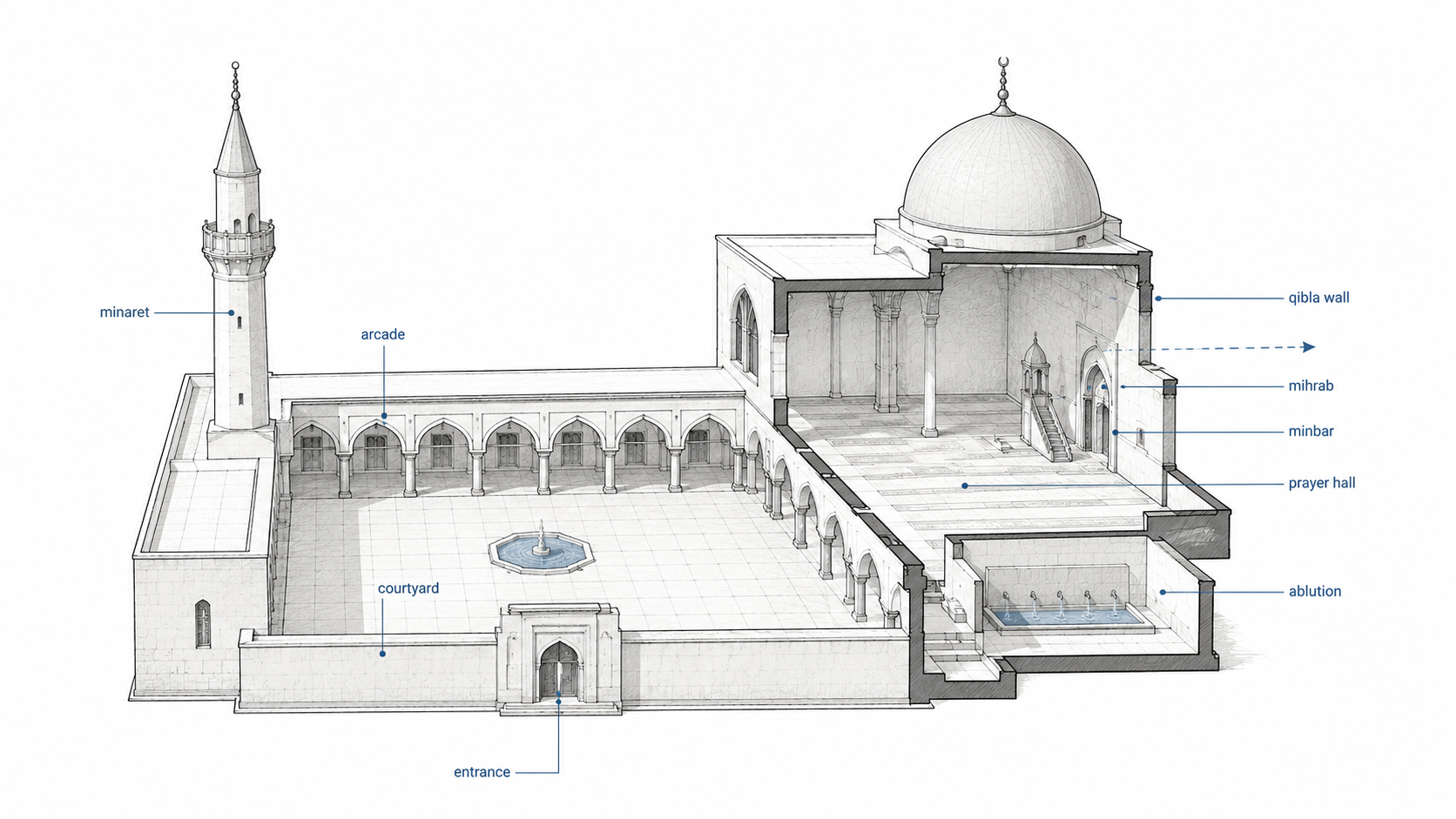
Illustration by ArchitectureCourses.org. A mosque is easier to understand when the parts are read as a working system: courtyard, prayer hall, qibla wall, mihrab, minbar, arcade, entrance, minaret, and ablution area.
Once you start with use, the history feels less random. Islamic architecture changed because it moved through different climates, materials, empires, trade routes, and cities. The form followed use, power, climate, faith, and local craft at the same time.
For the broader overview, start with Islamic architecture. This page follows the historical sequence more closely.
The Early Mosque Was Simple for a Reason
The earliest mosque model was direct: open space, shade, orientation, and room for a community to gather.
The Prophet’s Mosque in Medina is usually treated as the starting reference. It was not a monument in the later imperial sense. It was practical. A courtyard gave open space. Shaded areas protected people from sun. Simple columns and roof materials did the work. The building served prayer, teaching, social gathering, and leadership.
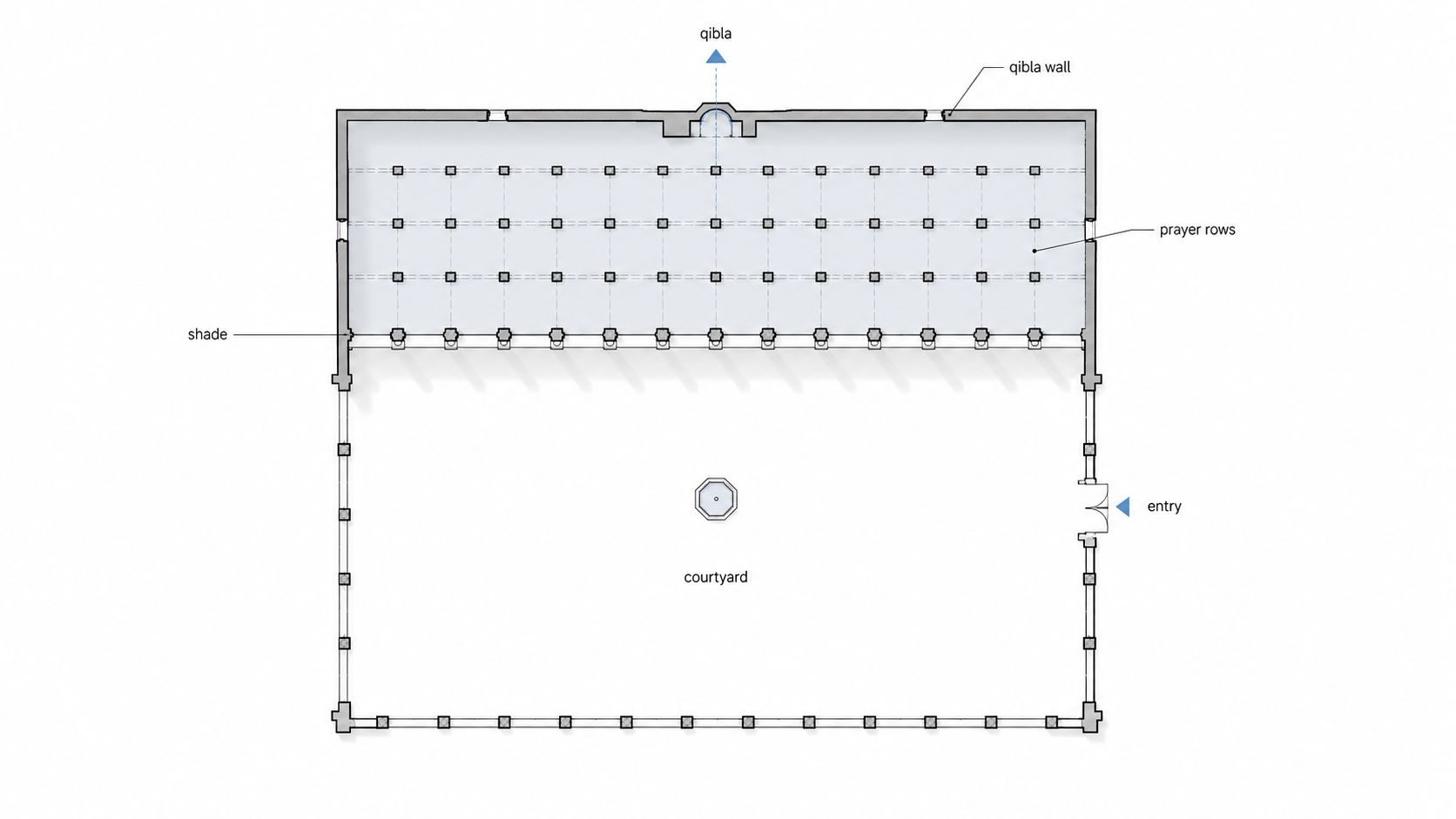
Illustration by ArchitectureCourses.org. Early mosque planning started with direction, shade, gathering, and a clear prayer edge before later ornament and monumentality became dominant.
That early simplicity should not be romanticized too much. It was not only a spiritual choice. It also made sense for available materials, climate, speed of construction, and the needs of a growing community. Later Islamic architecture became more elaborate, but the basic needs stayed recognizable: direction, gathering, shade, threshold, and a controlled place for worship.
The Main Periods at a Glance
Islamic architecture did not develop in a straight line. Some regions overlapped. Some styles lasted for centuries. Some buildings were altered by later rulers. This table is a working map, not a perfect wall chart.
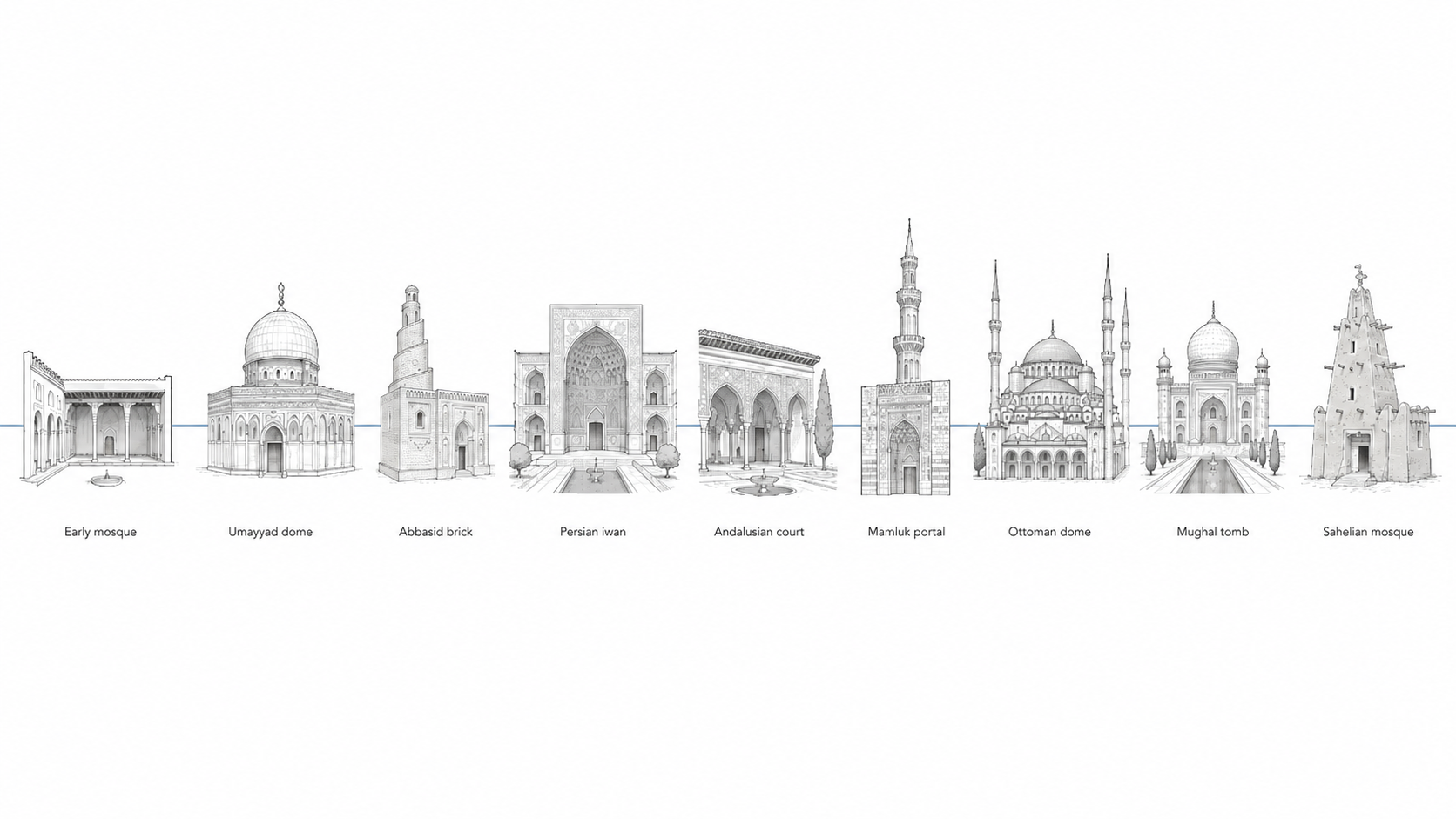
Illustration by ArchitectureCourses.org. Islamic architecture developed through overlapping regions and building traditions, not one clean straight line. Courts, domes, iwans, portals, minarets, gardens, and local materials all changed the form over time.
| Period or Region | Approximate Dates | What Changed Architecturally | Good Building to Study |
|---|---|---|---|
| Early Islamic | 7th century | Simple mosque spaces, courtyard logic, qibla orientation, shaded gathering areas | Prophet’s Mosque in Medina as the early reference |
| Umayyad | 661–750 | Imperial scale, domes, mosaics, courtyard mosques, strong public identity | Dome of the Rock; Great Mosque of Damascus |
| Abbasid | 750–1258 | Brick, stucco, large urban scale, experimental minarets, new capitals | Great Mosque of Samarra |
| Persian and Seljuk | 11th–14th centuries | Four-iwan plans, major domes, tilework, muqarnas, refined courtyard planning | Great Mosque of Isfahan |
| Moorish / al-Andalus | 8th–15th centuries | Horseshoe arches, double arches, courtyards, water, plasterwork, geometric surfaces | Great Mosque of Córdoba; Alhambra |
| Fatimid and Mamluk Cairo | 10th–16th centuries | Stone portals, urban mosque complexes, minarets, madrasas, hospitals, tombs | Al-Azhar Mosque; Sultan Hasan Mosque |
| Ottoman | 14th–20th centuries | Central domes, semi-domes, slender minarets, large unified prayer halls | Süleymaniye Mosque; Blue Mosque |
| Mughal | 16th–19th centuries | Charbagh gardens, marble, inlay, axial symmetry, monumental tombs and mosques | Taj Mahal; Badshahi Mosque |
| Regional Islamic architecture | varies | Local roof forms, mudbrick, timber, courtyard adaptation, climate-specific construction | Great Mosque of Djenné; Niujie Mosque; Southeast Asian mosques |
What Early Islamic Architecture Borrowed
The first major Islamic buildings did not appear in an empty world. Muslim rulers and builders inherited cities, craftsmen, materials, construction systems, and visual languages from the regions they entered.
Byzantine architecture helped shape early domes, mosaics, and monumental sacred space. Roman building traditions offered columns, arches, urban infrastructure, and construction discipline. Sasanian and Persian architecture brought vaults, iwans, courtly planning, garden symbolism, and large-scale brick construction.
The important part is what happened next. Islamic architecture did not simply copy those systems. It redirected them. A dome could serve a different religious setting. A courtyard could organize prayer instead of a villa. A mosaic surface could become text, pattern, and paradise imagery without using figural worship imagery in the same way as nearby traditions.
Borrowing is only half the story. The stronger buildings changed those older forms until they served a different religious, climatic, and urban life.
Umayyad Architecture Made the New Faith Visible
The Umayyad period gave Islamic architecture some of its first major public monuments.
The Dome of the Rock in Jerusalem, built in the late 7th century, is one of the key early works. It uses a centralized plan, a powerful dome, rich mosaics, and inscriptions to create a building that is architectural, political, and religious at the same time. It is not a congregational mosque in the usual sense, but it shaped the visual identity of early Islamic building.

The Dome of the Rock shows early Islamic architecture using centralized form, inscription, mosaic surface, and sacred presence at a monumental scale.
The Great Mosque of Damascus shows another direction. It uses the older urban and sacred fabric of Damascus, then turns it into a major congregational mosque with a large courtyard, prayer hall, mosaics, and strong civic presence. This is where Islamic architecture starts to work at city scale.
The Umayyad period moved Islamic building beyond simple communal space. Architecture became a public sign of rule, faith, and city-making.
Abbasid Architecture Changed Scale and Material
The Abbasid period moved the center of power east and changed the feel of Islamic architecture.
Brick and stucco became more important. Large new cities, including Baghdad and Samarra, allowed rulers to build at a scale that older urban sites could not always support. The Great Mosque of Samarra is the clearest example for many students: huge enclosure, massive scale, and the famous spiral minaret.
Abbasid work also helped develop abstract surface design. Stucco could be carved, repeated, and systematized. Pattern became more than decoration. It became a way to control large surfaces without relying on figural imagery.
The Abbasid period is not best read through one perfect monument. Its value is in scale, city-making, brick, stucco, and the control of large surfaces.
Persian and Seljuk Buildings Changed the Mosque Plan
Persian and Seljuk architecture gave Islamic architecture one of its strongest planning tools: the iwan.
An iwan is a vaulted hall or large arched space, usually open on one side. In Persian mosque design, iwans could organize the edges of a courtyard. The four-iwan mosque plan, with a major iwan on each side of the court, became one of the most important mosque types in Iran and Central Asia.
The Great Mosque of Isfahan is a good building to study because it did not appear as one untouched design. It grew, changed, and absorbed different phases. Its courtyard, iwans, domes, tilework, and structural layers make it one of the best examples of Islamic architecture as a long process.
This region also developed some of the richest work in domes, muqarnas, brick pattern, and tile. The surface is beautiful, but the structure underneath is the better place to start. The tile often makes the system visible. It frames the iwan, clarifies the dome zone, and gives scale to large walls.
Moorish Architecture Worked With Light, Water, and Edges
In al-Andalus, Islamic architecture developed a different tone.
The Great Mosque of Córdoba is the best starting point. Its hypostyle hall, repeated columns, double arches, striped voussoirs, and deep interior rhythm create a space that feels almost endless. The building also shows how a mosque can be expanded over time while keeping a strong interior field.
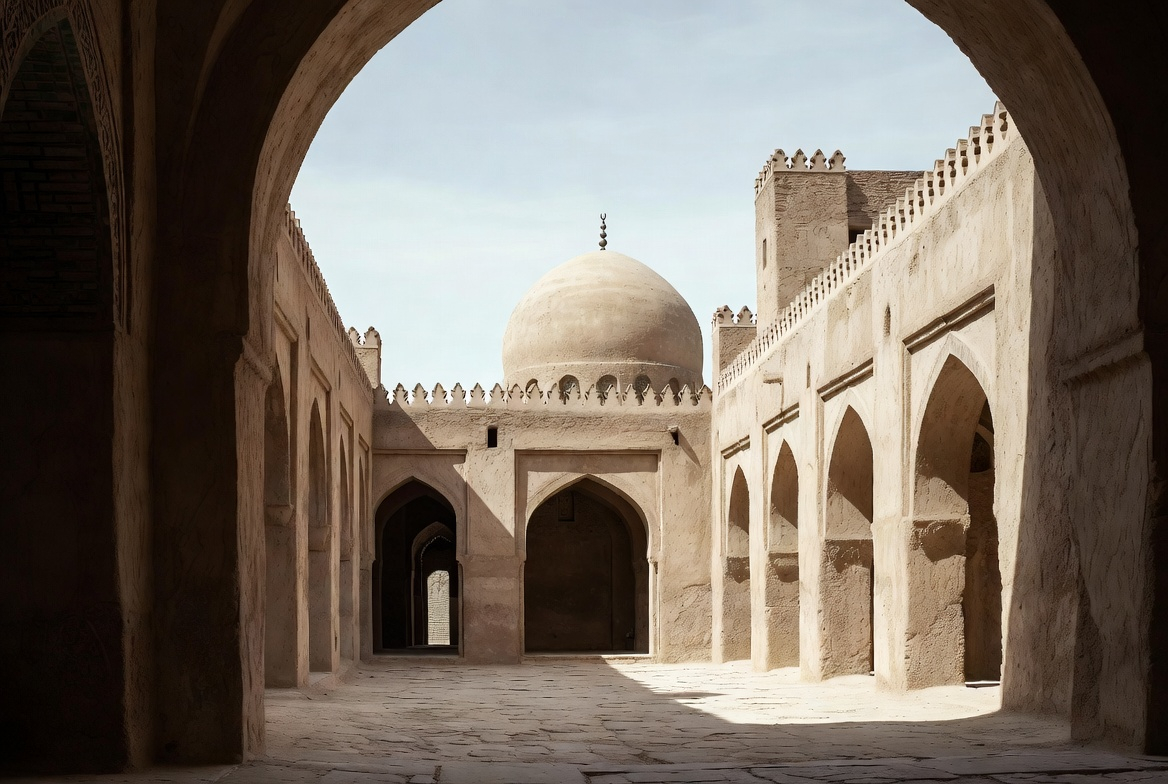
The Mosque of Córdoba shows how repeated arches, deep interior rhythm, and later expansion can shape one of the most recognizable spaces in Islamic architecture.
The Alhambra in Granada works differently. It is not one mosque. It is a palace complex, courtly setting, defensive site, garden system, and surface world. Water channels, courtyards, carved plaster, tile dadoes, slender columns, inscriptions, and framed views all work together.
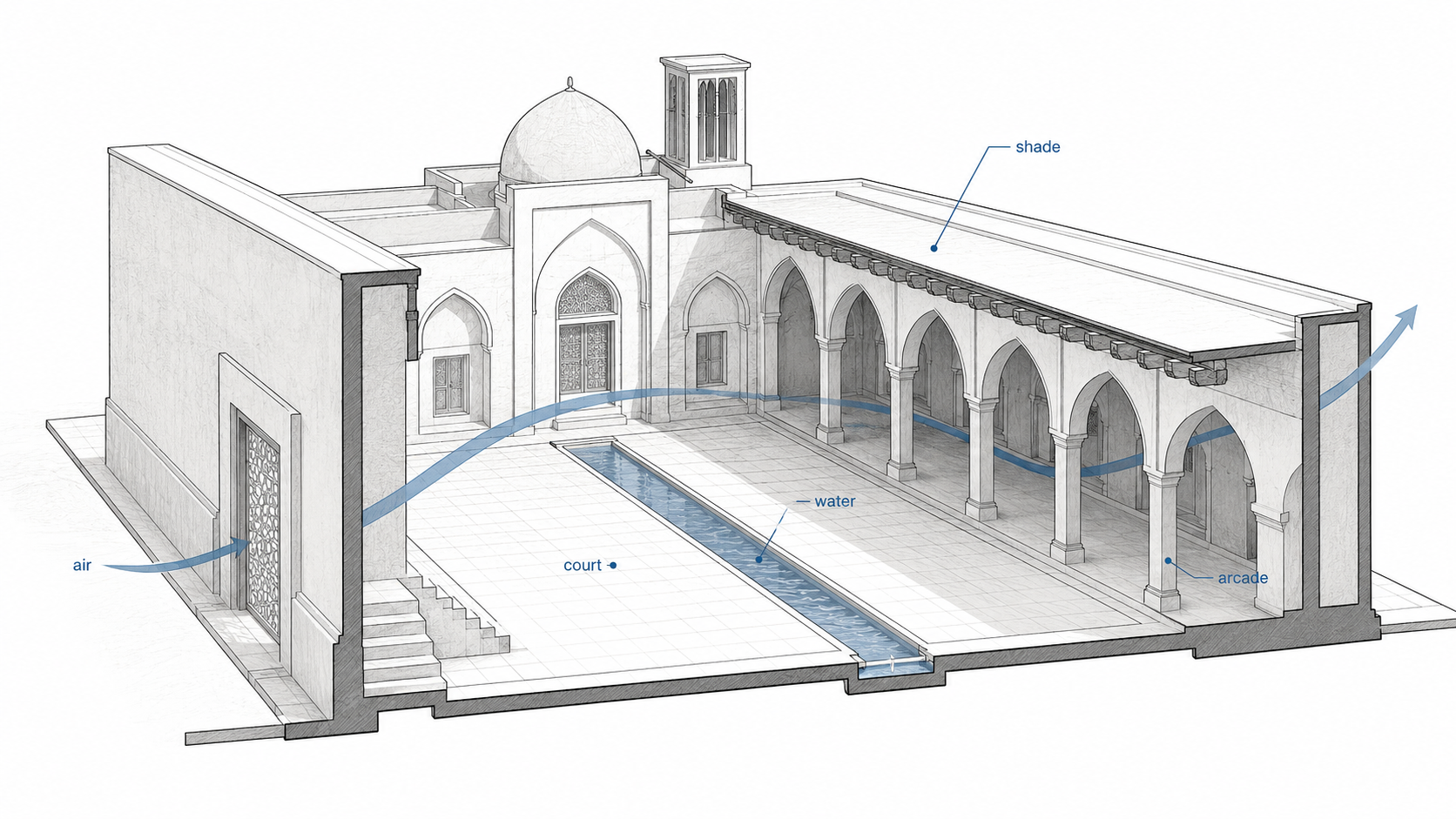
Illustration by ArchitectureCourses.org. Courtyards in Islamic architecture often handled shade, air, water, reflection, privacy, and movement at the same time.
Moorish architecture is often reduced to pattern. That misses the harder part. The best Andalusian spaces control temperature, sound, light, privacy, reflection, and movement. The ornament is only one layer of that control.
For more on this regional branch, continue with Islamic and Moorish architecture in Spain and Alhambra Palace architecture.
Fatimid and Mamluk Cairo Turned Buildings Into Urban Fabric
Cairo is where Islamic architecture becomes especially useful for studying the city.
The Fatimids founded Cairo in the 10th century and built major religious and ceremonial structures. Al-Azhar Mosque began in this context. Its original Fatimid layer still matters, but the building people see now includes major later additions. Cairo buildings often carry more than one period in one body.
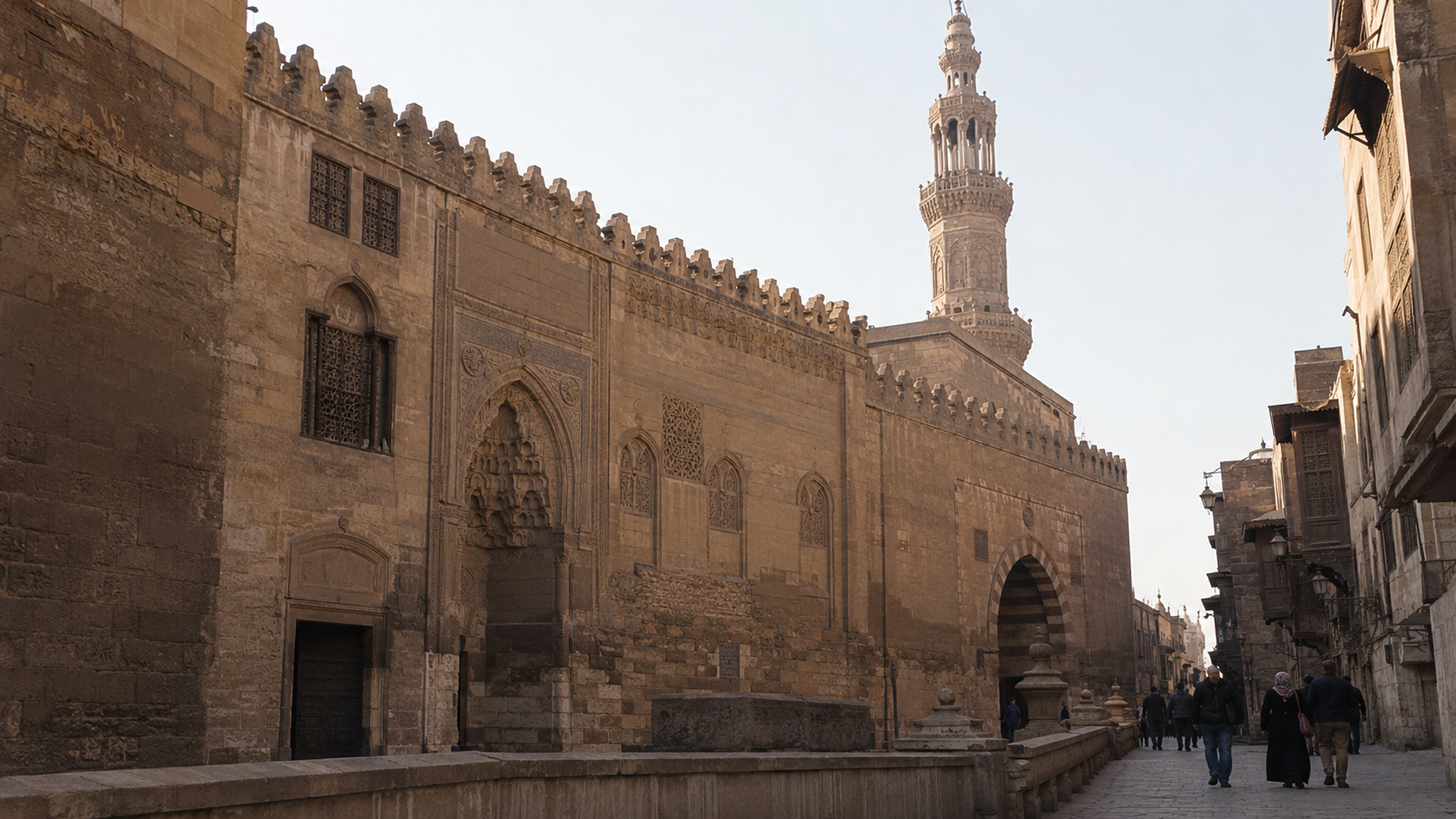
Image by ArchitectureCourses.org. Al-Azhar Mosque reads as a layered urban monument, with gates, walls, minarets, and street edges shaped by more than one period.
Mamluk architecture pushed this further. Mosques, madrasas, mausoleums, hospitals, and charitable complexes were inserted into dense streets. Portals became important because buildings had to announce themselves along tight urban edges. Minarets became skyline markers. Stone carving, muqarnas, inscriptions, and geometric panels gave heavy walls more scale and precision.
The Sultan Hasan Mosque and the Qalawun Complex show the Mamluk ability to combine religion, education, burial, medicine, power, and street presence. These were not isolated objects in open space. They were urban machines.
For a stronger Cairo path, pair this section with Islamic Cairo, Ibn Tulun Mosque, and Al-Azhar Mosque.
Ottoman Architecture Chased the Great Dome
Ottoman mosque architecture took the dome problem seriously.
In Istanbul, Hagia Sophia was impossible to ignore. Ottoman architects studied its huge central space, dome, semi-domes, buttressing, and interior volume. They did not simply imitate it. Over time, they developed a mosque language with central domes, semi-domes, slender minarets, layered courtyards, and large prayer halls that felt unified rather than forest-like.
Mimar Sinan is the key figure. His mosques tested structure, proportion, light, and spatial clarity. The Süleymaniye Mosque in Istanbul uses a large central dome and supporting semi-domes with a calm exterior massing. The Selimiye Mosque in Edirne pushes the centralized dome idea even further.
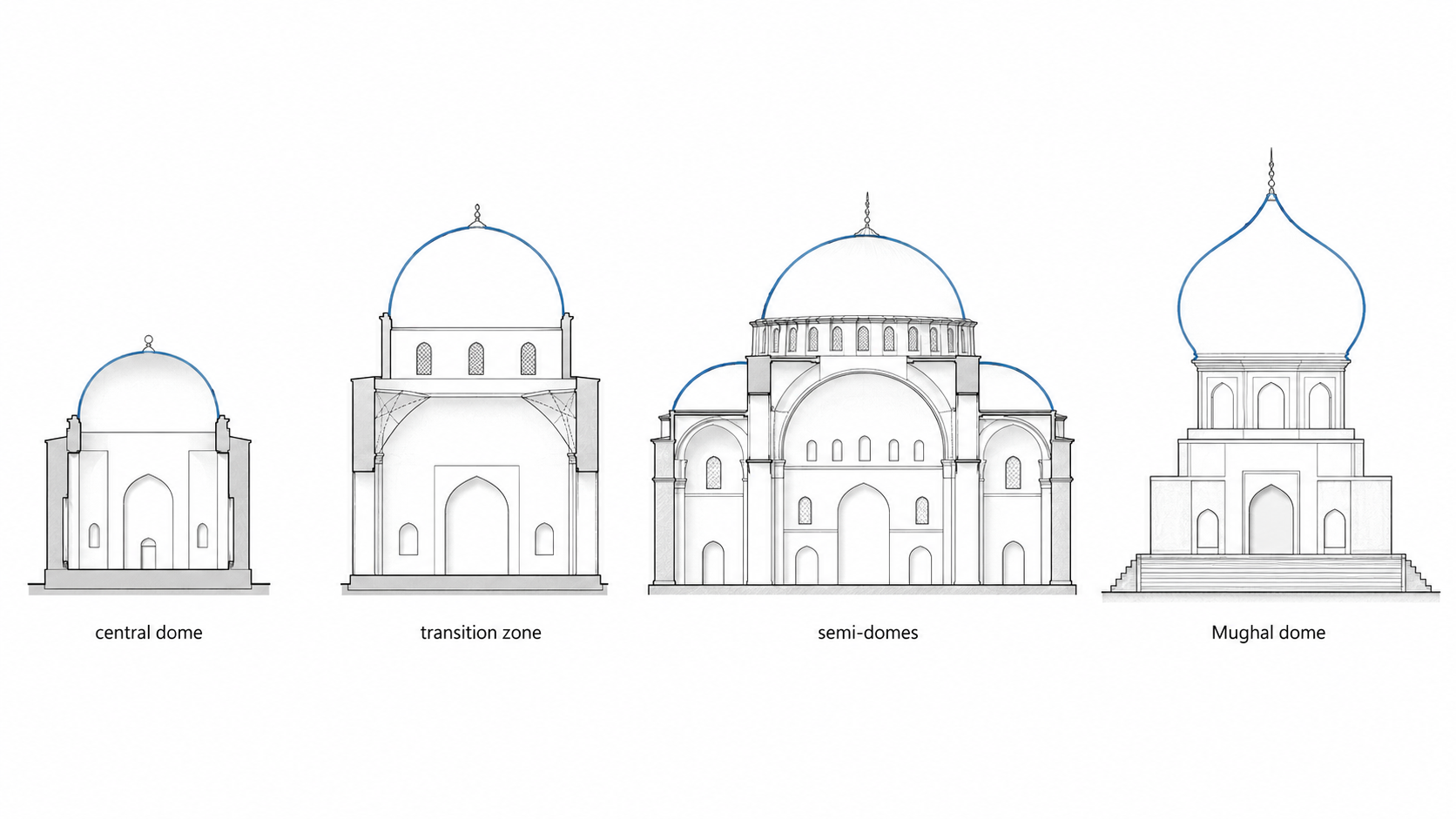
Illustration by ArchitectureCourses.org. Domes in Islamic architecture changed by region, structure, and building type, from early centralized monuments to Ottoman mosque volumes and Mughal tombs.
The Blue Mosque came later and made the Ottoman skyline language more widely familiar: multiple minarets, cascading domes, strong urban presence, and a large interior organized under a dome system.
Ottoman architecture is useful because it shows a long design argument. How do you make a huge prayer space feel unified? How do you bring daylight into that volume? How do you make the exterior mass read clearly from the city? The best Ottoman mosques keep returning to those questions.
Mughal Architecture Brought Garden Order and Monumental Symmetry
Mughal architecture blended Islamic, Persian, Timurid, and Indian traditions.
The result is different from Cairo or Istanbul. Mughal buildings often use axial planning, gardens, water channels, red sandstone, white marble, inlay work, large gateways, domed tombs, and carefully controlled symmetry.
The Taj Mahal is the most famous example, but it should not be studied only as a romantic monument. Its power comes from site planning, garden geometry, river edge, platform, gateway, tomb mass, marble surface, and inlay detail all working together.
The Badshahi Mosque in Lahore shows the Mughal mosque at a huge civic and ceremonial scale. Qutub Minar in Delhi belongs to an earlier Indo-Islamic context and is useful for studying conquest, inscription, tower form, reused material, and early Islamic building in South Asia.
For South Asian support pages, use Taj Mahal architecture, Badshahi Mosque, and Qutub Minar architecture.
Islamic Architecture Outside the Usual Map
A narrow history of Islamic architecture jumps from Arabia to Jerusalem, Cairo, Granada, Istanbul, Isfahan, and Agra. That leaves too much out.
In West Africa, mudbrick mosques such as the Great Mosque of Djenné show a different architectural intelligence. The material is local. The form responds to heat, maintenance, and community labor. The projecting wooden elements are not decorative sticks. They help with repair and replastering.
In China, mosques often absorbed local roof forms, timber construction, courtyard planning, and Chinese spatial traditions. A mosque could read as Islamic through orientation, inscription, and use while looking very different from an Ottoman or Persian mosque.
In Southeast Asia, pitched roofs, timber structures, deep overhangs, and local craft traditions often shaped mosque design before globalized dome-and-minaret imagery became common. Climate mattered. Rain mattered. Timber mattered.
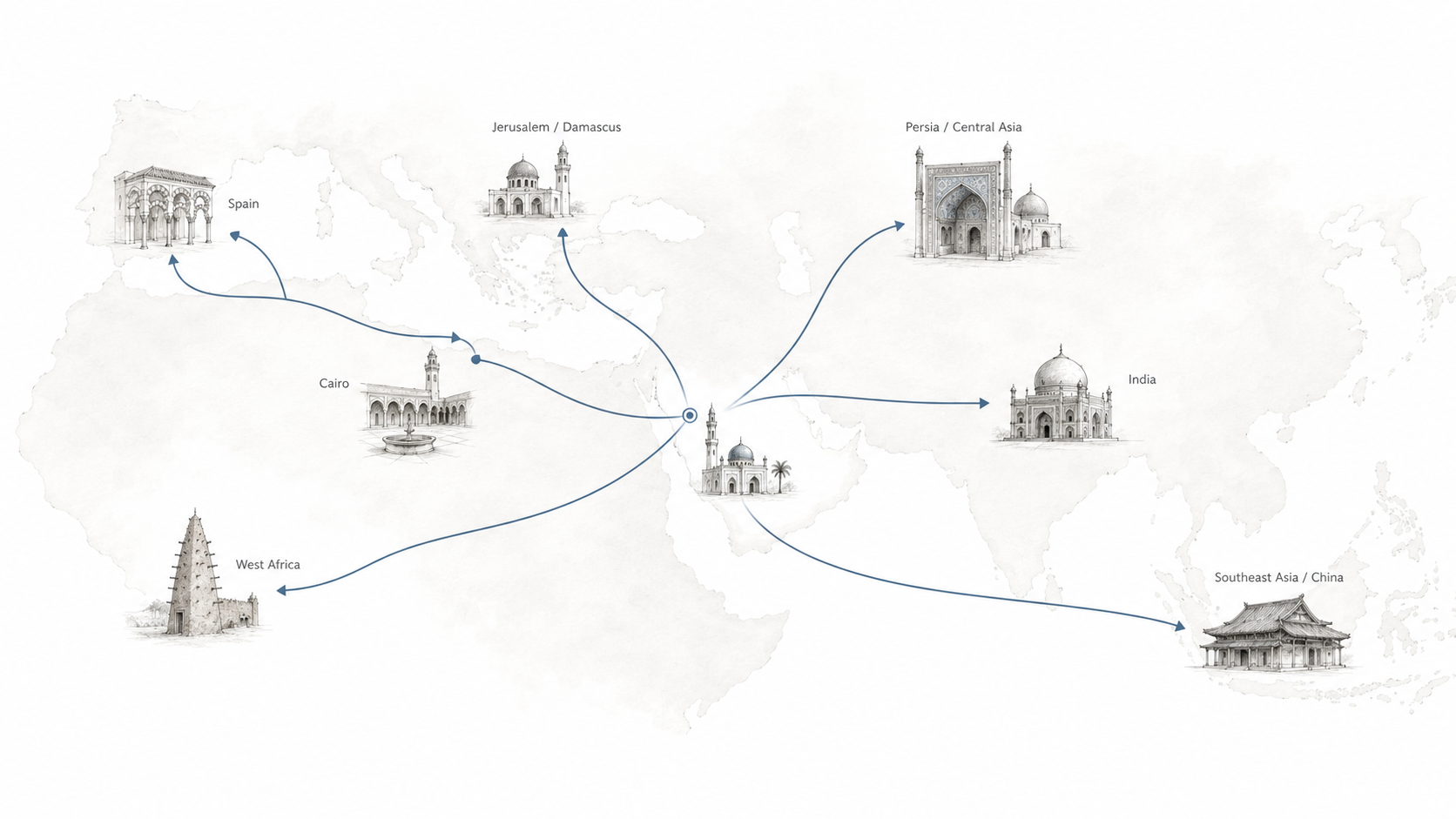
Illustration by ArchitectureCourses.org. Islamic architecture moved through cities, trade routes, empires, and local building cultures, which is why the tradition looks different from region to region.
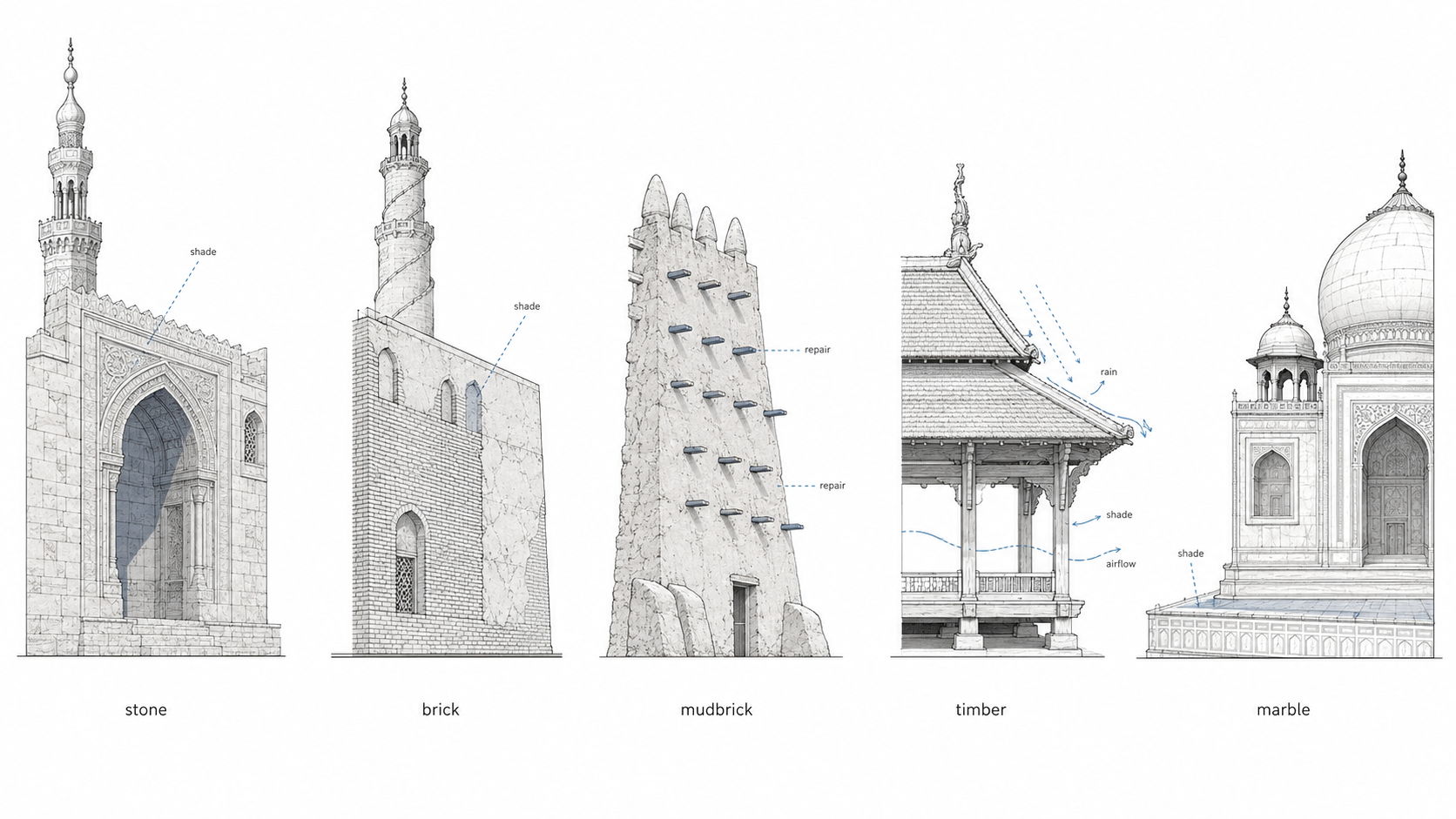
Illustration by ArchitectureCourses.org. Islamic architecture changed because local materials and climate changed. Stone, brick, mudbrick, timber, marble, heat, shade, rain, and repair all shaped the buildings.
This wider map matters. Islamic architecture is not one look. It is a religious and cultural building tradition shaped again and again by local materials, weather, builders, patrons, and politics.
The Design Systems That Travelled
Some architectural ideas moved across regions better than others. They changed as they moved.
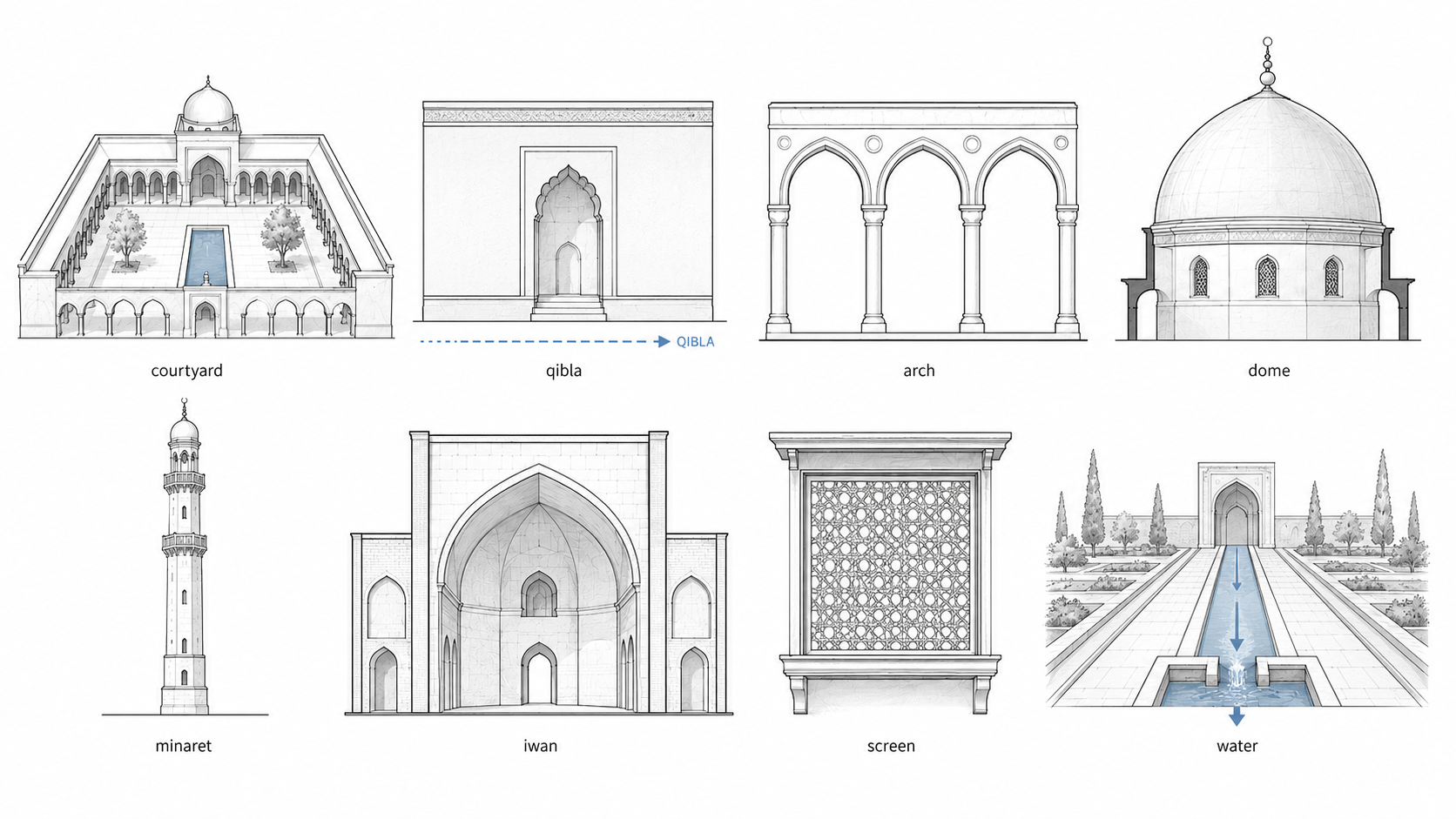
Illustration by ArchitectureCourses.org. The strongest Islamic architectural systems travelled across regions, but each one changed with climate, material, and building type.
| Design System | What It Does | Where to Study It |
|---|---|---|
| Courtyard | Handles light, air, gathering, circulation, and preparation before prayer | Courtyards in Islamic architecture |
| Qibla wall and mihrab | Gives the prayer space direction and focus | Mosque plans across all regions |
| Minaret | Marks the mosque in the city and gives vertical identity | Minarets |
| Arch | Frames openings, carries load, creates rhythm, and shapes thresholds | Arches in Islamic architecture |
| Dome | Creates focus, volume, monumentality, and sometimes acoustic effect | Dome of the Rock, Ottoman mosques, Mughal tombs |
| Iwan | Creates a deep vaulted edge and organizes courtyard plans | Persian and Seljuk architecture |
| Muqarnas | Mediates transitions and turns structure into a stepped visual surface | Persian, Mamluk, and Andalusian buildings |
| Geometric pattern | Orders surfaces, controls scale, and creates visual continuity | Islamic geometric patterns |
| Mashrabiya | Filters light, air, privacy, and street views | Mashrabiya designs |
| Garden and water | Shapes cooling, reflection, movement, and paradise imagery | Persian gardens, Alhambra, Mughal charbagh plans |
Where the History Gets Flattened
The weak version of Islamic architecture history turns the whole subject into domes, arches, and pretty patterns.
That version misses the work the buildings are doing. A courtyard is climate strategy. A minaret is an urban marker. A mashrabiya is privacy and ventilation. A garden is geometry, water control, symbolism, and status. A dome is not automatically “Islamic”; it becomes part of Islamic architecture through use, setting, inscription, structure, and patronage.
The other mistake is treating Islamic architecture as only Middle Eastern. That cuts out Spain, North Africa, West Africa, Turkey, Iran, Central Asia, South Asia, Southeast Asia, China, and modern diasporic buildings.
The cleaner map is less useful. The messier map is closer to the architecture.
Borrowed Forms Became New Rules
Islamic architecture borrowed heavily, then changed what it borrowed.
The pointed arch is a good example of why the history needs care. It has older roots across the Near East and Mediterranean. Islamic builders used and developed pointed arches in major buildings before Gothic architecture made them central to European cathedrals. Contact through Spain, Sicily, trade, travel, and the eastern Mediterranean helped architectural ideas move. It is too simple to say one tradition invented the whole thing for another. It is also wrong to ignore the exchange.
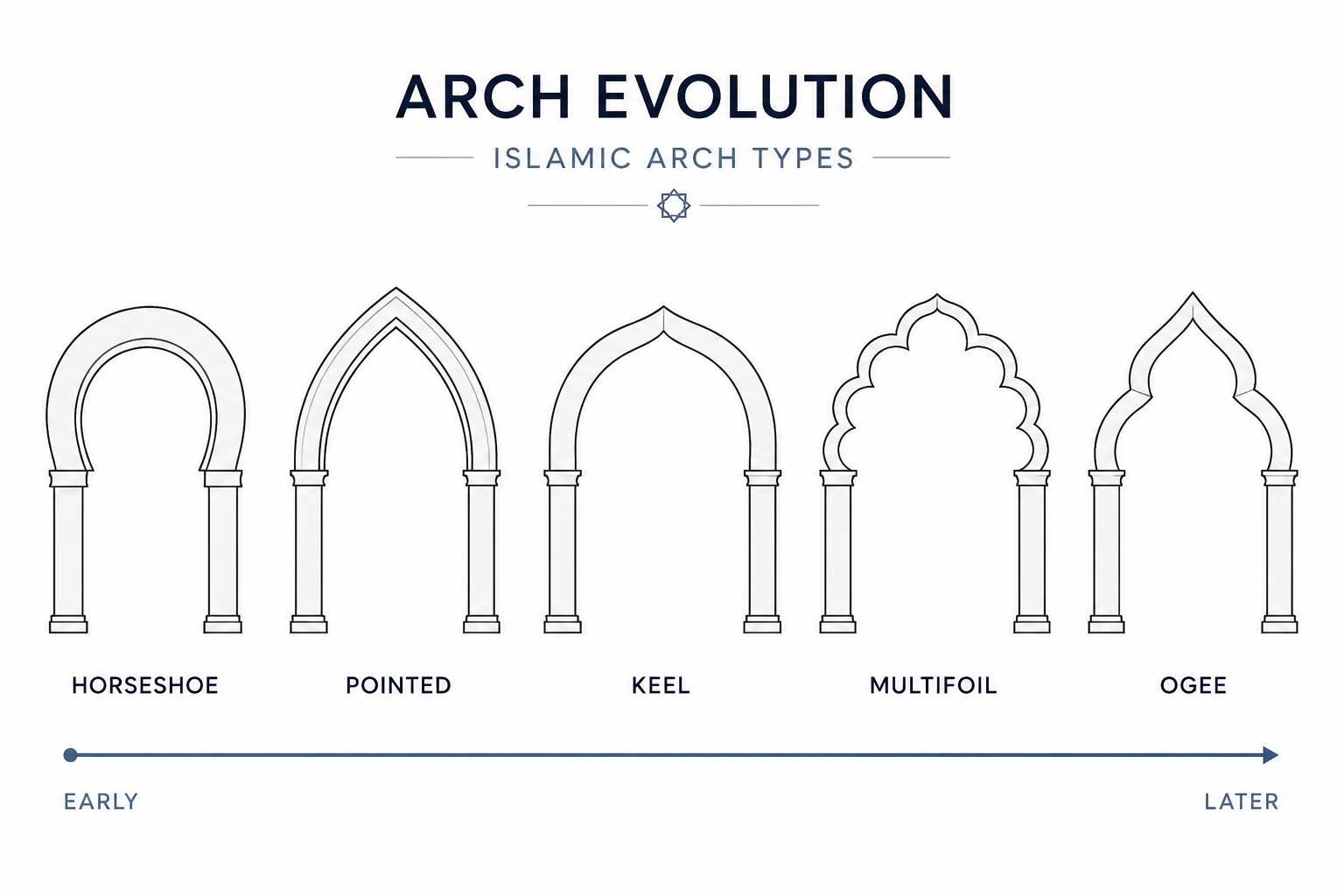
Illustration by ArchitectureCourses.org. Islamic arch forms developed through regional use, structural needs, and decorative refinement, from horseshoe and pointed arches to keel, multifoil, and ogee profiles.
The same is true of domes, gardens, tile, vaulting, and surface pattern. Forms moved. Builders adapted them. New religious, political, and climatic needs changed their meaning.
Architecture rarely moves in one clean line. Forms moved, builders adapted them, and new religious, political, and climatic needs changed their meaning.
What Modern Designers Can Still Use
The modern value of Islamic architecture is not copying a dome or pasting a pattern onto a façade.
The better lessons are quieter:
- Use courtyards to control light, air, gathering, and privacy.
- Use shade as an architectural system, not an afterthought.
- Let patterns help with scale, rhythm, and surface order.
- Treat water as climate, sound, reflection, and movement.
- Design thresholds carefully. The move from street to courtyard to interior matters.
- Use local materials honestly instead of forcing one global image of “Islamic style.”
A contemporary mosque, school, home, cultural center, or garden can learn from Islamic architectural history without pretending to be medieval. The useful part is not imitation. It is knowing which design system solved which problem.
How to Study Islamic Architecture Without Getting Lost
Do not start by memorizing every dynasty.
Start with the plan. Ask where people enter, where they gather, how they face the qibla, how shade is made, how the building meets the street, and what material is doing the work.
Then add the historical layer. Who paid for the building? Which empire or dynasty shaped it? Was it a mosque, palace, tomb, madrasa, fort, garden, or urban complex? Was it built at once or altered over centuries?
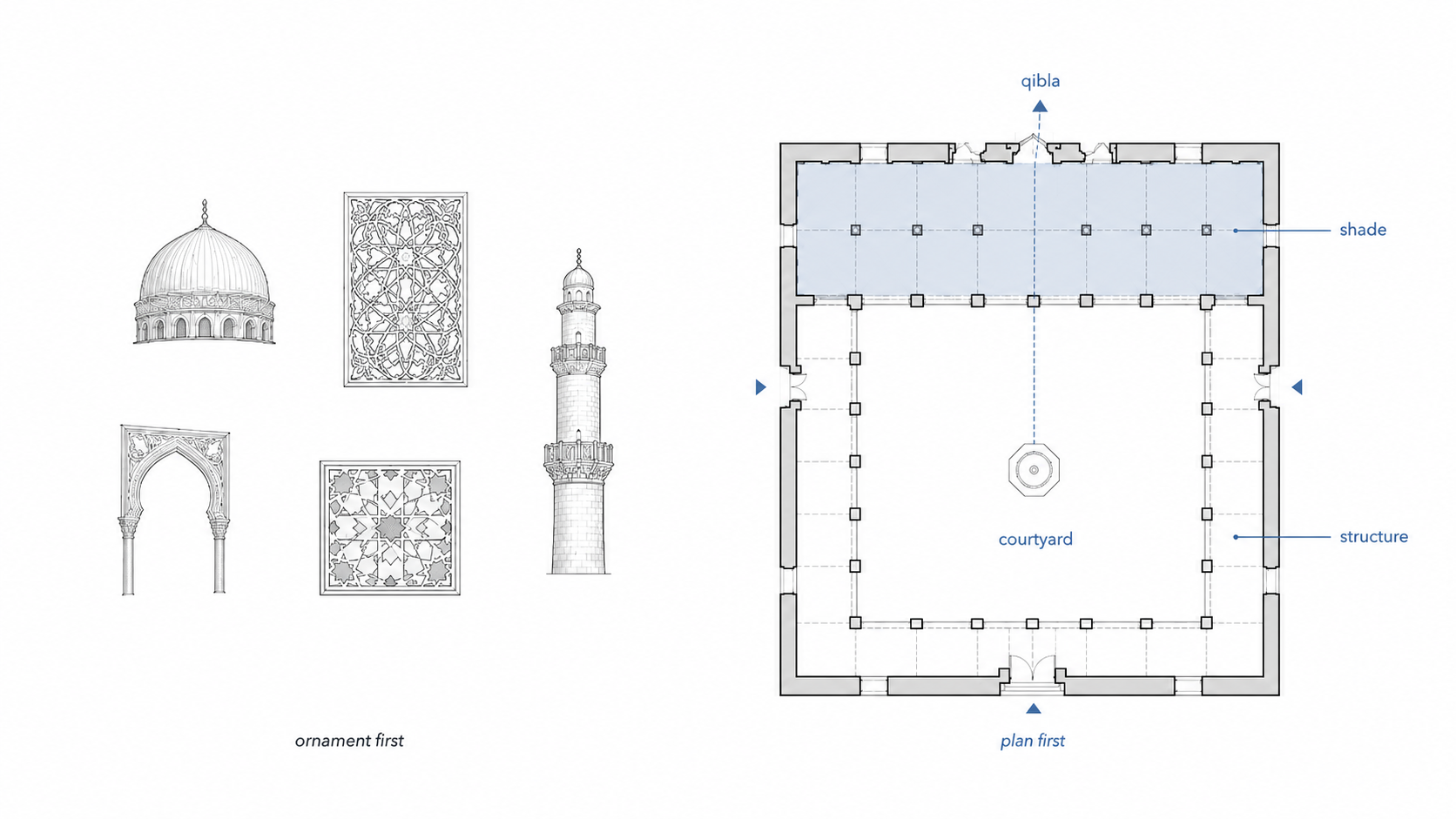
Illustration by ArchitectureCourses.org. Islamic architecture is easier to study when the plan, climate, structure, and building type come before ornament.
Then study the surface. Pattern, calligraphy, muqarnas, tile, carving, and inlay will make more sense once the plan and building type are clear.
A simple study order works best:
- Draw the plan shape.
- Mark the courtyard, qibla wall, entrances, and main axis.
- Note the climate response: shade, air, water, wall thickness, roof form.
- Identify the main structural system: columns, arches, vaults, domes, iwans, timber, mudbrick, or masonry.
- Add the historical period and patron.
- Study the surface last.
Recommended reference: Robert Hillenbrand’s Islamic Architecture: Form, Function and Meaning is a serious architecture-focused book for readers who want building types, plans, regional differences, and design meaning in one place.
Common Mistakes When Reading Islamic Architecture
| Mistake | Why It Fails | Better Reading |
|---|---|---|
| Starting with ornament | It makes the building look like surface decoration. | Start with plan, use, climate, and structure. |
| Treating all domes as the same | A dome in Jerusalem, Istanbul, and Agra does different work. | Ask what the dome is doing in that building type and region. |
| Using one region as the whole story | It cuts out Africa, South Asia, Southeast Asia, China, and Europe. | Study Islamic architecture as a global tradition with local forms. |
| Calling every old mosque “Arab architecture” | Many major works are Persian, Turkish, Indian, African, Andalusian, or local hybrids. | Name the region, dynasty, material, and building type more carefully. |
| Overstating European influence claims | Architecture moves through many routes, not one simple handoff. | Discuss exchange through Spain, Sicily, trade, travel, and shared building knowledge. |
FAQ
When did Islamic architecture begin?
Islamic architecture began in the 7th century with simple mosque spaces tied to prayer, gathering, shade, and community life. It became more complex as Islamic rule expanded into older Byzantine, Persian, Roman, African, and Asian building cultures.
What are the main features of Islamic architecture?
Common features include courtyards, qibla walls, mihrabs, arches, domes, minarets, geometric patterns, calligraphy, gardens, water, mashrabiya screens, iwans, and muqarnas. Not every Islamic building uses all of them.
What is the oldest major Islamic building still standing?
The Dome of the Rock in Jerusalem, completed in the late 7th century, is one of the oldest surviving major works of Islamic architecture.
Is Islamic architecture one style?
No. It is better understood as a broad architectural tradition shaped by faith, region, climate, materials, empire, and local craft. Ottoman, Persian, Mughal, Moorish, Mamluk, West African, and Southeast Asian Islamic buildings can look very different.
Why are geometric patterns common in Islamic architecture?
Geometry helps organize surfaces, create rhythm, avoid reliance on figural imagery in religious settings, and suggest order beyond the individual object. It also gives large walls, tiles, screens, and domes a readable scale.
How did Islamic architecture influence Europe?
Influence moved through places such as Spain, Sicily, the eastern Mediterranean, trade routes, travel, and craft exchange. Forms such as pointed arches, tilework, courtyards, gardens, and surface pattern entered wider architectural conversations, though the transfer was rarely simple or one-directional.
What should students study first?
Start with plans and building types. Learn how the mosque, palace, tomb, madrasa, garden, and urban complex work. After that, study surface details such as pattern, calligraphy, tile, and carving.
Read This Next
For the broader overview, start with Islamic architecture. For major features, continue with characteristics of Islamic architecture, Islamic arches, minarets, and courtyards in Islamic architecture.
For building case studies, use Dome of the Rock, Al-Azhar Mosque, Blue Mosque, Süleymaniye Mosque, Taj Mahal, and Badshahi Mosque.
What Stays Useful
Islamic architecture history is easier to read when you stop looking for one style.
The same tradition can produce a desert mudbrick mosque, a marble Mughal tomb, a timber mosque in China, a courtyard palace in Granada, and a domed Ottoman mosque in Istanbul. The connection is not a fixed look. It is a set of building problems answered through faith, climate, rule, material, geometry, and local craft.
The surface is often beautiful. The plan usually explains more.