

Al-Azhar is easy to misread.
From the outside, it can look like one famous Cairo mosque with a long history attached to it. The building is messier than that. The Fatimid prayer hall, later minarets, courtyard edges, gates, teaching spaces, repairs, and city pressure all sit on top of each other.
Read it as one style and the architecture goes flat. Read it as a working mosque that kept absorbing new layers, and the building starts to make sense.
Start With the Building, Not the Legend
Al-Azhar Mosque was founded between 970 and 972 CE after the Fatimids established Cairo as al-Qahira. It began as the Friday mosque of the new city and soon became tied to religious teaching.
That history is important, but it can get in the way of seeing the building. Al-Azhar is slower than the big postcard monuments. The Blue Mosque reads through dome hierarchy and skyline. The Taj Mahal reads through symmetry and garden order. Al-Azhar asks for a different kind of attention.
You have to read the courtyard, the arcades, the qibla wall, the minarets, the entrances, and the repairs as parts of a building that stayed in use. The useful part is the accumulation. The mosque did not freeze after its first phase. It kept being adjusted because people kept praying, teaching, entering, repairing, and governing through it.
For the broader parent topic, place it under Islamic architecture, but do not treat it as a clean style sample. Al-Azhar is more useful as a building that changed without losing its main order.
The Short History Before the Plan
The early mosque was built under the Fatimid Caliph al-Mu'izz li-Din Allah, with Jawhar al-Siqilli closely tied to the founding of Cairo and the construction of Al-Azhar. Its first form was simpler than the complex building now visible in the city.
Later rulers changed the mosque. Some work repaired damage. Some expanded the prayer space. Some sharpened the mosque’s public image. Some changed access, circulation, teaching use, or the way the building met the street.
Calling the whole mosque “Fatimid architecture” is too clean. The foundation is Fatimid. Much of the visible character comes from later hands.
For the broader historical sequence, read Islamic architecture history. This article stays with Al-Azhar as a building.
| Period | What Changed | What to Notice |
|---|---|---|
| Fatimid foundation | Original mosque and early prayer-hall order | The religious orientation, courtyard relationship, and early identity of the mosque begin here. |
| Medieval expansion | Arcades, teaching use, repairs, and circulation changes | The mosque becomes more than a single prayer building. It starts carrying institutional life. |
| Mamluk additions | Major minarets, portals, and visible vertical markers | Much of the skyline character comes from this later period. |
| Ottoman and later work | Repairs, added spaces, and administrative changes | The mosque remains active, but the plan becomes harder to read as one period. |
The Plan Explains More Than the Ornament
Start with the plan. The decoration can wait.
Like many historic mosques, Al-Azhar organizes worship around direction, shade, gathering, and movement. The qibla wall and prayer hall give the building its religious focus. The courtyard brings light, air, pause, and circulation into the middle of the complex. The arcades make a shaded edge between the open court and the deeper prayer areas.
On paper, that sounds simple. In the actual building, it is more complicated. Al-Azhar grew over time. Entrances, teaching areas, added rooms, repairs, and service spaces pull at the original order. The mosque does not behave like a clean teaching diagram.
That is where students often get stuck. They look for perfect symmetry. Al-Azhar gives them a working order instead: prayer direction held steady, courtyard still active, edges changed by use.
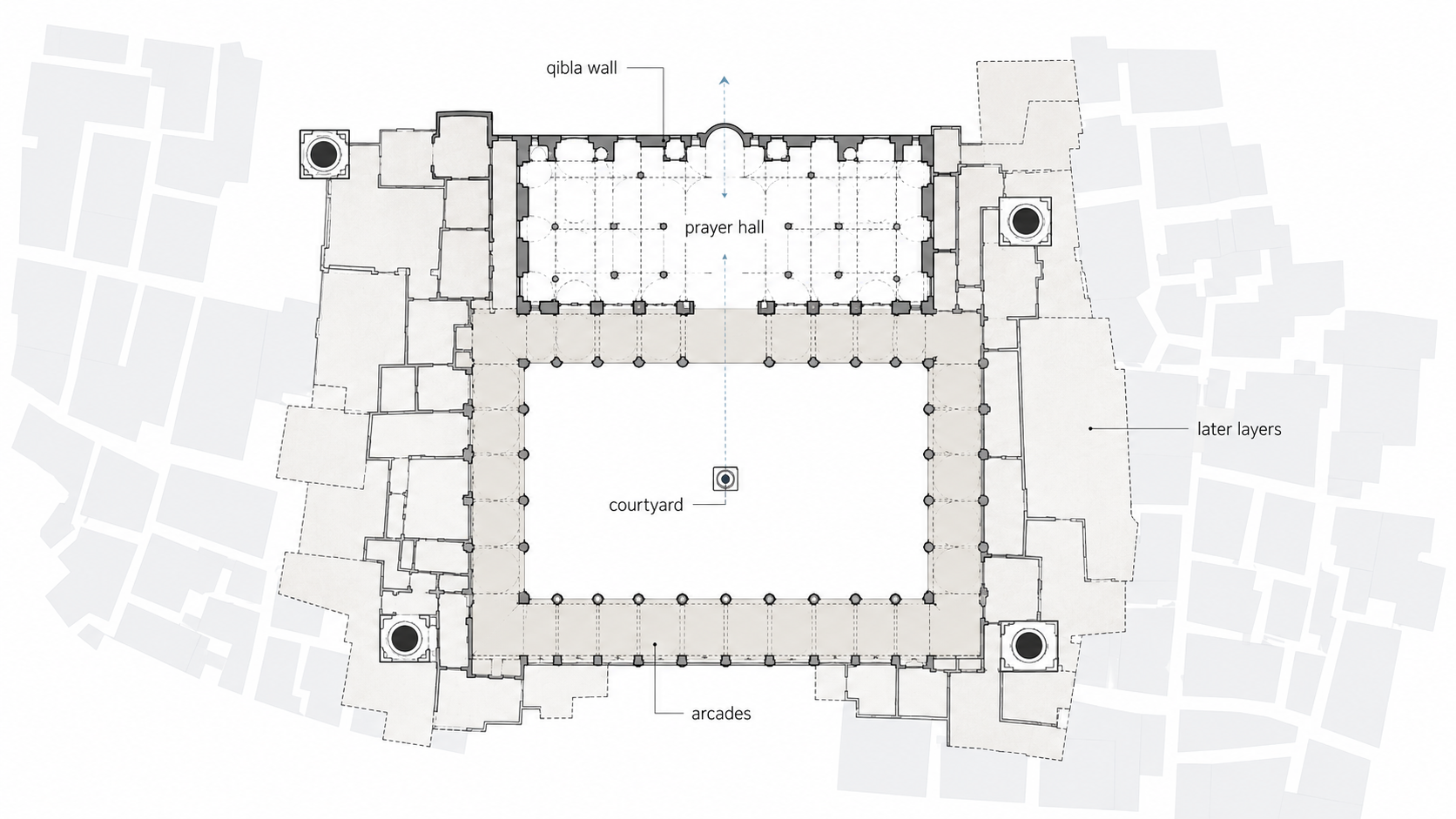
Illustration by ArchitectureCourses.org. Al-Azhar Mosque is easier to understand when the courtyard, qibla wall, prayer hall, arcades, minaret points, and later additions are separated visually.
Courtyard, Shade, and Teaching Space
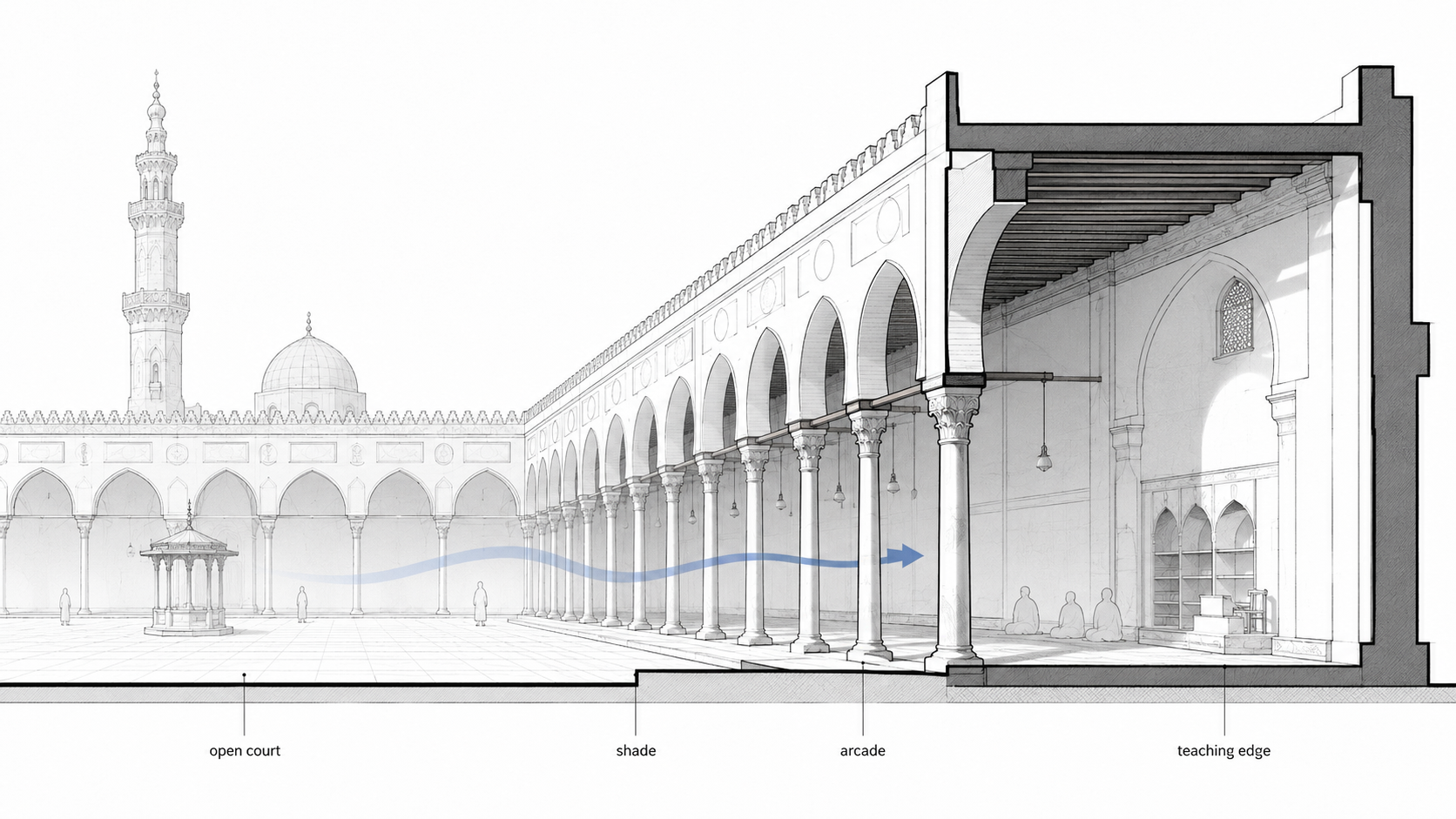
Illustration by ArchitectureCourses.org. The courtyard and arcades at Al-Azhar Mosque organize light, shade, movement, and teaching space.
The courtyard is doing work.
In a hot climate, a mosque courtyard brings daylight into a dense building, gives worshippers a place to pause, and helps large groups move without crowding every interior bay. It also creates one of the strongest spatial contrasts in the mosque: open sky in the center, shaded arcades along the edge.
At Al-Azhar, the courtyard also helps explain the mosque’s academic life. Teaching in historic Islamic architecture did not always look like a modern classroom. Learning could happen under arcades, beside columns, near the prayer space, or in attached areas. The building allows worship, study, and public religious life to overlap without needing a rigid separation.
This connects Al-Azhar to the larger subject of courtyards in Islamic architecture. The sahn is not decoration. It handles climate, movement, gathering, and preparation before prayer.
The Prayer Hall Works by Repetition
The prayer hall does not need one big theatrical room.
Its strength comes from repetition. Columns, arcades, and bays create a field of space. The body still turns toward the qibla wall, but the room spreads laterally. It does not pull the visitor down one long dramatic axis in the way a church nave often does.
That repeated structure matters. It gives shade. It carries load. It lets people gather in ordered rows. It also makes expansion easier than a single centralized dome scheme.
At Al-Azhar, later work makes the original rhythm harder to isolate. The old logic is still there. Direction first. Rows second. Structure and shade doing quiet work around both.
Arches Are Part of the Building, Not Icons
The arches at Al-Azhar should not be pulled out like decorative symbols.
They belong to the way the mosque works. Arches create shaded thresholds, frame the courtyard, support repeated bays, and give visual rhythm to long edges. Around the courtyard, they handle the shift from open court to shaded interior.
This is where Islamic arch articles often get lazy. A pointed arch, horseshoe arch, keel arch, and multifoil arch do not mean the same thing. They come from different regions, periods, construction habits, and decorative systems. Al-Azhar gives a better way to teach them: as parts of a living architectural surface.
For a clearer visual breakdown, use the companion guide to arches in Islamic architecture.
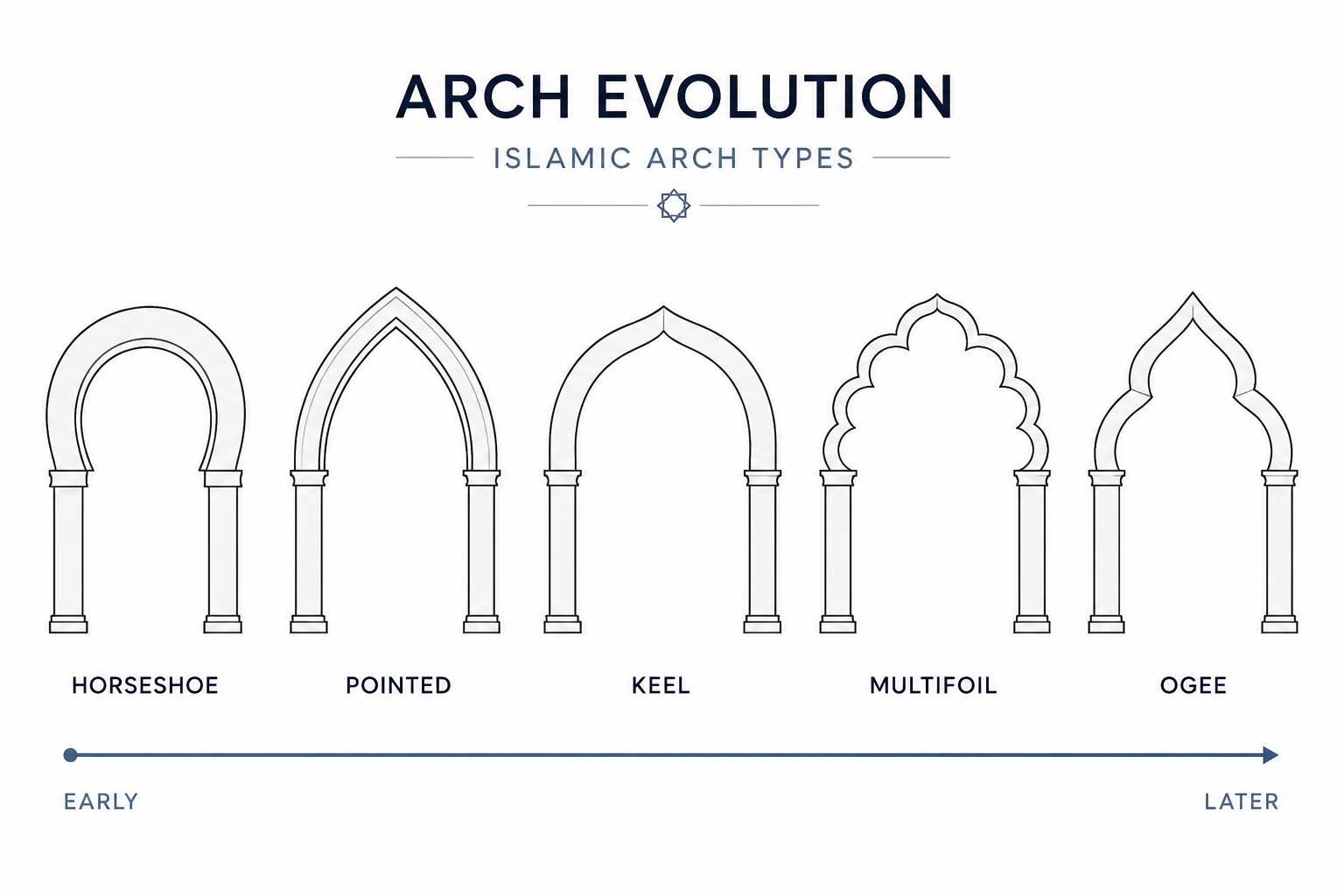
Illustration by ArchitectureCourses.org. Islamic arch forms developed through regional use, structural needs, and decorative refinement, from horseshoe and pointed arches to keel, multifoil, and ogee profiles.
The Minarets Show Later Hands
Al-Azhar’s minarets are the easiest place to see time.
They do not all belong to the original Fatimid mosque. The present minarets are tied to later periods, especially Mamluk and Ottoman-era work. Their shafts, balconies, crowns, and proportions do not read as one single design decision.
For visitors, the minarets help identify the mosque. For students, they do more than that. They show patronage. They show period. They show how a ruler or institution can mark an older mosque without rebuilding the whole thing.
The mosque also belongs beside the site’s broader page on minarets. A minaret is a tower, but it is also an urban marker, a ceremonial form, and a public claim in the skyline.
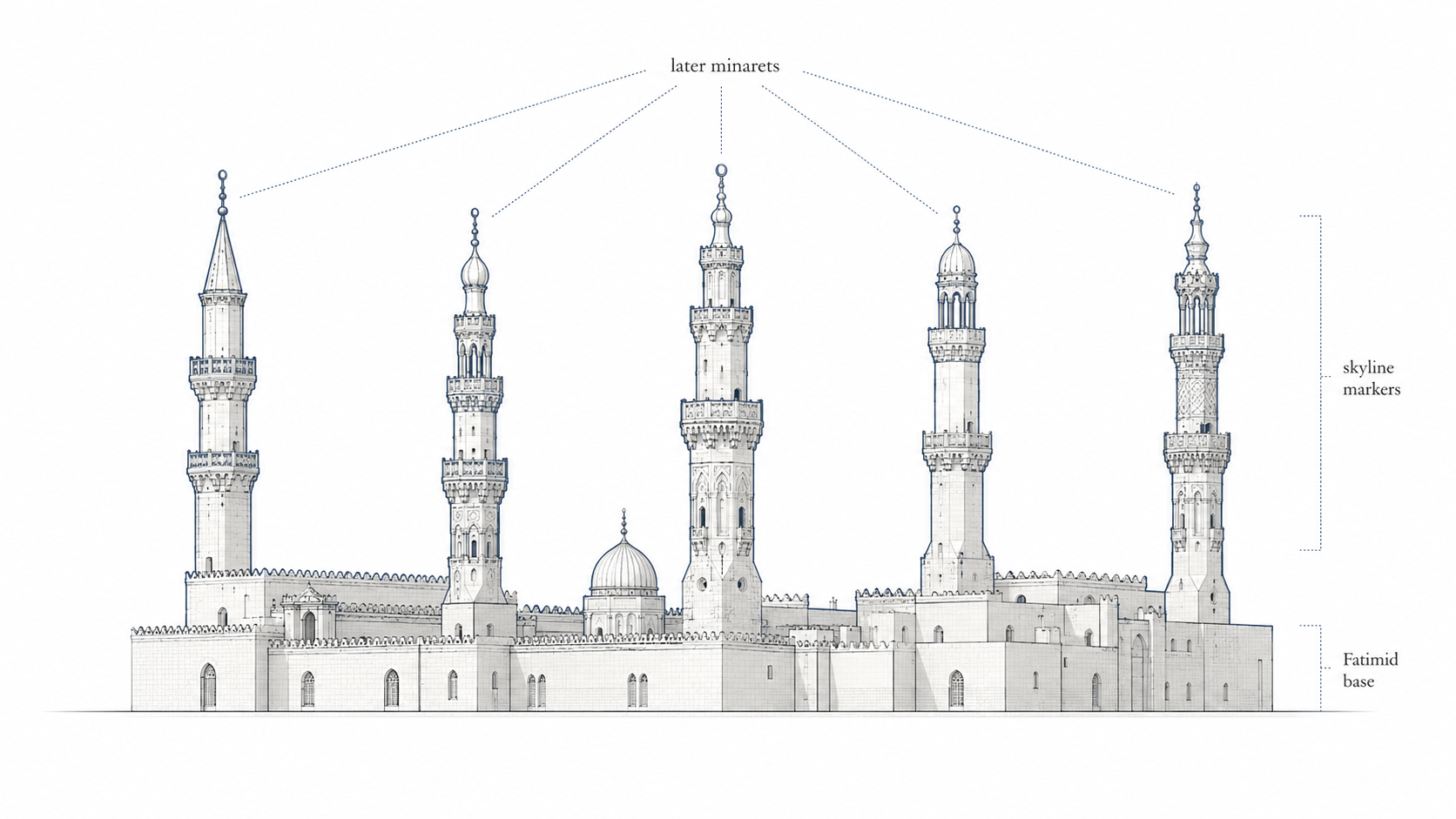
Illustration by ArchitectureCourses.org. The minarets of Al-Azhar Mosque show how later rulers changed the mosque’s skyline long after its Fatimid foundation.
Do Not Flatten It Into One Style
Al-Azhar began in the Fatimid period. The building in front of you did not stop there.
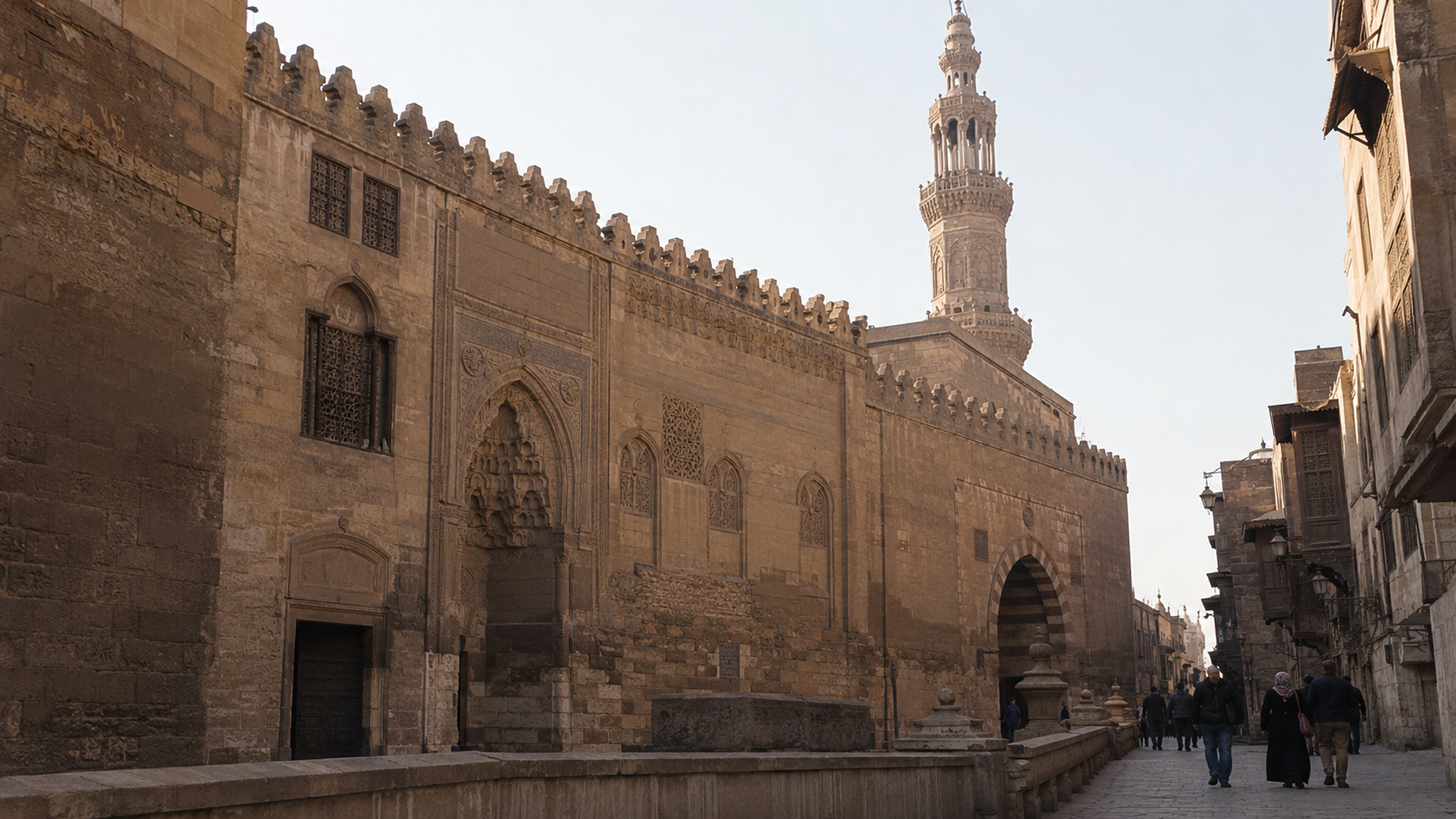
Image by ArchitectureCourses.org. Al-Azhar Mosque reads as a layered urban monument, with gates, walls, minarets, and street edges shaped by more than one period.
Later rulers added minarets, entrances, repairs, and spatial changes. Some of the most visible features are not from the first phase. That does not weaken the building. It gives the mosque its actual character.
A cleaner textbook might want one label. Fatimid. Mamluk. Ottoman. Al-Azhar resists that. Its plan, ornament, skyline, and circulation hold several histories at once.
The better label is not a style name. It is a condition: a religious complex that kept working long enough to carry many periods in one body.
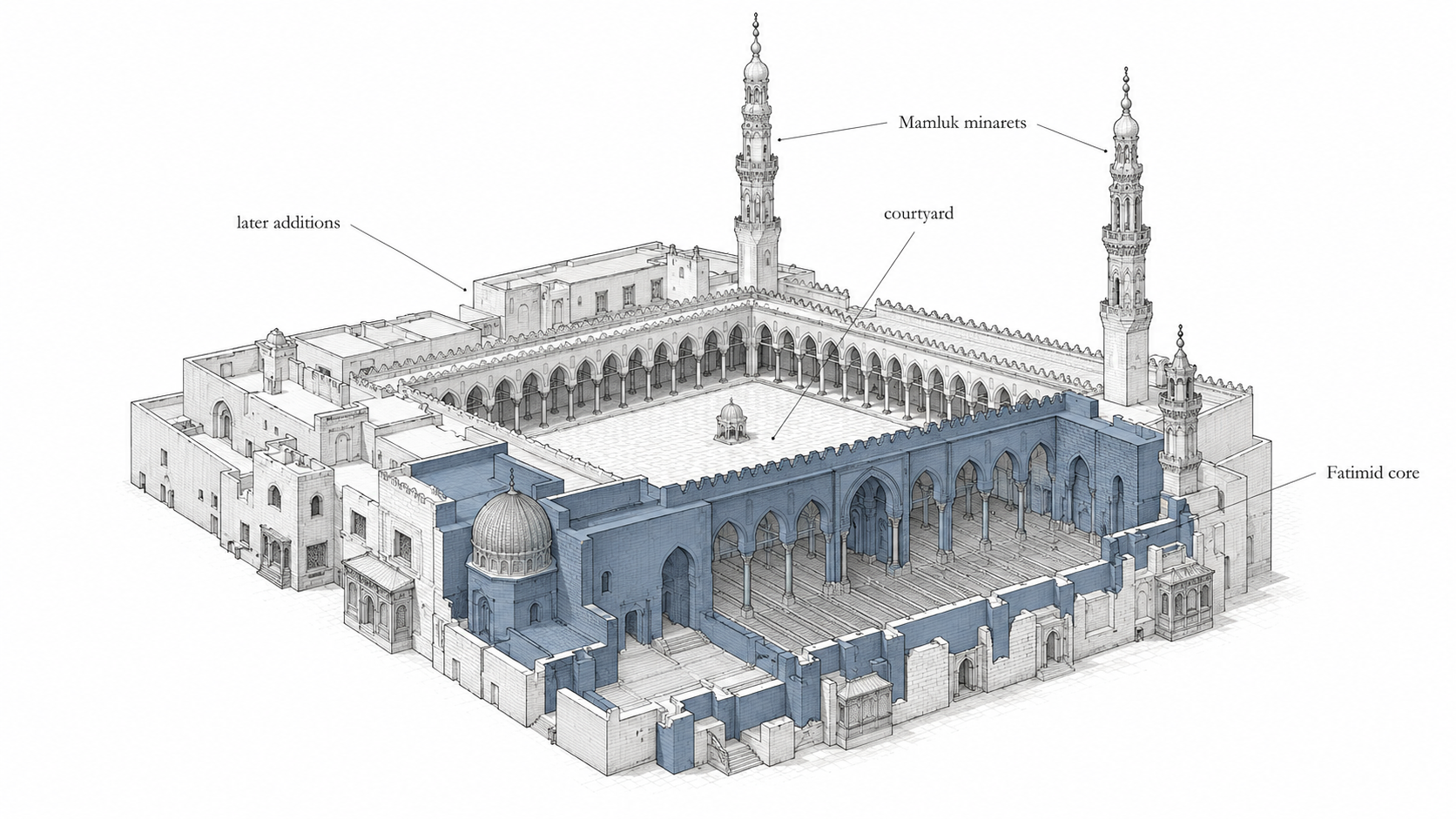
Illustration by ArchitectureCourses.org. Al-Azhar Mosque began as a Fatimid foundation, but much of its visible character comes from later architectural layers added around the courtyard and prayer hall.
The Exterior Reads in Pieces
Al-Azhar does not give you one perfect front.
The exterior is more like an urban edge built over time. Gates, walls, minarets, entries, and nearby streets shape the way the mosque appears. It sits inside dense Islamic Cairo, so you often read it in fragments rather than from one clean viewpoint.
Look first for the vertical markers. The minarets tell you where the mosque is before the whole building can be seen.
Then look at the entrances. Movement into Al-Azhar is shaped by the surrounding city, not by a single symmetrical approach. The mosque meets Cairo in a more practical way: through edges, gates, paths, and compressed views.
The surfaces also give clues. Stone, arches, portals, and decorative work from different periods sit close together. The building does not hide its edits.
The Interior Holds More Than Prayer
Inside Al-Azhar, the useful question is not which detail is prettiest.
The better question is how the space holds prayer, teaching, circulation, pause, and public religious life at the same time. Columns provide structure and shade. Arcades create edges where people can gather and learn. The courtyard relieves the dense interior. The qibla wall gives the room its direction.
Decoration adds meaning and order, but the spatial logic comes first. Al-Azhar is a good correction to the lazy idea that Islamic architecture is mainly domes, tiles, and ornament. Much of its intelligence is quieter: alignment, repetition, threshold, shade, and the handling of movement.
Decoration Has a Job
The calligraphy, geometric pattern, and vegetal ornament at Al-Azhar are not surface filler.
Calligraphy can turn a wall into a text-bearing surface. Geometry can order a field without using figures. Repetition can make a complex building feel more coherent, even when different periods sit close together.
At Al-Azhar, decoration also helps the eye slow down. It marks thresholds, frames surfaces, and gives certain edges more weight. It does not erase the building’s mixed history. It helps the visitor read it.
For readers who want to study that layer separately, continue with Islamic geometric patterns.
Where Al-Azhar Sits Beside Other Islamic Buildings
Al-Azhar should not be compared only by beauty or age. Compare what each building teaches.
| Building | Best Architectural Reading | How It Differs From Al-Azhar |
|---|---|---|
| Al-Azhar Mosque | A working mosque shaped by prayer, teaching, repair, and urban life | Its design is cumulative. The building gains meaning through use and later additions. |
| Dome of the Rock | Centralized sacred form, geometry, and early Islamic monumentality | It reads more clearly as a powerful object building. |
| Blue Mosque | Ottoman dome hierarchy, skyline, and imperial mosque planning | It has a stronger unified silhouette and more controlled composition. |
| Ibn Tulun Mosque | Early mosque scale, open courtyard, and strong perimeter logic | It is easier to read as a large, spacious architectural field. |
| Taj Mahal | Mughal symmetry, garden planning, and marble monumentality | It is a mausoleum complex, not a working urban mosque-university. |
The Building Kept Working
Al-Azhar’s fame can flatten the building.
A basic description says it is old, important, beautiful, and connected to learning. True enough. It still leaves the architecture vague.
The better question is what stayed steady while the mosque changed. The prayer direction stayed legible. The courtyard kept doing its work. The arcades still made shade and teaching edges. The minarets gave later rulers a way to mark the skyline without rebuilding the whole mosque.
That is a more useful reading than calling the whole thing “Fatimid” and moving on. Al-Azhar survived as architecture because its main spatial order could take additions without falling apart.
How to Study Al-Azhar
Do not start by memorizing dates. Start by drawing.
A quick plan sketch will teach more than a long paragraph. Mark the courtyard first. Then mark the prayer hall and qibla direction. Then show the arcades. Add the minarets as later skyline markers. Finally, note where the plan becomes irregular because of additions and urban pressure.
That small exercise changes Al-Azhar from a famous name into a building you can actually read.
- Draw the courtyard as the open center.
- Mark the qibla wall and prayer hall.
- Show arcades as shaded transition zones.
- Add minarets as period markers, not original Fatimid features.
- Use a second tone or lineweight to show later additions and irregular edges.
Recommended reference: For readers who want a deeper architecture-focused source, Robert Hillenbrand’s Islamic Architecture: Form, Function and Meaning is a better fit than a generic mosque picture book. Use it for plans, building types, regional differences, and how Islamic buildings actually work.
Common Mistakes When Describing Al-Azhar
The weakest descriptions usually make the building cleaner than it is.
| Mistake | Why It Fails | Better Reading |
|---|---|---|
| Calling it only a Fatimid mosque | The foundation is Fatimid, but the visible building includes later work. | Describe it as a Fatimid foundation with major later additions. |
| Starting with decoration | The plan, courtyard, prayer hall, and teaching use explain more. | Start with spatial order, then move to ornament. |
| Treating the minarets as original | The current minarets belong to later periods. | Use them to explain the mosque’s long timeline. |
| Writing it as a tourism checklist | The reader gets facts but not architecture. | Explain how the building works as space, structure, and city edge. |
FAQ
When was Al-Azhar Mosque built?
Al-Azhar Mosque was founded in the Fatimid period. Construction began around 970 CE, and the mosque was inaugurated in 972 CE.
Who built Al-Azhar Mosque?
The mosque was built under the Fatimid Caliph al-Mu'izz li-Din Allah. Jawhar al-Siqilli, who was central to the founding of Cairo, is closely connected to its construction.
What architectural style is Al-Azhar Mosque?
Al-Azhar began as a Fatimid mosque, but the building visible today includes later layers. Its architecture includes Fatimid origins, Mamluk minarets and additions, Ottoman-era work, and later restorations.
How many minarets does Al-Azhar Mosque have?
Al-Azhar is commonly described as having five minarets. The important architectural point is that they do not all come from the original Fatimid phase.
Why is Al-Azhar Mosque important?
It combines religious, educational, urban, and architectural history. It began as a Fatimid mosque in Cairo and became one of the most important centers of Islamic learning.
Is Al-Azhar Mosque still used?
Yes. Al-Azhar remains an active religious and educational institution. Its continued use is part of the reason the building carries so many layers.
What should architecture students notice first?
Start with the plan. Notice the courtyard, prayer hall, qibla orientation, arcades, entrances, and minarets. The ornament comes after the spatial order.