

Image: Symmetrical perspective of an ancient stepwell in India, showcasing its tiered stone steps and geometric design used for water storage and community gathering.
Ancient Indian Engineering: Real Innovations That Still Matter
Ancient India was full of smart solutions. Builders designed water systems that worked in deserts, laid out cities with proper drainage, and made structures that could survive earthquakes.
They used math, strong materials, and smart planning to solve everyday problems. And the best part? Many of their ideas still shape how we build things today.
Below, we’ll look at the tools, methods, and design choices that made Ancient India a leader in early civil engineering.
What Made Ancient Indian Engineering So Advanced?
Key Innovations of Ancient Indian Engineering
-
Urban Planning in the Indus Valley (grid streets, drainage, standardized bricks)
-
Stepwells and Water Management Systems (e.g. Rani Ki Vav)
-
Iron Pillars that resist rust (like the Delhi Iron Pillar, still standing today)
-
Advanced Metallurgy (Wootz steel, used in legendary Indian swords)
-
Precise Stone Cutting and Interlocking Techniques
-
Astronomical Observatories (like Jantar Mantar in Jaipur)
What to Learn From It
-
Engineering is not just about tools—it’s about understanding nature
-
Many ancient methods were sustainable and climate-aware
-
Design wasn’t just for beauty—it served function, culture, and environment
Best Books on Ancient Indian Engineering & Technology
Engineering Wonders of the Ancient World: India
Why read it: Written in a story-like format, this book shows how Indian innovations like stepwells, ironwork, and urban planning were ahead of their time.
Good for: Teen readers, educators, and curious learners.
India: A History of Science and Technology
Why read it: A detailed academic book, but easy to dip into. Covers civil, mechanical, and chemical engineering, with diagrams.
Good for: University-level readers and research students.
How Ancient India Mastered Water, Stone, and Steel
The Engineering Genius of Ancient India
Engineering & Technology in Ancient India

Image: A detailed guide to ancient India's engineering and technology, highlighting smart solutions in urban planning, water management, mechanical devices, and metallurgy.
Smart Ideas, Real Solutions, Way Ahead of Their Time
Ancient India was highly technical. Engineers and builders understood materials, structure, water systems, and machines. Their innovations were shaped by real-world needs like farming, trade, climate, and daily life.
Here’s a breakdown of their key contributions to civil, hydraulic, mechanical, and materials engineering—plus tips on what to focus on if you want to learn from the best of old-school engineering.
Civil Engineering & Urban Design
-
Cities like Mohenjo-Daro and Harappa used grid layouts, standardized bricks, and public drainage.
-
Structures were planned for climate, access, and sanitation—long before modern standards.
-
Large public buildings, reservoirs, and granaries reflect a system-wide approach to infrastructure.
What to focus on:
-
Early use of zoning and building codes
-
Underground sewage systems still studied today
Hydraulic Engineering
-
Ancient engineers built stepwells, canals, tanks, and reservoirs across dry zones.
-
Systems were gravity-driven, self-cleaning, and low-maintenance.
-
Examples include Rani ki Vav, Chand Baori, and stepped tanks in Gujarat and Karnataka.
Breakthrough:
-
Passive water management that worked seasonally
-
Inspired modern rainwater harvesting models
Mechanical & Material Engineering
-
Early use of water wheels for irrigation
-
Development of pulley systems, shafts, and gears in early mills
-
Mastery of Wootz steel—an ultra-strong metal used globally for weaponry
-
Early clockwork and automation seen in metal sculptures
Still used or relevant today?
-
Yes. Wootz steel influenced modern metallurgy
-
Basic machines show up in water-lifting tech and early industrial design
Takeaways
-
Ancient Indian tech was practical, scalable, and adapted to local conditions
-
They worked with nature—not against it
-
No flashy tools. Just deep knowledge of physics, materials, and purpose
Best Books on Ancient Indian Engineering & Technology
Science and Technology in Ancient India
Why read it: A foundational book that explains how early Indians applied science in real life—covering agriculture, me
Good for: Beginners and history students.
Why read it: Focuses on real tools, irrigation systems, roads, and material science used in the Indus Valley and Vedic periods.
Good for: Engineers, teachers, and curriculum writers.
Ancient Indian Inventions That Still Impress Modern Engineers
Smart Architecture of Ancient India | Real Examples and Lessons
Achievements of Ancient India in Civil Engineering

Image: Key civil engineering achievements of ancient India, including Indus Valley urban planning, stepwells, transport networks, fort design, and long-lasting metallurgy.
Smart Design. Real Impact. Built to Last.
Ancient Indian engineers were planners, problem solvers, and innovators. Their work shaped how cities grew, how people moved, and how water was managed.
Many of their ideas still influence construction, infrastructure, and planning today. Let’s break down the most important civil engineering achievements from ancient India—and why they still matter.
Urban Planning in the Indus Valley
Mohenjo-Daro and Harappa (c. 2500 BCE)
-
Grid-based street layouts with perfect 90° angles
-
Standardized fired bricks for homes and drains
-
Public and private drainage systems connected to covered sewers
-
Centralized granaries, wells, and water tanks
Why it matters:
-
First known use of urban zoning and sanitation at scale
-
Foundation for modern city planning
-
No known architect names—but their influence is global
Water Management Systems
Stepwells (Baolis) and Reservoirs
-
Deep, multi-tiered wells built into the earth
-
Provided access to groundwater in drought-prone areas
-
Engineered for both function and community use
Examples:
-
Rani ki Vav (Gujarat), Chand Baori (Rajasthan)
Still used today?
-
The concept survives in rainwater harvesting systems
-
Inspired modern sustainable water design in dry zones
Road and Transport Infrastructure
Grand Trunk Road – Originally Mauryan Era, Improved by Sher Shah Suri (16th c.)
-
Spanned thousands of kilometers, connecting key trade zones
-
Rest houses, waypoints, and tree-lined sections for shade
-
Enabled long-distance travel, trade, and military movement
Why it matters:
-
Early example of integrated national infrastructure
-
Served as the backbone for modern highway routes in India, Pakistan, and Bangladesh
Fort Design and Defensive Engineering
Strongholds with Advanced Strategy
-
Massive walls, layered gates, and reservoirs for long sieges
-
Elevation used for visibility and defense
-
Multi-path entryways to confuse intruders
Examples:
-
Chittorgarh Fort (Rajasthan), Daulatabad Fort (Maharashtra)
Engineering Insight:
-
Designed without modern tech, but optimized for geography
-
Many structural methods still inspire terrain-based planning in defense and hill architecture
Metallurgy and Structural Longevity
Iron Pillar of Delhi (c. 400 CE)
-
7-meter-high iron structure that hasn’t rusted in over 1600 years
-
High phosphorus content prevents corrosion naturally
-
Built without welding tools—one solid shaft
Why it matters:
-
Shows deep understanding of material science
-
Influenced modern alloys and corrosion-resistant steel research
What to Focus On If You're Studying Ancient Indian Civil Engineering:
-
How climate and geography shaped their solutions
-
Why their materials lasted so long (brick, iron, stone)
-
How systems were designed for sustainability
-
How engineering supported trade, economy, and public health
Ancient Indian engineering solved real problems. See how cities and tools were built to last.
15 Engineering Marvels of Ancient India
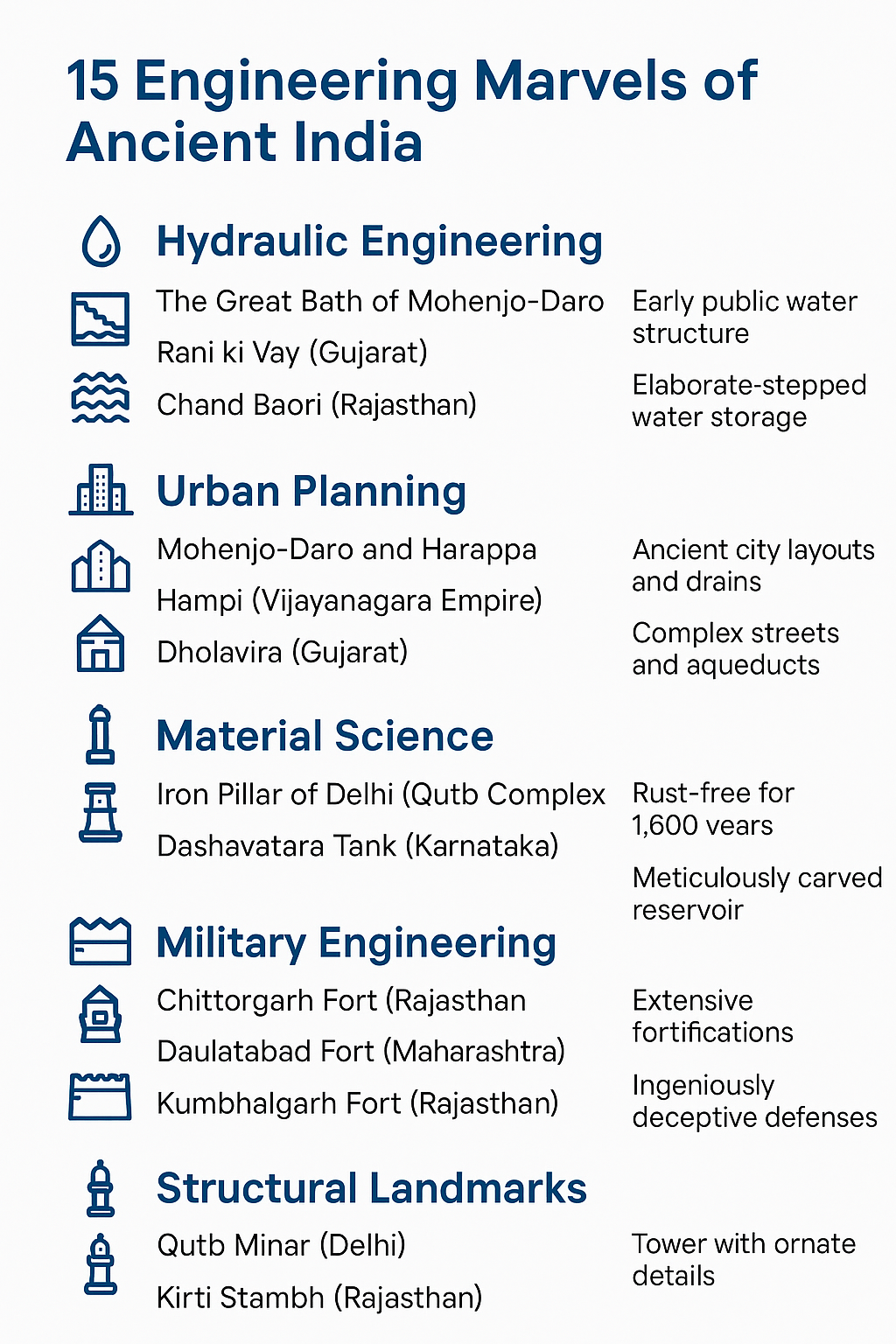
Grouped by Innovation: Water, Urban Planning, Materials, Defense, and Towers
1. Hydraulic Engineering & Water Management
1. The Great Bath of Mohenjo-Daro
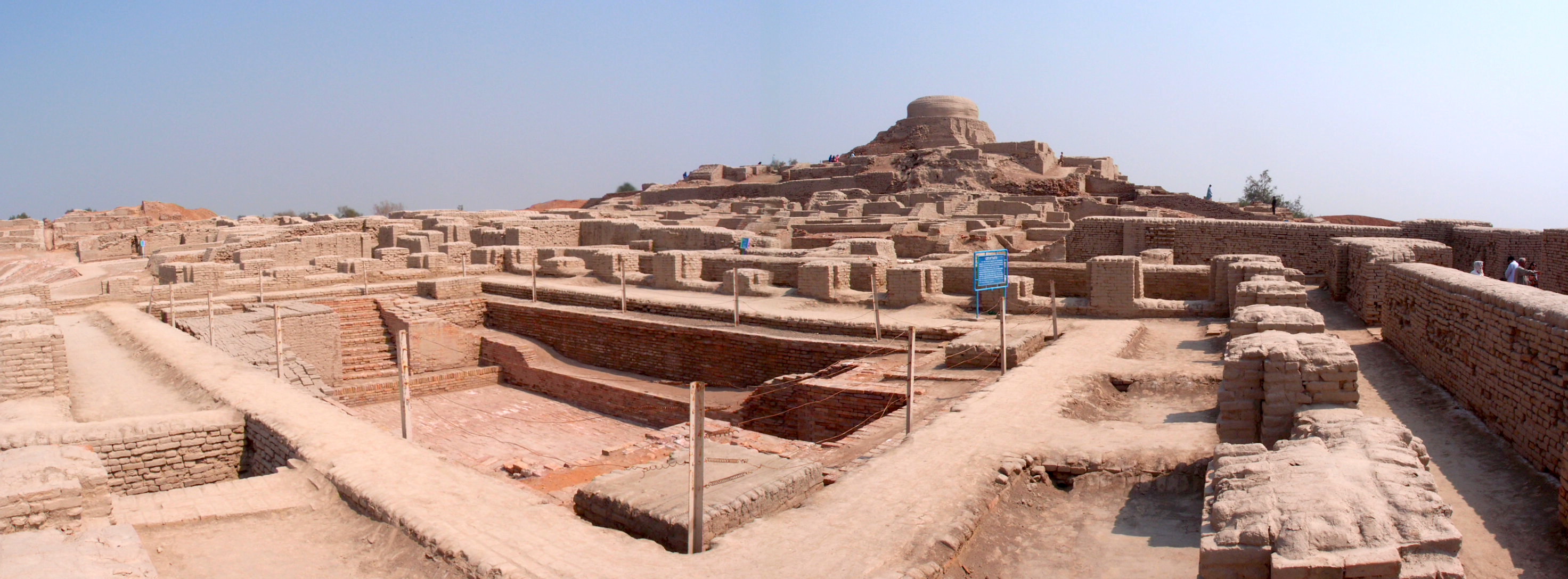
Image: Ancient brick-lined Great Bath of Mohenjodaro, one of the earliest known public water tanks from the Indus Valley Civilization, highlighting advanced urban planning and water management.
-
One of the oldest public water structures in the world
-
Waterproof bricks and advanced drainage system
-
Early example of public utility and hygiene planning
Focus on: early use of water-tight materials and sewer integration
2. Rani ki Vav (Gujarat)
-
Multi-tiered stepwell with precision symmetry and sculpted walls
-
Also functioned as an underground water storage and cooling system
Focus on: passive cooling and ground-level water access in arid zones
3. Chand Baori (Rajasthan)
-
13 stories deep, with 3,500 steps in perfect geometric alignment
-
Designed for maximum water collection and climate adaptation
Focus on: form-function integration for water conservation
4. Agrasen ki Baoli (Delhi) (optional addition)
-
Large stepwell with arched walls and hidden chambers
Focus on: stepwells as early examples of underground architecture
2. Urban Planning & City Infrastructure
5. Mohenjo-Daro and Harappa (Indus Valley Civilization)
-
Grid-based streets, standardized bricks, and covered drainage
-
Separated residential and administrative zones
Focus on: zoning, sanitation, and civic engineering ~2500 BCE
6. Hampi (Vijayanagara Empire)
-
Complex street layout, water channels, and markets
-
Advanced system of tanks, aqueducts, and public pavilions
Focus on: mixed-use planning and decentralized water systems
7. Dholavira (Gujarat)
-
Sophisticated rainwater harvesting system and reservoir network
-
City divided into zones with internal roads and security gates
Focus on: environmental adaptation through engineered layout
3. Military & Fort Engineering
8. Chittorgarh Fort (Rajasthan)
-
Massive ramparts, water tanks, layered entry gates
-
Designed to withstand long sieges and invasions
Focus on: defensive layout using terrain and multi-gate defense
9. Daulatabad Fort (Maharashtra)
-
Hilltop fortress with narrow access paths, false doors, and vertical drops
Focus on: psychological defense strategy and architectural deception
10. Kumbhalgarh Fort (Rajasthan)
-
36 km wall—the second longest after the Great Wall of China
Focus on: massive-scale construction and territorial boundary design
4. Material Science & Structural Engineering
11. Iron Pillar of Delhi (Qutb Complex)
-
1,600 years old and rust-free
-
High phosphorus content prevents corrosion
Focus on: early metallurgy and material longevity still unreplicated fully
12. Dashavatara Tank at Pattadakal (Karnataka)
-
Engineered tank for water storage and community use
-
Lined with carved stone and designed for seasonal collection
Focus on: early public water architecture with precision alignment
5. Tower & Structural Landmarks
13. Qutb Minar (Delhi)
-
72-meter-high minaret with intricate Indo-Islamic detailing
-
Built with local red sandstone and marble
Focus on: load-bearing vertical design and geometric ornamentation
14. Kirti Stambh (Rajasthan)
-
Early medieval victory tower with carved panels and inscriptions
Focus on: vertical engineering and symbolic architecture
15. Gol Gumbaz (Karnataka) (optional tower/roofing entry)
-
Massive unsupported dome with whispering gallery
Focus on: acoustic design and large-span construction without beams
What to Learn From These Structures
-
Engineering wasn’t decorative—it was practical, smart, and site-specific
-
Water conservation, urban layout, and defense were central design goals
-
Ancient Indian builders understood climate, topography, and materials deeply
-
Many techniques still inform modern sustainable architecture and civil planning
Mechanical Engineering in the Vedic Age

Image: Mechanical innovations of the Vedic period, from wooden plows and chariots to spinning wheels and early forges, showcasing practical engineering in ancient India.
Tools, Mobility, and Materials That Powered Daily Life
During the Vedic period (c. 1500–500 BCE), early Indian societies developed a range of mechanical tools that supported farming, mobility, textiles, and metallurgy.
These inventions weren’t complex machines by modern standards—but they were smart, practical, and efficient for the time.
They show how deeply the Vedic people understood motion, force, and material use in everyday life.
Agricultural Tools
Farm life was central to the Vedic economy. Tools were designed to make tilling and harvesting easier with minimal resources.
-
Wooden plow (Ardha) – Used for loosening and aerating soil
-
Sickle (Kuthara) – For harvesting grains and cutting fodder
-
Irrigation tools – Simple water-lifting devices to support dry farming
What to learn:
-
These early tools prioritized simplicity and strength
-
Many modern manual tools trace back to these same principles
Transportation Mechanisms
Movement of goods, people, and armies required effective transport. Mechanical innovations in vehicle design made overland travel more efficient.
-
Chariot (Ratha) – Lightweight, two-wheeled, used in both warfare and ritual
-
Bullock cart (Vahana) – Key for trade and agriculture, widely used across regions
Why it mattered:
-
Enabled long-distance travel and trade across early kingdoms
-
Influenced vehicle design for centuries
Textile Tools & Machinery
Weaving and spinning were common skills, especially among artisans and households. Early textile machines helped create durable fabrics.
-
Spinning wheel (Charkha) – Used to spin cotton and other fibers
-
Loom (Khargola) – Early horizontal looms to weave patterned fabrics
Legacy:
-
These tools laid the groundwork for India’s later dominance in textiles
-
Principles of tension and motion in spinning are still core to modern looms
Metallurgical Engineering
Though mostly pre-Iron Age, the Vedic period saw major steps in working with metal.
-
Smelting of copper and bronze
-
Early use of iron in tools and weapons by later Vedic times
-
Simple forges and refining techniques
Why it matters:
-
Provided tools for farming, building, and defense
-
Set the stage for India’s later metallurgical breakthroughs like Wootz steel
Takeaways
-
The Vedic approach to engineering was practical, local, and resource-aware
-
Tools were designed for durability and ease of repair
-
Early machines used simple principles of motion, force, and leverage
-
Many ideas survived and evolved into tools still used in rural India today
Good Reading: Ancient Indian Engineering & Technology
Why read it: Deep dive into ancient India’s metal science, including the Iron Pillar of Delhi and rust-resistant ironwork.
Good for: Engineers, material scientists, and historians.
Archaeometry in India: How Science Reveals Ancient Engineering

Image: Archaeometry in India reveals how ancient builders used advanced engineering, materials, and environmental planning through tools like XRF and radiocarbon dating
Archaeometry uses modern science to study ancient materials. It helps us understand how early Indian engineers built their structures, made tools, and adapted to their environment.
This field blends archaeology with physics, chemistry, and geology—offering a clearer picture of ancient India's technical skills.
What Can Archaeometry Tell Us?
1. Material Analysis
Techniques like X-ray fluorescence (XRF), neutron activation analysis (NAA), and scanning electron microscopy (SEM) help researchers study the makeup of metals, pottery, and bricks.
This reveals:
-
What materials were used
-
How they were made
-
What that tells us about trade, skills, and tools
2. Dating Ancient Sites
Methods like:
-
Radiocarbon dating
-
Thermoluminescence
-
Optically stimulated luminescence (OSL)
These help pinpoint how old a site or object is. That gives historians a timeline of how engineering practices evolved in India over the centuries.
3. Studying Old Structures
Tools like ground-penetrating radar (GPR), 3D laser scanning, and LiDAR let experts explore inside ancient buildings without damaging them.
This helps discover:
-
Hidden rooms or chambers
-
Foundation details
-
How massive structures were built and supported
4. Reconstructing Ancient Environments
Archaeometry also studies soils, pollen, and sediments to reveal what the land looked like in ancient times.
This shows how early Indians:
-
Adapted to changing climates
-
Managed water
-
Chose where to build
Why It Matters
Archaeometry uses science to understand how things were built in ancient India. It helps researchers find out what tools and methods were used by studying old materials and structures.
Engineering Colleges in India Today
How They Train the Engineers Who Build Our Future
India is home to thousands of engineering colleges. These schools prepare students with the skills needed to solve real problems—from building roads and bridges to working on AI and clean energy.
They carry forward India’s long tradition of engineering, from ancient stepwells to today’s skyscrapers and software.
Modern Engineering Colleges in India: Bridging Past and Future
What Do Indian Engineering Colleges Teach?
-
Core Subjects like mechanical, civil, computer, and electrical engineering
-
New Fields like robotics, AI, data science, and renewable energy
-
Real-World Practice through labs, group projects, internships, and final-year builds
The goal: not just to teach theory—but to prepare students for the real world.
Learning by Doing
Students don’t just sit in class. They work on projects, build machines, write code, visit construction sites, and join competitions. This hands-on learning makes them job-ready.
Working with Industry
Many colleges work directly with companies. Here’s how students benefit:
-
Internships at real companies
-
Industry-sponsored labs and tech parks
-
Guest lectures and workshops
-
On-campus job placements
This helps students learn what’s actually used in the field—not just what’s in textbooks.
Research and New Ideas
Colleges also support research in areas like:
-
Clean energy
-
Health tech
-
Space science
-
Smart cities
Many students join professors on real research projects. Some even launch startups before graduating.
How Many Engineering Colleges Are in India?
There are over 3,500 engineering colleges across India. Some are government-run, like the IITs and NITs. Others are private. All must follow quality rules set by AICTE (the main technical education authority).
Final Thoughts: India’s modern engineering colleges are shaping the builders of tomorrow. Whether it’s fixing a village water system or building a space probe—this is where it starts.
Extras
Muslim and Arab Rule in Medieval India

Muslim and Arab rule in medieval India (712 CE to 18th century) shaped the country’s cities, culture, economy, and science.
From early Arab governors in Sindh to powerful empires like the Mughals, these rulers introduced new ideas in architecture, administration, and technology.
Key Periods and Dynasties
- Early Arabs in Sindh (712 CE): Introduced early systems of governance.
- Delhi Sultanate (1206–1526): Brought Persian culture, built strong cities, and ruled much of North India.
- Deccan Sultanates: Regional rulers like those in Bijapur and Golconda mixed Islamic and local traditions.
- Mughal Empire (1526–1700s): United large parts of India, encouraged trade, and built major landmarks.
Architecture and Design
- Combined Indian and Islamic styles: arches, domes, gardens, and carved stonework.
- Important Examples:
- Qutb Minar, Delhi (early Sultanate)
- Humayun’s Tomb, Delhi (inspired Taj Mahal)
- Fatehpur Sikri (planned city)
- Gol Gumbaz, Bijapur (huge dome)
What to Focus On:
- Structural innovations like true arches and double domes
- Early city planning using symmetry and green spaces
Science and Technology
- Astronomy: Star charts, observatories, astrolabes
- Math: Spread of Indian numbers and trigonometry
- Medicine: Unani system mixed with Ayurveda; hospitals and manuals
- Tools: Papermaking, irrigation wheels, early cannons, and metalwork
Notable Figures: Al-Biruni (science), Firoz Shah Tughlaq (astronomy), Akbar’s Hakims (medicine)
Infrastructure Projects
- Roads: Grand Trunk Road repaired by Sher Shah Suri
- Forts: Red Fort, Agra Fort, Golconda
- Water Systems: Stepwells, public tanks, canals for farming
- City Plans: Organized cities with roads, gardens, and markets
Trade and Economic Systems
- Major Ports: Surat, Calicut, Chittagong boosted global trade
- Coins and Taxes: Silver “rupee” introduced; fair tax rules by Akbar
- Markets and Travel: Rest houses (sarais), price controls, trade fairs
- Main Exports: Cotton, spices, horses, steel goods
What This Era Gave Us
- More connected trade routes and safer travel
- New types of public buildings and city designs
- Blended knowledge from India, Persia, and Central Asia
- Scientific tools and skills still relevant today
Ancient Indian Science and Technology

Image: Overview of ancient Indian contributions to science and technology, featuring breakthroughs in astronomy, mathematics, Ayurveda, and metallurgy that still influence the modern world.
Smart Discoveries That Still Shape the Modern World
Ancient Indian science wasn’t just philosophical—it was hands-on, practical, and ahead of its time. From astronomy and math to medicine and metallurgy, Indian thinkers developed systems that are still relevant today.
Here’s a breakdown of their most important scientific contributions—what they discovered, how it worked, and why it still matters.
Astronomy & Mathematics
Indian scholars understood the skies long before telescopes. They calculated planetary motion, solar eclipses, and calendar systems with surprising accuracy.
Key Achievements:
-
Invention of zero
-
Decimal place value system
-
Early trigonometry and algebra
-
Accurate solar year calculation (Surya Siddhanta)
Who to know:
-
Aryabhata – Calculated pi, theorized Earth's rotation
-
Brahmagupta – Defined zero and negative numbers
-
Bhaskara II – Advanced algebra and trigonometry
Why it matters:
-
Forms the base of modern arithmetic and astronomy
-
Still taught in math curricula worldwide
Medicine and Ayurveda
Long before modern medicine, India developed a structured system of health science—Ayurveda. It was based on observation, balance, and prevention.
Key Achievements:
-
Surgical techniques in Sushruta Samhita
-
Herbal medicine and pharmacology
-
Concepts of digestion, immunity, and mental health
-
Emphasis on ethics in patient care
Who to know:
-
Sushruta – “Father of Surgery,” detailed surgical tools and methods
-
Charaka – Systemized Ayurvedic theory and diagnostics
Still relevant?
-
Yes. Ayurveda is globally recognized today in holistic wellness, preventive care, and herbal research.
Metallurgy and Alchemical Science
Ancient Indian metallurgists were far ahead of their time, working with advanced alloys, purification methods, and chemical treatments.
Key Achievements:
-
Production of Wootz steel – famous for strength and sharpness
-
Non-corrosive iron (Delhi Iron Pillar is still rust-free after 1600+ years)
-
Gold purification and chemical techniques
-
Alchemy focused on medicine and metalwork—not superstition
Why it matters:
-
Influenced modern metallurgy and material science
-
Wootz steel inspired Damascus blade techniques
What to Focus On When Studying Ancient Indian Science
-
The link between theory and real-world use (e.g., trigonometry for astronomy)
-
Early focus on precision, ethics, and observation
-
How India’s ancient thinkers influenced global scientific traditions
FAQ
Ancient Indian Engineers
Who were the engineers in ancient India?
They included architects, builders, craftsmen, and scholars skilled in civil, mechanical, and hydraulic systems.
Were ancient Indians skilled engineers?
Yes. Their work in city planning, water systems, metallurgy, and architecture shows advanced engineering knowledge.
Who is considered the first engineer in India?
Mythologically, Vishwakarma is the divine architect. Historically, no single "first" is recorded, but Indus Valley engineers were among the earliest.
Ancient Texts and Engineering Knowledge
Which Veda talks about engineering?
The Atharvaveda and Sthapatya Veda (a subtext of the Atharvaveda) include early insights into architecture and engineering.
Did ancient Indians use science in building?
Yes. They used geometry, astronomy, and mathematics in structurals layout, irrigation, and construction techniques.
Famous Engineering Examples from Ancient India
What are some famous ancient Indian engineering feats?
-
The Great Bath of Mohenjo-Daro
-
The Iron Pillar of Delhi
-
Stepwells like Rani ki Vav
-
Advanced drainage and water systems in Harappa
What did ancient Indians invent in mechanical engineering?
They built water wheels, spinning wheels, early gear systems, and fine metal tools—many used in textile and farming industries.
Oldest Types of Engineering
What is the oldest branch of engineering?
Civil engineering, used to build roads, buildings, and irrigation canals, is the oldest—seen in Indus Valley cities over 4,500 years ago.
What role did architecture play in ancient Indian engineering?
A major one. Forts, and stepwells show mastery of structure, design, symmetry, and sustainability.
Explore More
Best Books on Ancient Indian Engineering & Technology
1. Science and Technology in Ancient India
By: Debiprasad Chattopadhyaya
Why read it: A foundational book that explains how early Indians applied science in real life—covering agriculture, metallurgy, water systems, and town planning.
Good for: Beginners and history students.
2. Technology in Ancient India
By: Ravi Prakash Arya
Why read it: Focuses on real tools, irrigation systems, roads, and material science used in the Indus Valley and Vedic periods.
Good for: Engineers, teachers, and curriculum writers.
3. Engineering Wonders of the Ancient World: India
By: T. V. Padma
Why read it: Written in a story-like format, this book shows how Indian innovations like stepwells, ironwork, and urban planning were ahead of their time.
Good for: Teen readers, educators, and curious learners.
4. India: A History of Science and Technology
By: Helaine Selin (editor, essays by Indian scholars)
Why read it: A detailed academic book, but easy to dip into. Covers civil, mechanical, and chemical engineering, with diagrams.
Good for: University-level readers and research students.
5. Metallurgy in Ancient India
By: R. Balasubramaniam
Why read it: Deep dive into ancient India’s metal science, including the Iron Pillar of Delhi and rust-resistant ironwork.
Good for: Engineers, material scientists, and historians.
Why These Matter
-
Show how ancient India tackled real-world problems with design and science
-
Help compare ancient innovations with later Muslim and colonial developments
-
Useful for research, school projects, and understanding engineering roots
Free Study Guides and Virtual Tours:
-
Qutub Minar Architecture: Learn about its unique design and construction phases.
-
Ancient Indian Science & Technology: From zero to surgery—see India’s early breakthroughs.
-
Architectural Heritage of India: Explore forts, and colonial-era structures.
-
World Engineering Wonders: Compare India's feats with pyramids, Roman aqueducts, and more.
-
Modern Lessons from Ancient India: How ancient design inspires today’s green buildings.
Download: Ancient Indian Engineering PDF
Explore the Tools, Techniques, and Innovations of the Past
If you're interested in learning more about ancient Indian engineering, there are many helpful resources available—books, research papers, and online articles.
One popular option is the Ancient Indian Engineering PDF, which collects key information on:
-
Historic engineering techniques
-
Famous structures and inventions
-
Tools, materials, and design methods
This PDF offers a detailed look at how early Indian builders and inventors shaped cities, water systems, and more.
Related
Category: Ancient and Classical Architecture & Engineering
1. Ancient Engineering, Technologies, and Construction Techniques
How ancient civilizations built lasting structures using smart methods and local materials.
2. Ancient Roman Architecture: Techniques, Structures, and Impact
Roman innovations like concrete, arches, and road networks that shaped future cities.
3. Urban Planning in Ancient Rome: Roads, Forums, and Aqueducts
How Roman cities were laid out for public use, water access, and traffic flow.
4. Understanding Ancient Architecture: Features, Styles, and Cultural Significance
What buildings from ancient times reveal about the people and values behind them.
5. Ancient Greek Architecture: Foundations, Features, and Influence
Columns, temples, and symmetry that continue to inspire modern design.
6. Ancient Greek Columns: Types, History, and Design Tips
Breakdown of Doric, Ionic, and Corinthian columns and what made each one unique.
7. Ancient Chinese Architecture
Traditional roof styles, materials, and planning principles used in historic China.
8. Ancient Japanese Architecture
Simple forms and natural materials that blended with nature and culture.
9. The Ziggurat at Ur: Ancient Mesopotamian Architecture
Step temples that reveal early religious design and engineering.
10. Technological Advancement and Innovation in Islamic Architecture
How Islamic architects combined science and beauty in historical buildings.
11. Exploring Chinese Architecture: Ancient to Modern
Changes in Chinese architecture from dynastic times to today’s skylines.
12. Design of Ancient Architecture
Core principles in layout, structure, and form from early architecture.
13. Rammed Earth: An Ancient Technique for Modern Sustainable Construction
How compacted soil was used to build strong, eco-friendly walls.
14. Timeline of Building Materials: From Ancient Times to Today
What people used to build, from mud bricks to reinforced concrete.
15. Roman Architecture and Engineering
More focus on bridges, aqueducts, and stadiums from Roman times.
16. Medieval Engineering: Building the Foundations of a New World
Medieval tools and designs that helped shape towns, castles, and cathedrals.
Category: Courses & Learning
17. Construction and Engineering Courses: From Foundations to Advanced Techniques
A look at useful online courses that cover basics to expert-level topics.
18. Free Online Civil Engineering Courses: Certificates, Tools, and Career Tips
Courses that teach you real-world skills and offer certificates.
19. Civil Engineering Free Courses
Another source for free civil engineering resources and training.
20. Methods of Building Construction in Civil Engineering
Key techniques used in civil engineering projects, past and present.
21. Accreditation Standards in Engineering, Landscape, and Interior Design
The standards that give credibility to design and engineering education.
Category: Theory & History
22. Contributions of Muslim and Arab Rule in Medieval India
Science, architecture, and infrastructure developed under Islamic rule.
23. Pointed Arch: Engineering, Design, Types, and Modern Applications
Why the pointed arch mattered in Gothic and later styles.
24. Technology of Gothic Architecture: Engineering, Artistry, and Innovation
How tall cathedrals and stained glass windows were made possible.
25. A Detailed Guide to Architecture Styles: From Ancient to Modern Times
Overview of key architectural styles and what defines each one.
26. Is Architecture Easier than Engineering?
A brief comparison of what each path demands in skills and mindset.