

Additive Form Architecture: What It Is and Why It Works
Additive form is a design approach where different parts or volumes are combined to make one complete building. Instead of designing one big shape, architects "add" smaller pieces together—like stacking or arranging blocks.
This method makes buildings more flexible, creative, and easy to change or grow over time.
Key Features of Additive Form:
● Modular Design – Uses repeatable parts (like rooms or blocks)
● Flexible Layout – Easy to expand or rearrange in the future
● Functional Clarity – Different areas can serve different purposes
● Visual Variety – Creates interesting shapes and spaces
● Efficient Construction – Works well with prefabricated materials
Where It’s Used:
● Urban housing developments
● School and university campuses
● Cultural buildings (like museums and libraries)
● Temporary or mobile structures
● Green buildings using prefab parts
Additive form is about making buildings smarter, easier to build, and better for people.
Additive Form Architecture: Principles, Methods & Powerful Real-World Examples
Additive form is used in homes, schools, and cultural buildings.
It’s all about piecing smaller parts together to make one strong, flexible design—like building blocks, but for real architecture. This approach helps balance function, flow, and style in a way that feels both clear and creative.
What Is Additive Form in Architecture?
Additive form is a design approach where a building is created by connecting smaller parts—called additive elements—into a larger whole. Instead of starting with one big shape, the architect builds up the structure piece by piece.
Each element can have a different size, shape, or function, but together they form a unified, purposeful design.
How It Differs from Subtractive Form:
-
Additive: You build by adding parts
-
Subtractive: You start with a mass and remove material to shape it
Why It’s Useful:
-
Allows for easy expansion or changes
-
Encourages modular, flexible layouts
-
Supports phased construction over time
-
Makes it easier to design around different uses or zones
Additive form is especially helpful for projects that may grow, adapt, or evolve—like schools, housing, and cultural centers.
Related: Introduction to Architecture: A Beginner’s Guide to Building Design
Additive form is an architectural strategy that combines multiple distinct volumes into one unified structure.
It offers a modular, scalable way to shape space—building complexity through repetition, variation, and precise arrangement.
Core Principles of Additive Form Architecture

Understanding how additive design works—and how to apply it effectively.
Additive form architecture is about building up complexity from smaller parts. It’s not just stacking blocks—it’s about arranging them with purpose to shape space, guide flow, and respond to change.
Here’s what makes additive form work:
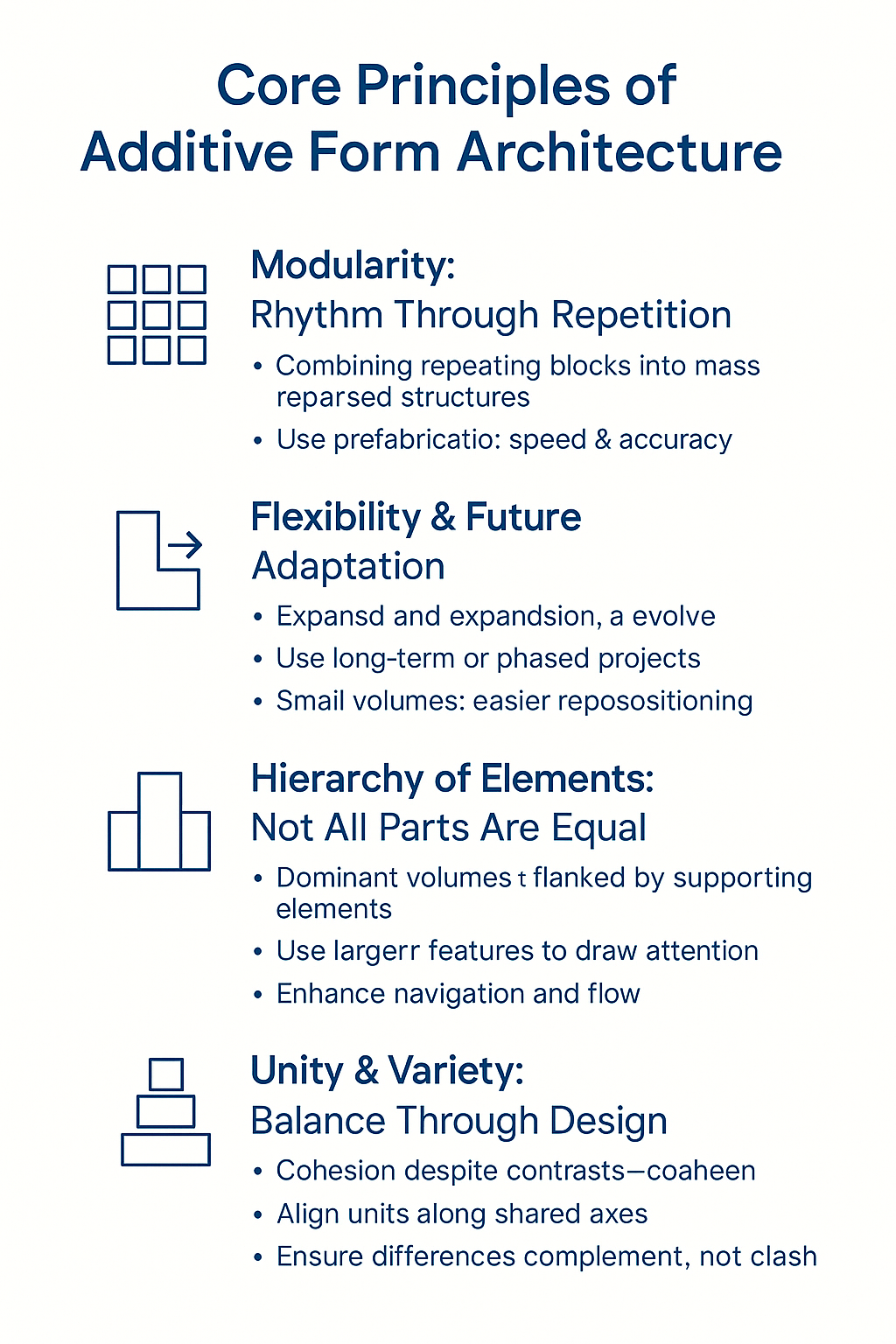
1. Modularity: Rhythm Through Repetition
Modular design uses repeatable, pre-defined units. These units create visual rhythm, simplify construction, and make future changes easier.
How it works:
▪ Repeating blocks can serve different functions (offices, classrooms, housing)
▪ Units align to form a consistent, scalable structure
▪ Prefabrication is often used for speed and accuracy
Example: Housing developments or co-living units with identical pods arranged around shared spaces.
2. Flexibility & Future Adaptation
Additive form allows buildings to grow over time. It’s ideal for long-term or phased projects that may need to expand, shift, or evolve.
Where it shines:
▪ Schools adding new classrooms
▪ Hospitals expanding departments
▪ Urban sites with phased masterplans
Key Insight: Small volumes = easier to replace or reposition.
3. Hierarchy of Elements: Not All Parts Are Equal
Even in additive architecture, some elements lead while others support. Designers use hierarchy to guide users and organize functions.
What to look for:
▪ A dominant volume (like a central atrium or courtyard)
▪ Secondary units branching off that core
▪ Visual or functional emphasis on entry points or public zones
Outcome: Clear flow, intuitive navigation, and layered experience.
4. Unity & Variety: Balance Through Design
Additive form plays with contrast—different volumes, shapes, or heights—but it still needs harmony. The goal is to keep it cohesive, not chaotic.
How architects create balance:
▪ Use consistent materials or color palettes
▪ Align modules using shared axes or grids
▪ Vary volume sizes while keeping proportions controlled
Good design means the building looks intentional, not random.
Quick Recap: Design Checklist
✔ Use modular units with consistent rules
✔ Plan for growth—design like a puzzle, not a monument
✔ Organize parts by importance: what leads, what follows
✔ Unify varied elements through scale, rhythm, and material
Additive form is powerful when done with clarity, care, and control.
Recommended Reading
Introduction to Architecture by Francis D.K. Ching
An essential resource for understanding how form, space, and function work together.
Real-World Examples of Additive Form in Architecture

Additive form architecture involves assembling distinct units or volumes into a larger, cohesive whole. This modular approach allows for adaptability, creative layering, and spatial variety—without sacrificing unity.
Below are two celebrated examples, each demonstrating how additive strategies shape space, identity, and use.
1. Habitat 67 – Moshe Safdie

Montreal, Canada | Expo 67
Why It Matters:
Habitat 67 is a pioneering work in modular additive architecture. Designed by Moshe Safdie, it reimagines urban housing through 354 prefabricated concrete modules, stacked into 146 unique residences.
What to Focus On:
-
Modular stacking: flexible and repeatable units
-
Integration of private terraces in a dense urban fabric
-
Complex forms with simple, identical building blocks
-
Influenced by traditional Middle Eastern housing clusters
What to Learn:
→ Additive form doesn’t have to sacrifice individuality.
→ You can balance privacy, community, and density using spatial repetition.
→ A good additive design scales without losing identity.
Insight:
Safdie’s goal was to humanize high-rise living—proving that modernism could be both systematic and soulful.
Tate Modern Extension – Herzog & de Meuron

London, UK | Completed 2016
Why It Matters:
Also known as the Blavatnik Building, this extension to the Tate Modern art museum is a masterclass in volumetric articulation. The structure is built from stacked and interlocking forms, twisting slightly as it rises.
What to Focus On:
-
Varying scales of interior galleries vs. exterior massing
-
Additive composition for visual movement
-
Tension between geometric order and expressive façade
-
Use of brick as a connective skin across volumes
What to Learn:
→ Additive form can be used sculpturally—not just functionally.
→ Each block or volume can respond to different programmatic needs.
→ It's possible to create architectural drama while staying modular.
Insight:
Herzog & de Meuron blend functional logic with expressive rhythm, showing that additive forms can feel organic, not mechanical.
Bonus Projects to Explore
● Sou Fujimoto’s House NA (Tokyo) – Transparent stacked boxes for layered micro-living.
● OMA’s Seattle Central Library – Volumes stacked by program use, visible in section.
● Alvaro Siza’s Leça Swimming Pools – Spaces added sequentially to embrace the shoreline.
Takeaway for Designers
Additive form is more than repetition—it’s about crafting relationships between parts:
-
How volumes connect, contrast, or complement each other
-
How form drives circulation, light, and experience
-
How simple units can scale into complex systems
Use additive strategies to control variety, shape dynamic spaces, and adapt over time.
Practical Techniques for Using Additive Form in Architecture
Additive form isn’t just a design theory—it’s a practical method for creating flexible, efficient, and future-ready buildings. Here’s how to apply it effectively:
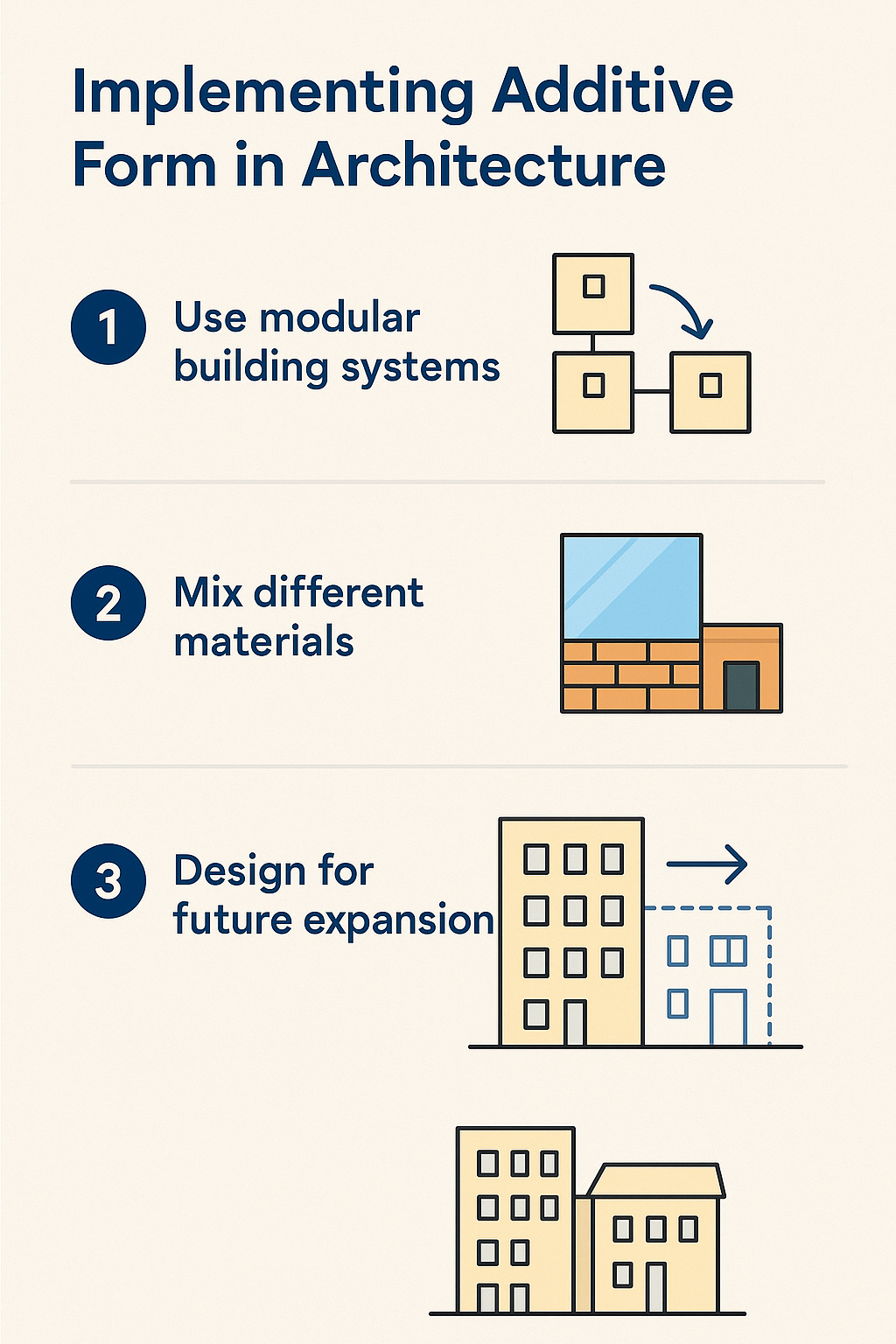
1. Modular Building Systems
Modular systems use repeatable units—like rooms or structural blocks—that can be assembled in multiple ways.
Why it works:
● Cost-efficient – Standard parts reduce material and labor costs
● Fast construction – Prefabricated modules can be built off-site
● Flexible layout – Add or remove parts as needed
Example: Prefab homes where each module (e.g., kitchen, bedroom) is stacked or aligned to form a complete house.
2. Mixing Materials for Contrast or Unity
Different materials can emphasize each part of an additive design—or bring the whole structure together.
Strategies include:
● Contrast – Brick + glass = solid vs. transparent
● Harmony – Wood + concrete = warm meets clean
● Tactile diversity – Rough next to smooth, matte beside reflective
Why it matters:
✓ Highlights form variation
✓ Adds visual and functional depth
✓ Helps each volume express its own role
3. Designing with Expansion in Mind
Additive form supports phased growth. You can plan the base structure now, and add more units later—without disrupting the original layout.
Ideal for:
● Schools and campuses
● Medical centers
● Office parks or co-working hubs
Benefits:
✓ Easy to scale as needs change
✓ Reduces future renovation costs
✓ Keeps design coherent over time
Quick Tip:
Start every additive project by asking: Can this grow later? If the answer is yes, you’re building smart.
Key Advantages of Additive Form in Architecture
Additive form isn’t just flexible—it’s smart, scalable, and sustainable. Here’s why more architects are turning to this approach:
1. Flexibility & Easy Expansion
Buildings made of smaller volumes can be adjusted over time.
-
Add or remove spaces without redesigning the whole
-
Ideal for growing schools, hospitals, or mixed-use projects
-
Perfect for phased construction or future-proof planning
Real Value: Start small, scale up as needs grow—without starting from scratch.
2. Creative Freedom & Visual Variety
Additive form opens the door to bold, dynamic compositions.
-
Mix shapes, sizes, and heights
-
Experiment with layout, materials, and light
-
Create buildings that look unique—but still feel coherent
Why It Matters: Flexibility fuels design innovation.
3. Functional Zoning Made Simple
Use separate volumes to define distinct zones.
-
Public vs. private areas
-
Work vs. living spaces
-
Quiet vs. active zones
Benefit: Better layout = better user flow and comfort.
4. Built-In Sustainability
Modular systems often support green building practices.
-
Off-site prefabrication = less on-site waste
-
Easier integration of solar panels, green roofs, or passive cooling
-
Units can be reused, relocated, or recycled
Bottom Line: Additive design isn’t just flexible—it’s future-ready.
Islamic Architecture: A True Pioneer of Additive Form

Long before modular housing or prefab trends, Islamic architecture was leading the way in additive design. From the layout of traditional homes to monumental religious complexes, this tradition used additive principles with clarity, purpose, and cultural intelligence.
Built Piece by Piece, With Intent
Islamic architecture often evolved through addition, layering, and repetition—not all at once, but organically:
-
Homes grew over generations, with rooms, courtyards, and upper levels added as families expanded.
-
Mosques and madrasas used clusters of prayer halls, sahns (courtyards), arcades, and iwans—each volume designed separately but forming a unified whole.
-
Markets and caravanserais expanded with demand, modularly laid out for trade, rest, and circulation.
This wasn't chaos—it was controlled growth, guided by geometry, climate, and deep social understanding.
Additive Form as a Way of Life
Rather than a fixed "masterplan," many Islamic cities and buildings were built to grow with people. This mirrored the Islamic view of architecture as a living, breathing structure—something that could evolve over time, while staying grounded in unity and order.
Key principles included:
● Hierarchical zoning – public, semi-private, and private arranged through additive space
● Repetition with variation – domes, arches, and courtyards balanced uniformity with uniqueness
● Adaptability – structures adjusted to climate, community needs, and sacred function
Why It Matters Today
What modern architects now call "modular" or "phased design," Islamic builders practiced centuries ago—with fewer tools, but far greater cultural coherence.
→ They weren’t following trends—they were setting them.
→ They didn’t rely on tech—they relied on wisdom, proportion, and place.
→ And they did it sustainably, long before carbon footprints were measured.
To overlook Islamic contributions to additive form is to erase a legacy of smart, sustainable, and socially conscious design. These architects weren’t just building structures—they were shaping systems of life, meaning, and resilience.
Challenges of Additive Form Architecture
Additive form has a lot going for it—but like any design approach, it comes with a few hurdles:
Additive form offers flexibility and creativity—but it also brings specific design and construction challenges. Here’s what architects need to watch out for:
1. Complex Layouts & Structural Demands
1. Design Can Get Tricky
Stacking or linking different volumes can lead to complex layouts. It might also mean extra structural work to keep everything stable.
Connecting multiple volumes can lead to irregular layouts and hidden complications.
-
Requires extra attention to circulation and flow
-
May need custom structural support for balance and load distribution
-
Unchecked complexity can confuse users or compromise usability
Tip: Use grid systems or central anchors to maintain clarity.
2. Higher Costs & Construction Time
2. It Can Cost More
Because you're working with multiple parts, different materials, and often custom layouts, the price tag can climb—especially compared to more straightforward designs.
More parts often mean more work—and a bigger budget.
-
Multiple modules = more labor and materials
-
Different materials or shapes may require custom fabrication
-
Prefab helps, but hybrid solutions raise logistical demands
Tip: Minimize variation where possible, and plan for scalable repetition.
3. Risk of Visual or Functional Disunity
3. Finding the Right Balance
The key is making it all feel connected. If there are too many separate blocks or pieces, the building can feel messy or disjointed. Good design keeps it functional and visually clean.
Additive form can feel disjointed if not carefully composed.
-
Too many disconnected elements can break cohesion
-
Poor alignment or mismatched materials create visual clutter
-
Users may feel lost without clear transitions or hierarchy
Tip: Balance variety with unity—use rhythm, shared materials, and consistent proportions.
Bottom Line:
Additive architecture works best when it's well-organized, structurally sound, and visually intentional. The challenge is turning flexibility into harmony—not chaos.
What's Next: Future Trends in Additive Form Architecture
Additive form isn’t just a design method—it’s a strategy for building flexible, human-scaled environments in a fast-changing world. Here’s how this modular approach is shaping the future of architecture.
Modular Housing for Dense Urban Living
Why it matters: Cities are growing fast. Additive form offers adaptable, efficient housing that can evolve over time.
Case Study: Walden 7, Barcelona – Ricardo Bofill
-
18 modular towers form a vertical community
-
Private terraces + shared courtyards
-
Maze-like design promotes interaction and privacy
-
Units can be added or reconfigured as needs shift
Key Takeaway:
Modular housing allows for fast, affordable, high-density construction—perfect for solving urban housing crises.
Smarter School & Campus Expansion
Why it matters: Education facilities need to grow with programs, tech, and student needs. Additive design makes that easy.
Case Study: LSE Centre Building, London – Rogers Stirk Harbour + Partners
-
Split into academic and admin zones
-
Additive volumes tailored to different functions
-
Flexible growth without disrupting core structure
What to learn:
Additive form supports phased expansion, adaptive reuse, and functional zoning—all essentials for future-ready campuses.
Cultural Spaces That Can Evolve
Why it matters: Museums, theaters, and libraries must adapt to new exhibits, tech, and audience needs.
Case Study: Tate Modern Extension, London – Herzog & de Meuron
-
Additive structure expanded a historic building
-
Stacked galleries, terraces, and public spaces
-
Balances contrast and cohesion beautifully
Trend Insight:
Public buildings will increasingly favor modular, expandable layouts that invite innovation and community use.
Greener, Smarter, More Sustainable Builds
Why it matters: The climate crisis demands buildings that are both flexible and efficient.
Case Study: Brock Commons, Vancouver – Acton Ostry Architects
-
18-story timber tower using stacked prefabricated modules
-
Fast build time, low waste, reduced carbon footprint
-
Model for sustainable high-rise housing
Next Step:
Future projects will combine modular design + sustainable materials (like CLT, solar, green roofs) to hit environmental targets without sacrificing function.
Recap: Why Additive Form Leads the Way
Additive form is powerful because it’s:
● Modular and scalable
● Easy to adapt and grow
● Culturally and environmentally responsive
● Ideal for prefabrication and sustainable construction
What to Watch:
→ Urban housing innovations
→ Adaptive campus design
→ Multi-use cultural hubs
→ Net-zero modular systems
Did You Know? Surprising Facts About Additive Form
Surprisingly Sustainable
Additive design cuts demolition waste by allowing buildings to grow or change without being torn down. It's one of the most eco-friendly ways to build today.
Ancient Origins
Additive form isn’t new. Traditional villages often used it—grouping small rooms around shared courtyards or public spaces.
Built to Evolve
Some modular buildings can grow or shrink based on real needs. In fast-changing cities, additive form lets architecture keep pace with life.
Additive Form in Disaster Relief: Rapid, Flexible Shelter Design
One of the most impactful but overlooked uses of additive form is in disaster relief. When speed, flexibility, and scalability are essential, additive architecture delivers.
Why It Works in Emergency Situations
● Modular units can be built off-site and delivered fast
● Structures are easy to assemble, expand, or relocate
● Can serve as housing, medical stations, classrooms, or kitchens
● Encourages phased response—start small, scale up as needed
This design method is ideal for regions hit by earthquakes, floods, or other climate-related events where time and adaptability are critical.
Real Example: Shigeru Ban’s Relief Shelters in Japan
After the 2011 earthquake and tsunami, architect Shigeru Ban designed shelters using modular, prefabricated paper and wood units.
→ These were lightweight, low-cost, and quick to set up
→ Could be adapted to fit gyms, community centers, or outdoor spaces
→ Offered dignity and privacy to displaced families
Why It Mattered:
✓ Rapid deployment
✓ Low environmental impact
✓ Simple tools and no heavy machinery required
Ban’s work proved that emergency shelter can be both humane and efficient—not just temporary tents.
Looking Ahead: Additive Form & Disaster-Ready Cities
As climate disasters increase, cities and NGOs are turning to modular, additive systems to:
-
Pre-build and store shelter units
-
React faster during emergencies
-
Offer scalable, upgradeable relief hubs
-
Integrate long-term housing from short-term modules
Think of it as LEGO-style resilience: start small, connect more, adapt quickly.
Additive Architecture for a Resilient Future
Additive form isn’t just for art museums or modern homes. It’s a life-saving design tool for the real world—capable of meeting urgent needs while staying adaptable, efficient, and sustainable.
Whether used for:
-
Urban housing
-
Campus expansion
-
Cultural centers
-
Or emergency shelters—
…it offers one of the most future-proof frameworks in architecture today.
Recommended Reading
Introduction to Architecture by Francis D.K. Ching
An essential resource for understanding how form, space, and function work together.
✓ Great for beginners
✓ Full of diagrams and real-world examples
✓ Builds a strong foundation in architectural thinking
Additive Form Meets Sustainability
Additive architecture isn’t just adaptable—it’s built for long-term sustainability. By treating buildings as modular, upgradable systems, architects can reduce waste, extend lifespan, and future-proof their designs.
Reuse, Relocate, Rebuild
Instead of demolishing entire buildings, individual volumes can be:
● Dismantled and reused in new locations
● Reconfigured to serve new functions
● Upgraded without affecting the whole structure
Result: Less material waste, lower emissions, and smarter resource use.
Built for Easy Tech Upgrades
As building technologies evolve, additive form makes it easy to:
● Add solar panels, green roofs, or passive ventilation units
● Retrofit smart systems (HVAC, lighting, automation)
● Upgrade only the part that needs it—not the whole building
Why it matters: Keeps buildings future-ready with minimal disruption or cost.
Bottom Line: Additive form supports sustainable goals by being modular, reusable, and adaptable—making it one of the smartest ways to build for the planet.
FAQ
🔹 What is additive form in architecture?
-
It’s a design approach where multiple individual units or volumes are combined into a larger structure.
-
Each part retains its identity but contributes to the whole—functionally and visually.
🔹 How is additive form used in residential design?
-
Common in modular homes, townhouses, and courtyard housing.
-
Units can be added, rearranged, or stacked to adapt to family size or site conditions.
🔹 What are the main advantages of additive form?
-
Flexibility – easy to expand or modify
-
Scalability – grow over time, phase by phase
-
Sustainability – less demolition, less waste
-
Design freedom – mix materials, shapes, and zones
🔹 Can additive form work in commercial or public buildings?
-
Yes—used in offices, schools, museums, libraries, and markets.
-
Each section (e.g., lobby, gallery, admin wing) can be distinct yet integrated.
🔹 How does additive form support sustainability?
-
Units can be relocated, reused, or upgraded, reducing construction waste.
-
Encourages off-site prefabrication, cutting energy use and emissions.
-
Allows for longer building life with minimal environmental impact.
🔹 Why is additive form ideal for modular housing?
-
Fast to build and easy to assemble
-
Customizable for different layouts
-
Perfect for urban infill, disaster relief, or temporary communities
🔹 Is it energy efficient?
-
Yes—prefab modules often use optimized materials and tight seals.
-
Allows for integration of green roofs, solar panels, passive ventilation, and more.
🔹 Does additive form only work for large-scale projects?
-
No. It’s great for small homes, tiny houses, studios, and phased renovations too.
-
Works at any scale, from a single room addition to an entire district.
🔹 What role does it play in future city design?
-
Supports adaptive urban growth—adding floors, wings, or buildings over time.
-
Aligns with sustainable development and dense, walkable neighborhoods.
🔹 Can additive form enhance social interaction?
-
Yes—by clustering units around shared courtyards, gardens, or paths, it fosters community.
-
Encourages balance between private space and collective connection.
Wrap-Up: Why Additive Form Architecture Matters
Additive form isn’t just a cool way to stack shapes—it’s a smart design approach that helps buildings grow, adapt, and stay useful over time. Whether you're designing a house, a school, or a massive office space, this method lets you build piece by piece while still keeping things connected and intentional.
What makes it great?
→ It's flexible
→ It’s sustainable
→ And it’s ready for whatever the future brings
As more architects look toward green design and smarter construction, additive form is playing a bigger role. It’s not just about what looks good—it’s about what works now and later.
Want to dive deeper?
Check out Introduction to Architecture by Francis D.K. Ching. It breaks down form, space, and structure in a way that’s super clear—even if you’re just getting started.
Related
Islamic Architecture
Courtyards “Sahn” in Islamic Architecture (6–8 min)
Explore the genius behind the sahn (courtyard) in mosques and homes. Learn how it works as a natural cooling system, social space, and spiritual centerpiece.
Architecture Fundamentals
Understanding the Basics of Architecture: A Beginner’s Guide (8–10 min)
A beginner-friendly overview of what architecture is, covering space, structure, style, and purpose.
Architectural Design Basics: From Concept to Construction (10–12 min)
Covers the full process from an initial sketch to built structure. Learn about design thinking, site analysis, drawings, and construction phases.
Design Basics in Architecture & Building: The Fundamentals! (6–8 min)
Quick insights into what makes a building “work.” Topics include layout, materials, and structural integrity.
Design Theory & Principles
Form Meets Function: Principles for Great Architectural Design (7–9 min)
How architects balance beauty and practicality. Learn the rules (and when to break them) to make better design decisions.
Form Follows Function in Architecture and Design (6–8 min)
Classic principle explained with modern examples. Discover how purpose shapes a building's form.
What is Form in Architecture? Principles, Examples, and Applications (6–9 min)
Learn what "form" means in architecture—from symbolic shapes to functional structures.
Architectural Form Examples: How Shape Defines Function (7–10 min)
See real-world projects where form impacts usability, comfort, and flow. Includes simple diagrams and examples.
Scale and Proportion in Architectural Design: Balancing Form and Function (5–7 min)
How to design buildings that "feel right." Understand the human side of space and dimension.
Process & Strategy
Architecture Design Process Examples: 7 Phases with Case Examples (10–12 min)
Real-world workflow from client briefing to construction. Includes design stages, diagrams, and project tips.
Clustered Form Architecture: Function, Space, and Design (6–8 min)
Explore how grouping volumes creates flexible, social, and scalable design—common in campuses and housing.