

Image by ArchitectureCourses.org. Architectural design gets clearer when people test ideas, read drawings, and explain decisions instead of jumping straight to polished presentation images.
How Good Design Moves From Idea to Building
Architectural design starts long before a finished drawing.
It starts when someone has to solve a real problem with space. A dark plan. A bad site. A building that needs to hold people, light, structure, cost, and daily use without falling apart as soon as real life hits it.
That is the useful way to read this subject. Not as style trivia. Not as software hype. As decision-making.
| Design Question | What Goes Wrong If You Ignore It | What to Check First |
|---|---|---|
| How will people move through it? | Dead corners, awkward entries, wasted floor area | Plan and circulation |
| How will it stand up? | Expensive redesign later | Basic structure and load path |
| How will light and climate affect it? | Glare, overheating, dim rooms, comfort problems | Orientation, openings, shade |
| Can it actually be built? | Nice concept, weak details, confused documents | Materials, assemblies, services |
What Architectural Design Has to Solve
Architectural design is the work of shaping space so it can be used, built, understood, and lived in.
That sounds simple until the parts start pushing against each other. A plan that looks clean may handle circulation badly. A dramatic form may kill the budget. A beautiful room may be hard to cool, hard to furnish, or hard to build.
Good design holds those pressures together instead of pretending they do not exist.
What Sits Behind the Drawing
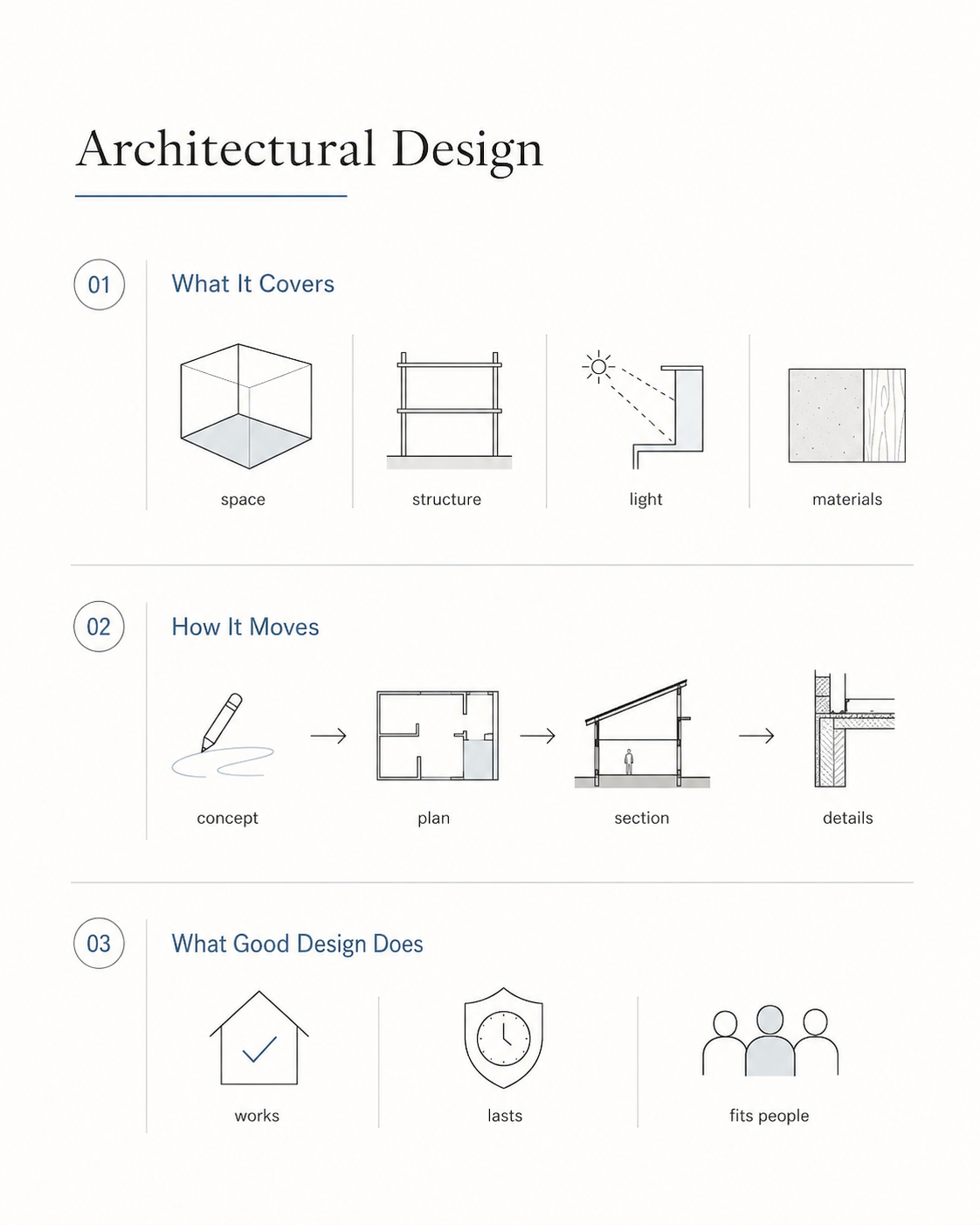
Illustration by ArchitectureCourses.org. Architectural design starts with a few core things working together: space, structure, light, material, and how people actually use the building.
- Use: who the building is for and what it needs to do
- Space: how rooms relate, open, compress, and connect
- Structure: what carries the load and where the span starts fighting back
- Light and Climate: how sun, shade, air, and heat change the experience
- Material: what the building is made from and how those parts meet
This is why the subject gets broad fast. Architecture keeps pulling design, construction, behavior, and judgment into the same room.
What Bad Design Feels Like
People usually notice bad design before they can explain it.
A house feels cramped even though the square footage looks fine on paper. A lobby feels confusing the second you walk in. A classroom overheats every afternoon. A stair lands where it should not. A window looks good in elevation and turns into glare every morning.
That is why this topic matters. You live inside the consequences.
The First Concept Test

Illustration by ArchitectureCourses.org. A concept is only useful if the plan, section, structure, and services can still carry the same idea once the design starts getting real.
- Can you explain the main idea in one sentence?
- Does the plan still work when you stop looking at the render?
- Can the section carry the same idea?
- Can the structure and services fit without wrecking the layout?
A lot of student work dies here. The concept gets too much attention. The plan gets too little.
Useful reference: Architecture: Form, Space, and Order is still one of the clearest books for learning how plan, section, and form support each other.
History Still Shows Up in the Work
Architecture history matters when it teaches judgment, not trivia.
Older buildings show what people valued, what materials allowed, and how structure shaped form before software could smooth everything out. That still matters because design problems have changed less than people like to think.
Ancient and Classical Work
Ancient work teaches permanence, mass, sequence, and proportion. Greek and Roman buildings still matter because they made order visible. They showed how structure, procession, and civic meaning can reinforce each other instead of pulling apart.
This part matters if your own work keeps feeling random. Introduction to Architecture History is the better next stop if you need the longer foundation.
Medieval to Industrial Work
Medieval buildings pushed enclosure, defense, height, and symbolic power. The industrial era shifted the game by changing material logic. Iron, steel, and large spans did not just change construction. They changed what rooms could become.
The practical lesson is simple: materials do not just support design. They change the design options.
Modern Work
Modern architecture cut away a lot of inherited ornament and forced the plan, structure, and function closer together. Sometimes that produced extraordinary clarity. Sometimes it produced buildings that aged badly because life turned out messier than the theory.
That tension is still with us. If you want the argument behind it, go next to Architectural Theory.
What Good Design Has to Hold Together

Image by ArchitectureCourses.org. Good design rarely comes from one move. It comes from structure, space, light, material, and use working together without one part wrecking the others.
Good design is rarely one brilliant move. It is usually a group of decisions holding together under pressure.
Plan and Movement
Start with movement.
If people cannot find the door, pass through the plan cleanly, or understand where public space ends and private space begins, the project is already in trouble. This is why Space Planning Essentials belongs near the center of the topic, not off to the side.
A plan does not become good because it is open. It becomes good when movement feels obvious without becoming dull.
Form and Use
Form still matters. But form that does not help use is usually expensive noise.
A strong massing move can clarify entry, light, view, and identity. A weak one only gives you a harder roof, harder drainage, or harder structure.

Image by ArchitectureCourses.org. A concrete facade works when massing, panel joints, shadow lines, and openings all support the same idea instead of fighting each other.
Structure and Services

Image by ArchitectureCourses.org. Ceiling details show where architecture stops being a concept and starts becoming construction. Structure, services, clearances, and finish layers all have to fit cleanly.
This is where vague concepts get punished.
The building has to carry weight. It has to fit ducts, pipes, wiring, stairs, and clearances. It has to let someone maintain it later. If you push that thinking too far down the process, you usually end up redesigning the project after you thought the hard part was done.
Before you move on, pair this page with How Buildings Work and Building Materials.
Light and Scale
Light changes everything. It affects comfort, mood, depth, shadow, and how large a room feels. So does scale. A ceiling that is slightly too low, a window head that lands awkwardly, or a corridor that narrows in the wrong place can make a space feel wrong even before anyone can say why.
One more thing: daylight is not just beauty. It is performance. Natural Lighting in Architectural Design is a better follow-up than another generic design gallery.
From First Idea to Buildable Work
1. Concept
This is where the project names its problem.
Not its style. Not its mood board. Its problem.
A site with harsh western sun. A house that needs privacy without going dark. A school that must handle noisy circulation and calm classrooms. Good concepts come from a pressure the design has to answer.
2. Schematic Design
This is the rough testing phase. Layout, massing, entry, section, and light all move quickly here. If the work hardens too early, the project gets brittle.
Worth knowing: this is usually where people fall in love with an image before the plan earns it.
3. Design Development
This is where the project starts getting serious. Material choices, structure, systems, dimensions, and envelope decisions stop being optional background work and start shaping the design directly.
If you want the longer version of that sequence, use Architecture Design Process.
4. Details
Details are not decoration. They decide whether the building drains, ages, seals, expands, and holds up.
That is also where quality becomes visible. One good corner can explain more than ten vague perspective shots.
5. Construction Documents
At this point the drawings stop being private design thinking and become instructions.
If a contractor cannot follow the set, the design is not ready. Components of a Construction Document Set is the practical next page here.
Where Design Starts Costing Money
Design decisions do not all cost money at the same stage.
Some are cheap to fix in schematic design and expensive once the drawings, structure, and services are already moving.
| Decision | Cheap to Fix Early | Expensive Later |
|---|---|---|
| Orientation and shading | Adjust plan, openings, overhangs | More glass problems, more glare control, more mechanical load |
| Structure grid and spans | Shift the layout before framing logic hardens | Transfer beams, awkward soffits, costly redesign |
| Service zones | Reserve ceiling and wall space early | Dropped ceilings, tight chases, messy coordination |
| Window size and placement | Test it in plan, section, and elevation together | Custom glass costs, privacy fixes, daylight problems |
| Drainage and envelope details | Resolve slopes, joints, and water paths early | Leaks, staining, callbacks, repair work |
This is one of the most overlooked parts of design education. Good design decisions are often money decisions too. Not because design should become cost cutting, but because weak early decisions usually come back later as more expensive technical fixes.
Where Design Branches Off

Illustration by ArchitectureCourses.org. Architectural design types become easier to read when you compare them by scale, movement, structure, and what usually breaks first.
| Design Type | What Changes | What Usually Breaks First |
|---|---|---|
| Residential | Daily use, privacy, comfort, storage, daylight, routines | Plans that look open but live badly |
| Commercial and Institutional | Flow, wayfinding, code pressure, flexibility, identity | Circulation and coordination |
| Urban and Landscape | Public life, movement systems, ecology, long-term change | Context ignored too early |
Residential design gets judged up close. Commercial work gets punished by complexity. Urban work gets tested over time.
That is why the same design instinct does not solve every scale. If the city-scale side is the part you want to push further, Urban Planning Essentials is the better next step.
Tools That Earn Their Place

Illustration by ArchitectureCourses.org. Design tools matter most when they support a clear workflow: sketching, drawing, coordination, modeling, and communication.
Tools do not rescue weak thinking.
They help when the design already has a spine.
- Sketching is still the fastest way to test early moves.
- CAD still matters because clear 2D thinking still matters.
- BIM tools such as Revit earn their place once coordination, documentation, and model-based work become real.
- Rhino and similar modeling tools help when geometry is actually doing work, not just showing off.
- Rendering helps communication, but it should not arrive before the plan is stable.
Also useful: AutoCAD Basics for Architects and Engineers, Revit Introduction: Modeling in 3D, and Rendering for Architecture Students.
If the bigger question is software order, use Top Software Every New Architecture Student Should Learn. It is a better fit than turning this page into a bloated software catalog.
Sustainable Design Is Basic Work Now
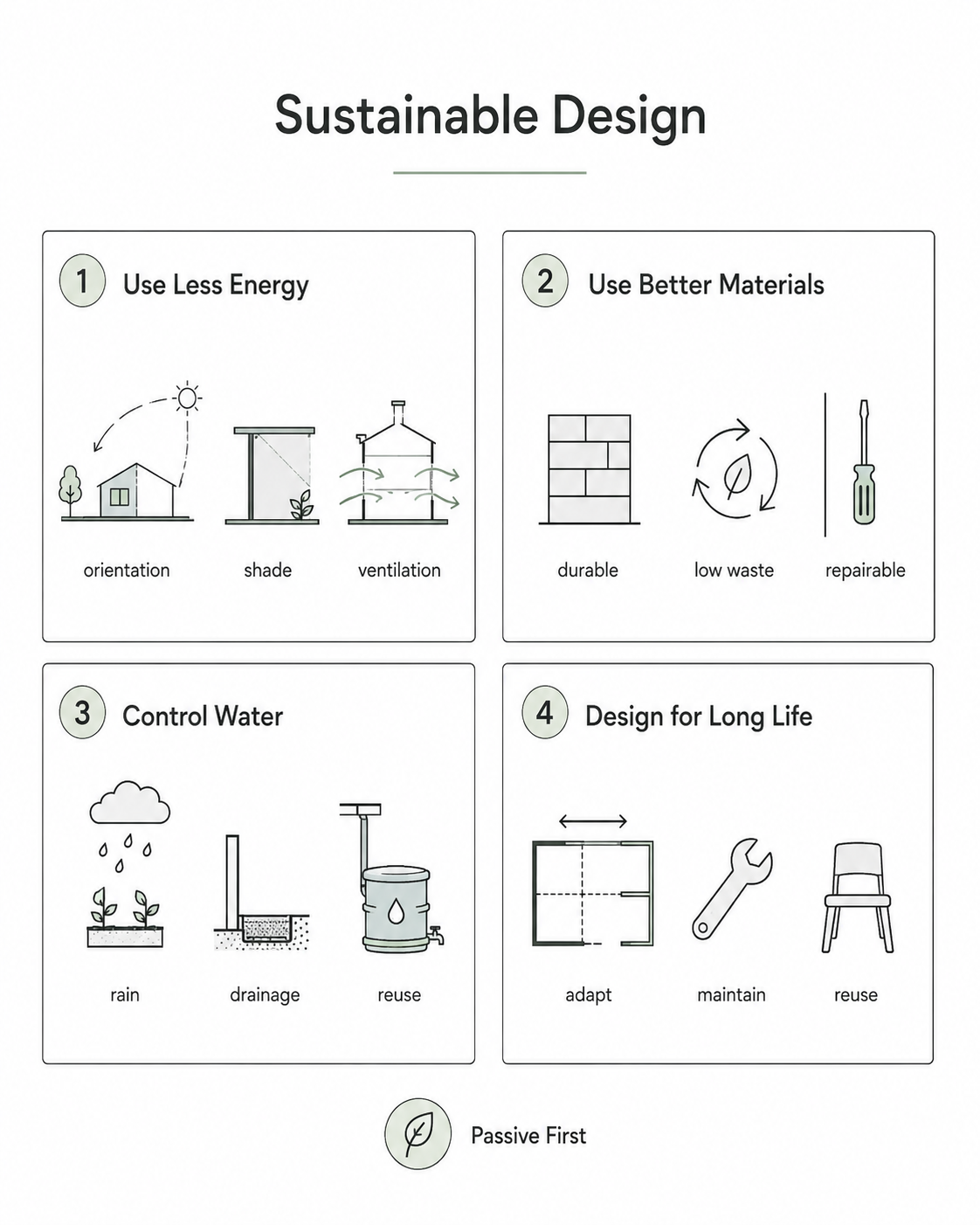
Illustration by ArchitectureCourses.org. Sustainable design starts with the basic moves first: orientation, ventilation, durable materials, lower energy demand, and systems that support long-term building performance.
Sustainability is no longer a bonus section.
It is part of whether the design is competent.
The first moves are usually passive. Orientation. Shade. Ventilation. Envelope control. Daylight. Material choice. Get those wrong and no later system is going to fully clean up the mess.
Start Here Before You Reach for Hardware
- Use the site well. Sun, wind, slope, and exposure are design inputs, not background information.
- Reduce loads first. A building that needs less energy is easier to run and easier to justify.
- Choose durable assemblies. Longevity is part of sustainability.
Certification systems can help organize priorities, but they should follow design logic, not replace it.
Read this next: Sustainability in Architecture Design.
What Pressures Design Now

Image by ArchitectureCourses.org. Glass-heavy architecture can look simple, but the real pressure is in solar gain, glare, privacy, structure, drainage, and long-term maintenance.
The work is tightening.
Housing pressure, climate risk, tighter budgets, retrofits, and mixed-use demands are pushing architects toward smaller margins for error. Projects need to do more at once. More flexibility. Better performance. Cleaner coordination.
That changes design choices early, not just at the end.

Image by ArchitectureCourses.org. Facade systems now carry more than appearance. Material choice, repetition, joints, shading, weathering, and maintenance all push design decisions much earlier.
Digital tools are also getting faster, but speed can hide weak thinking.
AI-assisted workflows can help with option generation, images, and repetitive tasks. They still do not fix a weak section, a confused plan, or a bad site response. That is why judgment keeps outranking novelty.
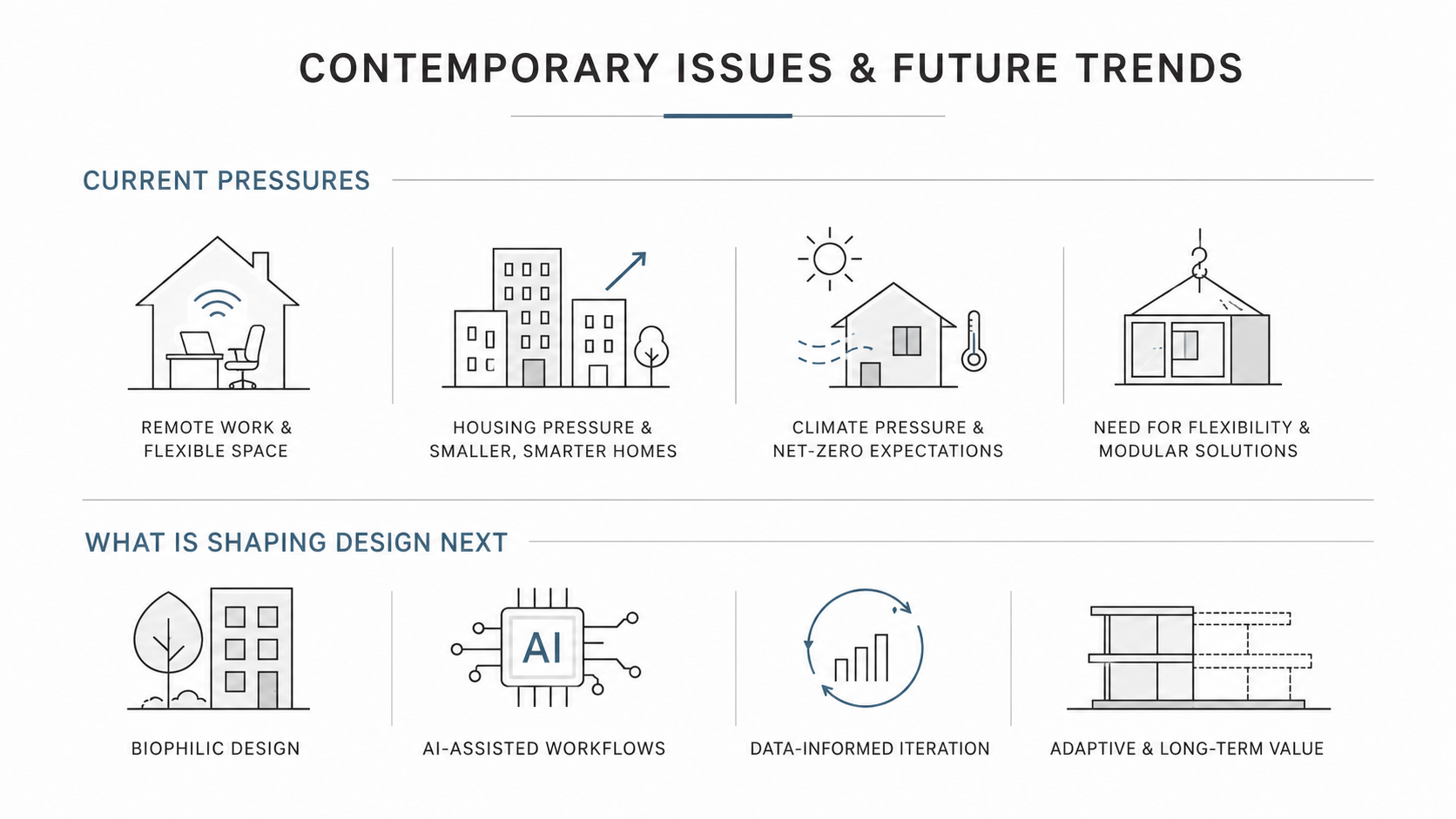
Illustration by ArchitectureCourses.org. The future of architectural design is being shaped less by flashy form alone and more by performance, climate pressure, material use, and digital decision-making.
Three Projects Worth Studying
You do not need a giant case-study list. Three strong examples teach more if you know what to look for.
Villa Savoye is still useful for reading plan freedom, pilotis, roof use, and modernist control.
Fallingwater still matters because it shows what happens when structure, section, landscape, and experience lock together instead of competing.
The High Line matters because it shows design at the city edge: reuse, circulation, public life, planting, and sequence all working together.
The lesson is not to copy them. The lesson is to ask what each project decided clearly and what pressures it solved well.
Where Beginners Waste Time
This is the part most beginner pages skip.
People waste time on the wrong side of the work.
- They render too early. The image looks finished while the plan is still weak.
- They delay the section. Then the stair, roof, and ceiling problems appear late and force redesign.
- They treat structure as a consultant problem. Then the concept starts collapsing once spans, loads, and services show up.
- They collect tools instead of making decisions.
Three weeks later the pretty concept is fighting the budget, the ducts, the sun, and the actual room sizes.
That is why early judgment beats late polish.
What Stays True Once the Basics Are Clear
The basics do not stop mattering once projects get larger.
Bigger buildings, tighter budgets, harder sites, and more consultants only make the same core questions sharper. Can people move through it clearly? Does the structure support the idea? Does the section still work once services arrive? Will the building age well, or will it start fighting use too early?
That is why design basics are not beginner-only knowledge. They stay under the whole field.
A flashy concept can hide weak thinking for a while. A clean plan, a strong section, and a buildable detail hold up much longer.
FAQ
What is architectural design in simple terms?
It is the work of shaping space so a building can be used, built, and lived in well.
Is architectural design mostly about drawing?
No. Drawing is one tool. The harder work is deciding layout, movement, structure, light, materials, and how the building will actually perform.
What should a beginner study first?
Start with space planning, basic drawing, building logic, and light. Those four carry more weight than software hype.
Do I need Revit or AutoCAD first?
AutoCAD is still a clean starting point for 2D drafting. Revit earns its place once coordinated BIM thinking becomes necessary.
Why do some good-looking projects fail?
Because the image was solved before the building was. Weak plans, ignored sections, poor envelope decisions, and late structure problems usually catch up.
Can one article teach architectural design fully?
No. But it can give you the right map, which is much better than drowning in disconnected theory and software lists.