
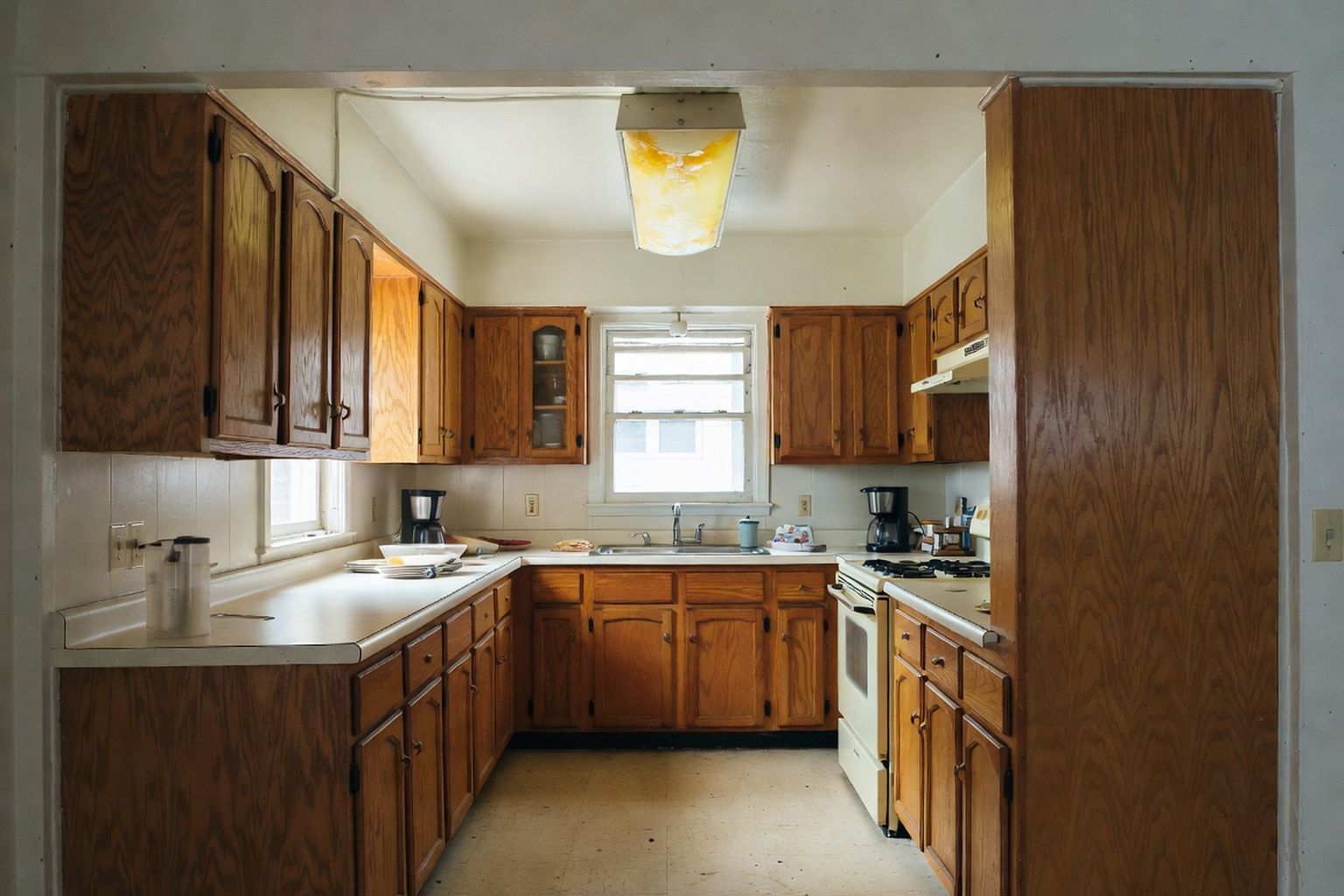


In most 1980s kitchens, the loud parts get noticed first: honey-oak doors, a fluorescent light box, beige counters, shiny vinyl, a soffit dropping the ceiling. Those date the room, but they don't decide the remodel — chasing them first is how the budget ends up in the wrong order.
Before you gut anything, check what the photos don't show. Are the cabinet boxes still solid? Does the layout work? Are the sink, window, range, and family-room connection already in the right places? Then look at what actually costs money — lighting, appliance openings, venting, flooring height, soffits, electrical, and the finish work hiding behind the old surfaces.
That's the real order. Paint color comes last. For the cabinet decision on its own, see 1980s kitchen cabinets. For what actually changes the room, see 1980s kitchen before and after.
First, figure out what kind of 1980s kitchen you have
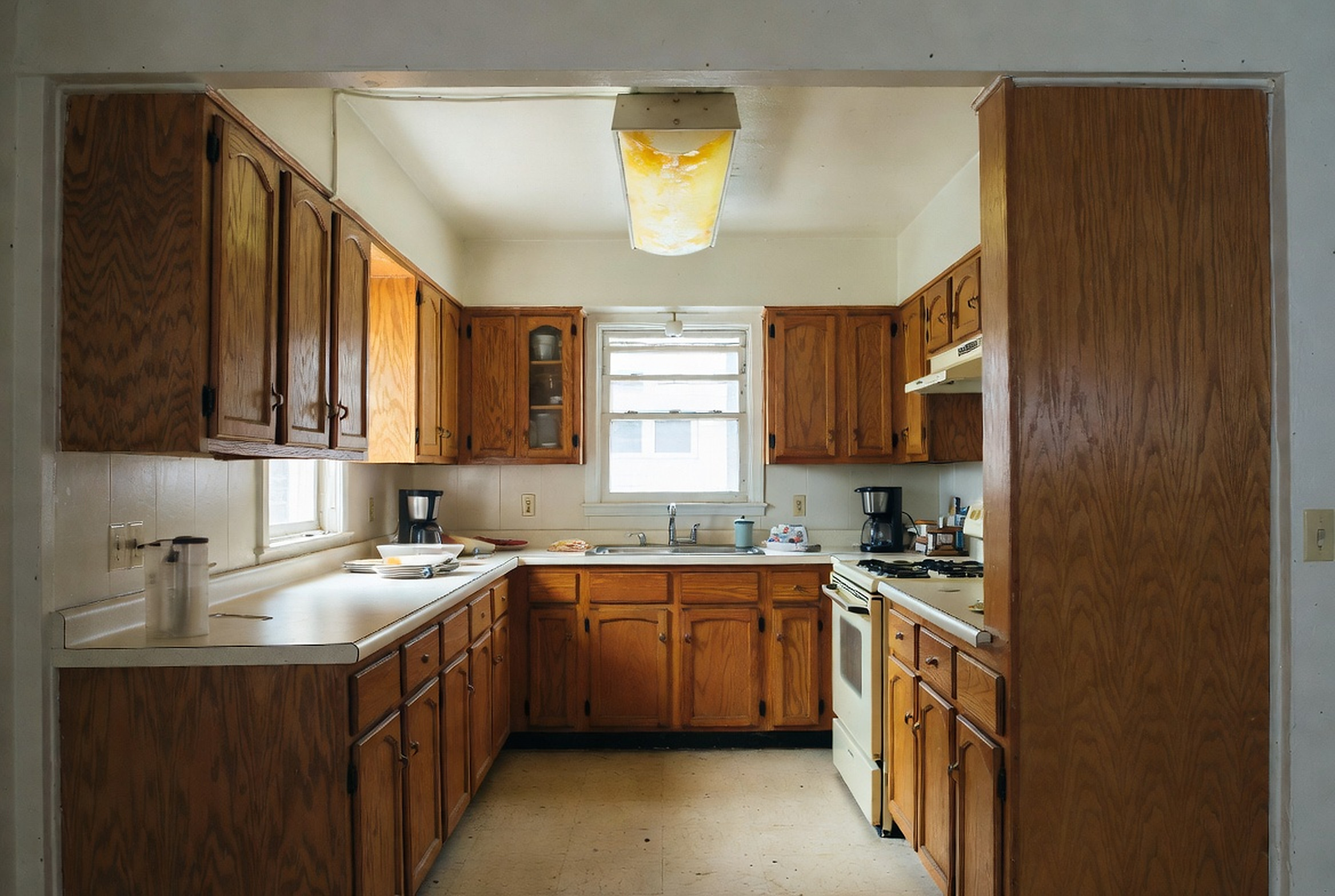
Most 1980s kitchens fall into a few familiar shapes.
The shape matters more than the cabinet color when you’re planning a remodel.
U-shaped kitchens with oak cabinets on three sides are very common. They usually work fine as long as the appliance clearances aren’t too tight. The main issue is often poor workflow between the sink, range, and fridge rather than the cabinets themselves.
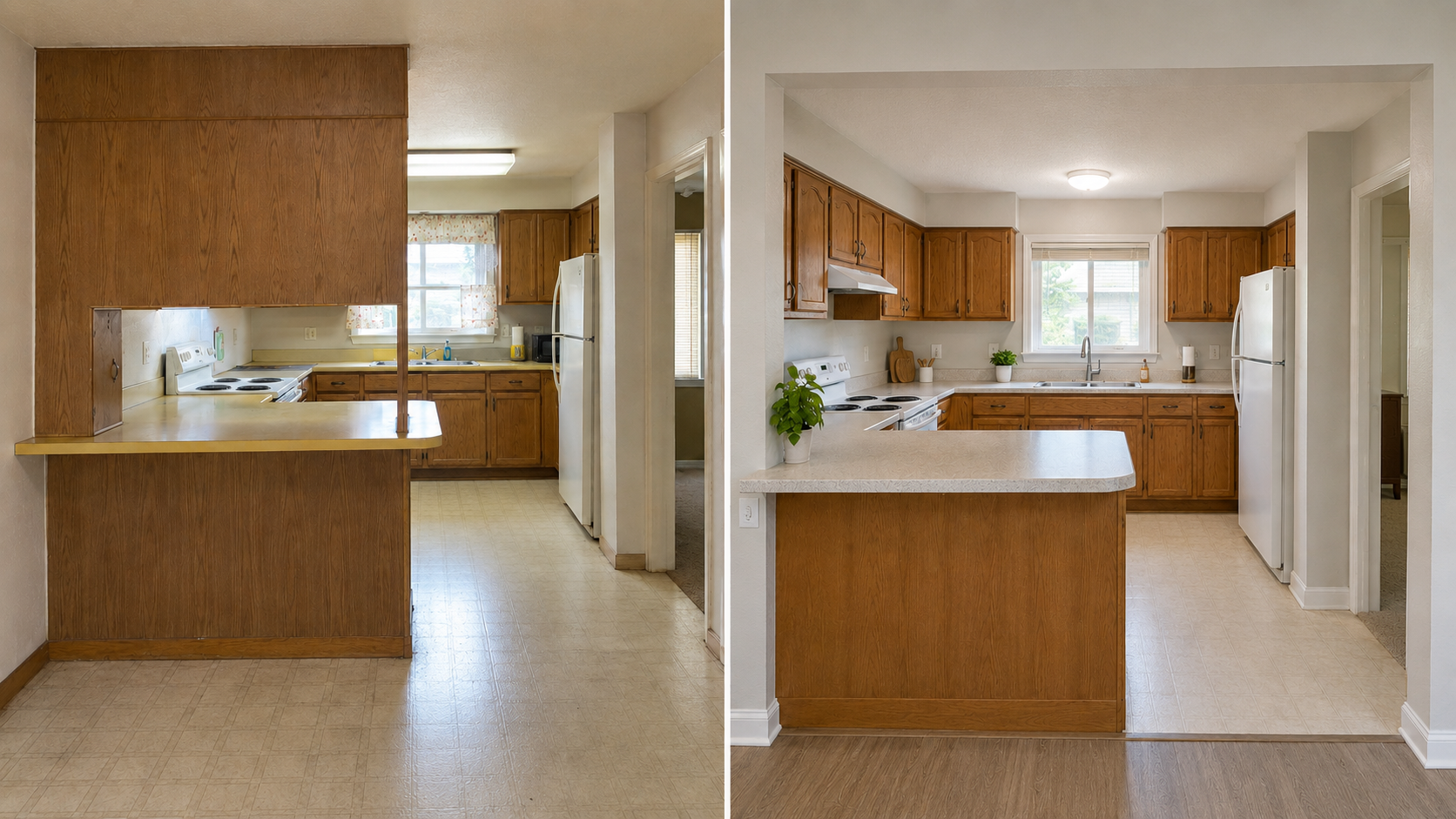
Peninsula kitchens that half-open to the family room are another frequent layout. These often need better circulation and traffic flow more than a full gut. The peninsula can feel like a wall if it’s not planned well.
Galley kitchens in ranches or split-level homes can be genuinely efficient. They work best when the door, fridge, and range aren’t fighting each other across the narrow aisle. Tight but workable spaces are common here.
Open family-room kitchens require the biggest coordination. Lighting and flooring decisions have to be made together, or the two rooms never quite feel like they belong to the same house.
The real value in naming the kitchen type is simple: it stops you from pricing the room as one undifferentiated thing. A kitchen with good cabinets but bad lighting and layout is a completely different project from one with failed cabinets and a terrible appliance arrangement — even when both look similar in listing photos.
Settle these before you spend — and where the full detail lives
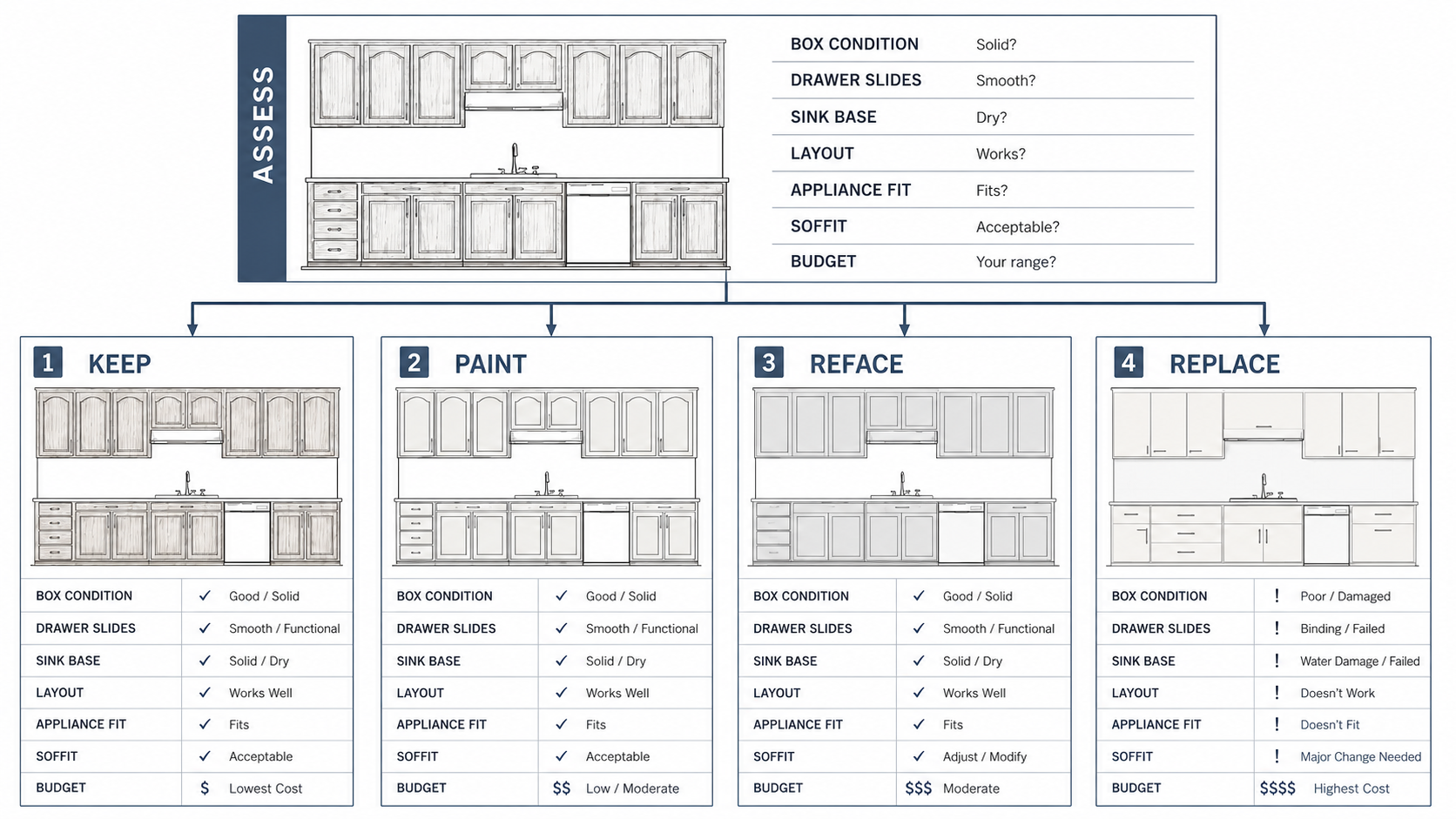
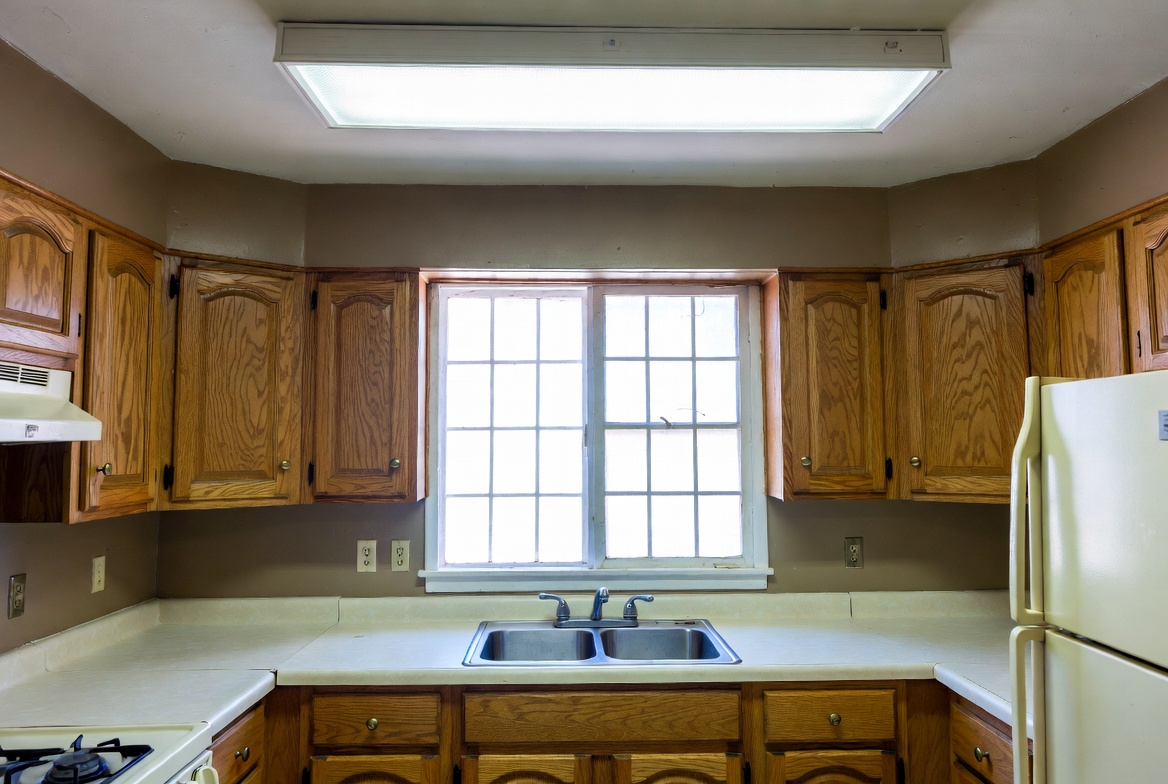
Four decisions drive everything downstream, and each has a page that goes deep, so the short version here is only meant to put them in sequence. The cabinets come first, because countertops, backsplash, and flooring all commit to whatever the cabinets are doing: keep, paint, reface, or replace is a real fork, and it turns on box condition and layout rather than door style — the full decision is on the cabinets page. The soffit has to be checked before you promise tall cabinets, because some are empty and some hide ductwork, wiring, or plumbing that turns removal into a ceiling job. The fluorescent ceiling box is usually worth pulling, but it is a ceiling project, not a fixture swap, so the lighting layout gets planned before the ceiling is patched. And the counters and backsplash follow the cabinet decision rather than leading it, because a backsplash set against cabinets you later replace is money spent twice. The soffit, lighting, and counter detail — with the before-and-after photos — lives on the before-and-after page; here, just hold their place in the order.
Flooring is a height problem before it is a look
1980s kitchens usually have vinyl, sheet flooring, ceramic tile, or layers of later flooring stacked over the original, and the floor decision affects far more than appearance. New flooring changes the height at doorways, hallways, the family room, the dishwasher opening, the toe kicks, and any stairs, so if the kitchen connects to a sunken living room, a split-level landing, a laundry, or a breakfast nook, those transitions have to be planned before the floor is ordered, not discovered during install.
I have pulled a kitchen floor that sat a half-inch proud of the family-room carpet and realized new tile would make the step worse rather than better until the subfloor was dealt with first. Do not assume the old floor lifts out cleanly, either — some is glued hard to the substrate, some has old underlayment, and some hides damage near the dishwasher, the sink, the patio door, or the refrigerator water line. And if a material might contain asbestos, it cannot be identified by sight: the EPA's guidance is to have suspect material sampled by a trained, accredited professional before renovation disturbs it, rather than sanding, grinding, or tearing it out on a guess.
Venting the range is not decoration
A lot of 1980s kitchens leaned on weak recirculating hoods, a microwave hood, or no real venting at all, and that only stops mattering if you do not cook. Steam, grease, odor, and heat need somewhere to go, and a handsome hood that does not actually vent is just a metal cover. I have ordered a good hood for a kitchen where the only duct path ran the better part of twenty feet with three elbows, and it moved about as much air as cracking a window — the hood was never the problem, the duct was. So check the duct path before you order anything: a short, straight run beats a long one full of turns, and if the kitchen sits under a second floor or far from an exterior wall, the venting can quietly drive the cabinet layout, the soffit, the ceiling repair, and the cost. If you are also moving the range, adding a stronger hood, or switching from electric to gas, make-up air and code requirements can enter the job, and the appliance manufacturer's instructions matter as much as the local rules.
Do not open a wall until you know what it carries
Many 1980s kitchens are almost open already, which makes wall removal tempting, and sometimes a half-wall between kitchen and family room comes out easily. But that same half-wall may carry outlets, switches, ductwork, plumbing, or low-voltage wiring, and a full wall may be load-bearing, which pulls in a beam, posts, and engineering. Opening a wall is not the mistake; guessing is. Before anything comes down, confirm whether the wall carries floor, ceiling, or roof load, what services run inside it, where the flooring will need patching once it is gone, and whether the cabinets, counters, and lighting still make sense around the new opening. The wall itself is rarely the expensive part — the repair around it is where the budget gets hit. The visual trade-offs of opening a 1980s kitchen, with before-and-after examples, are on the before-and-after page, and if you are weighing a bigger removal, read open concept kitchen mistakes first.
The scope chain: one choice pulls ten behind it
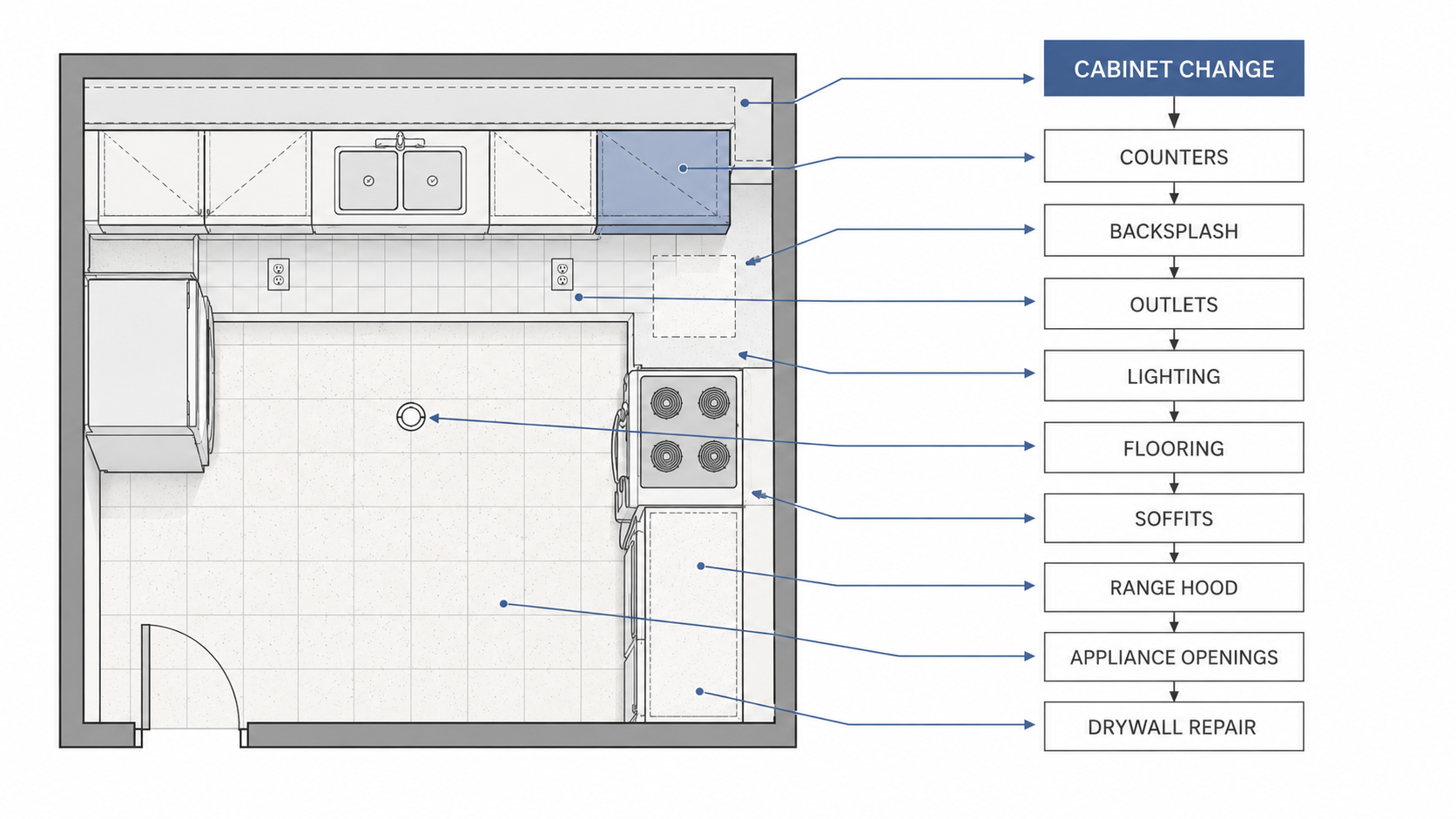
The biggest surprise in a 1980s kitchen is usually not structural — it is the chain reaction. Pull the soffit and the ceiling needs more repair than expected; pull the fluorescent box and the old texture will not match; change the cabinet layout and the flooring no longer runs under the new footprint; move the range and the hood duct has nowhere clean to go; swap the sink base and the old shutoff valves will not hold. I have watched a single relocated range turn into a new duct chase, a patched ceiling, and two moved outlets, none of which were on the original quote. That is how the cheapest-looking plan — paint the cabinets, replace the counters, add a backsplash, change the lights, install flooring — becomes expensive, because each trade needs the previous decision finished before it can start. The honest catch is that some of the chain only reveals itself once demolition begins, no matter how carefully you inspect, and that is exactly the argument for sequence: settle the expensive, permanent decisions first, so the cheap and reversible ones can still bend around whatever the walls turn out to be hiding.
A safe order for a 1980s kitchen remodel
The exact order shifts by house, contractor, and scope, but most 1980s kitchens behave when the work follows a clean path from hidden to visible.
| Step | Decision | Why it matters |
|---|---|---|
| 1 | Inspect cabinets, sink base, soffit, floor, and lighting | Finds the problems hidden behind the cosmetic plan |
| 2 | Confirm layout and appliance openings | Prevents buying counters or cabinets around a bad plan |
| 3 | Open or check soffits and walls if needed | Exposes ducts, wiring, plumbing, or framing before finish work |
| 4 | Electrical, lighting, range venting, and plumbing rough-in | Gets the messy work done before surfaces are finished |
| 5 | Cabinets, counters, backsplash, and flooring | Locks in the visible work after the hidden work is settled |
Start in the wrong order and the kitchen can still look fine on reveal day. The callbacks show up a few months later.
Where the money should go first
Spend first on the parts that are hard to redo — the layout, the cabinet structure, the electrical, the lighting, the range venting, the plumbing shutoffs, the flooring transitions, and the drywall repair. None of that is exciting, and none of it photographs well, but it decides whether the finished kitchen feels built or merely patched. Save the trend money for the things you can change later without tearing anything out: paint color, stools, small fixtures, cabinet pulls, and wall color. A 1980s kitchen rarely needs expensive everything; it needs the right things done in the right order, which is a cheaper kind of discipline than it sounds.
A small update or a full remodel
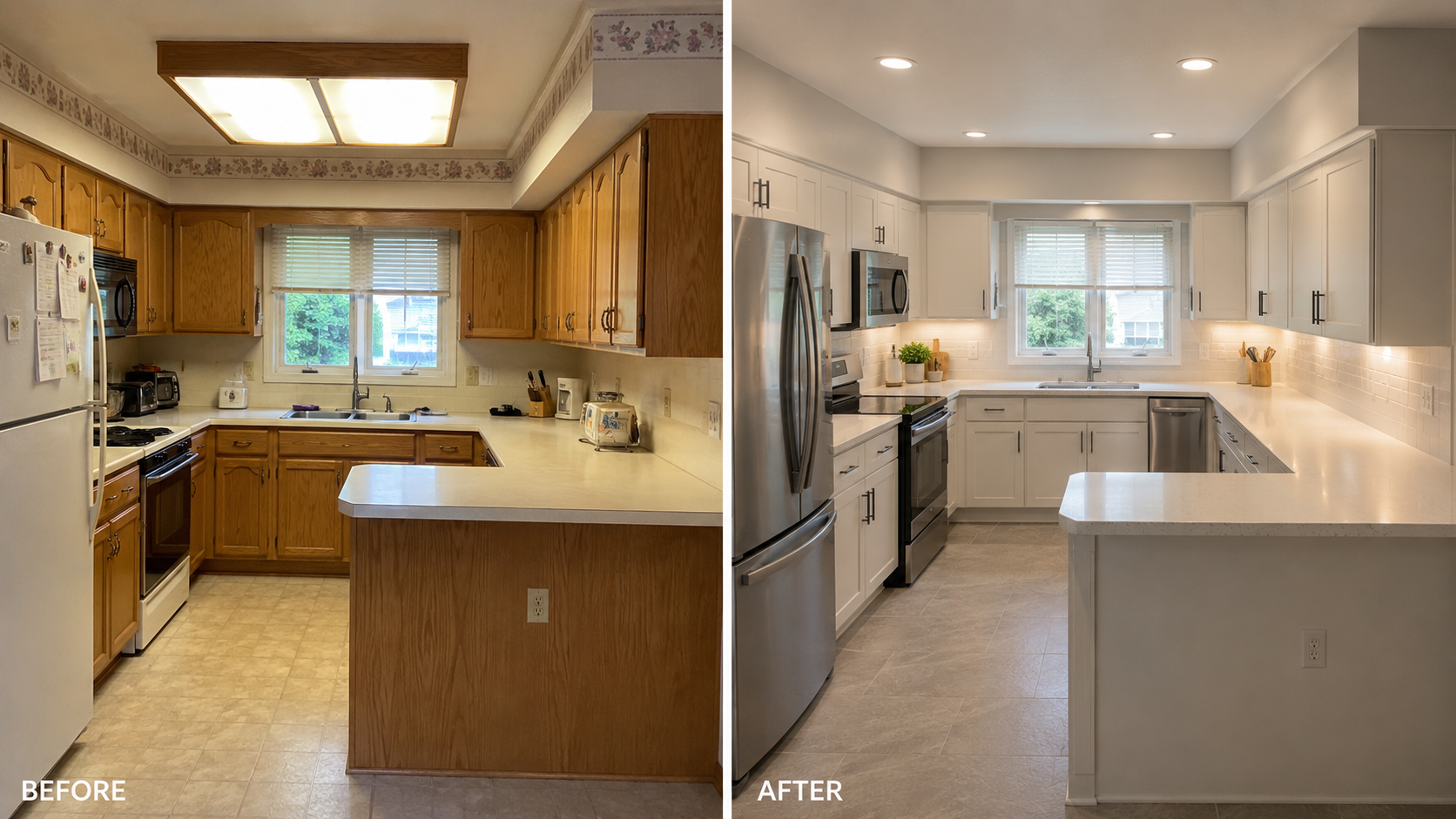
Not every 1980s kitchen needs to be gutted. If the cabinets are sound and the layout is decent, a smaller remodel can still change the room: remove the fluorescent box and repair the ceiling, add under-cabinet lighting before the backsplash goes in, replace the counters and sink once the cabinet decision is final, and use simpler hardware and a calmer wall color to take the heat out of the oak. The smaller the budget, the more the sequence has to be respected, because there is no slack to absorb a step done out of turn.
A full remodel earns its cost when the kitchen has layout problems that finish work cannot fix — a blocked work triangle, a refrigerator stranded in the wrong place, poor storage, a dead corner, a peninsula that traps traffic, weak venting, or cabinets that are simply not worth saving. Even then, a full remodel is not the same as overbuilding. A modest 1980s kitchen rebuilt with plain cabinets, durable counters, good lighting, a proper hood, and simple flooring will serve the house better than luxury finishes sitting on top of bad planning. If the kitchen ties into split-level stairs or a lower level, plan it alongside the 1980s split-level remodel, since a layout change there reaches well past the kitchen.
FAQ
Is it worth remodeling a 1980s kitchen?
Usually yes, when the layout is useful and the cabinets, plumbing, floor, and lighting can be corrected without wasting money. Many 1980s kitchens have decent space but dated surfaces and weak lighting, which is a fixable combination.
What is the first thing to update in a 1980s kitchen?
Lighting is often the best first visible change, but before spending anything, inspect the cabinets, soffit, flooring, venting, and sink base so the project does not start in the wrong order.
What makes a 1980s kitchen remodel get expensive?
Scope chain reactions: soffit removal, ceiling repair, cabinet replacement, appliance relocation, flooring patches, electrical changes, range venting, plumbing shutoffs, and backsplash timing all pulling on each other.
Should I keep, paint, reface, or replace the oak cabinets?
That is its own decision, made on box condition and layout rather than door style. The full breakdown is on the 1980s kitchen cabinets page.
Should I open the wall between a 1980s kitchen and family room?
Maybe. First confirm whether the wall carries load and what wiring, plumbing, or ductwork is inside, then plan the flooring patch, lighting, cabinet layout, and counter edges before anything comes down.
What flooring works in a 1980s kitchen remodel?
Durable tile, engineered wood, or quality vinyl plank can all work. The harder issue is the height transition at halls, the family room, stairs, and appliance openings.
Do I need to worry about asbestos in a 1980s kitchen floor?
Do not assume either way. If old flooring or adhesive is suspect and the work will disturb it, the EPA recommends sampling by a trained, accredited asbestos professional before you cut into it.