

A 1950s ranch kitchen remodel fails when the room gets new cabinets before anyone solves the layout.
The usual mistake is easy to understand. The kitchen feels small, so the first thought is to open a wall, add an island, replace every cabinet, and make the room look bigger. Sometimes that works. Often it creates a more expensive version of the same cramped kitchen.
In a 1950s ranch, the hard problems are usually appliance fit, low ceiling height, old floor layers, narrow work aisles, weak lighting, poor venting, dated wiring, and a wall opening that changes more than the finished photo shows.
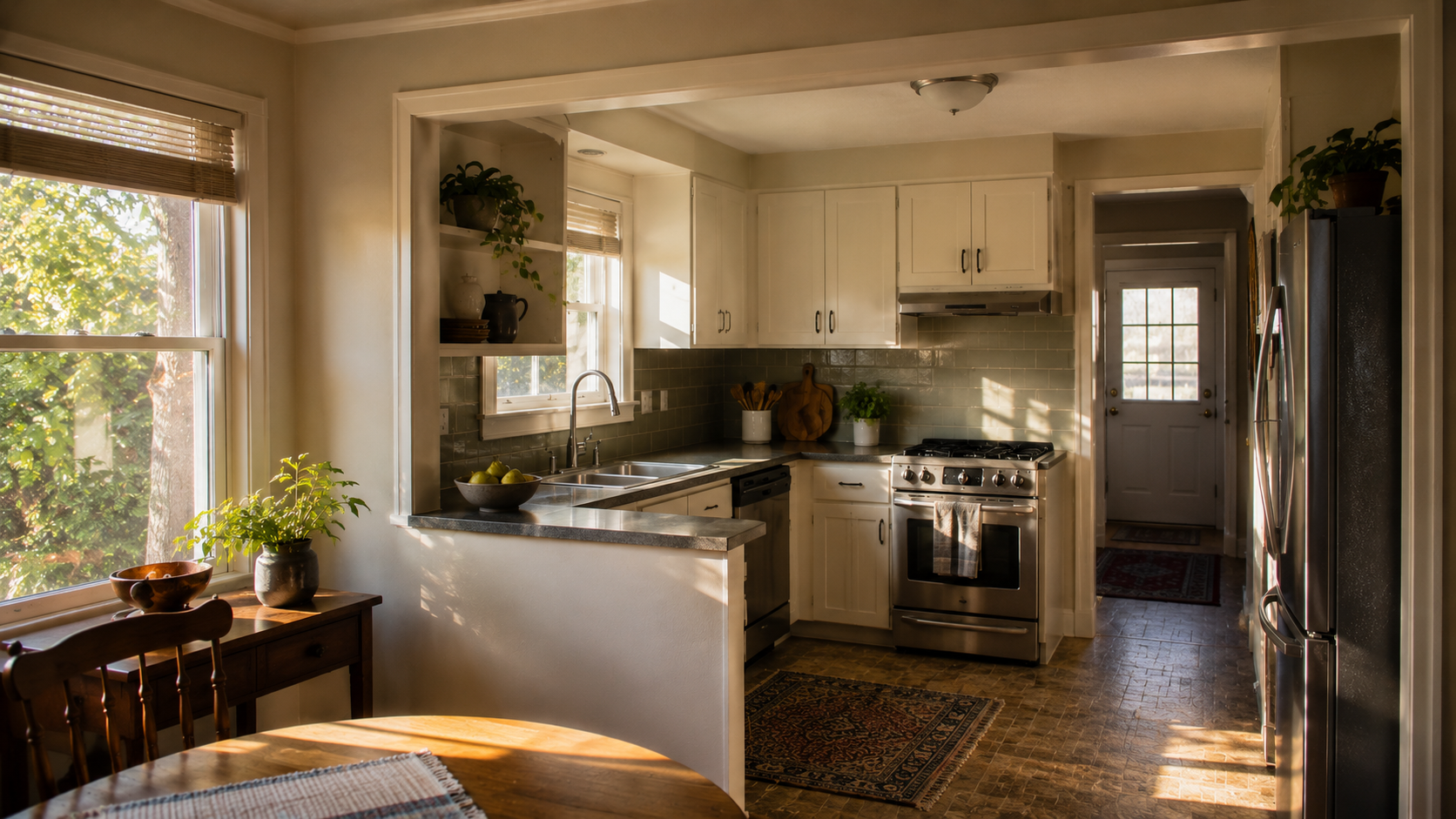
This page is about that exact room: the compact ranch kitchen sitting between the dining area, living room, hallway, garage entry, or backyard door. It is not a generic kitchen ideas page. It is a practical remodel guide for an old small kitchen where one wrong move can create floor patches, cabinet gaps, appliance conflicts, and a callback. For broader 1950s kitchen issues that are not ranch-specific, use the main 1950s kitchen remodel guide. For the whole house, use the 1950s ranch house remodel guide.
Start Here: Pick the Remodel Path Before Cabinets
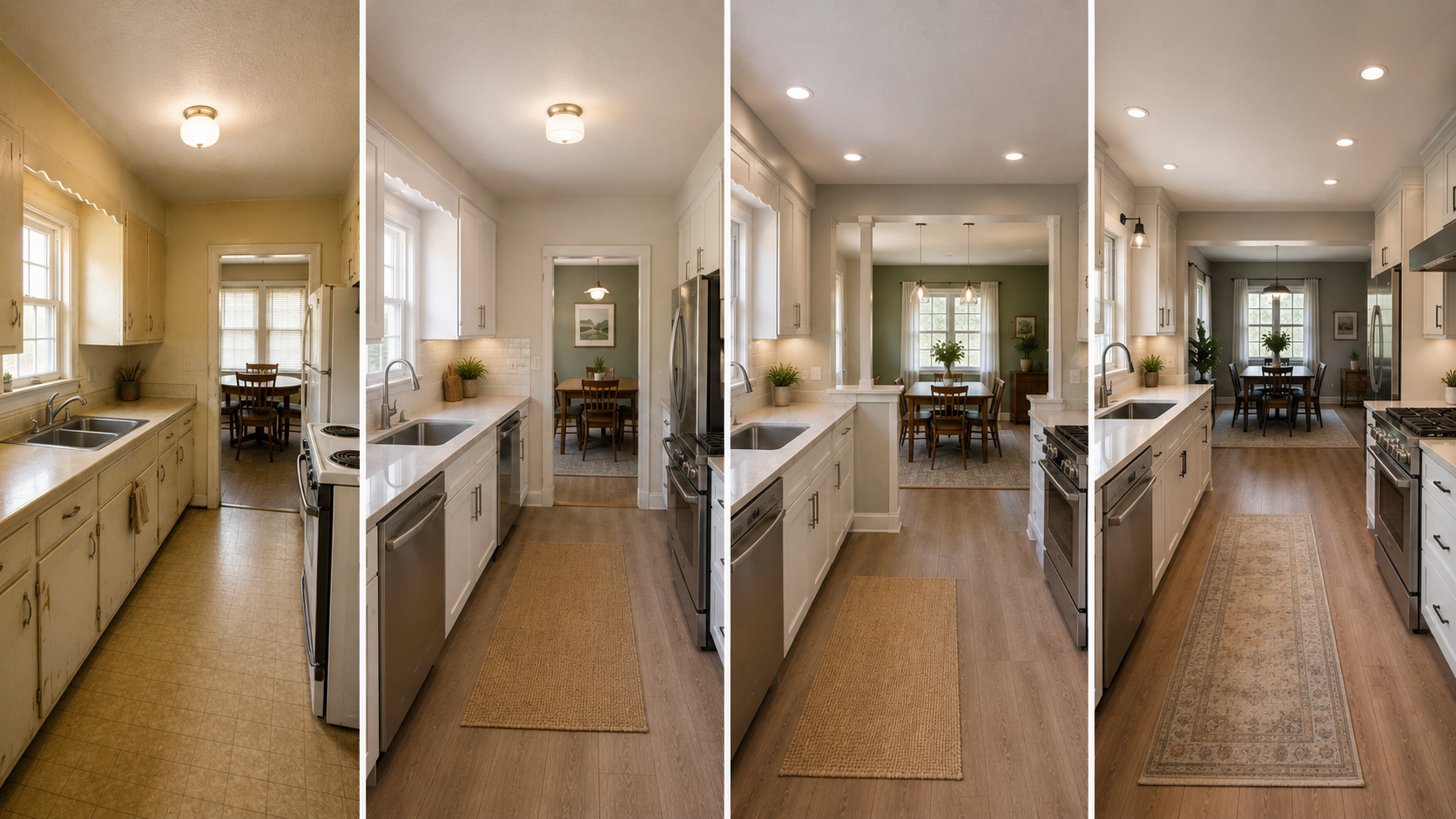
Before choosing cabinets, decide which remodel path the kitchen actually needs.
| Remodel path | When it works | What can go wrong |
|---|---|---|
| Light refresh | The layout works, cabinets are sound, appliances fit, and wiring is not being disturbed. | Paint and hardware cannot fix a bad aisle, poor venting, or a refrigerator that blocks the room. |
| Keep-layout remodel | The kitchen is small but functional, and the main problem is storage, lighting, surfaces, or appliance fit. | New cabinets can lock in old mistakes if appliance clearances are not checked first. |
| Wall-opening remodel | The kitchen needs more light, better dining connection, or a clearer path without losing too much storage. | The opening can trigger framing, wiring, ceiling repair, flooring patches, and trim work. |
| Full rebuild | Cabinets are failing, layout is broken, wiring or plumbing needs major work, or floors and walls must be opened. | The budget can jump fast because finishes become only one part of the job. |
That decision protects the project. A refresh should not become a hidden full rebuild by accident. A full rebuild should not pretend to be a cabinet swap.
The Ranch Kitchen Problem: A Small Room Between Too Many Jobs
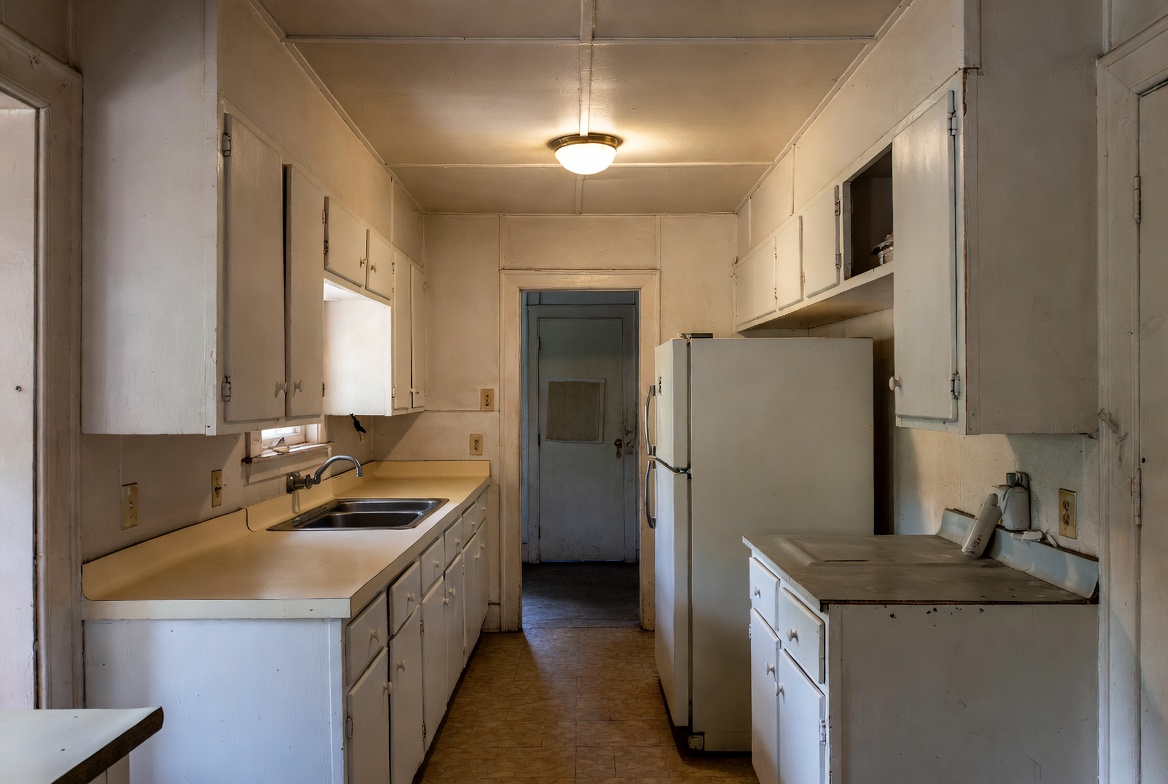
A 1950s ranch kitchen is usually not just small — it is small in a very specific way. The room often has one cabinet wall, one appliance wall, a tight work aisle, a low ceiling, a narrow doorway, and a dining area just beyond the wall. The refrigerator may sit at the entry. The range may be trapped in a short run. The sink may be under the only good window. A backyard door, basement stair, hallway, or garage door may cut through the traffic path.
That is why "open it up" is not enough of a plan. The wall is only one part of the room. If the refrigerator stays too deep, the range door hits the aisle, or the dishwasher blocks the main path, the room still fails after the remodel. A 36-inch-wide modern refrigerator, deep base cabinets, wider range, dishwasher door, and trash pullout can fight each other in a space built around smaller appliances and simpler daily use.
Before and After: What Should Actually Change
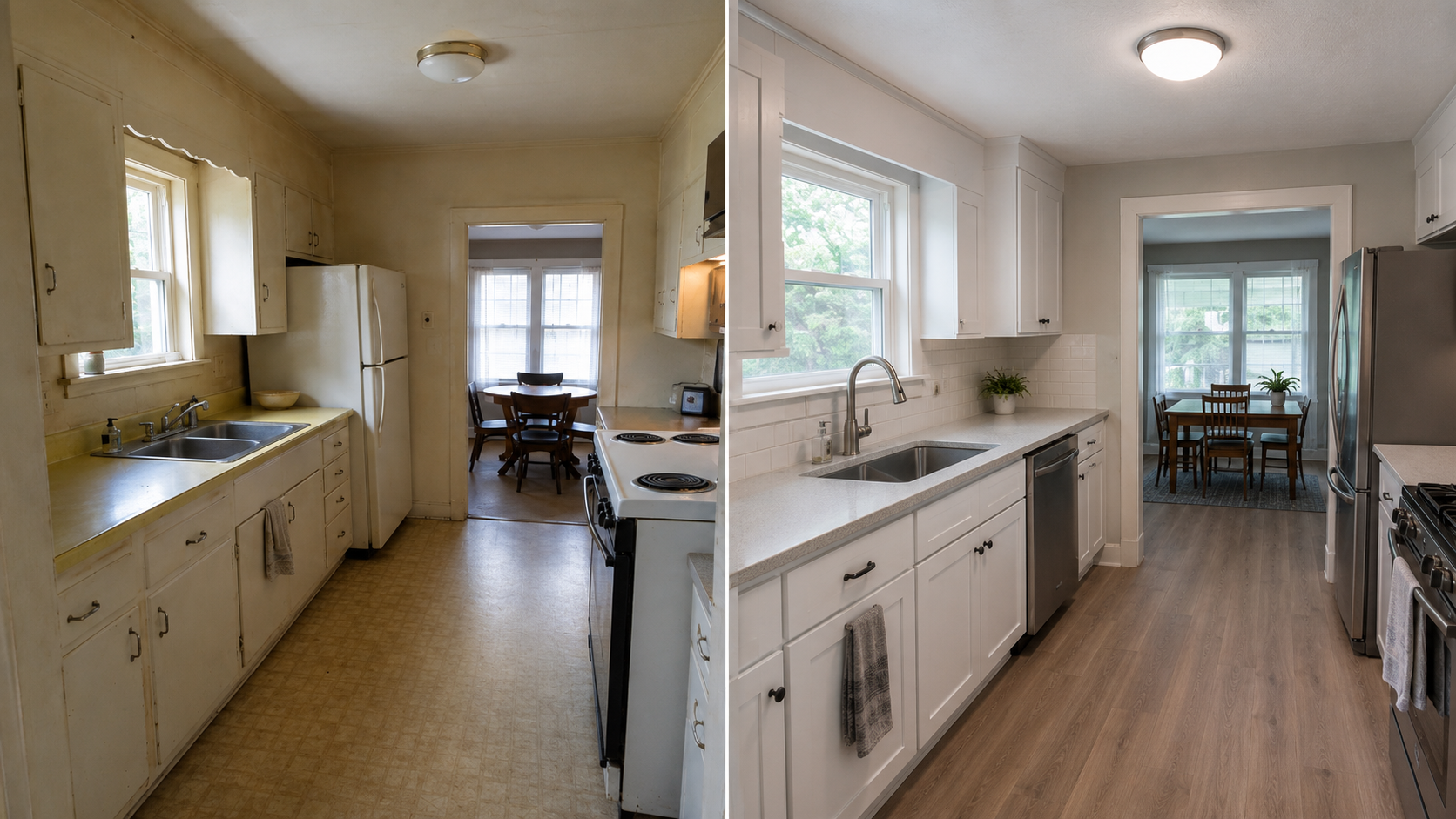
A good before-and-after should not only look brighter — it should show what changed in the way the room works. Look for the practical changes first: a clearer path from dining to kitchen, a refrigerator that no longer blocks the aisle, better task lighting at the sink and counter, fewer dead corners, stronger storage, and a wall opening that makes the room easier to use instead of just easier to photograph.
The finished image should still make sense with the ranch house. If the after photo looks like a new luxury kitchen squeezed into an old compact shell, check the aisle widths, door swings, fridge depth, range clearance, and floor transitions. Those are where the photo often lies. For a broader visual companion, use the existing ranch kitchen before-and-after page.
The Wall Opening Is Not the First Fix
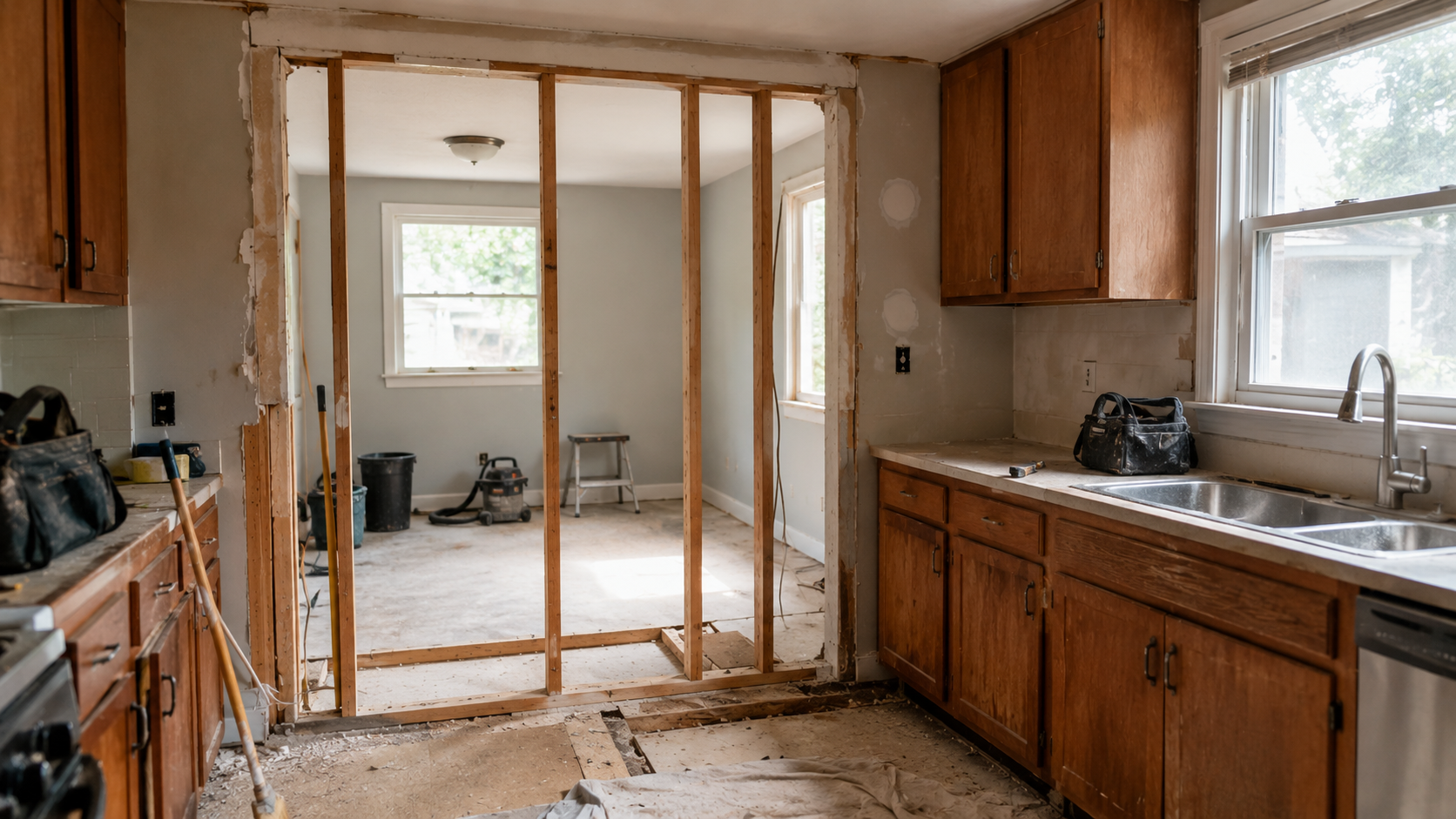
Opening the wall is the move everyone wants to talk about. It should not be the first decision. First decide what the kitchen needs from the opening — more daylight, better connection to the dining room, a cleaner serving path, a wider doorway. Those are different projects with different costs and different side effects.
A full wall removal can remove upper cabinets, expose flooring gaps, force ceiling patching, disturb wiring, and require a beam. A partial opening or wider cased opening can sometimes give the house enough connection without wrecking storage. If the wall may be structural, or if the opening affects ceiling framing, attic loads, HVAC, plumbing, or electrical runs, treat it as more than a finish decision. The dedicated removing a wall in a ranch kitchen guide is the better place for the structural sequence.
The Refrigerator Problem
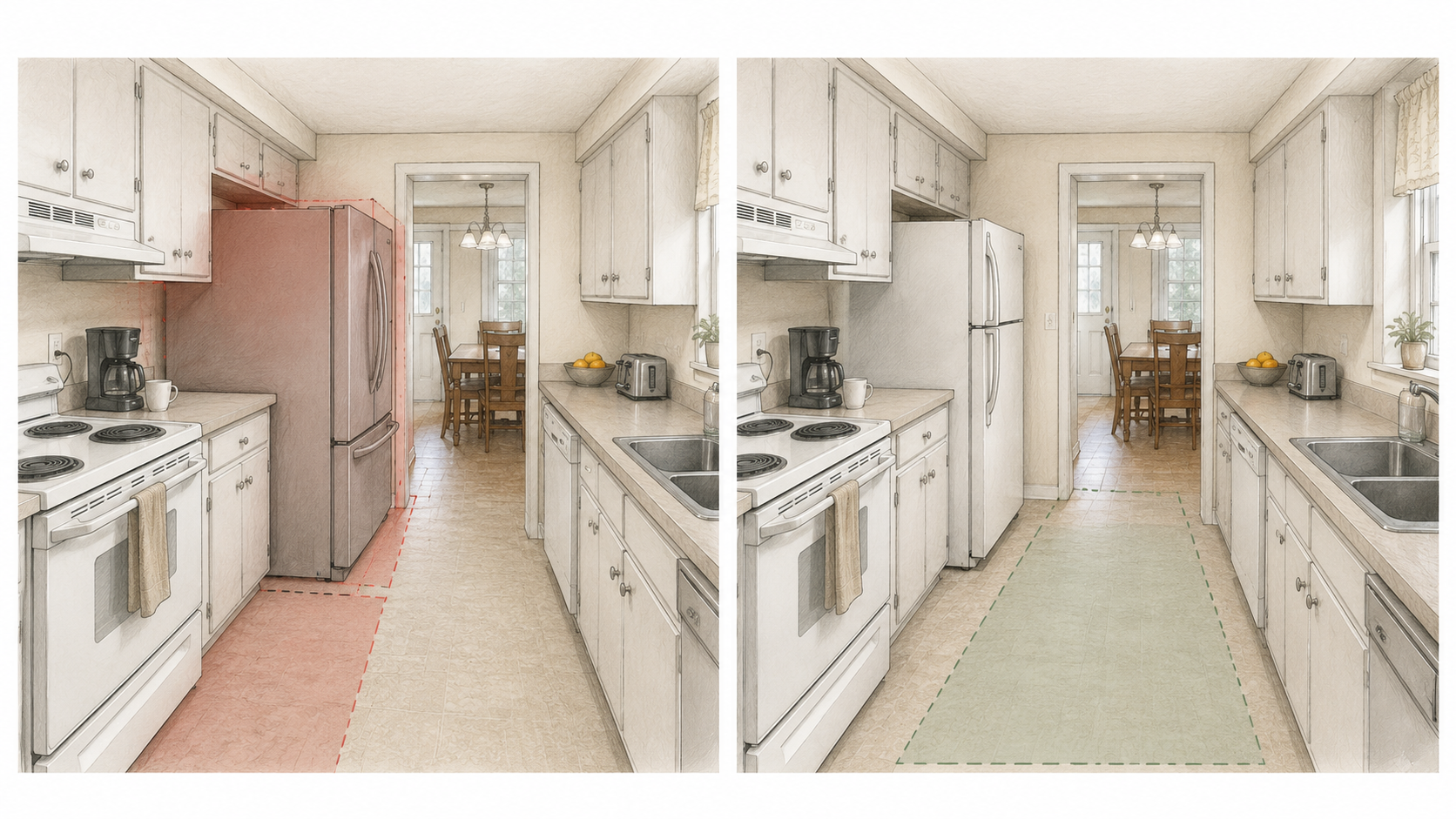
The refrigerator is often the object that breaks the old kitchen. Many older ranch kitchens were built around smaller refrigerator openings — an appliance closer to 30 or 32 inches wide and roughly 66 inches tall. A common modern full-size refrigerator runs about 36 inches wide and 70 inches tall, and the depth can be the bigger problem.
Width affects the cabinet run. Height affects the upper cabinet or soffit. Depth affects the aisle. Door swing affects the range, dishwasher, wall, doorway, or dining path. That is why "the fridge fits" is not enough. Measure the opening, the path into the house, the cabinet height, the depth from wall to aisle, the door swing, and the clearance when someone is cooking. A counter-depth refrigerator can help, but only if the width, hinges, handles, ventilation space, and storage needs still work.
The Doorway Problem Nobody Plans For
Here is the thing that stops a remodel cold on delivery day and almost never appears in any planning guide: new cabinet boxes may not fit through the doorways of a 1950s ranch house.
Original ranch doorways were often 28 to 30 inches wide, sometimes less where a bedroom hallway entry hit the kitchen. A standard base cabinet box today is 24 inches deep. A 36-inch-wide base cabinet in its box — not just the door, the assembled carcass — can be extremely difficult to maneuver through a narrow doorway, around a tight corner from the front entry, and into a kitchen that may only have one access point. One documented case from this era: a homeowner ordered stock big-box cabinets, waited weeks for delivery, and found that the largest units could not physically pass through the kitchen doorway without being disassembled and reassembled inside the room, which the supplier refused to cover as extra work.
Before any cabinet order is placed, measure every doorway and hallway on the delivery path from the exterior door to the kitchen. Include corners, door trim projections, and ceiling height at any low point. If a 36-inch-wide base unit cannot travel that path intact, you need either a different cabinet size, a different delivery route such as a window or exterior wall opening, or a supplier willing to assemble on-site. Finding this out after the cabinets arrive is the wrong time.
Cabinets: Keep, Reface, Partial Replace, or Rebuild
Original 1950s cabinets are not automatically junk. Some were built with solid boxes, simple doors, useful proportions, and better material than cheap replacement cabinets. Others are worn out, badly modified, too shallow, damaged by moisture, or impossible to make work with modern appliances. Do not decide by nostalgia — decide by condition and layout.
Keep them when the boxes are sound, the layout works, and the appliance openings can be corrected. Reface or repaint when the boxes are solid but the doors, finish, or hardware are tired. Partially replace when one appliance wall fails but the rest of the kitchen still works. Rebuild when the layout, boxes, floor, wiring, or appliance plan all fail together. The worst choice is replacing every cabinet while keeping the same bad refrigerator location, weak lighting, and blocked aisle — that spends the money without solving the room.
When a Keep-Layout Remodel Beats an Open Plan
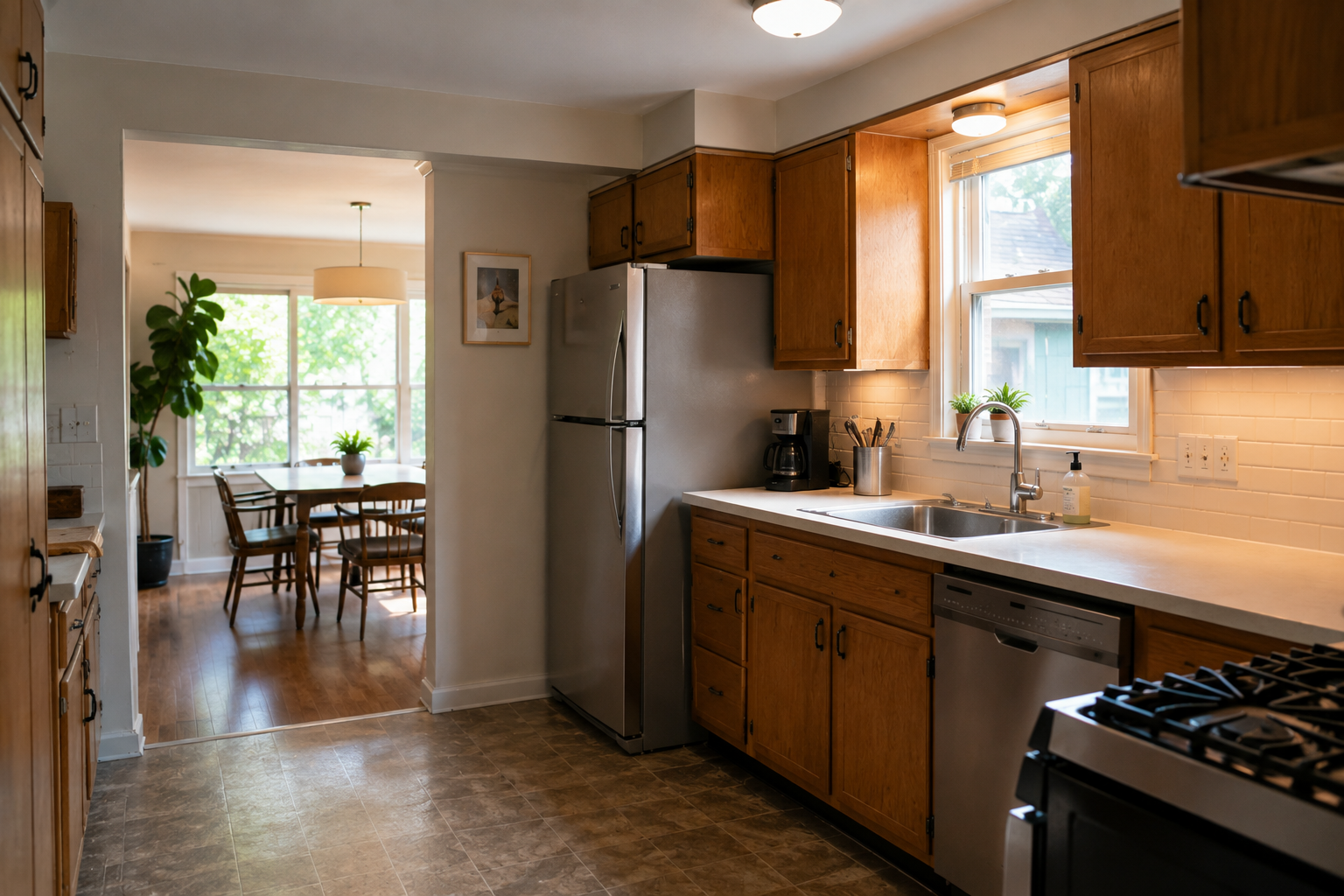
A keep-layout remodel can be the smarter move when the room is small but basically logical. The money goes into better lighting, smarter cabinet interiors, a correctly sized refrigerator, improved counters, repaired floors, a stronger sink zone, and a cleaner connection to the dining area — not beam work, major patching, or a wall opening that steals storage.
This works especially well when the kitchen has one good window, a workable sink location, a short but usable work triangle, and a nearby dining space that only needs a better threshold. If the main problem is tight circulation, use the small ranch kitchen layouts page before forcing a big open plan.
Hidden Work: Floors, Subfloors, and Old Layers
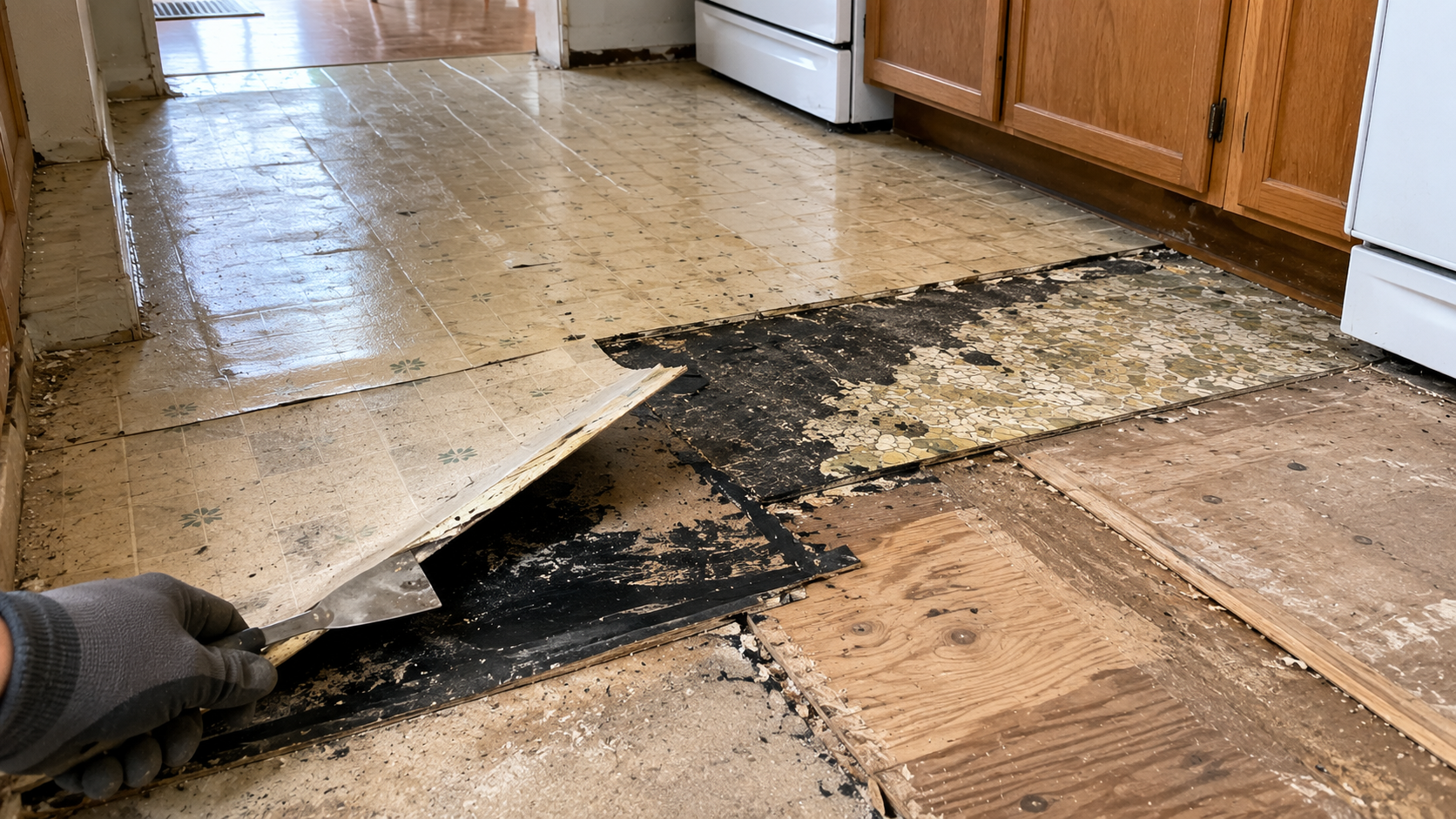
The floor can change the job after demolition starts. A 1950s ranch kitchen may have newer flooring over sheet vinyl, older tiles, underlayment, black adhesive, patched subfloor, and uneven transitions into the dining room. If a wall comes out, the old wall line may leave a flooring scar that cannot be hidden without replacing or feathering a much larger area.
This is not only a finish problem. Older resilient flooring, black adhesive, duct wrap, ceiling texture, and other materials can fall into the suspect-material category. Do not scrape, sand, grind, or demo unknown materials just because they are in the way. Use the asbestos in 1950s houses guide before disturbing old flooring or adhesive. Also check the subfloor around the sink, dishwasher, refrigerator water line, exterior door, and old radiator or pipe penetrations — soft spots, staining, or patched areas can turn a flooring update into carpentry and leveling work.
Wiring, Lighting, and Ventilation
Many 1950s ranch kitchens ran the whole room on one or two shared circuits. A modern kitchen code commonly requires dedicated 20-amp circuits for the refrigerator, dishwasher, disposal, and microwave, plus two dedicated 20-amp small-appliance circuits for countertop outlets. That can mean six dedicated circuits in a kitchen originally built with one or two. The panel may also need evaluation — a 60-amp or 100-amp fuse panel that sufficed in 1955 is often not adequate for today's appliance load, and adding circuits to an undersized panel is not the answer.
A pretty remodel still fails if the counter is dark, the range has weak ventilation, and every small appliance fights for one outlet. If walls or ceilings are open anyway, that is the moment to plan electrical, lighting, and venting properly. After cabinets go in, fixes become more expensive and messier.
What the Cost Photo Does Not Show
A 1950s ranch kitchen remodel cost depends less on the cabinet style and more on how much hidden work the room forces.
| Cost driver | Why it matters in a 1950s ranch kitchen |
|---|---|
| Wall opening | Can trigger framing, beam work, electrical relocation, ceiling patching, floor repair, and trim work. |
| Appliance fit | A modern fridge, range, dishwasher, or vent hood can force cabinet changes and aisle compromises. |
| Cabinet delivery | Large base units may not pass through original 28-to-30-inch ranch doorways without disassembly or a new access route. |
| Floor layers | Old adhesive, underlayment, uneven subfloor, or suspect material can slow the job. |
| Electrical and lighting | Old kitchens may need panel evaluation, new circuits, outlets, task lighting, and safer fixture planning. |
| Venting | Range exhaust may need a new route, especially when walls or soffits change. |
For planning numbers, use the broader ranch kitchen remodel cost guide and the 1950s-specific 1950s kitchen remodel cost page. This page is about scope decisions before those numbers are trusted.
Mistakes That Look Good in Photos but Fail
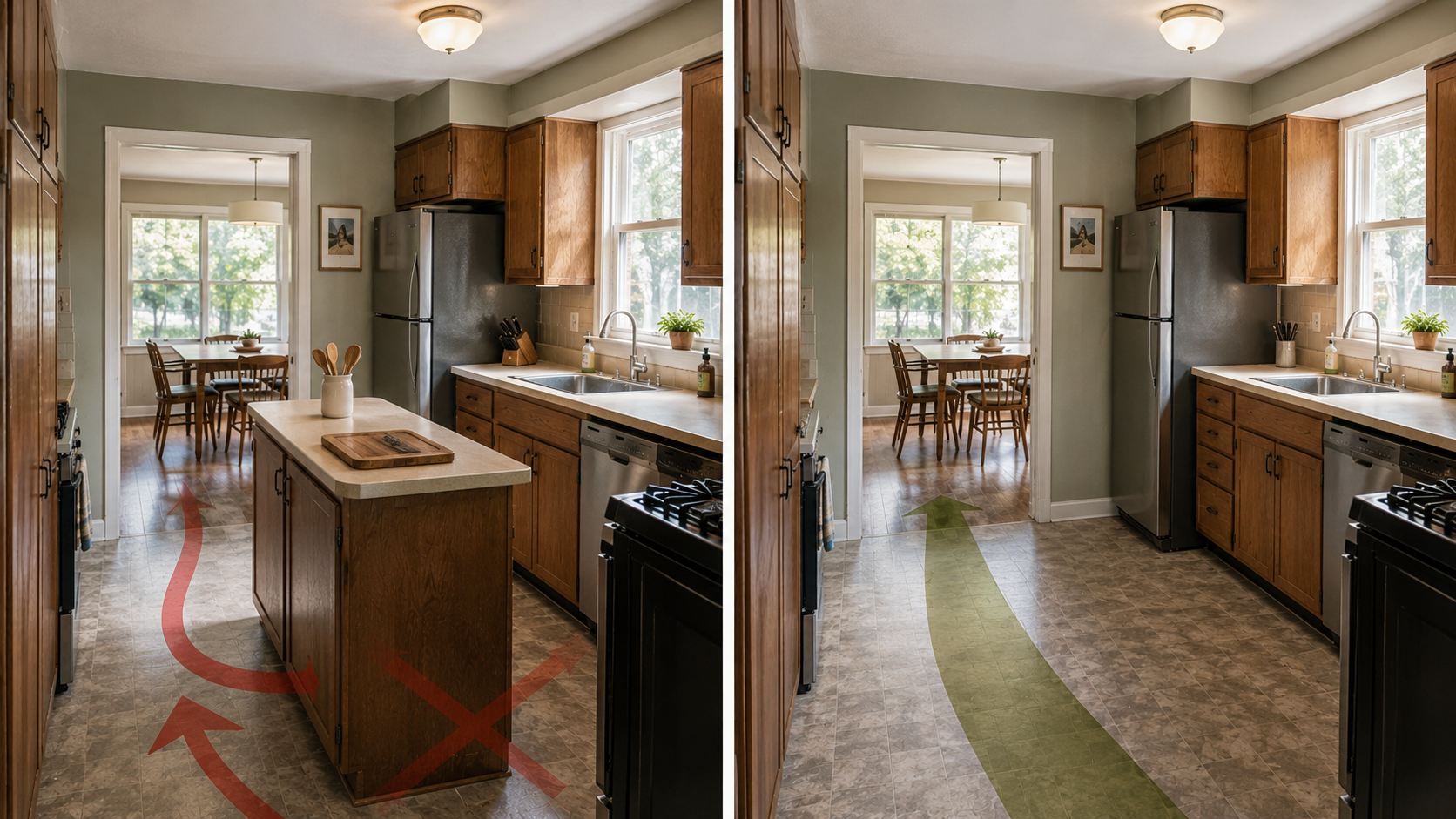
Some kitchen decisions photograph well and work badly. A forced island in a compact ranch kitchen can block the aisle, break the work triangle, and make two people move around each other all day. A too-deep refrigerator may fit the opening but still steal the path between kitchen and dining. Full wall removal without a storage plan can brighten the room and lose the cabinet wall it needed. Open shelving in a small visible kitchen can turn into a clutter display instead of a design feature.
The better test is simple. After the remodel, can someone open the fridge, use the sink, load the dishwasher, stand at the range, and walk through the room without negotiation? If not, the before-and-after is mostly cosmetic.
What to Ask Before Hiring
These questions save more money than arguing about backsplash tile.
- Which wall can open without wrecking storage, appliance placement, or ceiling and floor repair?
- What refrigerator width, height, depth, hinge side, and door swing actually fit this kitchen?
- Can the new cabinet boxes physically travel through every doorway and corner on the delivery path?
- Will the old floor layers be tested before scraping, sanding, grinding, or demolition?
- What electrical, outlet, lighting, and venting work is included before cabinets are installed?
- Where will the floor, ceiling, and trim patches land after wall work?
A contractor or designer who can answer those questions is thinking about the room. A proposal that jumps straight to cabinet style, quartz color, and "open concept" is not ready.
What to Preserve
A good window over the sink, a compact work triangle, solid cabinet boxes, original flat-front doors, simple hardware, built-in storage, and a clean dining connection may be worth keeping. A 1950s ranch kitchen does not have to become a theme set, but it does not need to erase every sign of the house either. If you are not sure what kind of 1950s house you have, start with 1950s house styles — a plain postwar ranch, a stronger mid-century modern house, and a Colonial Revival-influenced ranch do not want the same kitchen language.
FAQ
Should I open the wall in a 1950s ranch kitchen?
Only if the opening improves light, circulation, and dining connection without destroying storage or creating major patching problems. A partial opening or wider doorway is often better than full removal.
What is the biggest problem in a 1950s ranch kitchen remodel?
Appliance fit, almost always. A modern refrigerator, range, dishwasher, and vent hood can break the old cabinet layout and crowd the aisle faster than most homeowners expect.
Can I keep original 1950s kitchen cabinets?
Yes, if the boxes are sound, the layout works, and the appliance openings can be corrected. If the cabinets are damaged, too shallow, badly modified, or blocking a better layout, partial replacement or a full rebuild may be smarter.
Is a kitchen island a good idea in a 1950s ranch?
Often no. Many ranch kitchens are too narrow for an island after accounting for appliance doors, cabinet pulls, walking paths, and two-person use. A peninsula, wider doorway, better counter run, or smaller table may work better.
Will new cabinets fit through my doorways?
Not automatically. Original 1950s ranch doorways were often 28 to 30 inches wide. Large base cabinet boxes can be difficult or impossible to maneuver through narrow openings. Measure the full delivery path before ordering.
What should I check before removing old kitchen flooring?
Check for old vinyl tile, sheet flooring, black adhesive, underlayment, patching, and subfloor damage. Suspect materials should be tested before scraping, sanding, grinding, or demolition.
Is this different from a regular 1950s kitchen remodel?
Yes. A 1950s ranch kitchen has a specific layout problem: compact footprint, low ceiling, tight appliance fit, and a wall connection to dining or living space. The broader 1950s kitchen page covers old kitchens in more house types.
Read This Next
- 1950s Kitchen Remodel: Layout, Cabinets, Appliances, and What to Keep
- 1950s Kitchen Remodel Cost: What Changes the Price in an Old Kitchen
- 1950s Ranch House Remodel: What to Fix, Keep, Open Up, and Avoid
- Ranch Kitchen Before and After: Layout Fixes That Actually Change the Room
- Removing a Wall in a Ranch Kitchen: What Changes Before It Looks Better
- Small Ranch Kitchen Layouts: What Works When the Room Is Tight
- Ranch Kitchen Remodel Cost: What Changes the Price
- Asbestos in 1950s Houses: Where It Hides Before Renovation
- 1950s Houses: What They Are, What Works, What Doesn't