

A 1950s kitchen may be small and still worth working with.
The cabinets may be solid. The sink wall may be in the right place. The window may give good light. The room may only need better storage, better lighting, a real vent, and appliances that fit.
Check the other parts before you plan the finish.
Old wiring, tight counters, bad exhaust, worn flooring, poor dishwasher space, and a wall someone wants to remove can change the whole job.
Keep the parts that still work. Fix the parts that make the kitchen hard to use. Do that first, before the room turns into fake retro or a showroom kitchen that does not fit the house.
If this kitchen is part of a larger old-house project, start with the broader 1950s houses guide so the remodel fits the age, shape, and scale of the home.
Quick reality check
Small kitchen. Big decisions.
- 80–140 sq. ft. is common for many modest 1950s kitchens.
- $75–$175/sq. ft. can be a light refresh when layout and systems stay.
- $175–$400/sq. ft. is common once cabinets, appliances, outlets, floors, and venting join the job.
- $400–$750+/sq. ft. can happen when walls, plumbing, wiring, flooring, and full cabinets change.
- Big jump: moving the sink, opening a wall, disturbing old floor layers, adding real exhaust, or replacing failed cabinets.
Need a fast number? Run the 1950s kitchen remodel cost calculator before comparing quotes so room size, cabinets, wiring, plumbing, floors, venting, layout changes, and wall openings are counted early.
Start here: what kind of 1950s kitchen do you have?
- Good bones: solid cabinets, workable layout, decent daylight, and no obvious water damage. Start with a refresh or keep-layout remodel.
- Layout problem: bad appliance fit, tight aisles, poor storage, blocked doors, or a closed-off room. Fix the plan before choosing finishes.
- Hidden-systems problem: old wiring, weak ventilation, aging plumbing, floor layers, wall issues, or suspected old materials. Inspect before design.
- Full rebuild: failing cabinets, bad layout, unsafe systems, damaged flooring, and wall changes all happening at once. Price the hidden work first.
Quick answer: what should you do with a 1950s kitchen?
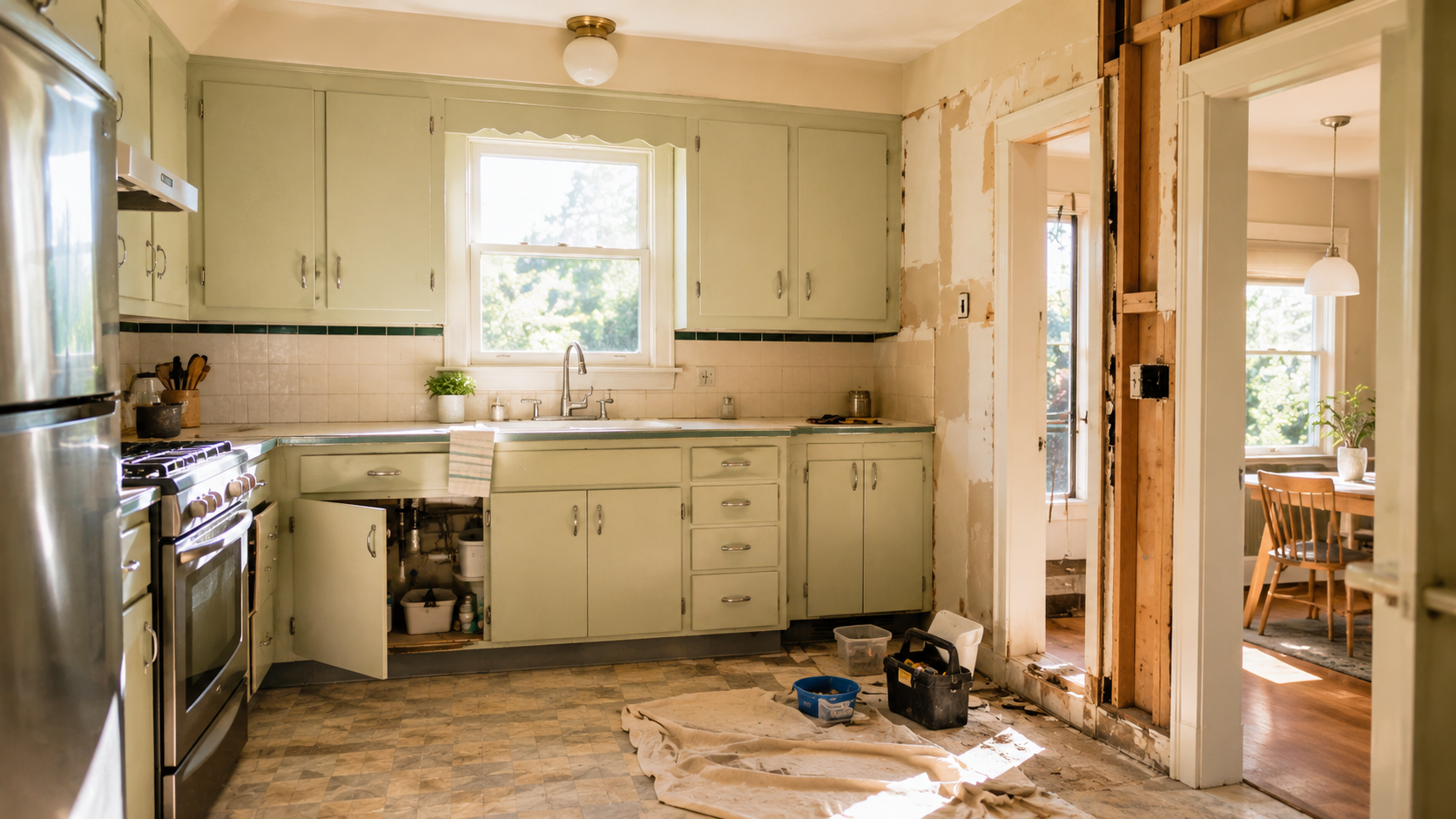
Do not gut it automatically. Do not preserve it blindly either. First decide whether the layout, cabinets, flooring, wiring, plumbing, ventilation, and appliance locations still work.
| Kitchen feature | Keep it when | Replace or change it when |
|---|---|---|
| Cabinet boxes | They are solid, dry, square, and still fit the layout. | They are swollen, shallow, cut apart, loose, or badly modified. |
| Cabinet doors | The style is simple and the doors can be painted, refinished, or repaired. | The doors are warped, broken, too damaged, or not worth the labor. |
| Layout | The sink, stove, and refrigerator are usable and the room has a clear path. | The refrigerator blocks the aisle, the dishwasher cannot open, or the work zones fight each other. |
| Wall opening | The kitchen only needs a better connection to the dining room or living space. | The wall blocks light and circulation, but structure and mechanical runs must be checked first. |
| Flooring | It is stable, safe, level enough, and does not need to be disturbed. | It is loose, damaged, moisture-stained, layered badly, or tied to cabinet changes. |
| Lighting | The room already has decent task light and only needs upgrades. | The kitchen is dim, shadowy, or dependent on one weak ceiling fixture. |
| Ventilation | The range hood works and vents outside. | The hood is weak, missing, recirculating poorly, or has no practical duct route. |
| Appliances | They fit the room without blocking doors, drawers, or walk paths. | Modern appliance size breaks the old cabinet openings or circulation. |
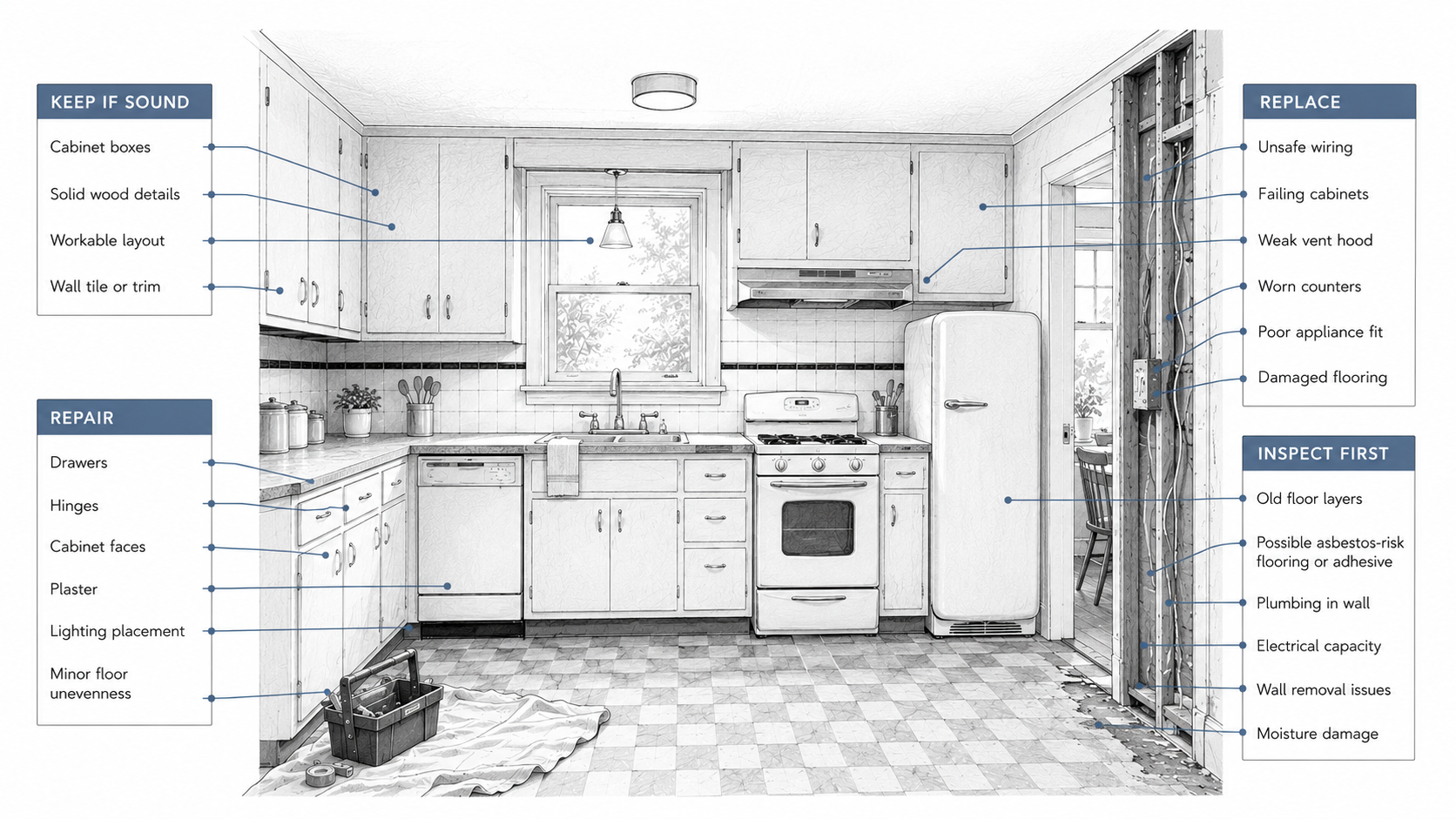
Best remodel path based on what you have
| If your kitchen has... | Best remodel path | Avoid |
|---|---|---|
| Solid cabinets, decent layout, poor lighting | Refresh, lighting upgrade, cabinet repair, better hardware, and a cleaner finish plan | Full cabinet replacement before checking whether the old boxes are worth keeping |
| Good shell but bad appliance fit | Keep-layout remodel with a new appliance plan, clearer door swings, and better cabinet openings | Ordering cabinets before measuring refrigerator depth, dishwasher swing, and oven clearance |
| Closed-off kitchen with good structure | Partial opening, wider doorway, cased opening, or better connection to the dining area | Removing the whole wall without pricing beam work, ceiling repair, wiring, ducts, and floor patching |
| Good original cabinets with one bad appliance wall | Partial cabinet replacement or one-wall rebuild while preserving the useful cabinet runs | Gutting the whole kitchen because one zone is failing |
| Old wiring, bad plumbing, damaged floor, and failing cabinets | Full rebuild with systems first, then cabinets, appliances, lighting, and finishes | Cosmetic refresh over hidden failure |
The safest path is usually a controlled remodel: keep the useful parts, repair the tired parts, and open walls or floors only when the payoff is clear.
1950s kitchen remodel reality check
A small 1950s kitchen can still be expensive because the room usually needs more trade work than square footage suggests. Use cost per square foot only as a quick planning check, not as a contractor quote.
| Planning item | Realistic starting point | What changes it fast |
|---|---|---|
| Typical 1950s kitchen size | About 80 to 140 square feet in many modest houses | Dining-room openings, added pantry walls, or combining rooms |
| Light refresh | Roughly $75 to $175 per square foot | Cabinet repair, lighting, hardware, paint, faucet, simple flooring, and minor electrical fixes |
| Keep-layout remodel | Roughly $175 to $400 per square foot | Cabinet refacing or replacement, counters, appliances, outlets, flooring, ventilation, and wall repair |
| Full rebuild | Roughly $400 to $750+ per square foot | New cabinets, layout changes, plumbing, wiring, floor layers, ventilation, plaster repair, and old-house surprises |
| Wall opening or structural work | Do not price this by square foot | Beam work, permits, ceiling repair, flooring patches, wiring, ducts, and lost cabinet storage |
The number usually jumps when the sink moves, the wall opens, the floor layers need testing, the range hood needs a real duct route, or the old cabinet boxes cannot be reused.
For the full budget breakdown, use the separate 1950s kitchen remodel cost guide before ordering cabinets, counters, or appliances.
Start with the kitchen you actually have
Many 1950s kitchens were built for a smaller refrigerator, fewer plug-in appliances, no dishwasher, shorter cabinet runs, and one main cook. That does not mean the room is useless. It means modern use is asking more from the same shell.
Before choosing cabinets, counters, or colors, document the existing kitchen.
- Measure the room.
- Measure appliance openings.
- Open the refrigerator, oven, dishwasher, and cabinet doors.
- Check where the sink, drain, and supply lines are.
- Check how many outlets the kitchen has and where they are.
- Look at the range hood and where it vents.
- Check the floor height at doorways and transitions.
- Look for old floor layers before demolition.
- Check whether a wall you want to open may contain structure, wiring, ducts, or plumbing.
That first inspection keeps the remodel honest. It tells you whether this is a refresh, a keep-layout remodel, or a full rebuild.
Common 1950s kitchen layout problems
The layout is usually the real problem, not the color of the cabinets.
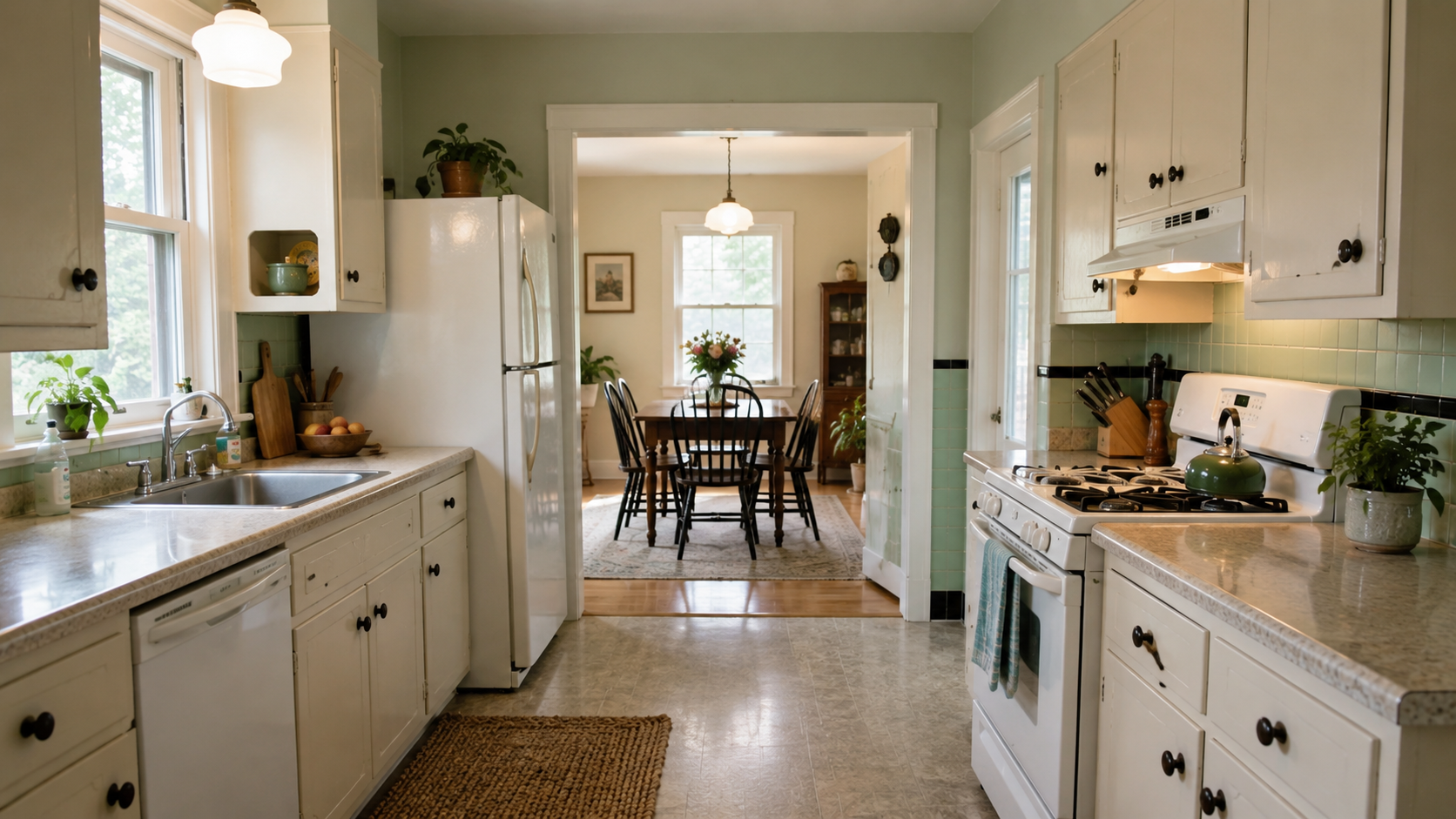
A 1950s kitchen may have a short work aisle, a small eating area, a sink under the window, a tight range location, and cabinets designed around appliance sizes that no longer exist. Once a modern refrigerator, dishwasher, and larger range go in, the old room can stop working fast.
The refrigerator is too deep
This is one of the most common problems. A deep refrigerator can stick into the main path, block a doorway, or make the kitchen feel narrower than it is. A counter-depth refrigerator is not always cheap, but it can protect circulation in a compact room.
The dishwasher blocks the sink zone
Many 1950s kitchens were not designed for a dishwasher. Adding one beside the sink can work, but the door needs room to drop without trapping someone at the sink or blocking the main path.
The range is in the wrong place
A range needs landing space, safe clearances, and ventilation. If the range is jammed into a corner or trapped beside a doorway, the remodel may need more than a new appliance.
The kitchen has no real landing space
Modern kitchens need places to set groceries, drain dishes, prep food, and unload appliances. A small kitchen does not need a huge island, but it does need usable counter space in the right places.
The island does not fit
Many 1950s kitchens are too narrow for an island. A forced island can make the room worse by blocking the refrigerator, dishwasher, oven, and walk path. A peninsula, wider doorway, shallow pantry wall, or better appliance order may solve more problems with less damage.
In ranch houses, this layout problem often connects to the larger 1950s ranch house remodel, especially when the kitchen is being opened toward the dining or living area.
Cabinets: keep, paint, reface, or replace?
Original 1950s kitchen cabinets can be better than cheap new cabinets. They can also be too worn, too shallow, or too badly modified to save. The boxes decide the path.
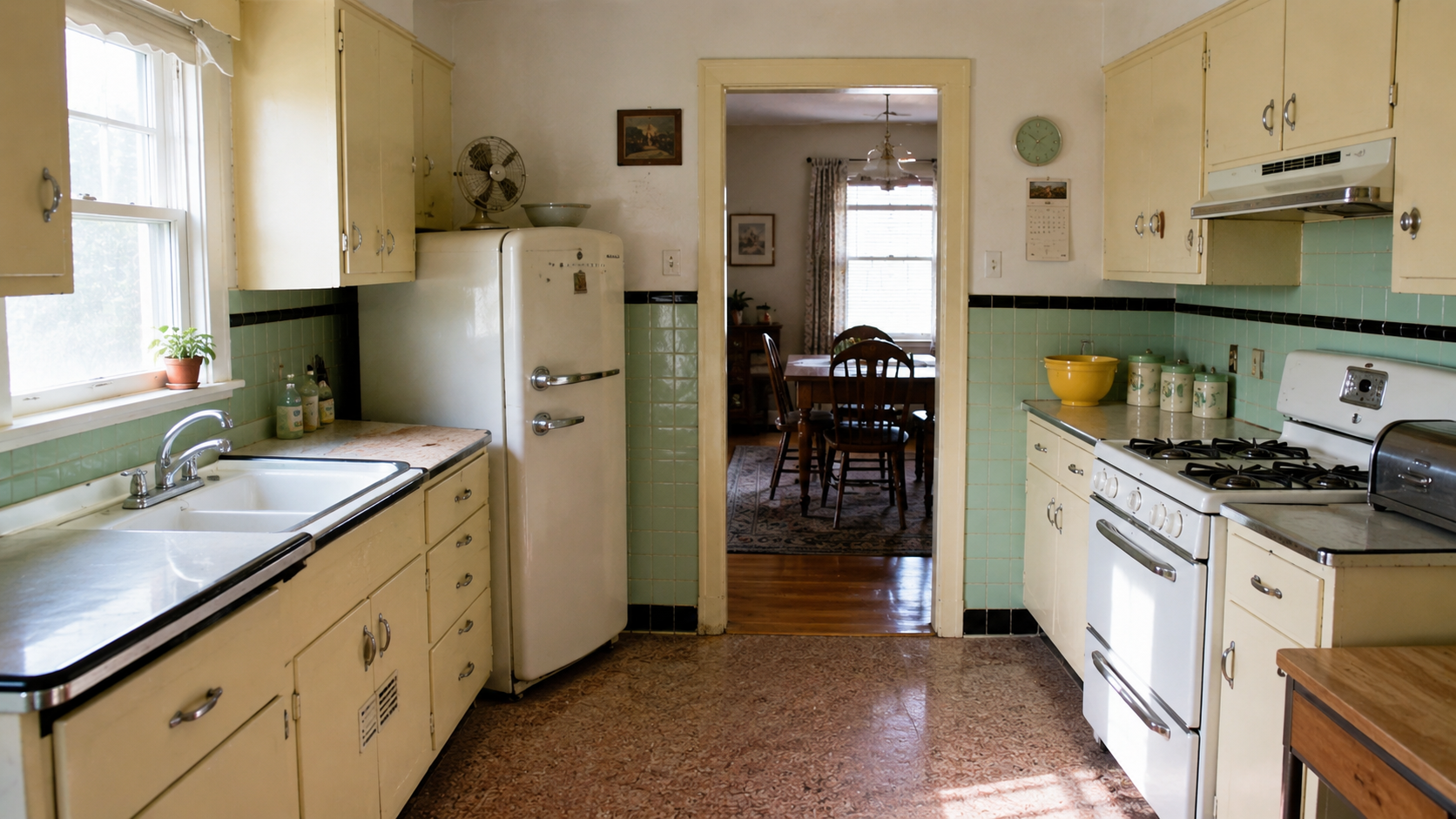
Keep or refinish the cabinets when the boxes are solid
If the cabinet boxes are dry, square, deep enough, and still attached well, keeping them can make sense. Paint, refinishing, new hardware, repaired drawers, better hinges, and interior organizers can improve the kitchen without destroying its period character.
Reface when the boxes are good but the doors are not
Refacing works when the layout still makes sense and the cabinet boxes are worth saving. It can clean up the room without paying for a full cabinet rebuild.
Partially replace when one wall fails
Sometimes most of the kitchen works, but one appliance wall does not. A partial replacement can fix the refrigerator, pantry, or range area while keeping good original cabinets elsewhere.
Fully replace when the kitchen no longer works
Full cabinet replacement is justified when the boxes are failing, the appliance openings are wrong, storage is poor, the layout is bad, and repairing everything would cost too much for a still-bad result.
Do not spend good money refinishing cabinets that are already failing. That is delay, not preservation.
Appliance fit: the problem most people miss
A 1950s kitchen can look like it has room until the modern appliances arrive.
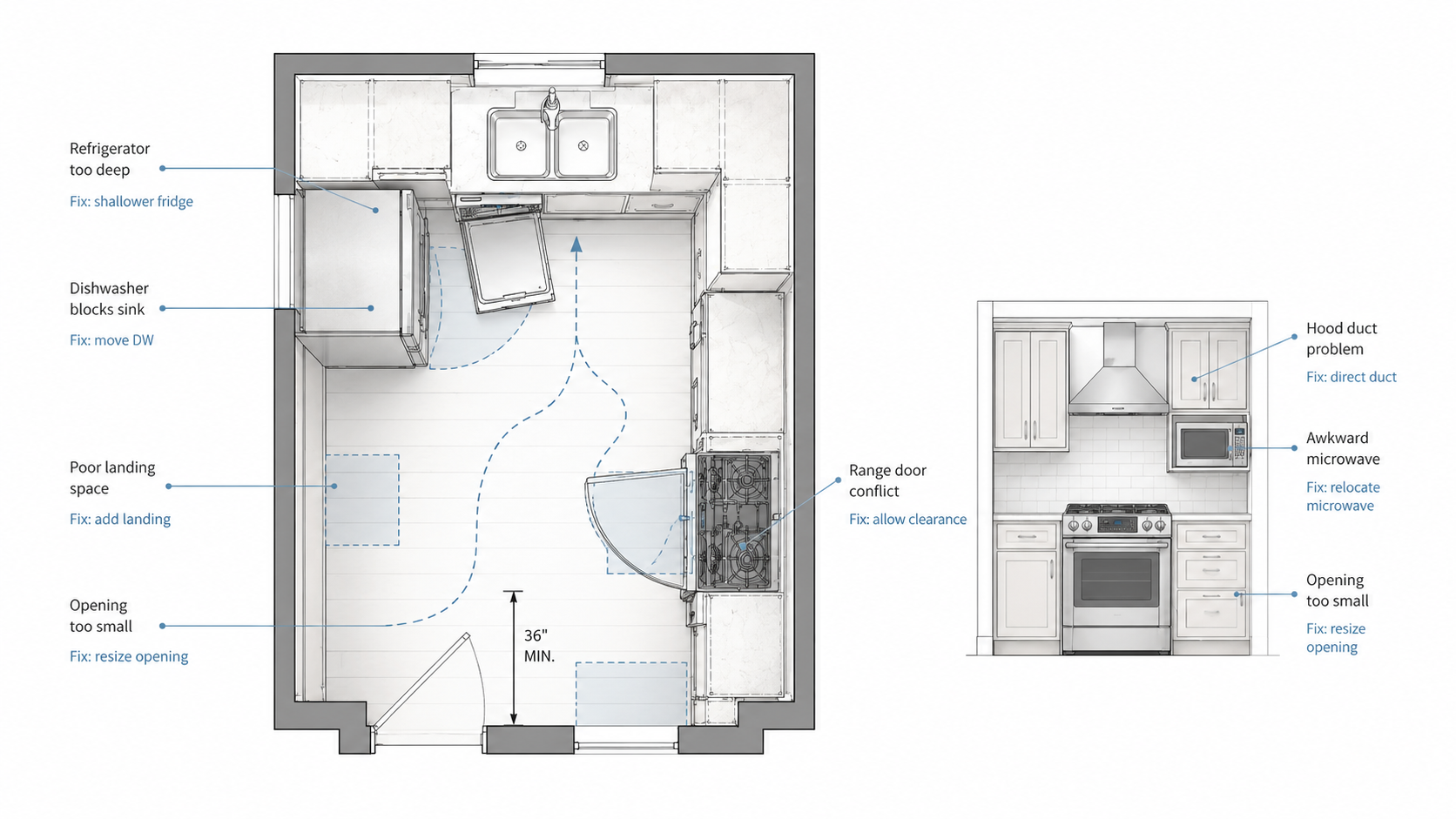
The refrigerator is deeper. The dishwasher door needs swing space. The oven door drops into the aisle. The range hood needs a duct route. The microwave needs a real location. The old cabinet opening may not match modern appliance widths.
Before ordering appliances, check:
- Refrigerator depth and door swing.
- Dishwasher door swing.
- Oven door clearance.
- Range hood width and duct path.
- Microwave location.
- Counter landing space beside appliances.
- Door swings from the basement, pantry, back entry, or dining room.
- Whether two people can pass through the kitchen when an appliance is open.
Appliance fit should happen before final cabinet drawings. Not after.
Should you open a 1950s kitchen wall?
Opening a wall can help a 1950s kitchen. It can also turn a simple remodel into a structural project.
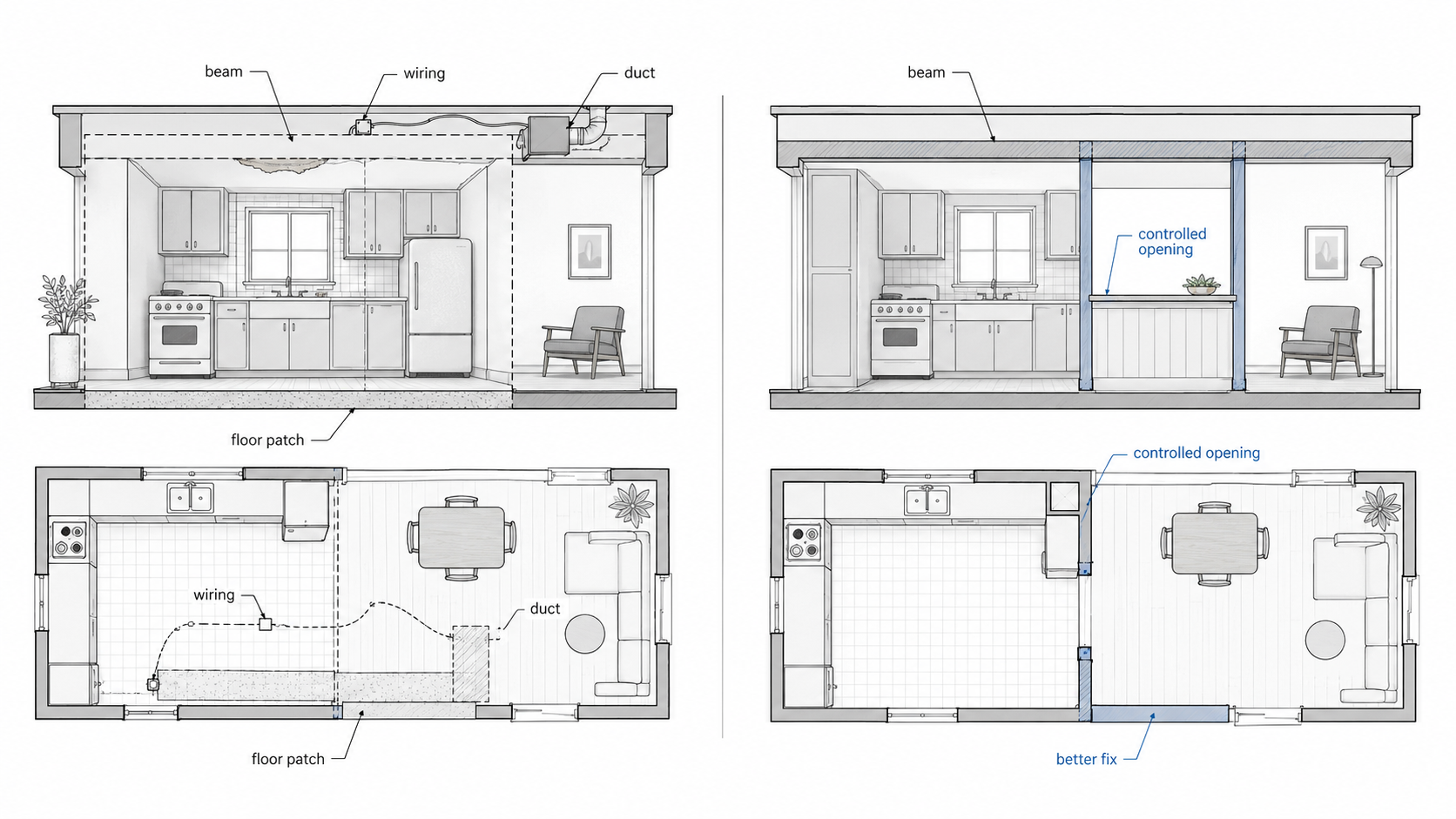
A full wall removal is not always the best answer. A wider doorway, pass-through, partial opening, or cased opening can bring more light and connection while preserving storage, structure, and some separation from cooking mess.
Open the wall when it solves a real problem
A wall opening makes sense when the kitchen is dark, isolated, cramped, or poorly connected to the dining area. The opening should improve daily use, not just copy an open-concept trend.
Check the wall before planning the opening
The wall may carry structure. It may also contain wiring, ductwork, plumbing, or old patchwork. If those items are ignored, the cost can jump quickly.
Think about what disappears
Removing a wall can also remove upper cabinets, a pantry spot, a place for the range, or a clean electrical path. A kitchen with better flow but no storage is not a win.
If wall removal is part of the plan, compare the scope with 1950s kitchen remodel cost before assuming it is just demolition.
Flooring, old layers, and asbestos risk
Kitchen floors in 1950s houses can hide a lot of history. One visible floor may sit over sheet vinyl, old tile, adhesive, underlayment, patched subfloor, or moisture damage near the sink.
Do not sand, scrape, grind, or tear out old flooring or adhesive until suspect materials have been checked. Some older floor products and adhesives may contain asbestos, and disturbance is the problem.
If the floor is stable and safe to leave in place, building over it may be better than tearing it out. If cabinets are coming out, flooring is loose, or the layout changes, the floor may need a careful plan.
For the safety side, see asbestos risks in 1950s houses before removing old flooring, adhesive, siding, ceiling material, or pipe insulation.
Lighting, ventilation, outlets, and daily use
Good kitchen design is not only cabinets and counters. It is light, air, power, and movement.
Lighting
Many older kitchens rely on one central ceiling fixture. That leaves shadows at the sink, counter, and range. A better remodel usually needs layered light: general light, task light, and focused light where food is prepared.
Ventilation
A nice range hood that does not vent well is mostly decoration. Plan the hood and duct path early, especially if the range is moving or the upper cabinets are changing.
Outlets and circuits
Older kitchens were not built for the number of plug-in devices used today. A remodel is the right time to review outlet placement, appliance circuits, grounding, and GFCI protection with a qualified electrician.
Daily use
Think about trash, recycling, dish storage, coffee equipment, small appliances, pantry goods, school bags, pet bowls, and the back door. These ordinary details decide whether the kitchen works after the photos are taken.
Design choices that still fit a 1950s kitchen
A 1950s kitchen does not need to become a fake diner. It also does not need to become a luxury kitchen from a much larger house.
The strongest updates usually keep the room calm and practical.
Use one or two period cues
Flat-front cabinet doors, simple pulls, a modest color, a clean laminate, warm wood, or a period-sensitive light fixture can be enough. Do not use every retro signal at once.
Keep finishes modest
Most 1950s kitchens were not huge luxury rooms. Simple counters, durable flooring, practical tile, and clean cabinet lines usually fit better than heavy stone, oversized fixtures, and dramatic designer finishes.
Let the house set the tone
A ranch kitchen, Cape Cod kitchen, split-level kitchen, and modest postwar bungalow kitchen do not all need the same treatment. The kitchen should feel connected to the house it belongs to.
Avoid the flip look
The fastest way to make a 1950s kitchen feel wrong is to erase every old-house cue and replace it with generic gray finishes, oversized lights, and cheap cabinets. A practical remodel should feel cleaner and more usable, not stripped of all identity.
Remodel choices that look good in photos but fail in real kitchens
Some remodel ideas photograph well for a few seconds and then fail every morning. A compact 1950s kitchen is not forgiving when clearances, storage, and ventilation are wrong.
- A large island in a kitchen that does not have the aisle width for it.
- Open shelves replacing useful upper cabinets in a small kitchen that already lacks storage.
- A deep refrigerator sticking into the main walkway.
- A dishwasher door that blocks the sink, a drawer bank, or the main path.
- A range hood that looks good but does not vent outside.
- Cheap new cabinets replacing better original boxes.
- Retro colors used everywhere instead of as one controlled detail.
- Flooring installed over old problems without checking what is underneath.
- A full wall removal that ignores beam work, wiring, duct conflicts, ceiling repair, and floor patching.
Before and after: what a smart remodel changes
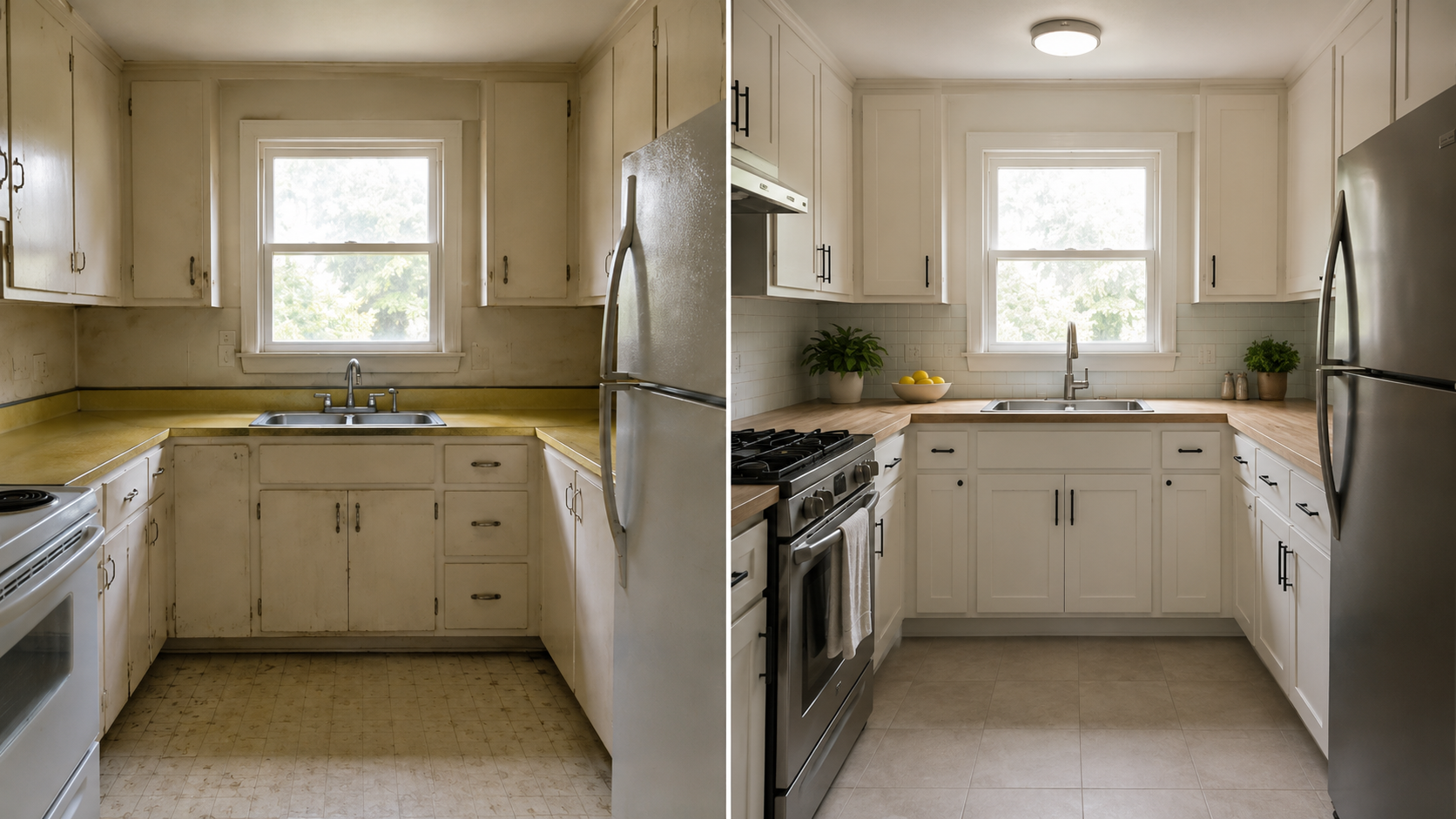
A good before-and-after does not need to make the old kitchen unrecognizable.
The “before” kitchen may have weak lighting, tired cabinets, poor appliance fit, old flooring, and awkward circulation. The “after” kitchen should improve the things that matter every day: storage, counter space, appliance clearance, lighting, ventilation, flooring, and the relationship to the next room.
The best remodel keeps the scale of the house. It does not force a large-island kitchen into a shell that was never built for one.
Questions to ask before hiring the work
These questions help separate a real plan from a surface-level kitchen quote.
- Can the existing cabinets be reused, refaced, repaired, or partly replaced?
- Will the new refrigerator, dishwasher, and range fully open without blocking the aisle?
- Does the range hood vent outside?
- Is there a clear duct route for the hood before the upper cabinets are ordered?
- Will electrical work be needed for modern appliances, lighting, countertop outlets, and GFCI protection?
- Are old floor layers being disturbed?
- Does the wall opening affect structure, ducts, wiring, or plumbing?
- What hidden work is excluded from the first price?
- What happens if floor damage, old wiring, or plumbing problems are found after demolition?
- What work needs permits or inspection in this location?
1950s kitchen remodel checklist
- Measure the full kitchen before choosing products.
- Check appliance depth, width, swing, and clearances.
- Inspect cabinet boxes before deciding to paint or replace.
- Check outlet locations and electrical capacity.
- Check plumbing condition at the sink wall.
- Confirm whether the range hood vents outside.
- Check old flooring layers before demolition.
- Decide whether the wall opening is worth the structural and finish work.
- Plan lighting before closing walls or ceilings.
- Choose finishes after the hidden scope is understood.
FAQ
Should I keep original 1950s kitchen cabinets?
Keep them if the boxes are solid, dry, square, and still work with the layout. Replace them if they are swollen, shallow, loose, badly modified, or not worth the repair labor.
Can a small 1950s kitchen be remodeled without moving walls?
Yes. Many small kitchens improve with better appliance sizing, lighting, storage, cabinet repair, flooring, and a clearer opening to the next room. Full wall removal is not always needed.
Is an island a good idea in a 1950s kitchen?
Only if the room has enough width and clearances. Many 1950s kitchens work better with a peninsula, better cabinet layout, or improved doorway instead of a forced island.
What is the biggest mistake in a 1950s kitchen remodel?
The biggest mistake is spending on finishes before checking appliance fit, wiring, plumbing, ventilation, flooring layers, and wall conditions.
Can old 1950s kitchen flooring contain asbestos?
Some older flooring and adhesives may contain asbestos. Do not sand, scrape, grind, or demolish suspect material until it has been checked.
Should I open the kitchen to the dining room?
Sometimes. A partial opening can improve light and connection without removing every wall. Check structure, wiring, plumbing, ductwork, floor patching, and storage loss first.
How do I modernize a 1950s kitchen without ruining it?
Keep the scale modest, use simple cabinet lines, improve lighting and appliance fit, fix ventilation, and preserve one or two period-sensitive details instead of using a heavy retro theme.
Read This Next
- 1950s kitchen remodel cost
- 1950s houses
- 1950s ranch house remodel
- 1950s bathroom remodel
- asbestos risks in 1950s houses