
How Did Romans Build Structures That Still Stand Today?
Roman Building Style: What Made It So Strong and Lasting
Can You Spot These Classic Roman Features in Modern Cities?
Getting Started: What Made Roman Architecture Different?
Roman architecture was about building smarter. Starting in the 1st century BC, Roman builders developed techniques that made structures last longer, cover more space, and cost less to maintain.
They blended practicality with ambition, and the result?
Roads, aqueducts, temples, arenas—many of which are still standing.
- Key Features: Arches, domes, concrete, urban planning
- Materials: Stone, brick, volcanic ash-based concrete
- Style: Bold, symmetrical, built to impress and function
How It All Started: 1st Century BC

The Roman building style didn’t appear overnight. It was a mix of Greek, Etruscan, and local innovations.
But in the 1st century BC, Rome began to shape its own look—monumental, structured, and distinctly Roman.
What Changed?

Image: Timeline infographic showing key periods and innovations in Roman architecture, from early brickwork to advanced engineering methods like arches and domes.
- More public buildings (forums, temples, amphitheaters)
- Better materials and tools
- Large-scale construction became more organized
Borrowing from the Greeks
Romans took Greek styles and made them their own. They kept the columns but added their own twist.
- Greek Influences:
- Doric, Ionic, and Corinthian columns
- Proportional design
- Roman Additions:
- Bigger scale
- Arches and domes for broader spans
- Concrete for mass production
Roman Building Style: Easy Guide to Its Key Features
What Is Roman Architecture and Why Is It So Famous?
The Game Changer: The Roman Arch

The arch was the Romans' secret weapon. It allowed them to build higher, wider, and stronger.
- Why it Mattered:
- Could span greater distances
- Distributed weight evenly
- Made aqueducts and big public buildings possible
Example: Pont du Gard aqueduct in France—arched, efficient, and still standing.
The Golden Age: 1st Century AD

This was Rome's architectural peak. The empire had the money, the manpower, and the ambition to build big.
- Famous Structures:
- The Colosseum: Over 50,000 seats, built with arches and vaults
- The Pantheon: Largest unreinforced dome in the world, perfect proportions

Image of the Pantheon in Rome showing its grand portico, large columns, and iconic dome representing ancient Roman design.
- Construction Techniques:
- Modular stone and brick
- Roman concrete (pozzolana + lime + rubble)
- Repetition of design for speed and efficiency
From Function to Grandeur (2nd – 5th Century AD)

As the empire grew, Roman style spread and evolved.
- Expansion: Adopted local styles from provinces (Egypt, Gaul, Syria)
- Function: More basilicas, baths, and housing blocks
- Christian Influence: Basilicas became churches
Smart City Planning
Rome was a pioneer in organizing urban space:
- Forums for civic life
- Baths for hygiene and socializing
- Grid street systems
Key Materials and Tools
- Concrete: Fast-setting, durable, and moldable
- Brick-faced concrete walls: Cheap and effective
- Wood scaffolding: Used temporarily in vault construction
Roman Architects You Should Know
- Vitruvius: Wrote De Architectura; defined firmness, utility, and beauty
- Apollodorus of Damascus: Designed Trajan's Forum and Column
- Severus and Celer: Creators of Nero's Domus Aurea (Golden House)
Iconic Buildings and What Made Them Special
- The Colosseum: Engineering + entertainment
- The Pantheon: Dome with oculus; symbol of Roman innovation
- Baths of Caracalla: Public luxury on a massive scale
- Roman Forum: Civic, religious, and political heart of Rome
- Trajan’s Market: Early shopping mall concept
How Romans Kept Buildings Standing
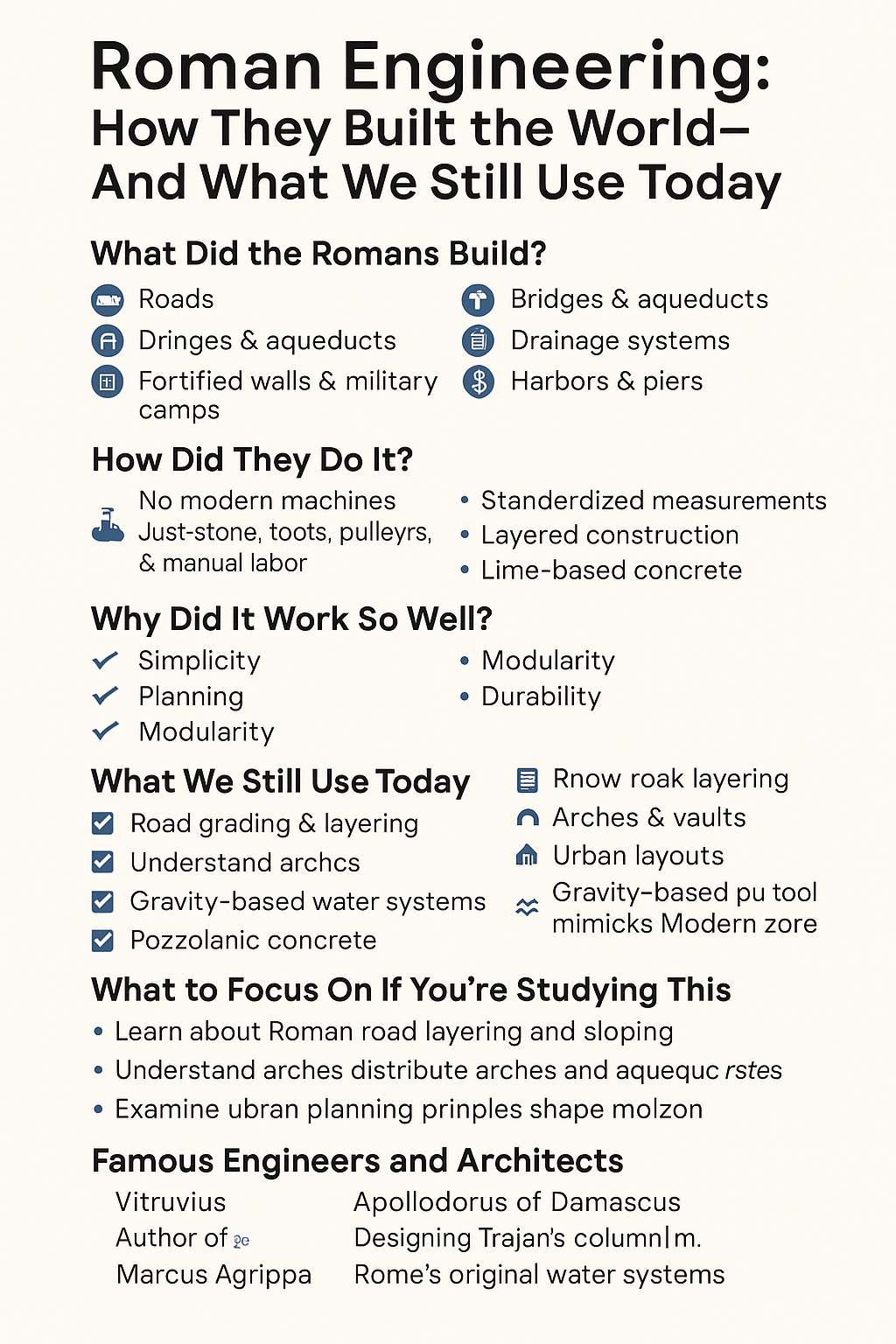
Image: Visual breakdown of Roman engineering techniques, showcasing how roads, walls, and water systems were built with stone, basic tools, and smart planning—many principles still used today.
- Used volcanic ash in concrete (resists erosion)
- Preferred arches to beams for better load distribution
- Integrated drainage and ventilation systems
- Mastered foundation and support systems for heavy loads
Why Do So Many Buildings Copy Roman Design?
Roman Influence Today
- Seen in neoclassical government buildings
- Inspired Renaissance and Enlightenment architects
- Modern urban planning owes a debt to Roman forum layouts
Practical Lessons from Roman Building Style
- Use what’s available: Romans optimized local materials
- Design with purpose: Everything served a function
- Balance beauty with structure: Nothing was decorative without a reason
- Innovate within tradition: They didn’t reject old ideas; they improved them
Bonus: Fun Facts
- Concrete Dome Trick: Pantheon dome gets thinner toward the top
- Central Heating: Romans used hypocaust systems in bathhouses
- Mass Housing: Insulae (early apartment buildings) housed up to 200 people
Final Takeaway
Roman architecture wasn’t just impressive—it was useful, smart, and way ahead of its time.
The blend of function, style, and engineering still inspires today. Whether you're designing a city hall or a quiet courtyard, there's something to learn from how the Romans built.
Their legacy? Buildings that still make people stop and stare—2,000 years later.
Roman Engineering in Action
Roman architecture wasn't just about looks. Beneath those grand columns and domes was some of the most advanced civil engineering of the ancient world.
The Romans built infrastructure that still influences how we design cities, roads, and utilities today.
Let’s look at how they managed to shape the landscape using basic tools and brilliant planning.
1. Roman Roads: Built to Last
Roman roads were famous for their durability, and many still exist today. These weren’t just dirt paths—they were multi-layered engineering marvels.
- Layers of Strength: Roads were made with compacted sand, crushed stone, gravel, and paving stones.
- Crowned for Drainage: The center of the road was slightly raised so water would run off to the sides.
- Strategic Routes: Roads connected military outposts, trade hubs, and cities across the empire.
Example: The Appian Way (Via Appia), built in 312 BC, stretched over 300 miles and is still partially walkable today.
2. Roman Aqueducts: Moving Water Without Pumps
To supply cities with clean water, Romans used gravity and precise calculations to build aqueducts that carried water over long distances.
- Gentle Slopes: Aqueducts dropped only a few inches per mile to maintain water flow.
- Arches and Channels: Where the landscape dipped, arches supported the channels.
- Covered Systems: To keep water clean, much of the system was underground.
Example: The Pont du Gard in France is an iconic multi-tiered aqueduct still admired for its beauty and functionality.
3. Bridges: Stonework That Spanned Rivers
Roman bridges combined strength and design. Their use of stone arches distributed weight evenly and resisted erosion.
- Keystone Arches: The central stone (keystone) locked each arch into place.
- Cutwater Piers: Pointed piers deflected water and debris.
- Standardized Methods: Romans used templates and repeated techniques for consistency across the empire.
Example: The Alcántara Bridge in Spain, built around 104 AD, is still standing and in use.
4. Building with Limited Tools, Unlimited Ingenuity
Despite having no cranes or modern machinery, the Romans used smart systems:
- Pulleys and Levers
- Scaffolding and Wooden Frames
- Team Coordination and Skilled Labor
They proved that genius isn't always about new tech—it's about knowing how to use what you've got.
Legacy of Roman Engineering
What makes Roman engineering stand out is its practicality and foresight. Their roads made movement fast and efficient. Their aqueducts ensured public health. Their bridges made trade and conquest possible.
These weren’t just construction projects—they were systems designed for a growing, interconnected empire.
Next time you see a modern bridge or a cleanly planned street, you might be seeing a little bit of Rome.
FAQ
What Are Roman Style Buildings Called?
Exploring the Terminology of Roman Architecture
Roman architecture has given us a variety of terms that describe its distinctive features. These terms help us understand and categorize the different types of structures the Romans built. Some common names include:
- Basilica: A large public building used for legal and other civic proceedings.
- Amphitheater: An open-air venue for public events, such as gladiator contests and theater performances. The Colosseum is the most famous example.
- Domus: A private residence or house, typically owned by wealthy Roman citizens.
- Villa: A luxurious country house, often with extensive gardens and outbuildings.
- Insulae: Multi-story apartment buildings where many Romans lived.
- Forum: A public square in a Roman municipium, or city, reserved primarily for the vending of goods; it was a place where various activities such as public speeches, criminal trials, and gladiatorial matches took place.
- Thermae: Large bath complexes that included facilities for bathing, exercising, and socializing.
What Is the Roman Architecture Style?
Deciphering the Characteristics of Roman Architecture
Roman architecture is characterized by specific elements and principles that have influenced building design for centuries. Key characteristics include:
- Use of Arches and Vaults: These elements allowed for stronger and more durable structures.
- Concrete Construction: Romans were pioneers in the use of concrete, which enabled them to build larger and more complex structures.
- Classical Orders: Incorporation of Doric, Ionic, and Corinthian columns, often combined in a single structure.
- Domes: The use of domes, especially in buildings like the Pantheon, which showcases the height of Roman engineering.
- Symmetry and Proportion: Romans emphasized harmony, balance, and proportion in their designs.
- Ornamentation: Decorative details such as frescoes, mosaics, and sculptures were widely used to enhance the aesthetic appeal of buildings.
What Were the Roman Building Techniques?
Mastering the Craftsmanship Behind Roman Buildings
The Romans developed and perfected numerous building techniques that were revolutionary for their time. Some key techniques include:
- Concrete (Opus Caementicium): A mix of lime mortar, volcanic sand, water, and small stones. This allowed for more flexibility in design and construction.
- Arches and Vaults: Mastery of the arch and vault enabled the construction of massive structures like aqueducts and the Colosseum.
- Brick and Stone: Romans used bricks and stones extensively, combining them with concrete to create strong and durable buildings.
- Hydraulic Engineering: Advanced techniques for building aqueducts and sewage systems.
- Road Construction: Building straight, durable roads that connected the vast reaches of the Roman Empire.
How Did Romans Decorate Their Interiors?
Luxurious Interiors and Fine Details
Roman interior design was as impressive as their architecture. Homes and public buildings were often adorned with:
- Frescoes: Wall paintings that depicted mythological scenes, landscapes, and daily life.
- Mosaics: Intricate designs made from small pieces of colored stone or glass, used on floors and walls.
- Marble: Widely used for floors, walls, and sculptures.
- Furniture: Elegant and functional furniture made of wood, marble, and bronze.
What Was the Role of Public Spaces in Roman Cities?
Social and Political Hubs
Public spaces were central to Roman life and included:
- Forums: Centers of political, economic, and social activity.
- Bathhouses: Places for bathing, relaxing, and socializing.
- Theaters and Amphitheaters: Venues for entertainment, including plays and gladiatorial games.
- Temples: Religious centers where citizens worshipped their gods.
How Did Roman Architecture Influence Modern Building Design?
Roman architecture has had a profound influence on modern building design. Elements such as arches, domes, and the use of concrete have been incorporated into contemporary architecture.
Public buildings like capitols, museums, and courthouses often feature Roman-inspired columns and facades, demonstrating the timeless appeal of Roman design principles.
Related
-
Roman Architecture Style | Materials, Tools, and Style
Covers the materials and tools Romans used and how these shaped their architecture. -
History of Romanesque Architecture
Covers the development and characteristics of Romanesque architecture. -
Romanesque Architecture Style
Overview of the general style and features of Romanesque architecture. -
Characteristics of Roman Architecture: Arches, Columns, and Innovation
Highlights key features like arches and columns that made Roman buildings unique. -
Ancient Roman Architecture: Techniques, Structures, and Impact
Details Roman building methods, major structures, and their lasting effects. -
Roman Forum Architecture: The Center of Roman Public Life
Focuses on the design and importance of the Roman Forum in public life. -
The Birth of Gothic Architecture: From Romanesque to Innovation
Explains how Gothic style evolved from Romanesque architecture. -
Romanesque Architecture Style Interior Design
Discusses interior design elements of Romanesque buildings. -
Roman Architecture and Engineering
Explores the relationship between Roman building design and engineering advances.