

Why Frank Lloyd Wright’s Organic Design Still Feels Radical Today
Forget myths—get inside the core of Wright’s design philosophy with real-world insights, brutal details, and architecture that breathes.
Frank Lloyd Wright Didn’t Just Work With Nature—He Made Buildings That Were Nature
Most designers try to blend into the landscape. Wright went further—he made the building and landscape inseparable.
He called it “organic architecture.” But don’t let the label fool you. This wasn’t about decorating a house with rocks and wood.
It was about purpose, honesty, and radical connection. The land shaped the form. The function shaped the structure. And people shaped the spirit.
What you're about to read isn't a tour through buzzwords. It's a breakdown of what actually made Wright’s work timeless—and what modern designers keep getting wrong.
Hard Truth: Most “Green” Buildings Today Miss the Point
You’ve seen them—buildings with solar panels, green walls, maybe some bamboo floors. They’re called “sustainable,” but they’re decorated, not designed, for nature.
Wright wouldn’t have been impressed.
→ His view? You don’t add nature on top of design. You design with nature from the start—or you’re faking it.
How Did Frank Lloyd Wright Actually Build His “Living” Spaces?
Frank Lloyd Wright’s Core Principles of Organic Architecture
The 6 Principles of Organic Architecture (That Actually Mattered)

Let’s break them down—Wright’s way, not the Pinterest version.
1. Form Follows Function—But Form Should Also Feel Natural
Every room had a purpose. Every material had a reason to be there. Every line followed life.
▪ Roofs that hugged the slope of the land
▪ Overhangs that blocked summer sun but let in winter light
▪ Open plans that flowed like rivers, not corridors
→ Wright once said:
“A building should appear to grow easily from its site and be shaped to harmonize with its surroundings.”
2. Materials Come From the Earth—And Stay Honest
Wright hated paint. He didn’t fake finishes.
● Wood looked like wood
● Brick stayed rough and proud
● Concrete showed its grain
He wanted buildings to age—to show time and weather like tree bark.
3. Interior and Exterior Are One Space
Walk into Fallingwater, and you’re not “inside.” You’re just deeper in the woods.
▪ Stone floors run from living room to patio without change
▪ Glass walls disappear into tree trunks
▪ Streams run beneath your feet—literally
He blurred boundaries. Not for beauty—for truth. You’re never out of nature. You're in it.
4. Open Plans That Breathe

IMAGE: Wright’s open plan Usonian design, with emphasis on flow, light, and spatial breathing.
Before open concept was cool, Wright was doing it with Usonian homes.
▪ Kitchen, dining, and living spaces flowed together
▪ Windows wrapped corners
▪ Light came from above, not just sides
These design choices came from a philosophy: that spaces should breathe, just like people.
5. Human Scale Is Sacred
He wasn’t designing for “clients.” He was designing for real humans who moved, sat, cooked, worked, and rested.
● Low ceilings in entries to create compression
→ Then BAM—high living room ceilings that made you look up
● Built-in furniture scaled to children and elders alike
→ Design that notices the body, not just the wallet.
6. Site Comes First. Always.

IMAGE:Showing how Frank Lloyd Wright prioritized natural site features—like slope, sunlight, and terrain—in organic architectural design.
Wright didn’t impose architecture on a place. He let the land speak.
Fallingwater bends around a stream. Taliesin West hugs the Arizona desert. Even tiny Usonian homes were shaped by sunlight, slope, and shade.
→ Want to copy Wright? Start with the ground beneath your feet. Not the trends in your feed.
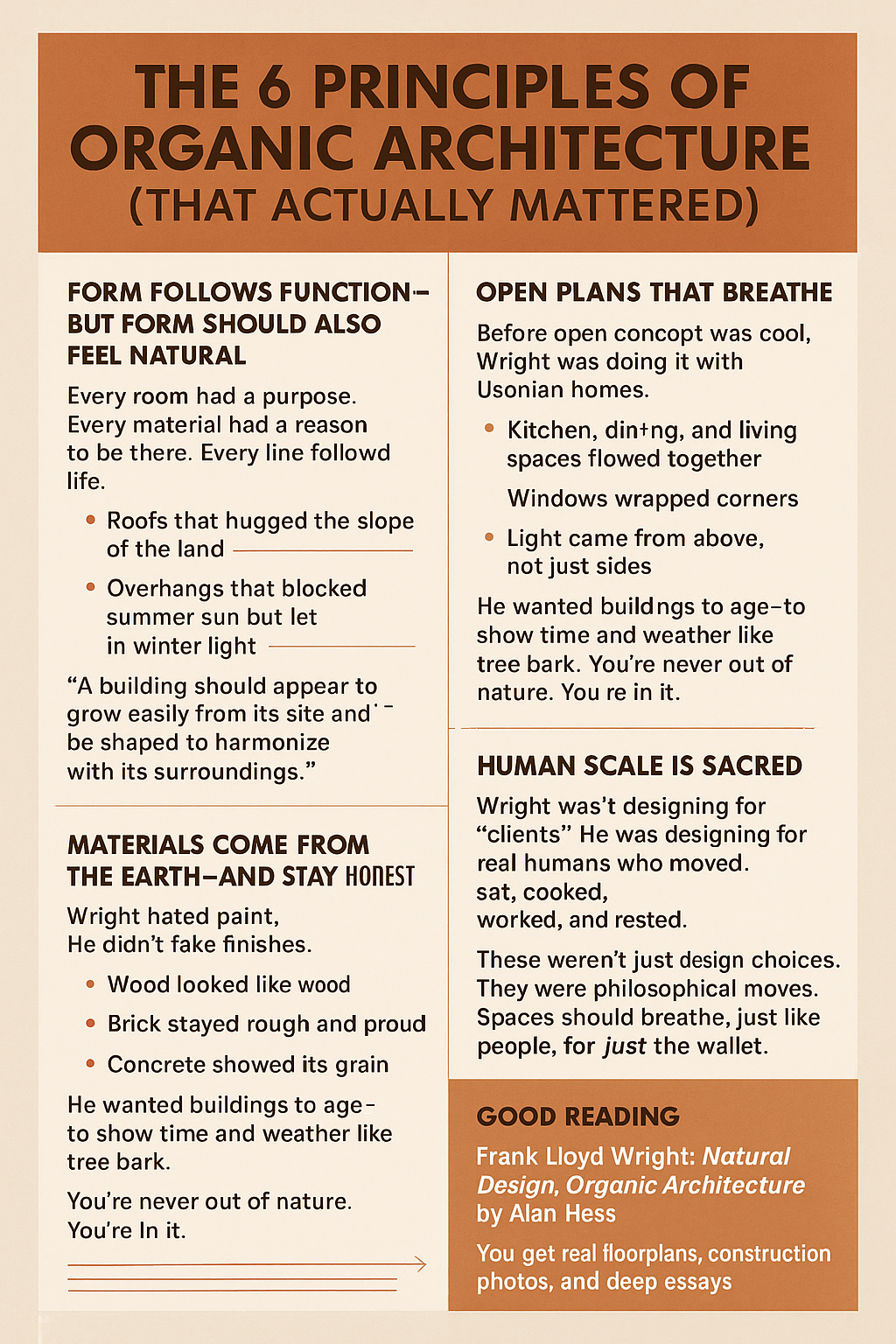
IMAGE: Breakdown of Frank Lloyd Wright’s six organic architecture principles, including natural materials, open plans, site-driven forms, and seamless indoor-outdoor flow.
Good Reading
Frank Lloyd Wright: Natural Design, Organic Architecture by Alan Hess
You get real floorplans, construction photos, and deep essays—not glossy fluff. If you want to build like Wright, not just look like Wright, this is the book.
“No house should ever be on a hill or on anything. It should be of the hill—belonging to it.”
—Frank Lloyd Wright
What It Took: The Grit Behind the Grace
Here’s what most architecture blogs won’t tell you:
▪ Wright’s projects leaked.
▪ His staff burned out.
▪ He built models overnight with glue still drying.
▪ Clients bailed. Contractors swore. Neighbors protested.
But he kept building, because the philosophy mattered more than comfort.
He believed that a wall, done right, could change how you feel about being alive.
A Night Inside Taliesin West
In 1937, Wright and his apprentices built Taliesin West—by hand—in the Arizona desert. No A/C. No prefab. Just stone, sand, canvas, and sweat.
They lived in tents while shaping walls from boulders they pulled with ropes. One apprentice burned his hands mixing lime with bare arms. Another passed out from heatstroke.
At night, they sketched by lantern. In the morning, they’d study the shadows to find the next shape.
This wasn’t theory. It was labor. And it birthed a place still standing nearly 90 years later.
Could Frank Lloyd Wright’s Ideas Fix Modern Design Mistakes?
Explore Wright’s organic architecture: how it works, why it matters, and what modern designers keep getting wrong about “natural” spaces.
Then vs. Now: A Brutal Comparison
Then:
Wright designed Broadacre City—a blueprint for one-acre, self-sustaining homes. Gardens. Work-from-home. Shared culture, without noise.
Now:
We’ve got “eco-towers” that block out sun, with fake green roofs and luxury gyms—but no neighbors who talk to each other.
Wright’s dream wasn’t just design. It was a challenge to how we live.
Wright’s buildings were bones of the earth, covered in the skin of craftsmanship, with the lungs of sunlight and wind.
His homes didn’t just hold life. They lived.
Best Books: Why This One’s Worth Owning
Book: Frank Lloyd Wright: Natural Design, Organic Architecture by Alan Hess
→ View on Amazon
Why read it:
You get real floorplans, construction photos, and deep essays—not glossy fluff. If you want to build like Wright, not just look like Wright, this is the book.
The Surprising Truth Behind Wright’s Most Natural Buildings
Building with Nature: Wright’s Real Lessons in Organic Form
Common Mistakes People Make When Trying to Copy Wright
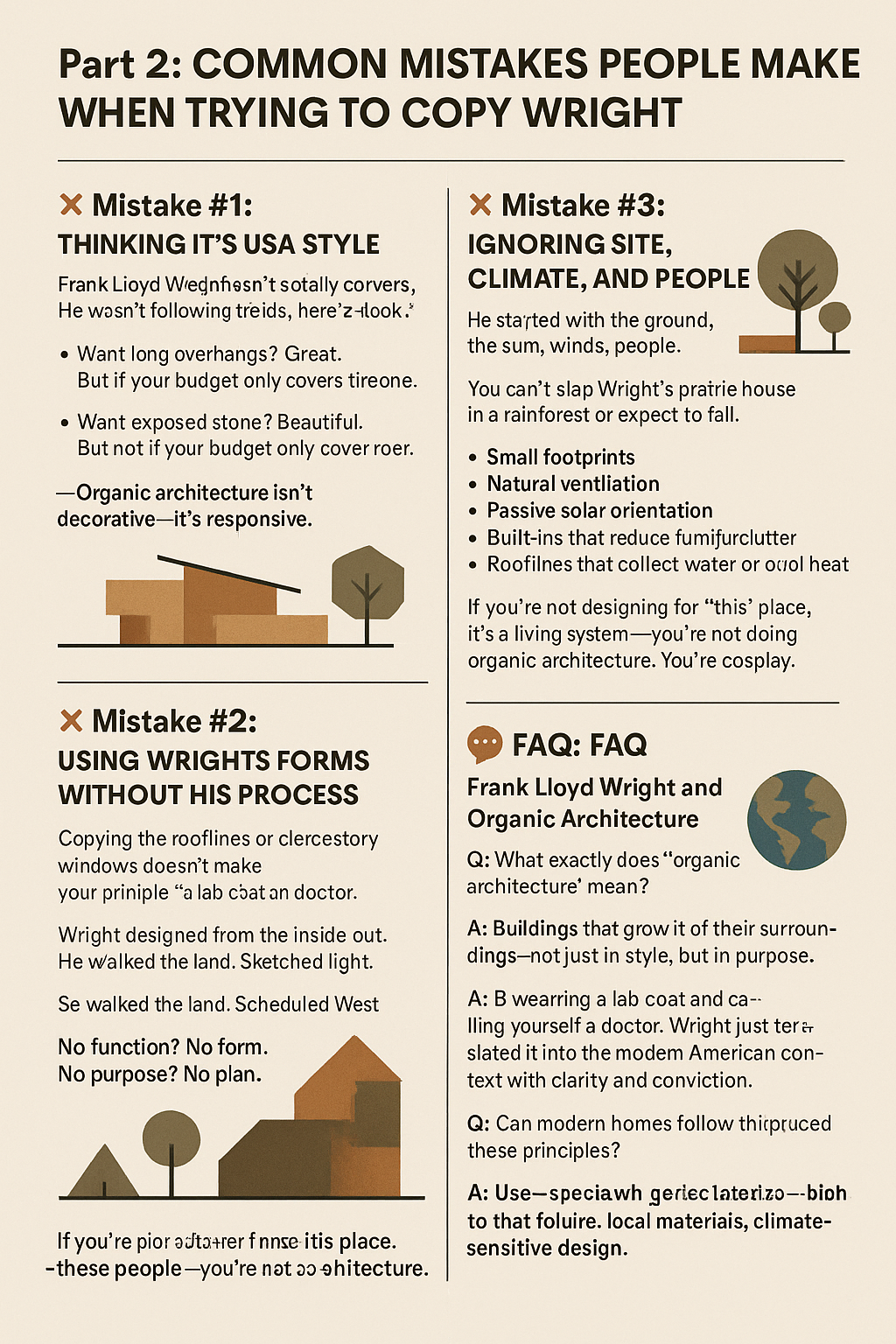
So you love the aesthetic. The cantilevers. The wood and stone. The “look.” But here’s where people blow it:
✕ Mistake #1: Thinking It’s Just a Style
Frank Lloyd Wright wasn’t designing for magazine covers. He wasn’t following trends. He was solving human problems with spatial solutions.
● Want long overhangs? Great. But if your climate doesn’t call for them, it’s wasted wood.
● Want exposed stone? Beautiful. But not if your budget only covers fake veneer.
→ Organic architecture isn’t decorative—it’s responsive.
✕ Mistake #2: Using Wright’s Forms Without His Process
Copying the rooflines or clerestory windows doesn’t make your building “organic.” That’s like wearing a lab coat and calling yourself a doctor.
Wright designed from the inside out. He walked the land. Sketched what light would do. Asked how people would cook, sit, talk, and sleep.
→ No function? No form. No purpose? No plan.
✕ Mistake #3: Ignoring Site, Climate, and People
He started with the ground, the sun, the winds, the people.
You can’t slap Wright’s prairie house in a rainy rainforest and expect it to feel right. You can’t mimic Taliesin West on a shaded northern slope.
→ If you’re not designing for this place, these people—you’re not doing organic architecture. You’re doing cosplay.
In Focus: How Wright’s Principles Apply to Tiny Homes and Off-Grid Design
Here’s something people don’t talk about enough: Wright’s Usonian homes were early prototypes for minimalist, off-grid living.
● Small footprints
● Natural ventilation
● Passive solar orientation
● Built-ins that reduced furniture clutter
● Rooflines that collected water or controlled heat
Sound familiar? That’s today’s eco-cabin or tiny house trend—but Wright was doing it in the 1930s.
Why This Still Matters:
We’re facing a housing crisis. Climate shifts. Rising material costs. People want homes that work, not just impress.
Wright gave us the blueprint:
→ Use less. Build smarter. Let the site lead. Design for life—not resale.
Real-Life Case: Usonian House, Restored in 2022
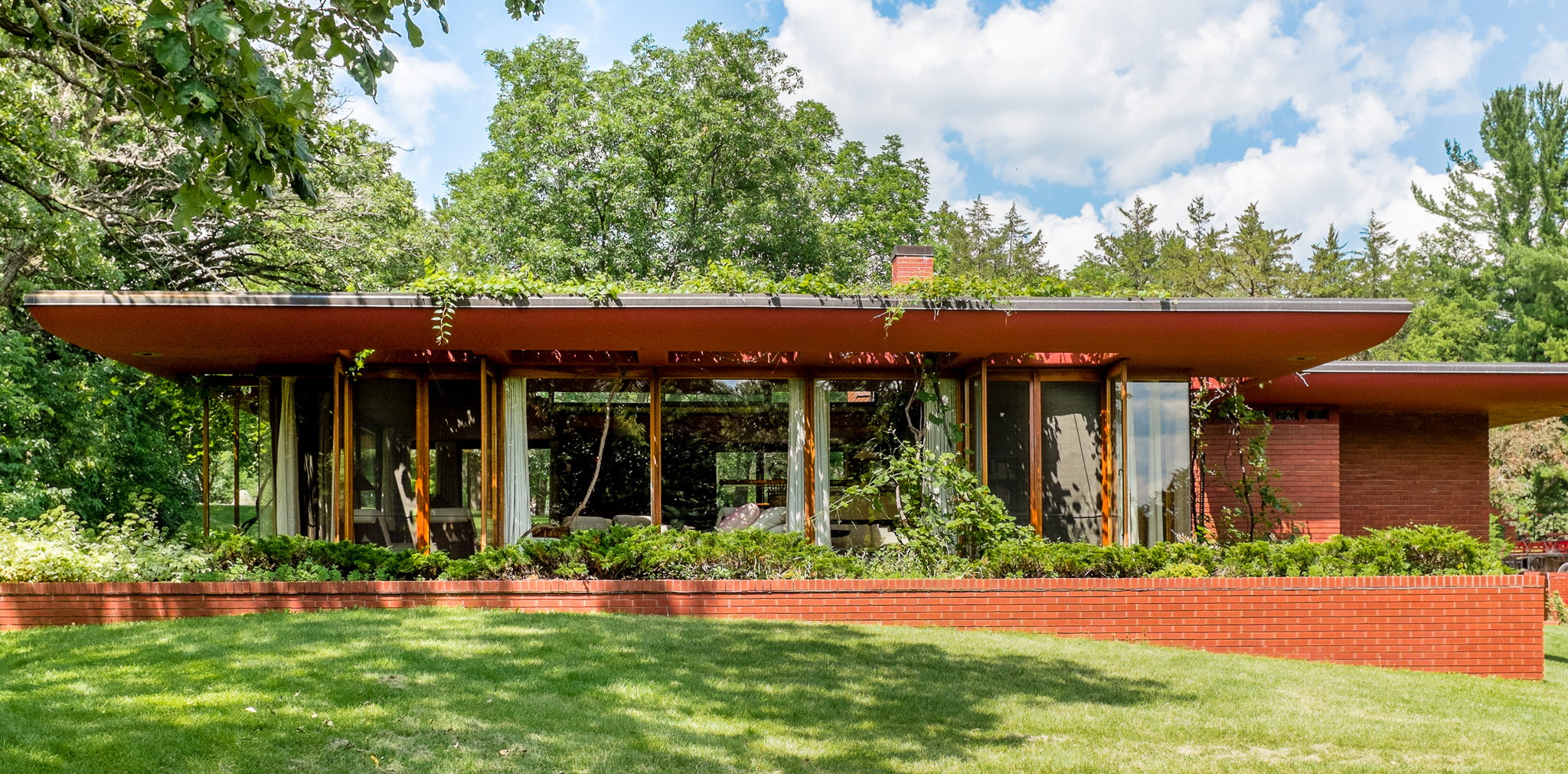
IMAGE: Restored Usonian house in Kalamazoo, Michigan, showcasing original Wright elements like radiant floors, clerestory lighting, and integrated furnishings.
In 2022, a modest Usonian home in Kalamazoo, Michigan, was restored with its original principles intact.
▪ Plywood interiors were refinished, not replaced
▪ Heating still ran through radiant concrete floors
▪ Clerestory windows brought in indirect light
▪ Built-in seating and desks eliminated clutter
After restoration, the home required no artificial lighting during the day and minimal HVAC even in winter.
The owner said:
“It’s the first house I’ve ever lived in that tells me when to wake up, when to rest, when to be still. It breathes.”
That’s the point. It breathes.
Amazon Book You Should Actually Buy (Not Just Flip Through)
Book: The Natural House by Frank Lloyd Wright
→ Buy on Amazon
Why it’s worth it:
This isn’t just a design book. It’s Wright explaining—clearly and unapologetically—why homes fail and how to fix them. No fluff. Just principles, plans, and purpose.
Final Thoughts
So yeah, Wright had flaws. He overpromised. He overspent. Sometimes, his roofs leaked.
But here’s what he got right—what most designers still miss:
→ A house isn’t a product. It’s a living system.
→ Design isn’t a style. It’s a response to people and place.
→ Organic doesn’t mean soft. It means true.
Wright’s buildings remind us that when we stop designing for trends—and start designing for life—we make spaces that endure.
No matter your budget, your skill, or your setting—you can build something that breathes.
And that? That’s still radical.
FAQ
Frank Lloyd Wright and Organic Architecture
Q: What exactly does “organic architecture” mean?
A: Buildings that grow out of their surroundings—not just in style, but in purpose, materials, and scale. They’re made to live in, not pose in.
Q: Was Wright the first to design this way?
A: Not entirely. Indigenous architecture around the world has long followed organic principles. Wright just translated it into the modern American context with clarity and conviction.
Q: Did all of Wright’s buildings succeed?
A: Nope. Some leaked. Some were expensive to maintain. But even his “failures” pushed architecture forward.
Q: Can modern homes follow these principles today?
A: Yes—especially with better tools. Think passive house, local materials, climate-sensitive design. The spirit of Wright’s work is more achievable than ever.
Q: What should I read first to understand his process?
A: Wright’s own book The Natural House is a strong start. Then grab Frank Lloyd Wright: Natural Design, Organic Architecture by Alan Hess.
Related
Design – Form and Function in Architecture
-
Form Follows Function in Architecture and Design
Understanding the classic design principle that function shapes form. -
Architectural Form Examples: How Shape Defines Function
Case studies showing the link between architectural shape and function. -
Clustered Form Architecture: Function, Space, and Design
Examining designs where clustered forms create functional spatial arrangements. -
Scale and Proportion in Architectural Design: Balancing Form and Function
How scale and proportion influence harmony between design and utility. -
Form Meets Function: Principles for Great Architectural Design
Guidelines for integrating practical use with visual appeal in architecture. -
How Form, Function, and Meaning Shape Islamic Architecture
Insights into the cultural and symbolic aspects influencing Islamic architectural forms. -
Mashrabiya Designs: History, Beauty, and Functionality
Exploring the architectural and functional significance of Mashrabiya screens. -
Creating Beautiful and Functional Spaces: Expert Tips for All Levels
Practical advice on designing spaces that are both attractive and useful. -
Interior Design Functional Elegance: Practical Tips for Stunning Interiors
Tips for achieving both elegance and functionality in interior spaces. -
Gothic Elements in Architecture: A Study of Form and Function
Exploring Gothic design features and their dual aesthetic and practical roles. -
Design Basics in Architecture & Building: The Fundamentals!
Introduction to core design principles for architecture and construction. -
Color Psychology Basics: What Every Designer Should Know
How colors influence perception and mood in design. -
Introduction to Interior Design: Understanding the Basics
Foundational concepts for beginners in interior design. -
Basic Design and Architecture: A Must-Read Guide for Students
Essential design and architecture knowledge for students. -
Basic Techniques and Principles of Architectural Drawing
Core drawing skills and principles for architectural representation. -
Architecture Basic Design: Key Concepts Every Student Must Know
Fundamental design ideas critical for architecture students.
Learn – Education and Fundamentals
-
Free Architecture Courses with Certificate: Top Online Platforms to Learn and Earn
Guide to free online architecture courses offering certification. -
The Principles of Design: Transforming Ideas into Visual Excellence
Core design principles for creating effective visual work. -
Understanding the Basics of Architecture: A Beginner’s Guide
Introductory guide to architecture fundamentals. -
Woodworking Basics: A Friendly Beginner’s Guide
Introduction to woodworking skills for beginners. -
Basic Elements for Sustainable Architecture
Key components involved in sustainable building design. -
Graphic Design Basics
Fundamentals of graphic design for beginners. -
Basics Architecture: Beams and Frames
Introduction to beams and frames in structural design. -
Design Elements In Architecture: Basics Explained Simply
Simplified explanation of important design elements in architecture.
Resources
- Frank Lloyd Wright Foundation: Explore Wright’s philosophy on organic architecture
- U.S. Green Building Council: Learn about modern sustainable practices