
What Works Where
Framing systems do not compete in one clean line.
I would read them by the job first. A small house, a pole barn, a steel bay, and a concrete podium are asking for different spans, crews, tools, rules, and tolerances. Treat them like one price comparison and the answer gets bad fast.
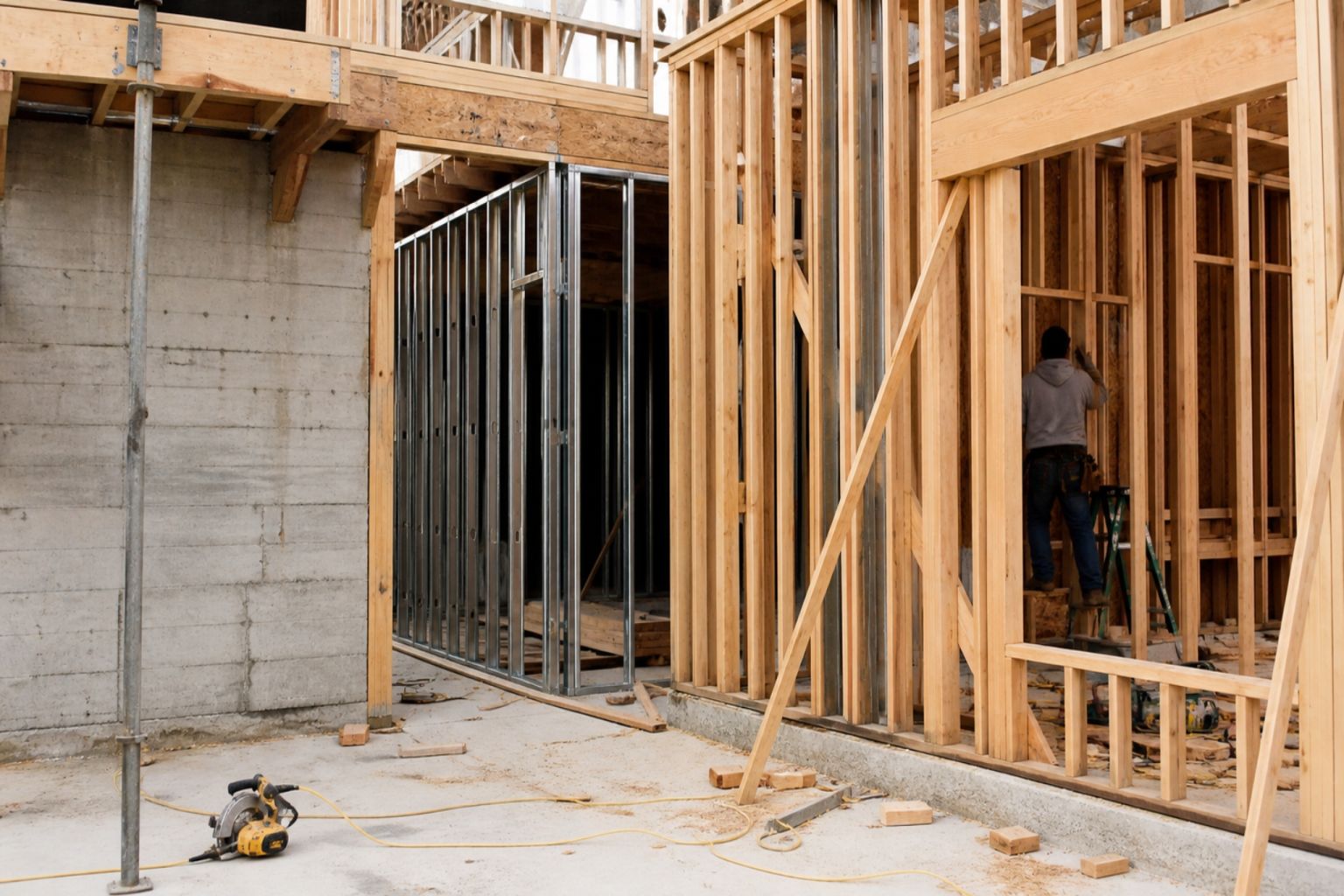
Wood framing wins most U.S. houses because the whole setup is already there: lumber, crews, inspectors, details, repairs. Steel starts making sense when spans, loads, fire rules, or commercial use change the problem. Post-frame is its own lane. Concrete frame is another world.
The frame is not the starting point. The building is.
Framing Carries the Building

Illustration by ArchitectureCourses.org. Wood framing starts at the sill plate, where the wall system is anchored and separated from moisture at poured concrete, CMU, or slab-on-grade foundations.
Framing is the structural skeleton of a building. It gives the building its shape, carries load, creates openings for doors and windows, and gives the rest of the assembly something to attach to.
In a house, that usually means floor joists, wall studs, plates, headers, roof rafters or trusses, and sheathing. In larger buildings, it may mean steel members, reinforced concrete, heavy timber, or hybrid systems. The material changes. The job stays the same: carry load and hand it off cleanly.
Where Comparisons Start Going Wrong

Illustration by ArchitectureCourses.org. Good framing depends on load path, alignment, stiffness, and sequence.
People compare framing systems as if they are picking paint colors. They are not. The system changes spans, fire requirements, crew type, foundation loads, enclosure details, and how much the job can tolerate late changes.
The load path is the whole job. Roof loads have to move into walls. Wall loads have to move into floors, beams, or columns. Those loads then have to get into the foundation without weak transfers, missing support, or strange offsets. That is why structural load basics and load-bearing vs non-load-bearing walls matter even on simple work.
If the frame is off by half an inch in the wrong place, the mistake does not stay in the framing crew’s world. It shows up later in drywall, flooring, windows, siding, roof lines, and callbacks.
Main Framing Types
| System | Most Common Use | Why It Gets Chosen | What Bites Later | Cost Direction |
|---|---|---|---|---|
| Platform wood framing | Detached houses, additions, garages, townhouses | Fast, familiar, easy to change, easy to source | Layout quality, sheathing, and weak load transfers | $ |
| Balloon framing | Older houses, occasional tall-wall conditions | Continuous studs over multiple levels | Fire blocking, retrofit work, long-stock handling | $$ |
| Timber frame / post and beam | Custom homes, lodges, pavilions, exposed-structure spaces | Open spans, architectural character, heavy members | Joinery, crane work, engineering, finish tolerances | $$$ to $$$$ |
| Post-frame | Barns, shops, garages, utility buildings, some barndominiums | Fast shell, fewer foundation points, wide spacing | Envelope detailing, slab edge, insulation strategy | $ to $$ |
| Cold-formed steel | Interior partitions, some exterior walls, mid-rise light-gauge systems | Straight members, noncombustible, prefab-friendly | Thermal bridging and different fastening rules | $$ to $$$ |
| Structural steel frame | Warehouses, offices, retail, long-span commercial buildings | Big spans, fewer columns, higher capacity | Fire protection, connection design, heavier logistics | $$$ |
| Concrete frame | Podiums, parking, institutional, mid-rise and high-rise work | Mass, fire resistance, stiffness, repetitive structure | Formwork, curing time, sequencing, heavier foundations | $$$ to $$$$ |
| Panelized / SIP / modular | Off-site home building, repeatable units, high-performance envelopes | Factory control, speed, less weather exposure | Transport, crane cost, and early design lock-in | $$ to $$$$ |
Wood Framing Still Carries Most Houses

Illustration by ArchitectureCourses.org. Two-story platform framing builds one floor at a time over a concrete or CMU base.
This is the framing most people mean when they say stick framing. One floor is framed, decked, and squared. Walls are built on that platform. Then the next floor or roof goes on top.
For detached houses and most low-rise residential work, it keeps winning because the process is straightforward and the supply chain is mature. You can still change openings, adjust layouts, or solve surprises in the field without blowing the whole job up.
The weak point is not the system. It is the execution. Sloppy layout, bad sheathing nailing, weak openings, poor blocking, and vague load transfers cause the headaches. That is where wall framing basics, how to frame a wall step by step, and standard wall stud spacing matter more than broad framing theory.
Typical house walls are commonly framed at 16 inches or 24 inches on center. The right spacing depends on load, sheathing, finish, and code path. The same goes for 2x4 versus 2x6 walls. A 2x6 wall is often better when you need more insulation depth, taller walls, or more structural capacity. It is not automatically better on every house.
Balloon Framing Is Mostly an Old-House Problem Now
Balloon framing uses long continuous studs that run past the floor line. Platform framing breaks the building into levels. That one difference changes fire behavior, sequencing, and repair work.
| Question | Platform Framing | Balloon Framing |
|---|---|---|
| How it is built | One floor at a time | Continuous studs over multiple levels |
| Why it became standard | Easier handling, easier layout, easier squaring | Older method tied to long stock and different practice |
| Main weakness | More shrink points at stacked levels | Fire spread in stud bays if not blocked well |
| Where you see it | Most current house construction | Mainly older houses and specialty conditions |
For new house construction, platform framing is usually the answer. For renovation, you need to know whether a wall is balloon-framed before you start opening cavities or adding insulation. Old houses punish that kind of guessing. Related reading: balloon framing explained and how balloon framing changed American houses.
Timber, Post and Beam, and Post-Frame Get Mixed Up Constantly

Illustration by ArchitectureCourses.org. Post-frame uses widely spaced posts and girts. It is not the same thing as a timber frame or an exposed post-and-beam house.
These three get bundled together by people who have not priced them, built them, or repaired them. That is where the confusion starts.
| System | What Carries the Load | Best Fit | What Changes the Price |
|---|---|---|---|
| Timber frame | Heavy timber members with joinery, often exposed | Custom houses, halls, pavilions, feature spaces | Fabrication, joinery, crane work, finish quality |
| Post and beam | Posts and beams, often with simpler joinery or metal connectors | Open-plan homes, porches, hybrid structures | Beam sizes, connectors, spans, exposed finish standards |
| Post-frame | Widely spaced posts or laminated columns with girts and purlins | Shops, barns, garages, farm and utility buildings | Post support, shell width, cladding, insulation strategy |
Timber frame and post and beam are usually about visible structure and open space. Post-frame is usually about shell efficiency. It is a different animal.
If you want the exposed-structure side of this, use timber frame beams and posts and post and beam homes. If the real question is foundation strategy under that type of structure, pier and beam foundation construction methods is the better follow-up.
One thing people underestimate here: once the structure stays visible, the framing stops being only rough work. It becomes finish work too. That changes labor, tolerance, sequencing, and cost.
Steel Splits in Two

Image by ArchitectureCourses.org. Steel framing splits into two very different families: cold-formed steel and structural steel.
People say steel framing as if it is one thing. It is not.
Cold-formed steel is the light-gauge world: studs, joists, tracks, panelized wall systems, and a lot of interior or mid-rise work. Structural steel is the heavier beam-and-column world: wide flanges, HSS, portal frames, open-web joists, and long-span buildings.
Cold-formed steel makes sense when you want straight members, noncombustible framing, pest resistance, or prefab-friendly wall systems. Structural steel makes sense when spans get big, openings get large, or the program hates interior columns.
The usual mistake is treating steel studs like a simple swap for wood studs. They are not. The fasteners change. The bracing logic changes. The thermal behavior changes. This part matters: wood studs vs metal studs is the comparison that helps most house-scale readers.
Concrete Frame Belongs to a Different Building Type
Concrete frame construction belongs in this discussion, but not as if it were just another detached-house option. Reinforced concrete frames, flat slabs, beam-and-slab systems, and shear wall structures live in a different project world: bigger loads, different fire requirements, repetitive floor plates, parking levels, podiums, and formal engineering from the start.
For most readers here, concrete matters in three places: as the base that light framing sits on, as the structural system for larger buildings, or as the wall or foundation condition that has to connect cleanly to the frame above. That is where the gap between concrete wall and framing stops being a small detail and starts affecting moisture, fit, and finish.
If you are framing a normal detached house, concrete is usually part of the foundation story, not the full frame story.
Panelized, SIP, and Modular Change the Job Before the Job Starts

Illustration by ArchitectureCourses.org. Off-site systems can speed enclosure, but only when the design is settled early.
These get described as framing types, which is only half true.
Panelized framing means wall, floor, or roof sections are built off site and then assembled on site. SIPs combine structure and insulation in one panel system. Modular usually means larger volumetric units or room-sized sections delivered partly complete.
The upside is factory control, less weather exposure, faster enclosure, and fewer field mistakes when the supplier is good. The downside is earlier lock-in. Transport, crane picks, and foundation accuracy matter more.

Illustration by ArchitectureCourses.org. Prefab systems reward early clarity and punish late design changes.
If the design is stable, the site is ready, and the supplier knows what they are doing, panelized or modular work can compress the schedule hard. If the drawings are fuzzy, the foundation is off, or the job is still changing in the field, the same system turns into an expensive coordination problem.
That is why modular should not be treated as a material. It is a delivery method first. A modular unit can still be wood, steel, or hybrid framing underneath.
House Framing Happens in a Sequence for a Reason
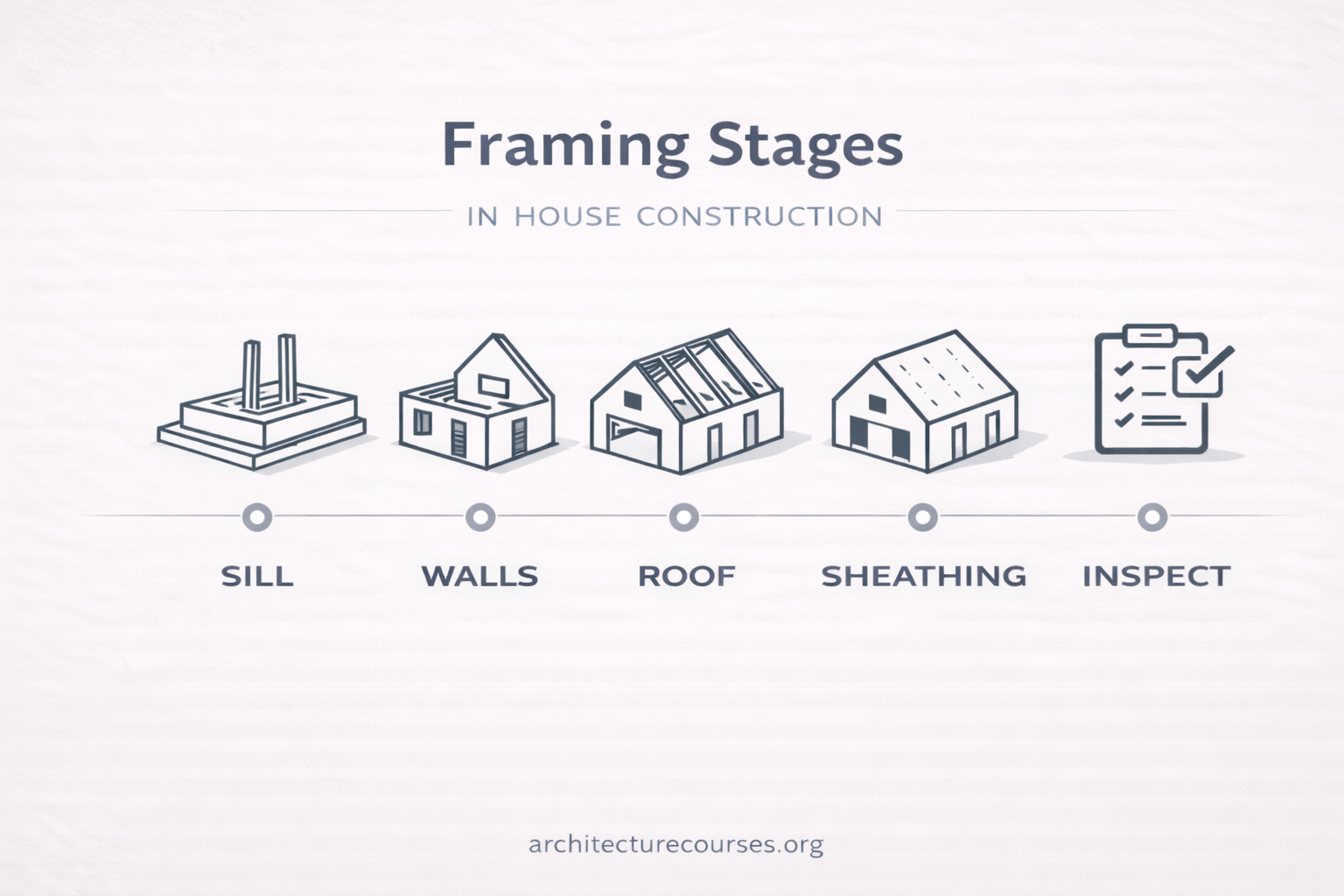
Illustration by ArchitectureCourses.org. House framing moves from sill plates and floors to walls, openings, roof framing, and sheathing.
Framing happens after the foundation is ready and before utilities, insulation, and finishes go in. On a typical house, the order looks simple until one step gets skipped or rushed.
- Sill plates and floor framing. Anchored to the foundation, then joists or floor trusses go in, then the subfloor.
- Wall framing. Exterior and interior walls get built, raised, braced, and tied together.
- Openings and structural pieces. Headers, king studs, jack studs, beams, and point loads get handled where needed.
- Roof framing. Rafters or trusses go on, then bracing and roof deck.
- Sheathing. Walls and roof get sheathed to add rigidity and prepare for weather layers.
- Inspection. The frame gets checked before insulation, drywall, and other concealed work continue.
The order matters most where people think it does not. A header set wrong early can make the window crew curse you three weeks later. A roof-to-wall tie skipped now can turn into uplift trouble later. Also useful: king studs and jack studs, jack stud framing, window header framing, window rough openings, roof to wall connections, roof trusses, and truss bracing.
Framing Terms That Sit Nearby
Some search terms sit close to framing but are narrower than the main structural systems above. They matter, but they are not separate core framing types.
Deck Framing
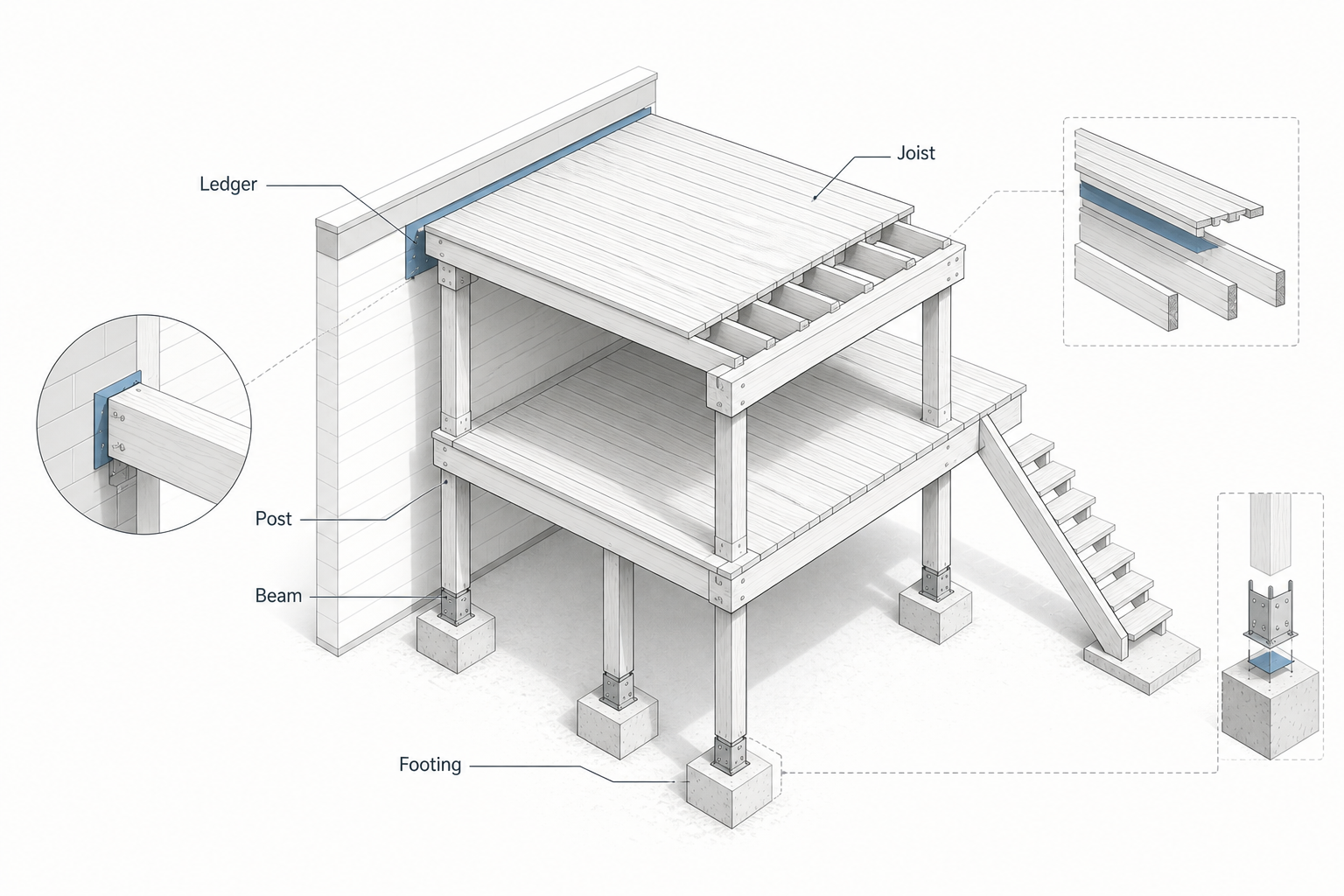
Illustration by ArchitectureCourses.org. Deck framing uses ledgers, joists, beams, posts, footings, and connector details, but the ledger connection and flashing are where many failures start.
Deck framing uses joists, beams, ledgers, posts, and footings, but it has much less tolerance for bad flashing and weak connectors. House framers who treat a deck like an indoor floor system usually learn the difference the expensive way.
Hardware and Connectors
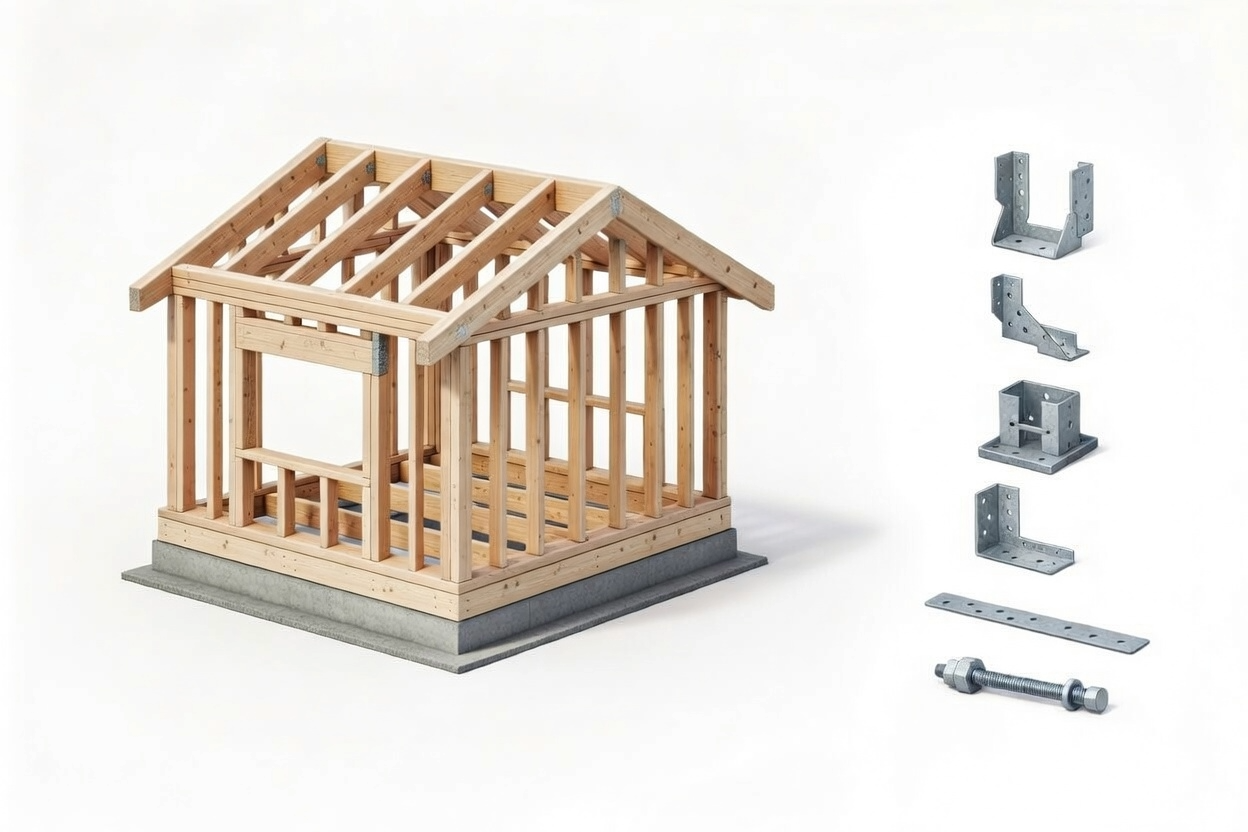
Illustration by ArchitectureCourses.org. Basic residential wood framing members only work as a system when the hardware and fastening schedule are right.
Connectors, hangers, hold-downs, straps, fastener schedules, and blocking can make or break the frame. If you want the load-transfer side of that, see T-brace framing, drag struts in framing, and roof tie beams.
Special Conditions
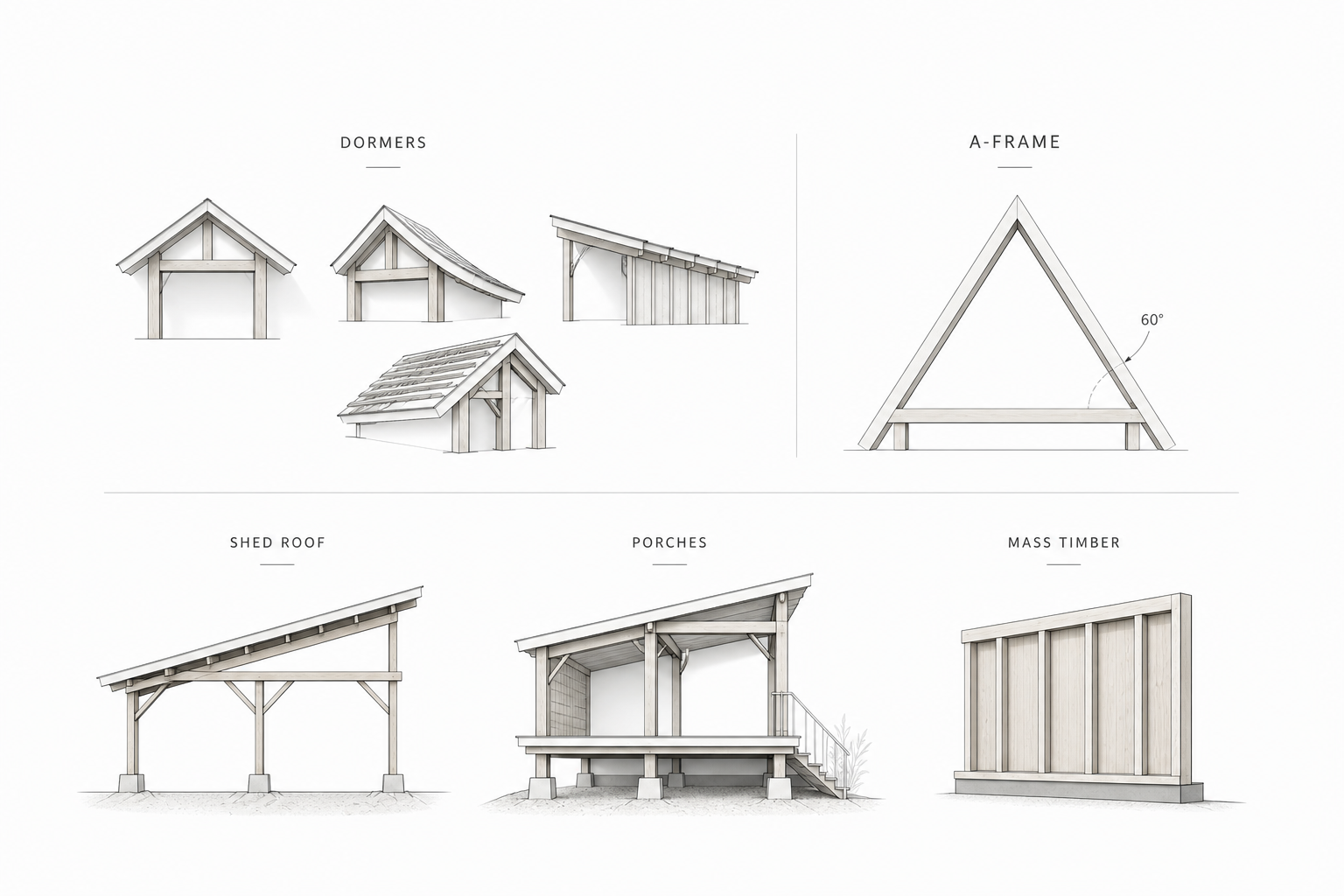
Illustration by ArchitectureCourses.org. Dormers, porches, A-frames, shed roofs, and mass timber walls are conditions layered onto a main framing system.
A-frame cabins, vaulted ceilings, dormers, window retrofits, and odd roof lines are special conditions layered onto the main system. Read this next: A-frame tiny house ideas, cottage roof framing, and how to frame a new window in an existing wall.
Use This When / Avoid This When
| Use This | When It Makes Sense | Avoid It When |
|---|---|---|
| Platform wood framing | You need a normal house, addition, or garage framed by a conventional crew | You need very long clear spans or higher noncombustible requirements |
| Balloon framing | You are studying or repairing an older house | You think it is the default for new work |
| Timber frame / post and beam | You want exposed structure and are ready to pay for precision | You want the cheapest shell or rough-framing tolerances to be enough |
| Post-frame | You want a shop, barn, garage, or simple wide-open shell fast | You assume it automatically behaves like a finished high-performance house wall |
| Cold-formed steel | You need noncombustible framing, straight members, or prefab panels | You are not ready to solve thermal bridging and different fastening rules |
| Structural steel | You need span, capacity, and fewer interior supports | You are pricing a basic house and pretending it is a small upgrade |
| Concrete frame | You are in podium, parking, institutional, or mid-rise territory | You are comparing it to detached-house framing without changing the building type |
| Panelized / SIP / modular | You want speed, factory control, or repeatable assemblies | You still expect unlimited field changes after fabrication starts |
What People Get Wrong
They compare systems without comparing the building. A detached house, a pole barn, a warehouse, and a podium apartment building are not close cousins.
They confuse structure with enclosure. A post-frame shell may be fast and economical, but the insulation, air sealing, and cladding decisions still decide whether the building performs.
They price exposed structure like rough framing. Once the framing stays visible, the tolerance and finish standard climbs.
They treat modular like a material. It is a delivery method first.
They ignore the load path. It does not matter how attractive a framing system sounds if the roof, walls, floors, and foundation do not hand loads off cleanly.
Where Cost Assumptions Break Down
The framing decision never ends with the frame.
- Choose steel, and now thermal breaks, clips, and screw coordination matter more.
- Choose post-frame, and now the wall assembly and slab edge details need more attention.
- Choose timber, and now shrinkage, joinery, and finish tolerance move up the list.
- Choose panelized or modular, and now foundation accuracy and early coordination matter more than field improvisation.
That second layer is where budgets drift. Not in the system name. In the details that system forces you to solve next.
FAQ
What is the most common type of framing in construction?
For detached houses and most low-rise residential work, platform wood framing is still the most common. In bigger commercial work, steel and concrete show up much more often.
What is the difference between stick framing and platform framing?
In normal residential use, people often mean almost the same thing. Stick framing usually means framing with individual members on site, and platform framing is the dominant light-wood method used for that work.
What is the difference between post-frame and post and beam?
Post-frame uses widely spaced posts or laminated columns and is usually optimized for shell efficiency. Post and beam is a heavier structural system, often more architectural, with beams carrying loads between posts.
Is steel framing better than wood framing?
Not across the board. Steel is straighter, noncombustible, and pest-resistant. Wood is easier to modify, easier to insulate in many house assemblies, and usually simpler for standard residential crews. Better depends on the job.
Are SIPs and modular homes a framing type?
Partly. SIPs are a structural wall and roof system. Modular is more of an off-site building method that can use wood, steel, or hybrid framing inside it.
Which framing system is cheapest?
For ordinary detached-house work, platform wood framing is usually the baseline cost answer. For simple large shells like barns or shops, post-frame can be very competitive. Once spans, fire requirements, or building type change, the comparison shifts.
Official Sources
Code, wood, steel, and prefab references
- 2024 International Residential Code table of contents and Chapter 6 references
- American Wood Council lumber guide
- National Frame Building Association post-frame overview
- BuildSteel cold-formed steel framing basics
- WoodWorks mass timber and CLT overview
- Structural Insulated Panel Association overview
- NAHB panelized building systems overview