
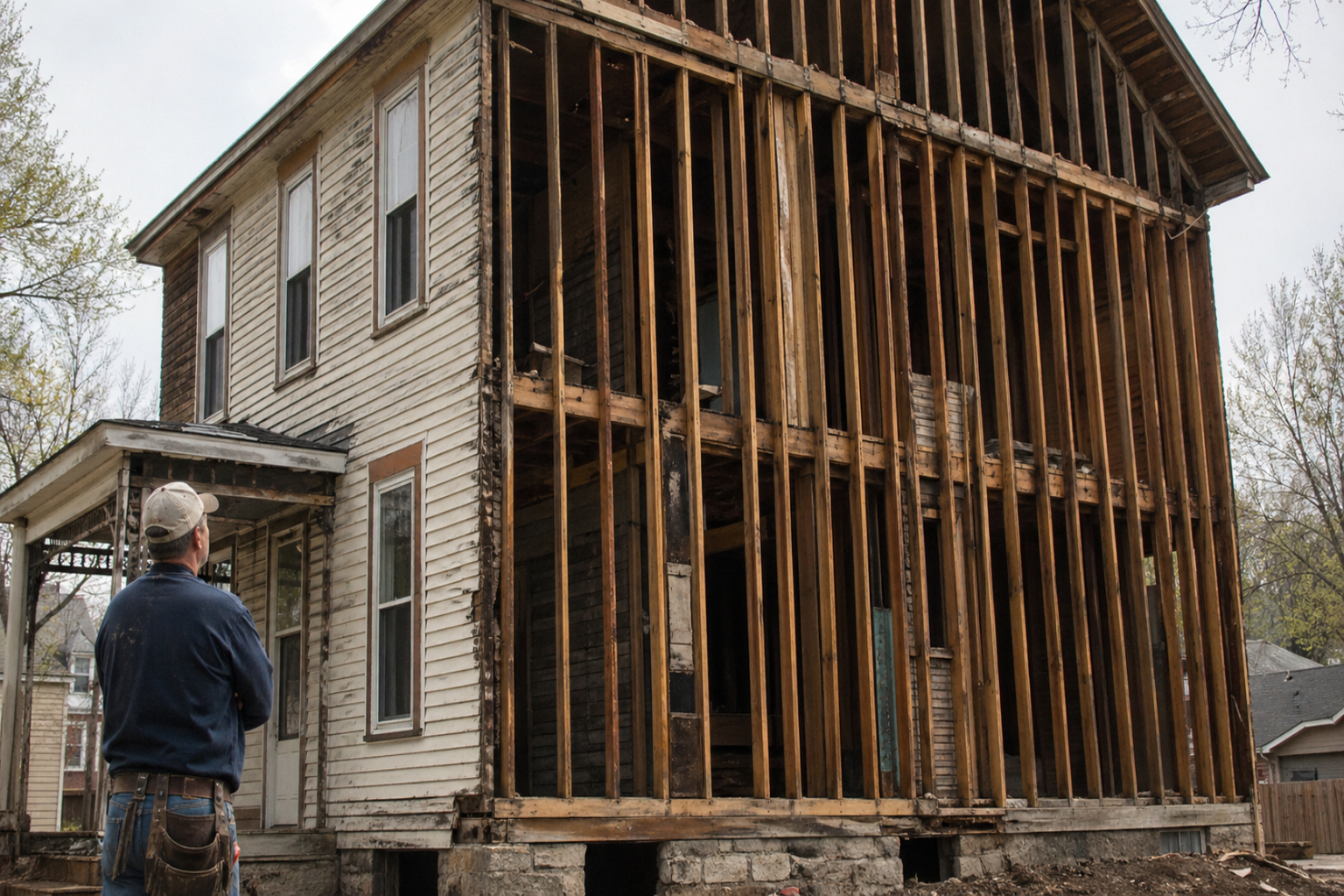
Balloon framing made complicated house shapes cheap enough to spread.
Before that, every extra corner cost more labor, more cutting, and more money. Masonry walls were heavy. Timber frames were strong, but they asked for real joinery and skilled hands. Builders could make complicated forms. They just had good reason not to unless the budget was there.
That kept a lot of American houses square for longer than people think. Big houses, small houses, refined houses, ordinary houses. Different trim, different details, same basic discipline. The box kept winning because the structure kept pushing in that direction.

Then balloon framing arrived in the 1830s. Long studs. Cheap nails. Repetitive members. Faster wall framing. Corners stopped feeling expensive. The house could turn, project, wrap, and break its outline without every move dragging the whole job into another class of labor.
Why Houses Stayed Boxy
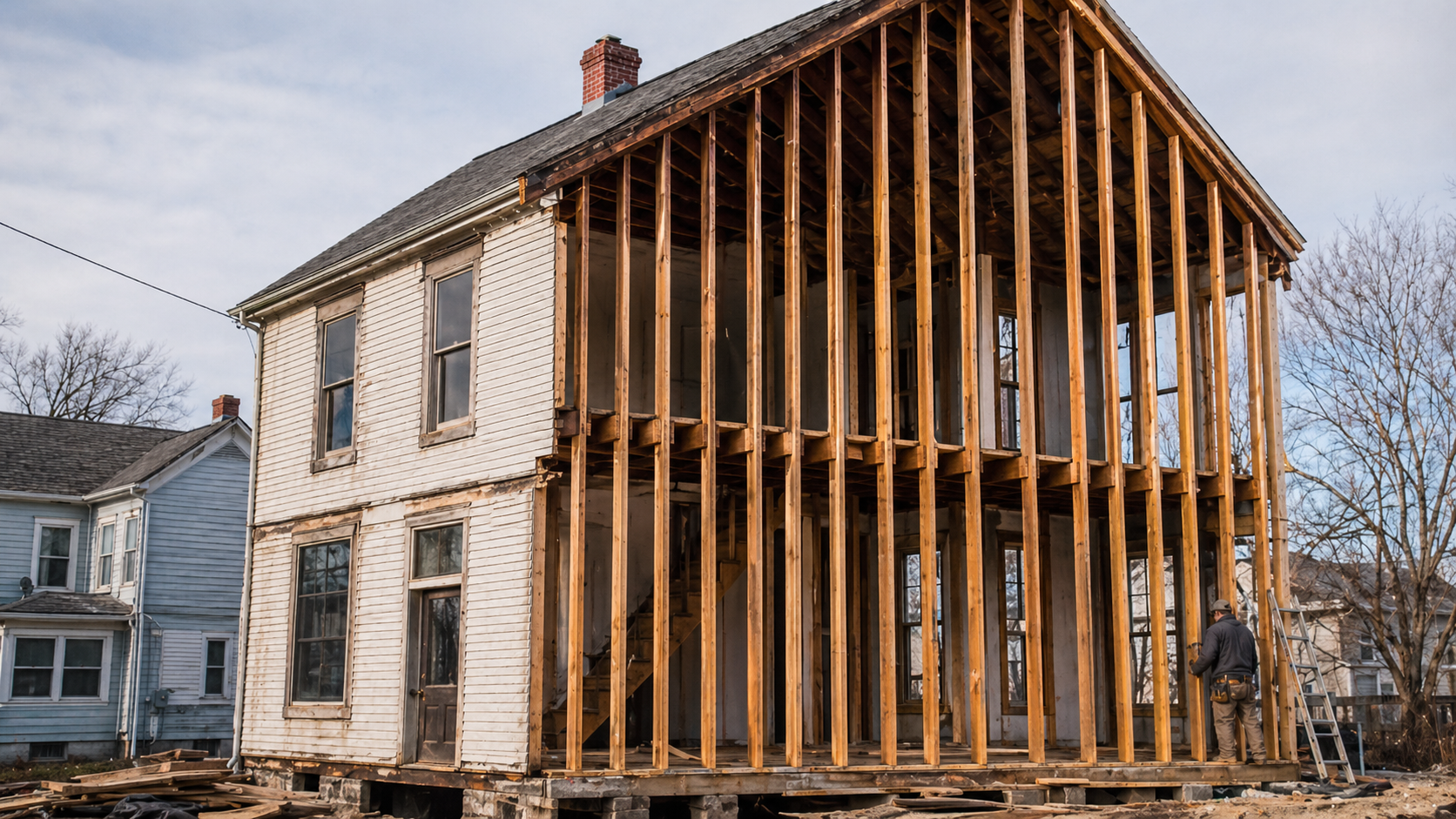
Image by ArchitectureCourses.org. Earlier American houses often stayed boxy because simpler forms were easier and cheaper to build. Balloon framing helped change that by using long continuous studs, which made taller and more flexible wood-frame houses easier to construct.
Earlier American houses were not simple because builders lacked imagination. They were simple because the work got expensive fast once the wall stopped running straight.
Brick and stone handled compression well and lasted a long time, but corners took more care. More labor. More material. More places for water and failure to start if the work was bad.
Heavy timber gave more freedom, but it still depended on large members and hand-cut joints. The frame could do impressive things. It could not do them cheaply.
That is why so many early houses stayed controlled in both plan and elevation. Georgian houses make the point clearly: balanced fronts, steady massing, simple footprints, a strong centerline, and very little appetite for projections that were hard to justify structurally.
The shape came from the method as much as the style. If you want the bigger style timeline around that older discipline, House Styles: Five Centuries of Architecture and 1800s House Styles are the right companion pages.
What Changed in the 1830s
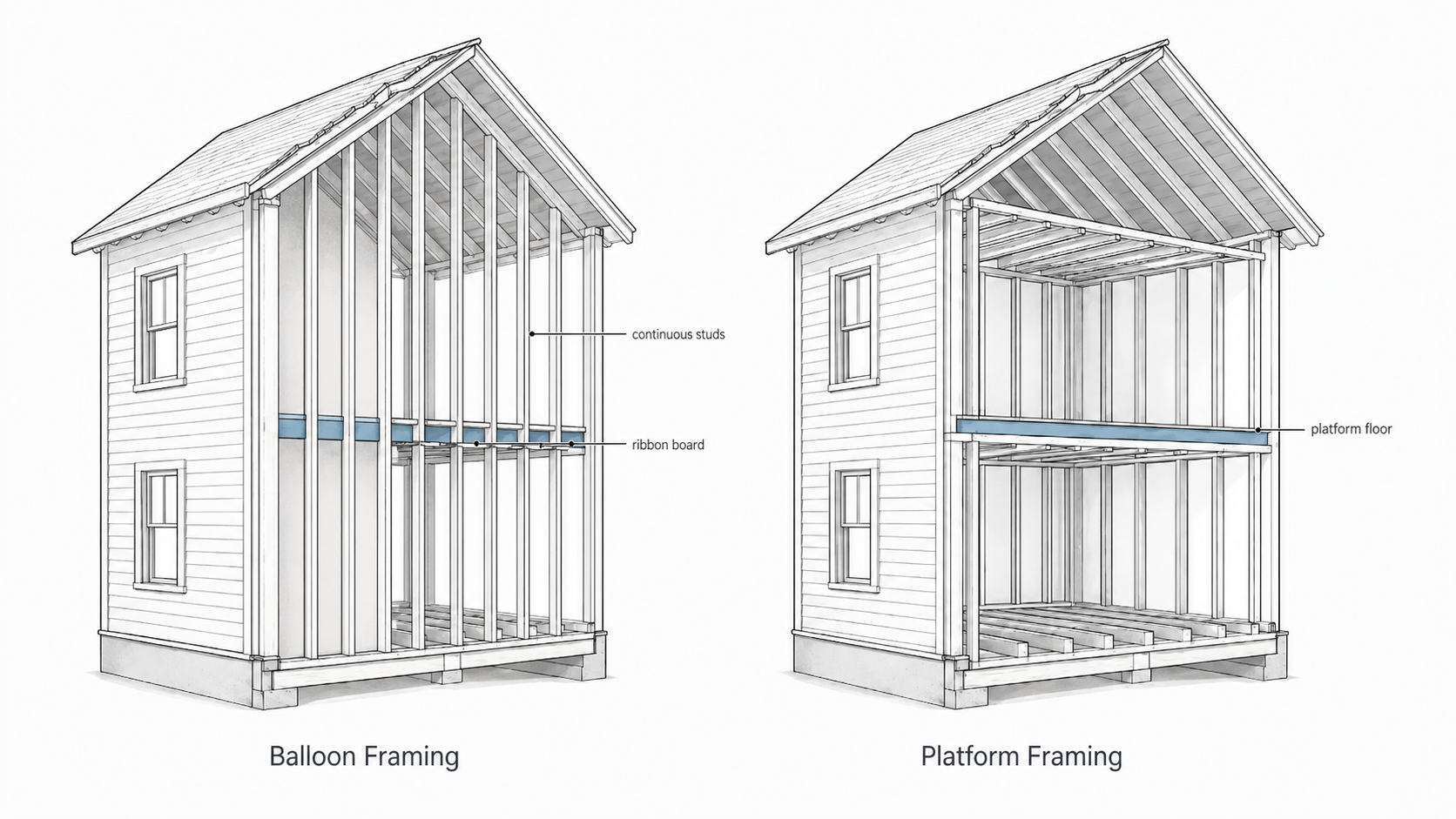
Illustration by ArchitectureCourses.org. Balloon framing uses long continuous studs with the second floor supported off a ribbon board, while platform framing stacks each wall level on its own floor platform.
Balloon framing did not make builders more creative. It removed part of the penalty for acting on that creativity.
Instead of building the wall out of heavy posts and beams, balloon framing used long light studs running past the floor line. The connections were nailed. The members were smaller. The lumber came in more standardized sizes. A wall could go up faster and with less specialized joinery than a heavy-timber frame demanded.
The exact origin story gets argued. Chicago is usually at the center of it, and early 1830s work there keeps coming up for a reason. The larger point is simpler: by the middle of the 19th century, the system fit the country that was taking shape around it. More mills. More nails. More rail transport. More demand for houses that could go up quickly.
Once that happened, the old box loosened.
If you want the construction side, go next to Balloon Framing Construction: How It’s Built. If you want the comparison that replaced it later, use Balloon Framing vs Platform Framing.
Cheap Corners Changed the Street
Balloon framing mattered because it made irregularity affordable.
A bay window stopped being a structural indulgence. A projecting wing stopped being a major commitment. A porch that wrapped a corner no longer asked the builder to fight the framing system every step of the way.
This did not turn every house into a Queen Anne overnight. Plenty of houses stayed restrained. But even modest houses started picking up small departures from the old box: a side ell, a porch return, a front bay, a roofline with more than one simple move.
Walk an older American neighborhood and you can still feel that change. The silhouettes get busier. The fronts stop mirroring themselves so rigidly. The massing starts to break and stack instead of sitting there like a clean block with decoration applied.
| Before Balloon Framing | After It Spread | What Changed |
|---|---|---|
| Simple rectangle or square footprint | Plans with bays, wings, porches, and offsets | Corners got cheaper to frame |
| Strictly balanced facades | More asymmetry and layered massing | The structure stopped punishing variation so hard |
| Straight rooflines with few interruptions | Dormers, cross gables, towers, and porch roofs | The frame adapted faster |
| More labor locked into major joints | More labor shifted to layout, nailing, and repetition | Speed changed what builders were willing to attempt |
Where the Change Shows Up First
The easiest place to see the difference is not trim. It is outline.
Once balloon framing spread, houses got easier to push out of the rectangle. Bay windows. Side wings. Cross gables. Wraparound porches. Towers where the budget and taste allowed it. Even simpler houses started picking up small shifts that would have been annoying to justify a generation earlier.
That is why late 19th-century styles read differently even before you look at ornament. Queen Anne is the obvious example because it pushes the freedom hard: asymmetry, towers, layered porches, surfaces that turn and stack instead of sitting flat. Queen Anne Architecture Style is worth opening beside this page because it shows what happens when that structural freedom gets used without much restraint.
The same shift shows up in more modest ways too. Folk Victorian houses, later 1800s farmhouses, and a lot of ordinary urban housing start to pick up more broken silhouettes once the framing method stops punishing every extra turn.
How to Read the Shape
You can often spot the change before you see a single framing member.
Earlier houses usually hold the outline tight. The footprint stays simple. The front elevation is more symmetrical. The roof is easier to read in one glance. Even when the house is large, it often still behaves like one composed mass.
Later balloon-framed houses loosen up. The footprint breaks. The porch wraps. The facade shifts. The roofline changes direction more than once. Corners start multiplying.

A quick field test helps. Stand back far enough to read the whole house at once.
- Pre-balloon clues: square or rectangular footprint, centered entry, matched window rhythm, simpler roof.
- Post-balloon clues: bays, wings, asymmetry, more porch turns, and a roofline that refuses to stay quiet.
This is not perfect. Colonial Revival houses often brought symmetry back on purpose even when the framing underneath was more flexible. But the general pattern holds. Once corners got cheaper, American houses stopped acting like they needed permission to use them.
What Balloon Framing Did Not Do
Balloon framing made complexity easier. It did not make every complicated house good.
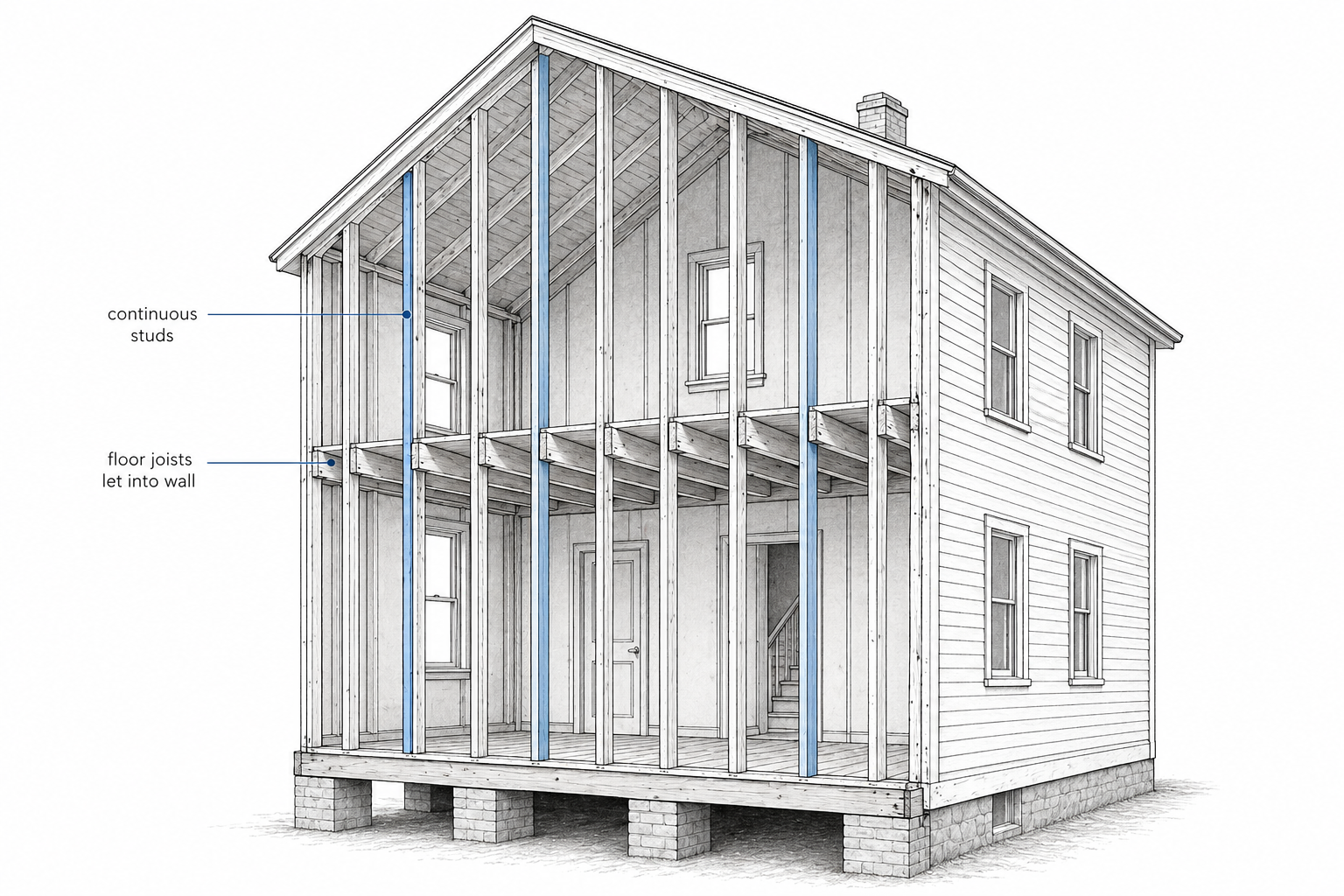
Illustration by ArchitectureCourses.org. This open-wall view shows the basic balloon-framing logic: long studs run past the second-floor line while the floor joists are carried by the wall framing.
That is where the story usually gets flattened. People say balloon framing arrived and suddenly houses became richer, freer, more expressive. Sometimes they did. Sometimes they just became busier.
A cheap corner is still a bad corner if it does nothing for the plan, the light, the room, or the elevation. The best houses from the period use the freedom well. A bay improves the room inside. A porch actually catches air. A roof move explains the massing. The weak houses just collect projections because the framing now allows it.
So the real lesson is narrower. Balloon framing expanded the range of what builders could do cheaply. Good designers used that freedom with restraint. Bad ones did what builders have always done when a new method makes something easier. They overused it.
Why It Spread Fast
It matched the country at exactly the right moment.
America in the mid-19th century needed houses fast. Sawmills were producing more standardized lumber. Railroads moved material farther and faster. Settlements were growing. Towns were filling in. Balloon framing fit that pace better than older methods did.
It let builders work faster. It reduced the amount of specialized cutting in ordinary house framing. It paired well with the material supply system that was emerging at the same time.
Once a building method spreads far enough, it stops being only a method. It starts shaping taste. People get used to what they keep seeing built around them. Balloon framing did not only make certain house forms possible. It helped normalize them.
Then Platform Framing Took Over
Balloon framing did not stay dominant forever.
Platform framing gradually replaced it because it was easier to stage, easier to build one floor at a time, and better at interrupting hidden fire travel inside wall cavities. Shorter studs helped too. The method made practical sense, and it still does.
But by then the visual change had already happened. The appetite for more varied house shapes was out in the world. Balloon framing opened the door. Platform framing walked through it and kept building.
So if you want the short answer to why American houses stopped being such disciplined boxes, it is not style alone. It is structure, labor, material supply, and cost all shifting together.
One more thing: if you are dealing with a real older house and not only the history, Types of Framing Construction helps place balloon framing next to timber, platform, steel, and concrete systems so you can read the house more accurately before opening anything up.
Renovating a Balloon-Framed House
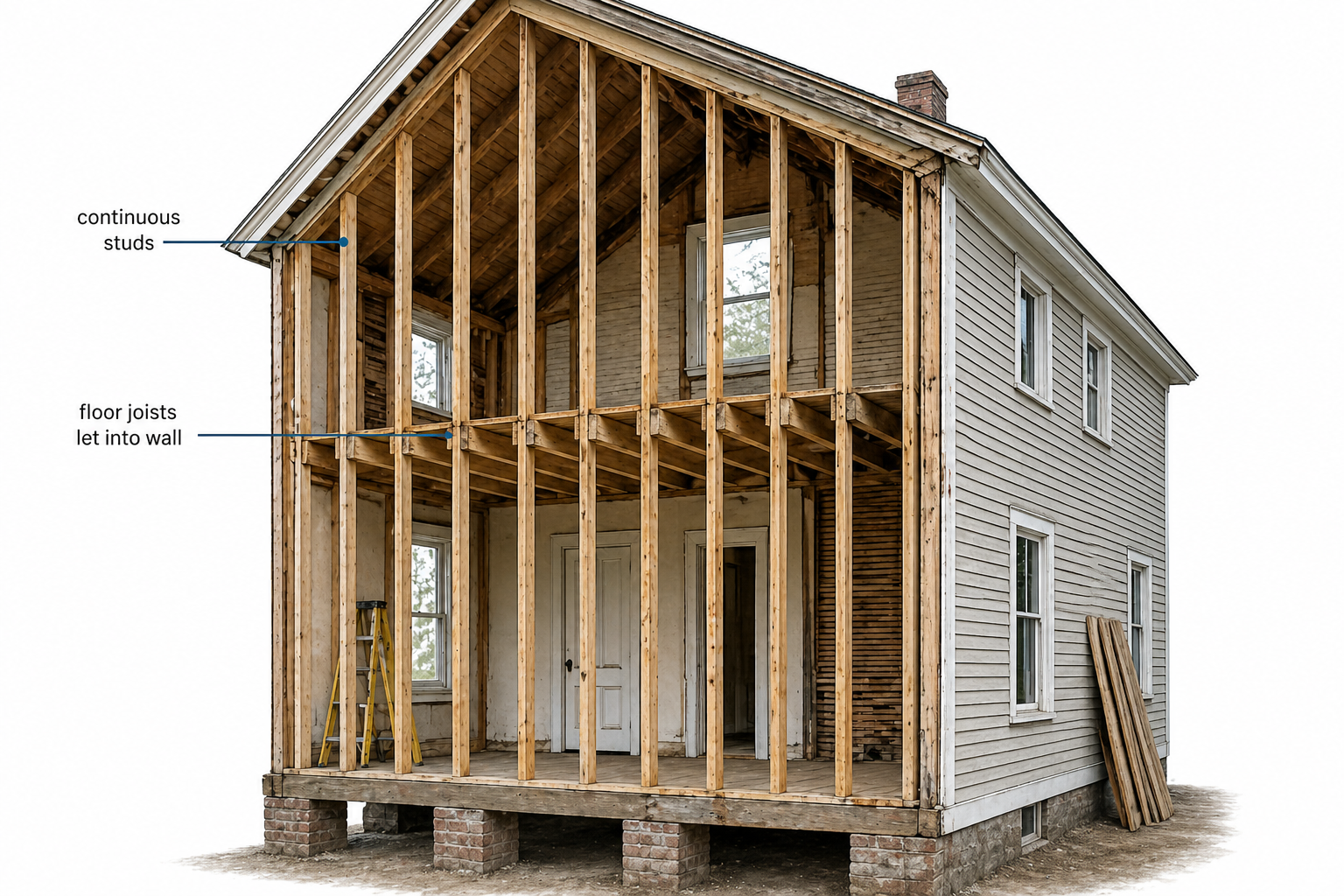
Image by ArchitectureCourses.org. This renovation view shows the key balloon-framing idea: long studs run past the second-floor line while the floor joists are carried by the stud wall.
If you own one of these houses, the framing method changes how you approach almost every renovation decision. Not because the structure is weak — most balloon-framed houses that are still standing have proven they can last — but because the wall cavities, fire paths, insulation conditions, and structural logic are different from what modern builders are trained to expect.
The contractor who has only worked on platform-framed houses will miss things. That is not a knock on them. It is a different system with different failure modes, and the mistakes tend to be invisible until they are expensive.
Fire Blocking
This is the most serious issue and the one that gets the least attention until something goes wrong. Balloon framing creates continuous wall cavities that run from the sill plate all the way to the attic without interruption. In a platform-framed house, each floor acts as a natural fire stop — the top plate of the wall below and the floor platform above create a break. Balloon framing has no such break. A fire that starts in the basement or first-floor wall cavity can travel straight up into the attic space without hitting anything that slows it down.
Any renovation that opens walls should include adding fire blocking at every floor line and at the top of the wall where it meets the attic. This is not optional and it is not cosmetic. It is the single most important safety upgrade you can make to a balloon-framed house. Use solid blocking, mineral wool stuffed tightly, or fire-rated caulk at penetrations. Check with your local code authority — many jurisdictions now require fire blocking to be added whenever balloon-framed walls are opened during renovation, even if the original scope of work did not include it.
Insulation
The continuous cavity is also the reason insulation in balloon-framed walls behaves differently than people expect. In a platform-framed house, you insulate each floor's wall cavities independently. In a balloon-framed house, the cavity runs the full height of the building. That means air can move vertically through the wall in ways that do not happen in modern construction.
Blown-in cellulose or dense-pack cellulose is often the best retrofit insulation for these walls because it fills the full cavity depth and resists air movement better than fiberglass batts. Batts in a tall continuous cavity tend to settle, compress, or leave gaps at the top — and a gap at the top of a two-storey wall cavity is a gap you will never see and never fix without pulling something apart again.
If you are insulating from the exterior during a siding replacement, that is the best opportunity you will get. Adding continuous exterior insulation over the sheathing solves thermal bridging through the studs and reduces the air movement problem at the same time. If you are insulating from the interior, dense-pack through drill holes at each floor level is the standard approach, but make sure the installer understands the cavity is continuous — not every insulation crew does, and the ones who treat it like a standard platform-framed wall will under-fill the upper portions.
Electrical and Plumbing in the Walls
Running new wiring or plumbing through balloon-framed walls is easier in some ways and riskier in others. The continuous cavity means you can sometimes fish wire from basement to attic without opening much wall. But that same open cavity means any penetration you make — drilling through a sill plate, cutting into a top plate — potentially opens a fire path that did not exist before.
Seal every penetration. Fire-rated caulk or putty pads around electrical boxes. Anywhere wire or pipe passes through a floor line, the gap around it needs to be filled. This is boring work and easy to skip. Do not skip it.
Structural Changes
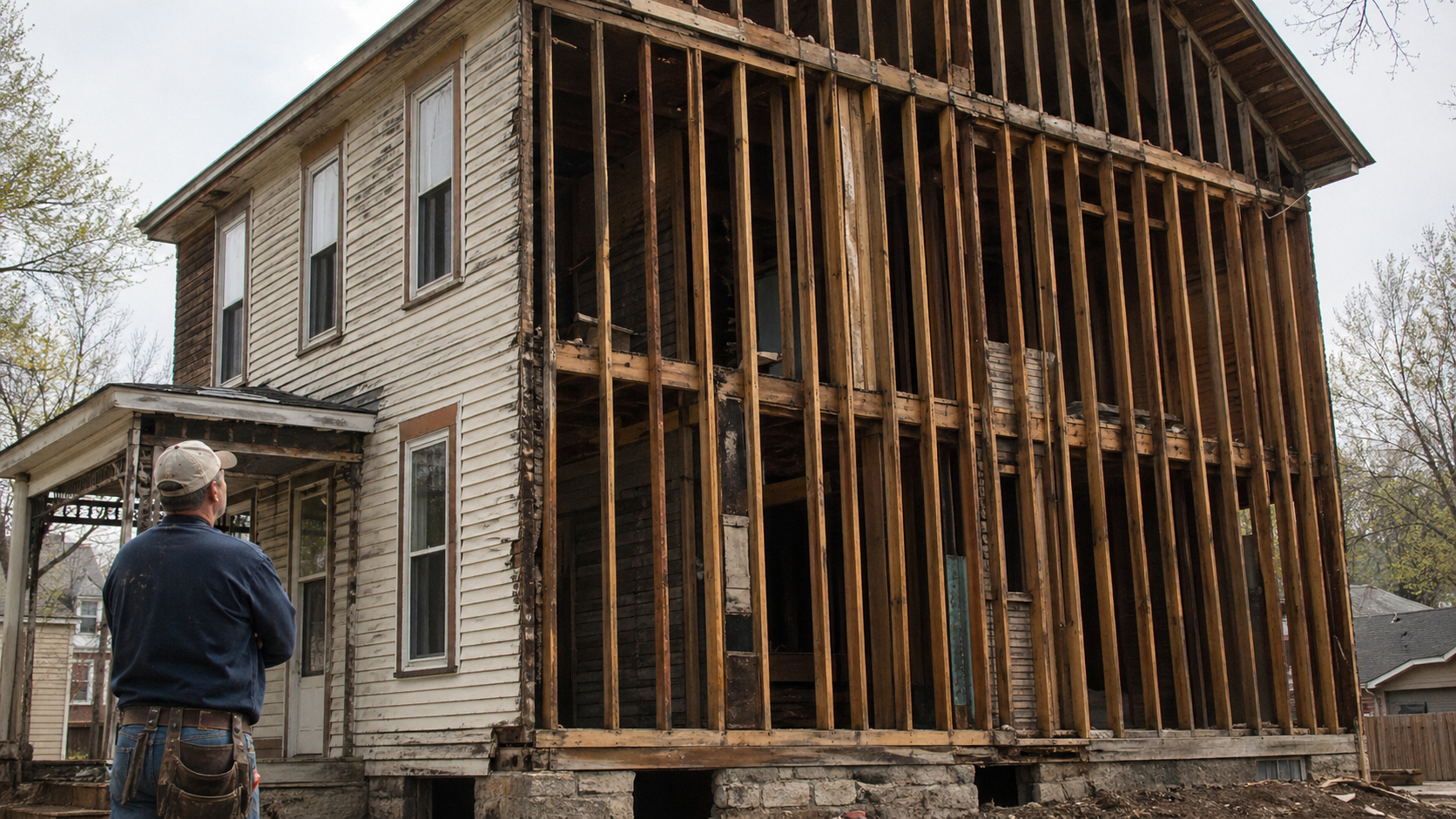
Image by ArchitectureCourses.org. Wall removal in a balloon-framed house depends on the load path: long studs can carry roof load while also supporting second-floor joists through the ribbon board.
Removing walls in a balloon-framed house requires understanding which studs are carrying what. The long continuous studs carry both floors and the roof. In a platform-framed house, each floor's walls carry only the load above that floor. In a balloon-framed house, a first-floor stud may be supporting the second floor via the ribbon board and carrying roof load at the same time.
That does not mean you cannot remove walls. It means you need to understand the load path before you cut anything. Get a structural engineer involved for any wall removal. The cost of the engineer's time is trivial compared to the cost of discovering mid-demolition that the wall you just opened was holding up the second floor from the ribbon board connection.
Also check the ribbon board itself during any renovation. This is the horizontal board let into the studs that supports the second-floor joists. In older houses, this member can be undersized, split, or deteriorated. If the ribbon board is compromised, the second-floor joists lose their bearing — and that problem does not always show obvious symptoms from inside the house until the damage is advanced.
Moisture and Rot
Balloon-framed walls with no insulation and no vapor control have been drying in both directions for a century and are often in surprisingly good condition because of it. The moment you insulate one side of the wall, you change the moisture dynamics. The wall that was surviving because it could dry freely may now trap moisture against surfaces that were never wet before.
This is where a lot of well-intentioned energy retrofits cause damage. Adding interior vapor barriers to balloon-framed walls in cold climates can trap moisture inside the cavity. Adding exterior insulation without addressing interior moisture sources can do the same from the other direction. The right approach depends on climate zone, existing conditions, and what is on both sides of the wall. If you are not sure, get a building science assessment before committing to an insulation strategy. The wall that has lasted 120 years without insulation can fail in five years with the wrong retrofit.
What to Check Before Starting Any Renovation
- Open one wall cavity and look. Check stud condition, check for fire blocking (there probably is none), check for old wiring that may need replacing, check for evidence of moisture or insect damage. One opened bay tells you a lot about the rest of the house.
- Check the sill plate. The bottom of a balloon-framed wall sits on a sill plate that is 100+ years old. Rot, insect damage, and deterioration at the sill are common and can undermine the entire wall above.
- Check the ribbon board at the second floor. This is the member that supports the floor joists. If it is split, rotted, or pulling away from the studs, the floor is losing its bearing.
- Verify the roof connection. How the top of the balloon-framed wall connects to the roof framing varies. Some connections are adequate. Some are not, especially in areas with high wind or seismic requirements that did not exist when the house was built.
- Assume no fire blocking exists until you see it. Plan to add it at every floor line and at the attic connection during any renovation that opens walls.
The general principle: a balloon-framed house that has been standing for a century is not fragile. But it was built under different assumptions about fire, insulation, moisture, and structural loading than current practice. Renovating it well means understanding those differences rather than treating it like a newer house that happens to be old. For the construction details of how these frames go together, see Balloon Framing Construction. For moisture and insulation strategy in older crawl spaces and basements below these houses, Crawl Space Encapsulation vs Vapor Barrier Only covers the ground-level decisions that affect the wall system above.
FAQ
What is balloon framing in simple terms?
It is a wall-framing system that uses long continuous studs running past the floor line instead of building one platform at a time.
When did balloon framing start?
It appeared in the early 1830s and spread quickly through the mid-19th century.
Why was balloon framing such a big deal?
Because it made wood-frame construction faster and made more complicated house shapes cheaper to build.
Did balloon framing create Victorian house styles?
No. But it made many Victorian forms much easier to build.
How can I tell if a house might be balloon framed?
Irregular massing, many corners, varied rooflines, and the age of the house can all be clues. Inside, continuous wall cavities and full-height studs are stronger evidence.
Is balloon framing still used now?
Not much. Platform framing replaced it as the standard system.
Are old balloon-framed houses safe?
They can be, but they often need attention around fire blocking, renovations, and wall-cavity details that modern framing handles differently.