

Image by ArchitectureCourses.org. A hammer beam roof opening over a large historic timber hall with exposed structure and clear room-scale drama.
A hammer beam roof only makes sense when the room can carry it.
The payoff is clear enough. Open span. Exposed timber. A ceiling that feels structural, not covered over later. But this is not an easy roof to get right. Hammer beams push load toward the walls, depend on proportion, and get expensive fast once the span grows or the timber stays exposed.

Illustration by ArchitectureCourses.org. Simplified hammerbeam roof diagram showing projecting hammerbeams, curved braces, and the open span below.
Done well, they can be extraordinary. Done badly, they look heavy, fake, or too ambitious for the room.
Start with the real questions: what a hammer beam roof is, how the main types differ, how far they can span, what drives cost, where they fit, and where they usually go wrong.
What a Hammer Beam Roof Is
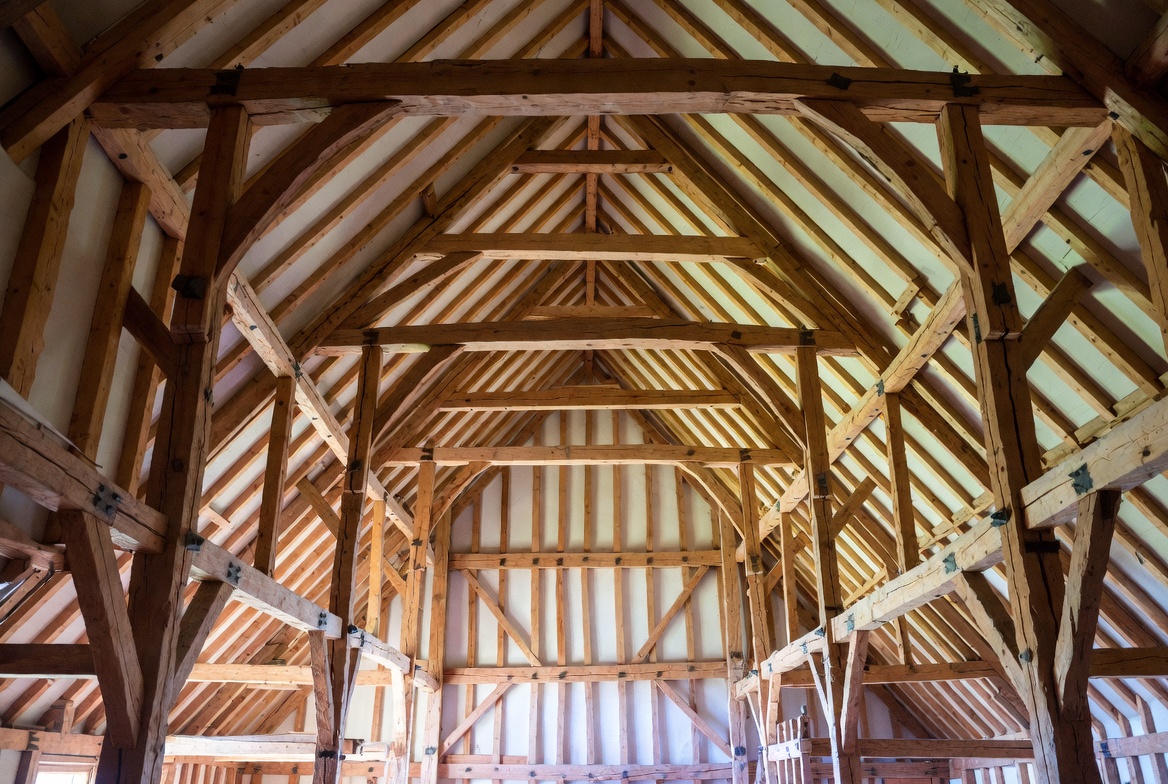
A timber hammer beam roof frame showing the open span, exposed rafters, and layered structure inside a large hall.
A hammer beam roof is an open timber roof where short horizontal members project inward from the walls instead of using one full tie beam across the whole room.
Those short members are the hammer beams. Above them, posts, braces, rafters, and other members work together to carry the roof load down and out to the supporting walls.
That is why a hammer beam roof can open up a room so dramatically. You do not have one long beam cutting across the full width at a low level.
It also explains the trade-off. A simpler tied roof tends to keep more of the force inside the roof triangle. A hammer beam roof pushes harder on the walls. That outward thrust has to be dealt with. If the walls, connections, buttressing, hidden steel, or other support work is weak, the roof starts asking too much from the building.

Hammer beam roof over a large hall. The point is the open span and the exposed timber below the roof.
So the first thing to get straight is this: a hammer beam roof is not just a pretty timber ceiling. It is a structural decision.
If your real question is basic truss anatomy first, start with truss basics. Hammer beam roofs make more sense once the ordinary load path is clear.
Why This Roof Exists
Hammer beam roofs were developed to solve a real room problem: how to cover a large space without filling it with interior supports and without dropping a heavy full-width tie beam across the room.
In a hall, chapel, lodge, or large gathering space, that matters. The ceiling becomes part of the room instead of a problem to hide.
That is still the appeal now. People do not choose hammer beam roofs because they are the cheapest roof system. They choose them because the room wants height, timber, and visible structure.
If the room does not want those things, this is usually the wrong roof.
Which Type Fits the Job
| Type | Best Fit | What It Gives You | Where It Starts Going Wrong |
|---|---|---|---|
| Standard hammer beam | Great rooms, halls, lodges, large timber homes | Classic open look without a full tie beam across the room | Bad wall support, clumsy proportions, too much timber for the room |
| Double hammer beam | Very large rooms and grand halls | More reach, more structure, more visual drama | Complex joinery, crowded ceiling, major cost jump |
| False hammer beam | Decorative ceilings, renovations, themed interiors | The look without the full structural work | Looks fake fast if the members are oversized or badly spaced |
| Gothic variation | Historic or church-like interiors | Pointed arches, more vertical pull, more ornament | Easy to overdesign and hard to detail cleanly |
| Hammer beam ceiling | Homes that want timber mood more than structural expression | Warmth and character with less engineering pain | Feels heavy in low rooms and fake in ordinary rooms |
The useful split is simple: some of these roofs are carrying real load, and some are mainly visual. If the system is decorative, say that early. Better to be honest than to stage a fake heroic structure over a room that is really being held up some other way.
Standard Hammer Beam vs Double Hammer Beam

Historic hammer beam roof. The room is big enough for the timber to feel earned.
Standard Hammer Beam
This is the form most people mean. One pair of hammer beams. One pair of rising braces or posts. Clear geometry. Strong visual effect.
It works best when the room is large enough to deserve exposed timber but not so large that the whole thing starts needing much heavier engineering.
In a lodge, a hall, a chapel, or a large living room, a standard hammer beam can feel right. In a smaller room, it often feels like too much structure for too little payoff.
Double Hammer Beam
This is the bigger move. Two tiers of hammer beams on each side instead of one. More timber. More members. More visual complexity. More span potential. More cost.
It belongs in rooms that can carry that amount of structure visually. Great halls. Big gathering rooms. Historic-style public spaces. Not average houses trying to look special.
The first failure here is usually not technical. It is proportional. A double hammer beam roof in the wrong room can feel crowded, dark, and overplayed before anyone even gets to the engineering.
False Hammer Beam Roofs and Decorative Ceilings
Not every hammer beam roof has to be structural.
A false hammer beam ceiling uses the look of hammer beams without relying on them to carry the actual roof load. That can be a smart move when the ceiling wants timber character but the structure above is being handled another way.
This is often the better answer in smaller homes, restaurants, renovations, event spaces, and rooms where a true hammer beam roof would be too expensive, too heavy-looking, or too structurally demanding.
The trick is restraint. Most fake hammer beam ceilings fail because the members are too thick, too low, or too theatrical. The designer is trying to get medieval grandeur in a room that really wants a cleaner timber gesture.
Put it this way: a believable false hammer beam ceiling can be good architecture. A fake oversized one just turns into set design.
Use It Here, Avoid It Here
| Use This | When | Avoid This | When |
|---|---|---|---|
| True hammer beam roof | The room is large, open, tall enough, and the structure is meant to be seen | True hammer beam roof | The room is small, chopped up, or too low to carry heavy timber well |
| Double hammer beam roof | The span is bigger and the room can visually carry a heavier ceiling | Double hammer beam roof | The budget is tight or the room is ordinary |
| False hammer beam ceiling | You want timber character without full structural cost | False hammer beam ceiling | You are trying to fake a grand hall in a modest room |
| Engineered wood hammer beam system | You want a cleaner long span and more dimensional control | Solid timber only | The span is pushing beyond what simple solid members do well |
Hammer beam roofs make sense in rooms where the ceiling matters. Great rooms. Lodges. Chapels. Event halls. Historic restorations. Large timber homes.
They do not make as much sense in low rooms, ordinary suburban living rooms, tight remodels, or standard roof systems where a simpler exposed truss would do the job better and for less money.
Do This Instead of This
| Do This | Instead of This | Why |
|---|---|---|
| Use a true hammer beam roof in a room with real height and real span | Force one into a low, average room | The roof needs space to read well |
| Use a false hammer beam ceiling when you want the look only | Pretend a decorative system is structural | Honest detailing looks better than fake structural drama |
| Use engineered wood or hidden steel when the span climbs | Insist on simple solid timber past its comfort zone | Long spans need more than good intentions |
| Scale the members to the room | Oversize everything for “impact” | Big timber can make a room feel crushed instead of grand |
| Bring the engineer in early | Wait until the room and roof shape are already fixed | Late structural fixes cost more and usually look worse |
What Controls the Design

Close-up of a hammer beam frame. The visible timber is only part of the story. The load path matters just as much.
Hammer beam roofs look romantic. Designing them is less romantic.
These are the things that decide whether the roof works:
Span
The wider the room, the harder the roof has to work. Once the span climbs, member sizes, connection forces, and wall demands all change quickly.
Outward thrust
This is the big one. Hammer beam roofs push load outward toward the walls. If the walls, buttresses, ties, hidden steel, or reinforcement are not doing their job, the roof starts asking the walls to do work they were never built for.
Timber type
Oak, Douglas fir, pine, glulam, LVL — they do not behave the same way. Some are chosen for appearance. Some for strength. Some because the job needs longer, more stable members.
Joinery and connections
Traditional mortise-and-tenon work is one path. Hidden steel connectors are another. Hybrid timber-and-steel systems can solve real structural problems without changing the look too much.
Room proportions
This part is easy to ignore and expensive to ignore. A hammer beam roof that works structurally can still feel wrong in the room if the members are too bulky, too low, or too crowded.
A lodge room with real height is one thing. A living room with average ceiling height trying to wear the same roof language is another.
This part matters. If lateral support is the real problem, read Truss Lateral Bracing: Types, Functions, and Installation and Types of Truss Bracing.
How Far Can a Hammer Beam Roof Span?

This is the question people ask first, and the honest answer is still: it depends on the material, the detailing, the support, and how much steel help is hidden in the system.
| Material | Rough Span Range Without Interior Supports | Typical Fit |
|---|---|---|
| Solid timber | About 30 to 60 feet | Homes, lodges, halls |
| Glulam or other engineered wood | About 50 to 80 feet | Larger timber rooms and cleaner long spans |
| Steel-reinforced timber systems | About 80 to 120 feet | Large public or commercial spaces |
Those are rough working ranges, not design values.
A 40-foot lodge room in timber is one thing. A 100-foot event space is a different problem entirely. Once the span starts getting serious, engineered wood and hidden steel stop being optional pretty quickly.
One more thing: the span number by itself does not tell you whether the room will feel right. Two roofs can span the same width and still land very differently in the room because the timber size, pitch, and spacing are doing different visual work.
What Makes the Span Harder
Some hammer beam roofs span farther than others for reasons that have nothing to do with optimism.
- Heavier roofing. Slate and tile ask more from the truss than lighter roof finishes.
- Snow load. Snow country changes the whole equation.
- Wind exposure. Big open sites and exposed ridges change connection demands.
- Poor wall support. A roof can be strong on paper and still fail the room if the supporting structure is weak.
- Long exposed timber members. Movement, checking, and stability matter more once the members get bigger and more visible.
So when someone says, “How far can this go?” the better question is, “In what timber, under what load, over what kind of room, and with what support?”
What a Hammer Beam Roof Costs
Hammer beam roofs are not low-cost roofs.
They ask for engineering, better timber, careful fabrication, and more judgment than a standard truss package. The price climbs quickly once the beams stay exposed, the span grows, or the detailing gets custom.
| Type | Rough Cost Per Square Foot | Rough Total for a 2,000 Sq Ft Roof |
|---|---|---|
| Standard hammer beam roof | $40 to $80 | $80,000 to $160,000 |
| Double hammer beam roof | $60 to $120 | $120,000 to $240,000 |
| False hammer beam ceiling | $20 to $50 | $40,000 to $100,000 |
The simple version: a decorative hammer beam look costs less than a true hammer beam roof. A true one costs less than a heavily customized or double system. And none of them are cheap once the room starts depending on the timber to carry the whole visual effect.
Labor, timber species, crane access, custom joinery, hidden steel, finish quality, and shop time all move the number.
The cheap version of this roof is still not cheap. That is worth saying plainly before anyone falls in love with the drawing.
Where Cost Jumps Fast
- Exposed finish grade timber. Once the wood stays visible, quality control gets stricter.
- Custom geometry. A one-off roof costs more than a repeated one.
- Complex joinery. Decorative joinery and special fabrication time add up fast.
- Difficult access. Crane work, site constraints, and remote jobs hit the budget hard.
- Historic-style detailing. Once the room wants carved or highly shaped timber, labor jumps.
Spend the money where the roof is doing real work. Do not spend it trying to make a modest room pretend it is Westminster Hall.
Famous Hammer Beam Roofs Worth Knowing
These roofs matter because they prove the type was not just decorative theater. It solved real span problems and left behind rooms people still remember.
- Westminster Hall, London. One of the best-known medieval hammer beam roofs in the world.
- St. George’s Hall, Windsor Castle. A strong example of a more elaborate hammer beam system in a ceremonial room.
- Hampton Court Palace. A famous example of exposed timber used for both structure and display.
- Exeter Cathedral. Often cited when people are looking at Gothic timber roof precedent.
They are useful references, but they can also throw people off. A grand medieval hall is not a model for an average house. The lesson is not “copy this.” The lesson is “see what scale, proportion, and structure look like when they are resolved well.”
Modern Hammer Beam Roofs
Hammer beam roofs still show up in modern work, just not in the same way.
Today they are more likely to appear in lodges, event spaces, timber homes, chapels, civic buildings, and high-end public rooms where exposed structure is part of the design brief.
Modern systems also cheat less romantically and more intelligently. Glulam, LVL, hidden steel plates, CNC fabrication, and better fire detailing make it easier to build a roof that looks traditional but behaves more predictably.
That does not mean every modern timber ceiling should become a hammer beam roof. A lot of current projects are better off with a simpler exposed truss or a scissor system. If the real goal is vaulted space with cleaner geometry, scissor trusses may be the better move.
Where Hammer Beam Roofs Go Wrong
- The room is too small. Heavy timber overhead in a short room makes the space feel pressed down.
- The walls are underdesigned. The roof thrust gets ignored until movement starts showing up.
- Decorative members pretend to be structural. The room ends up looking staged instead of crafted.
- The timber is oversized for effect. Bigger is not always better. Sometimes it just makes the ceiling look clumsy.
- The budget assumes standard framing. Hammer beam roofs are not standard framing.
- The engineer comes in too late. By then the design is already locked into a bad direction.
Most bad hammer beam roofs do not fail because the idea is bad. They fail because someone wanted the romance of the roof without paying for the discipline it needs.
Quick Checklist Before You Commit
- Is the room big enough and tall enough to carry exposed timber well?
- Does the roof need to be truly structural, or is a decorative ceiling enough?
- Can the walls and supporting structure take the outward thrust?
- Does the budget fit real timber work, not just a nice rendering?
- Would a simpler truss or vaulted system solve the room better?
- Is the engineer involved early enough to shape the roof, not just patch it later?
FAQ
What is the main advantage of a hammer beam roof?
It opens up a room without needing a full tie beam across the whole width, and it gives the ceiling real exposed structure at the same time.
Is a hammer beam roof structural or decorative?
It can be either. A true hammer beam roof is structural. A false hammer beam ceiling is mainly decorative.
How far can a hammer beam roof span?
Roughly 30 to 60 feet in solid timber, more in engineered wood, and more again with steel reinforcement. Real design depends on the whole system, not just the beam count.
Are hammer beam roofs expensive?
Yes. They cost more than ordinary roof framing because they need better design, more labor, and better material control.
Can you use one in a house?
Yes, but it makes the most sense in larger rooms with enough height to carry the timber without making the ceiling feel heavy.
Is a false hammer beam ceiling a bad idea?
No. It can be the smarter move when you want the look without the full structural cost. It becomes a bad idea when the proportions are wrong or the detailing feels fake.
What usually matters more, span or room size?
Both matter, but room size is what people ignore first. A roof can be structurally possible and still be the wrong visual move.