

Vaulted ceilings look simple from the floor. The structure making them work is not.
A scissor truss is a roof truss with sloped bottom chords instead of a flat ceiling line. That one change is what gives you a vaulted interior without building full rafters and a site-built cathedral ceiling. It can open up a room beautifully. It can also create layout, bearing, insulation, and cost problems fast if the design gets treated like a style choice instead of a structural one.
This page stays with the practical questions: what a scissor truss is, where it makes sense, how it differs from a regular truss, what materials are common, and where jobs start going sideways. For the wider truss picture first, see Types of Trusses and Truss Design 101.

What a Scissor Truss Actually Is
A scissor truss uses angled bottom chords that rise toward the center instead of staying flat. The top chords form the roof slope above. The web members connect those parts and distribute load back to the bearings at each end.
The result is a sloped ceiling line inside the room without switching to a completely different roof-framing system. That is the appeal. You get volume and headroom without simply making the whole building taller.

Scissor trusses are still trusses. They are not decorative ceiling shapes floating under a roof. They carry load, react differently than flat-bottom trusses, and have to be engineered for span, pitch, bearing, roof load, and ceiling geometry together.
Scissor Truss vs Regular Truss
| Type | Bottom Chord | Ceiling Result | Main Advantage | Main Trade-Off |
|---|---|---|---|---|
| Scissor Truss | Sloped | Vaulted or cathedral-style ceiling | More interior volume without a full site-built rafter roof | More design complexity, tighter insulation and bearing decisions |
| Regular Truss | Flat | Flat ceiling | Simple, efficient, and usually cheaper | Less headroom and less dramatic interior space |
If the project does not need volume, drama, or extra height inside, a regular truss is often the cleaner answer. Scissor trusses earn their keep when the interior ceiling shape matters enough to justify the extra coordination.
Where Scissor Trusses Earn Their Keep
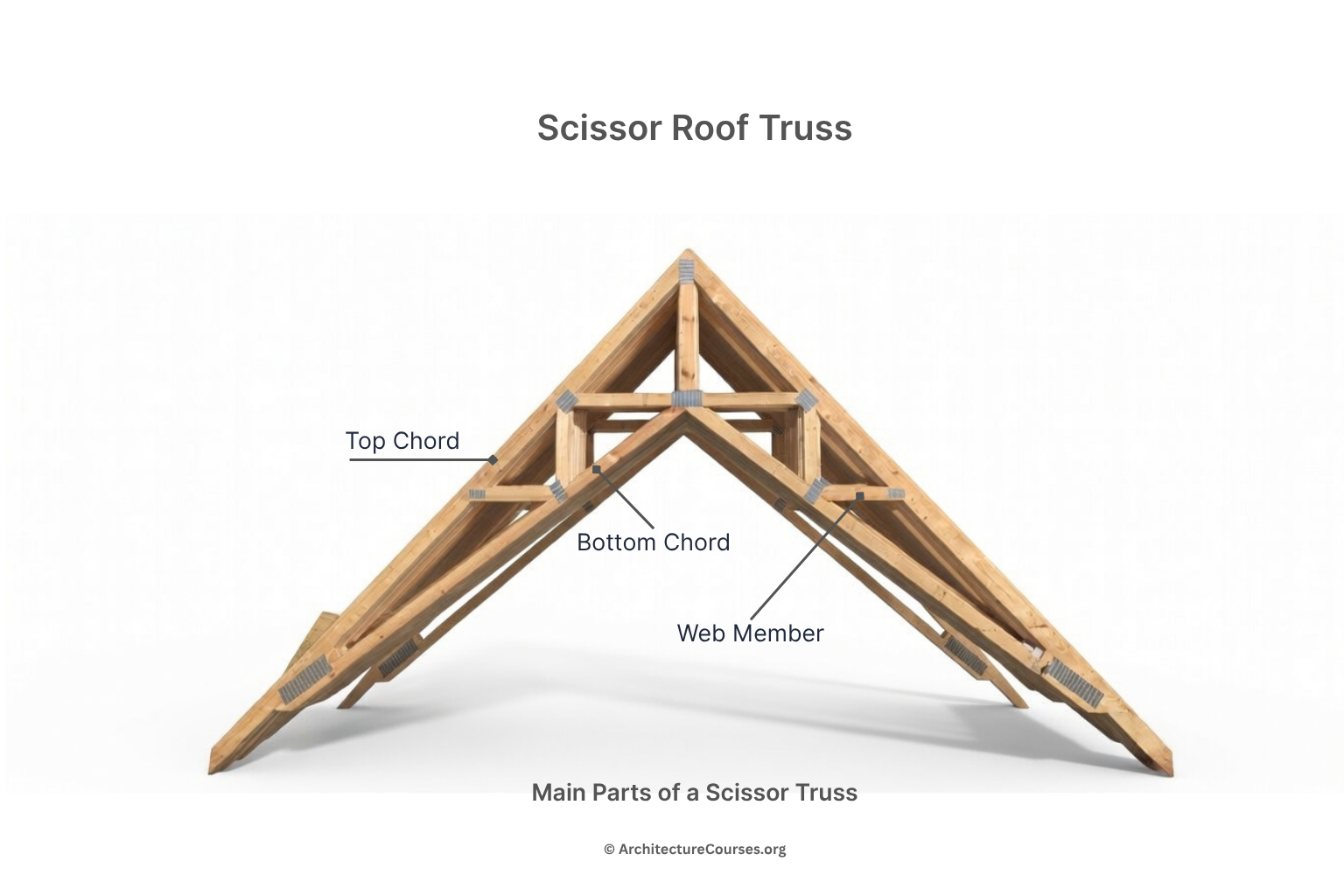
Illustration by ArchitectureCourses.org. Scissor roof truss diagram with labeled top chord, bottom chord, and web member.
Scissor trusses make the most sense when you want the room volume and the project can support the geometry that comes with it.
- Living rooms and great rooms. This is the classic use. A vaulted ceiling makes the room feel larger without adding another story.
- Garages and workshops. They can add usable headroom where overhead storage, lifts, lighting, or equipment matter.
- Barns and event spaces. They work well where a broad open room needs height and clear span at the same time.
- Rustic or exposed-structure interiors. In heavy timber or carefully designed wood applications, the truss can become part of the finished room.
- Projects using raised heels for insulation space. In some climates, that heel geometry matters as much as the ceiling shape.
They make less sense when the budget is tight, the room is small enough that the vault adds little, or the insulation and service layout are already fighting for space.
What the Design Is Balancing
Scissor trusses are never just “pick a vaulted ceiling and order some trusses.” The engineer and truss designer are balancing several things at once.

Roof Pitch vs Ceiling Pitch
The roof slope and the interior ceiling slope are related, but they are not the same thing. Push the ceiling too steep and the truss geometry starts getting awkward. Push it too flat and the “vault” effect starts disappearing.
Span, Load, and Bearings
Span is not a number you pick in isolation. It is tied to snow load, wind load, roof material, spacing, and where the truss is actually bearing. That is why a scissor truss that works in one project cannot just be copied blindly into another.
If the roof covering is changing, that matters too. Heavier roofing means different loading and sometimes a different truss approach. See Roofing Materials if you are still deciding what the roof assembly is carrying.
Insulation Space
This is one of the details people miss. The vaulted ceiling looks great on the rendering. Then the roof edge gets tight, the insulation gets pinched, and the energy performance gets worse right where the roof needs it most. Raised heel scissor trusses can help, but only if that decision is made early.
Services, Lighting, and Bracing
Vaulted ceilings change more than appearance. They affect lighting placement, duct runs, ventilation strategy, ceiling finish, and temporary bracing during installation. A scissor truss can solve one design problem and create three coordination problems if nobody is watching the whole section.
FIELD PICK: Plumb Bob Magnetic Truss Layout Tool for checking heel heights and layout points on site without guessing.
Material Options
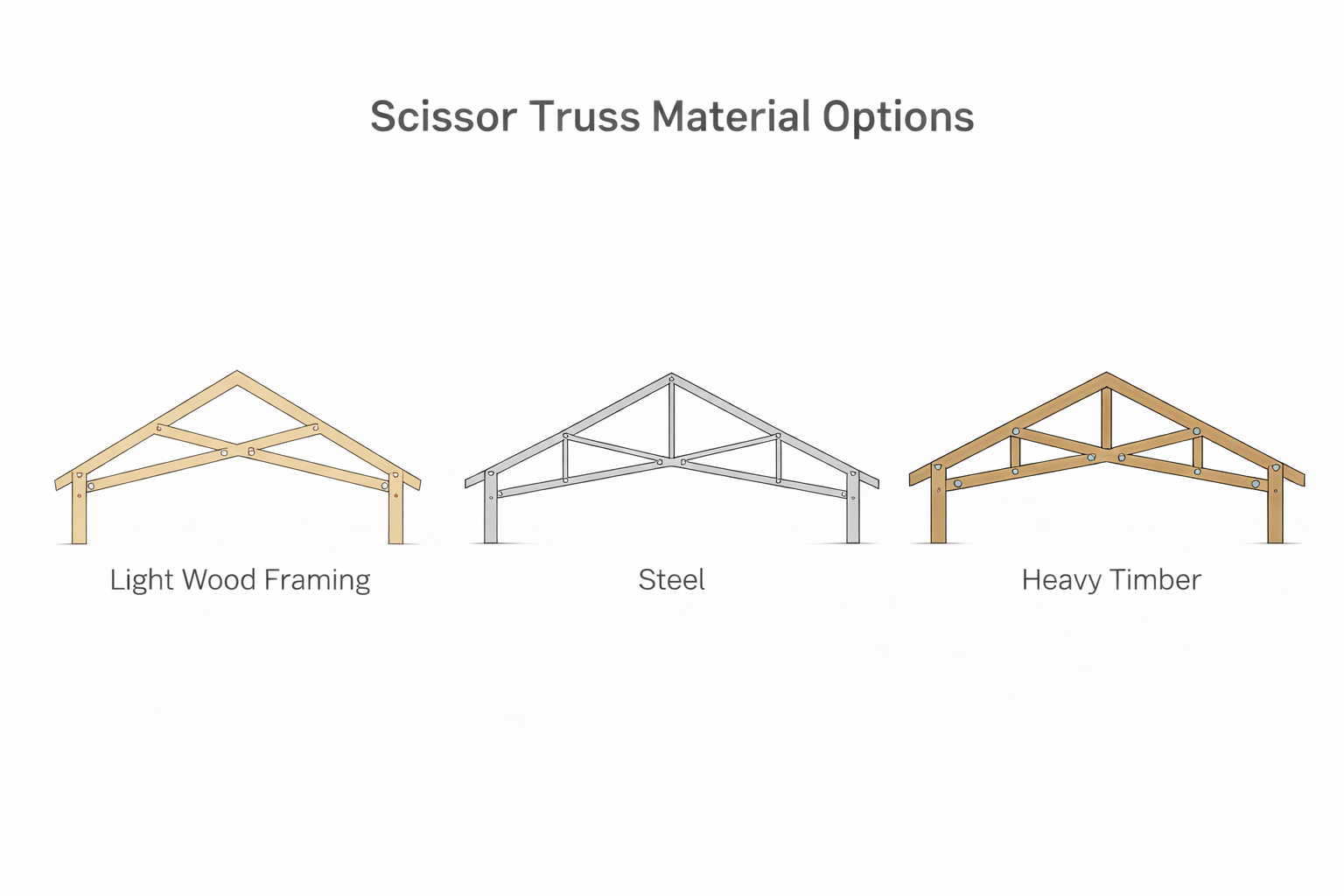
Illustration by ArchitectureCourses.org. Comparison of scissor truss material options including light wood framing, steel, and heavy timber.
| Material | Best Use | Why People Choose It | Main Drawback |
|---|---|---|---|
| Wood | Most residential projects | Affordable, available, and easy to integrate into typical home construction | Less suited to very large spans or exposed high-end feature work |
| Steel | Longer spans, modern designs, commercial work | High strength and cleaner performance on larger spans | Higher cost, different detailing, and more specialized installation |
| Heavy Timber | Rustic, lodge, or exposed-structure interiors | Strong visual impact and substantial structural presence | Higher cost and more demanding installation |
Wood is still the default in most home-scale scissor-truss jobs. Steel becomes more attractive as spans grow or the design goes more industrial. Heavy timber is the one you choose when the truss is meant to be seen and the budget can support that choice.
For the material-specific pages, see Steel Truss Design and Timber Trusses Explained.
Span and Cost Reality

Two questions come up every time: how far can a scissor truss span, and how much does it cost?
The honest answer is that both are engineering questions first, catalog questions second. Span depends on pitch, spacing, roof load, ceiling slope, material, connection design, and local code requirements. Cost depends on span, geometry, material, delivery, installation method, and how custom the truss package is.

Illustration by ArchitectureCourses.org. Scissor truss design steps diagram showing key sizing, load, code, software, and engineering review stages.
| Project Size | Typical Use | What Usually Changes |
|---|---|---|
| Small | Sheds, small garages, compact rooms | Simpler geometry, lower lifting demands, lower cost pressure |
| Medium | Most residential vaulted rooms | Balance between aesthetics, structure, and insulation becomes more important |
| Large | Barns, open rooms, event spaces, some commercial work | Engineering, lifting, bracing, and connection details get much more serious |
That is the part worth remembering: once the span gets larger, the project stops being a “vaulted ceiling” question and becomes a structure, installation, and cost-control question all at once.
When DIY Makes Sense and When It Does Not
Small pre-manufactured scissor trusses on simple accessory structures are one thing. A main-house roof carrying real loads over a major room is another.
DIY Might Make Sense When
- the span is short
- the trusses are pre-manufactured
- the structure is simple
- permits, loads, and installation requirements are already clear
- you are not improvising design decisions on site
Hire a Pro When
- the span is longer or the room matters architecturally
- the truss geometry is custom
- you are dealing with heavy timber or steel
- the roof carries higher snow or wind loads
- you need cranes, engineered connections, or structural review
A good middle path is simple: even when the installation is straightforward, the design should still be reviewed properly before anything gets ordered.
Where Jobs Start Going Sideways
Most scissor-truss problems are not mysterious. They come from ordinary mistakes made early.
Span and Pitch Were Treated Casually
A scissor truss that looks fine in elevation can still be wrong for the actual load path. The trouble often shows up later as sagging, cracked finishes, or ugly interior proportions.
Bearings and Heel Heights Were Not Coordinated
If the heel height, bearing points, and wall geometry are not lined up cleanly, the installation gets messy fast. That usually means site fixes nobody wanted to pay for.
Insulation Was Left for Later
This is common. The vaulted ceiling gets designed first. The thermal section gets figured out later. That is how projects end up with pretty ceilings and weak roof-edge performance.
Bracing and Connections Were Treated Like a Footnote
Scissor trusses still need proper temporary bracing during erection and correct permanent connections once installed. Fasteners, plates, connectors, and lateral restraint are not optional cleanup items.
The Project Needed a Different Truss in the First Place
Sometimes the right answer is not a scissor truss. If the room does not benefit much from a vault, or if cost and simplicity matter more, another truss type may be better. See King Post Truss and Types of Trusses for the broader comparison.
FAQ
What is a scissor truss?
A scissor truss is a roof truss with sloped bottom chords that create a vaulted interior ceiling while still working as a trussed roof system.
When should I use scissor trusses?
Use them when the project genuinely benefits from interior height, vaulted ceilings, or a more open room profile and the structure, insulation, and budget can support that choice.
Can I install scissor trusses myself?
Sometimes on small, simple projects with pre-manufactured trusses. For larger spans, custom designs, or main-house roofs, professional engineering and installation oversight are the safer call.
Are scissor trusses more expensive than regular trusses?
Usually yes. The geometry is more complex, the detailing is tighter, and the coordination load is higher. The ceiling volume may be worth it. The added cost is not imaginary.
What are raised heel scissor trusses?
They are scissor trusses designed with additional heel height at the bearing point to leave more room for insulation and improve roof-edge thermal performance.
Do scissor trusses span farther than regular trusses?
Not as a simple rule. Span depends on the full design, not the label. Some scissor trusses can cover substantial widths, but the geometry and load path may also make them less straightforward than a standard flat-bottom truss.
What’s Next
Scissor trusses are one of the cleaner ways to get a vaulted ceiling without switching to a completely different roof-framing strategy. That is the upside.
The catch is that they compress a lot of decisions into one piece of structure: pitch, span, bearing, insulation, ceiling shape, and installation method. Get those aligned, and the room opens up beautifully. Miss them, and the problems show up in both the roof and the ceiling below it.
- Truss Design 101 if you want the broader design logic before choosing a truss type.
- Types of Trusses if you are still comparing scissor trusses with simpler roof truss options.
- Timber Trusses Explained and Steel Truss Design if the material choice is still open.