

Sill plate replacement cost is hard to price from a photo.
The rotten board may be visible. The real job may not be. A sill plate sits at the wall-to-foundation line, where framing, anchorage, crawl-space moisture, rim joists, flooring, siding, termites, and foundation conditions can all meet in one narrow strip of wood. That is why one repair can be a local carpentry job and another can become structural work with jacking, temporary support, pest treatment, access cuts, permits, and finish repair.
For 2026 planning, Angi, HomeGuide, and HomeAdvisor commonly place sill plate replacement around $100 to $200 per linear foot, with large or whole-house projects often landing in the $10,000 to $40,000 range. But those numbers assume a full job with jacking. A short, accessible, localized repair can cost far less — and most homeowners have no idea which situation they are actually in until a contractor opens the area.
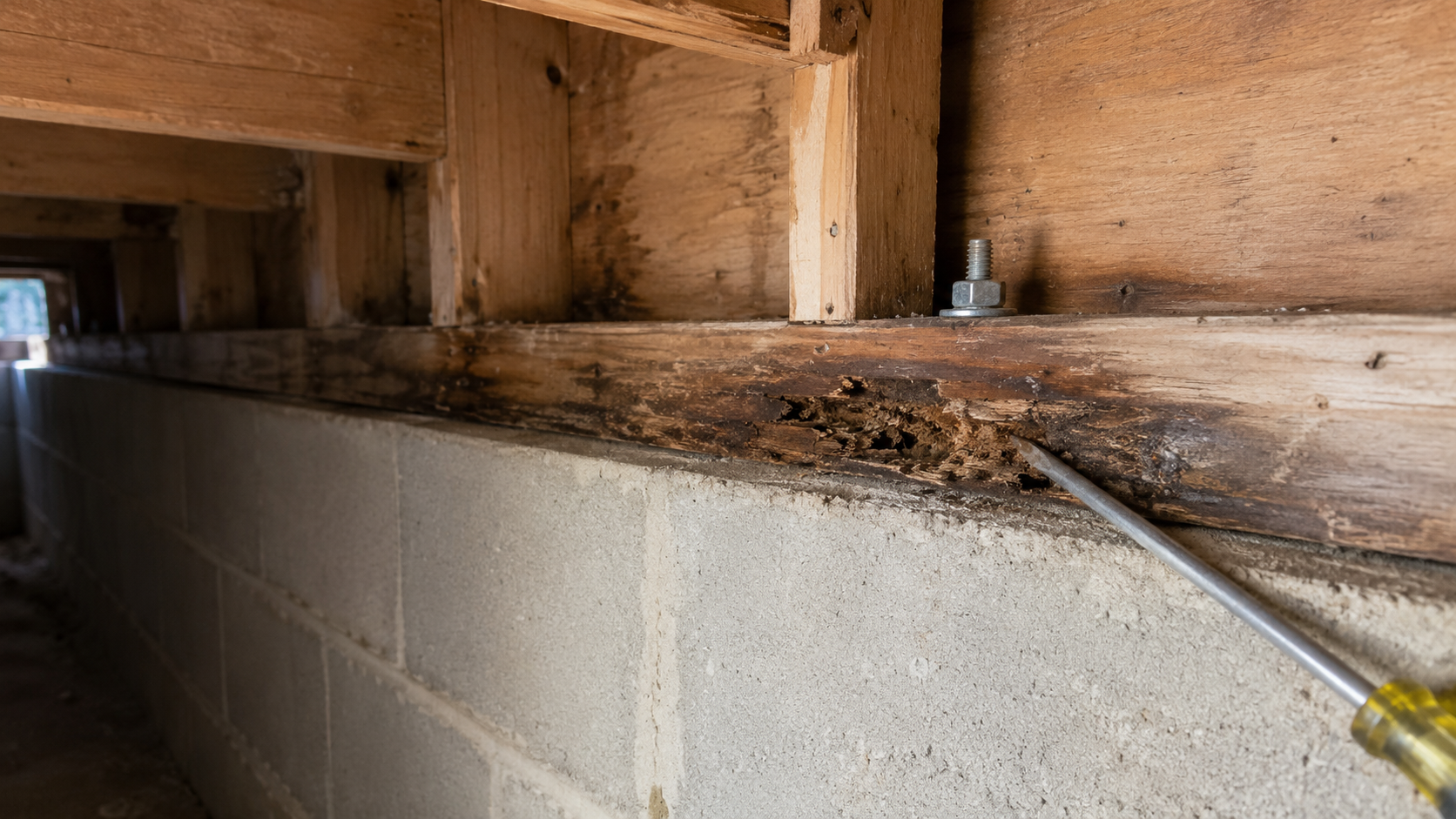
What You Are Paying to Replace
The sill plate is the horizontal wood member sitting on top of the foundation wall or stem wall. Wall framing sits above it. In many houses, the sill plate is anchored to the foundation with bolts, straps, or other connectors. That location is the reason the repair costs more than replacing trim.
A contractor may need to open the wall edge, crawl space, basement ceiling, siding, or floor area; support the wall or floor before removing damaged wood; remove rotten sill plate sections back to sound material; check rim joists, floor joists, subfloor edges, sheathing, and studs; restore anchorage or connectors where required; fix the moisture, drainage, foundation, or pest condition that caused the damage; and replace insulation, siding, trim, drywall, flooring, or paint after the structural work.
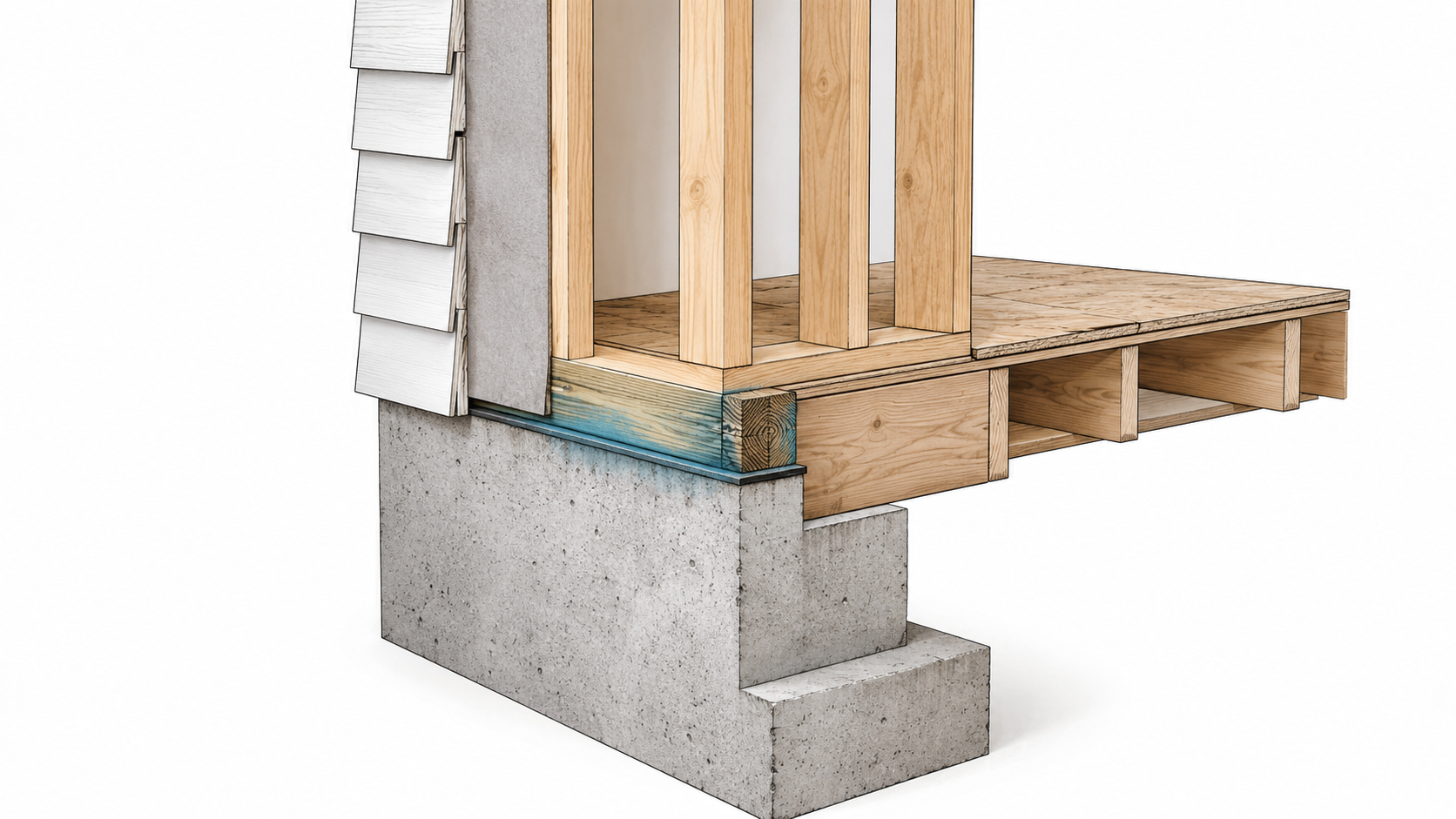
A quote that only says "replace sill plate" is not enough. You need to know how much of the plate, what else is damaged, how the wall will be supported, and what the price excludes.
Typical Sill Plate Replacement Cost Range
For 2026 planning, public cost guides place sill plate replacement in the high-cost structural repair category. Common planning ranges sit around $100 to $200 per linear foot, while major projects can run from the low five figures into much higher totals when long runs, structural support, access, moisture correction, and finish restoration are involved.
Use these as planning ranges, not quotes:
| Repair Scope | 2026 Planning Range | What It Usually Means |
|---|---|---|
| Small local sill repair | Often below whole-project averages, but can still reach several thousand dollars | A short damaged section, good access, limited related damage, and no major jacking or finish restoration |
| Per-linear-foot sill plate replacement | About $100 to $200 per linear foot | Useful for comparing length, but not enough to price access, support, moisture, pests, or finish repair |
| Crawl-space sill plate replacement | Moderate to high; often rises quickly when access is poor | Cost depends on working height, moisture, insulation, pest damage, and rim joist condition |
| Sill plate plus rim joist repair | Higher than sill-only work | More framing is affected, and the floor edge may need temporary support |
| Long run or whole-house sill replacement | Often $10,000 to $40,000 | Temporary support, phased work, anchorage, permits, and finish repairs may be needed |
| Garage sill plate replacement | Often high for the length involved | Garage walls, slab edges, overhead-door openings, water at the slab, and jacking can complicate access |
The number can look strange at first. A sill plate is only a piece of wood. But the cost is not the lumber — it is access, support, removal, replacement, anchorage, moisture correction, and closing the house back up.
The Question Every Cost Guide Skips: Does This Job Actually Need Full Jacking?
Many high-cost sill plate examples describe the big version of the job: opening access around the perimeter, using hydraulic jacks or temporary support, lifting or relieving sections of the house, and bringing in structural review when the scope requires it. That is a real job. It is also not the only job.
Short, localized damage — sometimes only a few feet of sill plate — may be handled with localized shoring rather than a full house lift, depending on the load, access, framing condition, and contractor or engineer judgment. The contractor installs temporary support directly above the damaged section, takes the load off that stretch of sill, replaces it, and brings the support down. No excavating the perimeter, no lifting the whole house, no week-long project. The lumber cost is still trivial. The labor is still real. But the scope is a fraction of the full-jacking version, and so is the price.
The distinction matters because the cost guides do not draw this line. They show you whole-house numbers and leave you to assume your small corner of damage costs the same. It usually does not. What it costs depends on these four questions:
- How many linear feet are actually rotten, and is the damage continuous or in scattered sections?
- Can the load be transferred locally with blocking and a temporary beam, or does the whole wall edge need to be relieved?
- Is the rim joist and the joist ends also damaged, or just the sill plate itself?
- Will a structural engineer sign off on localized support, or does the damage scope require a full-perimeter approach?
Get those answers before you budget. A contractor who inspects the actual damage and explains the support plan is giving you a real quote. One who quotes the full house lift without looking closely may be right — or may be pricing the worst-case job for a repair that does not need it.
Small Section vs Long Run Replacement
The biggest cost split is simple: how much of the sill plate is rotten?
A short damaged section near one corner, door opening, crawl-space wall, or localized leak may be repaired in sections. A long rotten run along a foundation wall is a different job — the contractor may need to support the structure, remove small sections at a time, replace related framing, and restore anchorage along the wall.
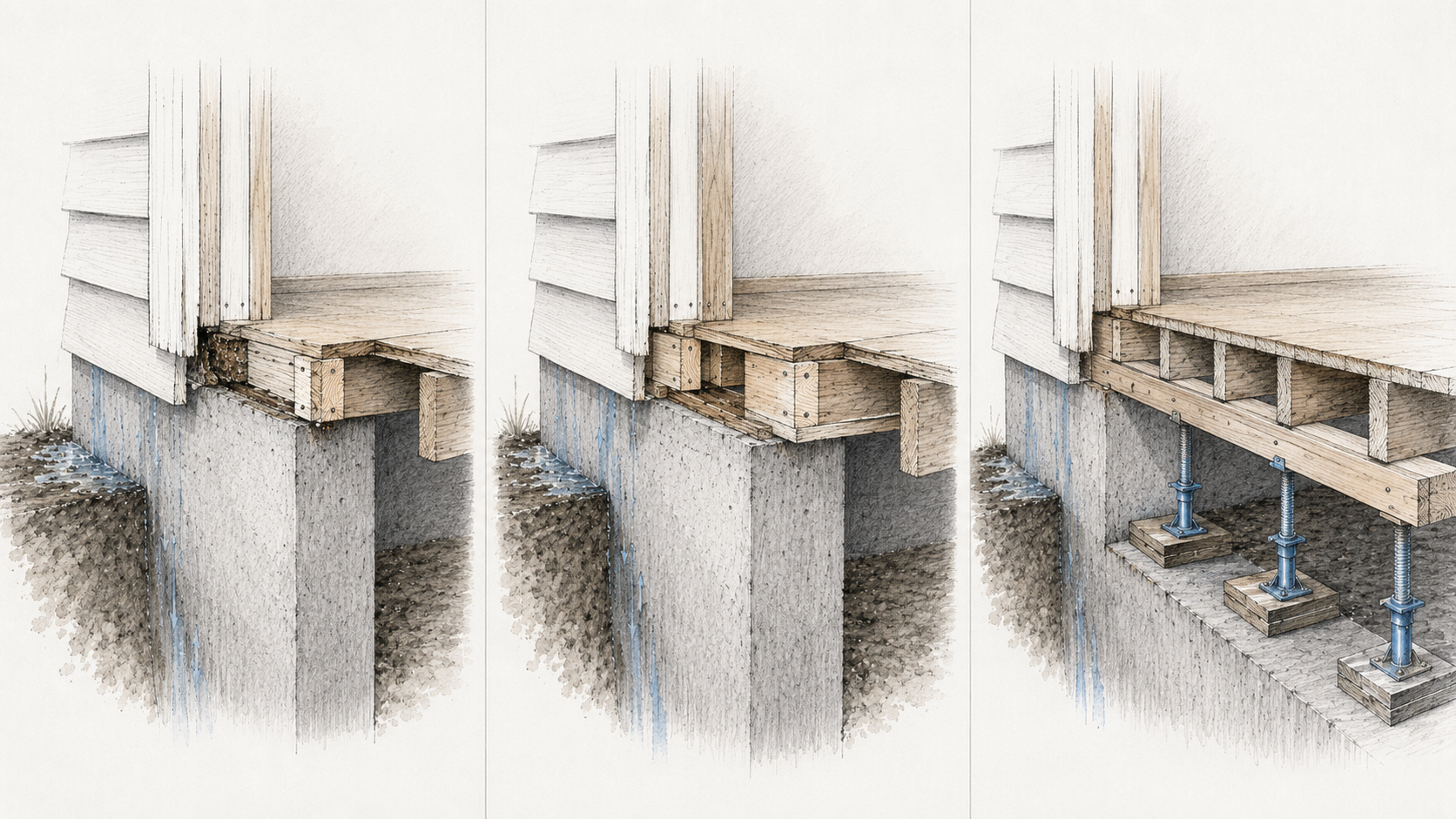
A local repair can still be serious. A long repair is almost always a bigger structural event. Ask the contractor to separate the quote by length and scope: how many linear feet are being replaced, whether the repair is one section or multiple sections, whether the wall or floor will be temporarily supported, and whether anchorage and finish restoration are included. A low number without those answers is not a real comparison.
Crawl Space Sill Plate Replacement Cost
Crawl-space sill plate replacement can be expensive because the work area is awkward and the moisture source is often still present. The contractor may be working in a low space around insulation, ducts, plumbing, vapor barrier, wet soil, old debris, pests, or limited access openings. If the sill plate has rotted in the crawl space, the rim joist, joist ends, beam pockets, and subfloor edge should also be checked.
Cost goes up when the crawl space is low or difficult to enter, when wet insulation must be removed, when the vapor barrier is missing or torn, when joist ends or rim joists are also soft, when temporary support is needed under the floor framing, when termite or carpenter-ant damage is present, and when moisture control work is needed before the repair is closed.
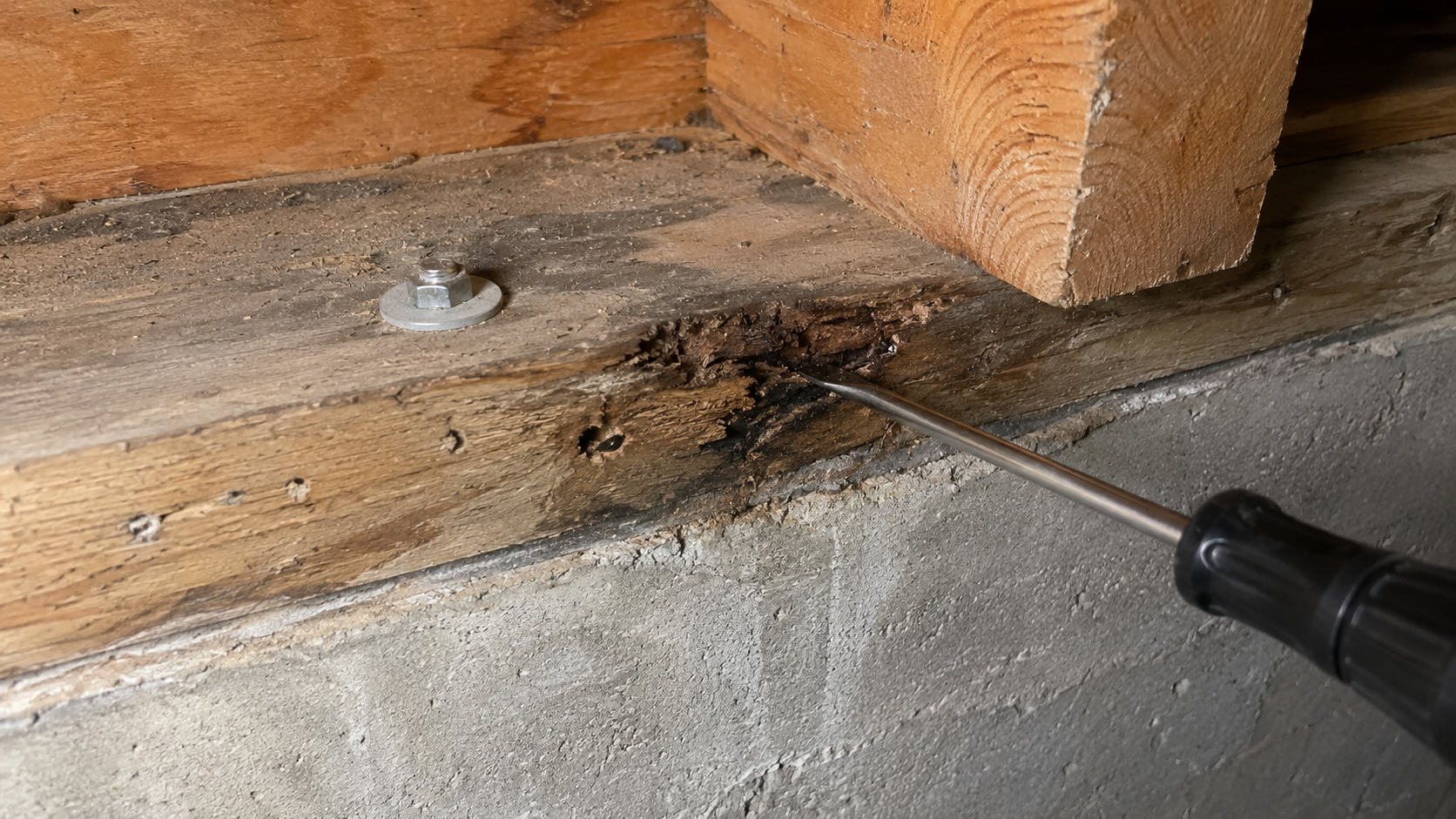
This is where homeowners get caught. One company may quote the crawl-space encapsulation; another may quote the structural wood. You need both problems understood separately. Moisture control does not replace rotten structural wood, and new wood does not solve a wet crawl space. For the moisture side, read crawl-space humidity. For the structural side, compare with crawl-space foundation repair.
Sill Plate and Rim Joist Replacement Cost
Sill plates and rim joists fail together often enough that you should expect the contractor to check both. The sill plate sits at the foundation line; the rim joist sits at the outer edge of the floor framing. If water has been trapped at that edge, both members may be stained, soft, or insect-damaged.
| Damage Found | What It Adds | Cost Effect |
|---|---|---|
| Sill plate only | Sectional replacement and anchorage work | Lower than multi-member repair |
| Sill plate plus rim joist | Floor-edge carpentry and more opening work | Higher |
| Sill, rim, and joist ends | Temporary support and structural framing repair | Much higher |
| Sill, rim, subfloor, and siding | Exterior and interior finish restoration | Higher again |
If a contractor prices only the visible sill plate without mentioning the rim joist, be careful. The repair boundary should be chosen by sound material, not by the first visible board.
Garage Sill Plate Replacement Cost
Garage sill plate repair deserves its own caution. Garages often rot at the bottom of framed walls because water sits at the slab edge, overhead door opening, side door, hose area, driveway slope, or exterior grade line. The sill plate may be bolted to the slab or foundation, and wall loads, door openings, and access can make the repair awkward. Garage walls still carry load, resist wind, frame openings, and connect to the foundation or slab — "garage" does not make the repair simpler.
Cost rises when the garage wall must be temporarily supported, when the wall is attached to a slab edge with poor drainage, when rot runs behind siding or sheathing, when the overhead door opening is affected, when anchor bolts or fasteners are corroded, and when the slab edge or exterior grade keeps wetting the wall.
Jacking, Shoring, and Temporary Support
Temporary support is one of the big cost drivers. If the damaged sill plate is under a load-bearing wall or floor edge, the contractor may need to support the structure before removing wood. That support can be as simple as careful blocking for a small local section, or more involved shoring and jacking for longer replacements.
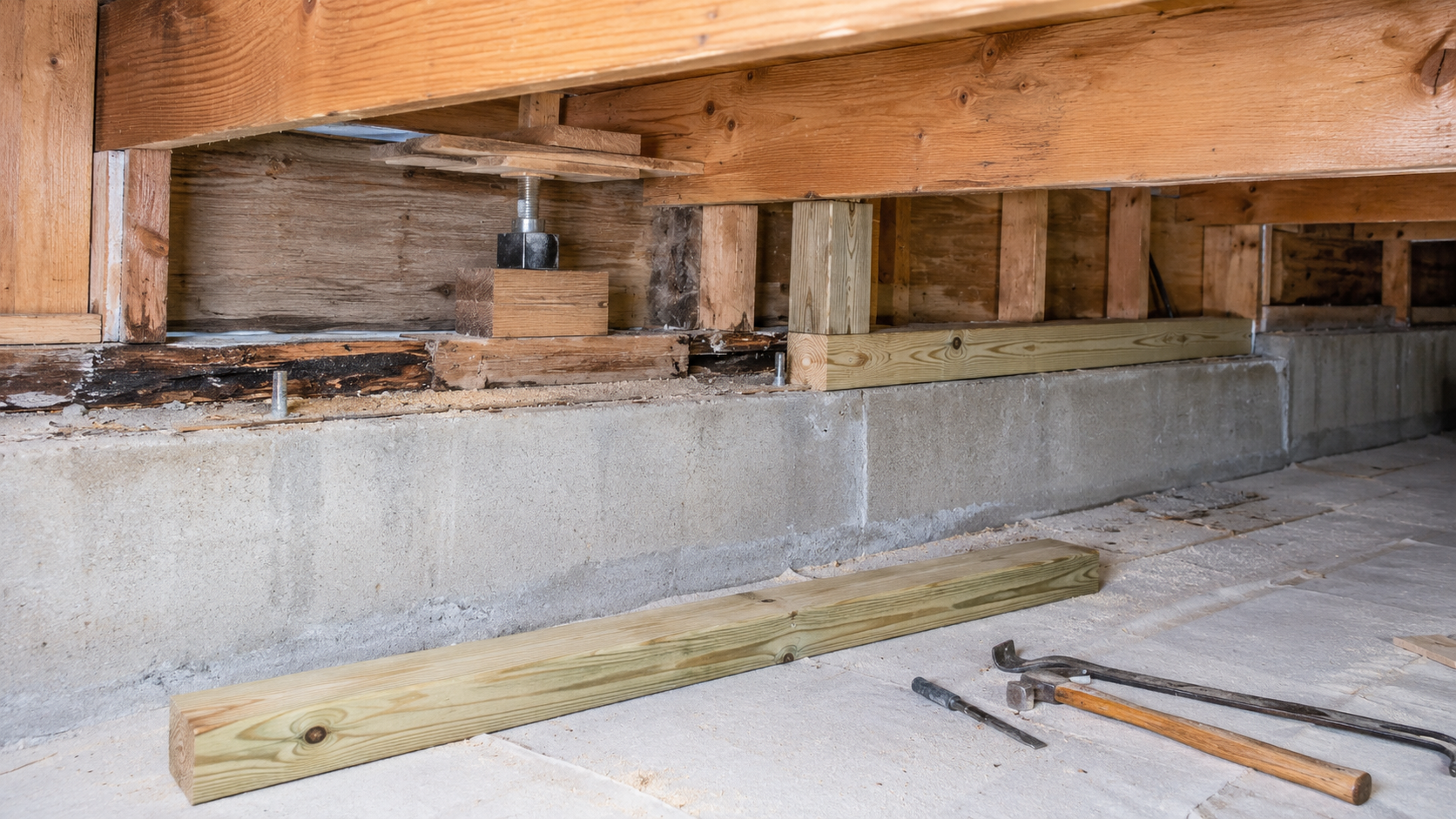
Good support planning protects the wall, floor, doors, windows, finishes, and foundation edge during the repair. Poor support can crack finishes, shift framing, bind doors, or leave the replacement wood carrying load badly. Ask how the structure will be supported and how much wall length will be opened at one time before any work starts.
Termite Damage and Pest Treatment
Termites and sill plate rot often show up together because damp wood is vulnerable. If termite damage is active, pest treatment should be handled before the repair is closed — replacing the wood without dealing with the insects can hide the problem, and treating the insects without replacing destroyed structural wood can leave the house with a weak edge condition.
Look for mud tubes near foundation walls, wood that sounds hollow when tapped, thin outer wood with damaged interior fibers, frass or insect debris, and soft wood near damp crawl-space or foundation edges. Do not assume all sill plate damage is only rot — pest damage changes the scope, sequence, and sometimes the professionals involved.
Moisture Correction Is Part of the Real Cost
The new sill plate should not go back into the same wet condition that destroyed the old one. That means the quote may need more than carpentry — drainage correction, crawl-space work, vapor barrier repair, foundation leak repair, exterior grading, siding clearance, flashing correction, or gutter and downspout changes.
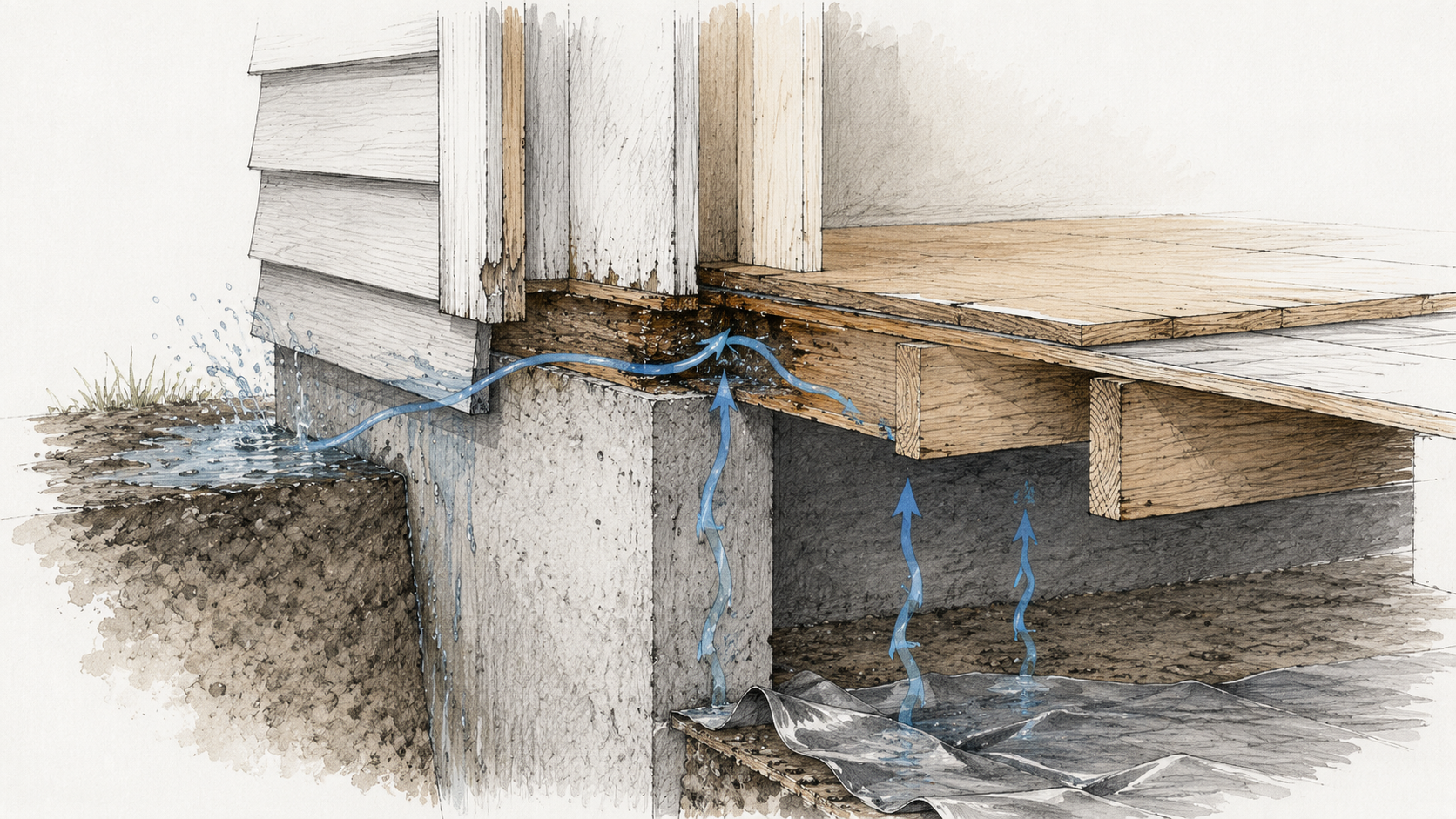
Separate the two parts clearly: wood repair (remove and replace damaged sill, rim, joist ends, or related framing) and moisture repair (stop the wetting pattern that caused the damage). If a quote covers only one of them, ask what is handling the other — because a dry repair on a wet problem is just a delayed repeat. For broader leak tracing, use home moisture, leaks, and water damage. For wood behavior after wetting and drying, see wood moisture content, acclimation, and movement.
What Should Be Included in the Quote
A good sill plate quote should not be one vague line. Ask for the scope in plain language — what is included, what is excluded, and what happens if more damage appears after opening the area.
| Quote Item | Why It Matters |
|---|---|
| Linear feet of sill plate | Defines the actual replacement length |
| Temporary support method | Shows how the wall or floor will be protected |
| Related framing inspection | Confirms rim joists, joist ends, subfloor, and studs are checked |
| Material type | Clarifies treated lumber, fasteners, connectors, and code expectations |
| Anchorage | Confirms bolts, washers, straps, or connectors are addressed where needed |
| Pest treatment | Separates termite treatment from carpentry work |
| Moisture correction | Prevents the same area from rotting again |
| Finish restoration | Siding, drywall, flooring, insulation, and paint can add real cost |
| Permit or inspection | Some structural repairs may require local approval |
| Change-order rule | Explains how hidden damage will be priced if found |
The best quote is not always the shortest. For this job, detail protects you.
Questions to Ask Before Paying
- How many linear feet of sill plate are being replaced?
- Is this a local section, one wall, or a longer run?
- Will this use localized shoring or a full house lift — and why?
- Is the rim joist included?
- Are joist ends and subfloor edges being checked?
- Is there termite or carpenter-ant damage?
- Who handles pest treatment if insects are active?
- What caused the sill plate to rot?
- Is crawl-space moisture correction included?
- Are anchor bolts, washers, straps, or connectors included?
- Is siding, insulation, drywall, flooring, or paint restoration included?
- Are permits or inspections needed?
- What happens if hidden damage is found after opening the wall?
The most important question is the simplest: what keeps the new sill plate from rotting again?
Can You Lower Sill Plate Replacement Cost?
You can lower the risk of surprise costs by getting the scope clearer before work starts. You usually cannot make a structural repair cheap without removing something important — but you can reduce confusion.
Useful steps before hiring: photograph the damaged area from inside and outside; check whether the crawl space is damp; look for termite tubes, wet insulation, or foundation staining; note where water drains outside the wall; ask whether the rim joist and joist ends are included in the inspection; get exclusions in writing; and compare scopes, not only prices. Do not cut cost by skipping support, anchorage, moisture repair, or pest treatment when the damage requires them — those are what make the repair last.
When the Cheapest Quote Is a Warning
A cheap sill plate quote may be fine for a tiny, accessible, non-complex local repair. It may also mean the contractor is not pricing the real job. Be cautious if the quote does not say how much sill plate is being replaced, does not mention temporary support, does not check rim joists or floor joists, ignores termites or moisture, does not include anchorage details, excludes all finish repair without explaining it, or promises to "just patch" soft structural wood.
The expensive repair is not always the bad one. Sometimes the expensive quote is the only one that includes the actual work.
How This Page Fits the Wood Rot Cluster
This page is the cost branch of rotted sill plate repair. If you are still trying to understand whether the sill plate is actually damaged, start there first. If you already know replacement is likely, this cost page helps you understand why prices vary so much. For the broader parent guide, read wood rot repair.
FAQ
How much does sill plate replacement cost?
Small local repairs can cost far less than whole-house replacement, but 2026 planning ranges commonly sit around $100 to $200 per linear foot. Extensive sill plate replacement can run into five figures, especially when long runs, jacking, rim joist damage, termite work, moisture repair, anchorage, permits, and finish restoration are all involved.
Why is sill plate replacement so expensive?
The sill plate sits under the wall at the foundation line. Replacing it may require opening finished areas, supporting the structure, removing damaged wood, restoring anchors or connectors, and fixing the moisture source. The lumber is cheap; the access and support are not.
Does every sill plate repair require jacking up the house?
No. Short sections of damage — sometimes only a few feet of sill plate — may be handled with localized shoring instead of a full house lift, depending on the load, access, framing condition, and contractor or engineer judgment. Full lifting or more involved shoring is more likely when long runs or major structural damage are involved.
Is sill plate replacement priced per linear foot?
Often, yes, but per-foot pricing does not tell the whole story. Access, jacking, related framing damage, pest treatment, permits, and finish repair can change the total more than the lumber length alone.
Does insurance cover sill plate replacement?
It depends on the policy and cause. Long-term rot, termites, and maintenance-related moisture are often treated differently from sudden covered water damage. Document the source and read the policy before assuming coverage.
Can I replace a sill plate myself?
Most homeowners should not treat sill plate replacement as basic DIY work. The sill plate can be structural and anchored to the foundation. Inspection and documentation are reasonable; cutting out structural wood without support knowledge is risky.
What is the difference between sill plate and rim joist replacement cost?
The sill plate sits on the foundation. The rim joist sits at the outer edge of the floor framing. When both are damaged, the repair usually costs more because the floor edge and wall base are both involved.
Should crawl-space encapsulation be included?
Only if crawl-space moisture is part of the cause. Encapsulation may help control moisture, but it does not replace rotten sill plate, rim joist, or joist wood. The quote should separate moisture control from structural repair.
Read This Next
Start with rotted sill plate repair if you need the structural overview first.
For the parent guide, read wood rot repair.
If crawl-space moisture is involved, continue with crawl-space humidity.
For foundation-edge structural problems, see crawl-space foundation repair.
If you are tracing the leak source, use home moisture, leaks, and water damage.