
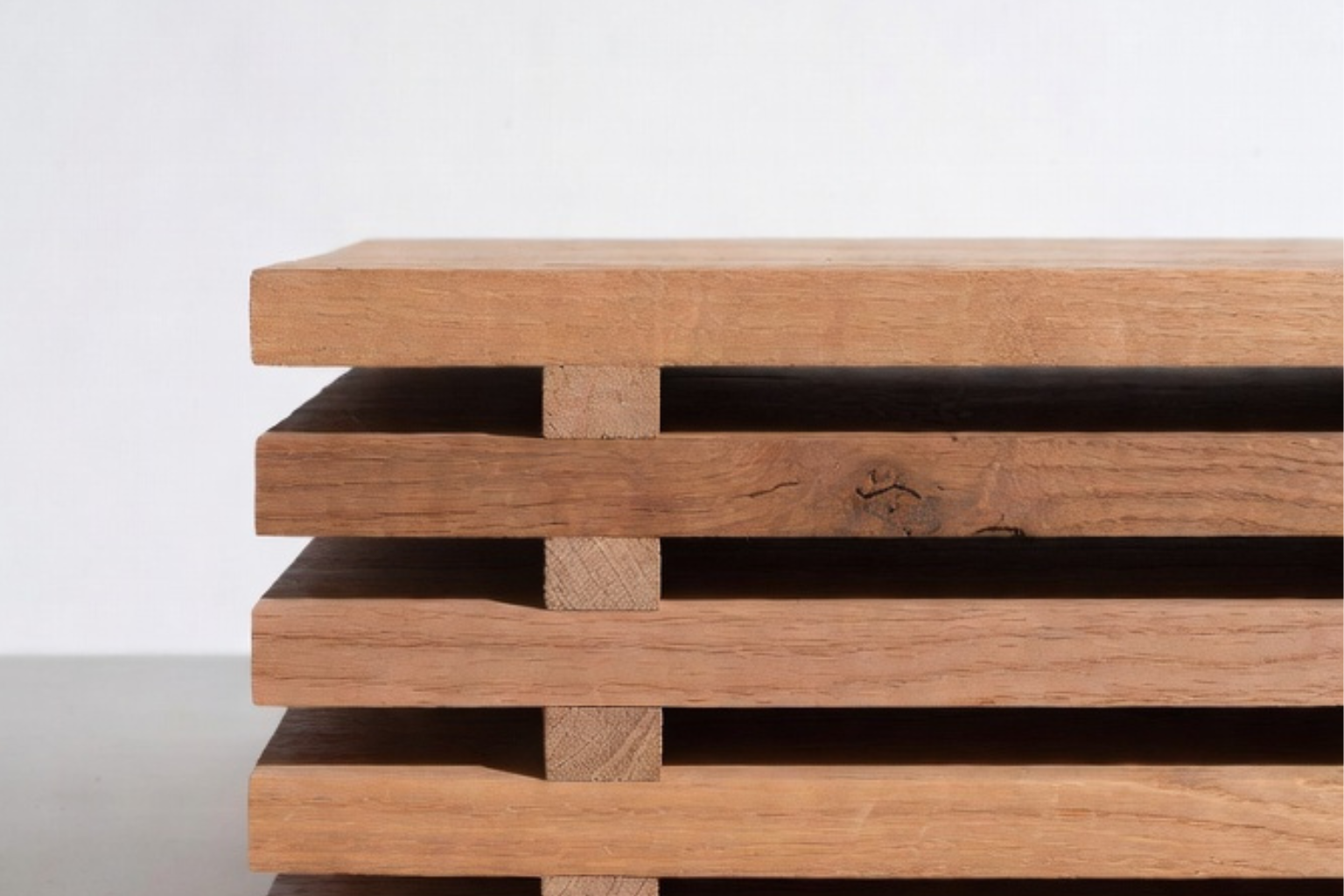
Image by ArchitectureCourses.org. Proper stickering — small spacers placed across the width at regular intervals — lets air reach every board face.
The problem with freshly delivered lumber is that it looks fine. It smells like a lumberyard, it's straight enough, and you want to get to work. So you do. You build the cabinet, install the floor, glue up the tabletop. Then three months later the door sticks, the planks gap, or a crack runs clean across the grain. Nobody immediately thinks moisture. They think they made a mistake at the bench. But the mistake happened before the first cut, the day the boards came in and went straight to the saw.
Wood from a warehouse has settled at whatever humidity that warehouse happened to hold. Your house is something different — usually drier in winter, more humid in summer, and almost always a different number than where that wood sat for the last several weeks. Build with it too soon and the wood spends the next several months working toward a new equilibrium on your time and at your expense.
If you are working through wood material decisions more broadly, Choosing the Right Wood for a Project covers species, grades, and applications. For the structural and mechanical behavior behind why wood moves the way it does, see Wood Properties.
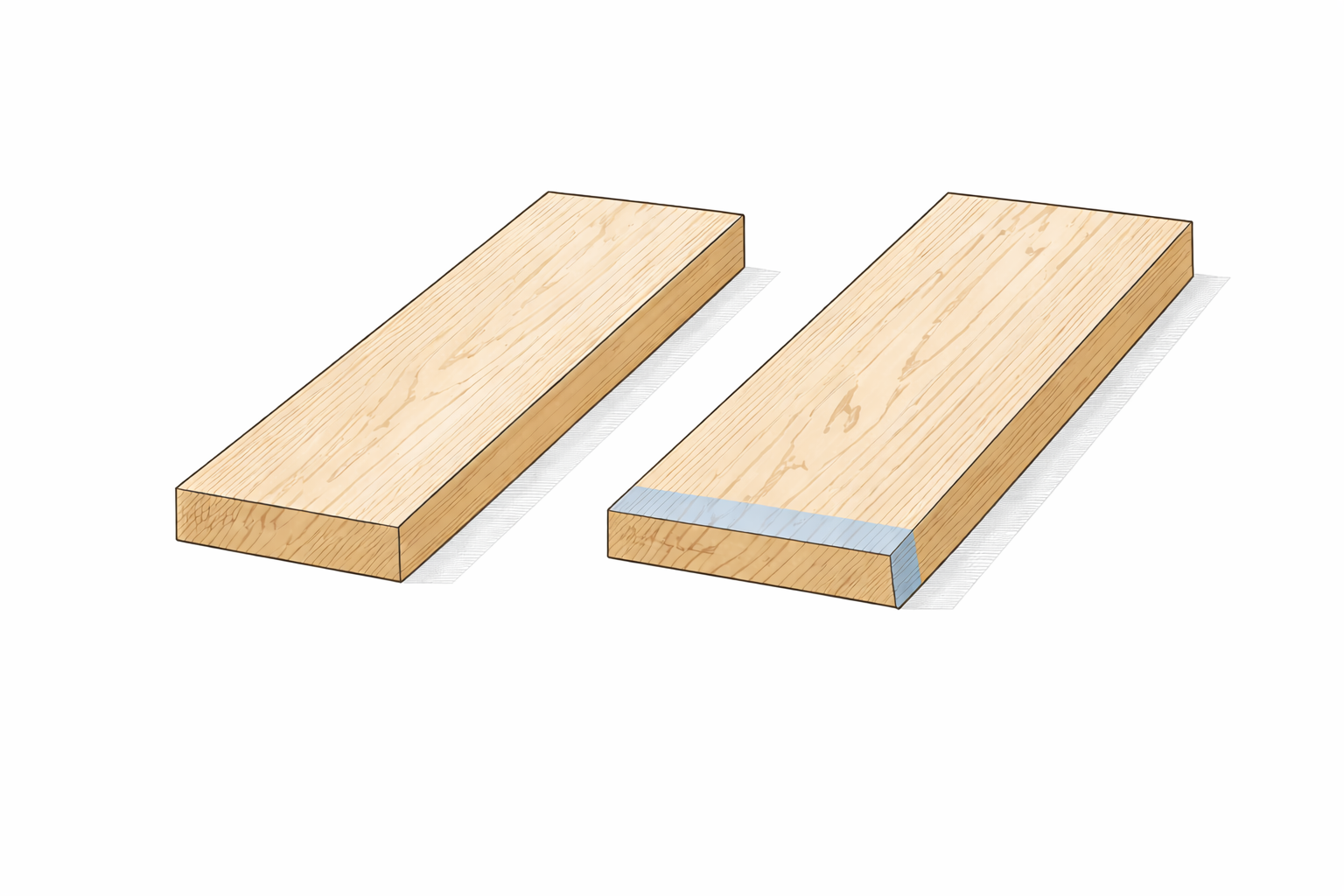
Illustration by ArchitectureCourses.org. The same board in drier and wetter conditions — movement happens across the grain, not along the length.
What Moisture Content Actually Measures
Moisture content is the weight of the water inside a board expressed as a percentage of the weight of the dry wood itself. A board at 10% MC contains water equal to a tenth of its oven-dry weight. That sounds abstract until you remember that a freshly felled tree can come in above 100% MC — the water outweighs the wood fiber. Kiln drying pulls that number way down, but it does not lock it in. The moment wood leaves the kiln it starts responding to the air around it, and it will keep doing that for as long as it exists.
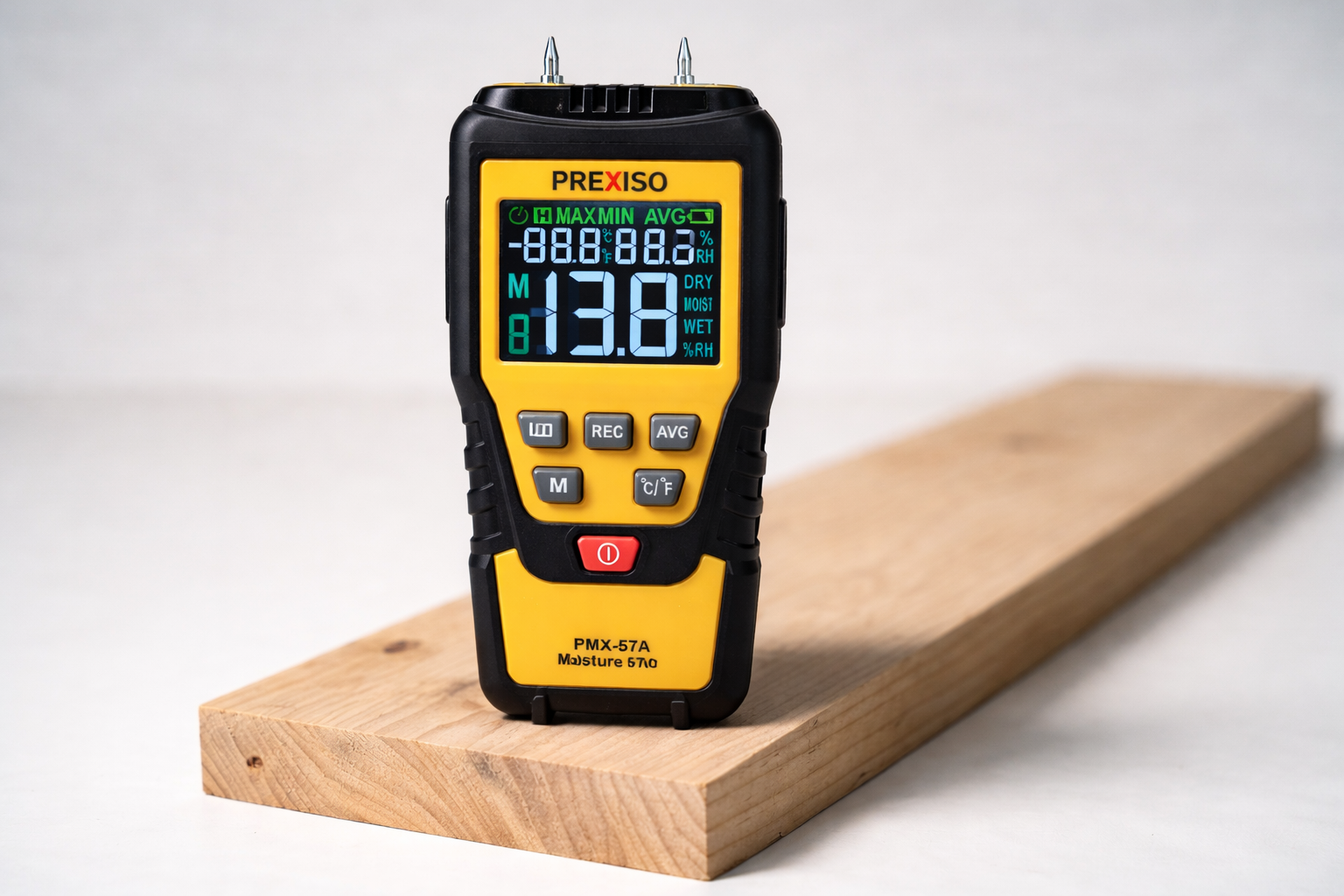
Photo by ArchitectureCourses.org. Checking wood moisture content before installation.
Kiln-dried does not mean stable. It means stable for wherever it was dried. Put it somewhere else and the process starts again.
| Application | Target MC Range | Why That Range |
|---|---|---|
| Freshly cut green lumber | 30–100%+ | Still saturated with tree moisture |
| Exterior framing and decking | 12–19% | Outside humidity swings; higher MC is expected |
| Interior framing (conditioned space) | 9–14% | Drier than exterior but not as stable as finish wood |
| Hardwood flooring | 6–9% | Movement after installation must stay minimal |
| Interior furniture and cabinetry | 6–10% | Conditioned spaces are stable; tight tolerances required |
| Instrument-grade and fine woodworking | 6–8% | Any movement at all is a problem |
Why the Width Moves and the Length Doesn't
Wood expands and contracts across the grain, not along it. A ten-foot board barely changes length across a full year of humidity swings. The width of that same board can shift by a meaningful fraction of an inch — sometimes more on wide, flat-sawn pieces.
Flat-sawn lumber (the most common kind, where the growth rings run roughly parallel to the face) moves more than quarter-sawn lumber, where the rings run more perpendicular to the face. Quarter-sawn is more dimensionally stable, which is why it was preferred for flooring in old houses and still gets specified for premium cabinetry and musical instruments. It is also harder to mill and more expensive. The trade-off is real.
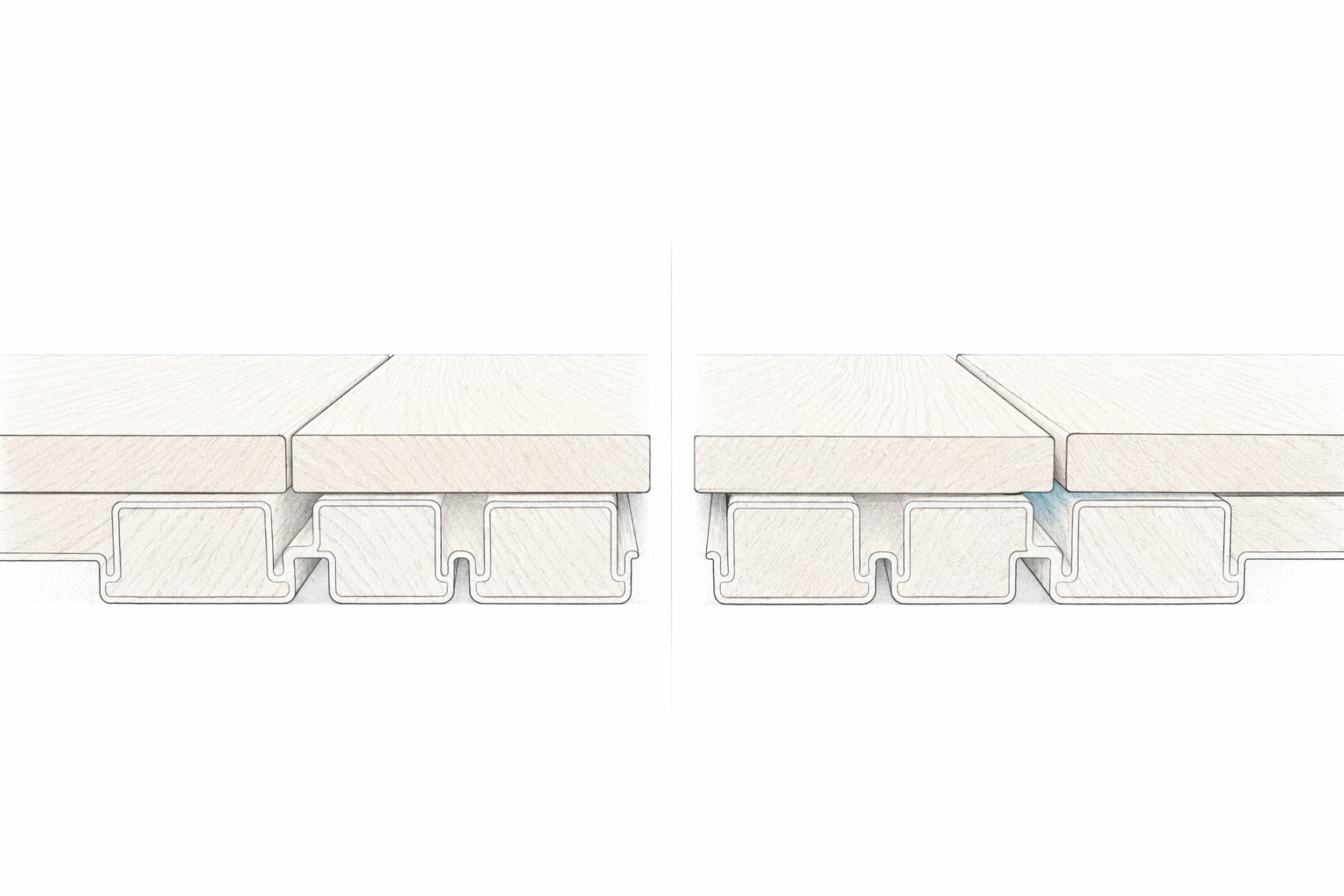
Illustration by ArchitectureCourses.org. Close-up comparison showing how poor acclimation can create subtle seam movement and slight edge misalignment at a wood floor joint.
That across-the-grain movement is what makes tabletops, wide cabinet doors, and floor planks the places where moisture problems show up first. A narrow piece of casing trim does not have enough width for movement to cause visible trouble. A fourteen-inch panel glued up for a tabletop has more than enough. When that movement is blocked — a wide panel locked rigidly into a frame and glued on all four edges — something gives. It is almost always the wood. A crack running across the grain is the result, and it always looks like a gluing mistake.
It was not.
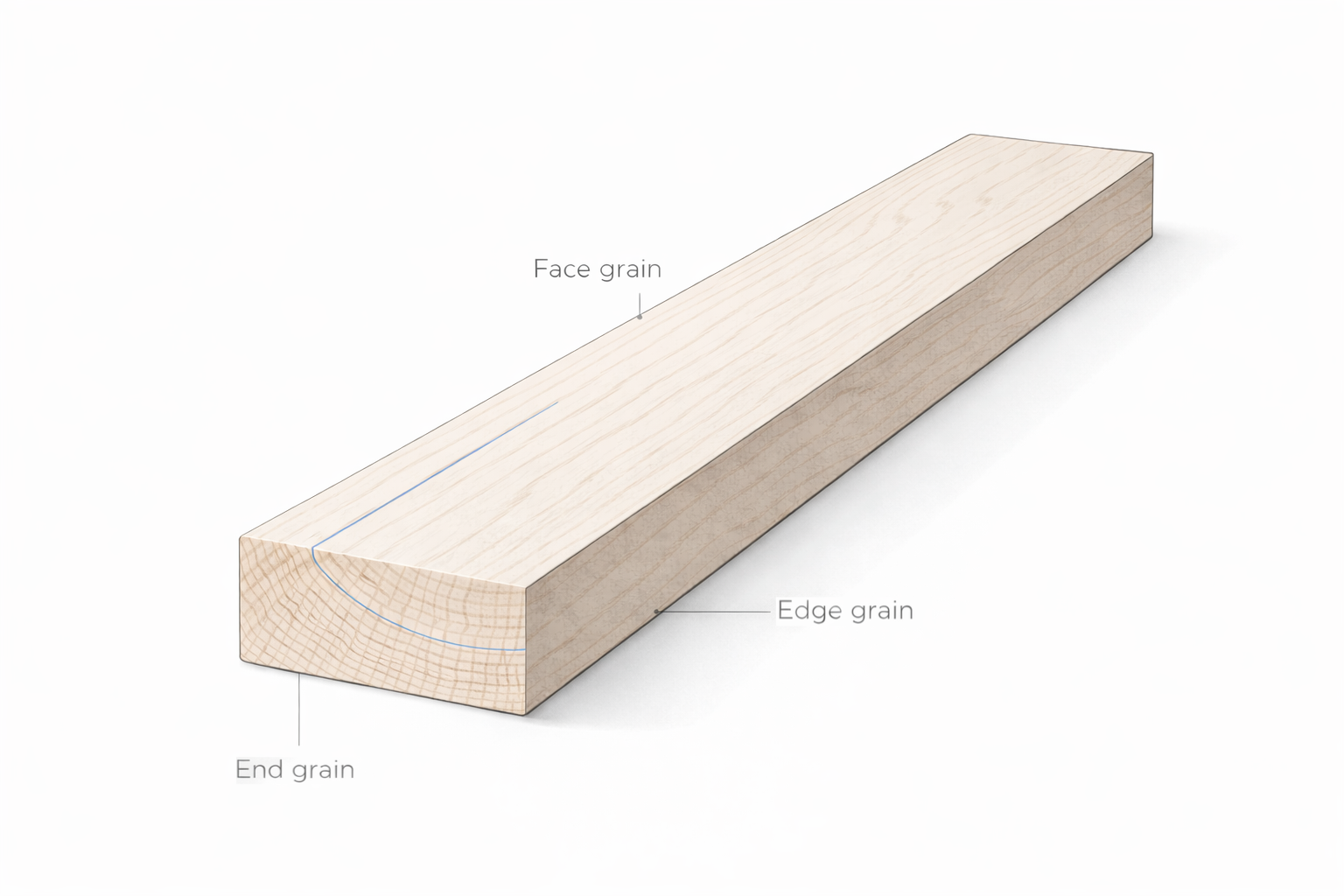
Illustration by ArchitectureCourses.org. Face grain, edge grain, and end grain show the wood structure from different directions — movement is concentrated across the face grain.
End Grain: Where Moisture Gets In and Out Fastest
The end of a board is not just a cut surface. It is where the wood's cellular tubes run straight toward you, open and exposed. Moisture enters and exits through end grain several times faster than it does through the face or edge. This is why cut ends dry out, check, and split first. It is also why sealing end grain during acclimation or storage — with wax, end-grain sealer, or even a coat of paint — is worth doing on thick slabs and wide stock you plan to keep around for a while.
On a floor or a tabletop, end grain is usually hidden. In furniture with exposed joinery or in live-edge work, it is part of the design. Either way, understanding that end grain responds to humidity faster than the rest of the board explains a lot of the failures that seem to start at corners and edges.
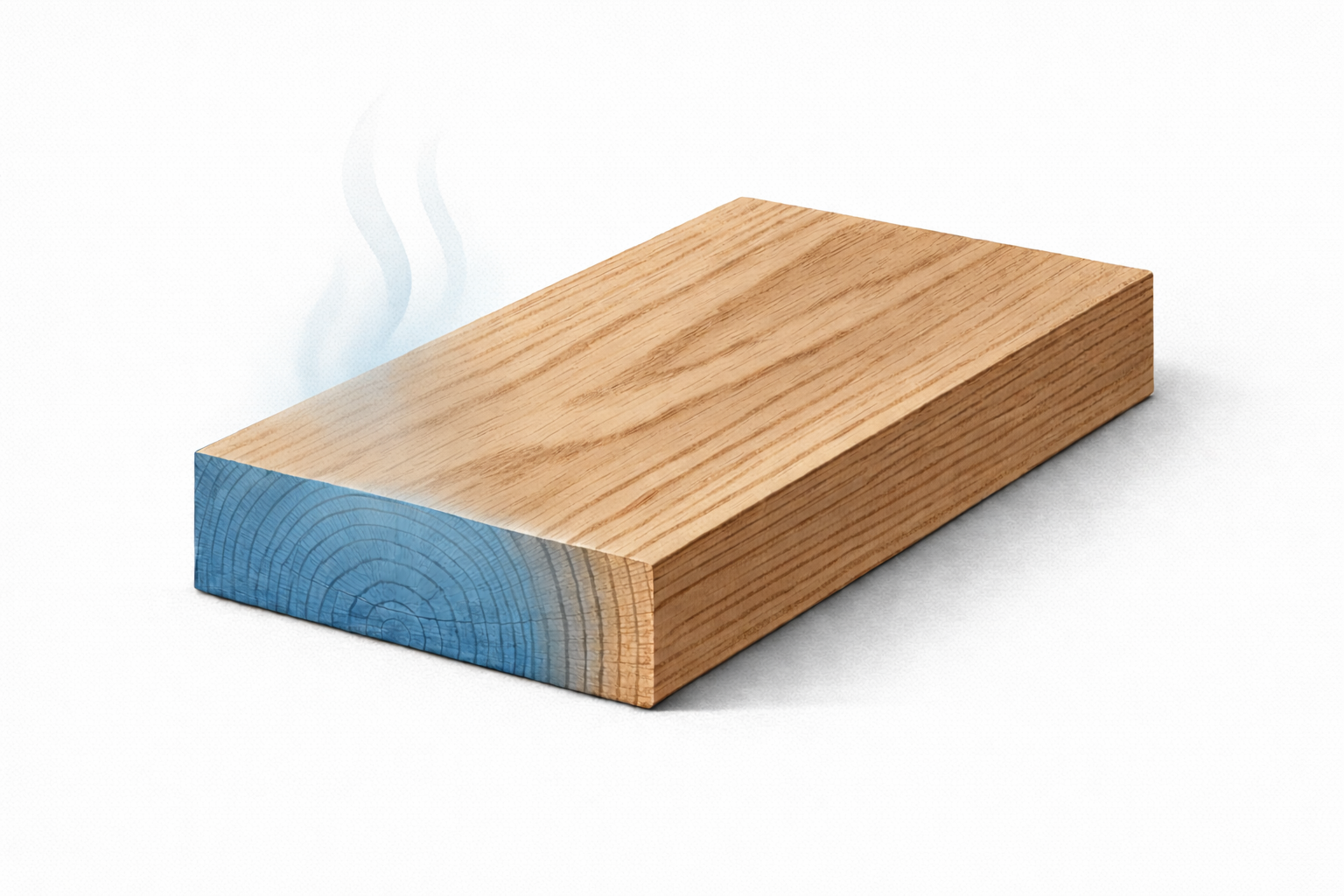
Illustration by ArchitectureCourses.org. End grain exchanges moisture faster than the board face, which is why cut ends react first.
Equilibrium Moisture Content: Where the Wood Is Trying to Get
Leave a board in one environment long enough and it stops moving. The moisture content stabilizes at whatever level the surrounding air demands. That point is called equilibrium moisture content, or EMC. Every combination of temperature and relative humidity has a corresponding EMC, and wood will work its way toward it whether you want it to or not.
In a typical heated and cooled house, EMC lands around 6–9%. In a basement that doesn't see much climate control, it might be 12–15%. In a garage in a humid climate, higher still. The number varies by region and season, but the principle is consistent: wood matches the air, and it will keep trying until it gets there.
This is why acclimation is not a fixed number of days. Three days is often repeated as a rule of thumb for flooring, and for some situations it is roughly right. For thick slabs, wide panels, or wood moving from a significantly wetter or drier environment, three days can be less than half of what you actually need. The only way to know is to measure.
Also Useful: The structural behavior that makes EMC relevant to design — how wood responds to load under different moisture conditions — is covered in Wood Properties.
How Long to Wait, Realistically
The gap between where the wood came from and where it is going to live determines how long acclimation takes. A small gap — lumberyard to a shop in the same region, similar humidity — might need a week. A big gap — wood from a dry western mill delivered to a humid coastal region in summer — might need three weeks or more before a moisture meter stops moving.
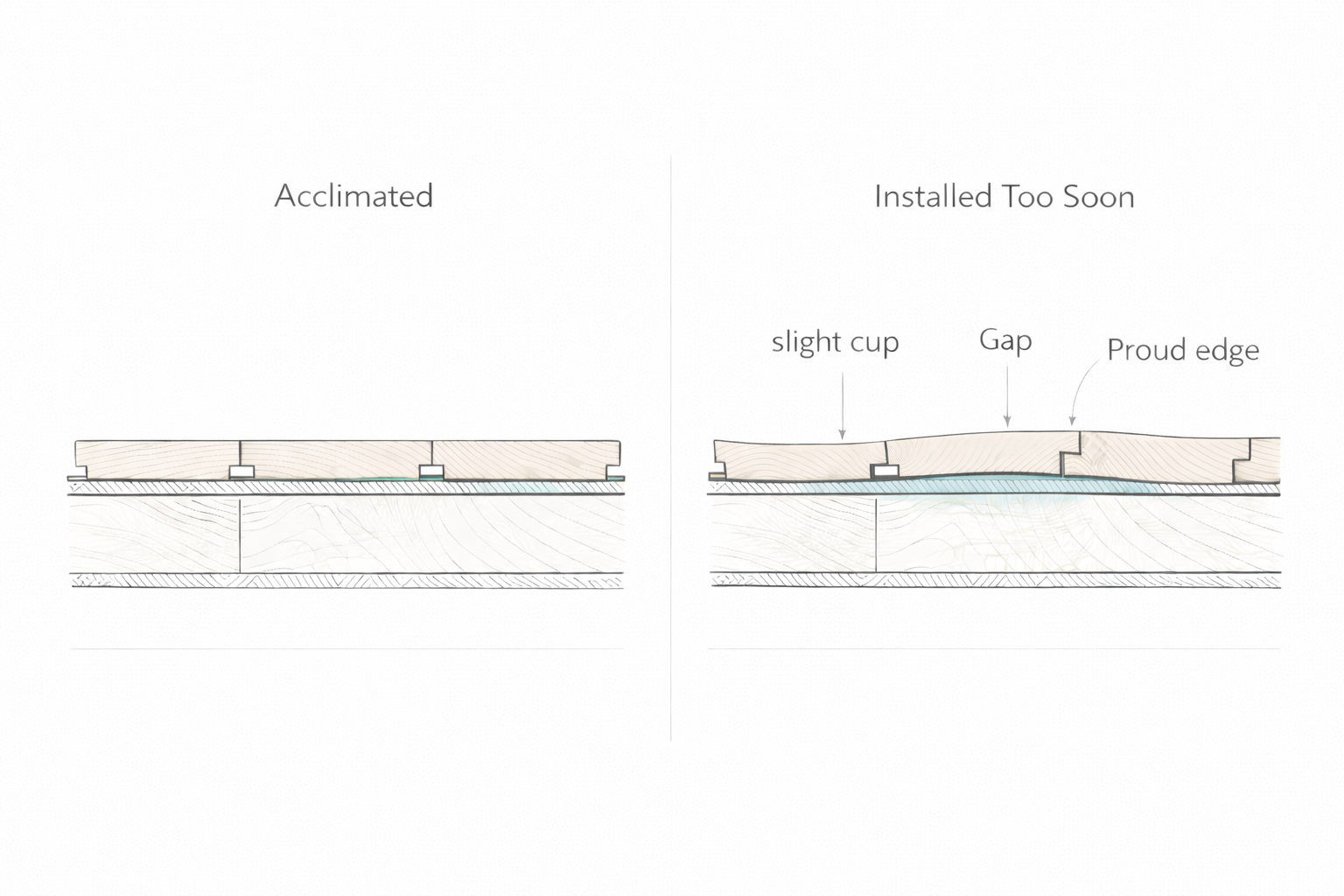
Illustration by ArchitectureCourses.org. Comparison showing how wood installed before proper acclimation can develop slight cupping, gaps, and edge misalignment.
Species and thickness compound this. Thicker stock moves moisture more slowly. Dense species like hard maple or hickory take longer than lighter species like poplar or pine. You cannot shortcut this with a fan or a dehumidifier running nearby — the wood has to equilibrate to the actual conditions, not to a temporarily altered environment.
| Material | Minimum Acclimation Time | Notes |
|---|---|---|
| Solid hardwood flooring (3/4") | 3–7 days | Verify with meter before installation |
| Engineered hardwood flooring | 48–72 hours | More stable, but not immune to movement |
| Solid lumber for furniture (4/4 to 8/4) | 1–2 weeks | In the actual room, not a garage or basement |
| Thick slabs (8/4 and above) | 2–4 weeks or more | Surface MC can look fine while the core is still wet |
| Wide glued-up panels | 2 weeks minimum | Movement after glue-up can cause delamination |
| Cabinet lumber in a new build | After HVAC is operational | Building envelope must be stable first |
That last row matters more than people give it credit for. Installing cabinetry in a new house before the HVAC system is running and the building has dried out is a common mistake on fast-moving job sites. The wood acclimates to a construction environment — damp concrete, open windows, no climate control — and then the house gets sealed up and the humidity drops. The cabinets move with it.
How to Stack It So Acclimation Actually Works
Boards stacked flat on top of each other trap the faces in the middle. The edges see air, the faces don't. Moisture moves out unevenly, and you end up with boards that are acclimated on the outside and still wet in the middle, which means they are still going to move.
Sticker the stack. Use small spacers — thin strips of wood, scraps of plywood, anything flat — placed every 16 to 24 inches across the width of the boards. Every face needs air contact. Keep the stack off concrete, which tends to be cold and often damp. Cold concrete pulls moisture upward. A couple of cheap 2x4s laid flat underneath the stack is enough.
Do not wrap boards in plastic while they are acclimating. Plastic traps humidity and slows the whole process to nearly nothing.
For the actual space: it should be as close as possible to the finished conditions the wood will live in. A garage or a basement is not the right place to acclimate wood that is going into a climate-controlled room. The reading you get in the garage is not the reading that matters.
Do This, Not This
| Do This | Not This | Why It Matters |
|---|---|---|
| Sticker the stack with spacers every 16–24" | Stack boards flat face-to-face | Trapped faces don't acclimate; only the edges see air |
| Acclimate in the finished room with HVAC running | Acclimate in the garage or a dry warehouse | The garage humidity isn't what the wood will live in |
| Verify MC with a moisture meter before cutting | Count the days and assume it's done | Thick stock can still be wet inside after two weeks |
| Design wide panels to float in a frame | Glue wide panels rigidly on all four edges | Movement will crack the panel or blow the joint |
| Use a pin or pinless meter before flooring install | Trust the flooring manufacturer's calendar | Calendar guidance assumes average conditions; yours may not be |
| Wait for HVAC to be operational in new builds | Install finish carpentry during active construction | Construction humidity is temporary; the wood moves again when the house dries |
Moisture Meters: What to Use and When
Two types are common. Pin-type meters drive two small probes into the surface of the wood and measure electrical resistance between them. Resistance drops as moisture content rises. They are accurate, inexpensive, and available everywhere. The probes leave small marks in the surface, which is fine for framing and flooring but worth considering if the board is going into something that will be seen.
Pinless meters use electromagnetic waves to read MC without contact. They scan a larger area and work faster on finished surfaces. They cost more and are somewhat less precise at very high or very low MC readings, but for most interior work they are accurate enough and convenient. The Wagner Orion 930 is a pinless meter that reads at two depths and gets consistent use in flooring and millwork QA. For a more basic field tool, the General Tools pin meter covers most jobsite needs without the cost.
For flooring, get both a reading of the wood and a reading of the subfloor. NWFA guidelines generally recommend that solid hardwood flooring be within 2–4% MC of the subfloor before installation. A wider gap means movement, and movement in a glued-down floor can lead to cupping, buckling, or delamination.
Professional shops use meters to confirm every batch before expensive material goes to the saw. For one-off projects this can feel like overkill, but the cost of a basic meter is a fraction of the cost of ruined stock or a floor that has to come up.
Read This Next: R. Bruce Hoadley's Understanding Wood is the clearest technical treatment of moisture, movement, and defects available. It is the book people reach for when they need to understand why something failed.
Where Moisture Problems Show Up First
Wide doors. Almost every time. A cabinet door that fit during installation and sticks by summer is usually a moisture problem, not a hanging problem. The door absorbed humidity and expanded across the grain. If the door is a flat panel rather than frame-and-panel construction, there is nowhere for that expansion to go except outward.
Frame-and-panel construction — where a floating center panel sits inside a groove in the surrounding frame — was developed specifically to handle this. The panel expands and contracts inside the frame without stressing the joints. If you have seen a very old piece of furniture with a cracked panel, that crack often happened because someone glued the panel in. The original builders knew not to.
Tabletops are the next common failure point. A top attached rigidly to its base with screws or glue going straight through has no room to move. Desktop hardware — small clips or buttons that seat in a groove routed into the apron and allow the top to slide slightly — is the correct solution. It is a small detail that prevents a common and expensive problem.
Hardwood floors expand and contract seasonally. That is not a defect. It is expected behavior, which is why the installation always includes a perimeter gap — typically 3/4" — hidden under the baseboard. If that gap was skipped or if the floor was installed at the wrong MC, the seasonal expansion has nowhere to go and the floor buckles at the most expanded point, usually in the middle of the room.
Worth Knowing: Species selection affects how much movement you are managing. Some hardwoods are more dimensionally stable than others, which matters when specifying for large surfaces or humid climates. See Hardwood for a breakdown by species.
What Engineered Wood Handles Differently
Plywood, LVL, and cross-laminated panels move far less than solid wood because their grain layers alternate directions. When one layer wants to expand, the perpendicular layer resists it. The result is a panel that is far more dimensionally stable than solid lumber of the same thickness.
This is one reason modern cabinetry uses sheet goods for the box — the carcase — while keeping solid wood for doors, drawers, and face frames. The box stays put. The solid wood is used in pieces narrow enough that movement is manageable, or in frame-and-panel configurations that accommodate it.
Engineered flooring follows the same logic. A hardwood veneer over a plywood core moves significantly less than solid hardwood of the same width. This makes engineered flooring a better choice in basements or over radiant heat, where solid wood would be working against significant humidity swings from below.
But engineered wood still moves. Its acclimation requirements are less demanding than solid wood, but they exist. Skipping acclimation on engineered flooring because it is supposed to be stable is how you end up with gapping.
Common Questions
Can I speed up acclimation with a dehumidifier or space heater?
Not really. Running a dehumidifier in a garage to bring it down to house conditions is not the same as acclimating in the actual house. The point is for the wood to reach EMC in the environment where it will be used. A temporarily altered environment gives you a temporarily altered reading. Once the dehumidifier is gone and the garage goes back to its normal humidity, so does the wood.
What if the lumberyard says the wood is kiln-dried to 6%?
That number tells you what the MC was when it left the kiln. It doesn't tell you what happened between the kiln and your door. Lumber picks up moisture in transit, in storage, and on a truck. Verify with a meter when it arrives.
Does this apply to pressure-treated lumber?
Yes, but for different reasons. Pressure-treated lumber is often quite wet when it comes from the supplier — the treatment process saturates the wood. Using it immediately for decking or framing leads to significant shrinkage and warping as it dries. Wherever possible, buy and store pressure-treated material ahead of time, or specify kiln-dried-after-treatment (KDAT) stock, which costs more but installs far more cleanly.
How do I know if the movement has stopped?
Take two readings with a moisture meter three to four days apart. If the number has stopped changing, the wood has stabilized. If it is still moving, wait.
Does this matter for plywood?
Less than solid wood, but not zero. Plywood stored outdoors or in a damp environment picks up moisture and can swell, delaminate, or warp. For cabinetry or finish work, plywood should be stored flat in a conditioned space.
Before You Build: A Short Checklist
- Has the lumber been in the installation environment — not the garage, not the basement — for an appropriate amount of time?
- Is the building's HVAC system operational and running at normal conditions?
- Are boards stickered with spacers and kept off concrete?
- For flooring: has MC been verified with a meter, and does it match the subfloor within 2–4%?
- For wide solid panels: does the design allow the wood to move, or is it locked rigidly on all four edges?
- For pressure-treated material: has it been given time to dry, or was KDAT specified?
- For new construction: were finish materials installed after the building dried out?
Most wood failures in finish work come back to one of these. The ones that don't usually come back to species selection or design — problems that get solved earlier in the process. Once the wood is already in the project and moving, the options are limited and none of them are fast.