
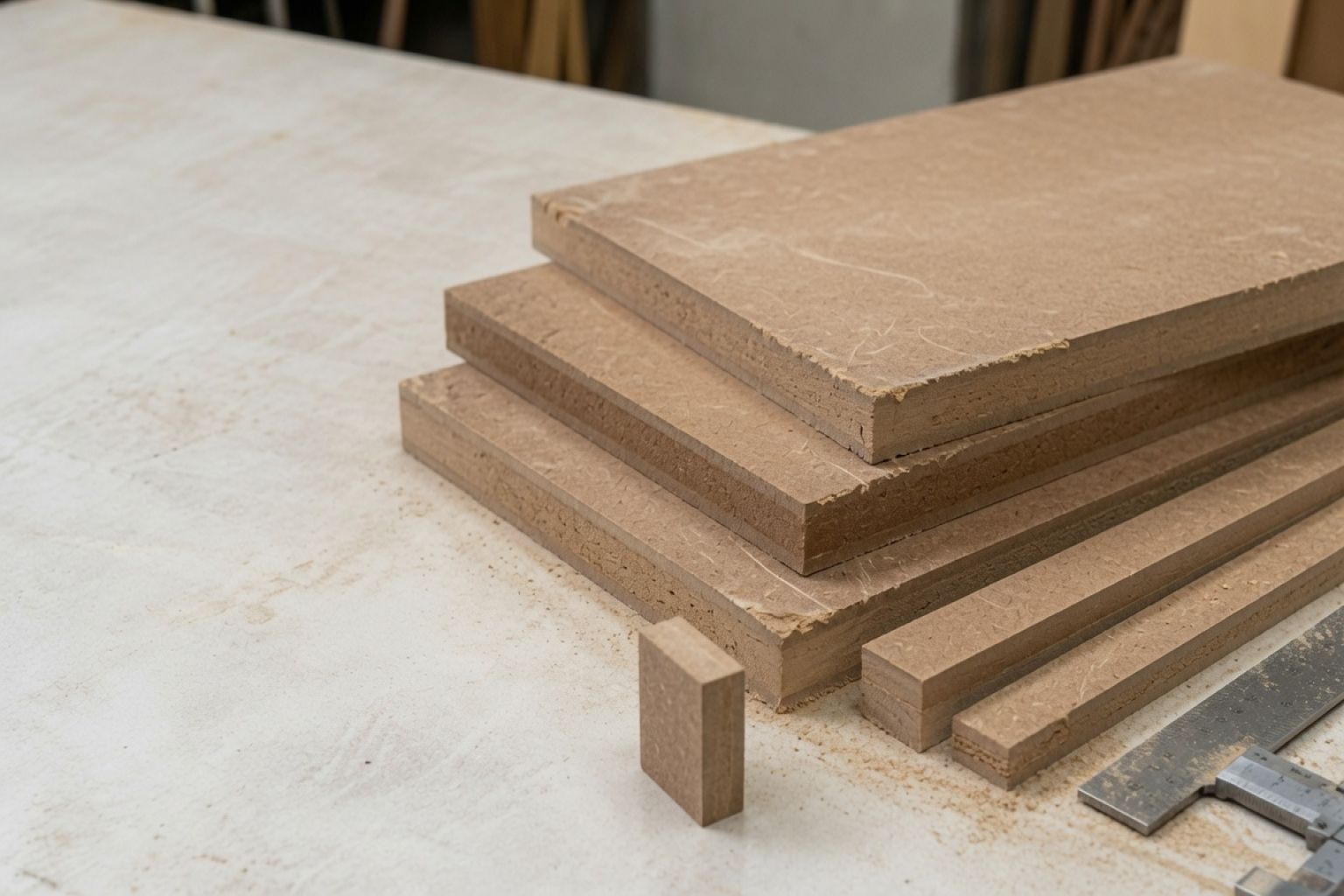
HDF is smooth, dense, and useful indoors. It is also easy to misuse. Exposed edges can swell, screws do not hold like they do in plywood, and a hard surface does not make the board waterproof or structural.
Use HDF for laminate flooring cores, painted cabinet parts, door skins, backing panels, trim, and other protected interior components. Choose another material when the job depends on wet-area durability, long unsupported spans, structural strength, or strong edge fastening.
What Is High Density Fiberboard?
High density fiberboard, or HDF, is made from wood fibers mixed with resin and pressed into a hard, uniform panel under heat and pressure.
It is not a wood species, and it is not plywood, solid wood, OSB, or particleboard. Names such as HDF board, HDF wood, high density board, and high density fibreboard usually refer to the same material family.
The working boundary in the industry runs around 800 kilograms per cubic metre, roughly 50 pounds per cubic foot. Panels above that line get sold as HDF, while the 600-to-800 range is MDF territory. The overlap is real, and marketing sometimes rounds up.
The board has no natural grain, knots, or veneer layers. Its face and edge are consistent because the material is made from compressed fibers rather than pieces of lumber or peeled wood veneer.
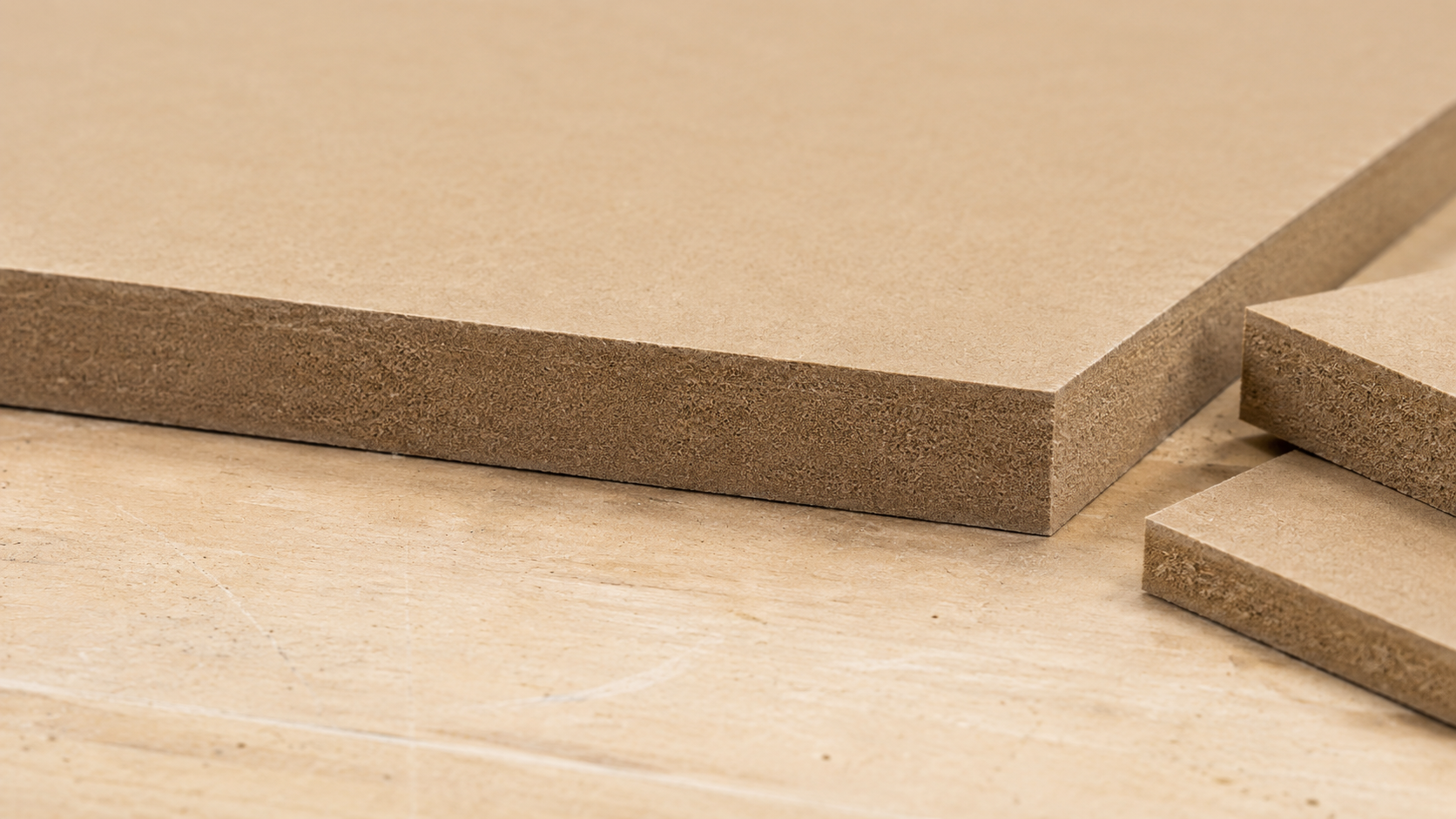
That uniform structure gives HDF its smooth face and clean machining. It also explains why water damage can spread through an exposed edge and why fasteners behave differently than they do in plywood or solid wood.
How HDF Is Made
Factory production varies by product, but the basic process is consistent. Wood is refined into fibers, mixed with resin and other additives, formed into a mat, and pressed into a dense panel. The sheet is then sanded, trimmed, coated, laminated, or cut into finished parts.
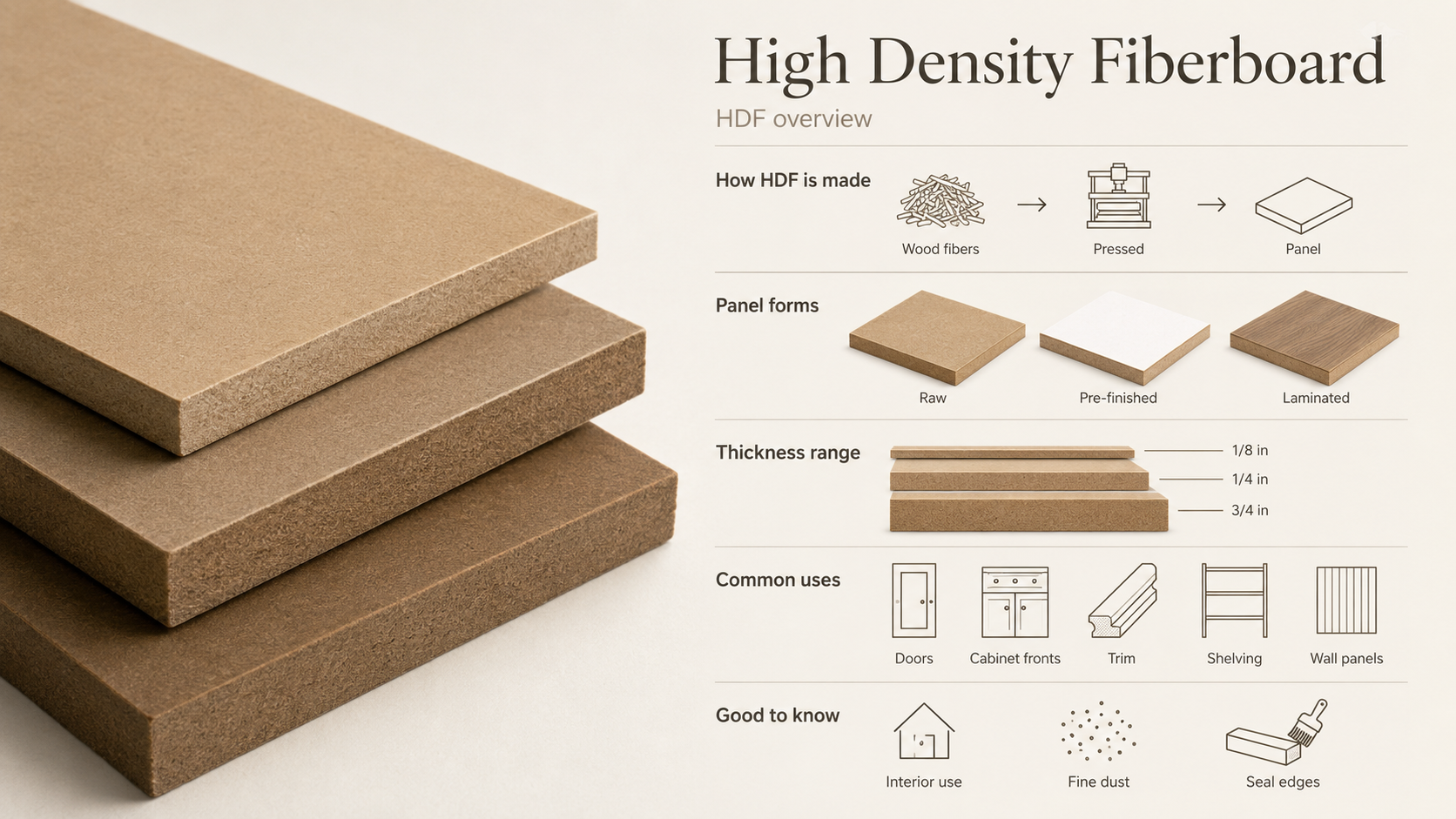
| Stage | What Happens | Why It Matters |
|---|---|---|
| Fiber preparation | Wood is broken down into fine fibers | Fine fibers create a smooth, even panel |
| Resin and additives | Binder and performance additives are mixed with the fibers | The formula affects strength, moisture resistance, emissions, and machining |
| Mat forming | The fiber mix is spread into a panel shape | Even forming reduces weak areas and density changes |
| Hot pressing | Heat and pressure compress the mat | The board gains its dense core and hard surface |
| Finishing | The panel is sanded, coated, laminated, or cut | The finished product may become flooring core, a cabinet part, a door skin, or a backing panel |
Where HDF Works Well
HDF works best in dry, controlled interiors where the panel is supported and its faces and edges are protected.
- laminate flooring cores
- painted cabinet doors and door panels
- door skins and molded door faces
- drawer bottoms and furniture backs
- wall panels and decorative interior panels
- thin backing panels
- painted trim and interior moldings
- laminated or veneered furniture parts
HDF is useful because it stays flat, has no knots, takes a smooth finish, and can be machined into repeatable parts. It is not an automatic upgrade over MDF or plywood. The right choice depends on water exposure, panel thickness, span, finish, and fastening.
HDF in Laminate Flooring
Laminate flooring is one of the most common uses for HDF. The visible pattern is normally a printed decorative layer protected by a wear surface. The HDF core gives the plank its body and supports the locking profile.
A dense core can feel solid underfoot and hold a clean click joint. The weak point is water. Moisture can enter through seams, damaged locking edges, cut ends, or the underside of the plank. Once the fiber core swells, the raised seam or distorted edge may remain after the area dries.
Do not judge a laminate floor by the word HDF alone. Check:
- whether the product is approved for the room
- the standing-water and spill limits in the warranty
- whether the edges or locking profile are treated
- whether the product is approved below grade
- the required underlayment or slab-moisture control
- the cleaning rules
"Water resistant" does not mean the fiber core can sit wet without damage. Kitchens, entries, laundry rooms, basements, and concrete slabs need closer attention than dry bedrooms.
HDF for Cabinets and Furniture
HDF can make a clean painted cabinet door because the face is smooth and has no grain or knots to show through the finish. It is also used for door center panels, flat slab doors, drawer bottoms, backing panels, and laminated furniture parts.
The face usually performs better than an exposed edge. Cut edges near sinks, dishwashers, wet floors, or steam need sealing and careful detailing. Water that reaches the core can leave a swollen edge that paint will not hide.
Hardware also needs planning. A dense board does not guarantee strong screw holding in every direction. Face fastening, edge fastening, pilot holes, inserts, hinge boring, and the thickness of the part all change the result.
An HDF door does not tell you the quality of the whole cabinet. The box, hinges, drawer hardware, edge sealing, and installation still matter.
HDF Compared With MDF, Plywood, and Particleboard
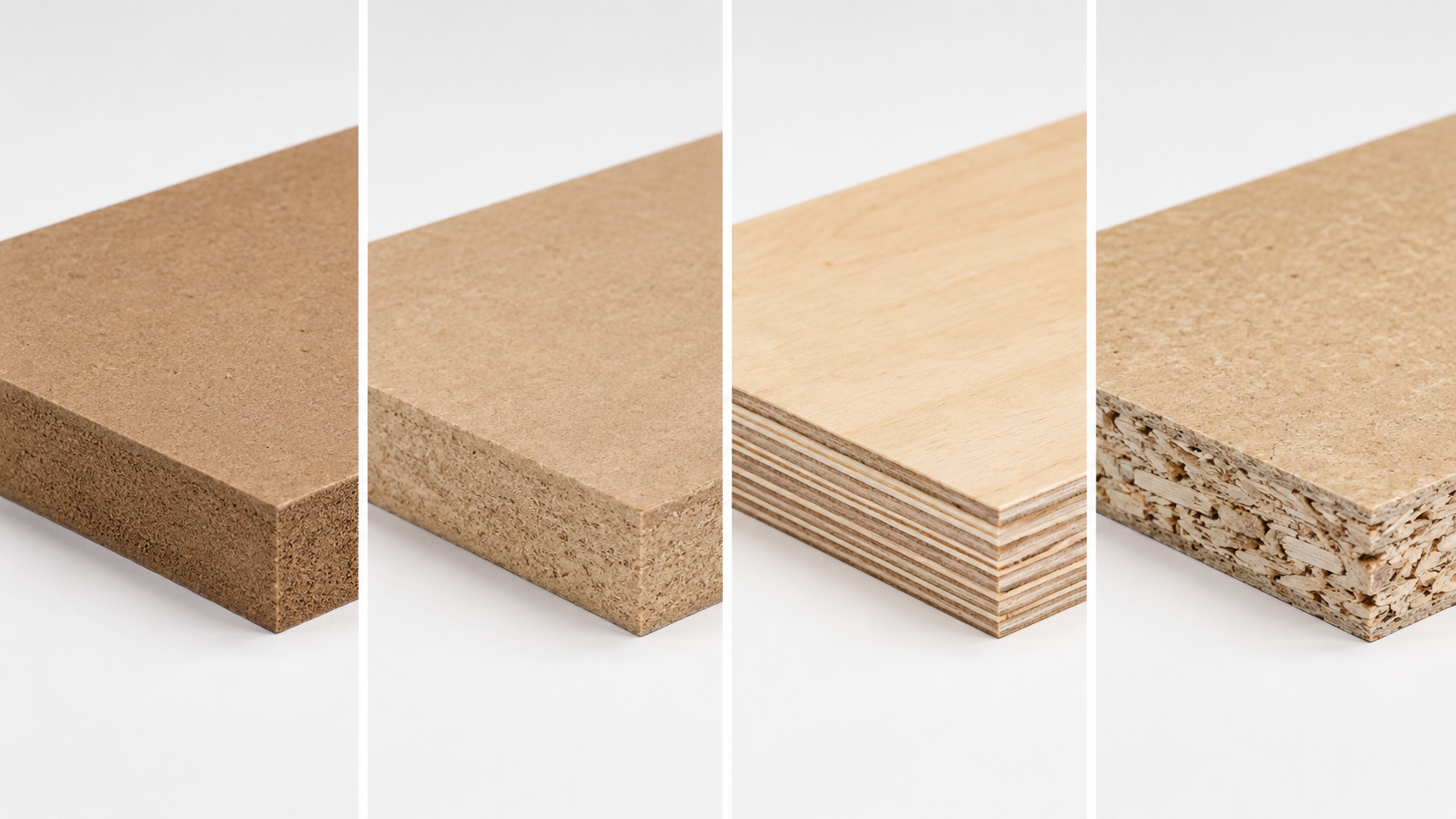
| Material | Good Uses | Main Limits |
|---|---|---|
| HDF | Dense thin panels, flooring cores, door skins, smooth painted or laminated parts | Heavy, hard on tools, moisture-sensitive at edges, not structural |
| MDF | Painted panels, routed profiles, trim, cabinet parts, supported shelving | Can sag, edges swell, and some screw locations are weak |
| Particleboard | Low-cost laminated furniture and cabinet components | Weak edges, poor water tolerance, limited fastener strength |
| Plywood | Cabinet boxes, shelving, subfloors, shop fixtures, and structural-rated panels | Higher cost, visible plies, possible voids or warping depending on grade |
| Solid wood | Frames, edges, furniture parts, visible surfaces, and repairable work | Moves with humidity and has natural variation |
HDF and MDF are close relatives. HDF is normally denser and harder. MDF is often easier to route and is common in thicker painted profiles. Read the MDF guide for that comparison, and check MDF sheet sizes and thicknesses when buying panels.
Plywood is different. Its veneer layers give it better strength and screw holding for many cabinet, shelving, subfloor, and construction uses. HDF usually wins when the part needs a dense, smooth, uniform surface; plywood wins when the panel needs to carry more load, take stronger fastening, or tolerate rougher service.
The broader wood materials guide explains where fiberboard, plywood, lumber, and other wood products fit.
Is HDF Waterproof?
No. Some HDF products are treated to resist moisture better than ordinary board, but the material is still made from wood fiber.
Damage usually begins at cut edges, flooring seams, screw holes, damaged coatings, sink cabinets, laundry areas, and slabs without proper moisture control.
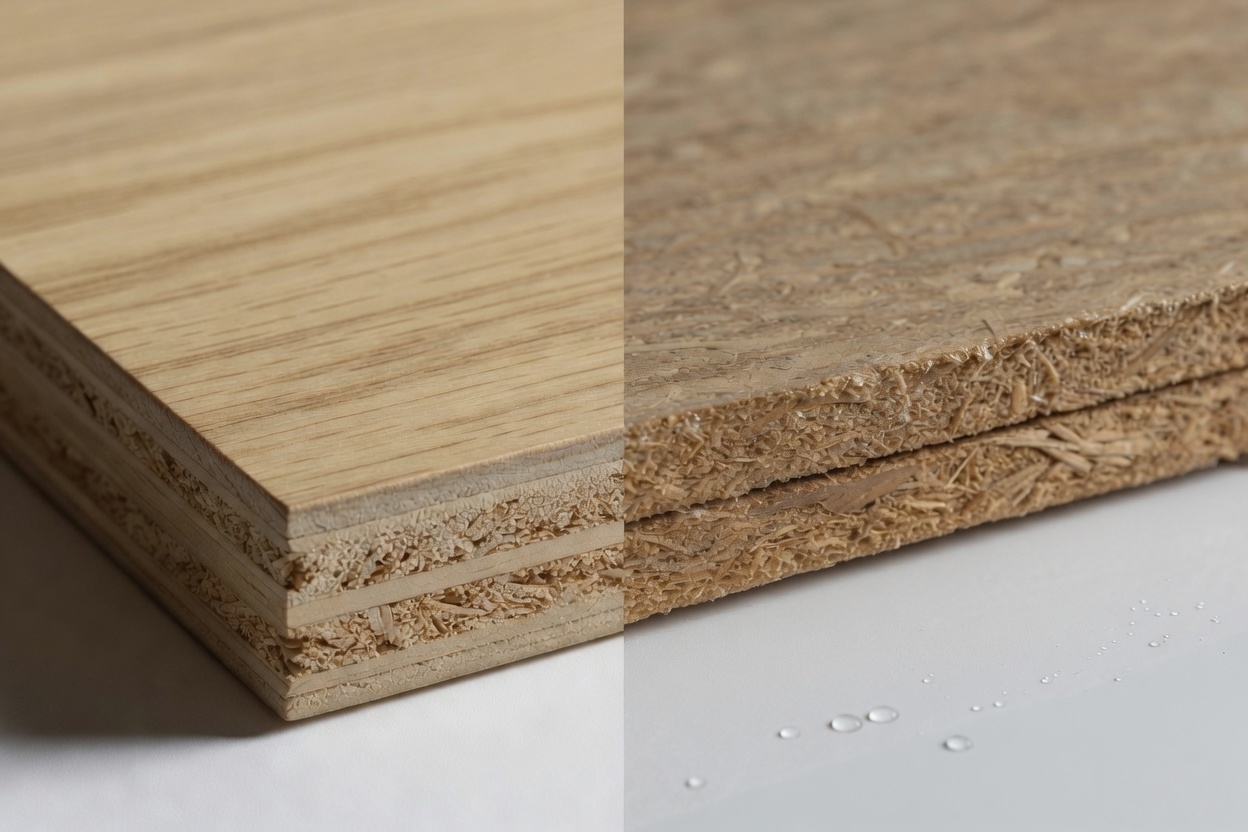
Drying may stop further damage, but it rarely returns a badly swollen edge to its original shape. Sanding can improve a minor raised area, but distorted flooring joints, cabinet edges, and door parts often need replacement.
Can HDF Be Used in Kitchens and Bathrooms?
It depends on the part and how much water reaches it. Painted cabinet doors and protected panels can work in a kitchen, while sink bases, dishwasher areas, wet lower cabinets, and cut edges carry more risk. A leak that goes unnoticed can damage the board before the face shows much change.
A protected HDF part may also be acceptable in a dry powder room. Ordinary HDF should not be used as shower board, tile backer, wet-wall sheathing, or any surface that receives repeated splashing.
| Use | Risk | Practical Decision |
|---|---|---|
| Bedroom furniture | Low | Suitable when the finish and edges stay dry |
| Painted cabinet doors | Low to moderate | Works when sealed and kept away from standing water |
| Kitchen sink base | Moderate to high | Use stronger moisture protection or a more tolerant material |
| Laminate flooring in dry living areas | Moderate | Check the seams, warranty, underlayment, and cleaning limits |
| Basement flooring | High | Test slab moisture and compare waterproof-core products |
| Full bathroom wet zones | High | Do not use ordinary HDF where repeated wetting is expected |
| Exterior work | Very high | Use an exterior-rated material |
Advantages and Limits
HDF makes sense when the project needs a hard, flat, smooth manufactured panel.
Advantages
- Smooth surface: useful under paint, laminate, film, veneer, and printed finishes.
- Uniform core: no knots, open grain, or veneer voids.
- High density: useful for flooring cores, door skins, and thin interior parts.
- Consistent machining: factory-made parts can be cut and repeated accurately.
- Stable appearance: the face does not show natural wood variation through a painted finish.
Limits
- Water damage: exposed edges and seams can swell.
- Weight: dense panels can be heavy.
- Tool wear: the dense fibers can dull cutters and blades.
- Fine dust: cutting and sanding need proper dust control.
- Fastener limits: edge screws do not behave like fasteners in plywood or solid wood.
- No general structural role: ordinary HDF is not framing, subflooring, or structural sheathing.
- Poor repair after swelling: damaged parts often need replacement.
Most failures come from a mismatch between the board and the job. Water, span, fasteners, or impact demanded more than the product could provide.
What to Check Before Buying
Do not buy HDF by thickness and price alone. Read the product sheet and confirm what the panel was made to do.
- Is it raw, painted, laminated, veneered, or made as a flooring core?
- What is the exact thickness and density?
- Are the faces and edges sealed?
- Is it ordinary interior board or a moisture-resistant product?
- Which rooms and uses does the manufacturer allow?
- What does the warranty say about water and cleaning?
- How should hinges, screws, and other hardware be installed?
- What emissions or certification requirements apply in your market? In the U.S., HDF falls under EPA's TSCA Title VI formaldehyde rule, so look for the compliance label.
- What happens to cut edges after fabrication?
Expect friction on the density question: many retail listings never state the core density at all, and no rule requires them to. When the number is missing, the warranty terms are the closest proxy you get, and two panels with the same thickness can still have different cores, coatings, and allowed uses.
For sheet dimensions and other panel types, see the 4x8 sheet-goods guide.
Handling and Installation
HDF damage often begins before installation. Panels can absorb moisture from a slab, bow when stored badly, or lose edge protection during cutting.
- Store panels flat, dry, and off concrete.
- Follow the manufacturer's acclimation instructions.
- Use sharp blades and control fine dust.
- Seal cut edges where water may reach them.
- Use pilot holes, inserts, or the specified hardware where needed.
- Follow flooring expansion gaps and underlayment requirements.
- Do not paint only the visible face while leaving vulnerable edges exposed.
Hidden edges still count. A cabinet door, flooring plank, or wall panel can look finished from the room while its cut edge remains open to water.
When HDF Is the Wrong Material
Choose something else when the project needs structural strength, exterior durability, repeated wetting, long unsupported spans, or dependable edge fastening.
- ordinary exterior siding
- shower walls or tile backing
- subflooring
- structural sheathing
- decking
- outdoor furniture exposed to rain
- long shelves without support
- sink-base bottoms without serious leak protection
- repairs where swelling has already destroyed the edge or joint
Before using HDF, ask what happens when the edge gets wet, the panel carries weight, or a screw pulls at the joint. That answer usually settles the material choice.
Frequently Asked Questions
What does HDF stand for?
High density fiberboard. It is an engineered panel made from compressed wood fibers and resin.
Is HDF real wood?
It contains wood fiber, but it is not solid lumber or plywood.
Is HDF better than MDF?
Not in every job. HDF is denser and harder. MDF is often easier to route and is widely used for painted profiles and thicker cabinet parts.
Is HDF waterproof?
No. Moisture-resistant products may handle limited exposure better, but seams and exposed edges can still swell.
Is HDF suitable for kitchen cabinets?
It can work for painted or laminated doors and panels. Use more caution around sinks, dishwashers, wet floors, and unsealed edges.
Can HDF be used in bathrooms?
Only in protected dry areas when the product allows it. Ordinary HDF is not suitable for showers, tile backing, or repeated splashing.
Does HDF hold screws well?
It depends on the panel, thickness, fastener, pilot hole, and whether the screw enters the face or edge. Do not assume it will hold like plywood or solid wood.
Can swollen HDF be repaired?
Minor surface swelling may be improved, but a distorted edge, flooring joint, or cabinet part often needs replacement.