

Sandwich panels can make a wall or roof go up fast. That speed is the reason people like them.
It is also where the trouble starts.
A panel can look clean from the outside and still be the wrong panel for the job. The core may be wrong. The joint may leak. The cut edge may expose foam. The fastener may crush the skin. The fire rating may apply to a tested assembly, not the random mix of panels, trims, openings, and site cuts that ended up on the building.
The question is not only “what is a sandwich panel?” The better question is: what is inside it, where is it being used, and who is responsible for every edge, joint, and penetration?
What Sandwich Panels Are
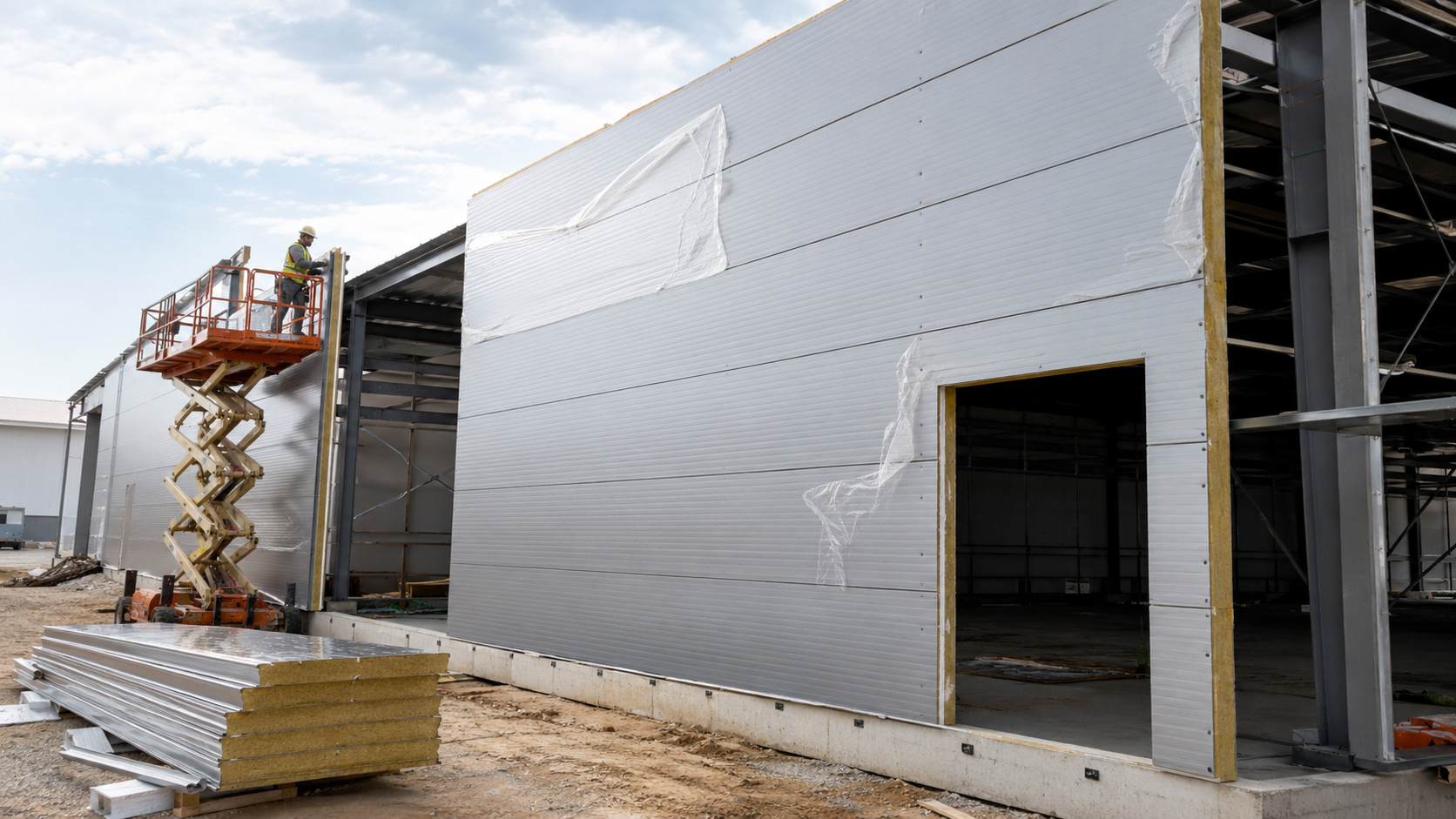
A sandwich panel is a building panel made from two outer skins with an insulation or structural core between them. Most building panels use metal skins, often steel or aluminum, with a core such as EPS, PU, PIR, or mineral wool. Some specialty panels use aluminum honeycomb or other composite cores.
The idea is simple: one panel can provide cladding, insulation, stiffness, and weather protection in a single piece. That is why sandwich panels show up in warehouses, cold rooms, factories, food buildings, farm buildings, modular buildings, workshops, roof systems, and quick commercial projects.
That does not make every panel interchangeable.
A cold room panel, a roof panel, a fire-rated wall panel, an aluminum composite panel, and a cheap EPS panel may all get called “sandwich panels” online. They do different jobs.
The Core Decides More Than the Skin
Buyers often shop by the outer metal face because that is what they see. Smooth wall. Ribbed roof. White finish. Aluminum face. Nice color.
The core is the bigger decision.
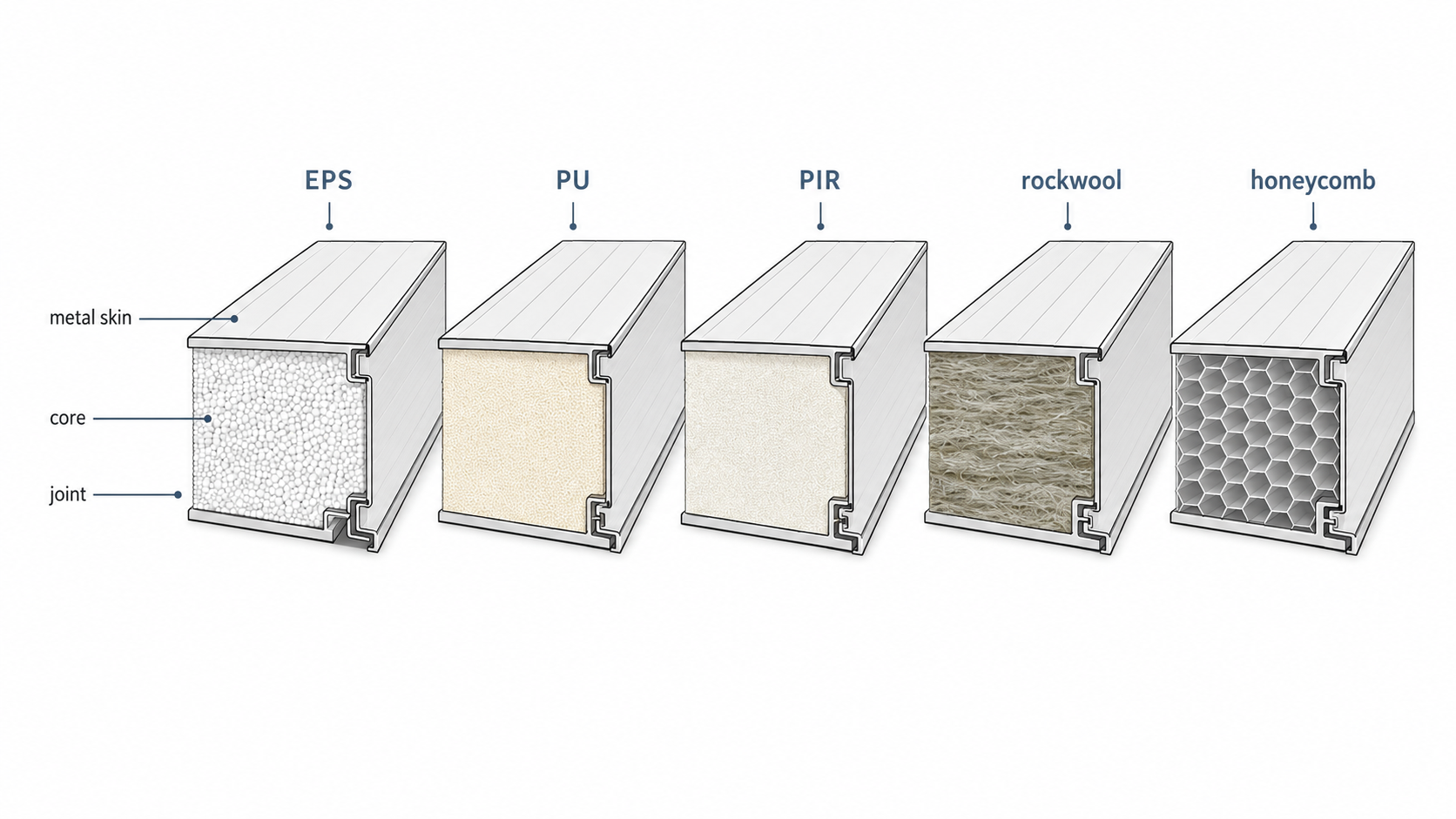
| Panel Core | Where It Often Shows Up | Main Strength | Main Caution |
|---|---|---|---|
| EPS | Low-cost walls, sheds, cold rooms, temporary or budget projects | Cheap, light, common | Combustible foam core; fire risk and code limits matter |
| PU / PUF | Cold rooms, industrial panels, insulated walls and roofs | Good insulation for thickness | Combustible foam; needs correct fire testing and detailing |
| PIR | Commercial insulated metal panels, roofs, walls, cold storage | Better fire behavior than older PU in many systems | Still a foam plastic; do not treat it as noncombustible unless the tested assembly says so |
| Rockwool / mineral wool | Fire-conscious walls, industrial buildings, boundary walls, some acoustic uses | Noncombustible core and better fire resistance potential | Heavier, often more expensive, and still needs correct joints and fixings |
| Aluminum honeycomb | Facades, ceilings, transport, lightweight architectural panels | Lightweight stiffness and flatness | Not the same as insulated wall or roof panels; check fire and structural use carefully |
EPS is not PIR. PIR is not rockwool. Rockwool is not honeycomb. Treating them as the same product is how people buy the wrong panel.
Roof Panels and Wall Panels Are Not the Same Purchase
A sandwich panel roof has a harder job than many wall panels. It has to shed water, resist uplift, handle foot traffic during maintenance, deal with thermal movement, and stay sealed at laps, ridges, gutters, openings, and fasteners.
A wall panel has its own problems. It has to stay flat, drain correctly, resist wind pressure, keep joints tight, and survive openings for doors, windows, louvers, pipes, lights, signs, and service penetrations.
The panel in the middle is usually fine.
The edges are where the building starts telling the truth.
Where Sandwich Panels Fail First
The cheapest quote often prices the panel, not the building.
That leaves out trims, closures, corner pieces, ridge caps, sealants, butyl tape, fasteners, flashings, foam closures, cut-edge treatment, labor, lift equipment, and waste. It also leaves out the person who has to make the panel system work around doors, vents, gutters, roof transitions, and uneven structure.
This is the section most supplier pages skip because it is not where the product looks good.
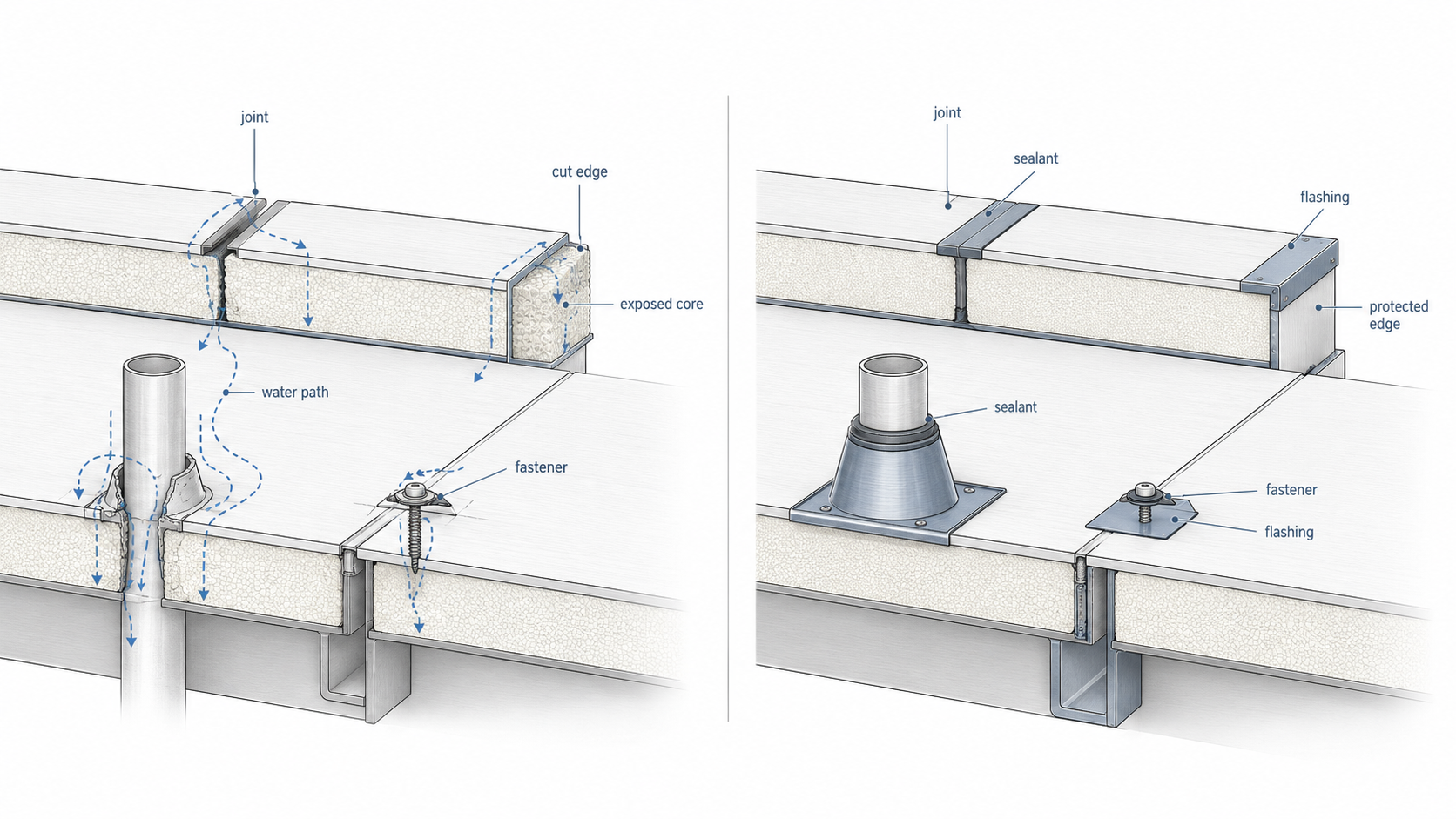
A factory panel arrives sealed and clean. Then someone cuts it. A door opening gets made. A pipe goes through it. A roof panel is trimmed at the eave. A wall panel meets a slab. A fastener misses the backup steel and gets reset nearby. That is where the panel stops being a neat product and becomes a building detail.
If the cut edge exposes foam and nobody protects it, water can get in. If the joint seal fails, the core can get wet. If the fastener is overdriven, the metal skin can deform and the washer may not seal. If a pipe penetration is treated like a hole in sheet metal instead of a hole through a composite panel, the repair later is ugly.
The middle of the panel sells the job. The edge decides whether the job lasts.
Sandwich Panel Price Is Not the Final Cost
Search demand around sandwich panel price, PUF panel price, roof panel price, and cold room panels for sale is strong for a reason. Buyers want a number before they talk to a supplier.
That is fair. But the number is not useful unless it includes the whole system.
| Cost Item | Why It Changes the Price | What to Ask |
|---|---|---|
| Core type | EPS, PU, PIR, rockwool, and honeycomb panels do not cost the same. | What core is quoted, and what fire or performance rating comes with it? |
| Panel thickness | Cold rooms and roofs may need thicker panels than basic wall cladding. | Is this thickness based on performance, or just price? |
| Metal skin thickness | Thin skins dent, oil-can, or deform more easily. | What is the gauge or thickness of each facing? |
| Trims and closures | Corners, edges, eaves, ridges, and openings need extra pieces. | Are flashings, trims, foam closures, and sealants included? |
| Fasteners | Roof and wall panels may need different fasteners and washers. | What fastener type is specified for the substrate and exposure? |
| Installation access | Long roof panels and tall walls need handling equipment. | Is lift equipment included, and where can panels be staged? |
| Waste and cutting | Openings, corners, roof slopes, and odd dimensions create offcuts. | How much waste is included, and who protects cut edges? |
A cheap panel quote with no trims, no tested assembly, no penetration plan, and no clear installation scope is not cheap. It is unfinished.
For broader material-selection logic, see materials selection and the materials selection process.
Fire Is the Core Question
Sandwich panels have a fire history because many of them use combustible foam cores. That does not mean every foam-core panel is banned or unsafe. It means the product, the assembly, the use, the insurer, the code, and the fire plan all matter.
This is where weak buying advice gets dangerous. A panel brochure may mention a flame-spread test, a class rating, or a fire certificate. That does not automatically mean the whole wall or roof assembly is acceptable for your building.
A tested assembly is not the same thing as a loose pile of products that look similar.
With foam plastic cores, ask about the full assembly. Ask what standard was tested. Ask whether the exact panel, thickness, joint, fastener, facing, orientation, and substrate are covered. Ask whether your building type triggers NFPA 285 or another exterior-wall fire requirement. Ask whether the insurer requires FM Approved or other listed systems.
Do not save money by guessing here.
EPS, PU, PIR, and Rockwool: Where Each Option Makes Sense
The right core depends on the risk, not only the price.
EPS can make sense for budget projects where code, insurance, and fire exposure allow it. It is common, light, and often cheaper. It is also the core that should make buyers slow down and ask the most fire questions.
PU and PUF panels are common in cold rooms and insulated industrial work because they provide strong insulation in a relatively thin panel. That does not remove the need for fire detailing. It increases the need to know the exact product and approval path.
PIR is often sold as a better-performing foam option, especially for insulated metal panels. It can be a good choice when the tested assembly is right. But PIR is still a foam plastic core. Do not call it noncombustible just because it sounds safer than PU.
Rockwool or mineral wool panels are heavier and often cost more. They are also the option many projects look at when fire resistance, noncombustibility, or separation between risky areas matters more than the lowest material price.
The honest answer is boring: choose the core after you know the building use, fire exposure, code path, insurer expectations, roof or wall role, and installation details.
Cold Room Panels Are a Special Case
Cold room panels are one of the biggest keyword clusters for this topic, and they deserve separate treatment.
A cold room panel is not only a wall panel with insulation. It is part of a temperature-control system. The joint, floor connection, ceiling connection, vapor control, door frame, cam locks, penetrations, and cleaning routine all matter.
Moisture is the quiet problem. Warm, wet air wants to find the cold surface. If it finds a gap at a joint, a pipe penetration, or a damaged edge, condensation can form where it is hardest to inspect.
In food, storage, and refrigeration work, that can become more than a comfort problem. It can become mold, corrosion, staining, odor, failed insulation, or a hygiene issue.
Cold room panels should be bought as a system, not as loose sheets.
When Sandwich Panels Are a Good Choice
Sandwich panels are useful when speed, insulation, and clean exterior surfaces matter.
They can make sense for warehouses, cold rooms, farm buildings, workshops, light industrial buildings, clean interior partitions, modular buildings, commercial roofs, and utility spaces. They are especially strong when the building has simple geometry and the installer knows the system.
Simple buildings like them.
Complicated buildings punish them.
When to Avoid Sandwich Panels
Avoid sandwich panels when the building has too many awkward openings, risky heat sources, sloppy site control, or unclear fire requirements.
Be careful around commercial kitchens, hot process areas, battery charging zones, welding areas, boiler rooms, flues, high-fire-load storage, and buildings where the insurer has strict property-loss rules. In these situations, the cheapest foam-core panel can become the most expensive decision in the building.
Also be cautious on small residential jobs where the panel system looks simple but the trims, openings, roof edge, and code path are not.
A sandwich panel is not magic drywall, not magic siding, and not magic roofing. It is a system.
Installation Mistakes That Ruin Good Panels
Good panels fail when the installation is careless.
The most common mistakes are not exotic. They are ordinary jobsite shortcuts.
- Panels are dragged, dented, or stored flat where water sits between sheets.
- Protective film is left on too long and bakes onto the surface.
- Fasteners are overdriven and crush the washer or skin.
- Cut edges are left exposed.
- Penetrations are sealed with random caulk instead of a proper flashing detail.
- Roof panels are walked on without protection.
- Panel joints are treated as finish lines instead of weather-control lines.
The worst one is the exposed cut edge. It looks small on day one. Later it can become water entry, corrosion, swollen core, staining, or a warranty argument.
What to Ask Before You Buy
A useful quote should answer more than price per square foot.
| Question | Why It Matters |
|---|---|
| What is the core material? | EPS, PU, PIR, rockwool, and honeycomb carry different fire, insulation, weight, and cost implications. |
| What thickness is being quoted? | Thickness affects insulation, span, stiffness, weight, and price. |
| What fire tests or approvals apply to this exact panel? | A vague certificate is not enough for commercial, cold room, or higher-risk work. |
| Is this a roof panel, wall panel, cold room panel, or facade panel? | The joints, skins, coatings, and load expectations may differ. |
| Are trims, sealants, fasteners, and closures included? | The panel alone is not the system. |
| Who protects cut edges and penetrations? | Many leaks and failures start after panels are cut on site. |
| Who approves the installation detail? | Manufacturer instructions, installer habits, and code requirements need to match. |
If the supplier only wants to talk about panel thickness and price, keep asking.
Red Flags
The biggest red flag is a quote that treats sandwich panels like plain sheets.
If there is no mention of core type, fire testing, trims, fasteners, cut edges, roof slope, joint seal, or penetrations, the quote is not finished. It is a number.
Another warning: the same panel is recommended for every job. Cold room, roof, partition, shed, facade, food space, and warehouse. That is lazy specifying. Different jobs need different cores, skins, coatings, joints, and approvals.
Be careful when someone says “fireproof sandwich panel” without explaining the test, assembly, and limit. Be careful when EPS is suggested for high-risk commercial areas without a serious fire discussion. Be careful when the installer says field cuts are “no problem” but has no detail for protecting the core.
A cheap sandwich panel can be a good buy. A vague panel is the one to worry about.
Sandwich Panels vs Other Wall and Roof Materials
Sandwich panels compete with framed walls, metal cladding over separate insulation, SIPs, tilt-up concrete, masonry, and conventional roof assemblies.
They win when speed and integrated insulation matter. They lose when the building has too many interruptions, high fire exposure, unusual geometry, heavy abuse, or a design that needs easy future changes.
For roofing comparisons, see roofing materials. For insulation context, see thermal insulation materials.
Buyer Checklist
- Confirm whether the panel is for roof, wall, cold room, interior partition, or facade use.
- Confirm the core: EPS, PU, PUF, PIR, rockwool, mineral wool, or honeycomb.
- Ask for the exact panel thickness and metal skin thickness.
- Ask what fire test, listing, or approval applies to the exact panel and assembly.
- Confirm whether trims, fasteners, sealants, closures, and flashing are included.
- Ask how cut edges, openings, and penetrations will be protected.
- Check roof slope, span, wind load, snow load, and maintenance access before ordering roof panels.
- Ask who owns leaks at joints and penetrations after installation.
- Keep product data, installation instructions, fire documents, warranty papers, and as-built photos.
FAQ
What are sandwich panels?
Sandwich panels are composite building panels with two outer skins and a core between them. In construction, they are often metal-faced panels with EPS, PU, PIR, mineral wool, or similar cores.
Are sandwich panels good for roofs?
They can be. Roof sandwich panels work well when the panel is designed for roofing, the slope is suitable, the spans are checked, and the joints, fasteners, ridges, eaves, and penetrations are detailed properly. A wall panel should not be casually used as a roof panel.
Which sandwich panel core is best?
There is no single best core. EPS is usually cheaper. PU and PUF are common for insulated panels and cold rooms. PIR is often chosen for better fire performance among foam cores. Rockwool is heavier and often used where fire resistance matters more. The building use decides the answer.
Are EPS sandwich panels safe?
EPS panels can be used in some projects, but EPS is a combustible foam. Fire rating, code approval, building use, insurer requirements, and installation details matter. Do not choose EPS only because it is cheaper.
What is the difference between PU, PUF, and PIR panels?
PU and PUF usually refer to polyurethane foam panels. PIR stands for polyisocyanurate. PIR is related to polyurethane chemistry but is often used where better fire performance is needed. The exact product and tested assembly matter more than the abbreviation.
Are rockwool sandwich panels better?
They are better for some jobs, especially where fire resistance or noncombustibility is important. They are usually heavier and may cost more. They still need correct joints, trims, and fastening.
Why do sandwich panels leak?
Most leaks start at joints, fasteners, roof laps, cut edges, penetrations, ridges, eaves, or wall-to-roof transitions. The middle of the panel is rarely the first problem.
Are sandwich panels cheap?
Some are cheap per square foot, especially EPS or basic PUF panels. The full cost depends on core, thickness, skin thickness, fire rating, trims, fasteners, delivery, lifting, waste, and installation. A cheap panel without the system pieces can become expensive fast.
References
Sources used for this article
- Metal Construction Association: Insulated Metal Panel IBC Specifications for Roofs and Walls
- Metal Construction Association: Insulated Metal Panels and NFPA 285
- FM: Property Loss Prevention Data Sheets
- RSA: Composite Panels Risk Control Guide
- NFU Mutual: Fire Safety Guide to Combustible Composite Insulated Panels
Read Next
Materials Selection — how to choose building materials by risk, cost, climate, maintenance, and installation limits.
Thermal Insulation Materials — useful background before comparing EPS, PU, PIR, rockwool, and other insulation cores.
Roofing Materials — broader roof material choices before choosing insulated roof panels.
Metal Buildings — where insulated metal panels often appear and what the wall and roof system has to handle.
Building Envelope Commissioning — why panel joints, air leakage, water control, and thermal performance need inspection instead of trust.