

Stand across the street from a 1980s house for a minute. The garage is usually the first thing you see — wide, pale, and right out front. Then you go looking for the front door and it takes a second, because it is tucked back beside the garage in the shade. The siding is one color, the brick is another, and nobody picked them to go together. The shutters are too skinny to ever close over the glass. The shrubs went past the windowsills years ago and nobody pulled them back.
That is not one thing. It is several things, all going at once.
That is why paint usually disappoints people. You spend money on paint, and the house is a different color but somehow still reads the same. One problem changed. The other five stayed in place.
The work that actually moves the house starts before you open a can. It starts by deciding what should fade back, what should come forward, what is worth keeping, and what has to be repaired before any finish goes on.
For the full house sequence, start with 1980s house renovation. For the broader style background, keep 1980s house styles nearby. This exterior page is the practical piece: garage, entry, siding, brick, trim, windows, lighting, planting, and the water problems hiding behind all of it.
The House Usually Does Not Need a New Style
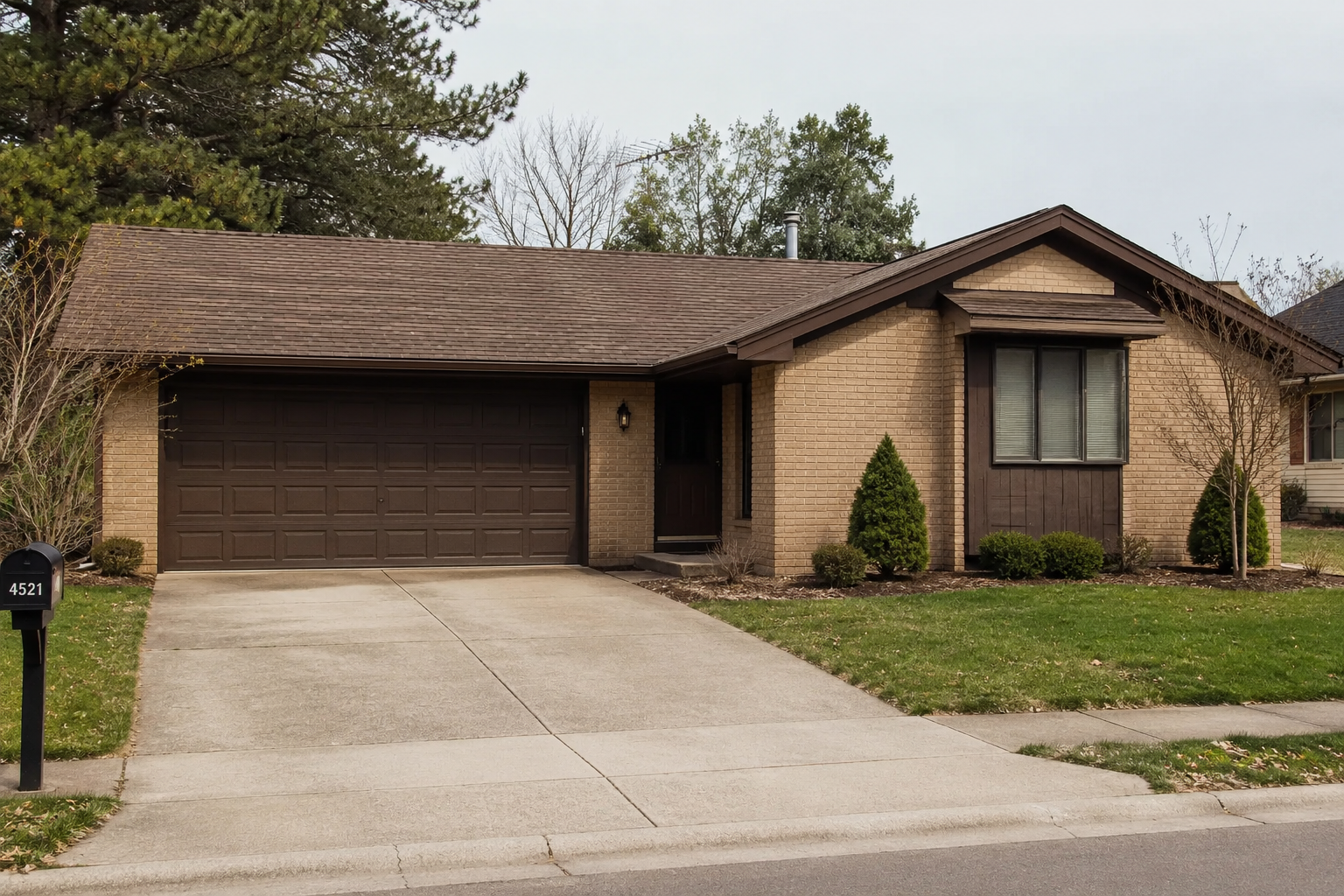
The fastest way to ruin a 1980s exterior is to force it into another decade.
Modern farmhouse trim, black windows, vertical siding, fake wood beams, heavy stone, and oversized porch details can all look good on the right house. On a plain suburban 1980s house, they usually look stuck on. You can tell they were added.
The roofline, the garage position, the window openings, the brick, the siding breaks, and the entry location are still running the show. They were there before the update and they will be there after. If those pieces are not handled first, the new style is just a costume over the old problem.
A better update keeps the house recognizable and takes away the parts that make it look tired: garage dominance, weak entry, faded siding, fake shutters, undersized lights, overgrown shrubs, and trim that does not match the wall.
The point is not to disguise the house as something newer.
The point is to remove the parts that are fighting each other so the rest can sit quietly.
What Makes a 1980s Exterior Look Dated
It is almost never one big ugly thing. It is a pile of small ones.
Beige siding on its own is fine. Beige siding plus brown brick plus almond windows plus shiny brass coach lights plus fake shutters plus overgrown shrubs plus a bright white garage door — that is what reads as 1980s and tired. No single piece is the whole villain. They gang up.
The usual suspects are easy to spot:
- Garage-heavy fronts where the overhead door is wider, brighter, and stronger than the entry.
- Recessed or weak entries where the front door disappears from the street.
- Fake shutters and thin trim that do not match the window size or the wall.
- Old lighting and planting that hide the entry, shrink the wall, or trap moisture against the siding.
So it is not really a curb-appeal problem. It is an order problem: too many things asking for attention at once, and the wrong things winning.
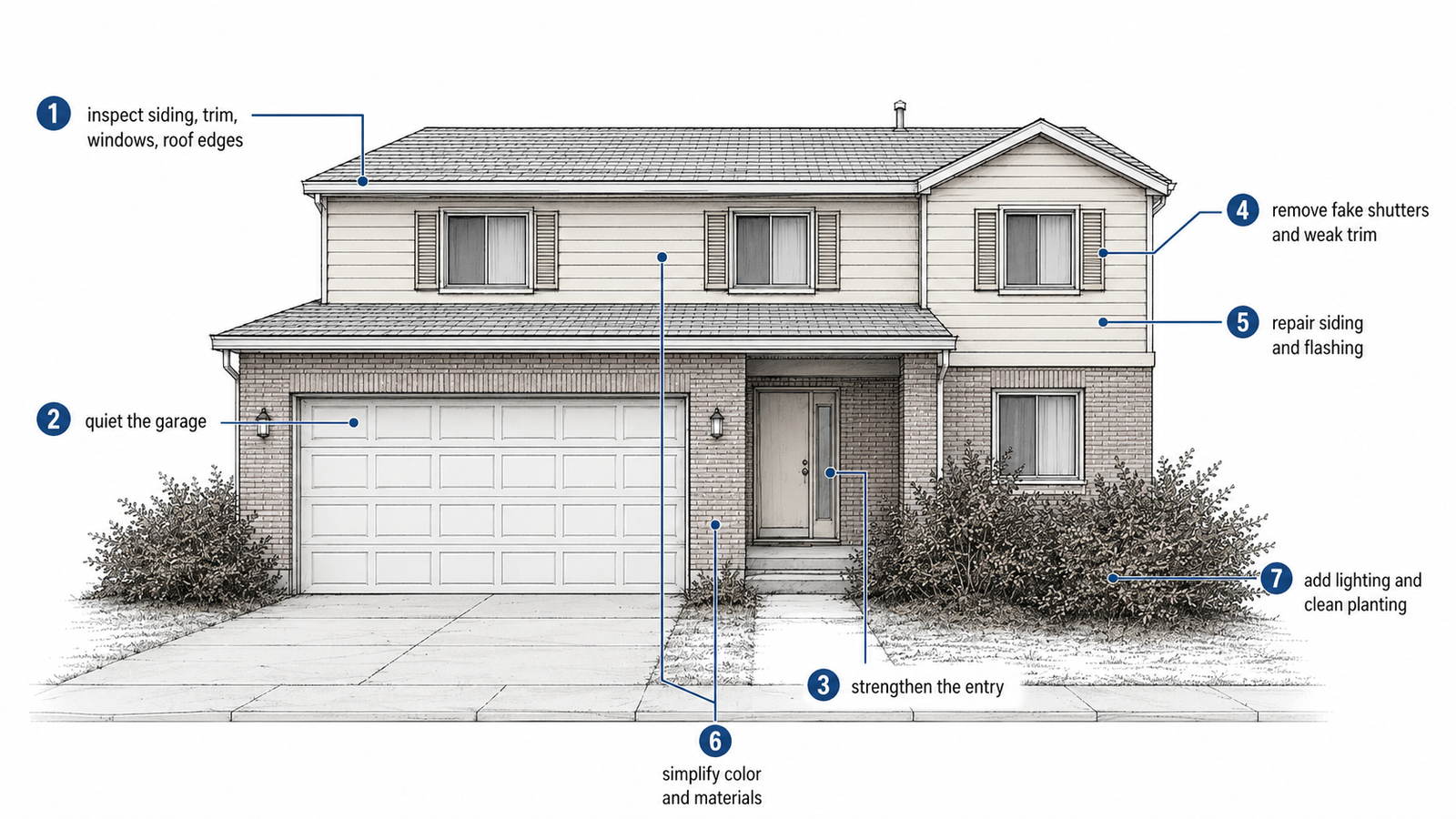
The Garage Is Usually the First Thing to Calm Down
A lot of these houses put the garage right out front. It worked for the floor plan, but it did the elevation no favors.
If the garage door is bright white, heavily paneled, arched, glossy, or stronger than the front door, the house reads as garage first and home second. That is why some 1980s exteriors still look off after a fresh paint job.
The first job is to make the garage quiet down:
- If the door is staying, paint it close to the siding color so it stops shouting.
- If it is being replaced, use a flatter, quieter panel style.
- Size the garage lights to the wall. Tiny coach lanterns beside a large garage door usually make the whole front look cheaper.
- Clean up the driveway edge so the eye is not dragged straight to the door.
Do not make the garage a feature unless the house can actually carry one. Most of these houses cannot. Quiet it down and let the front door do the talking.
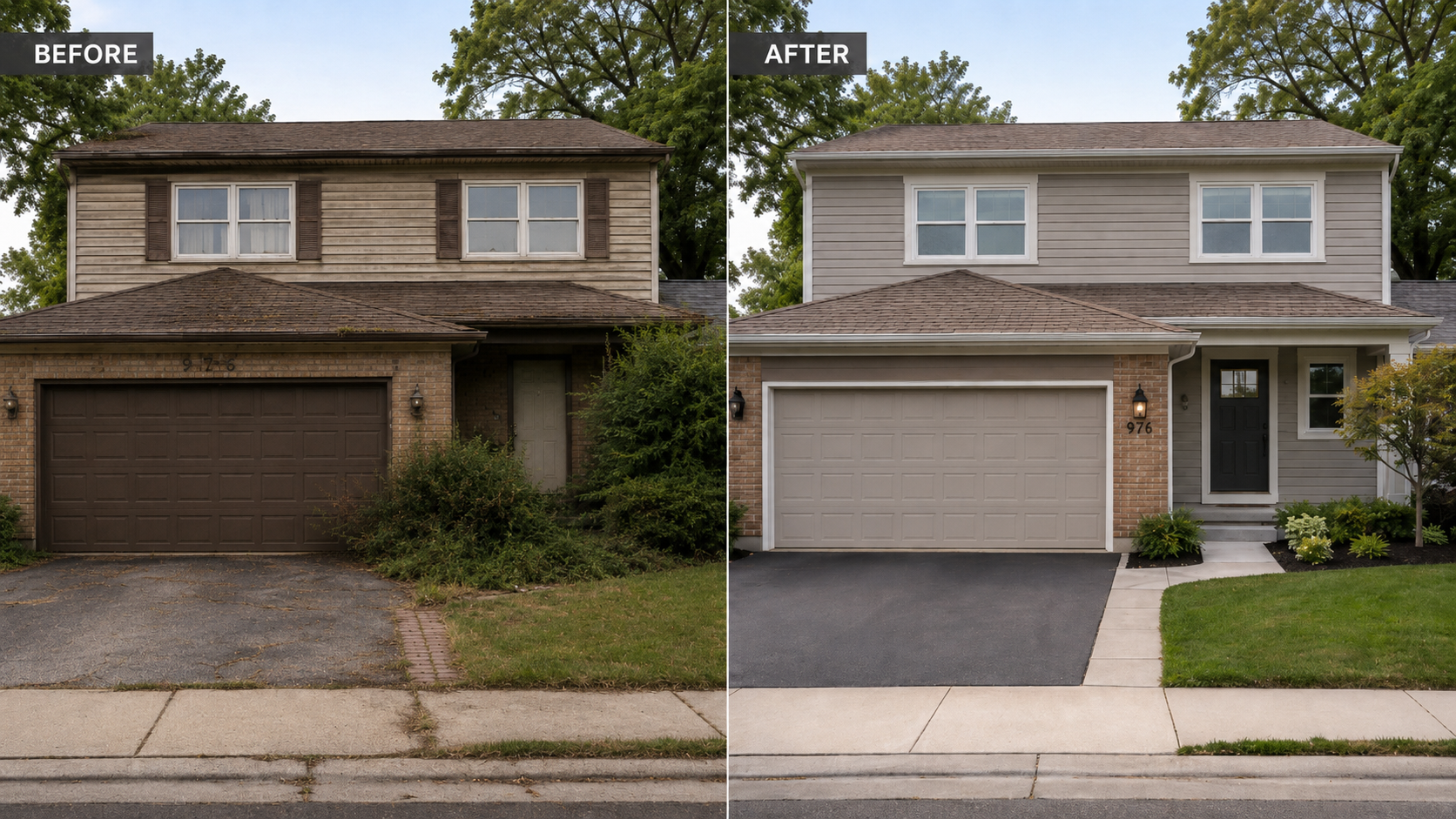
The Entry Has to Beat the Garage
Most 1980s entries are too quiet. The door may be shoved beside the garage, hidden under a shallow porch, framed in skinny trim, or fitted with one of those half-round glass inserts that dates the whole front by itself. Half the time, the door is not even the worst of it. The path, step, railing, porch light, house numbers, and planting all fail together, quietly, until you stop seeing the door at all.
First job: can you find the front door from the street in two seconds? If not, fix the walk and the frame around the entry before spending money on decorative parts.
After that, a good entry update might mean a simpler door, cleaner glass, bigger sconces, house numbers you can actually read, fixed steps, a decent handrail, and planting that points toward the door instead of swallowing it.
If the house is a split-level, the entry matters even more because the exterior door often opens onto a cramped landing between stairs. Tie this work to 1980s split-level remodel if that is the layout.
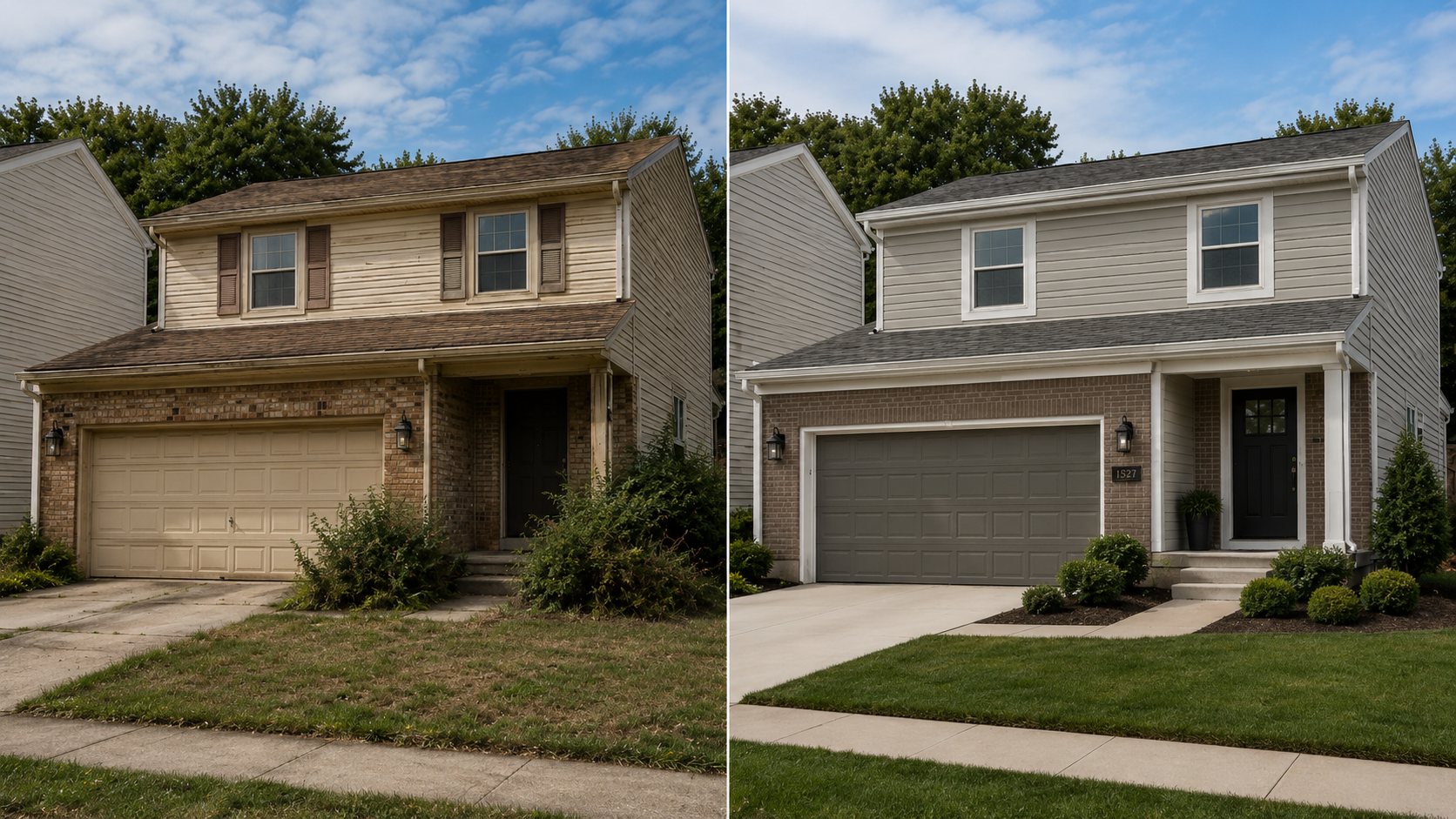
Brick Can Stay If the Rest of the Palette Works
Brown, red, orange, and beige brick show up on many 1980s exteriors. The brick is usually not the thing that is wrong. Sound brick gives the house weight and can save a pile of money. What is wrong is often everything around it: the siding color, the trim, the garage door, the roof, the windows, the gutters, and the planting.
Before reaching for brick paint, try fixing the stuff around it first. Change the siding color, the garage color, the trim, and the landscape edge. A lot of the time, the brick was fine and the beige was the problem.
Also look at the brick as a wall, not just as a color. Check for cracked mortar joints, blocked weep holes, soil or mulch piled against the brick, splashback at the base, staining below sills, and places where water cannot drain or dry. If the wall has a moisture problem, painting it shut can make the eventual repair worse, not better.
Painting brick can work. It is not a casual weekend decision, even though people treat it like one. Once it is painted, it becomes a maintenance surface. The wrong coating, poor prep, or trapped moisture can lead to peeling, staining, and repair work later.
Keep good brick when you can fold it into the palette. Paint it only after the rest of the exterior has been solved and the coating system suits the masonry and the climate.
Siding Is a Condition Decision Before It Is a Color Decision
Siding is where the budget gets away from you.
A paint job and a re-side are not the same animal. Pull old siding and you can find rotten sheathing, failed flashing, hidden rot, bad window details, no housewrap at all, and trim that was basically held together by paint and habit.
If the siding is warped, cracked, swollen, loose, soft, or gaping at the bottom edge, that is not a color question. It is an assembly question, and a different budget.
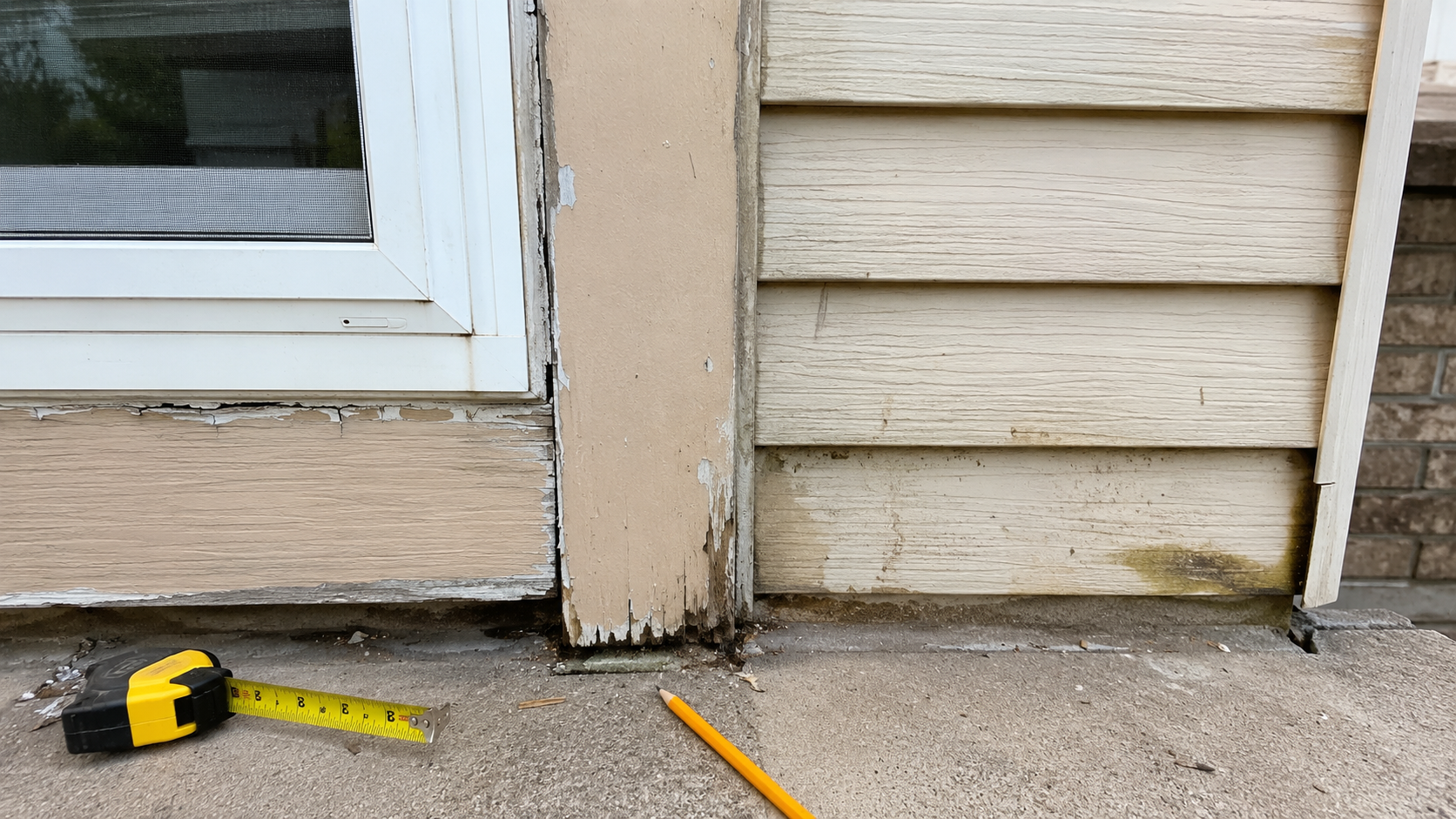
If the siding is sound, paint might be all you need. That depends on the material, the sun it takes, the old color, the condition, the paint system, and how well it gets prepped. Old wood wants repair and primer. Aluminum can chalk badly. Vinyl has product-specific paint limits, because a dark color on the wrong panel can distort it.
Before anybody prices anything, walk the house slowly. Check window corners, bottom edges, garage returns, hose bibs, where the deck ties in, door thresholds, shaded walls, and siding down near grade. That is where water shows itself first, and that is what you want to know before falling in love with a color.
| Exterior part | Keep or paint when | Repair or replace when |
|---|---|---|
| Siding | Panels are flat, dry, secure, and compatible with the paint system | Panels are soft, warped, cracked, loose, swollen, or open at joints |
| Trim | Boards are solid, tight, and properly flashed | Ends are soft, swollen, split, or stained near corners and windows |
| Brick | Brick and mortar are sound and the color can work with the palette | Mortar is failing, water is trapped, or paint is being used to hide damage |
| Garage door | The door works well and can be quieted with color or hardware changes | The door is damaged, unsafe, badly insulated, or visually dominates the front |
| Windows | Units perform well and the proportions suit the wall | Glass is fogged, trim is wet, flashing failed, or operation is poor |
Roof Edges, Gutters, and Fascia Can Date the Whole Front
The roof might be fine and the roof edge can still drag the whole house down.
Brown aluminum fascia. Sagging gutters. Skinny downspouts. Stained soffits. Bent drip edge. Water marks under the roof returns. On a lot of these houses, the eye goes garage, then gutter line, then dark fascia. If that run is worn or loud, no paint color underneath it will save the front.
Check the fascia, soffits, gutters, downspouts, and roof-to-wall flashing before picking colors. A gutter dumping water beside the siding or the garage return is not just ugly. It may be feeding the soft trim and stained sheathing you find later. The ugly thing and the rot are often the same thing.
Do not hang new gutters on rotten fascia. Do not paint a stained soffit before you know why it is stained. And do not paint the gutters some high-contrast color unless the roofline has earned the attention. Usually, it has not.
A quieter fascia and gutter color does more work than people expect: the garage settles down, the entry reads, the siding looks calmer, and you did not touch the rest of the house.
Fake Shutters, Thin Trim, and Small Lights Usually Date the House
Take the weak details off before adding anything.
Fake shutters age a 1980s house faster than almost anything. Some older houses can carry real shutters because the windows and the wall are proportioned for them. Most 1980s houses are not. The test is simple: if the shutter is too narrow to cover the window, it should not be on the wall.
The same goes for skinny door pediments, plastic trim blocks, stuck-on arches, and little coach lights swimming on a big wall. Those pieces were often added to make a plain front feel dressed up. Now they tend to make the house look cheaper than it is.
Strip that stuff off first. Then stand back and decide what the wall actually wants: better trim, a deeper sill, a cleaner siding return, a bigger light, or nothing at all.
Sometimes nothing is the answer, and that is a relief on the budget.
Windows Can Help or Make the House Look Fake-Modern
New windows can change the whole face of a 1980s house. They can also make it look like it is wearing somebody else's clothes.
Black windows are not magic. They work when the facade, the trim depth, the roof color, the siding, the brick, and the window proportions can all take that much contrast. Plenty of 1980s houses cannot. Bronze, dark brown, clay, almond, or a soft neutral may sit better.
Replace windows because they failed, because they are uncomfortable, because the proportions are wrong — not because the contrast looks good in a photo.
- Fogged glass between the panes usually means the seal is gone.
- Soft trim or staining under a window usually means water is getting in.
- Short, wide windows might just need better trim, not a new shape.
- If you add grids or muntins, match the house, not the catalog photo.
If you are changing window sizes, that is not only a window job. It is siding, flashing, drywall, insulation, trim, and paint, all at once. Plan it that way or it will surprise you.
Landscaping Should Reveal the House, Not Hide It
Those foundation shrubs went in to soften a weak elevation. Thirty or forty years later, they tend to do the opposite. They bury the entry, crowd the windows, hold moisture against the wall, block inspection space, and make the whole house look smaller than it is.
You can change the front of the house with a pair of loppers before you ever open a paint can.
Start with a clear path and a clean bed edge. Then use plants to point at the entry and settle the garage down. A few low shrubs, some grasses, one small ornamental tree, and a walk you can see will usually beat a packed mulch bed full of whatever was on sale.
Keep everything back from siding, vents, brick weeps, and low trim. A landscape that traps moisture or gives pests a way in is not worth the softer look.
What Gets Exposed When Exterior Work Starts
The risky part of one of these jobs is not picking the wrong paint color. It is prying off a piece of trim and finding out the wall behind it was never ready for paint in the first place.
Soft trim at the garage return. Cracked caulk under the windows. Loose siding down low. Stained sheathing. Bad flashing. Water with nowhere to go. All of it can sit behind a dated-but-intact-looking front, and the minute the siding or trim comes off, the job quietly turns from curb appeal into water repair.
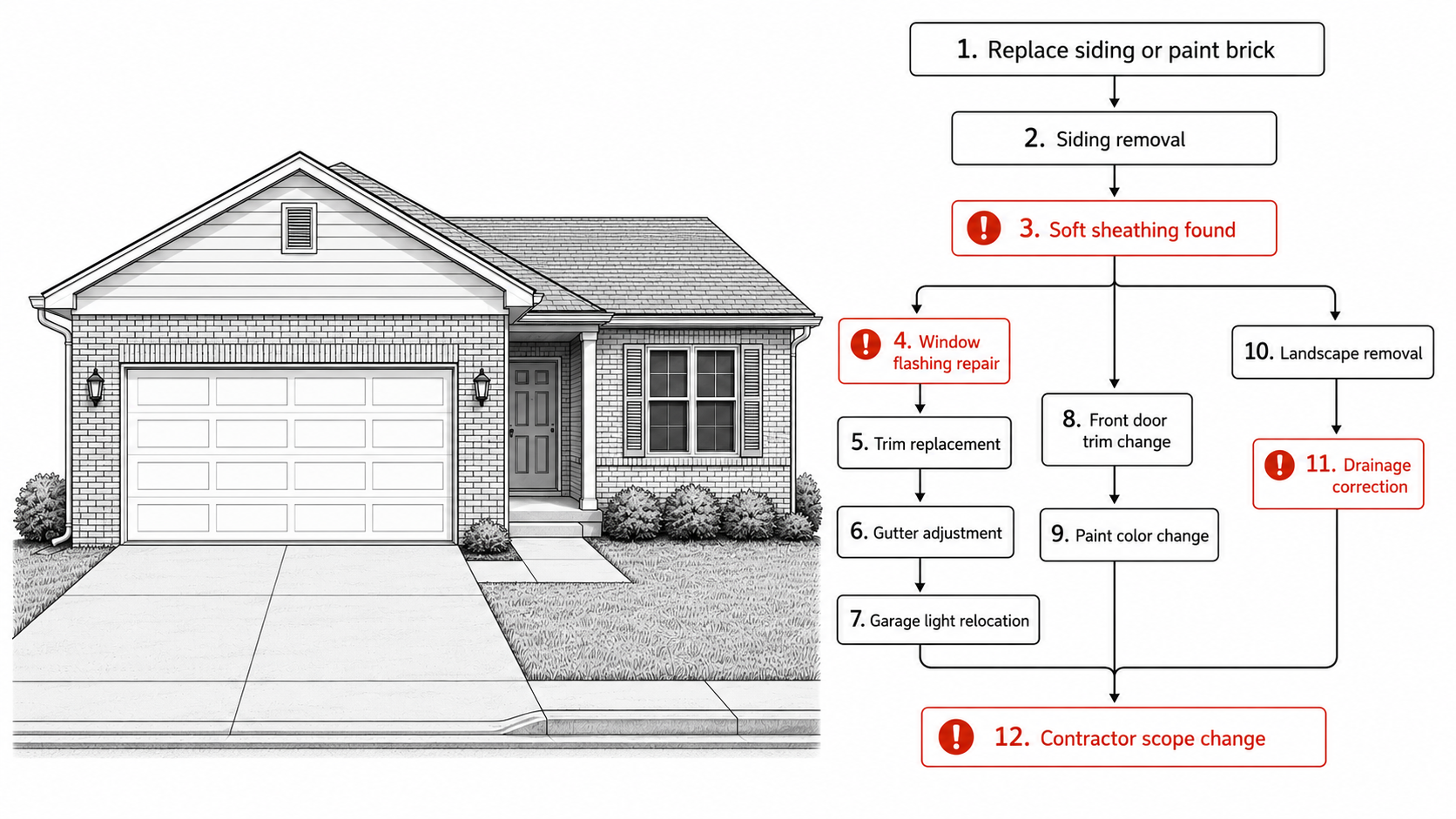
Check the bottom foot of siding, the window corners, the door thresholds, the garage returns, the deck connections, the gutter outlets, and anywhere roof water hits the wall. Those are the spots that turn a tidy refresh into carpentry, flashing, drainage, and a second coat of paint over the patch.
That is the moment a cheap refresh becomes a real remodel. It does not mean the work is wrong. It means the order you do it in is the whole game.
Best Update Order for a 1980s Exterior
A clean job follows the wall, not the paint deck.
| Step | Exterior decision | Why it comes first |
|---|---|---|
| 1 | Inspect siding, trim, windows, gutters, roof edges, drainage, and lower wall areas | Finds rot, failed seals, bad flashing, and water paths before cosmetic work |
| 2 | Decide what stays and what gets removed | Prevents replacing sound brick, windows, walks, or roof shapes just because they look dated |
| 3 | Repair envelope problems | Siding, flashing, trim, window, and drainage repairs should happen before paint |
| 4 | Calm the garage and strengthen the entry | Fixes the front hierarchy before decorative details are chosen |
| 5 | Choose paint, siding, trim, lighting, house numbers, and planting | Finishes work better after the shape and repairs are settled |
Buy the lights before you settle the trim color and the finish may fight you. Paint over bad siding and the damage can bleed back through inside a year. Put in windows after the new siding and you are cutting up work you already paid for. None of this is complicated. It just gets expensive when it is done out of order, mostly in callbacks.
1980s Exterior Update Decisions
| Decision | Best when | Watch out for |
|---|---|---|
| Keep | Brick, roof shape, window openings, or walkways are sound and still help the house | Keeping too much old trim, lighting, or shutter detail can leave the front dated |
| Paint | Siding or trim is sound, dry, compatible with paint, and properly prepped | Paint will not fix rot, failed flashing, warped siding, or bad caulk lines |
| Replace | Garage doors, windows, siding, trim, or lights are failed, unsafe, or visually damaging | Replacement can trigger flashing, drywall, trim, siding, gutter, and paint work |
| Remove | Fake shutters, weak trim, old lights, and overgrown shrubs are making the front busier | Removal can expose holes, stains, mismatched siding, or wall repairs |
| Repair | Water, rot, drainage, flashing, gutter, or trim problems are present | Skipping repair can trap moisture behind the new finish |
What to Avoid
Most bad 1980s exterior jobs fail because somebody tried too hard.
- Do not mix too many materials. Brick, stone, vertical siding, wood slats, black metal, and stucco can turn the front into noise fast.
- Do not force farmhouse details. Board-and-batten, rustic shutters, and fake beams can fight the original roofline.
- Do not reach for black windows by default. Some houses need softer contrast.
- Do not paint the brick to dodge a harder decision. The garage, siding, trim, roof, and landscape are usually the real problem.
- Do not paint over water damage. Fix the assembly first, then the finish.
When the work is done right, the house looks calmer. When it is done wrong, it just looks more expensive and still confused.
How This Fits the Rest of the 1980s Remodel
If the project is bigger than paint and shrubs, do not treat the exterior as its own island.
A front-entry change can pull in the interior stair lighting. New windows touch the trim, drywall, and comfort of the room. A garage-heavy front is often tangled up with a split-level entry problem. A siding job can crack open ventilation, drainage, or lower-level moisture issues you did not know you had.
So if this is part of a bigger renovation, tie it back to the rooms that actually drive the budget: 1980s kitchen remodel, 1980s bathroom remodel, and 1980s house interior.
If the house is really a raised ranch or split-entry, compare notes with raised ranch remodel.
FAQ
What is the biggest problem with 1980s house exteriors?
The garage, entry, siding, brick, trim, and planting often do not work together. The house may be sound, but the front elevation feels garage-heavy, flat, busy, or hidden.
How do I update a 1980s house exterior?
Start by inspecting siding, trim, windows, roof edges, gutters, drainage, and lower wall areas. Then calm the garage, strengthen the entry, remove fake details, repair the exterior envelope, and choose paint, lighting, and planting last.
Should I paint the brick on a 1980s house?
Only after checking whether the brick is sound and whether the house can be improved by changing siding, trim, garage color, lighting, and landscaping first. Painted brick becomes a maintenance surface.
Should I remove fake shutters?
Usually, yes. If the shutters are too narrow to cover the window or do not fit the wall, they usually make the exterior look cheaper and more dated.
How do I make a front-facing garage less dominant?
Use a quieter garage door style, paint it close to the siding color, improve the front entry path, scale the lighting properly, and avoid making the garage the highest-contrast part of the elevation.
Are black windows good for a 1980s exterior?
Sometimes. Black windows work only when the facade, trim depth, roof color, brick, siding, and window proportions can handle the contrast. Bronze, brown, clay, or softer neutral frames may fit better.
Should I replace siding or paint it?
Paint sound siding only when the material, prep, and paint system allow it. Replace or repair siding that is warped, soft, cracked, swollen, loose, or damaged at bottom edges and window corners.
What is the cheapest 1980s exterior update with the biggest impact?
Remove fake shutters, cut back overgrown shrubs, replace undersized lights, improve the front door area, and quiet the garage door. These changes can show whether the house needs a larger project.
What landscaping works best with a 1980s house?
Use simple planting that reveals the house and frames the entry. Keep shrubs low near windows, leave inspection space at walls and vents, and avoid planting that traps moisture against siding or brick.
Can I make a 1980s house look modern?
Yes, but the safer approach is to simplify the existing house instead of forcing a new style onto it. Clean siding, better lighting, a stronger entry, a quieter garage, and restrained colors usually work better than pasted-on details.