
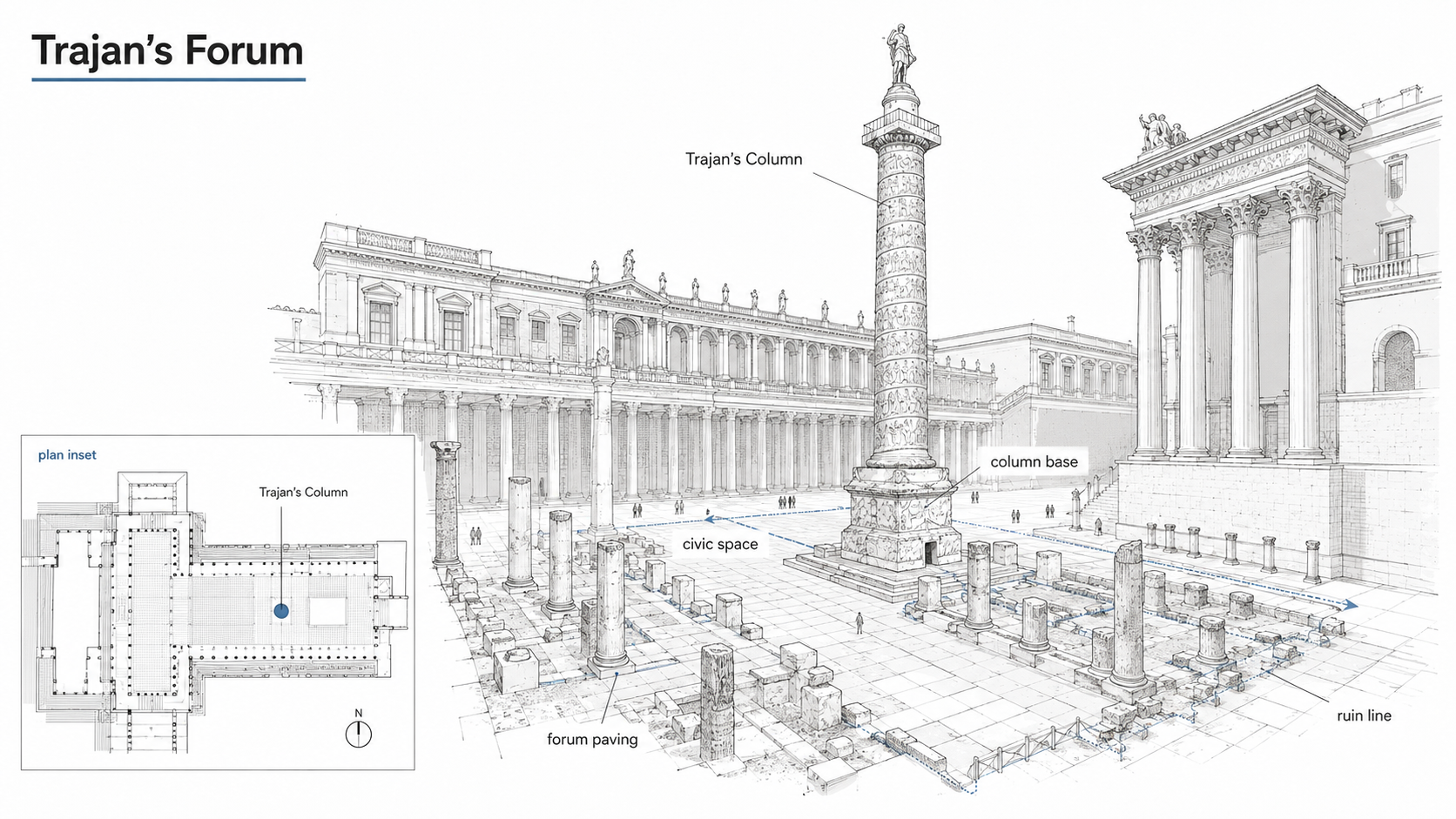
Trajan’s Column Was Part of a Larger Plan
Trajan’s Column is easy to read as one famous monument because it still stands.
But the column was only one part of the job. It sat inside Trajan’s Forum, with the Basilica Ulpia, libraries, markets, open courts, and public routes around it.
Rome was not placing a tall trophy in empty space. It was tying victory, records, movement, and civic power into one public setting.
For the wider Roman background, Ancient Roman Architecture and Roman Architecture and Engineering are the better companion pages. This article stays focused on Trajan’s Column and Forum as one connected design problem.

Quick Facts
| Feature | What To Know | Why It Matters Architecturally |
|---|---|---|
| Trajan’s Forum | Built in the early 2nd century CE as the last and largest of Rome’s Imperial Fora | It combined public space, law, libraries, markets, and political display in one urban complex. |
| Trajan’s Column | Completed in 113 CE | It joined monument, narrative relief, interior stair, burial chamber, and viewing platform. |
| Designer | Usually associated with Apollodorus of Damascus | The project shows the Roman habit of joining architecture, engineering, and public order. |
| Main material | Carrara marble for the column | The column depended on precise cutting, lifting, stacking, and alignment of large stone drums. |
| Main design idea | Victory, administration, memory, and public movement | The complex was a designed sequence, not a single isolated object. |
The Forum Was the Frame
The column makes less sense when it is separated from the forum.
Trajan’s Forum was a planned civic setting. It gathered public life, law, imperial image, reading rooms, commercial edges, and movement through one carefully controlled space. The column did not sit there as isolated decoration. It stood inside a system that helped people understand what they were looking at.
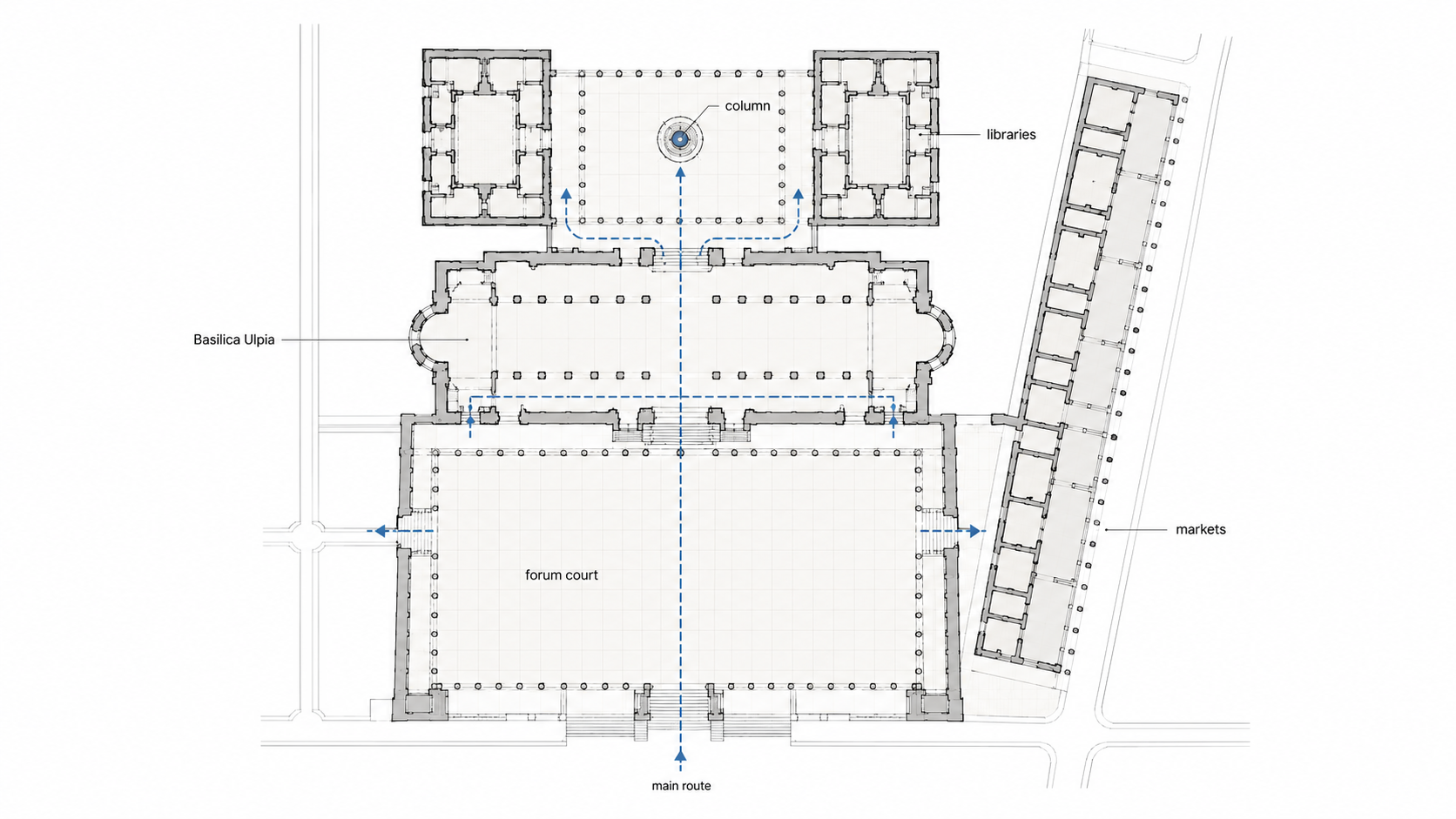
The forum court created the main public field. Basilica Ulpia formed the huge civic hall. Libraries framed knowledge and recordkeeping. The markets used levels, vaults, and terraces to handle trade and movement on a difficult urban site. The column stood near the center of that political and spatial story.
This is where Rome was different from a simple monument culture. Roman architecture often worked by linking parts: plaza, hall, route, arch, stair, market, inscription, sculpture, and infrastructure. One piece reinforced the next.
Trajan’s Column is famous because it survives, but the design intelligence was in the relationship between object and urban setting.
How the Forum Worked
Trajan’s Forum was organized public ground.
A visitor entered a controlled civic environment. Movement was directed. Views were framed. Large public rooms gave the state a physical presence. The surrounding architecture made the empire feel ordered, funded, and permanent.
Basilica Ulpia did much of the heavy lifting. It was a vast public hall used for legal and administrative business. Its rows of columns, long nave, apsidal ends, and scale gave public activity a formal setting. The building was useful, but it also made power visible.
The libraries added another layer. They were not only storage rooms for texts. They helped turn the forum into a place of record, learning, and imperial memory. The column between them gained force because the surrounding buildings already told visitors that this was a place of public record.
The Markets of Trajan worked differently. Their vaulted spaces and terraced levels show Roman skill with difficult sites. Rather than flattening the city into one plane, the design used levels. Shops, halls, passageways, and retaining structures became part of the urban solution.
The circulation is the part to watch. The complex moved people through open court, hall, library edge, column setting, and market levels without treating those pieces as separate attractions. The forum worked because movement, view, and function were coordinated. That is closer to urban design than monument placement.
Related reading: Roman Architecture Style is useful if you want the broader Roman vocabulary behind basilicas, forums, arches, and civic scale. For the city-planning side, use Urban Planning in Ancient Rome.
The Column Was Built as a Machine
The column looks like a carved stone scroll, but it is also a built machine.
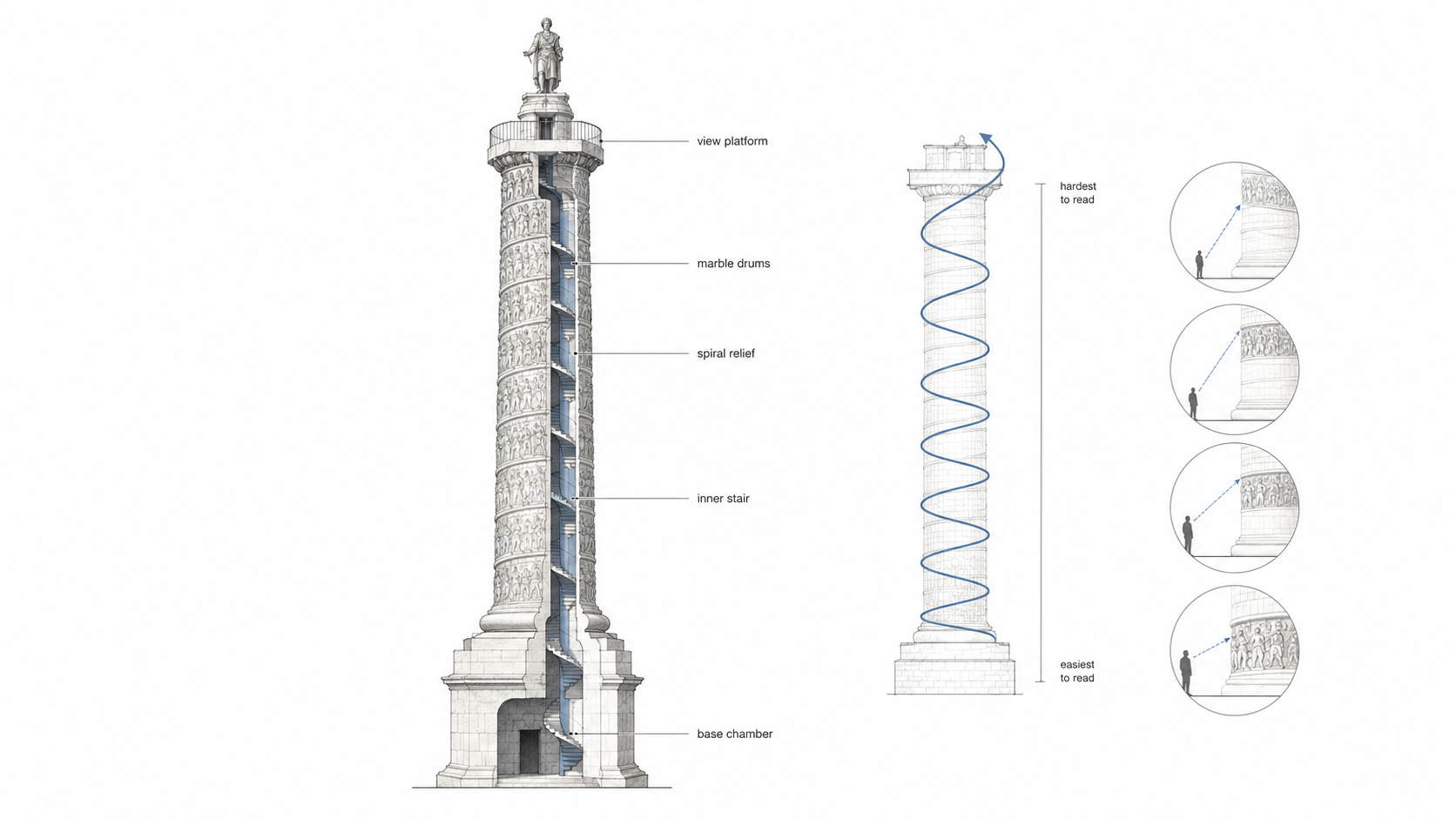
Its marble drums had to be quarried, transported, lifted, stacked, aligned, and carved with enough precision for the shaft to read as one continuous object. The spiral relief wraps upward around the surface. Inside, a narrow spiral stair climbs through the column to a viewing platform above.
That combination matters. Surface, mass, stair, chamber, and viewpoint were joined into one structure. The column was not a flat image enlarged into stone. It was architecture with an inside.
The base also mattered. It held the chamber associated with Trajan’s ashes and gave the shaft a physical and symbolic footing. A column this tall cannot begin weakly. The base had to hold weight, receive the narrative, and connect the monument to the forum floor.
That is why the column still feels different from later copies. It has height, sequence, internal movement, carved record, and civic placement.
The Relief Was a Route
The spiral relief is usually described as a story of the Dacian Wars. That is true, but too flat.
The carving works like a route. It moves around the column and rises as it goes. Scenes of soldiers, camps, crossings, speeches, battles, labor, equipment, and landscape are arranged into a continuous band. The viewer does not receive the whole story at once. The surface asks the eye to travel.
That gives the column a different kind of architectural value. It turns the surface into time. You stand still, but the story moves.
The relief also makes military power look organized. Roman soldiers are shown building, marching, crossing rivers, preparing camps, and following command. The message is not only victory. It is discipline, administration, and control.
That is a Roman idea in stone: power as order.
When the Story Is Too High to Read
This is the part that gets skipped.
Trajan’s Column is famous for its carved narrative, but much of the upper story is hard to read from the ground. The higher the relief climbs, the more the viewer loses detail. The work may be technically impressive and still difficult for a normal body standing in the forum to read clearly.
That does not make the design a failure. It makes the design more useful to study. The lower bands could be read more directly. The upper bands may have worked more as symbolic totality: the story continues beyond easy sight, wrapping the emperor’s victory around the shaft like proof that the record is larger than the viewer.
Modern memorials repeat this problem all the time. They put names, images, inscriptions, or story panels too high, too far away, too small, or outside a natural walking route. The designer thinks the story is present. The visitor cannot read it without stopping awkwardly, squinting, or walking away.
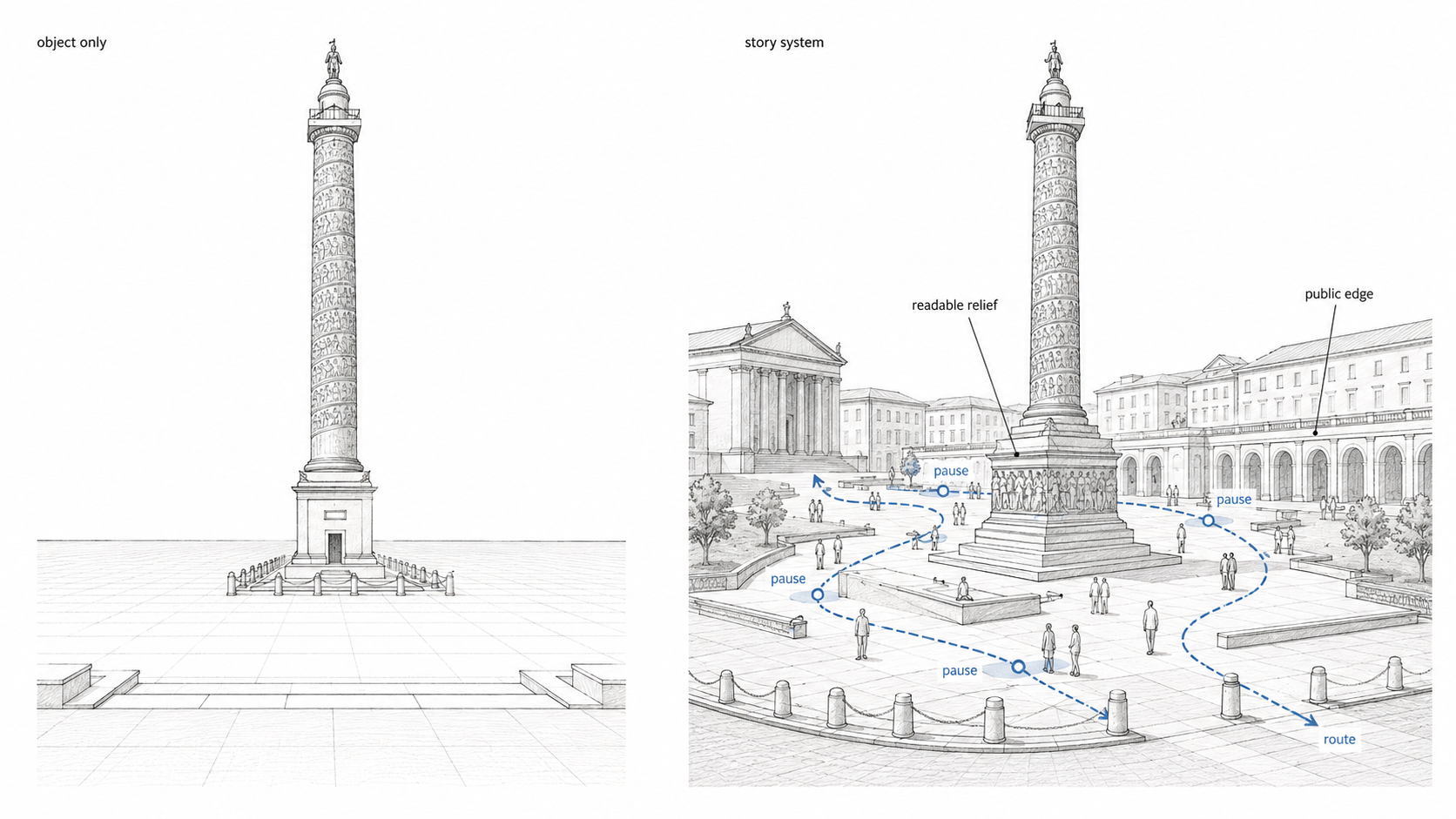
The lesson is practical. Narrative architecture needs distance, eye level, pace, and pause points. A story carved into a building is not useful only because it exists. It has to meet the human body where the body can read it.
Public Space Did the Rest
The forum helped solve the column’s legibility problem.
Visitors did not meet the column in a blank void. They approached through public space, civic buildings, and controlled views. The surrounding forum gave the column status before anyone studied the relief closely. The architecture prepared the viewer.
That is hard to achieve with a freestanding monument dropped into a traffic island or empty plaza. Without the frame, the object has to do all the work. Trajan’s Column did not work that way. The forum was part of the message.
This is one reason the project still matters for designers. A strong object can become weak if its setting does not support it. A modest object can become powerful if the approach, base, route, and surrounding edges are handled well.
Rome understood that sequence changes meaning.
Basilica, Libraries, Markets
The supporting buildings were not background decoration.
Basilica Ulpia gave the forum a huge civic room. The libraries gave the complex a recordkeeping and intellectual edge. The markets added commercial and logistical life. Together, they made the forum more than a commemorative site.
The mix matters because the project tied memory to use. People did not only arrive to admire the emperor’s victories. They moved through a working public district. Law, trade, reading, administration, and political display occupied the same urban field.
That is where the design becomes more useful than a simple Roman monument story. Trajan’s Forum shows how architecture can attach public memory to everyday civic function.
The best comparison is not another column. It is the Roman habit of making public buildings serve several jobs at once. Baths, basilicas, markets, amphitheaters, roads, and aqueducts all show the same broader instinct: architecture as public infrastructure.
What Later Monuments Copied
Later cities copied the column shape because the image was powerful.
A tall shaft, a strong base, a figure above, and carved or inscribed surfaces can turn memory into a public landmark. That is why commemorative columns appear again in later European capitals. The formula is easy to recognize.
But copying the shape is the easy part.
The harder part is copying the system. Trajan’s Column worked because it had a readable base, a narrative surface, an interior route, a forum setting, and a political reason for being there. A later monument can borrow the vertical form and still miss the architecture if the public space around it is weak.
That is the difference between a landmark and an object.
What Designers Should Take From It
Do not start with the column.
Start with the route. How does someone arrive? Where do they stop? What can they read at eye level? What happens from twenty feet away? What happens from across the square? Does the base invite attention or push people away? Is the story clear only in a drawing, or does it work on site?
Trajan’s Column and Forum are useful because they expose those questions.
| Design Move | What Rome Did | Modern Lesson |
|---|---|---|
| Set the object in a frame | The column stood inside a forum, not empty space. | The setting can carry part of the meaning. |
| Make the base work | The base grounded the column physically and symbolically. | A weak base makes even a tall monument feel unresolved. |
| Use sequence | The relief spiraled upward as a continuous story. | Narrative design needs a path, not only images. |
| Combine uses | The forum included civic, legal, intellectual, and commercial spaces. | Public architecture is stronger when memory and use support each other. |
| Respect viewing distance | Upper reliefs became harder to read from the ground. | Story elements must match human scale and eye level. |
Common Misreadings
The column is the whole project.
It is not. The forum changed how the column worked.
The relief is only decoration.
It was a narrative surface tied to imperial record and public memory.
The forum was only symbolic.
It also handled civic activity, movement, law, reading, commerce, and public assembly.
Later copies prove the design was simple.
They prove the opposite. The shape is easy to borrow. The full system is hard to repeat.
Books Worth Keeping Nearby
RESEARCH TOOL: Roman Architecture by Frank Sear
Dense but useful when you want the larger Roman building picture: forums, baths, aqueducts, villas, and public architecture explained as systems instead of loose ruins.
PRACTICE NOTE: Roman Building: Materials and Techniques by Jean-Pierre Adam
The better choice if you care about how Roman work was built: formwork, scaffolds, vaults, brick patterns, concrete, and the construction logic behind the monuments.
FAQ
What was Trajan’s Column built for?
It was built to commemorate Emperor Trajan’s victories in the Dacian Wars and to hold a carved narrative of those campaigns inside Trajan’s larger forum complex.
When was Trajan’s Column completed?
Trajan’s Column was completed in 113 CE.
Who designed Trajan’s Forum?
The project is usually associated with Apollodorus of Damascus, one of the most important architects and engineers connected with Trajan’s reign.
What makes Trajan’s Column unusual?
It combines a tall marble shaft, spiral relief, interior stair, base chamber, viewing platform, and political narrative in one built object.
Why was Trajan’s Forum important?
It was the largest of Rome’s Imperial Fora and joined public space, legal activity, libraries, markets, and imperial display in one major urban project.
Could people read the entire relief from the ground?
Not easily. The lower bands were more readable, while the upper bands became harder to see in detail. That viewing problem is one reason the column is useful to study as architecture, not only art history.
What can modern designers learn from Trajan’s Column?
That a monument needs more than a strong object. The route, base, viewing distance, story sequence, and surrounding public space decide whether people can read it.