

Theoretical Frameworks in Design: Architecture's Core Ideas Made Simple
What Are Theoretical Frameworks in Design?
In design—especially in architecture—a theoretical framework is like a mental blueprint. It guides how buildings are imagined, drawn, and built. It connects ideas from philosophy, culture, science, and art to real-life projects.
These frameworks shape everything from how space is used to what materials are chosen.
How Theory Shapes Architecture and Design Decisions
Theoretical Frameworks in Design: What They Are and Why They Matter
Key design theories like functionalism, semiotics, and sustainability. See how they guide architects and influence what gets built.
A clear guide to how theory meets practice in design—from classical ideas to modern approaches like parametric and eco-friendly architecture.
How Theory Shapes Architecture

Design Is More Than Just Looks
Understanding Design Theory: From Ideas to Real-World Buildings
Architecture can be about beauty to the general public, but more importantly, it’s about solving problems through space. Theory helps architects make informed choices that shape design decisions and spatial experiences.
So, theory helps architects make choices that:
- Fit how people live, work, and move
- Reflect local culture or climate
- Use materials wisely
- Improve function, not just form
What to Focus On (with Simple Examples)
1. Space Use
- A good floor plan improves comfort and flow.
- Example: Open-concept kitchens connect cooking with socializing.
2. Movement Through Space
- Layout guides how people travel within a building.
- Example: In airports, wide corridors and signage reduce confusion and crowding.
3. Purpose-Driven Design
- Every detail should support the building’s goal.
- Example: Libraries use quiet zones, light-filled reading areas, and acoustic design to help focus.
4. Climate and Context Matter
- Designs should respond to the local setting.
- Example: Homes in hot regions often have shaded courtyards or thick walls to reduce heat.
See Also: Critical Regionalism – Kenneth Frampton
Frampton’s idea of Critical Regionalism calls for architecture that blends modern techniques with local culture, climate, and materials—resisting global sameness without falling into nostalgic imitation.
Must Read
Architecture of Regionalism in the Age of Globalization: Peaks and Valleys in the Flat World 1st Edition by Liane Lefaivre
How Theory Shapes Better Design
Why we use frameworks—and how different types work together
In architecture and design, theory is a toolkit.
Designers use frameworks to think clearly, solve problems, and justify decisions. But not all frameworks do the same job. Some help you understand a space. Others help you predict what might happen, or recommend what should change.
That’s where the Four Types of Theoretical Frameworks come in:
-
Descriptive – What is happening?
-
Explanatory – Why is it happening?
-
Predictive – What will likely happen?
-
Prescriptive – What should we do about it?
These four types describe how a theory functions in practice. But they don’t tell you what kind of theory you’re using.
That’s where the Eight Common Theoretical Frameworks in Design fit in. These are the actual lenses—the content or ideology—you use inside those four framework types.
Let’s make this clear:
| Framework Type | Example Theory Used | How It Works in Practice |
|---|---|---|
| Descriptive | Functionalism | Studying how people move in a library to see if layout supports reading and flow. |
| Explanatory | Feminist Theory | Exploring why certain spaces exclude or inconvenience women. |
| Predictive | Ecological Design | Modeling how insulation choices reduce energy use in a passive house. |
| Prescriptive | Critical Theory, Postmodernism | Proposing inclusive design codes or questioning outdated civic design norms. |
So while the four framework types describe a theory’s purpose, the eight content frameworks describe the worldview or concept being applied.
Why this matters for designers and students
If you're in school—or practicing design—you’ll need to use both levels:
-
The framework type helps you organize your thinking.
-
The theoretical content helps you shape your ideas and values.
When combined, they give you the power to move from observation → to explanation → to prediction → to action. That’s what good architecture does.
Next, we’ll break down the four framework types and eight core theories—with real-world examples, simple language, and insights you can use right away.
Four Types of Theoretical Frameworks in Design

Designers and architects often rely on different types of frameworks to better understand problems, guide their decisions, and create solutions. Each framework serves a different role depending on the stage or goal of the project.
1. Descriptive Framework
- What it does: Outlines what’s currently happening or how things are structured.
- Purpose: Helps observe and document without offering explanations.
- Example: Recording how people naturally move through a public space to understand usage patterns.
- Use in architecture: Floor plan traffic studies or usage logs in shared buildings like airports and hospitals.
2. Explanatory Framework
- What it does: Explains why something occurs the way it does.
- Purpose: Helps uncover root causes or underlying factors.
- Example: Explaining why poor lighting in a corridor leads to low usage or discomfort.
- Use in architecture: Understanding how social or cultural behaviors influence space usage or design decisions.
3. Predictive Framework
- What it does: Forecasts what might happen under certain conditions.
- Purpose: Helps anticipate outcomes based on existing data or patterns.
- Example: Predicting how people might use a new park layout or public seating based on current usage trends.
- Use in architecture: Simulation models for crowd flow, energy use, or weather impact on buildings.
4. Prescriptive Framework
- What it does: Recommends what should be done to improve or solve an issue.
- Purpose: Provides actionable steps or best practices.
- Example: Suggesting layout changes to improve accessibility in a school or healthcare facility.
- Use in architecture: Design guidelines, zoning codes, LEED standards, or universal design principles.
So, what can we learn from all this? The most important takeaway for now is that these frameworks shouldn’t be treated as just academic subjects—they’re tools that help architects, designers, and planners make better decisions, solve real-world problems, and design with purpose.
If you're researching this for your architectural studies, don’t just learn it to pass your classes. If you want to become a better architect—the kind who truly makes a difference—then aim to understand the deeper meaning behind the theoretical examples we’ve explored.
Design Principles That Guide Great Architecture
Why Every Good Building Starts with a Solid Theory
4 Key Concepts Architects Use

Image: Showing four core architectural design ideas—functionality, form, context, and materiality—each illustrated with real-world buildings.
1. Symmetry: Calm, Balance, and Order
Symmetry creates harmony and visual stability. It’s often used in places meant to feel formal or spiritual.
- Why it matters: It gives clarity and focus. Humans naturally find symmetry pleasing.
- When to use it: In civic buildings, monuments, traditional homes, and cultural spaces.
- Famous example: Palace of Versailles (France) – Classical symmetry conveys power and control.
- Modern example: Foster + Partners’ Apple Stores – Clean, symmetrical layouts reflect brand clarity.
- Where to look: Government buildings, classical museums, and high-end showrooms.
2. Proportion: Sizing Things Just Right
Proportion is about the size relationships between parts of a design. When proportions are right, the space feels natural—even if you can’t explain why.
- Why it matters: It affects comfort and perception. Bad proportions make users feel uneasy.
- When to use it: Always—but especially in living spaces, furniture design, and facade layouts.
- Famous example: Villa Rotonda by Palladio – Perfect human-scale proportions based on Roman ideas.
- Modern example: Tadao Ando’s Church of the Light – Minimalist space built with ideal human-centered ratios.
- Where to look: Historic homes, luxury interiors, and minimalist modern architecture.
3. Function: Design That Works
Form should support use. A building must serve its users efficiently and clearly—this is the core of modern design thinking.
- Why it matters: It’s pointless to have a beautiful space that’s hard to use or move through.
- When to use it: Public buildings, workspaces, schools, and hospitals.
- Famous example: Villa Savoye by Le Corbusier – Function shaped the free plan, ribbon windows, and roof garden.
- Modern example: Seattle Central Library by OMA – Structure and layout mirror how people find and use books.
- Where to look: Libraries, airports, hospitals, well-designed public buildings.
4. Context: Building With Awareness
Context means responding to place—culture, climate, community, and site. A good building belongs to its surroundings.
- Why it matters: Ignoring context can make a design feel forced, disrespectful, or even unusable.
- When to use it: Especially important in heritage zones, rural areas, or environmentally sensitive sites.
- Famous example: Glenn Murcutt’s houses in Australia – Use local materials, raised floors, and passive cooling for the climate.
- Modern example: Gando Primary School by Diébédo Francis Kéré – Built with community input and local materials in Burkina Faso.
- Where to look: Regional projects, sustainable architecture, award-winning rural designs.
These four concepts shape real buildings you use every day. Next time you walk into a library, museum, or city square, try spotting one.
8 Common Theoretical Frameworks in Design
What they are, why they matter, and how to spot them in real life.
1. Functionalism
What it means: A design should work first—before it tries to impress.
Why it matters: It prioritizes use, comfort, and practicality.
Real-world example: A hospital layout that makes patient care fast and easy.
What to focus on: Efficiency, logic, and problem-solving through space and materials.
2. Structuralism
What it means: It’s not just about parts—it’s how everything fits together as a whole.
Why it matters: Small design details only make sense when they’re part of a bigger system.
Real-world example: Traditional Japanese homes, where every beam and sliding door connects to a cultural and spatial structure.
Focus on: Patterns, systems, and how users interact with the full environment.
3. Post-Structuralism
What it means: There’s no single truth in design. A space can mean different things to different people.
Why it matters: It allows for flexible, inclusive, and layered interpretation.
Real-world example: A public plaza that means peace to some, protest to others, and community to most.
Focus on: Openness, ambiguity, and how context shapes meaning.
4. Semiotics
What it means: Design is full of signs and symbols—learn to read them.
Why it matters: Everything from color choice to layout sends a message.
Real-world example: A red stop sign. Or luxury branding using minimalist black and gold.
Focus on: Visual language, metaphors, iconography.
5. Critical Theory
What it means: Design reflects power. Who benefits? Who gets left out?
Why it matters: It helps designers become aware of inequality and social impact.
Real-world example: Gated communities vs. accessible housing for all.
Focus on: Justice, access, voice, and power dynamics within spaces.
6. Feminist Theory
What it means: Gender matters in design—and it’s often overlooked.
Why it matters: Spaces shape experiences differently for women, men, and beyond.
Real-world example: Office buildings with no nursing rooms. Cities where lighting and transport ignore women's safety.
Focus on: Inclusivity, empathy, and questioning norms in layout and access.
7. Ecological Design
What it means: Design must work with nature—not against it.
Why it matters: Good design today can’t ignore climate or sustainability.
Real-world example: Passive houses that use insulation, sunlight, and airflow instead of mechanical cooling.
Focus on: Lifecycle, energy, resource use, and ecological balance.
8. Postmodernism
What it means: Rules are meant to be broken—play with style, irony, and history.
Why it matters: It brings personality, surprise, and critique into design.
Real-world example: The Piazza d’Italia in New Orleans—a public space that pokes fun at classical architecture.
Focus on: Juxtaposition, storytelling, contradictions, and cultural references.
These frameworks areelenses to help you see and shape the world differently. Good designers don’t stick to one—they blend, challenge, and reinvent these ideas based on context, user needs, and purpose.
Historical Influence of Design Theories

Image: Timeline infographic tracing key shifts in architectural design theory—from ancient Roman logic and Renaissance symmetry to Baroque drama, Bauhaus minimalism, and 19th-century revival styles—each with real-world examples and historic impact.
Ancient Design Rules
Ancient architects set the foundation for how we think about buildings today. Greek and Roman builders used geometry, repetition, and solid shapes to create a sense of order and clarity.
- Why it mattered: Design was based on logic, durability, and public function.
- Example: Roman aqueducts – Practical, elegant use of arches for water systems.
- Where to see it: Ruins in Rome, remains in southern France (Pont du Gard).
Renaissance Revival
Architects in the 1400s–1600s rediscovered symmetry and ideal proportions. This era focused on beauty through balance and mathematical design.
- Key name: Andrea Palladio
- What he did: Standardized villa designs with central symmetry and repetitive forms.
- Example: Villa Rotonda, Italy – Based on a perfect circle and square, designed for calm and proportion.
Baroque Style (1600s–1700s)
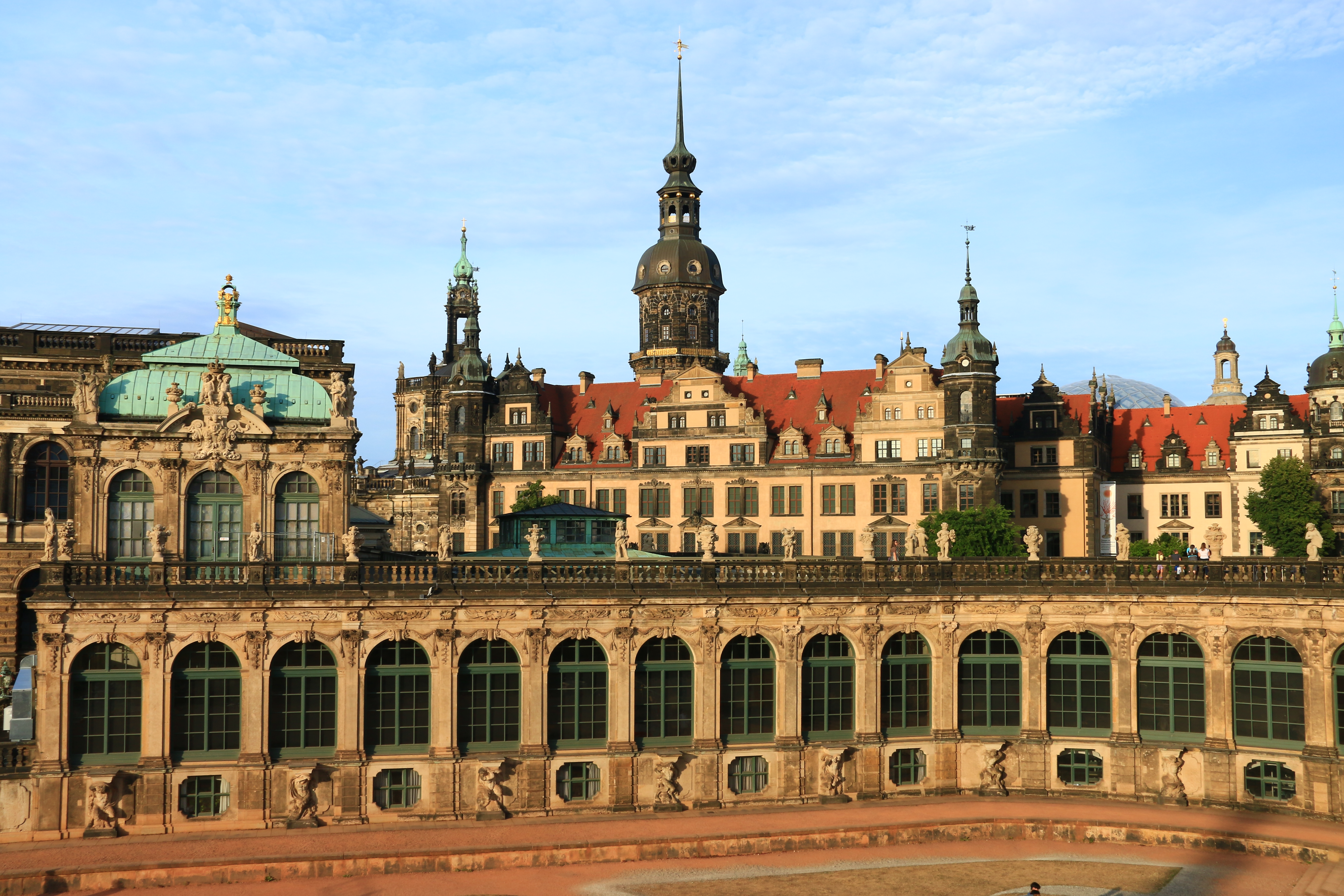
Image: Historic eastern perspective of Dresden's Zwinger Palace, showcasing Baroque architecture with ornate pavilions, sculptures, and landscaped courtyards.
Architecture turned dramatic. Baroque emphasized power and motion—curves, domes, and rich ornament.
- Why it mattered: Architecture became a tool for visual storytelling and emotional impact.
- Example: Zwinger Palace in Dresden, Germany – Arched galleries, statues, and theatrical scale.
- How it shaped theory: Encouraged exploration of movement, contrast, and light.
The Bauhaus Movement (1919–1933)
Born in Germany after WWI, Bauhaus design stripped buildings to their essentials—clean, functional, affordable.
- Why it mattered: It redefined architecture as a problem-solving tool, not just an art.
- Famous figure: Walter Gropius
- Example: Bauhaus School in Dessau – Modular layout, flat roof, no excess decoration.
- What we learned: Function and simplicity can be elegant.
19th-Century Revival Styles
In the 1800s, architects revived older styles to give buildings identity and emotion.
- Not just Gothic: Also included Neoclassical, Beaux-Arts, and even industrial reinterpretations.
- Example: St. Pancras Station, London – Gothic-inspired facade with a modern iron-and-glass train shed behind it.
- Why this matters: Revivals influenced public memory and showed how style could be symbolic.
These shifts shaped how we think about beauty, purpose, and meaning in the built environment—less about imitation, more about evolution.
Frameworks Behind Great Design
Architectural Thinking: Core Ideas That Shape the Built World
How Design Theory Shows Up Today

Image: Visual summary of three influential modern architectural theories—sustainable design with One Central Park, parametricism via Heydar Aliyev Center, and vernacular architecture in Burkina Faso—each shown with defining features and global relevance.
Building for the Planet: Sustainable Design
Modern architecture is increasingly driven by environmental concerns. Sustainable design focuses on reducing waste, using energy-efficient systems, and incorporating renewable materials.
- Why it matters: Reduces carbon footprint, supports long-term use, and adapts to climate needs.
- Key strategies: Green roofs, passive solar design, recycled or locally sourced materials.
- Example: One Central Park in Sydney – Covered in vertical gardens, solar panels, and mirror systems that redirect sunlight into shaded areas.
Designing with Code: Parametric Architecture
Parametric design uses algorithms and software to create complex, non-linear forms that would be nearly impossible to design by hand.
- Why it matters: Allows for innovation in both form and function; designs can be more adaptive and customized.
- Tools used: Grasshopper (for Rhino), Dynamo, Revit.
- Example: Heydar Aliyev Center in Baku, Azerbaijan by Zaha Hadid – Fluid curves and seamless transitions represent movement and modern identity.
Building with Roots: Vernacular Design
This design method uses traditional, location-specific materials and methods. It's less about style and more about connection—buildings that respond to their natural and cultural context.
- Why it matters: Respects the past, reduces environmental impact, and serves local needs.
- Common traits: Earth-based walls, thatch roofs, shaded courtyards, and natural ventilation.
- Example: Rural homes in Burkina Faso built using compressed earth blocks and wind tunnels to cool interiors.
Don’t mistake these modern theories for just abstract ideas—no, not at all. In fact, they directly shape how buildings function, feel, and fit into their surroundings today.
In Architectural Design: Theory Behind the Walls
Architecture goes beyond shelter—it shapes experience. Design theory helps architects balance innovation, meaning, and responsibility.
-
Modernism – Focuses on function, simplicity, and the honest use of new materials like steel and glass.
-
Postmodernism – Breaks the rules. Adds emotion, cultural references, and even irony to make buildings feel more personal or playful.
-
Sustainable Design – Prioritizes environmental impact. Encourages renewable materials, passive heating/cooling, and low energy use.
Key Design Decisions Shaped by Theory
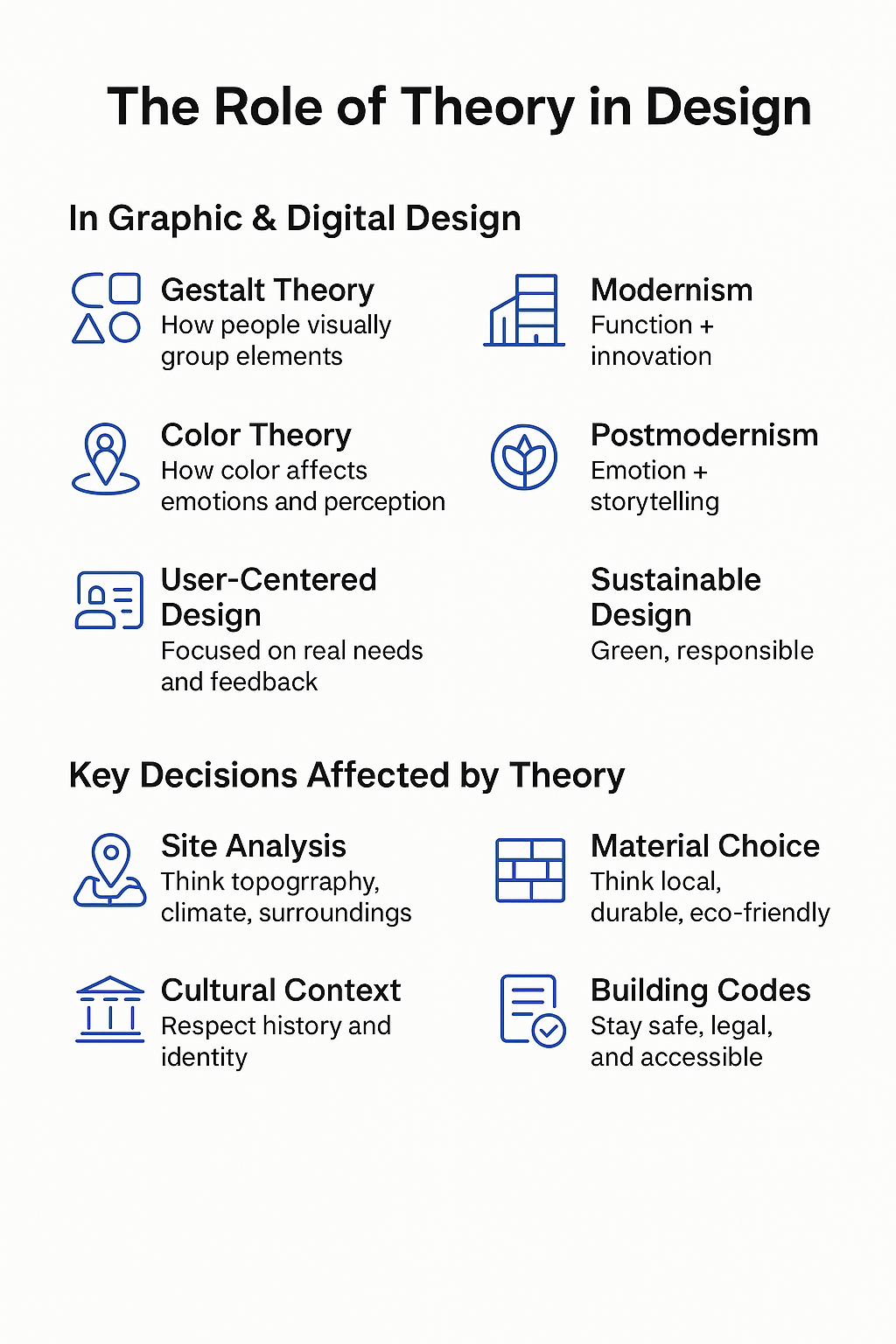
Whether digital or physical, theory affects real-world choices at every step of the process:
-
Site Analysis – Topography, sunlight, wind, views, and context all matter. Theory helps interpret how a space should respond to its environment.
-
Material Choice – Theory guides choices based on ethics, durability, and design goals. Use what’s local, lasting, and suited to the climate.
-
Cultural Context – Good design respects the people and stories connected to a place. Theory helps avoid design that feels generic or insensitive.
-
Building Codes – Legal frameworks grounded in safety, health, and equity. Theoretical awareness ensures compliance is not just a box-tick, but integrated meaningfully.
Design in Action: Real-World Examples That Show Theory at Work
What makes great buildings more than just structures? It’s the ideas behind them.

Image: Chronological layout of architecture history showing how major theories evolved into real projects like Bosco Verticale, The Edge, and Tate Modern.
These three projects show how architectural theory becomes lived experience. Each one represents a breakthrough—not just in form, but in how it thinks about people, place, and the future.
Critical Regionalism Architecture Examples
Bosco Verticale (Vertical Forest), Milan

Image: Bosco Verticale in Milan, a pair of residential skyscrapers designed to host thousands of plants and trees as part of an urban forest concept.
Architects: Stefano Boeri Architetti
Completed: 2014
Theory in Action: Ecological Design, Sustainable Urbanism
-
What’s special: Two residential towers—each covered in over 20,000 trees and plants—create a literal forest in the sky.
-
What it solves: Urban air pollution, biodiversity loss, and the disconnect between nature and city life.
-
Experience: Residents live in private garden balconies that change with the seasons. From the street, the towers feel alive.
-
Behind the idea: The architects didn’t just want to reduce environmental impact—they wanted to restore ecosystems inside cities.
-
What to learn: Designing with nature doesn’t mean sacrificing density or beauty. Learn how microclimates, plant-soil systems, and wind load simulations can shape entire buildings.
-
Focus on: Structure-plant integration, maintenance strategy, irrigation systems, and long-term urban resilience.
The Edge, Amsterdam

Image: The Edge in Amsterdam, known as one of the world’s smartest and greenest office buildings, showcases predictive and sustainable design frameworks in modern architecture.
Architects: PLP Architecture
Completed: 2015
Theory in Action: User-Centered Design, Smart Technology, Sustainability
-
What’s special: Called “the smartest building in the world,” The Edge uses data to personalize workspaces, lighting, and energy use.
-
What it solves: Office inefficiency, energy waste, and employee disengagement.
-
Experience: Workers book desks via app, lights adjust to their preferences, and everything from temperature to meeting room usage is optimized in real time.
-
Behind the idea: The building isn't static—it's adaptive. A workplace shaped by sensors, AI, and human behavior.
-
What to learn: Architecture is now part of the digital ecosystem. Learn how IoT (Internet of Things), data privacy, and behavior modeling influence design.
-
Focus on: Systems thinking, energy dashboards, workplace wellbeing, and post-occupancy feedback loops.
Tate Modern, London

Image: Aerial view of Tate Modern in London, a former power station transformed into a major contemporary art gallery, reflecting adaptive reuse theory in architecture.
Architects: Herzog & de Meuron
Conversion Completed: 2000 (with expansion in 2016)
Theory in Action: Adaptive Reuse, Postmodernism, Cultural Sustainability
-
What’s special: A former power station transformed into one of the world’s most visited museums of modern art.
-
What it solves: Wasteful demolition, lack of large-scale cultural space, and disconnection from industrial heritage.
-
Experience: Visitors move through massive turbine halls, now filled with art. The building feels both raw and curated—powerful yet inviting.
-
Behind the idea: The architects preserved the soul of the structure—retaining its original scale and materials—but gave it new meaning.
-
What to learn: Old buildings hold untapped potential. Reuse can be more powerful than reinvention.
-
Focus on: Historic layering, public engagement, material honesty, and emotional storytelling through architecture.
Takeaway
These buildings don’t follow trends—they follow purpose. They were designed to solve problems, express values, and create better ways of living and working.
If you're studying design, don’t just look at what these buildings are—ask why they exist, how they were shaped by context, and what theories helped them break new ground.
FAQ: Theoretical Frameworks in Design
What are the 8 most common theoretical frameworks in design?
These guide how designers think and work:
- Functionalism – Design should be useful and efficient.
- Structuralism – Understand how parts relate to the whole.
- Post-structuralism – Questions fixed meanings and encourages flexible design.
- Semiotics – Studies how signs and visuals communicate meaning.
- Critical Theory – Looks at social and power structures in design.
- Feminist Theory – Focuses on gender equity and inclusive design.
- Ecological Design – Encourages harmony with the environment.
- Postmodernism – Blends multiple styles, symbols, and historical references.
What are examples of theoretical frameworks in design?
- Architecture: Bauhaus (function), Le Corbusier’s Five Points (modernism)
- Graphic Design: Gestalt theory, semiotics, color theory
- Interior Design: User-centered design, cultural symbolism
What are the 4 types of theoretical frameworks?
- Descriptive – Explains what’s happening
- Explanatory – Explains why it’s happening
- Predictive – Forecasts outcomes
- Prescriptive – Recommends solutions
What frameworks guide architectural design?
- Functionalism – Design matches purpose
- Modernism – Clean lines, rational layout
- Postmodernism – Emotion, storytelling, style mixing
- Sustainability – Energy, material, and site-conscious
How does site analysis affect design?
- Helps align building orientation, massing, and layout with:
- Sun path
- Wind direction
- Views and topography
- Local culture and zoning laws
What influences material choices in architecture?
- Durability and lifespan
- Cost and availability
- Environmental impact
- Cultural relevance
Why is cultural context important?
- Reflects community identity
- Connects with tradition or symbolism
- Prevents cultural mismatch or erasure
What’s the role of building codes?
- Ensures:
- Structural safety
- Fire protection
- Accessibility (e.g. ramps, elevators)
- Public health (ventilation, plumbing)
How does design support sustainability?
- Passive solar design
- Renewable energy use
- Water management systems
- Recycled and local materials
What are ethical responsibilities of architects?
- Be fair, transparent, and responsible
- Serve community interests
- Avoid harming the environment or cultural heritage
How can architecture address urbanization?
- Design for density
- Support transit and walkability
- Include mixed-use buildings
- Use adaptive reuse to save resources
What is semiotics in graphic design?
- Using symbols, icons, and signs to communicate ideas visually.
How does Gestalt theory shape design?
- Helps organize layout so viewers see a whole message, not just parts.
Why does color theory matter in branding?
- Color affects mood and perception—red excites, blue calms, green suggests eco-friendly.
What is user-centered design?
- Focuses on testing, feedback, and user needs to make better experiences.
What’s the value of a prescriptive framework?
- Gives a proven path to follow when solving a design problem.
Why is typography important?
- Shapes how messages are read, felt, and understood.
What makes a layout effective?
- Clear hierarchy
- Good white space
- Balanced alignment
How does design influence buying?
- Good visuals create trust, clarify value, and trigger emotion.
Extra:
In Graphic & Digital Design: How Theory Shapes What We See
Design isn’t just decoration—it’s communication. In graphic and digital design, theory helps guide decisions about layout, emotion, interaction, and usability.
-
Gestalt Theory – Explains how people naturally group shapes, lines, and spaces. Helps with logo design, spacing, and visual hierarchy.
-
Color Theory – Shows how color choices affect mood, attention, and branding. Warm tones may invite; cool tones may calm.
-
User-Centered Design – Puts the user first. Every interface decision is tested and refined based on feedback, behavior, and accessibility.
-
Typography & Layout – Affects readability, tone, and impact. Good type hierarchy and clean spacing help users focus and trust the design.
Related: Want to Explore More?
Architecture Theory & History
-
Architectural Theory for Beginners: How Ideas Shape Space
A simple intro to how architectural concepts influence the spaces we build. -
Critical Regionalism in Architecture | Definition, Key Features, and Examples
Explore how architecture can reflect local culture, climate, and identity. -
The Four Essential Design Frameworks: Descriptive, Explanatory, Predictive, Prescriptive
A quick breakdown of four thinking tools architects use to design smarter. -
Architectural History and Theory
A broad overview of key ideas and moments that shaped architectural thinking.
Architecture, Design Theory & Human-Centered Thinking
-
Human Values and Environmental Studies
Looks at how ethics, sustainability, and environment intersect in design. -
Human-Centered Design and Architecture
Explores design that prioritizes people’s needs, comfort, and experience. -
The Role of Humans in the AI Era: Architecture and Design Perspective
Reflects on how human creativity and judgment remain essential in a tech-driven design world. -
Parametric Brick Facade: A Collaboration Between Human Hands and AI Minds
A real-world example of blending human skill with AI to create expressive architecture.
Color & Interior Design
-
Color Theory
The basics of how color works and how designers use it effectively. -
Color Theory and Application in Interior Design
Learn how color choices shape mood and function in interior spaces. -
Color Harmony Theory: A Practical Guide
A hands-on guide to creating pleasing color combinations in design work.
See Also: Critical Regionalism – Kenneth Frampton
Frampton’s idea of Critical Regionalism calls for architecture that blends modern techniques with local culture, climate, and materials—resisting global sameness without falling into nostalgic imitation.