

Süleymaniye Mosque: When Sinan Didn’t Miss
Sinan at His Sharpest
Built in the 1500s. Burned. Quaked. Rebuilt. The Süleymaniye Mosque is still here; and it’s worth understanding why.
This Mosque Shouldn’t Still Exist—But It Does
The Süleymaniye Mosque was a power move.
Süleyman the Magnificent wanted to make Istanbul the center of the Islamic world. So he called in his most trusted mind: Mimar Sinan.
And what they built still stands.
Not because it’s flashy. Not because it’s sacred.
But because it was built right—with strategy, vision, and structure that made sense.
This mosque went through fire, earthquakes, and war. Parts collapsed. Designs got erased.
But it always came back.
Why?
Because Sinan didn’t just design a monument. He designed a system.
📘 MUST READ
Ottoman Architecture – Godfrey Goodwin
A wide-angle view of how Ottoman architecture worked—what changed under different sultans, how civic spaces evolved, and how religion, trade, and geography affected design decisions.
→ Buy on Amazon »
The Project
Sinan’s Most Controlled Work

Süleymaniye Mosque: What It Shows About the Ottoman Mindset
Süleymaniye Mosque Time Period
The Süleymaniye Mosque was built between 1550 and 1557, during the classical Ottoman period under Sultan Süleyman the Magnificent.
This was the peak of the empire: military power, political control, and architecture all working at full scale. It was also the height of Mimar Sinan’s career, when Ottoman architecture became highly structured, balanced, and engineered for permanence.
Key dates:
-
Construction start: 1550
-
Completion: 1557 (some sources say 1558 for final touches)
-
Empire status: Dominant. Expanding. Stable.
-
Architectural style: High Classical Ottoman
This was the same era when Sinan also built the Şehzade Mosque and began preparing for his later masterpiece, Selimiye.
Who Was Süleyman?
Tenth sultan of the Ottoman Empire. Ruled from 1520 to 1566—longer than anyone else.
He wasn’t just a ruler. He fought wars, rewrote laws, wrote poetry, and pushed architecture like it was strategy.
He wanted Istanbul to lead the Islamic world—not just spiritually, but physically.
That’s why he kept turning to one man: Mimar Sinan.
Who Was Mimar Sinan?
Engineer. Builder. Military mind. Designer of over 300+ structures across the empire.
Held the title of chief royal architect for 50 years.
Served three sultans, but Süleyman was his most important client.
You can trace Sinan’s influence from schools to mosques to palaces, and even through the work of the next generation.
He trained Sedefkar Mehmed Agha, who later designed the Sultan Ahmed Mosque (Blue Mosque).
Related: Islamic Architecture: Connecting History, Styles, and Global Impact
Design Breakdown
The Style
A sharp mix of Byzantine scale and Ottoman function.
Borrowed dome logic from Hagia Sophia—but made it cleaner, lighter, and more structurally honest.
The Courtyard

IMAGE: An aerial view of the Süleymaniye Mosque in Istanbul, highlighting its symmetrical domed courtyard, cascading roofline, and grand central dome.
It’s big. Like, really big.
Four minarets = imperial funding.
Ten balconies = Süleyman was the 10th sultan.
Everything means something.
Columns made from granite, marble, and porphyry. You won’t find throwaway materials here.
The Dome
53 meters tall. At the time, the tallest dome in the empire.
Surrounded by semi-domes and arches, supported by buttresses hidden inside the walls.
Sinan’s trick? Make the support invisible. Let the space breathe.
The Interior
Surprisingly quiet.
Iznik tilework and Mother of Pearl inlays exist, but they don’t overpower the space.
Even the minbar is calm—softly decorated, not loud.
Sinan didn’t need flash. He needed balance.
Related: Courtyards “Sahn” in Islamic Architecture
What Else Was Built With It
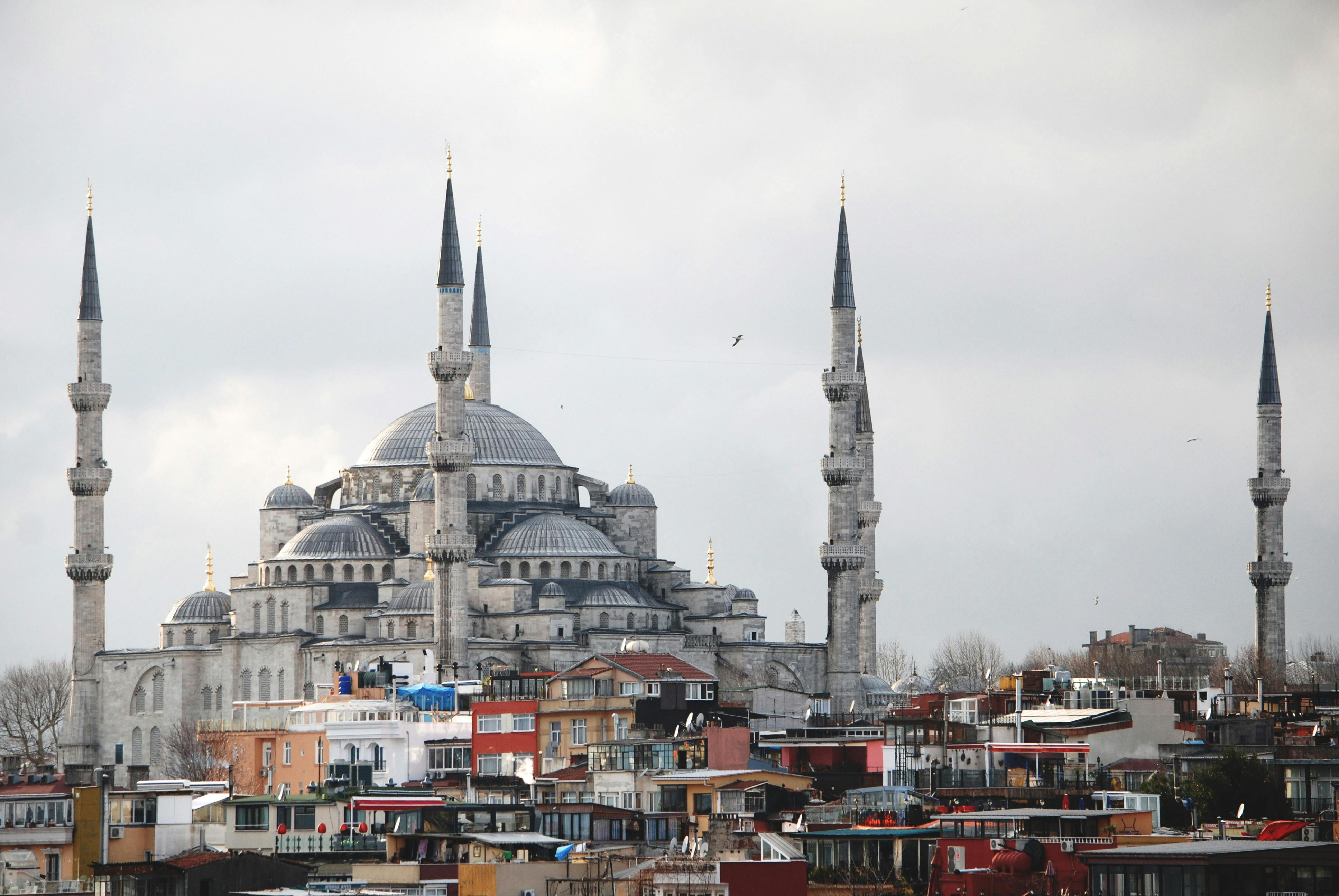
This wasn’t just a mosque. It was a full complex:
-
A hospital
-
A public kitchen
-
A school
-
A medical college
-
Qur’an schools
-
Public baths
-
A place for travelers to rest
-
Mausoleums for Süleyman, his family, and later… Sinan himself
This was a city within a city.
And most of it is still there.
Related: Characteristics of Islamic Architecture
What Damaged It
1660: Fire
1766: Earthquake
1914–18: Another fire
Every time, it came back.
Some details were lost. Some were changed. But the structure held.
It was restored again in 1956, and now it’s one of the few surviving Ottoman projects that still functions—and still feels grounded.
Interior Breakdown: What Makes This Space Work
(and Why It’s Not Flashy)

The Süleymaniye interior isn’t a showpiece. It’s a system.
It looks simple—almost plain. But that’s the point. Sinan wasn’t chasing decoration.
He was chasing clarity, proportion, and usefulness.
Proportions First
-
The prayer hall is a perfected rectangle: 59 meters long × 58 meters wide.
-
Main dome sits 53 meters high, with smaller domes cascading outward to stabilize it.
-
Columns, arches, windows, and domes are all set on modular spacing that reduces stress and creates visual balance.
What to learn: You don’t need more ornament—you need tighter geometry. If your volumes don’t feel right, fix the grid.
Light & Air Do the Heavy Lifting
-
249 windows—layered at multiple levels—pull in daylight from every angle.
-
Light doesn’t just illuminate—it guides movement, marks time, and highlights transitions.
-
The dome’s high windows make the interior feel light, not compressed.
-
Passive airflow cools the space and carries smoke up and out.
Design note: No chandeliers needed. Daylight was the plan all along. Light creates experience—if you design it that way.
Acoustics by Design
-
Sound in the hall travels cleanly, with no dead spots or harsh echoes.
-
Materials like polished stone and lime plaster were chosen for acoustic softness, not just finish.
-
Domes reflect sound downward. Piers absorb it laterally. No tech. Just form.
Architect tip: If your space echoes, it’s not magic—it’s math and material. Sinan knew both.
Decoration That Doesn't Distract
-
The mihrab (prayer niche) is elegant, carved marble—not overloaded.
-
The minbar (pulpit) is made of marble inlaid with mother of pearl and ivory—but it's quiet.
-
Iznik tiles are used sparingly—only around key focal points.
-
No gold overload. No overcrowding. Just balance.
Lesson: Decoration isn’t the point. It’s the punctuation. Sinan used craft only where it clarified space or meaning.
Program & Spatial Use
-
No unnecessary space. Every side chamber leads to something useful.
-
The galleries give vertical relief without stealing attention.
-
Prayer hall stays focused—no clutter, no offshoots.
-
Surrounding buildings (madrasa, hospital, kitchen) were separate. The mosque stays calm.
Design takeaway: Don’t try to cram everything into one building. Separate functions. Keep the sacred clean.
Why It Feels So Right
People walk in and don’t know why it feels good.
But here’s the truth: it’s the math, the air, and the restraint.
Sinan didn’t try to impress—he tried to last.
And he did.
Related: Islamic Architecture in Egypt: Mosques, Minarets, and Madrasas
GRID IN MOTION
What the Suleymaniye Ceiling Gets Right

IMAGE: Ornate dome interior of the Süleymaniye Mosque in Istanbul, showcasing detailed Islamic geometric patterns, Arabic calligraphy, and harmonious symmetry in Ottoman design.
The ceiling of the Suleymaniye Mosque in Istanbul is about faith, yes—but it’s also a masterclass in geometry done at scale. Look past the context. What matters is the layout logic: radial symmetry, layered rosettes, and balance across a massive surface. It’s one of the cleanest examples of pattern used to control space from a vertical axis.
Why It Works Structurally
● Radial Grid, Not Flat Tiling
The dome isn’t covered in repeating floor tiles. It’s structured on concentric circles that divide space like a compass—outward, not linear. That layout keeps the eye moving toward the center without losing symmetry.
● Pattern Mirrors Form
The pattern doesn’t fight the structure. It follows the shape of the dome—round form, round grid. That’s why it feels seamless, not forced.
● Controlled Density
No overload. The center holds the most complexity (starburst rosette). Outer rings use simpler motifs and repeat evenly. This creates tension and release—key to good pattern hierarchy.
Modern Use Tip:
Want this look in a modern space? Use radial ceiling tiles, acoustic domes, or light wells with layered patterns. The key is matching the pattern’s logic to the shape of the surface. Don’t slap square grids on round ceilings.
MUST READ
Symmetries of Islamic Geometric Patterns: Radial, Grid, and Repeating Systems
Breaks down complex ceilings like Suleymaniye into real layouts. No metaphors—just grids, ratios, and build logic.
→ Add to cart now if you want to reuse these systems in real design work.
🔗 [Check Price on Amazon]
Technical & Construction Breakdown: What to Actually Focus On
This mosque wasn’t just designed—it was engineered. Sinan didn’t guess. He calculated, tested, adjusted, and controlled every part of it. If you’re studying architecture or construction, this is where your eyes should go.
1. Site Planning & Orientation
-
Built on Istanbul’s Third Hill—intentionally elevated. Not just for the view. It set the visual hierarchy of the entire city.
-
North–south axis alignment aligns with both Mecca direction and Ottoman imperial visibility.
-
Lesson: Choose topography with purpose. Architecture isn’t just in the building—it’s the relationship between the building and everything around it.
2. Foundation Strategy
-
This was a seismic zone. Sinan built flexible foundations that could absorb quake shock.
-
Deep foundations with layers of stone and mortar.
-
Lesson: Start from the ground up. If the base fails, nothing above matters. Don’t just think about gravity—think about time, water, and movement.
3. Structural System
-
Central dome system with semi-domes and exedrae (supporting half-domes) off to the sides.
-
Buttresses were integrated into walls—not exposed. Hidden strength.
-
Piers carry the dome’s load and channel it downward, not outward.
-
Lesson: Master load path logic. Sinan’s domes didn’t rely on over-design—they relied on efficiency.
4. Material Use & Load Distribution
-
Mixed stone types: marble for aesthetics, limestone for weight-bearing, porphyry for detail.
-
Sinan reused material from older Roman/Byzantine structures—cheaper, proven, local.
-
Lesson: Don’t overdesign with one material. Use the right material in the right place. Know your local supply chain.
5. Dome Engineering
-
Main dome is 53 meters tall. That’s serious vertical load.
-
Supported by four massive piers and transitioned through pendentives.
-
Flanked by semi-domes to distribute lateral thrust.
-
Dome shell is double-layered—a thermal and structural technique.
-
Lesson: Dome design is about pressure balancing. Get the thrust path right or it cracks.
6. Buttressing Logic
-
Sinan’s signature move: hide the mass.
-
Buttresses are absorbed into interior walls, then visually softened with arcades and galleries.
-
Still doing their job—just not screaming it.
-
Lesson: Structural honesty doesn’t mean you have to expose everything. There’s beauty in control.
7. Acoustics
-
Vast internal space with centralized geometry allows sound to carry without echo.
-
Strategic use of materials (plaster, stone, wood) that absorb or reflect at key zones.
-
High ceiling = vertical dispersal of sound energy.
-
Lesson: Form = function, especially in sacred/public spaces. Sound shapes space as much as light.
8. Ventilation & Soot Control
-
249 windows provide cross-ventilation.
-
Airflow was designed to channel soot particles to a special chamber, where it was collected and used as ink for calligraphy.
-
Lesson: Passive systems can do more than just cool. They can reduce maintenance, extend lifespan, and even feed other systems.
9. Lighting Strategy
-
Light enters from layered window heights—high dome windows, mid-level wall cutouts, and courtyard reflections.
-
Daylight changes with time and season, giving a living spatial experience.
-
Lesson: Use daylight intentionally. Don’t just light the space—shape the experience with contrast, shadow, and brightness zones.
10. Material Detailing
-
Joints are precise. Columns fit tight. Domes align clean. No filler work.
-
Iznik tiles used sparingly. Craft over clutter.
-
Copper, marble, mother-of-pearl, ivory—used only where it supports structure or hierarchy.
-
Lesson: Finish matters. Don’t decorate to hide bad construction. Make the construction so clean you don’t need to cover it.
11. Water Management
-
Sloped courtyards. Stone drainage systems.
-
Roof runoff managed through hidden channels and gutters, leading away from foundations.
-
Baths and kitchens had their own greywater systems.
-
Lesson: Think drainage from Day 1. Water ruins more buildings than earthquakes.
12. Durability & Redundancy
-
The structure was made to fail gracefully. If a quake hits, domes crack in controlled spots.
-
Courtyard stones are replaceable slabs.
-
Multi-tiered systems for energy dissipation—not single failure points.
-
Lesson: Redundancy isn’t waste—it’s protection.
Takeaway for Architects
-
Sinan didn’t waste space. He didn’t over-decorate. He didn’t copy.
-
He calculated airflow, daylight, structure, material sourcing, and life span.
-
This is what architectural control looks like: every decision backed by logic, site, and system.
You want to learn how to design something that works and lasts?
Forget the dome shape. Study the decisions behind it.
Related: Islamic Cairo Architecture: What Still Stands and Why
What Everyone Misses About This Mosque

People show up, stare at the dome, take photos, and leave.
What they miss is that this whole thing was designed like a warning.
Sinan didn’t build it for peace.
He built it to prove that the Ottoman Empire could still do something perfectly planned, fully controlled, and impossible to copy.
What To Learn From It
- Scale doesn’t need to shout. Sinan knew how to use space, not just fill it.
- Symbolism can be structural. Minarets and balconies weren't just aesthetic. They told you something.
- Resilience is designed, not luck. It’s still here because it was built to breathe, flex, and last.
- Surrounding structures matter. Mosques weren’t islands. They were ecosystems.
Every minaret, every gallery, every shadow was intentional.
It was the sultan saying:
“We own this hill. We own this city. We own this view.”
And Sinan made sure that message never needed to be said out loud.
Related: Arches in Islamic Architecture: History, Design, and Global Influence
What to Steal From Süleymaniye: Designing Under Pressure
Sinan didn’t get infinite time, infinite money, or a blank canvas.
He had to build fast. In a political capital. Under constant scrutiny. With a client who thought like a general.
So here’s what you can actually learn from this project—if you're designing today.
1. Client Control = Strategic Design
Süleyman was the 10th sultan. He wanted everyone to know it.
Sinan delivered a mosque with ten minaret balconies and a dome that out-scaled the Hagia Sophia.
But here’s the move: he didn’t make it obvious. He coded the message into the form.
If your client has an agenda—find a structural way to express it.
Don’t plaster it in text. Build it into how the space feels and moves.
2. Design for Repair, Not Perfection
This place burned. It shook. It cracked.
And yet—it held.
Sinan built in redundancy, modularity, and controlled failure points.
The structure was ready to lose parts without collapsing.
If your project lives in the real world—make sure it can take hits.
Build to fix, not to worship.
3. Use Site Constraints as Leverage
That Third Hill was uneven, exposed, and complex.
Sinan used it to elevate the courtyard, hide the shops, and give the mosque a skyline crown.
Got a weird site? Use the weird.
Make the topography work for hierarchy, light, and drainage.
4. Let Performance Lead Aesthetics
The Süleymaniye sounds clean because Sinan tested plaster types.
It ventilates naturally because he studied airflow, not just decoration.
Even soot became useful ink through design.
- The Süleymaniye Mosque sits in Istanbul. Still the largest mosque in the city.
- Süleyman the Magnificent commissioned it in 1550.
- Sinan finished it in 1558—eight years of planning, testing, building, and revising.
Let the function do the talking. Make the space work first. Beauty follows.
Walking Tour: Study the Complex on Foot Like an Architect
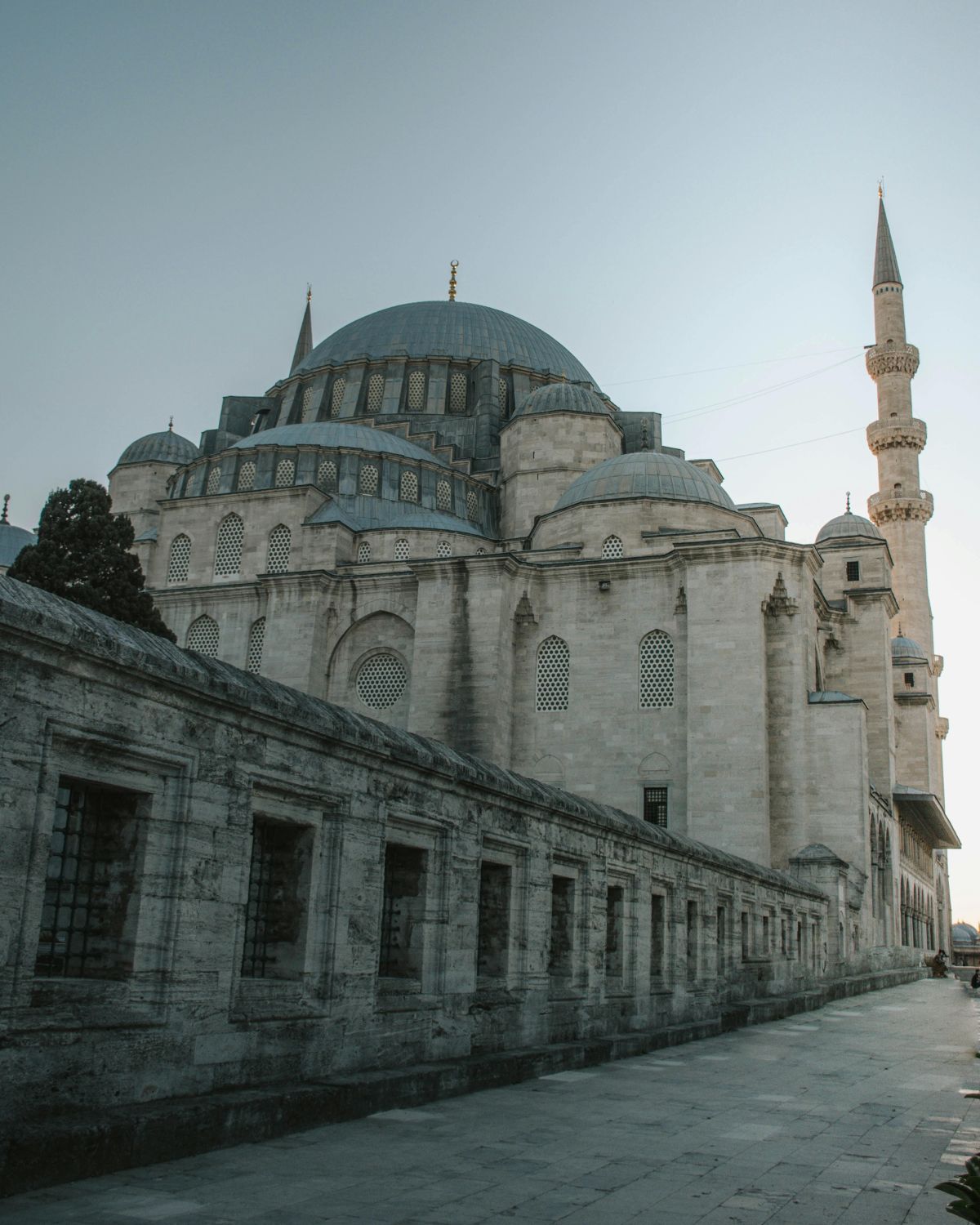
Here’s how to map out a walking route—designed to reveal spatial logic, structural transitions, and historical layers. Going on foot lets you see alignment, feel scale, and connect spaces as Sinan intended.
Tour Route (about 1.5 km total)
-
Start at the south plaza below the mosque
— View the hillside substructure: shops built into vaults used to level the slope. Then walk up through the courtyard steps to feel how the ground lifts the complex. -
Enter the courtyard at the west gate
— Study the stone columns (marble, granite, porphyry). These aren’t random—they bear visual and structural weight. Count the window rhythms aligned with piers. -
Move into the main hall
— Stand under the dome center. Look up at hidden buttresses. Identify weight flows from arches to piers and then downward. -
Exit east towards the mausoleums
— See how the imperial cemetery aligns perfecly with the mosque’s Qibla wall. Understand orientation as extension of axis. -
Walk to Sinan’s tomb (a short downhill stroll)
— Notice how it’s tucked into the triangular plot—humble, yet structurally connected. -
Loop back through the hamam and imaret
— These ancillary buildings expand the mosque’s program. You’ll see connections between function zones (hospitals, schools, baths) laid out like urban rooms.
Why On Foot:
-
Scale and human interaction: Measuring steps lets you feel how dome height relates to courtyard scale. The tactile sensation reveals Sinan’s intentional proportions.
-
Material transitions: Walking lets you run your hand over reused columns, carved capitals, and marble joints—notice when materials shift at structural nodes.
-
Visual axes clarity: From plaza to dome, from dome to cemetery axis, each step reinforces orientation and hierarchy.
-
Program adjacency: Circulating around shows how imaret, hamam, madrasa, and mosque feed into each other—an urban ecosystem brought down to human paths.
This walking route and design secrets will let you study the Süleymaniye Mosque like an architect, not a tourist.
FAQ
-
Who designed the Süleymaniye Mosque?
Mimar Sinan, the chief imperial architect under Sultan Süleyman. He built over 300 major structures. -
When was it built?
Construction started in 1550 and finished around 1557–58. -
How long did construction take?
Roughly 7 to 8 years from start to full completion. -
Why is it named after Süleyman?
He commissioned it and ruled longer than any other Ottoman sultan. It was his personal project. -
What makes it architecturally significant?
It merged Ottoman clarity with Byzantine scale. It wasn’t just decorative—it was structurally smart and politically sharp. -
How tall is the main dome?
About 53 meters tall. One of the highest domes in the empire at the time. -
Why does it have four minarets?
That was the rule for imperial mosques. Four minarets = mosque built by a sultan. -
What does ten balconies on the minarets mean?
It marks Süleyman’s place in the line—he was the 10th sultan. -
How did it survive damage over time?
It was hit by fire, earthquakes, and war, but rebuilt every time using solid foundations and smart design. -
Who funded it?
Süleyman himself. It was his legacy move. -
What else did Mimar Sinan design?
Mosques, bridges, schools, hospitals. He trained future top architects and reshaped Ottoman city planning. -
Was it part of a larger complex?
Yes. The mosque was part of a full civic system: schools, baths, kitchens, hospital, college, guesthouse, and more. -
Who is buried there?
Süleyman, his wife Roxelana, his daughter, mother, sister, and other royals. Sinan is buried just outside the mosque. -
What materials were used?
Marble, granite, porphyry, limestone, and reused stone from older classical buildings. -
How is the interior decorated?
Subtle tilework, calm marble surfaces, stained glass, and restrained ornament. No overload. -
Why is the interior understated?
Sinan focused on proportion, light, and structure. The space carries itself—no need for decoration to shout. -
What was its civic function?
It served the poor, housed travelers, educated children, trained doctors, and fed the city. It was a functioning urban hub. -
How did Süleyman influence architecture?
He invested heavily in public works and used architecture to anchor Istanbul as the empire’s center of power. -
What dome innovations did Sinan bring in?
He hid the buttresses inside walls, used light to soften bulk, and opened the space with perfect balance. -
How does it compare to Hagia Sophia?
Hagia Sophia inspired the dome logic, but Sinan simplified it and made it more coherent and flexible. -
Can visitors go inside the mausoleums?
Yes. They’re open to the public, including Sinan’s tomb nearby. -
How tall are the minarets?
Two of them are about 76 meters tall. The other two are slightly shorter. -
How did it influence later mosque design?
It became the template: dome center, layered semi-domes, integrated civic spaces, smart orientation. -
What’s its role in the city skyline?
It dominates the Third Hill in Istanbul—clear, high, and visible from miles away. -
Is there symbolism in the layout?
Yes. Every minaret, axis, and measurement was deliberate. It told you something about rank and power. -
How’s ventilation and lighting handled?
249 windows pull in natural light. Interior airflow was designed to clean soot and ventilate passively. -
Were any features lost in restoration?
Yes. Some original colors, tiles, and design choices changed during post-quake and fire rebuilds. -
Who restored it last?
A full restoration happened in 1956. Others happened after the 1660 fire and the 1766 earthquake. -
What does its survival teach architects?
Design for repair. Don’t rely on visual tricks—make structure strong, breathable, and modular. -
How is it used today?
Still an active mosque. Still a tourist site. Still functions as part of Istanbul’s city life.
References & Resources
The Age of Sinan – Gülru Necipoğlu
The definitive book on Mimar Sinan’s work. Deep dives into his mosque designs, his politics, his client relationships, and how he shaped the Ottoman skyline. A serious read for anyone who wants to understand what architectural control really looked like in the 1500s.
→ Buy on Amazon »
Ottoman Architecture – Godfrey Goodwin
A wide-angle view of how Ottoman architecture worked—what changed under different sultans, how civic spaces evolved, and how religion, trade, and geography affected design decisions.
→ Buy on Amazon »
Sinan: Architect of Süleyman the Magnificent and the Ottoman Golden Age – John Freely
Readable, well-structured, and focused. Covers both Sinan’s life and his built legacy without getting lost in academic fog. Great entry point for understanding who built what—and why it still holds up.
→ Buy on Amazon »
Islamic Art and Architecture: The System of Meaning – Nasser Rabbat
Goes beyond visuals. Explains why layout, hierarchy, and materials matter in Islamic buildings—something Sinan understood better than most.
→ Buy on Amazon »
The City in the Islamic World – Salma K. Jayyusi (ed.)
A massive, well-researched collection on how Islamic cities were shaped—socially, politically, spatially. Covers everything from baths to caravanserais to mosque complexes like Süleymaniye.
→ Buy on Amazon »
Architecture & Construction
- Çelik, Z. The Remaking of Istanbul: Portrait of an Ottoman City in the Nineteenth Century. University of California Press, 1993.
- Necipoğlu, Gülru. The Age of Sinan: Architectural Culture in the Ottoman Empire. Reaktion Books, 2005.
- Erzen, Jale Nejdet. “Aesthetics of Domes in Ottoman Architecture.” METU Journal of the Faculty of Architecture, Vol. 21, No. 1, 2004.
- Sezer, C., & Oruç, C. (2015). Seismic Performance of Historical Ottoman Mosques. Middle East Technical University.