
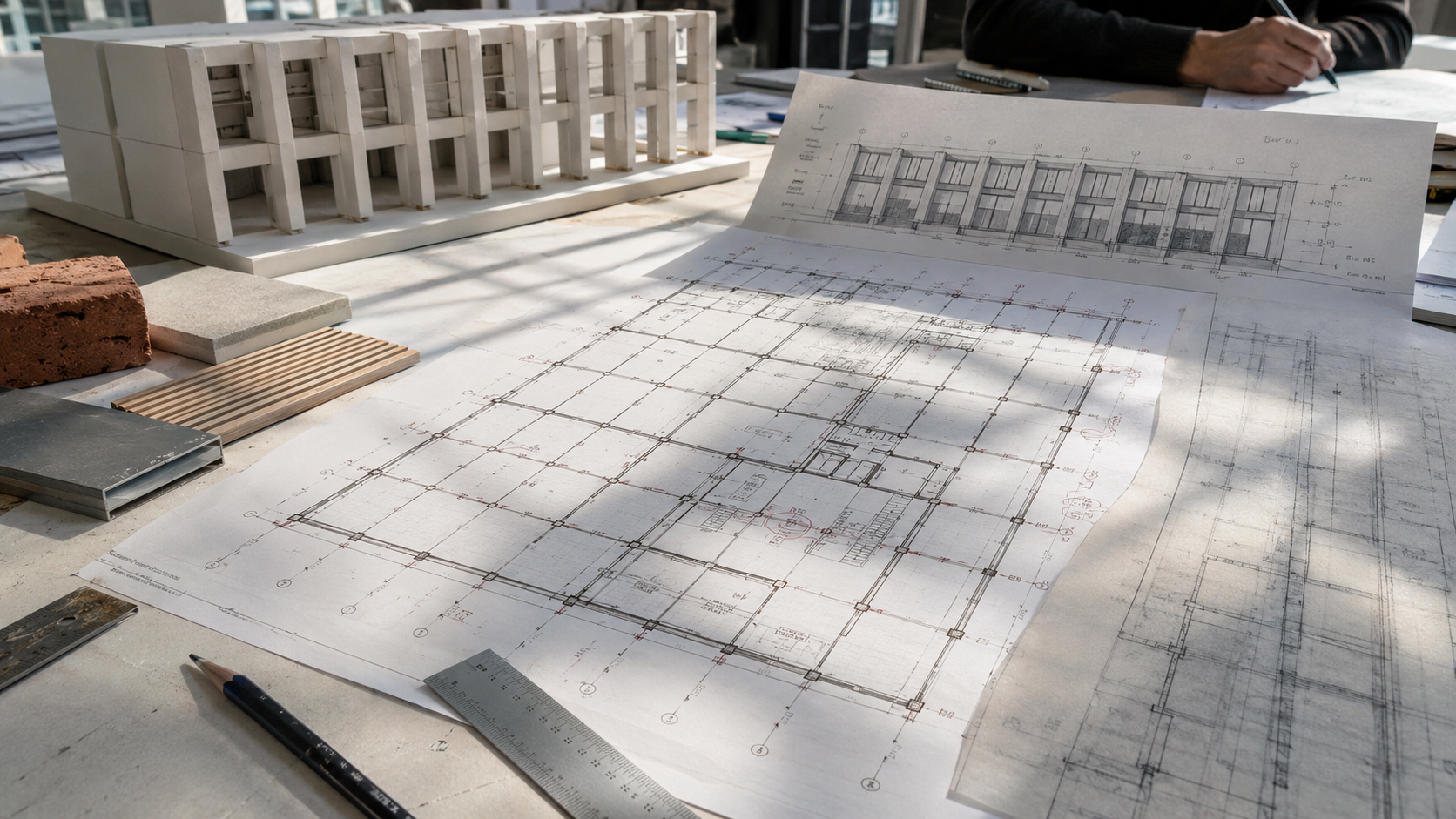
Why Grids Still Matter
Pattern is not decoration first.
In architecture, pattern is how a building keeps order under pressure. The grid sets the rhythm. Joints prove it. Openings test it. Light exposes the weak parts. If the rule drifts from plan to facade to detail, the building starts to feel uncertain even before anyone can explain why.
A good pattern makes drawings easier to read and construction easier to coordinate. A bad one becomes a pretty surface with no bones behind it.
Useful starting points: For the broader design foundation, see Basic Design and Architecture. For the size and relationship side, read Scale and Proportion in Architectural Design.
Pattern Has to Do Work

| Pattern Move | What It Should Control | Where It Usually Fails |
|---|---|---|
| Structural grid | Columns, spans, shafts, walls, and ceiling zones. | The facade rhythm ignores the frame. |
| Facade module | Windows, panels, mullions, joints, shading, and room rhythm. | The surface looks ordered, but rooms behind it do not fit. |
| Material repeat | Brick courses, tile joints, boards, panels, seams, and fasteners. | The joint pattern fights the material size. |
| Light rhythm | Openings, reveals, roof slots, screens, and shadow depth. | The pattern works in elevation but fails when sunlight hits it. |
| Interior module | Cabinetry, lighting, ceiling slats, tile, doors, and built-ins. | Every finish uses a different count. |
Why Grids Still Matter
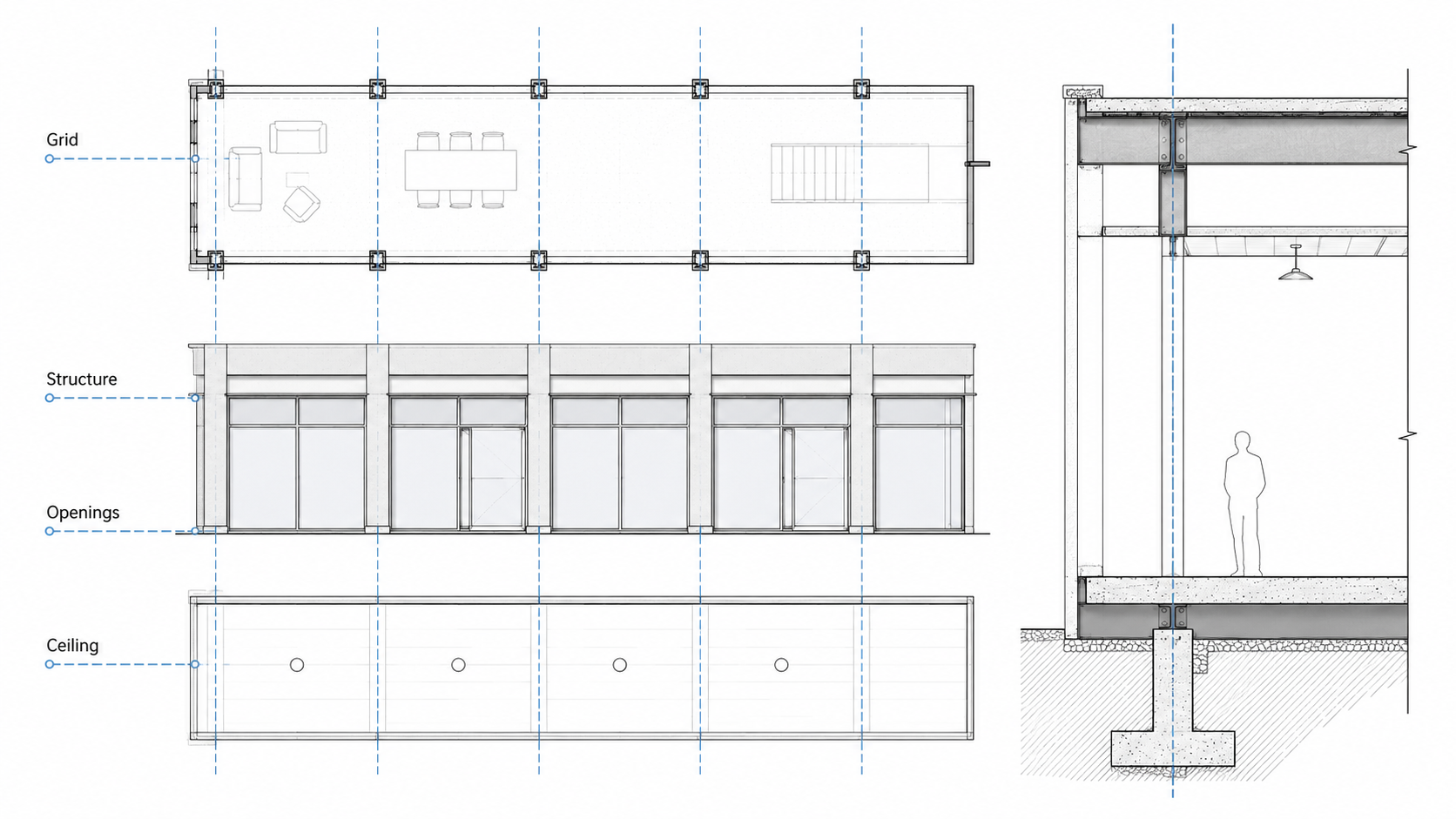
Illustration by ArchitectureCourses.org. A shared grid can organize the structure, facade openings, ceiling rhythm, and section instead of leaving each layer to follow a separate rule.
Every project starts with two questions: what repeats, and where does it change?
The grid answers the first question. It helps size spans, stack services, place openings, control ceiling zones, and keep trades from inventing new solutions at every bay.

When the grid is right, drawings get calmer. Door heads align. Mullions stop fighting columns. Lights sit where the ceiling can accept them. Ducts and beams stop competing for the same space.
When the grid is wrong, everything becomes a one-off. That is where cost and coordination start leaking out of the project.
Grids are not there to make buildings stiff. They are there to make exceptions visible.
From Grid to Structure

A structural grid is not a cage. It is the rhythm section.
Columns, walls, beams, joists, and slabs all need a beat. The grid gives them one. Then the design can break the beat where there is a reason: entry, stair, hall, view, courtyard, or public room.
If every bay changes, nothing is special. It is just expensive.
- Pick a bay that fits the use.
- Test spans before you fall in love with the drawing.
- Stack risers, shafts, stairs, and service zones into the same cadence where possible.
- Let the grid touch the facade so the outside does not lie about the inside.
Also useful: Form in Architecture helps connect mass, void, and structural rhythm.
Proportion Is the Quiet Partner
The grid sets the steps. Proportion decides how those steps feel.
You do not need a magic ratio for every project. You need a small family of relationships that can survive across rooms, openings, panels, ceiling lines, and details.
Two-to-three may work for tall windows in a library or living room. One-to-two may work better where wall space, glare control, or furniture matters. Square bays can calm small rooms. None of these are rules by themselves. They are starting points.
The test is consistency.
If the list of proportions keeps growing, the building will start to feel busy even if the drawings look clean. When a facade starts fighting you, check the proportions before redrawing the whole massing. One width-to-height correction can save more work than another week of sketching.
Facade Pattern Should Tell the Truth
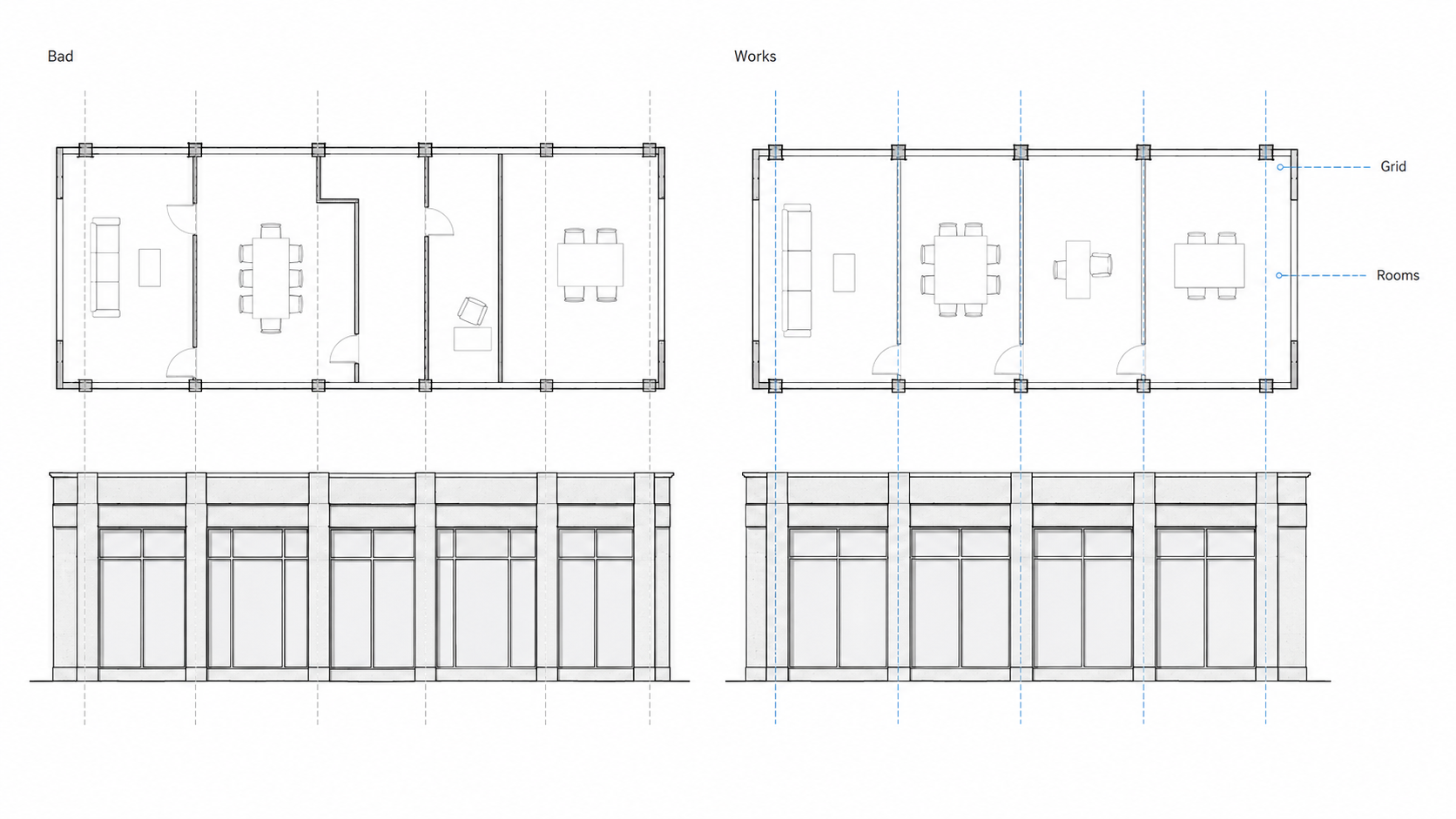
Illustration by ArchitectureCourses.org. A facade pattern can look orderly and still fail if it ignores the room layout and structural grid behind it.
Good facades are not tricks.
If rooms repeat, show it. If a stair or service zone needs a solid bay, let that bay read. If the structure has a clear rhythm, do not cover it with a random skin.
The facade does not have to reveal everything. It does have to avoid lying so badly that the building feels false.
Choose one base module and one smaller support module. Use the larger one for the field. Use the smaller one for entries, corners, secondary rooms, or adjustment zones.
If a third and fourth size keep appearing, there may be a plan problem hiding behind the elevation.
Light Exposes the Pattern
Drawings can look perfect until light hits the room.
Deep reveals sharpen a pattern. Shallow ones blur it. A row of high windows can set a steady work rhythm. A roof slot can turn a long hall into a calm walk. A screen can make shade useful instead of decorative.
Light also exposes weak spacing. If the shadow rhythm gets muddy, the openings may be wrong. If glare lands where people work, the pattern is not performing yet.
Build a rough shoebox model. Cut openings to the module. Move a lamp like the sun. Watch the shadow lines.
That will tell you more than another polished elevation.
For drawing clarity: Basic Techniques and Principles of Architectural Drawing is a better support page than another render pass.
Materials and Joints Carry the Rule
Pattern dies at the joint.
Metal meets frame. Sill meets jamb. Cap meets wall. Tile meets drain. Brick turns a corner. Sheet metal finds a seam. If the repeat also sheds water, moves safely, and can be built without heroic labor, the detail has a chance.
If it traps water, the pattern becomes a maintenance problem.
Draw the joint three ways: whole wall, wall slice, and one corner at a larger scale. Trace the line of water, the line of air, and the line of heat. If those lines break, the pattern is not finished.
Material logic matters:
- Brick wants courses, corners, openings, and lintels that respect the unit.
- Stone needs joint discipline and support that does not pretend weight disappeared.
- Timber wants regular spacing and room for movement.
- Sheet metal wants seams that shed water and fasteners that do not fight the rhythm.
Related: Building Materials and Wood Materials in Construction and Design.
Movement Follows the Beat
People read patterns with their bodies before they read them on a drawing.
Door spacing changes the pace of a corridor. A clean stair rhythm prevents hesitation. Repeated light pools can pull people through a hallway without adding signs.
A badly spaced entry can make a building feel awkward before the visitor knows why.
Lay dots on the plan at walking pace. Place doors on the beat. Put light where movement changes. Then walk the sequence in your head.
Better yet, tape it out. A chalk layout or quick floor mockup catches problems that a clean plan hides.
For room-by-room checks: Space Planning Essentials is useful before corridors become too long, too dark, or too clever.
Site Scale Keeps the Pattern Honest

Streets have rhythm too.
Bay widths, roof lines, porch depths, window heads, entry spacing, and storefront modules create a pattern long before your building arrives. You do not have to copy the street. But you do need to know what beat you are entering.
A modern facade can sit well on an old block if it understands the cadence. A quiet design can still feel loud if it ignores cornice lines, entry spacing, or window proportions around it.
Study the block before designing the pattern:
- Typical bay width.
- Window-head height, especially on older streets where one bad head line can make a calm block feel jumpy.
- Entry spacing by address.
- Roof or cornice line.
- Solid-to-void ratio.
Good historical references: Islamic Architecture and Renaissance Ideal Cities both show how geometry can shape space without becoming random ornament.
What Islamic Geometry Still Teaches

Islamic and Arabic pattern families show how far simple rules can go.
Stars, polygons, lattices, screens, and tiled fields often come from a small kit of geometric moves. The power is not just the ornament. It is the grammar. The pattern can grow, turn, shade, filter light, and hold several scales without losing count.

That is useful for contemporary work too. Screens, guards, shading devices, wall panels, and ceiling fields can use a tight family of parts instead of a new shape every few feet.
Start with a circle. Divide it. Use the same angle family for solid and void. Keep the number of unique pieces low. If the surface needs depth, change relief before changing the whole pattern.

Interior Grids People Feel
Interior patterns work at hand scale.
Ceiling slats that match light spacing. Cabinet doors that align with window rhythm. Tile that respects the drain. Door pulls that sit on a line already present in the room.
These choices sound small until they are wrong.
Pick a cabinet width that can also work for shelves, wall panels, or storage modules. Set tile so cuts land at edges instead of floating in the middle of the field. Align hardware with a sash, rail, or panel line so the room gets quieter.
If every finish uses a different count, good materials will still feel noisy.
Pattern and Cost
Contractors price risk.
A repeat they can learn is cheaper to trust than a wall full of exceptions. Two panel sizes beat twelve. Three hardware sets beat seven. One light family across a floor beats a different fixture in every room.
Pattern can save money by removing odd parts, reducing layout time, simplifying procurement, and cutting down on field decisions. It also saves coordination hours. Those are real hours, even when nobody puts them in a rendering.
Count the repeats on every sheet. If a one-off survives the first pass, write down why. Entry, corner, stair, equipment, view, structure — those can be good reasons.
“It looked better once” is not enough.
Drawing Habits That Protect the Pattern
Most patterns fall apart during coordination.
One drawing shows the rule. Another breaks it by accident. A ceiling plan drifts from the structural grid. A tile layout ignores the drain. A window schedule introduces sizes the elevation never needed.
Use a few simple habits:
- Keep one pattern key: module, exceptions, joint families, light families.
- Use one reference grid across plan, elevation, ceiling, and detail views.
- Lock the detail family: head, sill, jamb, base, corner.
- Mark field conditions early, especially where water, movement, or tolerance affects the repeat.
Also useful: Lines in Architectural Sketches helps keep the rule visible before software makes the drawing look more resolved than it is.
Where It Usually Goes Wrong
Skin Without Bones
A decorative grid on a facade that ignores the plan will feel false. Tie the repeat to structure, room size, material size, or daylight. If inside and outside disagree, fix the plan before polishing the elevation.
The Module Is Too Tight
A grid that never yields becomes a cage. Widen one bay at the entry. Let a stair take a solid bay. Give a public room a pause. Rule and change together make comfort.
The Pattern Hides Bad Joints
If you cannot see how water leaves, you are buying future repairs. Draw the joint larger. Solve gravity first. Repeat the same water logic across every corner.
Light Comes Too Late
If you set openings only for a facade image, the building may punish you with glare, heat gain, or dead interiors. Start with solid and void, then adjust the beat for use and daylight.
Too Many Families
Too many door types, lights, panels, tiles, and trims turn a clean idea into a procurement mess. Keep the list short. Spend the detail time on the few patterns that do the most work.
Quick Pattern Tests
Do not turn these into cute studio exercises. Use them as checks.
Plan Test
Trace the main circulation line. Then mark every place where the module changes. If the changes happen for no reason, the plan is drifting.
Span Test
Take the grid into structure early. Check whether the bay size works with real member depths, not just the drawing. A beautiful grid that forces every beam into a custom solution is not clean. It is expensive.
Light Test
Cut two openings in a rough box using your module. Move a lamp like the sun. Watch where shadow helps the rhythm and where glare ruins it. This will tell you more about openings than another afternoon of render settings.
Related concept: Parti in Architecture helps connect pattern to project intent.
Minimal Work Still Needs Pattern
Quiet buildings depend on rhythm more than expressive ones.
With fewer cues, every slip shows. Frames. Joints. Reveals. Cabinet gaps. Tile cuts. Light spacing. When they repeat cleanly, the calm feels intentional. When they wander, the calm feels empty.
Keep one primary repeat at eye level and one finer grain where hands and feet touch. A stair tread pattern. A handrail post cadence. A cabinet door rhythm. Stop before adding a third layer unless the use needs it.
Related: Minimalist Architecture.
A Simple Workflow for Students and Young Teams
Run the same loop on every plan, elevation, and detail.
- Does the size fit the body?
- Does the grid hold the room?
- Does the light set a clean beat?
- Do the joints protect the pattern?
- Does the street understand the building?
If one answer is weak, fix that link first. The rest usually follows.
Keep one proof sheet: one plan, one section, one joint, one light study, one note on cost or schedule. That single sheet will do more in a review than a dozen pretty images.
How to Apply This on a Project
- Write the rule in one sentence. Example: windows, lights, and cabinets align to a 4-foot module.
- Draw the exceptions and name why they exist: entry, stair, corner, balcony, service zone.
- Choose material families that keep the repeat with the least custom work.
- Set a light rhythm that matches the module. Check morning and afternoon.
- Detail one joint that carries water, air, and heat lines without breaking the rule.
- Walk the plan at the pace of steps. Adjust door and light spacing to match the body.
- Check the street beat. Tune head heights and bay widths to the block family.
For the basic toolkit: Design Elements in Architecture pairs well with this checklist.
FAQ
How do I pick a grid size?
Start with use. Small rooms often need tighter bays. Studios, halls, and classrooms may need wider spans. Then check standard material sizes and structural depths. If you cannot name the reason for a dimension, it is not ready.
Is symmetry required for a good architectural pattern?
No. Symmetry is only one option.
Many strong patterns are stepped, offset, or asymmetrical. The important thing is not mirror balance. It is whether the repeat has a clear rule and whether each break in the rule has a reason.
How many exceptions are safe?
As few as you can defend. Mark each exception on one sheet and name the reason: entry, corner, stair, structure, light, or drainage.
What if the site grid fights the building grid?
Respect the street where it matters: entry spacing, roof lines, window heads, and bay rhythm. Then let the interior grid serve use, structure, and sun. Use thresholds or reveals to mediate the shift.
Can a minimalist building rely only on material quality?
No.
Good materials still need rhythm. Material without order can look expensive and unresolved at the same time.
How do I check if a student project is on track?
Ask five questions: What is the base module? Where does it serve use? Where does it change? How does it drain? How does it age?