

Roof lines do more than shape curb appeal. They affect drainage, attic space, wind behavior, framing complexity, and how well a new roof or addition fits the house below it.
This page covers the roof lines homeowners compare most often, from gable and hip roofs to butterfly, gambrel, and A-frame forms. It also clears up one part that gets messy fast: not every label in a roof chart belongs to the same category. Some are main roof types. Some are variants. One is a roof feature. One is a catch-all.
Start with climate, plan shape, and budget. Then decide how much visual complexity the house can carry without making the roof harder to build, flash, and maintain. If you are still at the broad planning stage, home roof design is a good next step after this page.
Worth having:
Framing Roofs
A clear field guide to pitches, valleys, eaves, and roof framing logic.
>> View on Amazon

Low-slope and sharply profiled roof forms showing how roof lines change the character of a building before you ever get to materials.
Common Roof Lines and How to Read Them

Roof-line chart comparing base roof types, variants, compound forms, and roof features that often get mixed together.
Start with the right buckets
The drawing set is useful. The weak point is the labeling logic. A gable roof, a dormer, and a catch-all “combination roof” do not sit at the same category level.
| Bucket | What belongs here | Why it matters |
|---|---|---|
| Main roof types | Gable, hip, flat, shed, mansard, gambrel, butterfly, bonnet, curved, sawtooth, A-frame. | These describe the primary roof form you see first. |
| Variants and subtypes | Box gable, cross gable, pyramid hip, cross hip, skillion, lean-to. | These modify a base family rather than replacing it. |
| Roof features | Dormers. | A dormer sits on another roof. It is not the main roof form. |
| Mixed or compound forms | Combination roofs. | This only becomes useful once you name what is being combined. |
That sorting rule makes the page easier to use. First choose the main roof family. Then look at variants. Then decide whether features like dormers or compound intersections make sense for the plan.
1. Gable Roof Line

Open gable roof on a brick house with a clear ridge and two simple sloping planes.
A gable roof is the basic triangular roof line: two sloping sides meeting at a ridge. It drains well, frames cleanly, and fits a wide range of house shapes.
- Common in: Traditional, Colonial, and Craftsman houses.
- Strengths: Simple geometry, good drainage, and easy attic ventilation.
- Watch for: Gable ends need proper bracing in exposed wind conditions.
- Variations: Cross gable, front gable, and box gable.
2. Hip Roof Line

Residential hip roof with four sloping sides and a compact, balanced roof mass.
A hip roof slopes on all sides. That gives it a calmer profile than a gable and better wind behavior in many conditions, though the framing is more involved.
- Common in: Ranch, French Colonial, and Mediterranean houses.
- Strengths: Stable form, cleaner wind profile, strong overhang control.
- Watch for: More hips, valleys, and cut members mean more labor and more places for bad detailing.
- Variations: Cross hip and pyramid hip.

Illustration by ArchitectureCourses.org. A shows an intersecting hip roof over a more complex plan. B shows a pyramid hip roof, with four sides rising to a central peak. C shows a standard hip roof on a longer rectangular plan.
How to read the hip-roof diagram
- A. Hip Roof on a Varied Plan: Multiple hips and valleys meet over an irregular plan.
- B. Pavilion Hip Roof on a Square Plan: All sides rise evenly to a single peak.
- C. Common Hip Roof on a Rectangular Plan: Four sloping pitches meet at a central ridge.
3. Flat Roof Line

Modern house with a flat roof and a clean horizontal roof edge.
A flat roof is never perfectly flat. It has a slight slope for drainage, even when the roof line reads as a clean horizontal plane. If you want the low-slope side of this subject in more detail, see low-pitched roofs and flat roofing materials.
- Common in: Modern, industrial, and some mid-century work.
- Strengths: Clean profile, rooftop use potential, easy solar placement on some projects.
- Watch for: Waterproofing, drainage, insulation strategy, and edge detailing matter more than the simplicity suggests.
4. Shed Roof Line

Single-slope shed roof on a modern house.
A shed roof uses one continuous slope. It is simple, sharp, and useful when you want high windows, daylight, or a clean addition roof that does not fight the existing house.

- Common in: Contemporary houses, cabins, additions, and small modern builds.

Minimal shed roof eave detail showing runoff at the drip edge. Image by ArchitectureCourses.org.
- Strengths: Straightforward framing, strong daylight potential, clean modern profile.
- Best fit: Extensions, narrow plans, and houses that benefit from one strong roof pitch instead of multiple intersections.
5. Mansard Roof Line

Mansard roof with a steep lower slope and a flatter upper roof profile.
A mansard roof is four-sided with a steep lower slope and a shallower upper slope. It adds usable upper-floor volume without making the building read like a full extra story.
- Common in: French and Second Empire work.
- Strengths: More upper-floor space and a strong formal profile.
- Watch for: More complex framing, flashing, and roofing transitions.
6. Gambrel Roof Line

Gambrel roof form with two slopes on each side and a fuller upper volume.
A gambrel roof also uses a double slope, but it reads as a gable-ended form rather than a hip-based one. It is the roof line many people associate with barns and Dutch Colonial houses.
- Common in: Farmhouses, barns, and Dutch Colonial revival houses.
- Strengths: Good upper-floor volume and a familiar historic profile.
- Watch for: The slope break needs clean detailing and good water control.
7. Butterfly Roof Line

Butterfly roof diagram showing two opposing roof planes falling inward to a central valley.
A butterfly roof flips the expected pitch inward. That makes it visually memorable, but it also puts heavy pressure on the central drainage detail.
- Common in: Mid-century modern work and some environmentally driven designs.
- Strengths: Distinct profile, clerestory potential, and rainwater harvesting on the right project.
- Watch for: Center-valley drainage, waterproofing, and overflow planning cannot be casual.
8. Bonnet Roof Line

Bonnet roof with a lower outward flare that extends the shelter line near the walls.
A bonnet roof uses a change in pitch so the lower roof flares outward like a protective skirt. It can work well where shade, porch cover, and deep eaves matter.
- Common in: French Colonial and Caribbean-influenced houses.
- Strengths: Covered edge zones, strong sun protection, and a softer formal profile.
- Watch for: More framing and more transition lines to flash well.
9. Dormer Roof Line

A dormer does not belong in the same bucket as gable, hip, or gambrel roofs. It is a roof feature added onto a larger sloped roof to bring in light, headroom, or both.
- Common in: Cape Cod, Cottage, and Victorian houses.
- Strengths: More daylight, more usable upper-floor space, and a stronger facade rhythm.
- Variations: Gable dormer, shed dormer, and eyebrow dormer.
- Watch for: Every dormer adds valleys, sidewall flashing, and roofing interruptions.
10. Skillion and Lean-To Roof Line
Skillion and lean-to roofs live in the same single-slope family as shed roofs. The naming often shifts by region, building type, or how the roof is attached to the main structure.
- Common in: Contemporary houses, industrial-style additions, and narrow side or rear extensions.
- Strengths: Simple geometry, efficient drainage, and strong daylight potential.
- Watch for: On larger houses, a single-slope roof can look thin or awkward unless the massing supports it.
11. Combination Roof Lines

Combination roof lines only become useful once you name the roof families being combined.
“Combination roof” is not a clean roof type by itself. It is a mixed condition. That can be useful, but only after you say what is being mixed. For a closer look at one of the most common pairings, see hip and gable roof combinations.
- Examples: Gable plus hip, flat plus shed, or mansard plus dormers.
- Why it helps: Mixed roofs can solve awkward plans, additions, and program changes better than one pure roof family.
- Where it goes wrong: More intersections, more valleys, more detailing, and more chances for the roof to look patched together.
12. Curved Roof Line
A curved roof uses a continuous arc or softened profile instead of a straight pitch break. It can be elegant, but it needs the right structural system and the right material set.
- Common in: Contemporary work, pavilions, and some industrial or civic buildings.
- Strengths: Strong visual identity and smoother spatial volume inside.
- Watch for: Higher fabrication cost and fewer forgiving construction shortcuts.
13. Sawtooth Roof Line
A sawtooth roof repeats a steep zigzag profile, often with glazing on one face. It came out of industrial daylighting logic and still works best when light control is part of the design brief.
- Common in: Industrial buildings, studios, workshops, and some modern houses.
- Strengths: Strong daylight control and a distinctive silhouette.
- Watch for: Repeated valleys, repeated transitions, and a lot more envelope detail than the shape suggests.
14. A-Frame Roof Line
An A-frame runs the roof all the way toward the ground so the roof and wall read almost as one move.
- Common in: Cabins, chalets, and small retreat houses.
- Strengths: Fast snow shedding, strong visual identity, and a compact structural idea.
- Watch for: The side walls disappear quickly, so upper-level usable space shrinks with the slope.
Where Roof Choices Start Causing Trouble
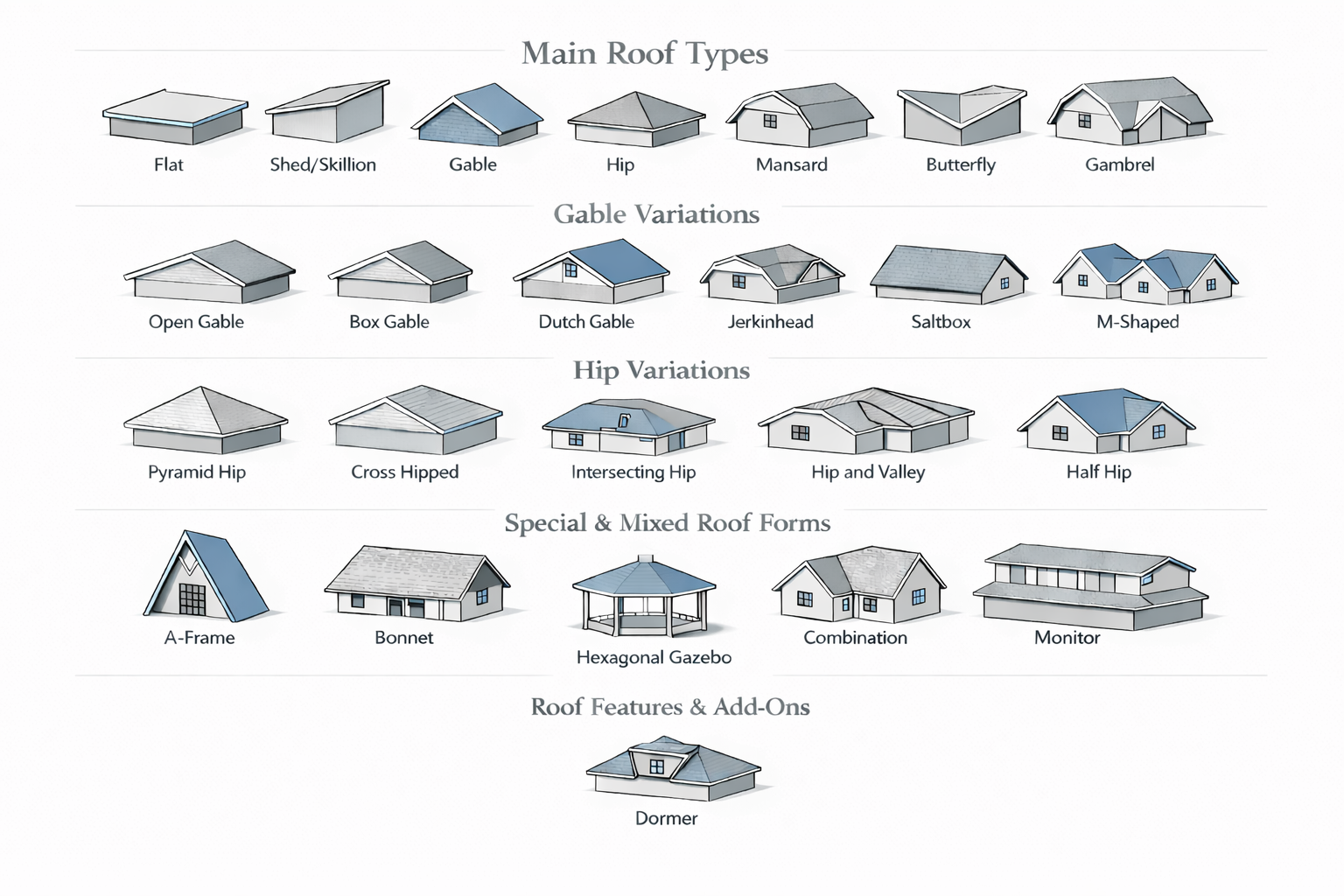
Illustration by ArchitectureCourses.org. Roof types and variations chart with common residential roof forms and major subtype groupings.
Roof problems often start long before the first leak. They start when the roof line and the house plan are pulling in different directions.
| Common mistake | What it causes later | Better move |
|---|---|---|
| Choosing a low-slope or inward-draining form for the look alone. | Drainage trouble, heavier waterproofing demands, and more maintenance. | Use flat or butterfly roofs only when the drainage design is strong enough to deserve them. |
| Forcing a trendy roof onto a simple house mass. | A roof that looks added on rather than integrated. | Let the plan and facade rhythm lead the roof decision. |
| Mixing too many roof families on one house. | Extra valleys, awkward proportions, and higher framing cost. | Name the main roof family first, then add one secondary move only if the plan needs it. |
| Treating dormers like style accessories. | More flashing failures and fussy roof intersections. | Add dormers only when they earn their place through light, headroom, or facade balance. |
| Ignoring local weather. | Ponding, snow load trouble, wind exposure issues, or high maintenance. | Match the roof line to rain, snow, wind, and sun before judging the look. |
How to Narrow the Options Faster
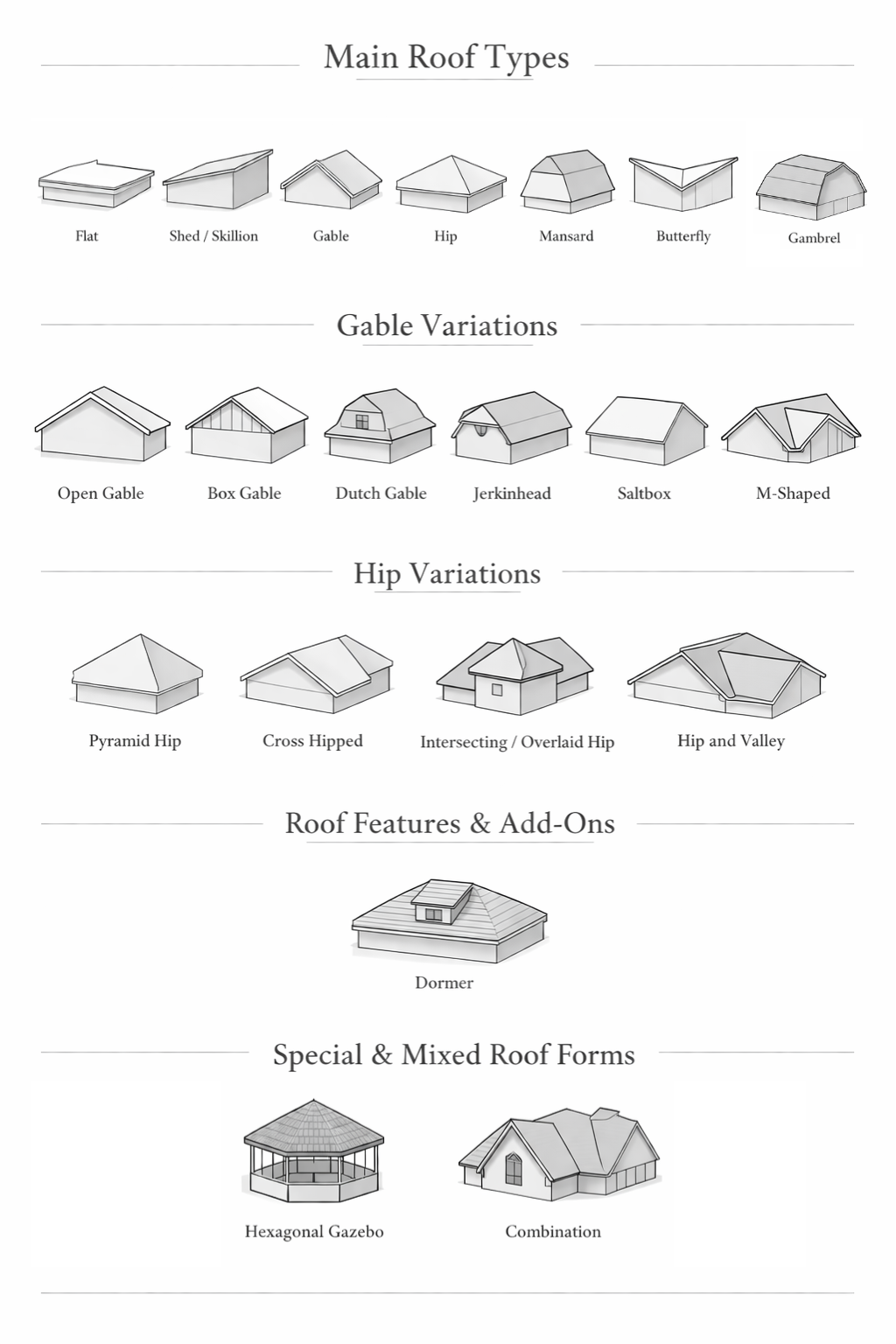
Illustration by ArchitectureCourses.org. Roof forms grouped into main roof types, gable variations, hip variations, roof features, and mixed forms.
| If your priority is | Start by looking at | Use extra caution with |
|---|---|---|
| Fast drainage in rain or snow | Gable, hip, steep shed, A-frame | Flat roofs, butterfly roofs, and overly busy compound roofs |
| Better wind behavior | Hip roofs and simpler low-profile forms | Tall exposed gables without proper bracing and detailing |
| More upper-floor or attic space | Gambrel, mansard, and carefully placed dormers | Complex double-pitch roofs without the budget to detail them well |
| A clean modern profile | Flat, shed, and selected butterfly roofs | Low-slope roofs treated casually at the drainage and waterproofing layer |
| Lower framing complexity | Simple gable and simple shed roofs | Combination roofs, curved roofs, and heavy intersection work |
| A roof for an addition | Shed, lean-to, simple gable, or a clean subservient hip | Trying to make the addition roof louder than the original house |
A Few Books That Help
1. The Visual Handbook of Building and Remodeling
A broad reference for roof work, framing, envelope details, and renovation questions that tend to overlap on site.
2. Roofing with Asphalt Shingles
Useful when the question moves from roof shape into execution, sequencing, and field details.
3. Home Maintenance for Dummies
Helpful for connecting roof choice with long-term upkeep instead of first cost alone.
FAQ
1. What roof line works best in rainy climates?
Gable and hip roofs are the safest starting point because water leaves the roof quickly and cleanly.
2. Which roof line handles snow well?
Steeper gables, A-frames, and other steeply pitched roofs clear snow better than low-slope forms. For the steeper side of this topic, see steep roofs.
3. Are flat roofs a bad idea?
No. They just demand better drainage, waterproofing, insulation, and maintenance planning than many homeowners expect.
4. What roof line works best in high-wind areas?
Hip roofs often perform well because the slopes break wind more evenly than tall exposed gable ends.
5. What is the difference between a gable roof and a hip roof?
A gable has two roof planes meeting at a ridge. A hip slopes on all sides.
6. Is a dormer a roof type?
No. A dormer is a roof feature added onto a larger roof.
7. Is a skillion roof the same as a shed roof?
In many cases, yes. The naming shifts by region and building type, but both describe a single-slope roof family.
8. What roof line gives the most upper-floor space?
Gambrel and mansard roofs create more usable upper volume than a basic gable or hip.
9. Are butterfly roofs practical?
They can be, but only when the center drainage detail is designed and built with real care.
10. Do complex roof lines cost more?
Yes. Every added valley, pitch change, dormer, or roof intersection adds labor, flashing, and long-term maintenance risk.
11. Can the wrong roof line hurt resale value?
Yes. A roof that fights the style of the house or creates obvious maintenance concerns can make buyers hesitate.
12. What is the safest roof line for a simple addition?
A shed or lean-to roof is often the cleanest answer because it ties in with less structural and visual drama.
13. Are hip roofs better than gable roofs?
Not across the board. Hip roofs often behave better in wind. Gable roofs are simpler, cheaper, and easier to ventilate.
14. What roof line should I avoid for a tight budget?
Curved roofs, complex mixed roofs, and elaborate valley-heavy layouts are where labor and detailing costs climb fast.
What to Keep in Mind
The best roof line is the one that fits the house, the weather, and the budget at the same time. A simple roof with clean drainage and good proportions will usually beat a trend-heavy roof that looks impressive in a sketch but turns into a flashing problem, a framing headache, or an expensive addition mismatch. If you are still narrowing the look, see simple roof design for a small house.
Related
Roof Types and Roof Form Comparisons
- Gabled Roofs
- Hip Roof Line: Advantages, Disadvantages, and Applications
- Steep Roofs: Design, Construction, and Maintenance
- Why Choose a Low-Pitched Roof? Pros, Cons, and Design Insights
- Saltbox Roof Construction and Framing: Materials, Tools, and Techniques
- Hip and Gable Roof Combinations
Roof Materials and Design Follow-Ups
- Roofing Materials List: From Metal Sheets to Shingles
- Flat Roofing Materials: Complete Guide for Homeowners and Builders
- Home Roof Design: Essential Tips for Every Style
- Simple Roof Design for a Small House
Resources
| Organization | Resource Type | Website |
|---|---|---|
| American Society of Home Inspectors (ASHI) | Inspector directory and home inspection guidance | homeinspector.org |
| National Roofing Contractors Association (NRCA) | Roofing guidance and training resources | nrca.net |
| U.S. Department of Energy (DOE) | Energy and roof-performance resources | energy.gov |
| Habitat for Humanity | Housing and repair resources | habitat.org |
| International Code Council (ICC) | Code references and building safety resources | iccsafe.org |