

Architectural form shapes how buildings look, work, and feel. This guide offers real-world lessons, examples, and free resources to help you master it.
Understanding Architectural Form: Real Lessons, Real Design
Form is one of the first things you notice—and one of the hardest to get right. Whether you're a student just starting out or a designer looking to sharpen your eye, understanding form is non-negotiable.
Over the years, I’ve taught architecture to hundreds of students. And if there’s one truth that never changes, it’s this: form isn’t just about looks—it defines how a building lives.
That’s why I’ve teamed up with ArchitectureCourses.org to build a clear, free resource focused on one thing: helping you understand architectural form in real, usable terms.
Inside, you’ll find:
● Simple explanations of key form types
● Real-world examples from landmark buildings
● Practical tips from studio experience
● Free architecture courses tied to this topic
So if you're tired of theory-heavy articles with no application, this guide is for you. Let’s break down what form really means—and how to use it in your own work.
Best Books on Form and Space
- Introduction to Architecture by Francis D.K. Ching
- Form, Space, and Order by Francis D.K. Ching
- The Architecture of Happiness by Alain de Botton
This guide to "Forms in Architecture" is part of the main section on foundational architecture and design courses.
What is Form in Architecture?

Form is the shape, structure, and visual outline of a building.
It’s what you see first—but more importantly, it shapes how a building feels, functions, and fits into its environment.
In simple terms, form defines how a building looks and how it lives—from the way it holds space to how it reflects its purpose. Whether driven by use, emotion, or artistic intent, form is where function meets design.
How to Understand Architectural Form (With Real Examples)

Architectural forms range from simple geometric shapes to bold, nature-inspired structures. Below are common types—with iconic examples to help make them clear.
● Geometric Forms
● Use clear, defined shapes like squares, triangles, circles
● Often seen in modernist and minimalist architecture
→ Example: Fallingwater by Frank Lloyd Wright
→ Uses stacked rectangular volumes that blend into the landscape
Frank Lloyd Wright's Fallingwater is a great example of how geometric shapes can blend with natural surroundings.
● Organic Forms
● Inspired by natural shapes—curves, waves, irregular lines
● Often emotional and expressive
→ Example: Casa Batlló, Antoni Gaudí
→ Fluid shapes evoke water, bone, and nature in motion
See also: Examples of Architectural Forms
Key Types of Modern Architectural Form
Here’s how architects today organize space through form—each with a specific function or spatial experience in mind:
▪ Linear Forms

Long, stretched shapes often used in minimalist or horizontal buildings
→ Think: galleries, modern villas, or stretched office blocks
▪ Centralized Forms:
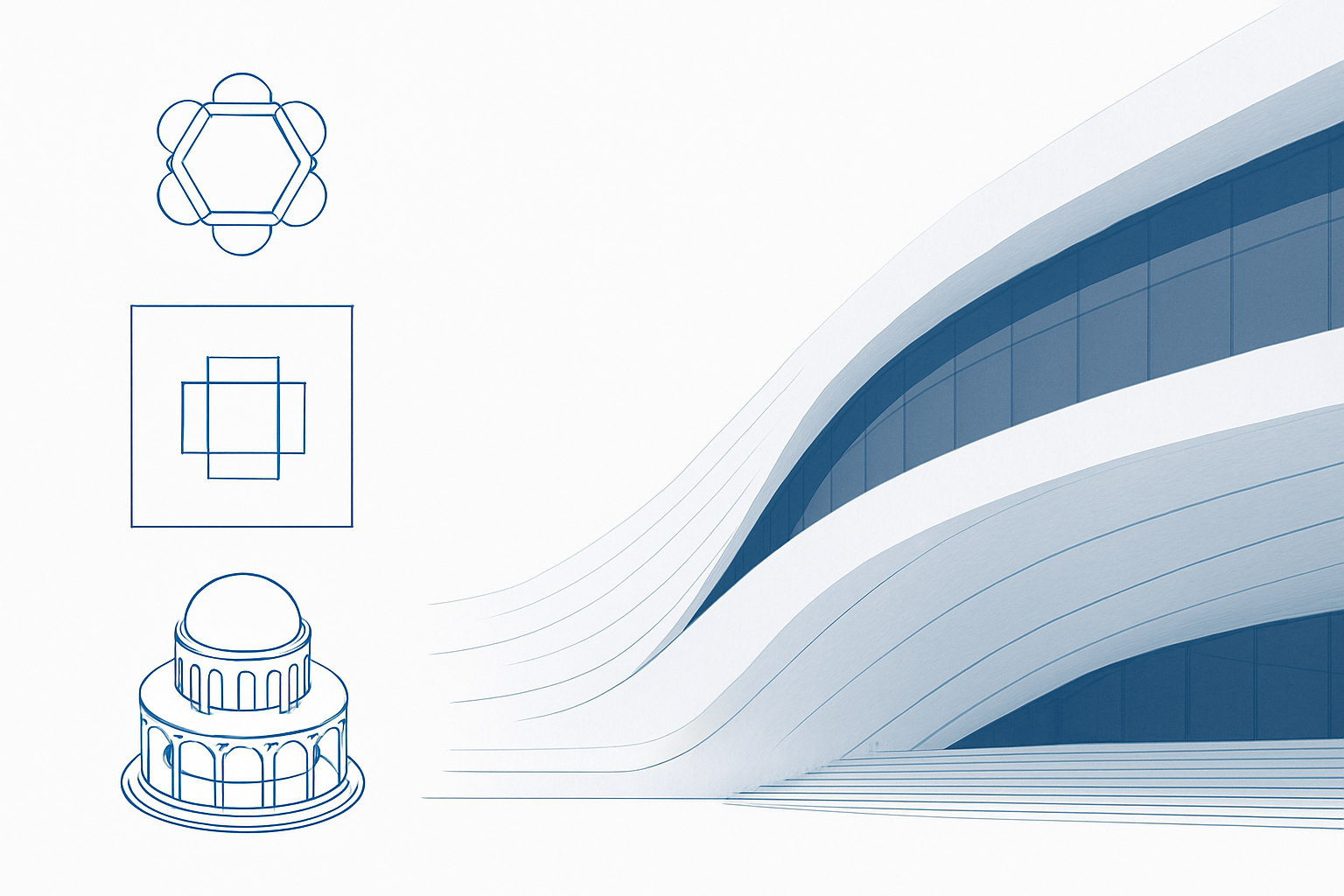
Organized around a single, dominant central space
→ Creates a sense of focus or ceremony
→ Used in temples, round pavilions, or monumental lobbies
▪ Clustered Forms

Multiple small forms grouped together—can feel dynamic or community-oriented
→ Example: Habitat 67, Montreal
→ Modular living spaces stacked in bold patterns
▪ Grid Forms


Structured by a repeating square or rectangular grid
→ Works well for flexible interiors and industrial spaces
→ Example: Pompidou Center, Paris

IMAGE: Grid-based architectural design of the Pompidou Center in Paris, showing exposed structural framework and mechanical systems.
Want to Go Deeper?
Free Lesson: What Is Grid System Architecture?
Also: Introduction to Architecture: A Beginner’s Guide to Building Design
Includes a full breakdown of form, space, and how to use them in real-world design.
Must Read
- Introduction to Architecture by Francis D.K. Ching
- Form, Space, and Order by Francis D.K. Ching
- The Architecture of Happiness by Alain de Botton
The Evolution of Form in Architecture

Architectural form has always evolved alongside materials and technology. In the past, form was shaped by limitation—wood, stone, and brick dictated what could be built.
Today, it’s shaped by possibility.
▪ Traditional Forms
● Focused on symmetry, proportion, and balance
● Used simple shapes with monumental impact
→ Example: Greek temples reflected harmony through clear geometry
▪ Modern Forms
● Fueled by materials like steel, concrete, and glass
● Freed architects to create curves, cantilevers, and twists
→ Example: Guggenheim Bilbao, Frank Gehry
→ A fluid, sculptural form that’s as functional as it is striking
Key Shift
Then: Form followed material limits
Now: Form follows vision, data, and environmental performance
Smart Roofing Choices Based on Form
Modern roofs aren't just protective—they complete the building's shape and function. Your form often determines the right material.
● Metal Roofing
Durable, sleek, and great for flat or curved roofs.
→ Ideal for minimalist, modular, or commercial designs.
● Green Roofs
Living surfaces that reduce heat and blend into surroundings.
→ Best for flat forms that can handle load-bearing soil and drainage.
● Solar Tiles
Built-in power with a clean profile.
→ Works well on angled, south-facing forms with consistent sun exposure.
What “Form Follows Function” Really Means
Popularized by Louis Sullivan, this principle is simple:
The shape of a building should come from its use.
Example:
In Frank Lloyd Wright’s Robie House, wide overhangs protect windows from rain and sun.
→ The horizontal layout fits residential life, offering both openness and shelter.
Form wasn’t decoration—it was performance.
Related
-
Building Forms in Architecture: From Traditional to Modern Design
-
Frank Lloyd Wright: Merging Form and Function in Architecture
What Is Additive Form Architecture?
Additive form is a design method where buildings are made up of distinct, repeatable parts—stacked, arranged, or clustered into a larger whole.
● It’s not one big mass
● Each unit stands alone, yet adds to a unified design
● Common in housing, campuses, and modular construction
▪ Why Use Additive Form?
● Flexibility – Easy to expand or phase construction over time
● Clarity – Each unit serves a role, with its own shape
● Cohesion – Pieces feel connected, even when different
▪ Real-World Examples
Habitat 67, Montreal – Moshe Safdie
→ 354 concrete units stacked to create private homes with shared identity.
Barbican Estate, London
→ Uses separate forms for housing and public space, but ties them together with unified material and rhythm.
▪ How It Works in Practice
Designers start with individual spaces, then explore how they connect, stack, or spread.
Each piece must work on its own—and still fit the big picture.
From Experience:
In a recent modular housing project, we built out in stages. The form allowed for growth without disruption, and each unit worked solo or in a group. That flexibility saved time, cost, and headaches.
See: Understanding Additive Form in Architecture: Key Concepts and Examples
Architectural Form Facts That Aren’t Just Trivia
▪ The Burj Khalifa Fights the Wind With Form
Its spiraled taper wasn't just for style.
→ The shape breaks up wind loads to prevent dangerous sway.
▪ Gaudí’s Sagrada Família Is Still Teaching Us
140+ years later, it's still under construction.
→ Its nature-inspired form pushed structural and artistic boundaries—before computers could.
▪ Some Buildings Are Printed, Not Built
3D-printed forms are no longer futuristic.
→ They allow for zero-waste, organic shapes that were once unbuildable—and it's only just beginning.
FAQ
What’s the difference between form and shape in architecture?
Shape is the outline or silhouette.
Form includes shape plus mass, volume, and how it occupies space.
Can form impact a building’s function?
Yes. A bad form can waste energy, create awkward spaces, or confuse circulation.
A good form makes the building easier to use and more efficient to maintain.
What’s a real example of “form follows function”?
In hospitals, clear layouts and direct access to patient rooms support fast response times.
The building’s shape follows the flow of medical care—not just aesthetics.
Keep Learning
Best Books on Form and Space
Introduction to Architecture by Francis D.K. Ching
Great for beginners—clear visual explanations of form, space, and architectural thinking.
Form, Space, and Order by Francis D.K. Ching
A must-read for deeper understanding. Breaks down how forms are organized and why they matter.
The Architecture of Happiness by Alain de Botton
Looks at how buildings make us feel. Less technical, more emotional—perfect for creative thinkers.
Final Thoughts
No matter your level—student, designer, or curious observer—understanding form is foundational.
When you learn to shape space with purpose, you’re not just drawing buildings.
You’re creating places people can live in, work in, and remember.
Form isn’t just how a building looks. It’s how it works, lasts, and makes people feel.
Related
General Concepts of Form in Architecture
- Form in Architecture
- Architectural Form Examples
- Different Forms of Architecture
- Evolution of Forms Architecture
- Geometric Forms in Architecture
- Types of Modern Architecture
Architectural Theories and Principles
- Form Follows Function
- Form and Space
- Form Space and Order (D.K. Ching)
- Architecture Form Space
Architectural Styles and Movements
- Modern Architecture
- Geometric Modern Architecture
- Modern Bali Architecture
- Organic Architecture
- Organic Form Architecture
- Organic Form Architecture Plan
- Free Form Architecture
Architectural Forms and Structures
- Additive Form
- Centralized Form
- Clustered Form
- Linear Form
- Linear Form in Architecture
- Grid Form
- Grid Form Architecture
Architectural Design and Functionality
- Form Finding
- Architecture Form Finding
- Form and Function
- Architecture Form and Function
Transformation and Evolution of Form
- Form Transformation
- Form Transformation Architecture
- Transformation of Form in Architecture
Form-Related Structures and Systems
- Form Active Structure System
Architecture as an Art Form
- Art Form
- Architecture as an Art Form
- Art Forms Architecture
Architectural Shapes
Affiliate Notice:
"We're passionate about sharing knowledge and making architecture accessible to everyone. That's why we offer these free courses! To keep providing high-quality content, we sometimes recommend resources we've personally tried or thoroughly researched, like books and courses. We carefully select them based on strict criteria to ensure they're the best of the best for your learning journey.
While there's no additional cost to you, we do earn a commission through affiliate links if you choose to purchase something after following our recommendation. This commission helps us continue creating valuable content for you."