

Being your own general contractor can save money. It can also turn your house into a stalled, half-finished job if you are disorganized, undercapitalized, or too slow to make decisions.
That is the real trade-off. You are not just "managing a build." You are the person every problem lands on. Wrong sill height. Missing permit signature. Window delivery pushed three weeks. Electrician says the plan does not match the service location. Framer wants an answer now.
That does not mean you should not do it. It means you should be honest about what the job really is before you try to save a GC fee.
What the Job Becomes
On paper, being your own GC sounds clean: schedule trades, buy materials, keep the budget in line, get the project done.
In real life, it is mostly coordination. Handoffs. Calls. Confirmations. Small decisions that would be forgettable on their own but expensive when they stack up. Blocking locations. Fan box ratings. Rough opening changes. Lead times that quietly doubled while nobody was watching.
The job also gets easier or harder depending on how well you understand the physical work. If your framing vocabulary is weak, your conversations with subs will be weak too. That is where house framing, wall framing, and roof trusses help. Not because you are trying to become the framer. Because you need to understand what is being discussed when the framer tells you one change affects three other things.
One early lesson on almost every owner-managed job: the schedule matters, but the handoffs matter more.
Where the Savings Hold Up
The GC fee is what pulls most people into this idea. Fair enough.
On many residential jobs, that fee is significant enough that owner-management can pencil out. The problem is that homeowners often calculate the visible savings and ignore the invisible losses. If the project runs late, if a crew leaves because the job was not ready, if materials arrive damaged and sit for a week, if one wrong field change ripples across three trades, you start paying that fee anyway. Just indirectly.
| Area | Where savings are real | Where they disappear |
|---|---|---|
| Finish selections | Buying tile, flooring, lighting, plumbing trim, and hardware yourself can cut markups | Storage damage, late decisions, wrong quantities, and non-returnable special orders |
| General conditions | Shopping dumpsters, toilets, temp power, and site services yourself can save real money | Loose scheduling that causes idle days and repeat delivery charges |
| Scope control | Clear drawings and tight scopes reduce change orders | Field-approved "small" changes that trigger rework across multiple trades |
| Self-management | You keep control of decisions and sequence | You become responsible for every miss, delay, and coordination failure |
The cheapest project on paper is not always the cheapest finished project. Rework eats savings quietly.
Where Handoffs Break
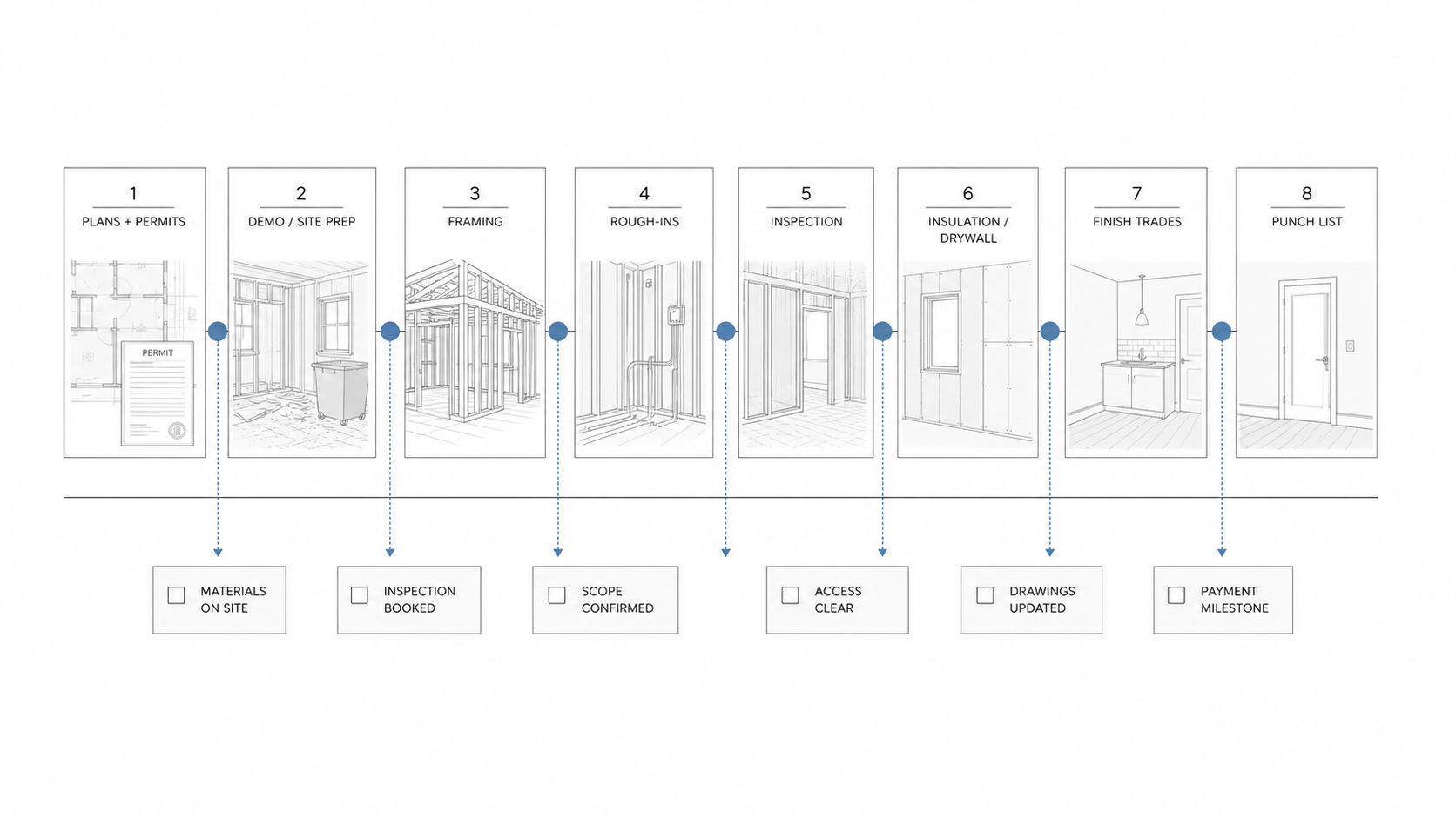
This is the part people underestimate most.
Owner-builders tend to think in big milestones: framing, rough-in, insulation, drywall, finishes. Crews do not work that way. They arrive asking a simpler question: is this actually ready for me?
If the answer is no, the schedule starts slipping in ways that are hard to recover from.
Before any crew shows up, check six things:
- Is the previous work complete enough for this trade to start?
- Are the materials on site, counted, and protected?
- Are the drawings and details consistent with the latest decision?
- Has the needed inspection happened, or is it at least booked?
- Is there power, access, and clear space to work?
- Do the crew and supplier have the same understanding of scope and timing?
If even one of those is missing, you are not really ready.
That is why a three-week lookahead matters more than a pretty master schedule. Use construction planning and scheduling and construction project management workflow as the baseline. Then keep the live version tighter and uglier. A whiteboard is fine. A spreadsheet is fine. The tool matters less than whether it is current.
When the Job Starts Slipping
Most owner-managed jobs do not go bad all at once. They go bad in a pattern.
An inspection is still not passed, but the next crew is booked anyway. The windows are on site, but it turns out they were ordered off the older opening schedule. The plumber wants one fixture decision, the electrician wants another, and neither crew can finish because the wall layout changed after framing started. Money is already out the door, but visible progress is not closing at the same speed.
That is the point where people start telling themselves the project is only "a little behind." Usually it is not. Usually it is drifting because too many small decisions are unresolved at the same time.
The fix is rarely dramatic. Freeze one thing. Confirm one trade. Re-check one delivery. Close one inspection. Then move. Jobs recover from that. They do not recover from five unresolved issues left floating for another week.
Money Rules That Keep Jobs Alive
Contingency is not optional. It is part of the job cost.
On a clean new build, 10 percent is a reasonable floor. On a remodel, especially one touching an older house, 15 percent is safer. Open one wall and you may find wiring, plumbing, framing, or water damage that was never visible from the plan set.
The second rule is cash flow. Not budget. Cash flow.
You need to know when deposits go out, when milestone payments hit, which materials need to be bought earlier than feels comfortable, and which bills pile up before the next inspection or draw. A cost plan is more useful here than a vague budget number, which is why cost plan construction is the better internal read than another generic piece about "what building costs."
The third rule is simple: pay on milestones, not vibes.
- Deposit only when it is actually needed
- Progress payments tied to visible work or passed inspections
- Retainage held until punch list work is closed
- Final lien waivers before the last check clears
That last part matters. A surprising number of owner-builders do not think seriously about lien exposure until the project is already tense. Read construction lien before that happens.
Paper Before Deposits
If you are vague on paper, you will pay for clarity in the field.
Every trade should have a one-page scope at minimum. What is included. What is excluded. Who supplies what. What drawing or detail controls. What gets inspected. What triggers payment.
That one page does not need to look fancy. It needs to remove the sentence, "I thought that was included."
Insurance paperwork matters too. Do not accept "yeah, we're covered." Get the certificate. Check dates. Check names. Check that it is current before anyone starts. Builder's risk is also worth looking at on larger jobs. If you cannot see the paperwork, it does not exist.
For early job setup, permits, and the paperwork side of getting moving, pre-construction planning is the closer internal fit.
Do Not Fight Inspectors
Owner-builders often treat inspectors like the enemy. That is usually a mistake.
The better move is to call before a critical stage if you are unsure about something. Not to ask them to design the job for you. Just to check what commonly fails on similar work in that jurisdiction. That one call can save a reinspection, a torn-open wall, or a crew sitting around waiting for permission to continue.
Some failures are predictable: hold-down layout, shear nailing, fire blocking, stair geometry, vent terminations, service clearances. None of these are exotic. They are just easy to miss when the job is moving and everyone is tired.
If the project is entering the code-heavy stage, keep residential building codes close. And if you are dealing with inspection sequence and site readiness, construction inspection process is the better follow-up.
You also need the boring official sites in reach: your local building department, your state licensing board, OSHA fall protection, and if you are paying qualifying independent contractors, IRS Form 1099-NEC.
Subs Decide Whether This Works
Good subs make owner-builders look smart. The wrong subs will burn the budget and the calendar at the same time.
Do not hire anyone on talk alone. Ask for recent jobs nearby. Go see the work if you can. Verify license where relevant. Ask the supply house what kind of account history they have. You will not always get a straight answer, but you will usually get enough.
Then scope them properly.
A surprising amount of stress disappears when each crew knows exactly what they are walking into. That sounds obvious. It is not how most loose residential jobs actually run.
One more thing: do not try to buy goodwill by being "easy." Easy clients often become expensive clients because they let unresolved details slide until they are too embedded to fix cheaply.
Procurement Kills More Schedules Than Framing
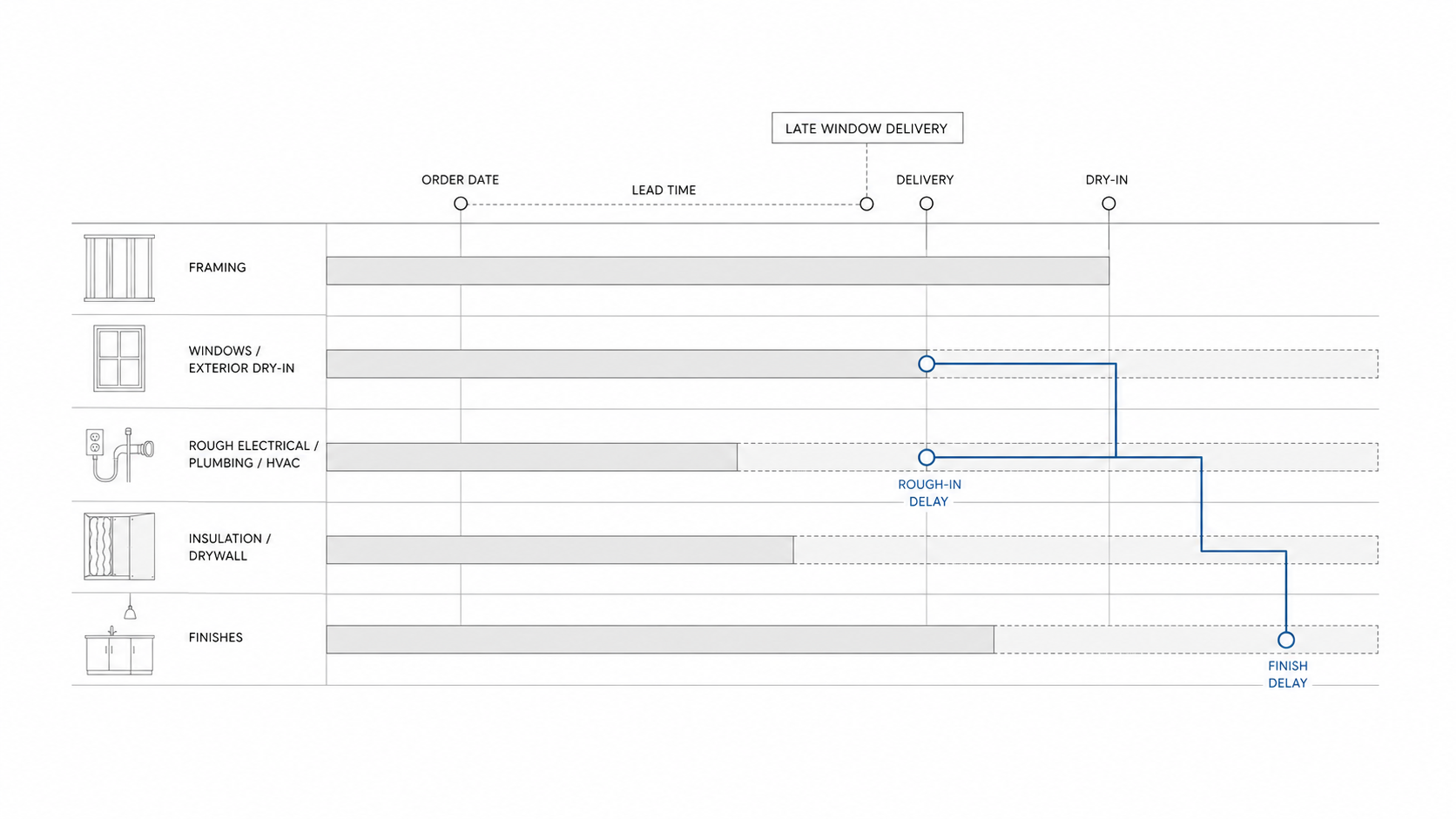
Illustration by ArchitectureCourses.org. A delayed window package can hold up dry-in, rough-ins, drywall, and finish work, which is why procurement is part of construction management.
Windows are the classic example, but they are not the only one.
Exterior doors. Special-order tile. Panelboards. Plumbing trim. Engineered lumber. Certain HVAC equipment. The items vary, but the pattern stays the same: one delayed package knocks rough-in, insulation, drywall, and finish sequence out of alignment.
You need a live procurement list. Order date. Confirmed lead time. Actual promised ship date. Site arrival date. Condition on arrival.
That sounds administrative. It is. It is also one of the most practical things an owner-GC can do.
If the delayed item is tied to framing openings, roof penetrations, or exterior dry-in, the problem gets worse. That is where windows in construction, exterior roof sheathing, and exterior wall sheathing become useful support pages instead of abstract reading.
Quality Control Is a Habit
You do not need to hover over every crew all day. You do need a few consistent habits.
- Check the first hour of a new task, not just the end of it
- Require photos of hidden work before it disappears behind finishes
- Approve one mockup before letting repetitive work run full speed
- Mark up questions with photos instead of sending vague texts
That first-work check matters a lot. One wrong flashing detail repeated twenty times is not a quality issue. It is a management issue.
If framing changes are on the table, keep structural conversations anchored in something specific. King and jack stud framing and load-bearing vs non-load-bearing walls are useful for that. Not because a homeowner should be designing headers alone, but because it is easier to manage subs when everyone is discussing the same thing.
What Not to DIY
There is nothing wrong with doing some work yourself. Demolition, paint, cleanup, some finish carpentry, site organization — those can all make sense if you are careful.
But structure, service-entry electrical, gas work, major waterproofing, and steep roofing are where owner confidence outruns owner skill. That is where a mistake becomes expensive, dangerous, or both.
If you are changing openings, removing walls, or making structural changes to a one-story house, read how to tell if a wall is load-bearing in a single-story house before anyone starts cutting. It will not replace an engineer or qualified framer, but it will stop some bad assumptions early.
What Surprises People
Not the hard days. Those are expected.
What surprises people is how much of the job is administrative even when the project is physically simple. Calls that need to happen before 8 a.m. Deliveries that need someone there. Missing signatures. Scope gaps. A crew that is technically ready but still missing one answer that nobody thought to get last week.
That is why some owner-builders do well on modest, tightly scoped jobs and fall apart on larger ones. The problem is not that they are lazy. The problem is that they thought the job was mostly construction. It is mostly coordination.
Should You Do This
| You may be a good fit | You should probably hire a GC |
|---|---|
| You can make decisions quickly and keep them made | You change your mind often once finishes and details appear |
| You can give the project real hours every week for months | Your schedule is already full and unpredictable |
| You stay reasonably calm when deliveries, schedules, and people go sideways | Conflict and negotiation drain you fast |
| You are comfortable with paperwork, tracking, and follow-up | You already avoid paperwork and administrative detail |
| You have enough contingency and can absorb delays | The budget only works if nothing goes wrong |
If you read the right-hand column and keep thinking, "That is probably me," that is useful information.
Being your own GC can work well on the right project with the right temperament. But a stalled job costs more than a management fee. And the management fee comes with someone who already knows the inspection sequence, already has the sub relationships, and already made the procurement mistakes on a previous project. That is what you are actually paying for.
FAQ
Do I need a contractor license to manage my own project?
In many U.S. jurisdictions, homeowners can act as their own GC on their primary residence. But there are rules and disclosures that vary by state and sometimes by county. Check with your local building department first. Some states limit what you can self-perform even on your own house.
How much does being your own GC save?
The GC fee on residential work is typically 10–20% of the project cost. You can keep some of that. How much depends on how well you manage procurement, scheduling, and scope control. A well-run owner-managed job might save 8–12% net. A badly run one can cost more than hiring a GC would have, because rework, idle crews, and delayed decisions add up quietly.
What is the most common reason owner-managed jobs stall?
Procurement. One delayed item — windows, a panelboard, engineered lumber — and the framing crew finishes, the next trade cannot start, and the schedule never fully recovers.
Should I use written contracts with subs?
Yes. One page with clear inclusions, exclusions, payment milestones, and inspection responsibilities prevents most disputes. Verbal agreements work until they do not.
What should I never DIY?
Service-entry electrical. Gas lines. Structural changes without engineering. Major waterproofing. Steep roofing.
How do I keep inspectors from failing my work?
Call before the critical stage. Ask what they commonly fail on similar jobs. That one conversation prevents most reinspection delays.
Read Next
Building Construction Process — the full sequence from site work through finishes. Useful for understanding what stage you are managing at any given point.
Construction Planning and Scheduling — the scheduling side in more detail. The three-week lookahead method starts here.
Cost Plan Construction — cash flow planning, not just budget totals. This is where most owner-builders need the most help.
House Framing — if your framing vocabulary is weak, this is the fastest way to get it where it needs to be before the framer shows up.
Residential Building Codes — the code requirements that affect daily job decisions. Read before your first inspection, not after your first failure.