

Construction is risk management with mud on your boots. Jobs don’t go sideways because someone forgot a task. They go sideways because one of these three things got ignored:
- Water: drainage, flashing, and sequencing done wrong. The building gets wet, then everything gets expensive.
- Decisions: vague scope, late changes, “we’ll figure it out later.” Later is the most expensive time.
- Coordination: trades stacked in the wrong order, long-leads not ordered, inspections missed, rework piles up.
This guide is the process the way people actually experience it: what happens, what usually breaks, and what pros do to keep it boring.
Building Construction Process:
What Happens When (and Who Does What)
How to not screw this up when you’re new
What Actually Breaks Projects (and How to Avoid It)
You don’t learn construction evenly. You learn by not creating messes you can’t afford to fix. So stop trying to be good at everything.
If you’re new, hold onto three things:
- Water first. If you don’t understand how water gets out of a wall, off a roof edge, and away from the foundation, you’re gambling.
- Air second. If you can’t point to where the air barrier is and how it stays continuous at windows, top plates, rim joists, and penetrations, you’re not done.
- Order third. Doing the right work in the wrong order is how you pay twice.
Before you cover anything up, pause: “Will I need to see this again?” If yes, take photos, measure, mark it, write it down. You will forget. Everybody does.
What to ignore early: brand wars, “best product” debates, and chasing perfect finishes. A mid-tier system installed right beats a premium system installed sloppy.
When to get help: anything structural, waterproofing-critical, or code-triggering. Beams, trusses, load-bearing walls, foundation walls, fire separation, egress, gas, electrical service. Don’t wing it.
One last pro move: slow down at transitions. Most failures happen at edges: windows, corners, roof-to-wall, deck ledgers, penetrations, bottom-of-wall.
Mental rule: make water boring, make air continuous, and don’t hide problems behind drywall.
We made a free PDF checklist so you don’t miss the basics. Download it now: Building Construction Process: A Straight Checklist for Homeowners.
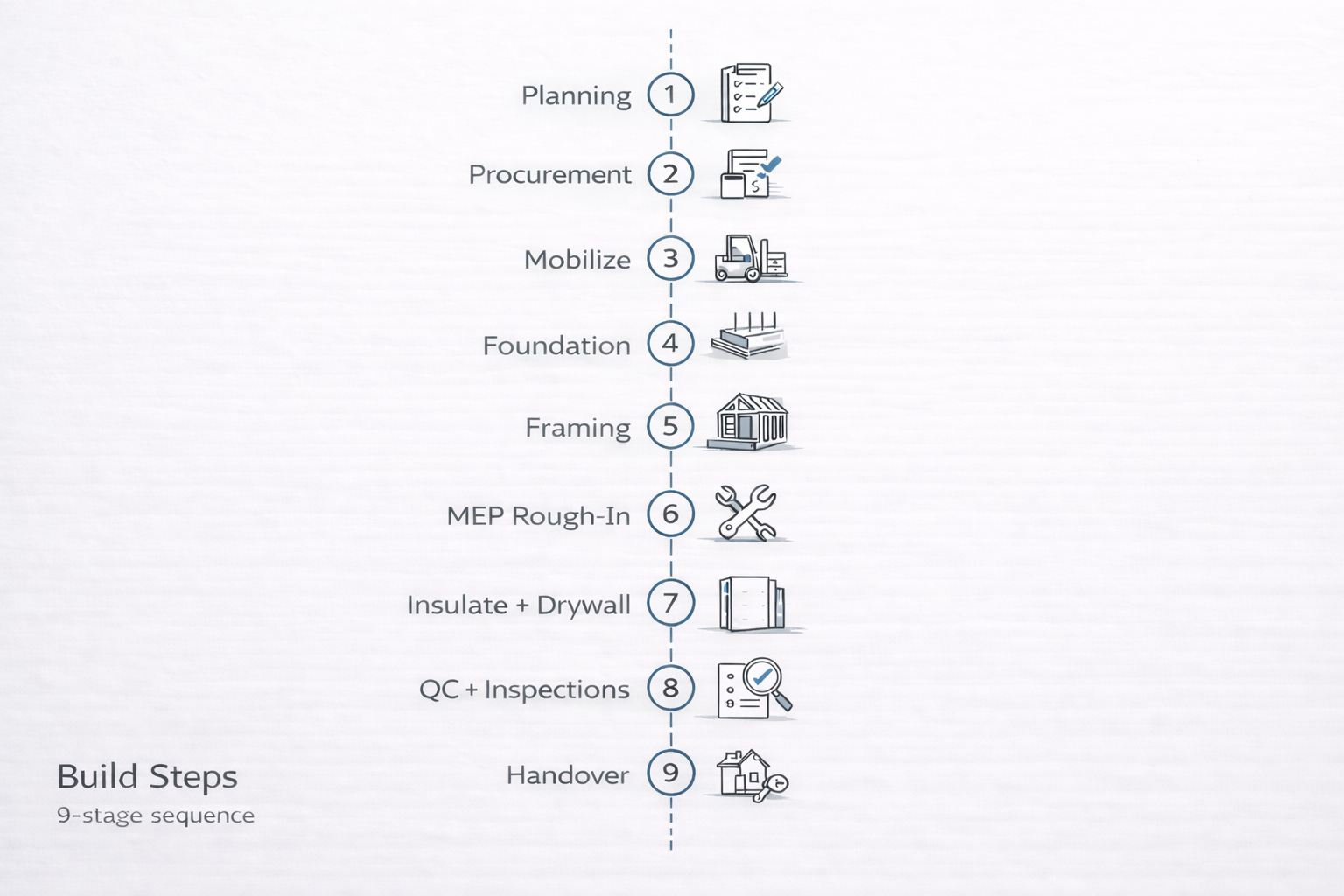
1) Planning and pre-construction
Pre-con is where you “buy” your future problems. If you skip decisions here, you pay for them later with rework.
The main rookie mistakes are boring: not confirming utilities, not checking drainage, not locking the scope, and starting demo/excavation before permits and inspections are clear.
If you only do one adult thing in pre-con: walk the site after a hard rain (or during snowmelt). Where water sits now is where water will fight you later.
What a professional setup looks like
- Scope in writing: what’s included, excluded, and what counts as a change. This is how you stop the slow bleed of “small asks.”
- Site reality check: access for trucks, spoil pile plan, where water goes during rain, where you get temp power and water.
- Utilities confirmed early: service locations, capacity, and lead times. Start here if you’re fuzzy: utilities and infrastructure.
- Budget with contingency: not optional. Weather and unknowns are normal.
Field mistakes that cause expensive surprises
- “We’ll fix grading later.” Later becomes water against the foundation, then cracks, leaks, and angry calls.
- Permits treated like admin work. Miss one inspection and the schedule stalls. Trades scatter. Restart costs money.
- Ordering late. Windows, doors, electrical gear, HVAC units, engineered lumber, even garage doors can decide your schedule.
If you need a cost baseline before you talk yourself into fantasy numbers, start with residential construction costs per square foot.
2) Procurement
Procurement isn’t shopping. It’s risk management.
The two ways people get wrecked: substitutions (same-looking product, different performance) and late deliveries that force you to “just install something” to keep moving.
- Long-lead list: make it early, update it weekly, assign one person to own it.
- Approvals: slow approvals = missed production slots.
- Don’t mix random systems: tape + WRB + sealant + primer. If the manufacturer says “use our primer,” that’s chemistry, not vibes.
3) Mobilization
Mobilization is where jobs either start clean or start messy and stay messy.
You want three things before real work begins: access, dry storage, and a simple site layout (dumpster, porta, tools, deliveries don’t block work).
Beginners lose weeks here by not thinking through where things go. If drywall gets delivered early and sits damp, you just bought mold risk.
Safety isn’t “extra.” It’s what keeps you working. If you want the official baseline, use OSHA.
4) Site prep and foundation
This is where people either respect water or get humbled by it.
Common screw-ups: grading that sends water toward the house, footings poured on sloppy soil, no drainage plan, and rushing cure time because “we’re behind.”
If you’re trenching for utilities and infrastructure, don’t treat trench safety like optional paperwork. Soil collapses are fast and ugly. Use the official guidance: OSHA Trenching & Excavation.
5) Framing and dry-in
Framing looks like progress. It also hides future mistakes fast.
Real-world pain points: out-of-square that snowballs into windows and doors fighting you, missing blocking where it matters, and structure changes made casually (“we’ll just cut that”).
If you’re touching anything structural (beams, trusses, load-bearing walls), that’s not the time to “learn by trying.” That’s when you get help.
The goal is simple: get the structure up, then get it protected. The second part gets underestimated.
- Water control: WRB and flashing done with real overlaps and real sequencing, not “good enough.”
- Air control: continuity matters more than the brand of tape. Air leakage is comfort, but it’s also moisture transport.
6) Enclosure
This is the phase that decides whether your building lasts or quietly rots.
Most enclosure failures are not “bad siding.” They’re bad flashing, WRB laps reversed, no drainage path, and air barrier discontinuity.
If you don’t know what “shingle fashion” means (top overlaps bottom so water sheds), stop and learn it before you wrap anything. One reversed lap can feed water behind the whole wall.
Manufacturer PDFs that actually matter (warranties and inspectors lean on this stuff):
- WRB install (Tyvek PDF): DuPont Tyvek HomeWrap installation guidelines. This is the “how to lap, tape, detail openings” baseline.
- Integrated sheathing (ZIP PDF): ZIP System installation manual. The unsexy stuff that causes failures: surface prep, roller pressure, temperature limits, corners, penetrations.
A detail that keeps showing up in leak stories: roof-to-wall intersections without kick-out flashing. Kick-out flashing basics.
7) MEP rough-in
MEP is where sequencing kills you. Trades show up, each one wants to move fast, and suddenly your air barrier is Swiss cheese.
One rule that saves a lot of pain: every penetration needs a plan. Not later. Now.
For air sealing details that hit the real connection points (sill plate, rim joist, top plate, penetrations), use the official guide: DOE/Energy Star Air Sealing Guide for Contractors (PDF).
8) Insulation and interior finishes
Finishes are where people blow budgets trying to “make it nice” while ignoring the stuff that keeps it dry and comfortable.
The real trick isn’t premium materials. It’s flat, plumb, dry. If substrate is bad, everything looks bad.
Also: keep photos of everything before you close walls. Future-you will need them. Everybody does.
9) Monitoring, inspections, and quality control
Pros don’t “trust the process.” They verify the work before it gets buried.
- Daily: safety, housekeeping, water exposure plan.
- Weekly: schedule look-ahead, long-lead review, inspection calendar, change order log.
- Quality gates: window flashing review before cladding, air-seal walkthrough before insulation, mechanical start-up checks before handover.
Don’t manage by vibes. Track schedule, change orders, inspections, and photos. If you can’t explain what changed and why, you’re about to have a fight you can’t prove.
Download our free PDF: Commercial Building Construction Process (Start to Finish).
Completion and handover
Handover isn’t “we’re done.” It’s punch list, documentation, and teaching the owner how not to break the building.
- Punch list: finish issues, missing parts, adjustments.
- Closeout package: warranties, manuals, inspection sign-offs, as-builts if available.
- Walkthrough: shutoffs, filters, basic maintenance schedule, what to watch in the first season.
If you don’t get a certificate of occupancy where required, you’re not “basically finished.” You’re not legal to occupy.
Final words!
What Actually Breaks Projects (and How to Avoid It)
Construction isn’t complicated because the steps are mysterious. It’s complicated because small misses turn into big bills once you bury them behind drywall, siding, or concrete. Most “disasters” aren’t one huge mistake. It’s the same few failures repeating: water management, air leaks, and doing things in the wrong order.
FAQ
What’s the single most expensive “small mistake”?
Water detailing. Bad flashing and bad drainage don’t look dramatic on day one. Then you get rot, mold, and callbacks that cost more than the original install.
Which phase is worth slowing down?
Pre-construction. If scope, utilities, and long-leads aren’t nailed early, the job turns into constant improvisation.
Why do projects go over budget even with a plan?
Because plans don’t control reality. Sequencing, procurement lead times, site conditions, and rework do. Rework is the quiet budget killer.
Where do homeowners get burned the most?
Late changes, allowances that were too low, and trusting finish samples without seeing them in the real light and real room. Also: assuming “the siding is the waterproofing.” It isn’t.
Where can I learn the basic sequence in plain language?
Start with building a house step by step, then come back here for the “what breaks in real life” layer.
Official resources
These are the links that matter when you need something enforceable, current, or citation-grade. Not opinions.
- Codes (model codes): International Code Council (ICC) — home for the IRC/IBC/IECC code families. Clean starting point before you argue with an inspector.
- Code library: ICC Digital Codes — the readable code text (jurisdictions adopt versions, but this is the source library).
- Energy code support: U.S. DOE Energy Codes — official explanations, compliance tools, and links to model energy-code paths.
- High-performance program requirements: ENERGY STAR — air sealing + performance targets and certified product categories used in real programs.
- Jobsite enforcement basics: OSHA — safety rules that get jobs fined, shut down, or worse.
- Lead rules for older homes: U.S. EPA Lead (RRP) — if you touch older houses, this can bite hard.
- Hazard guidance: FEMA — flood, wind, wildfire guidance that affects siting and retrofit priorities.
- Forensics and failure research: NIST Publications — fire, materials, performance, and building-failure research when you want evidence, not opinion.
Manufacturer installation guides
These are the “do it this way or your warranty is useless” documents. If you’re new, this is where you stop guessing.
- ZIP System (HUBER) — sheathing + WRB system; their tape/roller/temperature rules are the difference between “sealed” and “leaks.”
- DuPont Tyvek — WRB details and compatible flashing guidance; widely used and easy to spec.
- 3M — tapes and sealants with substrate and temperature limits spelled out (helps you avoid “wrong tape on wrong surface”).
- Henry Company — self-adhered membranes, WRBs, roof/wall waterproofing; strong on sequencing and termination details.
- Sika — sealants and adhesives; data sheets help you avoid compatibility failures.
- Tremco Sealants — joint sealant systems and movement reality for transitions.
- W. R. MEADOWS — concrete curing, jointing, and waterproofing; useful for “how to not ruin concrete during cure.”
Standards bodies
These are what pros cite in specs and reviews, especially once you leave DIY territory.
- ASHRAE — energy and building performance standards that drive commercial compliance and envelope/mechanical coordination.
- NFPA — fire codes and referenced standards; shows up fast once you touch assemblies, egress, or commercial work.
- American Wood Council (AWC) — wood framing spans, bracing, and code-referenced design resources used by engineers and officials.
- American Concrete Institute (ACI) — concrete standards and best practice that drive specs and QC (even on small jobs when things matter).