

A 1990s kitchen can look worse than it works.
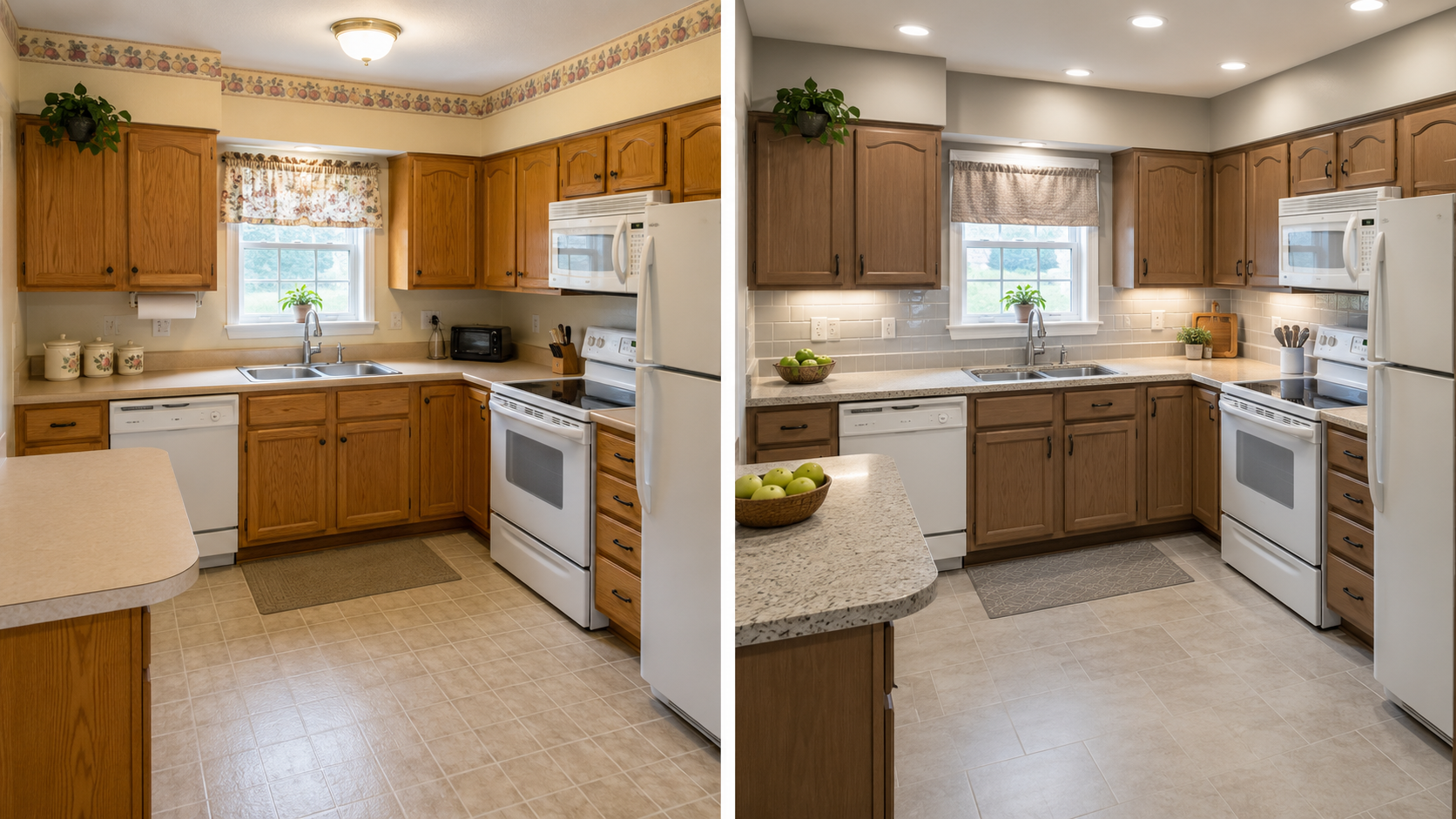
That is the trap. The oak cabinets, laminate counters, beige floor, fluorescent light box, white appliances, and brass hardware all point to the same decade. But behind those dated finishes, the kitchen may still have a useful footprint, decent storage, good daylight, and a family-room connection that is hard to beat.
The wrong remodel starts with cabinet color. The right remodel starts with the things that control the project: layout, cabinet boxes, soffits, flooring, lighting, appliance locations, and what the old kitchen is hiding.
This is especially true in many 1990s houses, where kitchens were often opened to family rooms but still carried older builder details. Some need a full remodel; some only need a careful refresh. The expensive mistake is treating both kitchens the same.
The Quick Answer
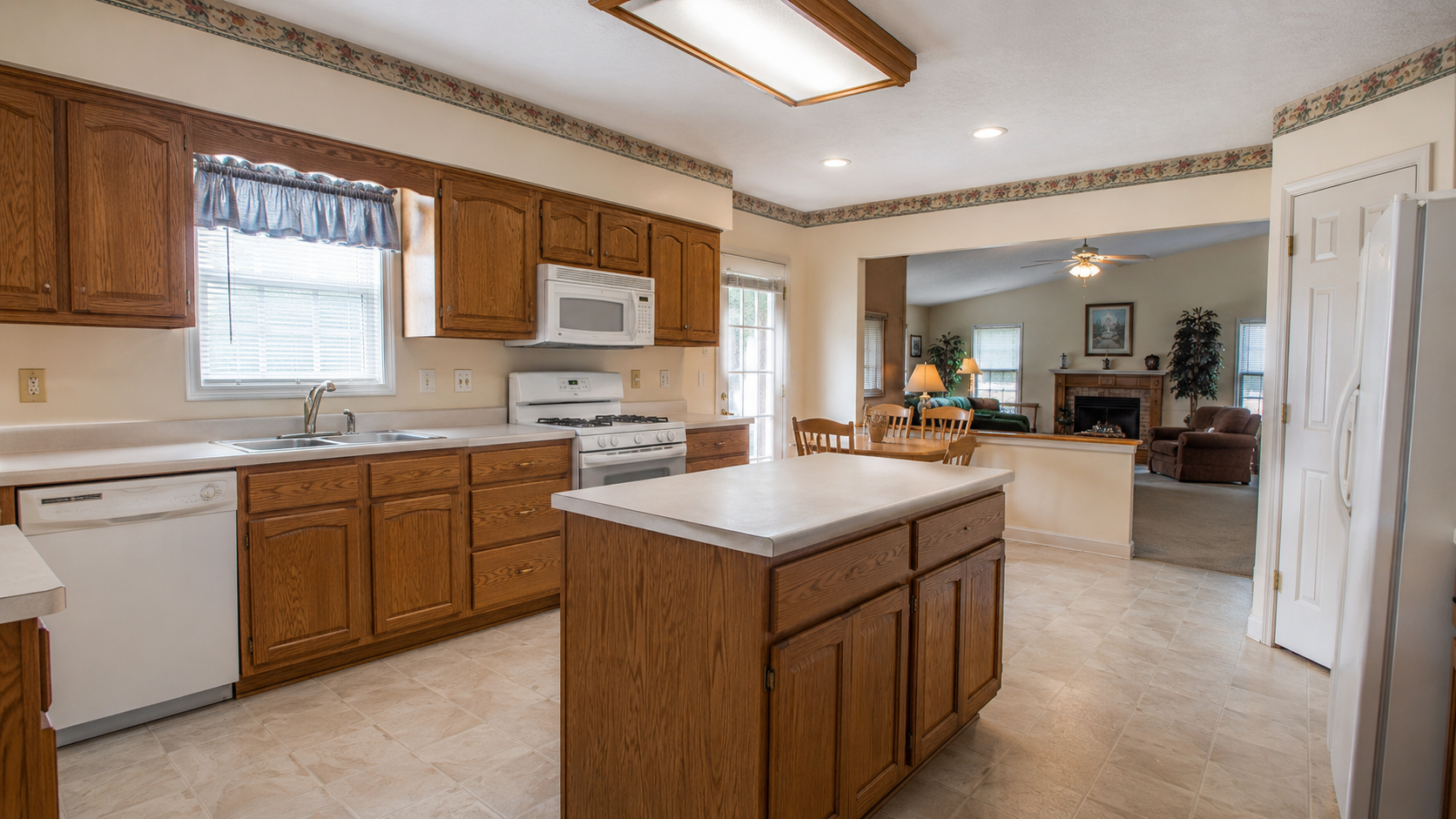
Start a 1990s kitchen remodel by deciding whether the kitchen needs a refresh, a partial remodel, or a full layout change. If the layout works and the cabinet boxes are solid, update lighting, hardware, counters, backsplash, wall color, and flooring before replacing everything. If the cabinets are damaged, the soffits hide old utilities, the floor stops at the cabinet line, or the island or peninsula blocks circulation, plan for a larger remodel from the beginning.
| Project type | Best when | Watch for |
|---|---|---|
| Refresh | The layout works and the cabinets are solid, but the room looks dated. | Lighting, hardware, wall color, faucet, and small finish updates may not fix deeper layout problems. |
| Partial remodel | You are keeping the layout but changing counters, backsplash, lighting, flooring, or cabinet finish. | New counters and floors can lock you into the old cabinet footprint. |
| Full remodel | The cabinet layout, storage, island, appliances, or circulation do not work. | Cabinet removal can trigger flooring, electrical, plumbing, drywall, and ceiling work. |
What Makes a 1990s Kitchen Look Dated?
Most 1990s kitchens do not look dated because of one single thing. They look dated because many original choices are still stacked together.
- Honey oak or orange-toned cabinets
- Laminate counters with rounded edges
- Short tile backsplashes
- White or black appliances
- Fluorescent ceiling boxes
- Polished brass or shiny gold hardware
- Beige vinyl, ceramic tile, or builder-grade flooring
- Oak trim, oak floors, and oak cabinets all in the same view
- Small islands or peninsulas that interrupt traffic
- Soffits above upper cabinets
- Busy wallpaper borders, warm wall colors, or heavy window treatments
The important part is that these are not equal problems. A cabinet color problem is different from a layout problem, and a lighting problem is different from a flooring problem. If you treat every dated surface as a demolition target, the remodel gets expensive fast.
First, Decide: Refresh, Remodel, or Gut Job?
Before you buy tile, counters, paint, or appliances, name the scope. A refresh keeps the kitchen mostly intact. A partial remodel keeps the basic layout but changes major finishes. A full remodel changes the cabinet plan, island, appliance locations, walls, plumbing, electrical, flooring, or ceiling.
This matters because 1990s kitchens often sit on the edge between "easy update" and "real construction." One decision can push the whole project over the line.
It is probably a refresh if:
- The cabinet layout works.
- The drawers and doors are solid.
- The island or peninsula does not block traffic.
- The flooring can stay for now.
- The appliances fit their current openings.
- You are mainly bothered by color, lighting, hardware, and dated finishes.
It is probably a partial remodel if:
- You are changing counters and backsplash.
- You are painting, refinishing, or refacing cabinets.
- You are replacing appliances but keeping their locations.
- You are removing a fluorescent light box or adding recessed lighting.
- You are changing flooring but keeping the cabinet footprint.
It is probably a full remodel if:
- The cabinet layout frustrates you every day.
- The sink, range, and refrigerator relationship is poor.
- The island or peninsula blocks the family-room connection.
- The floor stops at the old cabinet line.
- The soffits need to come out.
- You need new electrical, plumbing, ventilation, or appliance locations.
Once you know the scope, the design choices get easier. You stop asking "What color should the cabinets be?" and start asking "What decisions will still make sense five years from now?"
The Kitchen Doesn't End Where the Cabinets Do
The single feature that defines a 1990s kitchen is the one most remodels forget to plan for: it opens to the family room. That open kitchen-family room was the decade's big idea, and it means your kitchen is really half of one large space — and you cannot remodel half of a room without showing the seam.
This is the mistake I see most often: a crisp new white kitchen that dies at the carpet line, with the family room beside it still wearing 1995 — the oak-trimmed fireplace, the orange stair railing, the beige carpet, the brass ceiling fan. From the new kitchen you are looking straight at the old house. The before-and-after photo looks great cropped to the kitchen; standing in the actual room, the two halves argue.
So before you set the budget, decide where the eye actually stops. Walk to the far side of the family room and look back. Everything you can see from the kitchen is part of the visual project, whether or not it is part of the construction. That does not mean gutting the family room. It means the materials have to hand off: the new kitchen floor needs a deliberate transition to the family-room floor, the wall colors need to relate, and the loudest 1990s objects in the sightline — usually the fireplace surround, the railing, and the trim — need at least a coat of paint so they stop fighting the new kitchen.
Sometimes naming this shrinks the project, because you realize the kitchen finishes only have to be as upscale as the room they sit in. Sometimes it grows it, because the floor or the fireplace turns out to be inside the frame. Either way, decide the real boundary on purpose. The cabinets are where the kitchen ends. They are not where the remodel ends.
Check the Layout Before Choosing Finishes
A 1990s kitchen remodel should start with movement. Stand in the kitchen and watch what happens during a normal day. Where do people enter from the garage? Where do groceries land? Where does someone stand at the sink while another person opens the refrigerator? Does the dishwasher block the main aisle? Does the island help prep, or does it just sit in the way?
Many 1990s kitchens were designed around family life, but not all of them were planned well. Some have a useful kitchen-family connection; others have a peninsula that cuts the kitchen off from the room it is supposed to serve.
Good layout signs
- The kitchen connects naturally to the family room or breakfast area.
- The sink, range, and refrigerator are close enough without crowding each other.
- There is enough landing space beside major appliances.
- People can pass behind the cook without squeezing.
- The island or peninsula gives useful prep space instead of blocking circulation.
- There is room to add drawers, pantry storage, or a better trash location.
Bad layout signs
- The refrigerator opens into the main walkway.
- The island is too small to work but too large to ignore.
- The peninsula traps people inside the kitchen.
- The dishwasher blocks cabinet access when open.
- The range has poor ventilation.
- The kitchen has too many doors and not enough continuous counter space.
Peninsula or Island?
A lot of 1990s kitchens were built with a peninsula. Some work; some make the kitchen feel boxed in even when the house is supposed to be open.
Do not remove a peninsula just because islands look better in photos. First check traffic, seating, prep space, electrical, flooring, and cabinet storage, because a badly planned island can create the same problem in a newer shape. Before I commit to an island, I tape its footprint on the floor and live around it for a week — it is the cheapest way to find out whether the aisles actually work before anyone pays for cabinets.
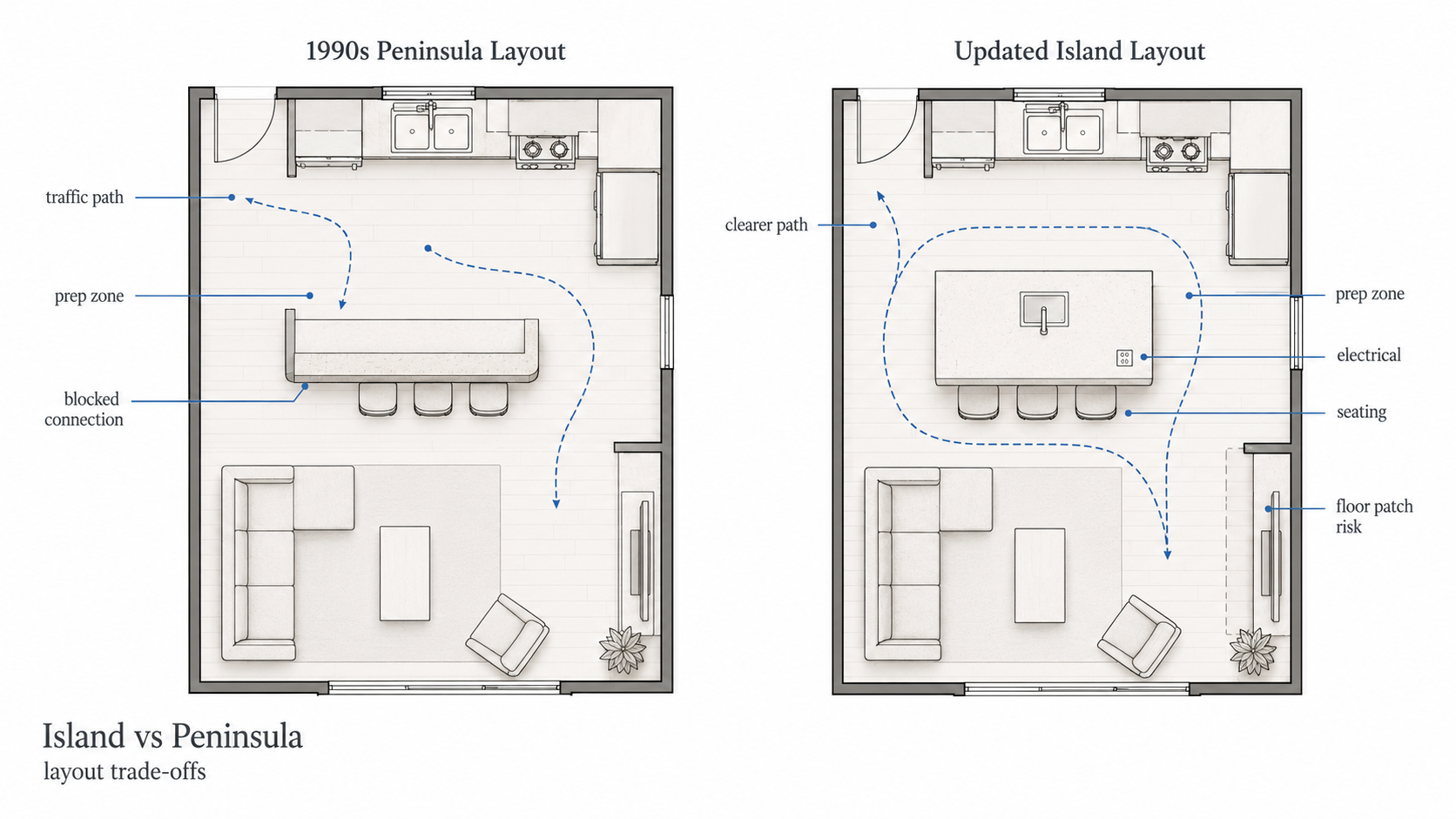
A peninsula-to-island change is worth considering when it improves the connection to the family room, creates better prep space, and gives the kitchen a clearer traffic path. It is a bad trade when it removes too much storage, creates a narrow aisle, or triggers floor patching that was not in the budget.
Oak Cabinets: Keep, Paint, Refinish, or Replace?
The cabinets are the emotional center of most 1990s kitchen remodels. Honey oak can make the whole kitchen feel dated, but oak cabinets are not automatically the problem.
First check the cabinet boxes, drawers, hinges, sink base, layout, and door quality. If the boxes are solid and the layout works, you may be able to keep, refinish, paint, or reface them. If the boxes are swollen, drawers are failing, or the layout is wrong, new paint only delays the real decision.
For the deeper cabinet decision, work through 1990s oak kitchen cabinets before you choose paint, stain, refacing, or replacement.
Keep the cabinets when:
- The layout works.
- The cabinet boxes are solid.
- The drawers open cleanly.
- The oak tone can be balanced with better lighting, counters, backsplash, and wall color.
Paint or refinish when:
- The cabinets are structurally good.
- The color is the main problem.
- The layout is worth keeping.
- You are willing to pay for proper prep or do the prep slowly yourself.
Replace when:
- The layout does not work.
- The sink base or lower cabinets are damaged.
- The drawers and storage are poor.
- You are moving appliances, plumbing, or walls.
- The old cabinet footprint will expose flooring problems anyway.
The Soffit and Ceiling Problem
Soffits are one of the most important 1990s kitchen remodel clues. Some are empty boxes that filled the gap above shorter upper cabinets. Others hide ducts, wiring, plumbing, exhaust runs, or structural conditions, and you cannot tell from the outside. I have opened a soffit expecting an empty box and found the upstairs bathroom's drain line running through it.
This is why removing soffits should not be priced like a simple cosmetic change. Once the soffit is opened, the job can become drywall, electrical, HVAC, plumbing, ceiling repair, cabinet redesign, and lighting work.
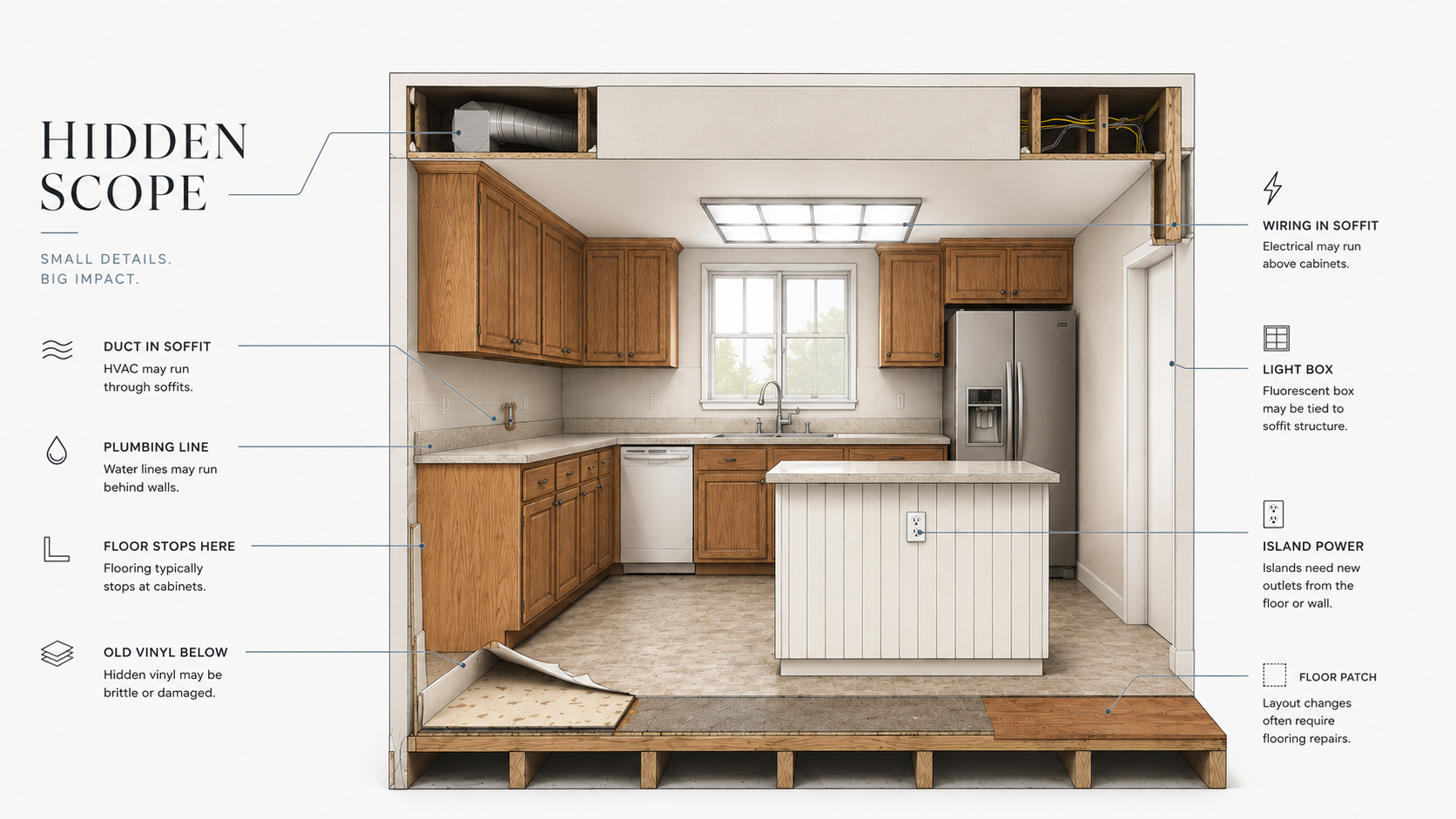
Before removing a soffit, ask:
- Does it hide ductwork?
- Does it carry electrical wiring?
- Does it hide plumbing from a bathroom above?
- Will taller cabinets fit if it is removed?
- Will the ceiling need patching across the whole kitchen?
- Will old lighting locations need to move?
There is also a cheap middle path that gets overlooked. If the soffit hides utilities and removing it would start a ceiling project, you can dress it instead of demolishing it — run trim or crown to it, or extend the cabinets up to meet it, so the run reads as intentional full-height cabinetry rather than a dated gap. Done deliberately, that costs a fraction of removal and erases most of the "1990s soffit" look. Keep the old cabinet layout, and the soffit may not be worth touching at all. Replace cabinets and change lighting, and it may be the right time to open it and solve the ceiling properly.
The Flooring Patch Problem
Flooring is the other hidden trap. Many 1990s kitchens have tile, vinyl, laminate, or hardwood that was installed around the cabinets, not under them. If you remove cabinets, an island, or a peninsula, you may find unfinished subfloor, old vinyl, cut tile, height changes, or missing hardwood.
This matters because a cabinet layout change can force a flooring decision. A simple island replacement can become a full kitchen floor project, and a peninsula removal can expose a patch line right where the new traffic path should be.
Do not replace flooring too early
Flooring should usually wait until the cabinet footprint is decided. If you install new flooring before deciding whether cabinets or islands are moving, you may pay once to install it and again to patch it. This is why the order matters: layout first, cabinets second, flooring after the footprint is known.
Lighting Usually Comes Before Cabinet Color
Old lighting makes 1990s kitchens look more dated than they are. Fluorescent ceiling boxes, yellow bulbs, weak recessed cans, and no under-cabinet lighting can push honey oak toward orange and make beige counters look dull. Before deciding that the cabinets must be painted, look at the light.
A better lighting plan may include recessed lighting, pendants over an island, under-cabinet lighting, a cleaner fixture over the breakfast area, and bulbs with a color temperature that does not turn the whole kitchen yellow. Lighting will not fix a bad layout, but it can change how every finish reads.
Counters and Backsplash Can Date the Kitchen Fast
Counters and backsplash sit directly against the cabinets, so they control how the wood looks. If the counter is too yellow, too brown, too speckled, or too busy, the oak will look louder. If the backsplash is short, glossy, patterned, or beige in the wrong way, the kitchen can feel stuck even after hardware and lighting improve.
Choose counters and backsplash after the cabinet decision is clear. If the cabinets are staying oak, pick materials that calm the wood. If the cabinets are being painted, choose counters and backsplash after the paint color has been tested in the actual kitchen light.
Do not buy counters before the layout is settled. New counters lock in the cabinet footprint, so if the island, peninsula, sink, or appliance layout changes later, the counter money may be lost.
Appliances, Ventilation, and Electrical
Appliance replacement looks simple until the openings do not work. A 1990s refrigerator opening may be too narrow, too short, or too shallow for the model you want. A slide-in range may not fit the old counter and cabinet condition cleanly. A dishwasher replacement may reveal damaged flooring or a swollen cabinet side. A microwave-hood combination may not give the ventilation the kitchen really needs.
Check before ordering appliances
- Opening width, height, and depth
- Door swing and traffic clearance
- Electrical requirements
- Water line condition for refrigerator or dishwasher
- Range hood exhaust route
- Countertop cutouts
- Cabinet panels or fillers needed around new appliances
If the remodel includes a new island, plan electrical early. Island outlets, lighting, appliance circuits, and code requirements should not be afterthoughts.
1990s Kitchen Remodel Cost
A 1990s kitchen remodel cost depends less on the decade and more on scope. The same kitchen can be a small refresh, a partial remodel, or a full construction project depending on whether you move cabinets, appliances, plumbing, electrical, flooring, or soffits.
| Project level | Planning range | Best for | Main risk |
|---|---|---|---|
| Small refresh | $1,000–$5,000 | Lighting, hardware, faucet, wall paint, minor repairs, simple decor cleanup | The kitchen may still look dated if counters, flooring, or cabinets are the real issue. |
| Cosmetic update | $5,000–$15,000 | Counters, backsplash, fixtures, some lighting, cabinet hardware, small appliance upgrades | New finishes can lock you into an old layout. |
| Partial remodel | $15,000–$35,000 | Cabinet painting or refacing, counters, backsplash, appliances, flooring, lighting | Flooring, ceiling, and cabinet-condition problems may expand the work. |
| Full remodel | $35,000–$75,000+ | New cabinets, new island, layout changes, soffit removal, electrical, plumbing, flooring repair | The project becomes multi-trade construction, not only a kitchen finish update. |
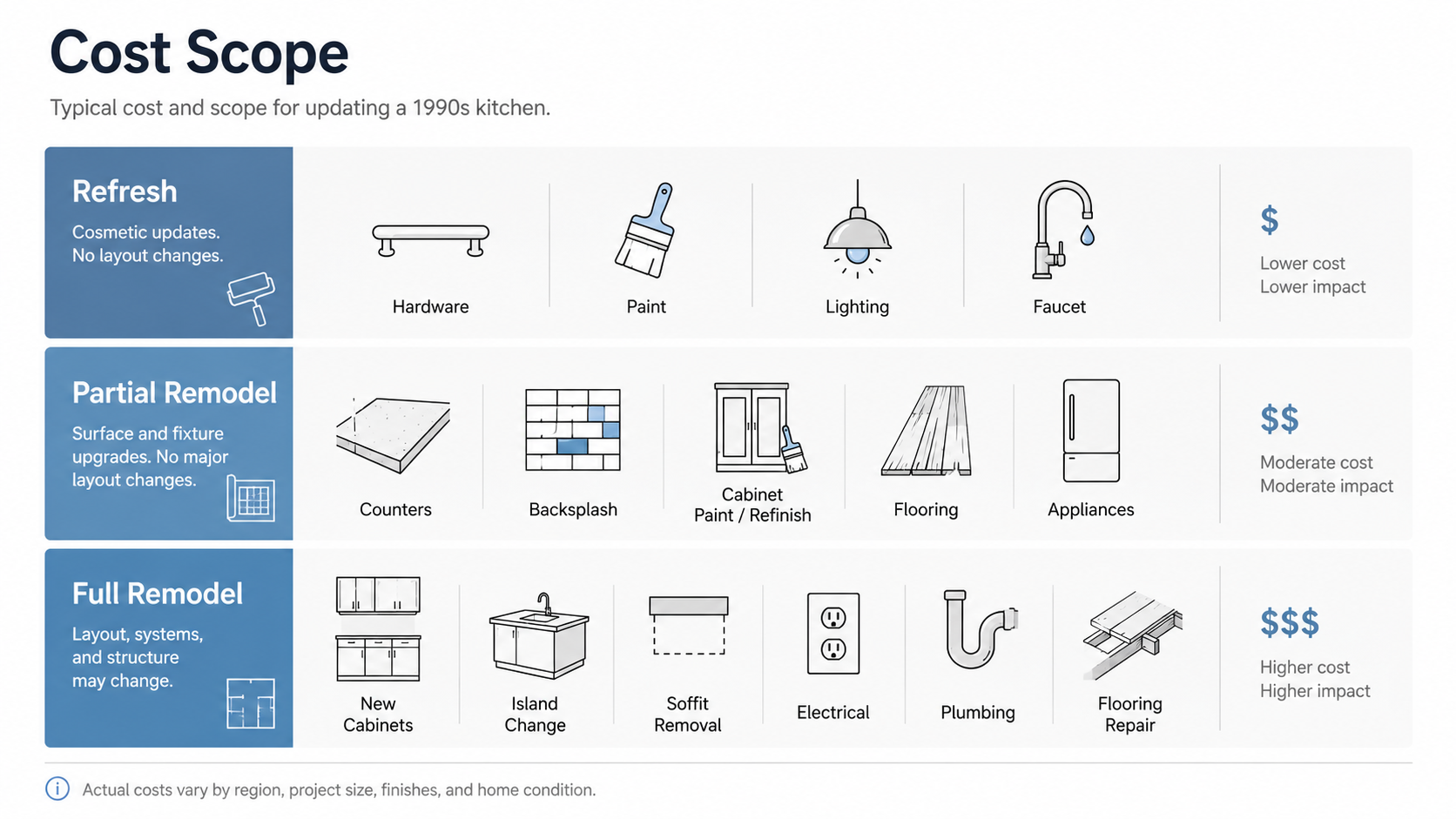
These are planning ranges, not quotes. A small kitchen with solid cabinets and no layout change can stay controlled. A larger kitchen with soffit removal, island wiring, floor patching, new cabinets, new counters, and appliance relocation can climb quickly — a full gut with custom cabinetry and a layout change regularly lands well past $100,000 in 2026, depending on region and finishes.
The cost question should not be "How much does a 1990s kitchen cost to remodel?" The better question is "What scope am I actually buying?"
What to Leave Alone
Not every dated feature needs to be removed. A good remodel edits the kitchen. It does not punish the house for being from the 1990s.
Leave the layout alone if it works
If the kitchen already connects well to the family room, has good traffic, and supports cooking, do not move plumbing and appliances just to create a more dramatic before-and-after.
Leave solid cabinets alone if the budget is better used elsewhere
Solid cabinets with a useful layout may deserve paint, refinishing, hardware, or better surrounding finishes instead of replacement.
Leave some separation if it helps the house
Many 1990s kitchens are already open enough. Removing more walls can bring noise, clutter, cooking smells, fewer upper cabinets, and fewer places for furniture.
Leave flooring until the footprint is decided
New flooring should not come before the cabinet, island, and peninsula plan. Otherwise the floor may need patching after the real remodel begins.
The Best Update Order for a 1990s Kitchen
If the kitchen is not being fully gutted, use this order before spending money:
- Layout: Decide whether the cabinet footprint, island, peninsula, sink, range, and refrigerator locations are staying.
- Cabinet condition: Check boxes, drawers, doors, hinges, sink base, and water damage.
- Soffits and ceiling: Find out whether soffits and old light boxes hide work.
- Flooring: Confirm whether the floor runs under cabinets or stops at the old footprint.
- Lighting: Fix yellow, weak, or badly placed light before judging cabinet color.
- Appliances and ventilation: Confirm openings, circuits, water lines, and exhaust.
- Counters: Choose counters after the cabinet footprint is final.
- Backsplash: Pick it after counters and cabinet color are settled.
- Cabinet finish: Keep, refinish, paint, reface, or replace based on condition and layout.
- Hardware and styling: Finish with pulls, knobs, wall color, and small details.
This order prevents the classic remodel mistake: buying the visible finish first, then discovering that the hidden work controls the budget.
FAQ About 1990s Kitchen Remodels
Is it worth remodeling a 1990s kitchen?
Yes, if the kitchen has a useful location, decent room size, good daylight, and a layout that can be improved without wasting the whole budget. Many 1990s kitchens have better bones than they first appear to have. The key is checking cabinets, soffits, flooring, lighting, and appliance locations before choosing finishes.
What should I update first in a 1990s kitchen?
Start with layout and cabinet condition. After that, check soffits, flooring, lighting, appliances, and ventilation. Finishes such as counters, backsplash, paint, and hardware should come after the footprint is clear.
Should I paint 1990s oak kitchen cabinets?
Paint is a good option when the cabinet boxes are solid, the layout works, and the orange oak tone is the main problem. Do not paint cabinets with swollen bases, failing drawers, bad doors, or a layout you already dislike. For a deeper cabinet-specific decision, see 1990s oak kitchen cabinets.
Can I update a 1990s kitchen without replacing cabinets?
Yes. Better lighting, hardware, counters, backsplash, wall color, and flooring can change the kitchen a lot if the cabinets are solid and the layout works. The kitchen may need replacement only when storage, circulation, damage, or appliance placement cannot be solved with a refresh.
Should I remove a 1990s kitchen soffit?
Remove it only after checking what it hides. Some soffits are empty; others contain ductwork, electrical, plumbing, or exhaust routes. If you are already replacing cabinets and changing lighting, soffit work may make sense. If you are doing a light refresh, dressing the soffit with trim or extending the cabinets to meet it can give the full-height look for far less than opening the ceiling.
How much does a 1990s kitchen remodel cost?
A small refresh may stay around $1,000–$5,000, while a cosmetic update can fall around $5,000–$15,000. A partial remodel can run $15,000–$35,000, and a full kitchen remodel with new cabinets, layout changes, electrical, plumbing, flooring, and soffit work can reach $35,000–$75,000 or more — and a full custom gut can pass $100,000. Local labor, materials, cabinet quality, and scope control the final number.
What is the biggest mistake in a 1990s kitchen remodel?
The biggest mistake is buying finishes before confirming the scope. New counters, new floors, cabinet paint, or appliances can all become wasted money if the layout later changes. Decide the footprint first.
Read This Next
Start with the main 1990s houses guide if you are planning updates beyond the kitchen. For the biggest cabinet decision inside this remodel, read 1990s oak kitchen cabinets before choosing paint, refinishing, refacing, or replacement.