

Most 1990s oak kitchens are not bad because they are oak.
They feel dated because too many things are working against the wood at the same time: orange clear coat, beige floors, yellow wall color, brass hardware, laminate counters, fluorescent light, short backsplashes, and white appliances that make the cabinets look even warmer than they already are.
That is why painting the cabinets is not always the answer. Sometimes paint is the smartest update. Sometimes refinishing keeps the best part of the kitchen. Sometimes the cabinets should be left alone while the lighting, counters, backsplash, and hardware do more of the work. And sometimes the cabinet boxes are not worth saving at all.
Oak kitchens are one of the most recognizable features in many 1990s houses. The right decision starts before color. It starts with cabinet quality, layout, damage, and what else the kitchen will force you to fix.
The Quick Answer
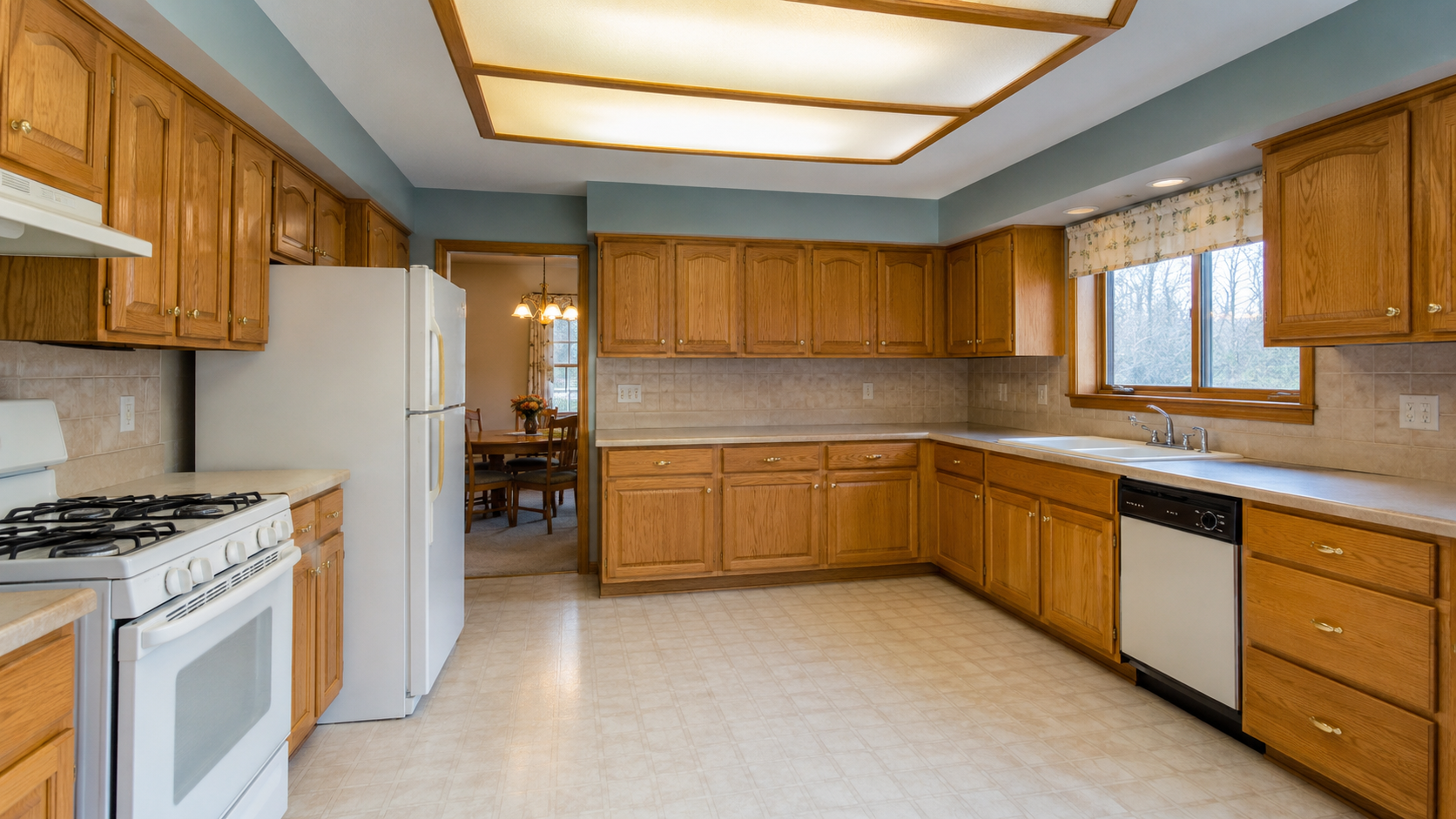
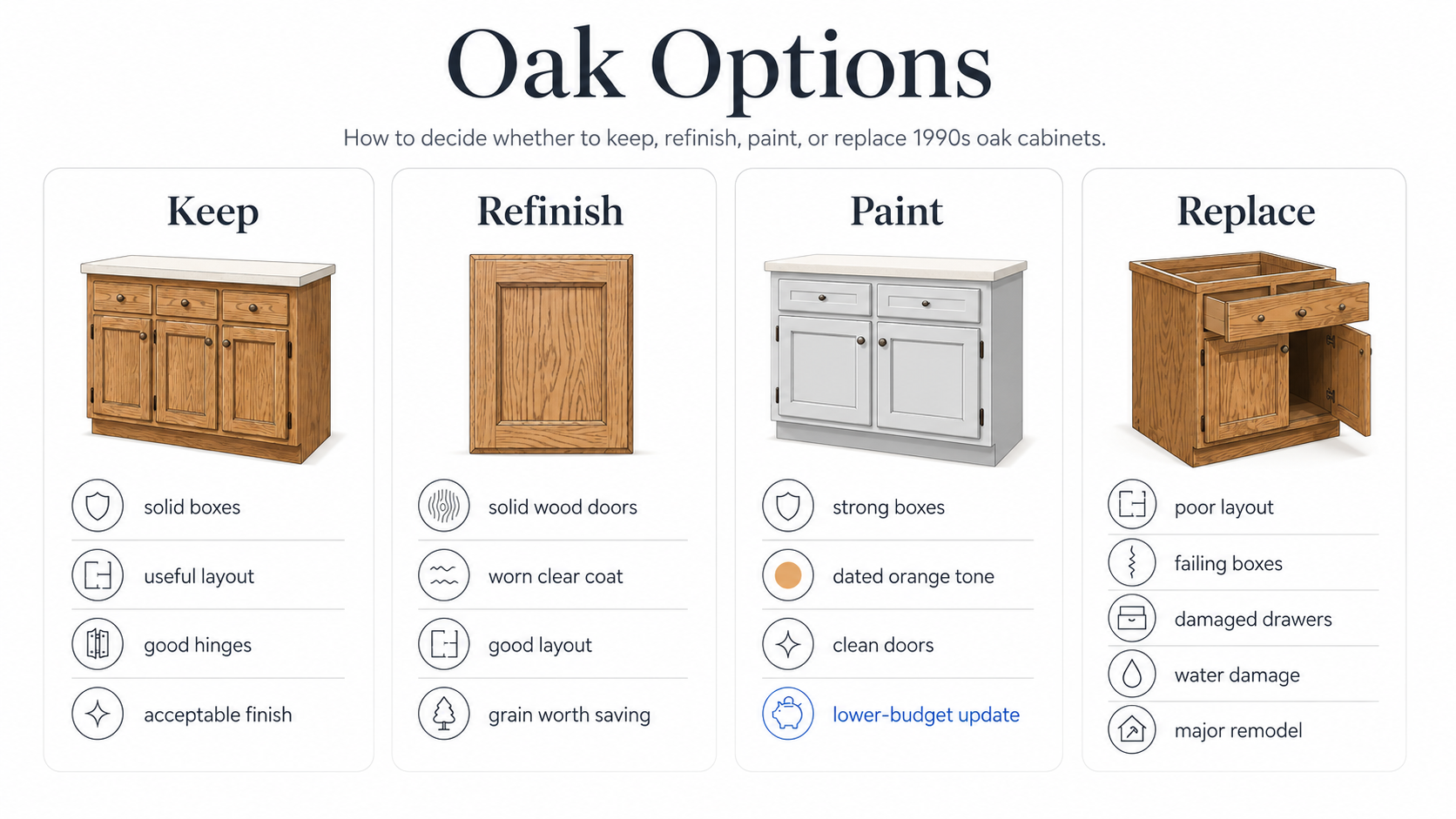
If the cabinet boxes are solid and the layout works, 1990s oak cabinets are often worth keeping, refinishing, or painting. If the boxes are swollen, the drawers are failing, the layout is poor, or the remodel needs major plumbing, flooring, or electrical changes, replacement usually makes more sense.
| Best choice | Use it when | Avoid it when |
|---|---|---|
| Keep | The cabinets are solid, the layout works, and the oak tone can be balanced with better finishes. | The whole kitchen still feels dated after lighting, hardware, wall color, and counter changes. |
| Refinish | The doors are real wood, the grain is worth saving, and the existing clear coat is worn or too orange. | The cabinet boxes are poor, veneer is damaged, or the layout needs to change. |
| Paint | The boxes are good, the layout works, and the oak color is the main problem. | You expect paint to hide bad doors, bad drawers, bad prep, or a bad floor plan. |
| Replace | The layout is wrong, boxes are damaged, drawers are weak, or the remodel affects floors, walls, and utilities. | You only dislike the orange tone and the cabinets are otherwise strong. |
Why 1990s Oak Cabinets Are Everywhere
Honey oak cabinets were common in 1990s suburban kitchens because they were warm, familiar, durable, and easy for builders to sell. They worked with beige tile, white appliances, laminate counters, brass fixtures, and the open kitchen-family room layouts that became popular during the decade.
The problem is not that oak stopped being useful. The problem is that the old finish often went very yellow or orange, and under strong ceiling light that tone bounces into the walls, counters, floors, and trim. Then the whole kitchen feels tired even when the cabinets are still doing their job.
Before you decide they are ugly, check whether the kitchen is actually suffering from three separate problems: too much warm wood, weak lighting, and surrounding finishes that make the oak look worse.
First, Check the Cabinet Quality
Do not start with Pinterest. Start with the cabinet boxes. The first thing I do in a 1990s kitchen is open the sink base, not look at the doors.
A lot of bad cabinet decisions happen because the doors get judged before the structure is checked. Oak doors can look dated and still be attached to strong boxes. They can also look acceptable while hiding swollen bottoms, loose hinges, cheap drawer slides, worn face frames, and water damage near the sink.
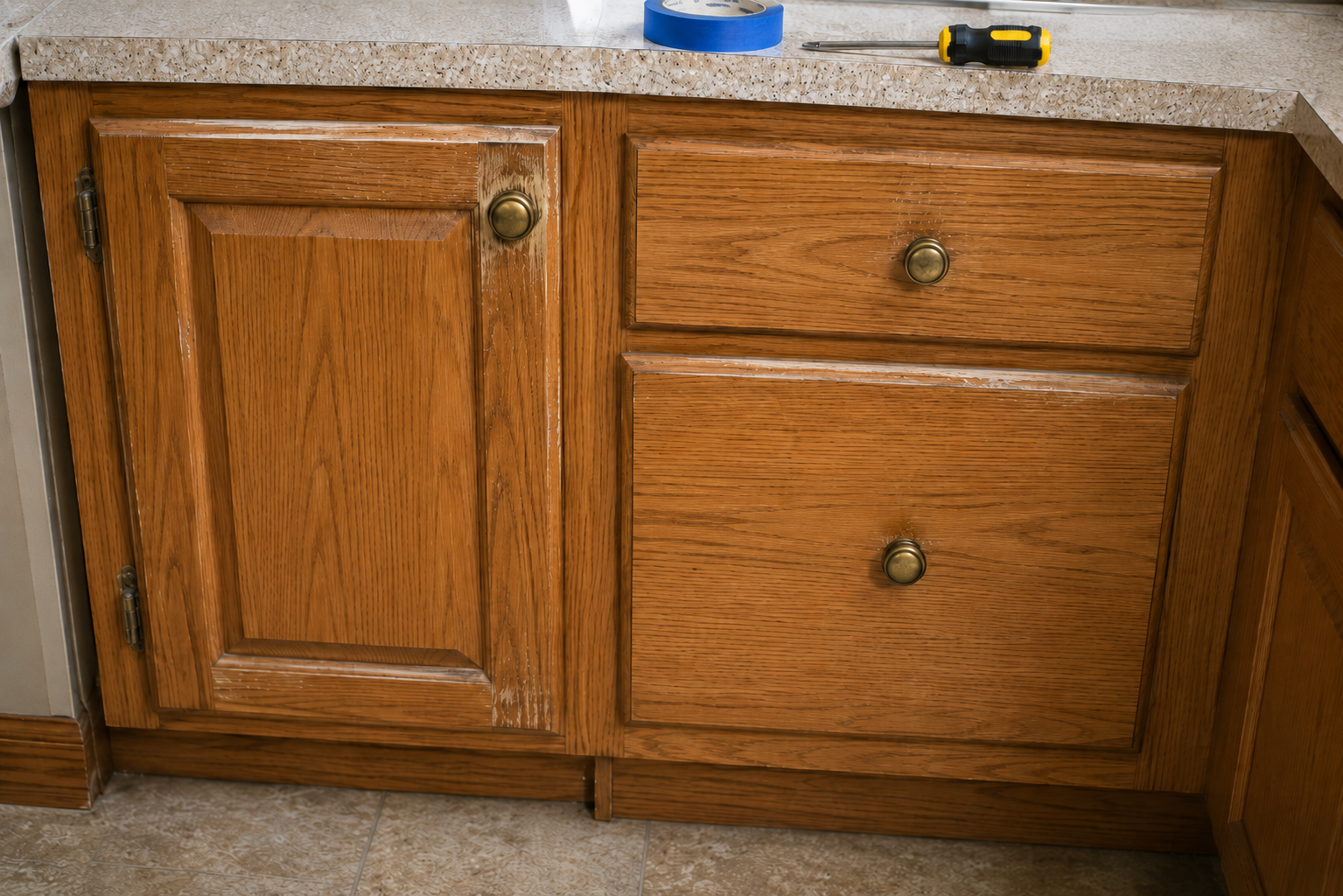
Check these before choosing paint, stain, or replacement
- Cabinet boxes: Look inside base cabinets, especially under the sink and near the dishwasher.
- Drawer boxes: Pull drawers out and check corners, bottoms, slides, and wobble.
- Door material: Solid oak doors are better candidates than thin veneer or damaged panels.
- Hinges: Loose, worn, or odd-size hinges can make a simple update more annoying.
- Face frames: Check for cracks, heavy wear, poor previous repairs, or separating joints.
- Layout: A strong finish cannot fix a kitchen with poor storage, blocked aisles, or a bad appliance triangle.
- Soffits: Check whether the upper cabinets stop under a soffit that may hide ducts, wiring, or plumbing.
- Flooring: Look for tile, vinyl, or hardwood that stops at the cabinet line.
If the cabinets pass those checks, you have options. If they fail, painting may only delay the larger remodel.
Keep the Oak Cabinets When the Bones Are Good
Keeping 1990s oak cabinets makes sense when the layout works and the wood is not the only reason the kitchen feels old. This is common. The cabinets may be solid, the drawers may work, and the kitchen may already have a useful island, pantry, or breakfast area. The dated feeling often comes from the old hardware, weak lighting, beige walls, busy backsplash, laminate counters, and floor color instead.
Signs the cabinets are worth keeping
- The cabinet boxes are solid plywood or sturdy framed construction.
- The drawers open cleanly and do not sag.
- The doors are real wood or good-quality wood veneer.
- The kitchen layout works for cooking and storage.
- The sink base is not swollen or soft.
- You like some warmth in the kitchen and do not want a cold white box.
- The oak grain fits the house better than a painted modern look would.
If you keep the cabinets, the goal is not to decorate around them forever. The goal is to make the rest of the kitchen stop fighting them.
What usually helps without touching the cabinet finish
- Cleaner wall color
- Less yellow lighting
- Simple cabinet hardware
- Calmer countertop material
- Backsplash tile that does not add more orange, beige, or pattern
- Better under-cabinet lighting
- Less busy decor on top of cabinets and counters
This works best when the oak is one warm material in the room, not the dominant color on every surface.
Refinish Oak Cabinets When the Wood Is Worth Saving
Refinishing is different from painting. Paint covers the wood; refinishing keeps the wood visible but changes the old finish. For 1990s oak cabinets, that can mean stripping or sanding the worn clear coat, reducing the orange tone, and using a calmer stain or finish.
Refinishing makes the most sense when the doors are good quality and the grain is part of what makes the kitchen worth saving. It is not a magic fix for a poor layout.
Good candidates for refinishing
- Solid oak doors with good profiles
- Cabinet boxes that are still strong
- Worn finish near handles but no major water damage
- A layout you want to keep for at least five more years
- A kitchen where a warmer wood tone fits the house
Refinishing is usually less forgiving than people expect. Oak has strong grain, so if the old finish is deep, uneven, or damaged, the result may not look like a new custom cabinet. A skilled refinisher can improve the tone, but the door profile, grain pattern, and original construction still remain. That is not a bad thing — in the right kitchen, a less orange oak finish can look calmer, warmer, and more natural than a rushed white paint job.
Paint Oak Cabinets When Color Is the Main Problem
Painting 1990s oak cabinets works when the cabinets are structurally good but the orange tone is dragging down the whole kitchen. Paint can make a strong 1990s layout feel much cleaner, help the kitchen connect with newer counters, floors, walls, and appliances, and reduce the "oak everywhere" feeling when the house has oak trim, oak stairs, oak floors, and oak cabinets all at once.
But paint is not a shortcut. Oak has open grain, so if the cabinets are not cleaned, sanded, filled, primed, sprayed or brushed correctly, and allowed to cure, the finish can chip, show brush marks, collect grime, or reveal grain more than expected.
Paint is a good option when
- The cabinet boxes are solid.
- The layout works.
- The doors are not warped or badly damaged.
- You want a bigger visual change than new hardware can give.
- You understand that oak grain may still show unless grain filling is part of the prep.
- You are willing to pay for proper prep or do the slow prep yourself.
Paint is a bad option when
- The sink base is swollen.
- Drawers are failing.
- The cabinet layout frustrates you every day.
- The doors are cheap, damaged, or already coated badly.
- You expect paint to make old cabinets behave like new custom cabinets.
- You are painting only because replacement feels too expensive, even though the kitchen needs a layout change.
Painted oak can look excellent. Badly painted oak can look worse than the original cabinets. The difference is prep.
One option that gets overlooked: you do not have to paint all of it. Painting only the island, or only the lower cabinets while refinishing the uppers in calmer oak, breaks up the "oak everywhere" feeling for less money and effort than a full repaint. Done deliberately, that split reads as an intentional design choice rather than a kitchen you could not afford to finish.
Replace the Cabinets When the Layout or Boxes Are Wrong
Replacement is the right call when the cabinets are the wrong foundation for the kitchen you need. This is where many homeowners hesitate. They see solid wood doors and feel guilty removing them. But a kitchen is not just doors — it is storage, circulation, appliance placement, lighting, counter space, ventilation, and the way people move through the room.
Replacement makes sense when
- The base cabinets are swollen from leaks.
- The drawers are shallow, weak, or poorly placed.
- The island blocks circulation or is too small to be useful.
- The refrigerator, range, and sink layout does not work.
- You need more drawers instead of deep lower cabinets.
- You are moving walls, plumbing, appliances, or windows.
- The old cabinet footprint leaves bad flooring patches anyway.
Replacing cabinets is more disruptive, but it can be the cleanest decision when the kitchen needs a real redesign. Spending thousands on paint or refinishing only makes sense if the cabinet layout deserves more years of use.
Before You Replace, Look at What You'd Replace It With
There is one more thing to weigh before you tear out oak, and it is the part most people skip: the cabinets you would buy to replace them, on the same budget, are often built worse than the ones you already have.
Many 1990s oak cabinets — not all, but many — have solid oak doors and face frames over plywood or solid-wood boxes. That was fairly standard builder construction at the time. The cabinets in the $10,000 to $15,000 replacement range today are frequently a different animal: particleboard or MDF boxes, thermofoil or thin printed-veneer doors, with the wood grain photographed on rather than grown in. They can look crisp and modern on day one, and the better ones hold up fine. But on a like-for-like budget, swapping solid oak for engineered board is often a downgrade in the actual material, dressed up as an upgrade in the color. The cabinets I see torn out for being "too orange" are often better boxes than what goes back in.
This is why the quality check earlier on this page matters so much. If your boxes passed it — solid plywood layers, sound face frames, drawers that do not sag — then the orange is a finish problem, and finish is the cheapest thing in the entire kitchen to change. Paint and refinishing cost a fraction of replacement precisely because they keep the part that is expensive to build well.
None of this means never replace. If the layout is wrong, the boxes are water-damaged, or you are moving walls and appliances anyway, new cabinets are the right call and the material question is secondary. But "I don't like the color" is the one reason to replace that almost never survives this comparison. You can change a color. You cannot easily buy back solid wood at builder-grade prices.
The Cost Section: What Each Cabinet Update Can Really Cost
These are 2026 planning ranges in U.S. dollars for a typical kitchen. Real quotes vary by region, door count, finish quality, contractor, material, and how much repair is needed. Use the ranges to compare direction, not as a final estimate.
| Cabinet path | Typical planning range | What it includes | Big cost risk |
|---|---|---|---|
| Small refresh | $300–$1,500 | Hardware, wall paint, lighting swaps, simple decor, minor repairs | It may not be enough if counters, floors, and backsplash still fight the oak. |
| DIY cabinet painting | $300–$900+ | Cleaner, sanding supplies, primer, paint, brushes or sprayer rental, hardware | Your time. Prep can take longer than the actual painting. |
| Professional painting / refinishing | $2,000–$6,500+ | Door removal, cleaning, sanding, priming, spraying or finishing, reinstalling | Cheap quotes may skip prep, grain filling, proper curing, or cabinet-box finishing. |
| Cabinet refacing | $5,000–$12,000+ | New doors and drawer fronts, veneer or matching surfaces on boxes, hardware | It keeps the same layout. Bad storage stays bad. |
| Full cabinet replacement | $10,000–$30,000+ | New cabinet boxes, new doors, new drawers, new layout options, installation | It can trigger counters, backsplash, flooring, electrical, plumbing, and drywall. |
The cheapest option is not always the best value. A $4,000 paint job on cabinets you will remove in three years is expensive. A $15,000 cabinet replacement in a kitchen with a good layout may also be wasteful if refinishing and better surrounding finishes would solve the problem.
The Five-Year Test
Before choosing, ask one blunt question: will this cabinet decision still make sense five years from now?
If you paint the cabinets now but plan to move walls, replace floors, change the island, or relocate appliances later, you may be paying twice. If you replace cabinets now but the old boxes were solid and the layout worked, you may be spending money that could have gone into counters, lighting, flooring, ventilation, or exterior repairs. A 1990s oak kitchen should be judged as a system. Cabinets are only one part of it.
What Paint Cannot Fix
Paint changes color. It does not change the cabinet plan.
This is where many 1990s kitchens disappoint owners after the update. The cabinets look cleaner, but the same weak spots remain: not enough drawers, poor pantry storage, a cramped island, awkward corner cabinets, bad lighting, low uppers, or soffits that make the room feel heavy.
Paint will not fix
- Bad appliance placement
- Too few drawers
- Weak cabinet boxes
- Water-damaged sink bases
- Cheap drawer slides
- Bad countertop layout
- Flooring that stops under the cabinet line
- Soffits that lower the room visually
- Poor lighting
- A backsplash that still makes the oak tone look orange
If those problems bother you every day, painting may only make the kitchen prettier from the doorway. It will not make it work better.
The Floor and Soffit Problem Nobody Warns You About
This is the part that turns a cabinet update into a renovation.
Many 1990s kitchens have flooring that was installed around the cabinets, not under them. If you remove the cabinets, you may find missing hardwood, cut tile, old vinyl, height changes, damaged subfloor, or patch lines — and suddenly the cabinet replacement also needs flooring work. I have seen a straightforward door swap turn into a full floor once the toe kicks came off.
Soffits create the same problem overhead. Some are empty boxes; some hide ducts, plumbing, electrical runs, or exhaust paths. If you remove upper cabinets and soffits without checking, the kitchen can become a drywall, HVAC, and electrical project. This is why a cabinet decision should happen before the budget is fully spent. The cabinets may be the visible issue, but the floor and ceiling can control the real scope.
How to Update the Rest of the Kitchen
A 1990s oak kitchen often looks better when the surrounding finishes get calmer. The cabinets do not have to carry the whole update.
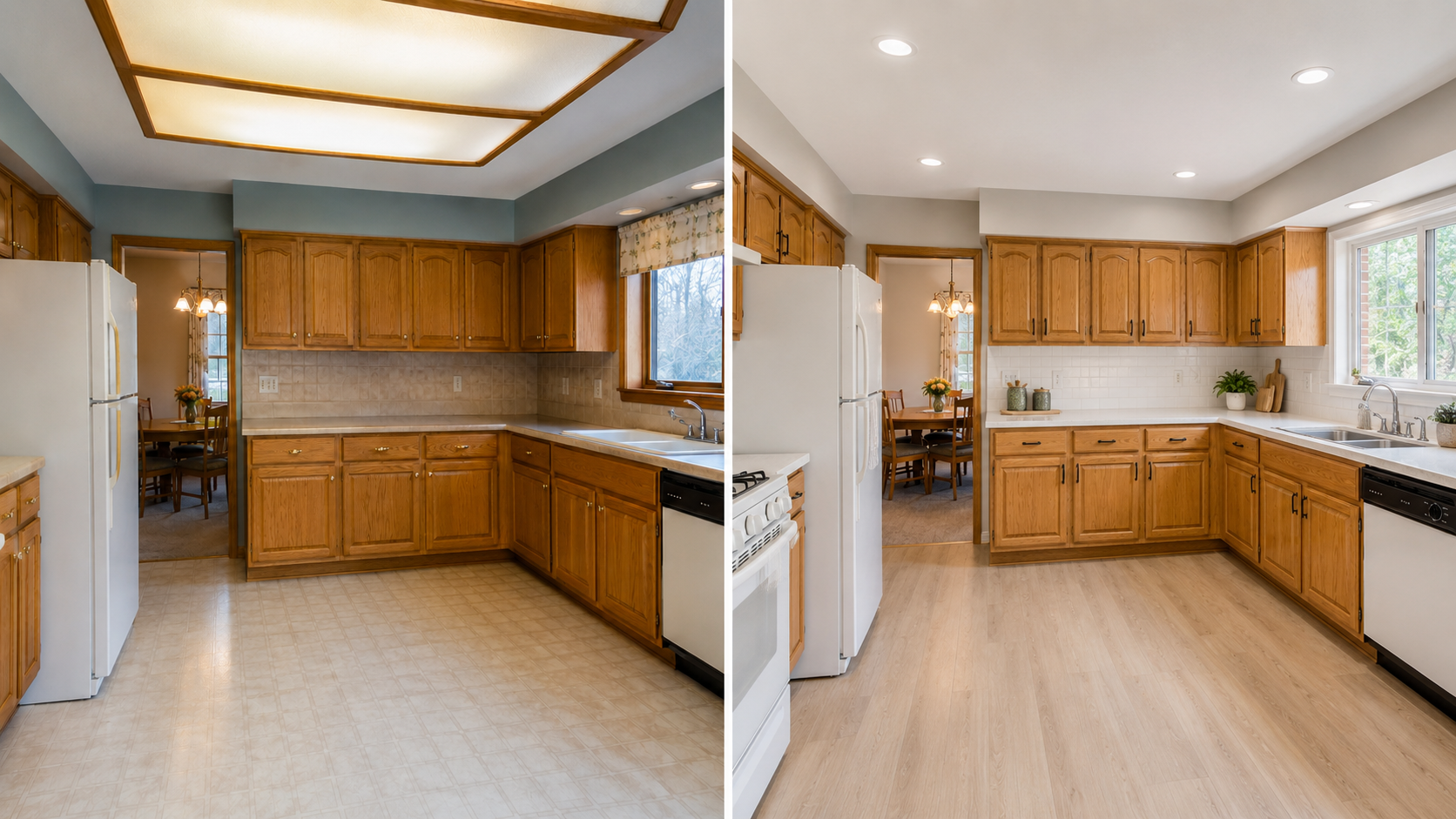
Lighting first
Old fluorescent boxes and yellow bulbs make honey oak look more orange. Better ceiling lighting and under-cabinet lighting can change the room before any cabinet finish changes.
Hardware second
Simple knobs or pulls can help, but hardware alone will not save a kitchen with bad counters, weak lighting, and orange walls. Choose hardware that fits the cabinet door style, and do not force ultra-modern pulls onto a door profile that cannot support the look.
Countertops and backsplash
Counters and backsplash matter because they sit directly beside the oak. If they are too yellow, too busy, too beige, or too high-contrast, the cabinets look louder. A calmer counter and simpler backsplash can make oak feel intentional instead of leftover.
Wall color
Wall color should not fight the cabinets. Many 1990s kitchens had yellow, tan, red, sage, or beige walls that pushed the oak warmer. A cleaner neutral, soft green-gray, muted blue-gray, warm white, or quiet off-white can help, depending on the counter and floor.
Flooring
The floor can either calm the oak or double it. If the floor is also orange, yellow, or busy, the whole kitchen can feel heavy. But do not replace flooring until you know whether the cabinet footprint will stay. Flooring too early can create expensive patching later.
Keep, Refinish, Paint, or Replace: The Decision Checklist
Keep them if:
- The layout works.
- The boxes and drawers are solid.
- You can calm the kitchen with lighting, counters, hardware, backsplash, and wall color.
- You do not need a major remodel soon.
Refinish them if:
- The oak is good quality.
- The finish is worn or too orange.
- You still want visible wood grain.
- The cabinet layout is worth keeping.
Paint them if:
- The cabinet boxes are good.
- The layout works.
- The orange tone is the main issue.
- You are prepared for proper prep, priming, finishing, and curing time.
Replace them if:
- The layout does not work.
- The boxes are damaged.
- The drawers and storage are poor.
- You are already changing appliances, walls, flooring, or plumbing.
- The cabinet update would only delay the remodel you actually need.
Best Choice for Resale
For resale, the safest choice is not always white paint or full replacement. Buyers usually respond to a kitchen that feels clean, well-lit, functional, and maintained.
If the cabinets are solid and the house is not being sold as a full luxury remodel, a smart refresh can be enough. A clean finish, better hardware, updated lighting, a calmer wall color, and a less dated counter or backsplash can help the kitchen photograph better without pretending to be brand new. Full replacement makes more sense when the old layout hurts the listing: poor storage, cramped traffic, damaged cabinets, bad island placement, or obvious wear that makes the kitchen feel neglected.
FAQ About 1990s Oak Kitchen Cabinets
Are 1990s oak cabinets worth keeping?
They are worth keeping when the cabinet boxes are solid, the drawers work, the layout is useful, and the oak tone can be balanced with better lighting, counters, hardware, backsplash, and wall color. They are not worth keeping just because they are wood — but they are often better built than the cabinets you would replace them with at the same price.
Should I paint honey oak cabinets?
Paint honey oak cabinets when the structure and layout are good but the orange finish is the main problem. Do not paint them if the boxes are swollen, the drawers are failing, or the layout needs to change. Paint improves color, not function.
Is it better to refinish or paint oak cabinets?
Refinish when the wood grain is worth keeping and you want a warmer, more natural kitchen. Paint when the grain and orange tone are part of the problem and you want a cleaner visual reset. Both options need good prep and solid cabinet boxes.
Can you modernize oak cabinets without painting them?
Yes. Better lighting, simpler hardware, calmer counters, a cleaner backsplash, updated wall color, and less visual clutter can make oak cabinets feel more current without paint. This works best when the cabinets are good quality and the layout already functions well.
When should 1990s oak cabinets be replaced?
Replace them when the boxes are damaged, drawers are weak, storage is poor, water damage is present, or the layout does not support the way the kitchen needs to work. Replacement also makes sense when the remodel already involves flooring, walls, appliances, plumbing, or electrical changes.
What is the biggest mistake with painting oak cabinets?
The biggest mistake is skipping prep. Oak needs cleaning, sanding, priming, and often grain filling if you want a smoother finish. Rushed paint can chip, show grain badly, collect grime, or make the cabinets look like a weekend cover-up.
Read This Next
Start with the main 1990s houses guide if you are updating the whole home, not just the kitchen. This cabinet decision should also connect to the future 1990s kitchen remodel, 1990s house renovation, 1990s interior design, and honey oak trim update pages.