

A 1990s house is old enough to show its age, but not old enough to feel historic.
That is why these houses confuse a lot of owners. They can have good space, big windows, practical kitchens, attached garages, and family-friendly layouts. They can also have honey oak cabinets, brass fixtures, beige carpet, arched windows, heavy built-ins, and a front garage that takes over the whole elevation.
The best way to understand a 1990s house is not to laugh at the finishes. Look at what the house was trying to do. Most 1990s homes were built around comfort, suburban growth, bigger family spaces, and easier everyday living. The decade moved away from closed-off rooms and toward open kitchen-family areas, two-story foyers, large primary suites, breakfast nooks, finished basements, and outdoor decks.
Some of those choices still work. Some need updating. And a few should be inspected before anyone spends money on paint, flooring, or cabinets.
What Defines a 1990s House?
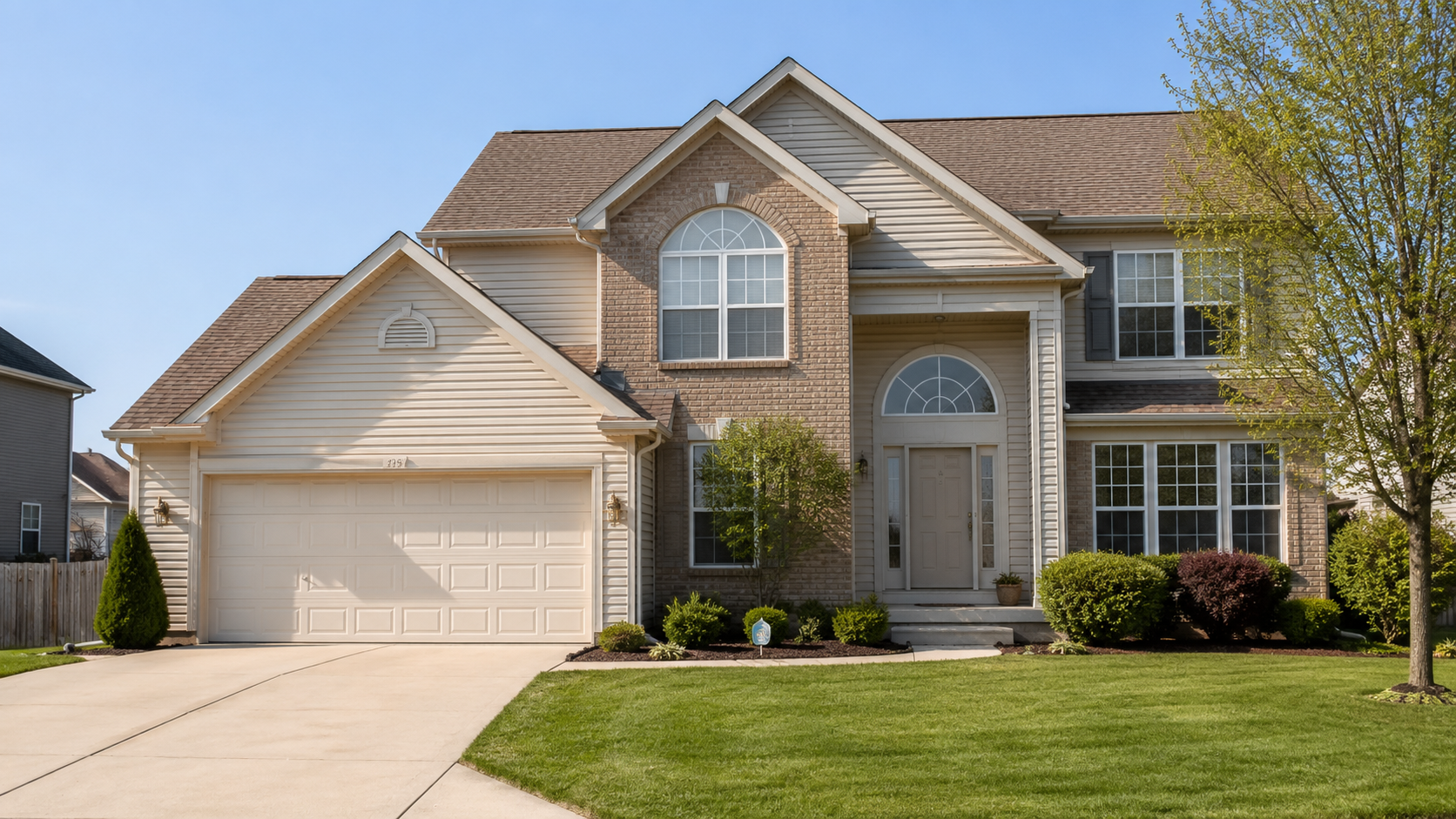
A 1990s house is not one single style. It is more of a builder-era pattern. Across many American suburbs, builders mixed traditional details with bigger floor plans and newer construction materials. A house might have a brick front, vinyl siding on the sides, a tall foyer, an arched window, a two-car garage, and a kitchen that opens into a family room.
That mix is what makes the decade recognizable. The house may borrow from Colonial, Tudor, Mediterranean, ranch, or contemporary design, but the final result is usually practical, suburban, and family-centered rather than architecturally pure.
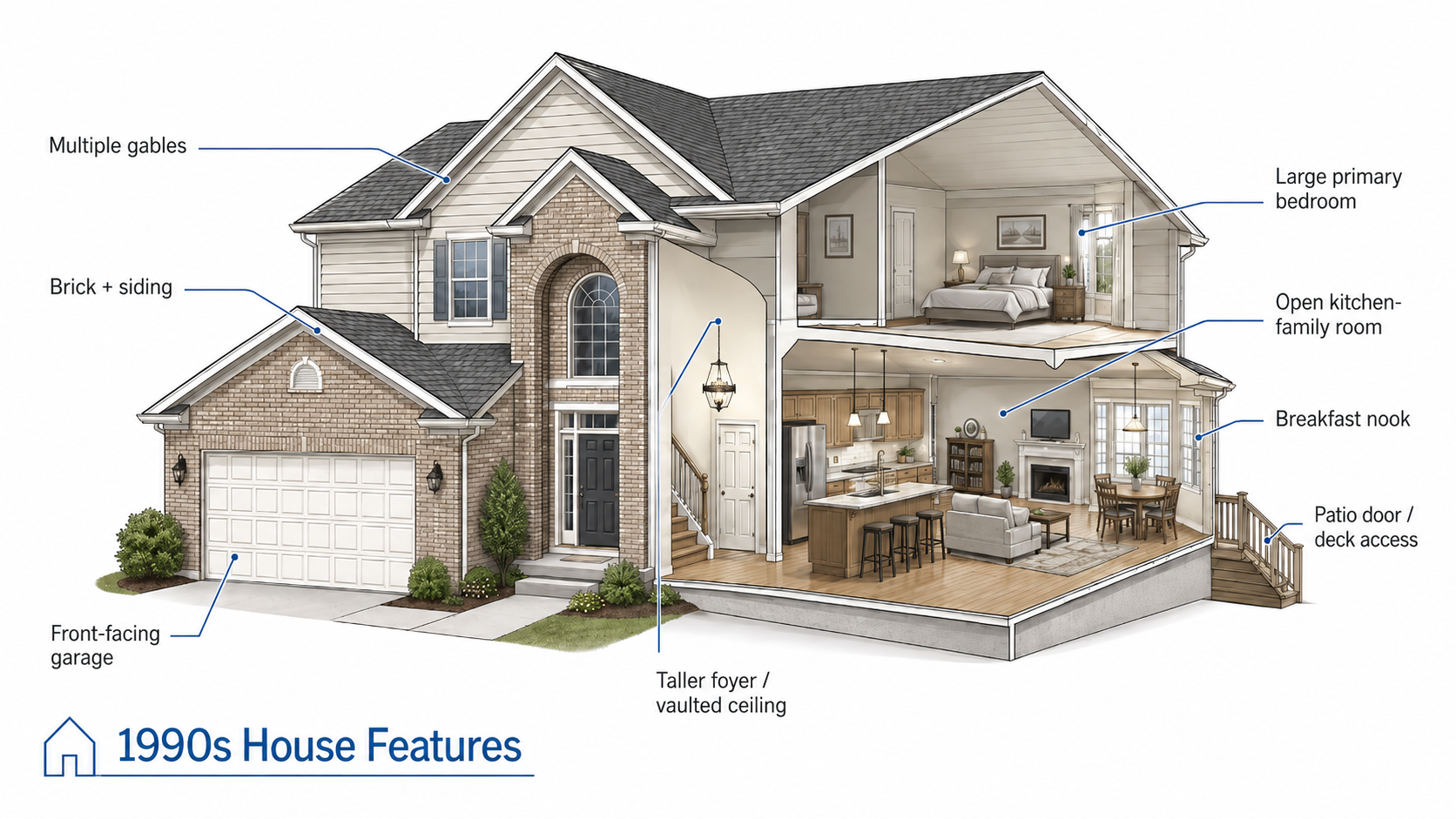
Common 1990s house features
- Front-facing two-car garages
- Mixed brick, vinyl siding, stucco, or manufactured trim
- Multiple gables and busy rooflines
- Arched windows, half-round windows, or arched entry details
- Open kitchen-family room layouts
- Breakfast nooks and island kitchens
- Vaulted ceilings, two-story foyers, or taller family rooms
- Large primary bedrooms with attached bathrooms
- Bay windows, patio doors, decks, and backyard access
- Beige carpet, oak trim, honey oak cabinets, brass hardware, and builder-grade lighting
Not every 1990s home has all of these features. A modest 1992 ranch will not look like a 1998 suburban two-story. But the planning logic is similar: more space, more daylight, more garage, more open living, and more convenience for family life.
Why 1990s Houses Still Matter
Many 1990s homes are now in the renovation window. In 2026, a house built between 1990 and 1999 is about 27 to 36 years old — old enough for original roofs, windows, siding, decks, bathroom waterproofing, HVAC equipment, and finishes to need serious attention.
At the same time, these houses are not disposable. Their layouts often solve problems that older houses struggle with: bigger kitchens, more storage, larger closets, attached garages, main-floor laundry in many plans, and better family-room connections than many mid-century or early postwar homes.
That creates a good renovation opportunity. You do not need to erase the house. You need to separate the parts that still work from the parts that date the house or hide maintenance trouble.
The Trap Is That It Still Feels New
Here is the real problem with a 1990s house, and it is not the oak. The finishes shout their age — the brass, the honey oak, the beige carpet all read instantly as "old." But the systems behind the walls still feel new enough to ignore, and that mismatch is the trap. The loud cosmetic dating pulls the whole budget toward paint, cabinets, and lighting, while the quiet, expensive, sometimes safety-related parts of the house reach the end of their service life at the same time.
A house built in the 1990s is right in the window where the original roof, windows, furnace, air conditioner, water heater, and bathroom waterproofing all come due, often within a few years of each other. The finishes make the house look ten years older than it is; the mechanicals make it act its age. The houses I walk into rarely have a problem you can see — the oak and brass are shouting so loudly that the thirty-year-old water heater and the original furnace get a pass.
Two things on a 1990s house deserve a hard look before any of that, because they are specific to the decade and they carry real money and risk.
The first is the plumbing. A great many homes built from the late 1970s through the mid-1990s were piped with polybutylene — grey flexible plastic supply line, often stamped "PB2110," usually visible near the water heater, under sinks, or running across a basement ceiling. It was discontinued around 1995 after a long history of brittle failure, and the bigger issue today is insurance: a growing number of insurers exclude water damage on poly-pipe homes, raise premiums, or require a full repipe as a condition of coverage, and a few will not write a policy at all. If you see grey plastic supply pipe, have a plumber identify it before you budget anything else. It is not a cosmetic line item.
The second is the deck. A 1990s deck is old enough that the ledger — the board where the deck attaches to the house — may predate current fastening standards, and the ledger connection is the one that actually drops decks when it fails. Have it looked at before the season, not after.
None of this means a 1990s house is a bad buy. It means the cosmetic age should set the mood, and the mechanical age should set the budget order. Decide what gets inspected before you decide what gets painted.
1990s House Exteriors
The outside of a 1990s house often shows the decade before you even step inside. Builders wanted houses to look larger, more detailed, and more upscale from the street, and the result was a mix of gables, brick accents, arched windows, decorative trim, and big garages.
Mixed materials
Many 1990s houses used brick on the front and siding on the sides and rear. This kept the street-facing elevation more formal while controlling construction cost. In some regions stucco replaced siding; in others, vinyl siding became the standard finish.
That material mix can still work, but it needs careful updating. Painting everything one flat color can make the house look cheaper if the proportions are wrong, and replacing siding without thinking about trim, shutters, gutters, garage doors, and window color just creates another mismatched layer.
Garage-dominant fronts
The attached garage became one of the strongest 1990s exterior signals. In many homes the garage sits forward of the main entry and takes up a large part of the front elevation.
That is not always a problem. It becomes a problem when the garage door is the brightest, plainest, or largest visual object on the house. A better exterior update usually calms the garage down, strengthens the entry, and simplifies the trim.
Arched windows and entries
Arched windows, half-round transoms, and arched entry details were common 1990s features. Some are worth keeping; others look dated because they are surrounded by the wrong trim, shutters, colors, or oversized light fixtures.
Before removing an arched feature, look at the whole elevation. Sometimes the arch is not the problem — the problem is the busy combination of arch, shutter, beige siding, white garage door, brass coach lights, and heavy front landscaping all at once.
1990s House Interiors
Inside, 1990s homes were built for openness and comfort. Formal rooms did not disappear, but the family room became more important. Kitchens got larger, breakfast areas became common, and the living room and dining room often became secondary spaces while the kitchen-family room carried daily life.
Great rooms and family rooms
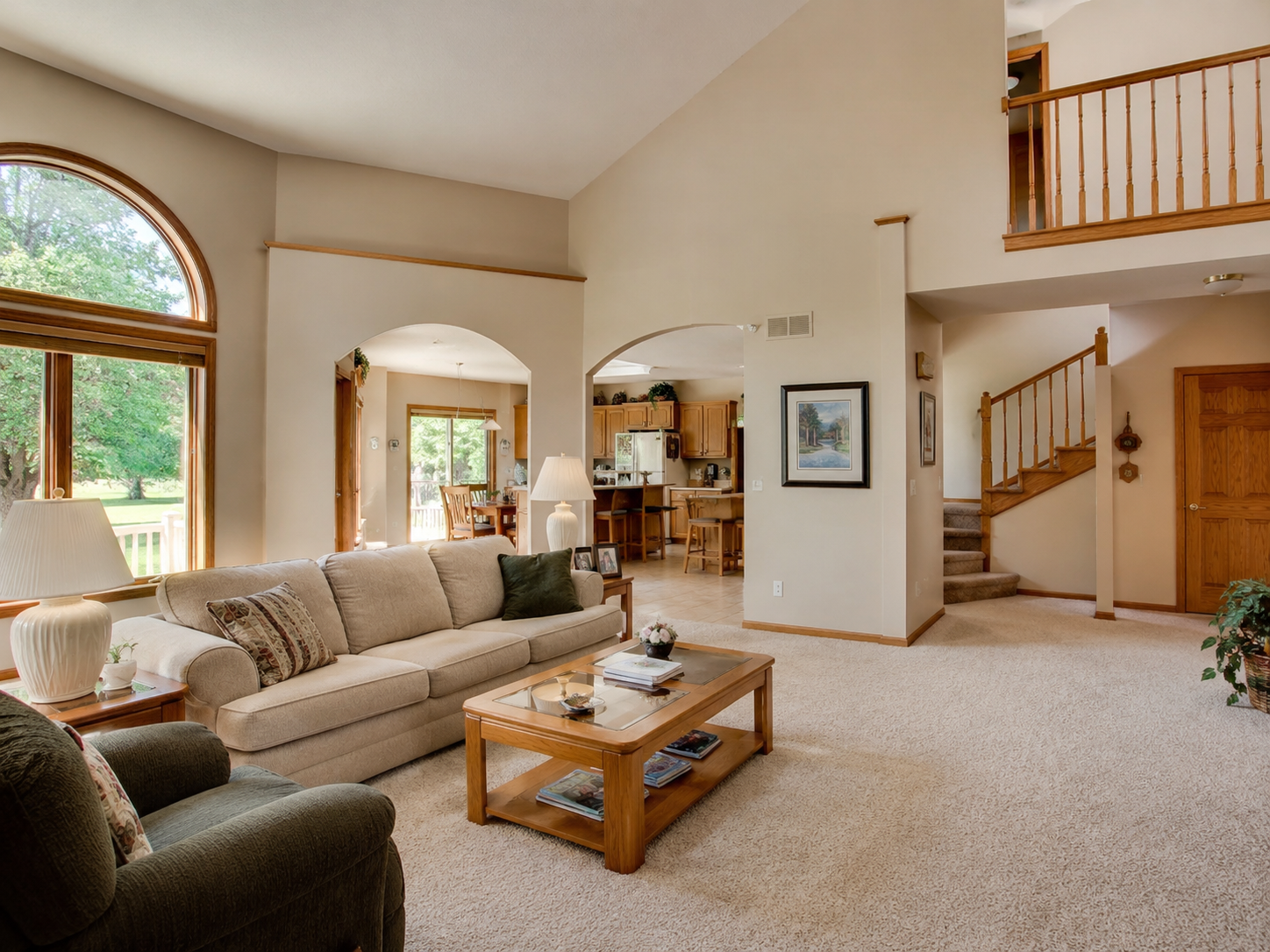
The great room is one of the best parts of many 1990s houses. It may have tall ceilings, large windows, a fireplace, built-in cabinets, and a direct connection to the kitchen.
The mistake is assuming the whole room is outdated. Often the room volume, daylight, and layout are good, and only the surfaces have aged: beige carpet, shiny brass fireplace doors, heavy ceiling fans, dark built-ins, oversized sofas, orange oak railings, and too many display shelves. A good update keeps the useful room and edits the noise.
Formal rooms
Many 1990s homes still have a formal dining room, formal living room, or front office. These rooms can feel underused today, but they should not be treated as wasted space — they often become home offices, homework rooms, libraries, music rooms, or quieter sitting areas.
The key is not to force every room into an open plan. Some separation is useful. If the house already has an open kitchen-family area, the front rooms can stay more defined.
1990s Kitchens
The kitchen is where many 1990s houses feel the most dated. Honey oak cabinets, laminate counters, white appliances, tile backsplashes, small islands, fluorescent ceiling boxes, and builder-grade hardware are common.
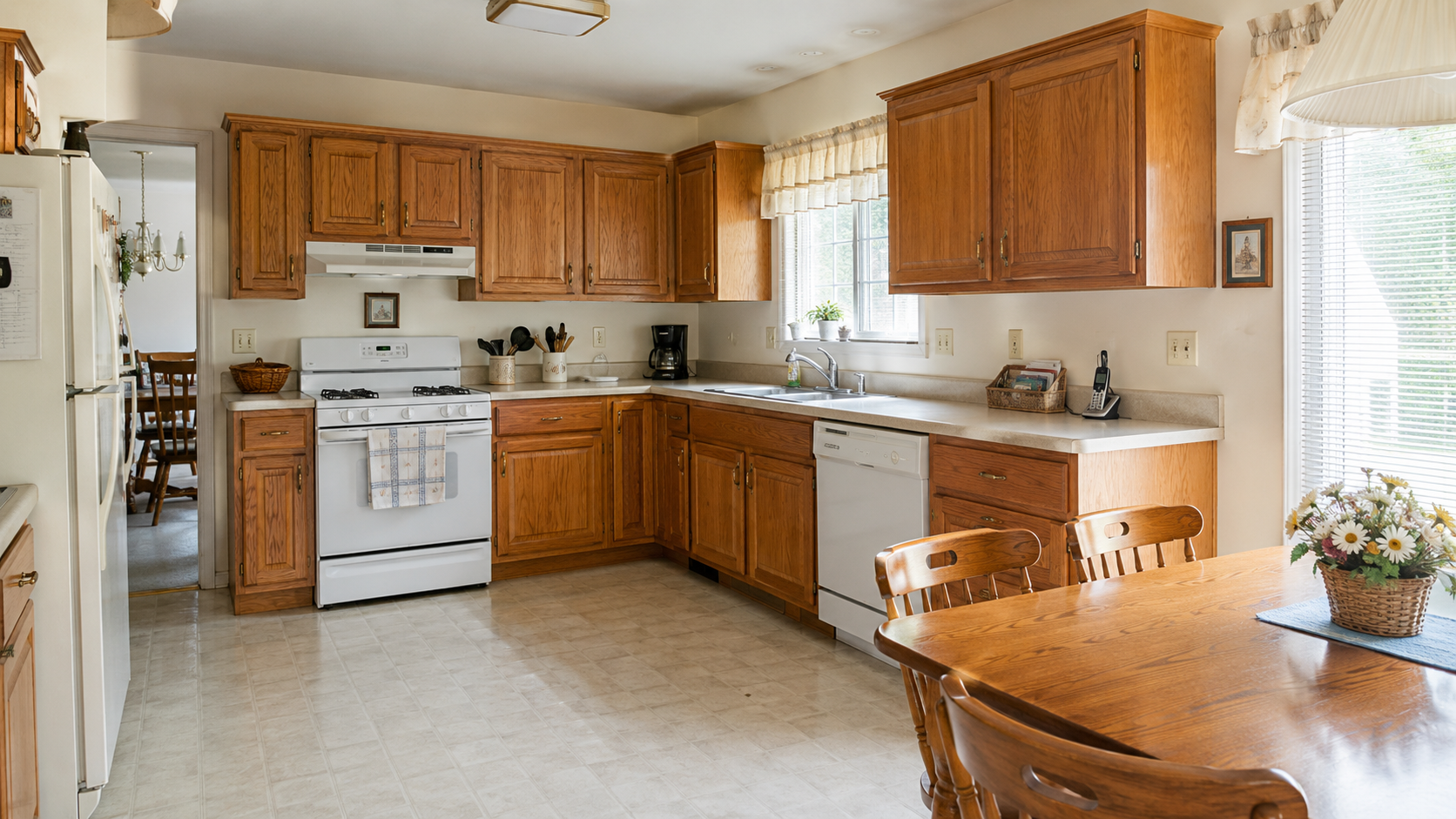
But the kitchen footprint may be better than it looks. Many 1990s kitchens already have decent cabinet runs, a pantry, a breakfast table area, and a connection to the family room. So the first question is not always "Should we gut it?" The better question is what the layout already does well.
What to check before replacing a 1990s kitchen
- Does the kitchen already connect well to the family room?
- Is the cabinet layout useful, or just dated in finish?
- Can the island be enlarged without hurting circulation?
- Are the floors continuous, or will wall and cabinet changes expose patching problems?
- Is there enough lighting, or only one central fixture or old fluorescent box?
- Are soffits hiding ducts, pipes, or wiring?
Oak cabinets are not automatically bad. Some are solid enough to refinish, stain, or paint; others are builder-grade boxes with worn hinges, poor drawer hardware, and awkward dimensions. For the cabinet-specific decision, read 1990s oak kitchen cabinets before you paint, refinish, or replace the boxes. For the full kitchen scope — layout, soffits, flooring, lighting, counters, and cost — see 1990s kitchen remodel.
1990s Bathrooms
Many 1990s bathrooms were designed to feel larger and more private than earlier bathrooms. Primary bathrooms often had double vanities, corner tubs, separate showers, large mirrors, brass fixtures, cultured marble tops, and beige or pastel tile.
These rooms can date a house quickly, but they also hide practical problems. Before spending money on new tile, check the shower, tub surround, vanity base, exhaust fan, flooring edges, and wall areas near plumbing fixtures. A bathroom can look only mildly dated while the caulk, grout, drywall, subfloor, or vanity base is already failing — which is why bathroom updates should start with moisture, ventilation, and plumbing condition before finishes.
What Has Aged Well
Some parts of 1990s houses are worth protecting. Removing them can make the renovation more expensive and less useful.
Keep the daylight
Large windows, patio doors, bay windows, and tall family-room glazing are strong assets. Replace failing windows when needed, but do not reduce daylight just to chase a darker trend.
Keep the useful kitchen-family connection
A connected kitchen and family room still works for daily life. The update should improve storage, lighting, sightlines, and finishes without turning the whole main floor into one loud room with no quiet zones.
Keep practical storage
Many 1990s homes have better closets, pantries, laundry areas, and garage storage than older houses. Built-ins may need editing, but storage itself is valuable.
Keep room volume when it helps
Vaulted ceilings and two-story spaces can be hard to heat, cool, paint, and light. But when they bring daylight and make the main living area feel generous, they are often worth keeping. The fix is usually better lighting, better fan placement, simpler trim, and improved window treatments — not flattening the space.
What Makes a 1990s House Look Dated
Most 1990s houses do not look dated because of one single feature. They look dated because too many original choices are still working together.
- Honey oak cabinets with matching oak floors and oak trim
- Polished brass door hardware, lights, faucets, and fireplace trim
- Beige carpet across stairs, bedrooms, and family rooms
- Heavy built-in entertainment centers sized for old televisions
- Vertical blinds, swags, heavy curtains, or busy window treatments
- Arched niches, plant shelves, and display ledges
- Fluorescent kitchen light boxes
- Large mirrors with no frame in bathrooms
- Builder-grade white garage doors and flat front entries
- Busy exterior trim, shutters that do not fit, and dated coach lights
Updating all of these at once is expensive. The smarter move is to decide which changes calm the house fastest. The arched niches, plant shelves, and angled cut-outs are worth singling out here: drywalling them flat is cheap, and the fastest change I have seen in these houses is rarely a new kitchen — it is a sheet of drywall over the niches and ledges, which quietly erases the decade off the walls. Beyond that, lighting, hardware, paint, and flooring transitions can change the feel before any major construction begins.
Inspect Before You Update
A 1990s house can still feel "new enough" to owners, but many original components may be at or past their normal service window. That matters because cosmetic renovation can cover problems instead of solving them.
Check the exterior envelope
Look closely at original siding, stucco, brick transitions, window trim, roof edges, and deck connections. A 1990s exterior update should not be only paint and new shutters. If siding is warped, stucco is cracked, trim is soft, or window flashing is suspect, those details need attention first.
Check roofs and attic ventilation
Many 1990s roofs have already been replaced once, but some have not. Even when shingles look acceptable from the ground, attic ventilation, insulation, bathroom fan routing, and roof penetrations can create moisture and heat problems.
Check bathrooms for moisture
Original showers, tub decks, caulk lines, vanity bases, toilet flanges, and floors around tubs deserve careful inspection. A pretty bathroom remodel that ignores water damage is not an upgrade.
Check mechanical systems
Furnaces, air conditioners, water heaters, electrical panels, and plumbing fixtures may not all be original, but the house is old enough that records matter. Before spending the full budget on surfaces, confirm what has already been replaced and what is still pending — and, as above, confirm whether the supply plumbing is polybutylene.
How to Update a 1990s House Without Erasing It
The best 1990s updates are controlled. They do not fight the house. They reduce visual noise, repair aging parts, and keep the useful parts of the layout.
Start with the biggest visual conflict
In some houses the biggest issue is the oak kitchen; in others it is the beige carpet, the brass fixtures, the front garage, the exterior colors, or the bathroom finishes. Do not spread the budget evenly across small updates if one major feature is making the whole house feel tired.
Simplify before you modernize
A 1990s house can look better by becoming calmer. Remove busy window treatments, reduce orange wood tones, replace mismatched fixtures, clean up the lighting, and choose fewer finishes. The goal is not to make the house look like a new build. The goal is to stop the house from shouting the decade all at once.
Be careful with open concept changes
Many 1990s homes are already open where it matters. Removing more walls can create noise, clutter, cooking smells, awkward ceiling patches, flooring problems, and fewer places for storage or furniture. Before opening anything, decide what problem the wall is actually causing.
Use exterior updates to fix proportion
A 1990s exterior update should make the entry easier to read and the garage less dominant. That can mean a better garage door, better exterior lighting, simpler trim, improved front steps, cleaner landscaping, and a color scheme that connects the brick, siding, roof, and windows.
1990s Houses Compared with Earlier and Later Homes
Compared with many 1970s and 1980s houses, 1990s homes often have larger kitchens, more open family rooms, bigger bathrooms, and more storage. Compared with many 2000s homes, they can feel less oversized and sometimes easier to update because the layouts are simpler.
The weak point is that 1990s houses sit in the middle. They are not old enough to get the charm credit that a 1930s or 1940s house gets, and not new enough to feel current. That is exactly why a careful update can pay off. You are not trying to preserve a museum piece; you are trying to turn a practical house into a cleaner, stronger version of itself.
For a broader comparison of house types and eras, see the main guide to house styles.
Quick Checklist for a 1990s House
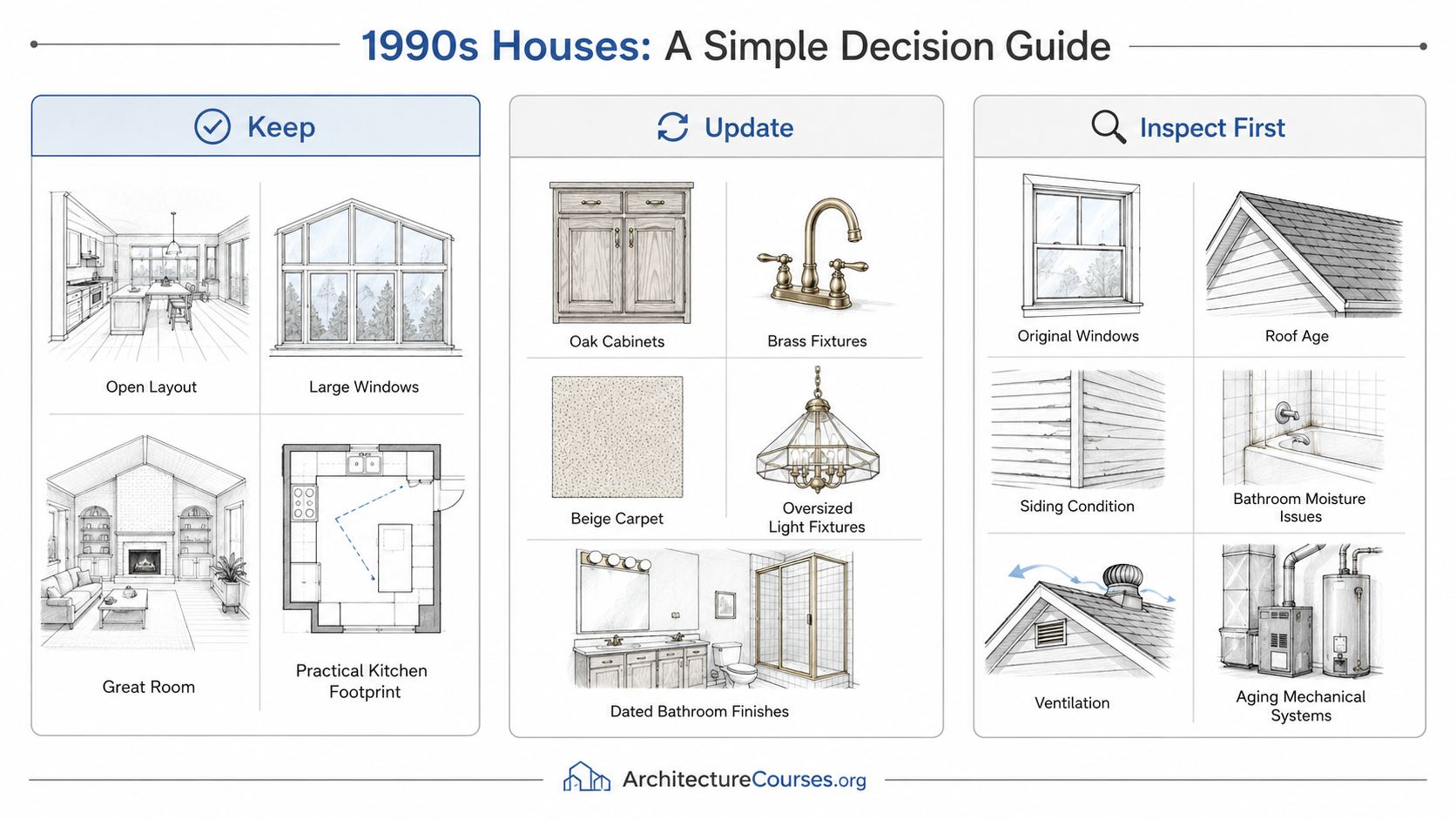
- Keep: daylight, practical kitchen-family layout, storage, useful room sizes, backyard access, and good ceiling height.
- Update: oak overload, brass fixtures, beige carpet, dated lighting, heavy built-ins, bathroom finishes, and weak exterior color schemes.
- Inspect first: roof age, windows, siding or stucco condition, supply plumbing (polybutylene), bathroom moisture, deck connections, HVAC, water heater, attic ventilation, and exterior drainage.
FAQ
Are 1990s houses worth renovating?
Yes, many are worth renovating because the layouts often still work. The best candidates have good daylight, useful room sizes, a practical kitchen-family connection, and no major hidden water or exterior problems. The mistake is spending the whole budget on finishes before checking the roof, windows, bathrooms, siding, ventilation, plumbing, and mechanical systems.
What is the most dated part of a 1990s house?
The most dated parts are often honey oak cabinets, brass fixtures, beige carpet, heavy built-ins, old bathroom vanities, fluorescent kitchen lighting, and busy exterior trim. In many houses the dated feeling comes from the combination of these items rather than one feature alone.
Should I paint 1990s oak cabinets?
It depends on cabinet quality. Solid cabinet boxes with a useful layout and good proportions may be worth painting, staining, or refacing. Weak builder-grade boxes with worn drawer hardware, poor storage, and awkward layouts may not justify the work. Check the cabinet construction before deciding.
What should I inspect before buying a 1990s house?
Pay close attention to roof age, windows, siding or stucco, supply plumbing (grey polybutylene pipe is a known concern), bathroom moisture, deck attachments, attic ventilation, HVAC equipment, water heater age, exterior drainage, and any signs of past leaks. A 1990s house can look cosmetic on the surface while several original systems are aging at the same time.
How do you modernize a 1990s house exterior?
Start by reducing garage dominance, cleaning up the color palette, improving the entry, replacing dated lights, and correcting shutters or trim, while checking the siding, windows, and roofline details. Paint alone can help, but it should not hide failing trim, poor flashing, or damaged siding.
Read This Next
- 1990s Kitchen Remodel: What to Update First and What to Leave Alone
- 1990s Oak Kitchen Cabinets: Keep, Refinish, Paint, or Replace?