
Why Architects Still Matter in the AI Age
AI is fast—but human creativity is still the engine of great design.
In architecture, it's not about man vs. machine. It's about knowing what only people can bring to the table: vision, empathy, and meaning.
The Real Role of Architects in the AI Era
The Value of Human Creativity in Architecture
What Makes a Human Designer Different?
AI can simulate light, airflow, and geometry in seconds. But it can’t tell you how a space feels. It doesn’t know what it means to honor your grandparents. It doesn’t understand grief, joy, nostalgia—or how those emotions shape design.
Human architects do.
They design with memory, with intuition, with context. They think about how a widow walks into her kitchen. Or how a kid plays near a sunlit stairwell. AI can’t replicate that.
Real Example: A Design That AI Wouldn’t Understand
In rural Turkey, architect Nilay Çökelez redesigned a small family home after an earthquake. The client had one demand: build a new house that “feels like the old one.”
AI would’ve optimized the floor plan for thermal performance or structural strength. Nilay did that too—but she also kept the sun’s path across the courtyard just like the original house. That way, the morning coffee still caught the same light. That’s memory. That’s human.
What Machines Miss
Here’s what AI doesn’t get:
● Cultural weight → Some rooms carry history.
● Emotional design → Grief spaces, healing gardens, sacred thresholds.
● Silent signals → A hallway tells a story. A window honors someone lost.
● Non-verbal knowledge → Things you can’t explain, but know when you see them.
AI doesn’t understand these. Humans do.
What It Took
Ask any good architect—every great design came from a fight. A late-night sketch, a gut call, a reworked plan after a client’s tearful story. That’s the creative cost. AI skips that. But that’s also why it misses the mark.
Real design isn’t just problem-solving. It’s meaning-making.
Why Architects Still Matter in the AI Age: Architecture and Design Perspective
What AI Is Good At—And What It Gets Wrong

In architecture and design, AI is a powerful tool—but not a replacement. It shines in data-heavy tasks, but still stumbles on anything that requires emotion, ethics, or cultural sense. Here’s a breakdown:
Where AI Performs Well
These are areas where AI tools have already changed how architects work:
▪ Layout Generation at Scale
AI can produce dozens of floor plan variations instantly, helping architects explore spatial configurations in early concept stages.
▪ Energy and Systems Simulation
AI excels at simulating building performance—predicting heating, cooling loads, airflow, and daylighting with precision.
▪ Sustainable Material Suggestions
By analyzing databases of material properties, AI can suggest greener, more efficient material options based on cost, carbon, and thermal profiles.
▪ Regulatory Compliance Checks
Certain tools now use AI to flag zoning issues or fire code violations in drawings—saving weeks of back-and-forth revisions.
Where AI Still Fails
These are tasks that still require real human thinking, empathy, and experience:
▪ Understanding Cultural Context
AI doesn’t know how people feel about space. It can’t read habits, social norms, or emotional responses—especially across cultures.
▪ Creativity and Design Risk
AI only works with what it’s trained on. It can't invent new aesthetics, take bold risks, or break rules on purpose like a great architect might.
▪ Reading Between the Lines
Clients rarely say exactly what they want. Architects read body language, adjust tone, and find the real need. AI doesn’t do nuance.
▪ Emotional, Ethical, and Historic Layers
A design that looks efficient may feel wrong if it disrespects a site’s history or misses symbolic or spiritual needs. AI can’t sense that.
Real Case Example: Beirut Hospital
On a major hospital project in Beirut, an AI-generated plan seemed ideal—circulation was clean, departments were efficient, and square footage was minimized.
But a Lebanese architect quickly flagged a serious issue: the layout ignored the local norm of large family gatherings during hospital visits. The design offered little room for visitors, lacked visual privacy, and clashed with cultural expectations.
The plan was completely reworked—by hand. More generous waiting areas, private family rooms, and screened courtyards were added. AI got the math right. The human got the meaning right.
Humans + AI: The New Design Workflow
Can AI Really Replace Human Designers?
Collaborative Approaches – Humans + AI in Design
Why It’s Not a Battle
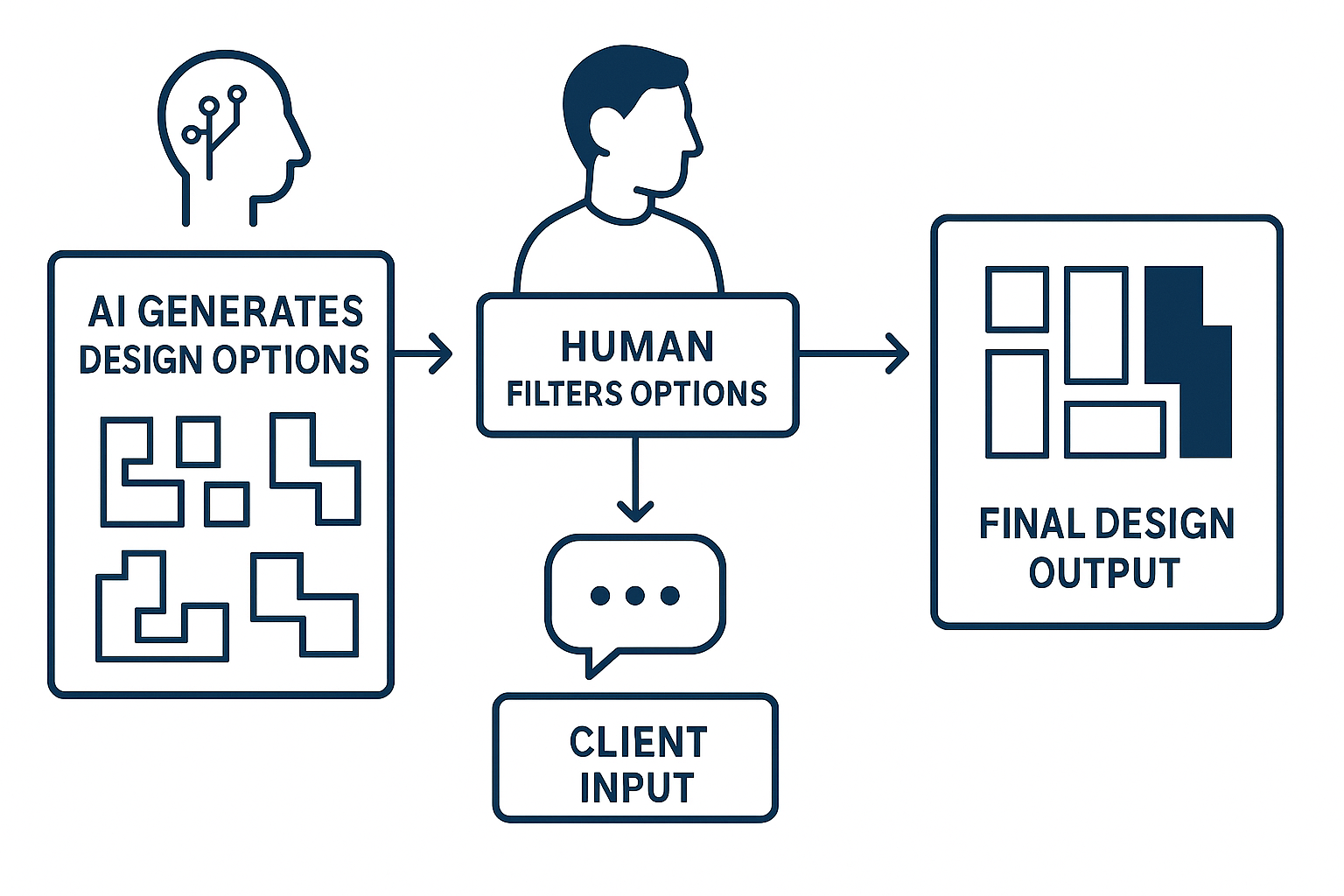
This isn’t humans vs. machines. It’s tools + talent. And like any tool, AI is only as good as the hand guiding it.
You don’t give AI a problem and walk away. You stay in the loop. You question its assumptions. You push back when its suggestions don’t align with real-world context.
Smart architects don’t reject AI—they lead it.
What AI Is Good At
Here’s where AI shines:
▪ Repeating tasks (drafting variants)
▪ Finding patterns fast (energy loss, heat maps)
▪ Crunching constraints (zoning, structural logic)
▪ Generating options (based on input rules)
But AI has no clue what the right answer is. It can spit out 100 options, but it won’t know which one fits the client’s soul, the neighborhood’s history, or the budget realities.
That’s the human’s job.
Real Case: AI Helped, But Didn’t Lead
In 2023, an architecture firm in Melbourne used AI to generate 500 massing options for a mixed-use tower. The AI nailed solar angles and street shadows.
But it took a human team to scrap most of the outputs, modify three, and reshape one based on how local residents used the alley behind the site. The final building had better light, but also honored foot traffic patterns. That part? Pure human.
Who’s In Charge? You Are.
AI doesn’t get the final say. It’s a co-pilot.
Think of it like a calculator: it speeds you up, but it doesn’t write your equations. Your ethics, your cultural knowledge, your experience—that’s still the foundation.
And if it spits out something that looks great on paper but fails in real life, it’s on you to fix it.
Quick Comparison
| TASK | WHO SHOULD LEAD? |
|---|---|
| Energy Optimization | AI + Human Verification |
| Emotional Zoning | Human |
| Code Compliance Drafting | AI |
| Cultural Sensitivity | Human |
| Final Design Selection | Human with AI Support |
Key Insight
Architects who know how to direct AI are 10x more valuable than those trying to compete with it.
It’s not about being faster. It’s about being wiser.
How Architects Use AI Without Losing Control
The Future of Design: AI Tools, Human Imagination
Skills Architects Should Build Now
To stay ahead, architects should not learn to “compete” with AI. They should learn to lead it.
Skills worth investing in:
-
Critical thinking & judgment
-
Deep cultural and client understanding
-
Emotional storytelling through form
-
Visual communication
-
Ethics, privacy, and value-centered design
"Our best work starts where the software ends." —Nora El-Khalil, Urban Designer
What AI Still Doesn’t Understand About Architecture
AI Can’t Replace Values, Context, or Culture
Real Projects That Prove Architects Are Still Essential
AI is fast. AI is smart. But it’s not human—and that matters.
You can train a model to generate floorplans. But it won’t understand what a prayer room feels like.
It won’t know what it means to give a grandparent a step-free entrance that honors dignity instead of pity.
And it definitely won’t account for the subtle rituals, habits, or unspoken family dynamics that shape how people use space.
Case Study: A Multi-Generational Home in Jordan
● What AI Suggested:
Modular units. Open concept. Maximized footprint.
● What the Architect Did Instead:
→ Added a shared prayer room with acoustic privacy.
→ Created a hidden guest suite—for surprise visits, common in the culture.
→ Designed separate front entrances: one for family, one for guests—preserving boundaries without isolation.
→ Used shaded courtyards to balance privacy, light, and tradition.
This wasn’t about software. It was about sense—emotional, cultural, and social.
Why This Matters
● AI sees patterns. Architects see people.
● AI optimizes space. Humans optimize experience.
● AI speeds up choices. Architects slow down to ask the right questions.
Key Insight
"A building might fit the plot—but if it doesn’t fit the people, it fails."
How architects use AI tools while keeping creativity, emotion, and human values at the center.
The future of architecture blends AI support with human insight, ethics, and real-world design experience.
FAQ: What People Ask About AI in Architecture
Q: Can AI fully design a house?
A: Not yet—and not responsibly. It can offer layouts, but without human review, mistakes happen.
Q: Will AI replace architects?
A: No. AI assists—it doesn’t lead. Clients still need human intuition, ethics, and experience.
Q: What tools do architects use now?
A: Tools like Midjourney (concept art), Rhino (parametrics), Revit (BIM), and Grasshopper (generative design)—all guided by humans.
Conclusion
Use the Tool, Don’t Be Replaced By It
AI isn’t the enemy. But ignoring its limits is dangerous. What sets human architects apart isn’t just knowledge—it’s judgment, culture, and vision. Machines don’t dream. We do.
To stay essential, don’t abandon your creativity. Lead with it. Use AI to do the heavy lifting—but design from the heart.
Related
- Introduction to Architecture: A Beginner’s Guide to Building Design
- Architectural Design Basics: From Concept to Construction
- Human Values and Environmental Studies
- Kevin Lynch's 5 Elements of a City | Guide to Urban Design
- Why Old-School Architecture Can't Compete Anymore
Resources & References
Best Books on AI in Architecture
-
"Architectural Intelligence" by Molly Wright Steenson
How design meets computation—history + insight. -
"Designing Design" by Kenya Hara
Not AI-specific, but deeply about the essence of design thinking. -
"The Future of Architecture in 100 Buildings" by Marc Kushner
A humanistic look at tech-driven change in global design.