

IMAGE: Visual guide to Kevin Lynch’s five elements of city design—paths, edges, districts, nodes, and landmarks—used to understand and shape how people navigate urban spaces.
When Art and Science Work for Human Life and Physical Development
A Study on Kevin Lynch's Urban Design Elements
By M.Arch Elias Redwan | Updated on July, 2025 | Theory
Absolutely Digested Version: Kevin Lynch's 5 elements of urban design—Paths, Edges, Districts, Nodes, and Landmarks—provide a framework for understanding and organizing cities.

Image: Aerial view capturing traffic on multiple overpasses, highlighting urban navigation and connectivity aligned with Kevin Lynch's principles of city design.
Each element plays a crucial role in how we perceive, navigate, and interact with urban spaces. This guide explores these elements in detail, offering insights and examples to illustrate their impact on urban design.
See also: The Image of the City (Harvard-MIT Joint Center for Urban Studies Series)
🔹 LYNCH FRAMEWORK
INTRO — Kevin Lynch’s 5 Elements of Urban Design

Image: Infographic illustrating Kevin Lynch’s five key elements of urban design—paths, edges, districts, nodes, and landmarks—used to organize and understand city structure.
What makes a city feel legible, walkable, and alive? Kevin Lynch figured it out back in 1960.
In The Image of the City, he outlined five elements that shape how we experience urban space:
Paths, Edges, Districts, Nodes, and Landmarks.
These are what help people orient themselves, form memories, and move through a city without getting lost.
Here’s how each one works in real life.
Kevin Lynch's 5 Elements of a City
Comprehensive Guide to Urban Design
🔹 CITY FLOW
1. PATHS: The Lifeblood of Urban Navigation

IMAGE: Infographic showing Kevin Lynch’s five elements of city design, with emphasis on paths—highlighting how streets, transit lines, and walkways structure urban movement and interaction.
Paths are the channels along which people move. They’re the streets, walkways, transit lines, canals, and railways that guide us from one point to another.
Think of them as the veins of a city, directing the flow of human activity. They’re crucial for navigation and significantly influence our experience and perception of urban spaces.
Why Paths Matter:
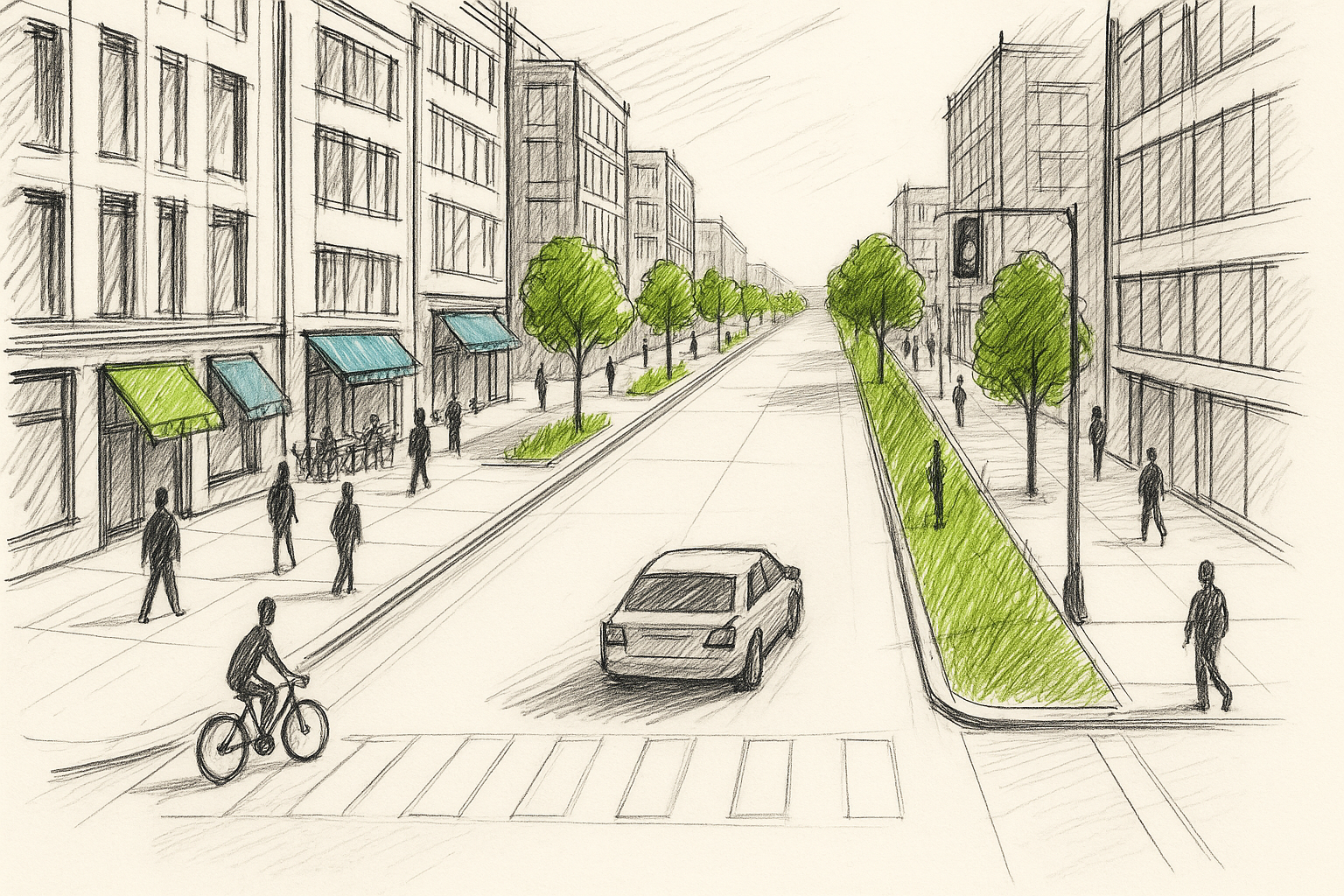
IMAGE: Dynamic illustration showing movement and flow of pedestrians and vehicles along city paths, highlighting the role of paths in urban life, connectivity, and navigation.
- Navigation: They help us find our way around.
- Experience: The quality of paths (wide boulevards vs. narrow alleys) affects our journey.
- Connection: Paths connect different parts of the city, enabling movement and interaction.
Fun Fact: Ever wondered why Broadway in New York City feels so dynamic? It’s because it cuts across the city grid, creating unique intersections and vibrant pockets of activity.
🔹 URBAN PATHS: A Fresh Perspective
PATHWAY DESIGN : Channels of Human Interaction
- Beyond Navigation: Paths don’t just move people; they shape how we interact. A wide boulevard encourages social gatherings, while a narrow alleyway might promote intimate encounters or quieter moments.
- Example: In Barcelona’s La Rambla, the bustling pedestrian street creates spontaneous interactions—street performers, outdoor cafés, and local vendors make it more than a route; it’s a community hub.
- Insight: Cities with poorly maintained paths often see less foot traffic, reducing safety and economic activity. Well-lit, clean paths can enhance social connections and local commerce.
MUST READ: The Death and Life of Great American Cities
🔹 ARCHITECTURAL EDGES
2. EDGES: Defining Boundaries

IMAGE: Blueprint-style visual of a river acting as an edge between two urban districts, representing Kevin Lynch's concept of edges in city design.
Edges are the boundaries between different areas. They can be physical barriers like rivers, walls, and highways, or perceptual ones, like changes in architecture or land use.
Edges help to define spaces and create a sense of structure in the urban environment.

IMAGE: A river serving as a natural boundary between two city districts, demonstrating Kevin Lynch’s concept of edges as defining urban boundaries and spatial limits.
Types of Edges:
- Natural Edges: Rivers, forests, and coastlines.
- Artificial Edges: Highways, railways, and walls.
- Perceptual Edges: Shifts in building style, land use, or street activity.
Fun Fact: The Great Wall of China is an extreme example of an edge that not only defines boundaries but also has a profound historical and cultural significance.
🔹 SPATIAL LIMITS: Psychological Boundaries
- Human Perspective: Edges act as psychological markers. They tell us where we belong and where we might feel out of place. A poorly maintained edge, like an industrial zone bordering a residential area, can create discomfort.
- Example: The Thames River in London doesn’t just separate districts—it’s a visual and cultural boundary. Bridges connecting both sides provide continuity while preserving the distinct identities of the areas.
- Tip: Integrate edges into the city’s design with features like walkways or artistic installations, transforming boundaries into accessible public spaces.
🔹 CITY ZONES
3. DISTRICTS: The Identity of Neighborhoods

IMAGE: Illustration representing Kevin Lynch’s concept of districts as unique city areas defined by cohesive architecture and cultural character, shaping urban identity and experience.
Districts are the medium-to-large sections of a city that have a distinct identity. They are the neighborhoods, downtowns, and suburbs that people recognize and navigate by.
Districts are defined by their unique characteristics, such as architecture, culture, and land use.

IMAGE: A vibrant urban district defined by cultural character, cohesive architecture, and active street life—capturing Kevin Lynch’s concept of districts as identity-rich zones within a city.
A bustling urban district showcasing unique cultural architecture and street life, representing the concept of districts in urban design.
Key Features of Districts:
- Cohesion: A unifying theme or style.
- Function: Specific uses like residential, commercial, or industrial.
- Culture: Distinct cultural or social identity.
Fun Fact: Manhattan’s Chinatown and Little Italy are perfect examples of districts with strong cultural identities that attract locals and tourists alike.
🔹 DISTRICT DESIGN: Emotional Attachments
- Identity Creation: Districts are where people feel a sense of belonging. They foster pride and attachment, shaping how residents interact with their environment.
- Example: In Tokyo’s Harajuku, the district’s unique blend of street fashion and quirky shops has created a global cultural phenomenon. It’s not just a shopping area; it’s a lifestyle destination.
- Insight: Districts thrive when their design amplifies local culture. Over-gentrification, however, can erode the very identity that makes them special.
🔹 CITY CENTERS
4. NODES: Hubs of Activity

IMAGE: Vibrant urban square bustling with people and activities, illustrating Kevin Lynch’s concept of nodes as key focal points for transportation, social interaction, and city energy.
Nodes are strategic points in a city that act as major junctions or focal points. They can be intersections, plazas, squares, or any significant gathering spots.
Nodes are crucial for orientation and are often bustling with activity, serving as central points for transportation and social interaction.

IMAGE: Dynamic urban square filled with people and activity, illustrating Kevin Lynch’s concept of nodes as central hubs for movement, interaction, and energy in city design.
Examples of Nodes:
- Intersections: Major road crossings.
- Transit Hubs: Train stations, bus terminals.
- Public Spaces: Plazas, parks, squares.
Fun Fact: Times Square in New York City is one of the most famous nodes globally, known for its vibrant atmosphere and iconic billboards.
🔹 SPATIAL FOCAL POINTS: The Pulse of the City
- Energy Centers: Nodes act as the city’s heartbeat. Vibrant nodes attract diverse groups of people, fostering cultural exchanges and economic vitality.
- Example: Shibuya Crossing in Tokyo is a node that’s not just functional but iconic. It embodies the energy of a fast-paced urban lifestyle, drawing locals and tourists alike.
- Tip: Nodes should offer a mix of utility and aesthetics—public seating, accessible transit, and eye-catching design elements make them more welcoming.
🔹 REFERENCE POINTS
5. LANDMARKS: Points of Reference

IMAGE: A city landmark standing out in the skyline, representing Kevin Lynch’s concept of landmarks as visual anchors that aid navigation and embody cultural or historical meaning.
Landmarks are easily identifiable objects that serve as reference points. They can be natural features like mountains or lakes, or man-made structures like buildings, statues, or bridges.
Landmarks help people orient themselves and navigate through the city.
Characteristics of Landmarks:

- Visibility: Easily seen from a distance.
- Uniqueness: Distinctive features that stand out.
- Significance: Often have historical, cultural, or functional importance.
Fun Fact: The Eiffel Tower in Paris is not just a tourist attraction; it’s a global landmark that symbolizes the city itself.
Landmarks: Anchors of Memory
- Cultural Symbols: Landmarks hold collective memory. They’re points of pride and orientation, connecting people to their city’s past and future.
- Example: The Gateway Arch in St. Louis isn’t just a structure; it symbolizes westward expansion and the city’s historical significance.
- Insight: Landmarks don’t have to be monumental. A well-loved mural or a centuries-old tree can serve as a neighborhood’s cherished focal point.
🔹 URBAN PRCEPTION
A Fresh Perspective: Kevin Lynch’s Elements and Human Behavior

IMAGE: Infographic exploring how Kevin Lynch’s five elements—paths, edges, districts, nodes, and landmarks—shape urban experience and behavior by linking design to human scale, movement, and social interaction.
Kevin Lynch’s framework of Paths, Edges, Districts, Nodes, and Landmarks offers more than just a blueprint for urban planning—it sheds light on how cities shape human behavior and vice versa.
Here’s an expanded take on how these elements connect to the way we interact with and experience urban environments, focusing on overlooked aspects.
🔹 DESIGN + BEHAVIOR
The Missing Element – Human Scale in Urban Design

Image: Infographic on Kevin Lynch’s urban design element "Paths," showing how streets, walkways, and transit lines guide movement, shape interaction, and influence city life
Lynch’s five elements brilliantly organize urban spaces, but one crucial aspect often overlooked is the concept of human scale—how comfortable or intimidating a city feels to individuals.
- Why It Matters: A plaza designed without considering human scale might feel too vast and impersonal, discouraging use. On the flip side, a well-proportioned public square invites people to linger and engage.
- Example: Florence’s Piazza della Signoria balances grand historical architecture with cozy seating areas and accessible walkways, making it both impressive and welcoming.
- Practical Tip: Ensure that even grand nodes or paths include small-scale features like shaded seating, water fountains, or greenery to make them relatable and usable.
Human Connection in Urban Design: Kevin Lynch’s elements reveal the heart of city planning—how spaces shape the way we live, work, and connect.
When we prioritize human behavior—how we move along paths, recognize edges, bond with district identities, gather at nodes, and find meaning in landmarks—we create cities that go beyond function, becoming vibrant, fulfilling places to call home.
Conclusion: The Harmony of Urban Design
Kevin Lynch’s 5 elements of urban design—Paths, Edges, Districts, Nodes, and Landmarks—are the building blocks that help us understand and shape our cities.
Understanding these elements helps planners, architects, and communities shape cities that work better for everyone.
Key Takeaways on Urban Design
🔹 DESIGN BALANCE
- Paths: Crucial for navigation and connectivity within the city.
- Edges: Define boundaries and create a sense of structure.
- Districts: Offer identity and cohesion to different city areas.
- Nodes: Serve as central hubs of activity and orientation.
- Landmarks: Act as reference points and contribute to the city’s uniqueness.
Important Book: The Image of the City (Harvard-MIT Joint Center for Urban Studies Series) by Kevin Lynch
FAQ
Kevin Lynch’s 5 Elements of Urban Design
What are the 5 elements of urban design according to Kevin Lynch?
Kevin Lynch identified Paths, Edges, Districts, Nodes, and Landmarks as the five key elements of urban design that shape our perception and experience of cities.
Why are Paths important in urban design?
Paths are essential because they facilitate movement and connectivity within the city, influencing how people navigate and experience urban spaces.
Can Edges be both physical and perceptual?
Yes, edges can be physical, like rivers and highways, or perceptual, like changes in architecture or land use.
How do Districts influence urban navigation?
Districts provide a sense of identity and cohesion, helping people recognize and navigate different areas of a city.
What makes a Node significant in urban design?
Nodes are crucial for orientation and serve as major points of interaction and activity, such as intersections, plazas, or transit hubs.
Why are Landmarks important in urban design?
Landmarks are easily identifiable and help people navigate and orient themselves within the city.
How can urban planners use these elements effectively?
Urban planners can use these elements to create more navigable, functional, and aesthetically pleasing cities by considering how each element influences perception and interaction.
Related
- Human-Centered Design and Architecture
- Human Values and Environmental Studies
- Introduction to Architecture: A Beginner’s Guide to Building Design
- Architectural Design Basics: From Concept to Construction
- Why Old-School Architecture Can't Compete Anymore
- Why Architects Still Matter in the AI Age: Craft vs Code
Keep Learning
Learn more about Urban Design and Planning:
Books:
- The Image of the City by Kevin Lynch
- What’s in it: The foundational text on urban design elements.
- Why you should buy it: It’s a classic that offers deep insights into how cities are perceived and navigated.
- Urban Design: A Typology of Procedures and Products by Jon Lang
- What’s in it: A comprehensive guide to urban design processes and typologies.
- Why you should buy it: It offers practical advice and examples for urban designers.
Affiliate Notice:
While there's no additional cost to you, we do earn a commission through affiliate links if you choose to purchase something after following our recommendation. This commission helps us continue creating valuable content for you."