
Most people visit King’s, stare at the Chapel, take the photo, and leave with the wrong lesson.
The building is the headline. The system is the story: how space controls attention, how courts pace movement, how old fabric survives modern use, and how students actually live inside it without turning into museum guards.
What This Covers:
- What makes King’s architecture legible in one walk
- The Chapel facts that are actually worth remembering
- How the site is organized (courts, the river edge, circulation)
- Study, social, and portfolio habits that keep showing up
If you’re newer to this stuff, park this tab too: why studying architecture rewires how you see buildings.
The Big Misunderstanding
“It’s just historic beauty.”
King’s is a working environment. It has to handle crowds, sound, weather, student traffic, formal events, deadlines, cleaning cycles, and constant wear. If you look at it like a postcard, you miss the real design intelligence: sequencing, thresholds, and control.
If you want a practical baseline for reading buildings (not just styles), this helps: a simple intro to how buildings are put together.
Fast Context
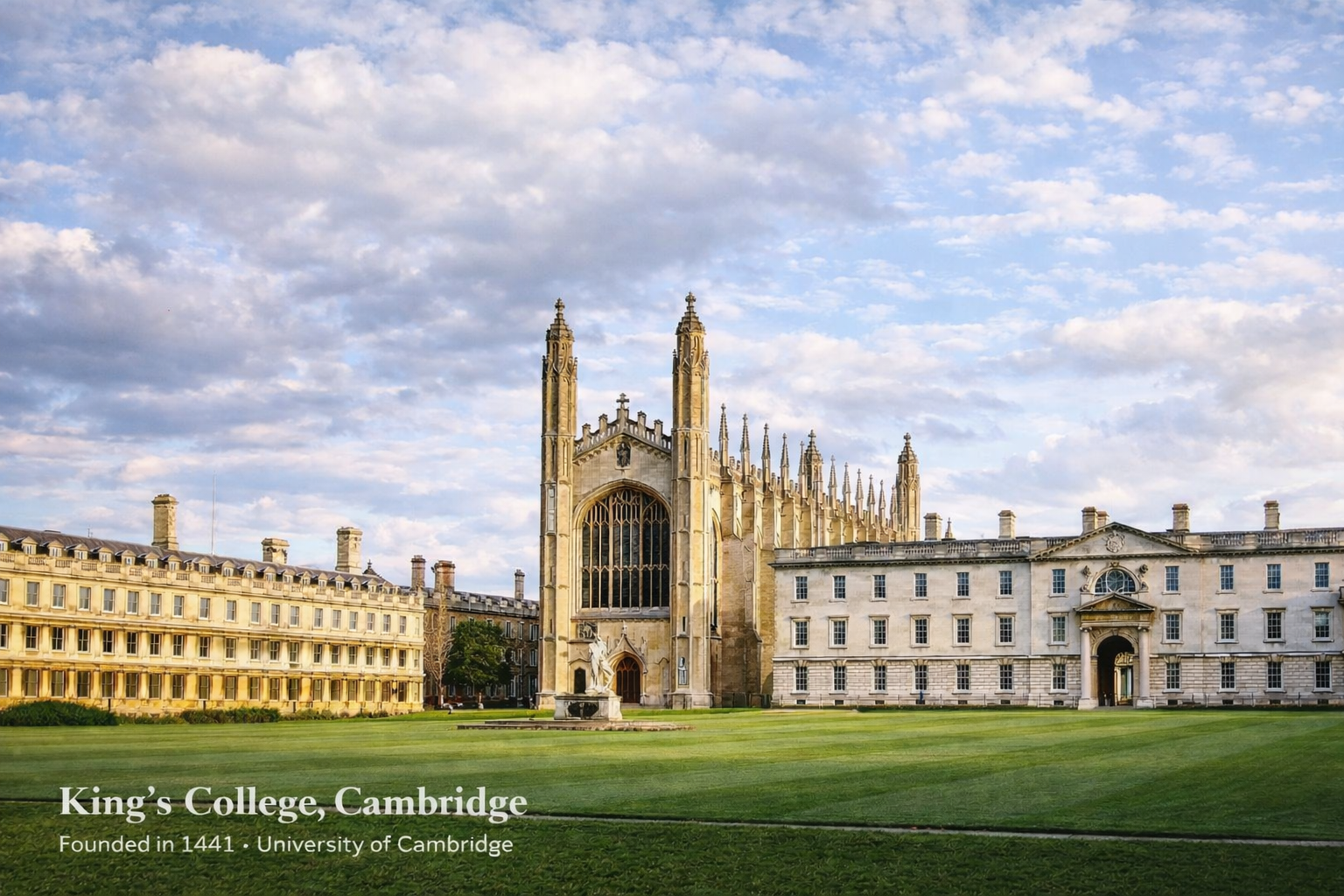
King’s College is a constituent college of the University of Cambridge, founded in 1441.
Non-US Note: this is a UK collegiate system. College life, housing, and teaching format won’t map cleanly to typical US campuses.
The Chapel Basics
Start with the measurable stuff. It keeps you honest when you describe it later.
Dimensions
The Chapel is about 289 ft long, with an interior height around 80 ft and an exterior height around 94 ft.
Build Timeline
Work began in 1446 and the main structure was completed by 1515, with glazing and finishing continuing after. It wasn’t a single clean campaign. It’s a long project with interruptions, funding swings, and changing leadership.
Fan Vault
The fan vault is widely cited as the world’s largest. It was constructed in the early 1500s under master mason John Wastell.
Stained Glass
The medieval stained glass isn’t background decoration. It’s a daylight machine. It changes the room all day, every day, and it’s a big reason the Chapel feels “alive” instead of static.
Rubens Altarpiece
Rubens’ The Adoration of the Magi (painted in 1634) was installed above the altar in 1968, and the installation involved alterations that caused serious controversy at the time.
When you’re trying to describe what you’re seeing, having the right drawing language matters. This is a clean reference: types of architectural drawings.
Site And Layout
King’s works because the campus isn’t one “object.” It’s a sequence.
Courts As Organizers
The courtyards do the heavy lifting: they pace movement, frame views, and create calm pockets that keep the place from feeling like a tourist funnel.
Threshold Control
Watch how you enter spaces. Narrow-to-wide transitions. Door-to-court-to-hall rhythms. The site teaches you how to move without signage doing all the work.
The River Edge
The “Backs” condition matters: long views, reflective light, and a calmer acoustic field than the street side. It’s not just pretty. It changes how buildings read.
If you want to think about why some spaces feel ordered and calm (and others feel messy), this is a useful lens: how hierarchy shows up in buildings.
How Students Learn
One of the big practical differences at Cambridge is the supervision model: small-group or one-to-one teaching that expects you to arrive prepared, not curious.
Supervision Reality
Typical pattern: you write, you bring work, you get pressed on the gaps. The pressure isn’t the session. The pressure is the weekly production cycle.
Work Rhythm
The people who do well don’t “study harder.” They build a repeatable loop: read early, draft rough, revise once, ship it, then recover.
If you want the nuts-and-bolts of how architecture students build study systems, start here: how architecture students study in real life.
Student Life Habits
These aren’t genius tricks. They’re boring systems that stop slow failure.
Calendar Discipline
Pick a fixed weekly block for reading and drafting. Treat it like a site meeting. If it moves, the whole week slips. A lot of people don’t fail from difficulty. They fail from drift.
Two-Layer Notes
Keep two notes per lecture or reading: (1) what the source says, (2) what you think it means. Most students only keep layer one. That’s why supervision questions feel “unfair.” They’re testing layer two.
Bring A Draft
Show up with something concrete: a thesis paragraph, a diagram, a reading summary with a position. People who show up “ready to discuss” without a draft get shredded. Not because the supervisor is cruel. Because there’s nothing to work on.
Social Life Boundaries
The best social trick is boring: schedule it. If you wait until you “have time,” you’ll either isolate or binge. Most students who look balanced are just controlling frequency: two good nights a week, not seven chaotic ones.
For practical tools (notes, assignment structure, study workflows), this page is the one: notes and study tools that actually help.
Professional Study Angle
If you’re a practicing architect, designer, or builder visiting King’s, the “tour” mindset wastes your time. Study it like a working site.
Draw The Sequence
Don’t sketch the facade first. Sketch the approach and thresholds: where you slow down, where the view opens, where the axis locks in, where the ceiling height changes.
Track The Joints
Old buildings teach joint logic. Where movement is absorbed. Where water is managed. Where cleaning is possible. Look for the boring details. They’re why the place still works.
Light As Material
In the Chapel especially, daylight is the primary finish. It’s doing more than stone carving for how the room feels.
Red Flags
- You only have photos. If you didn’t map circulation and thresholds, you didn’t study the architecture.
- You romanticize craft. Craft matters, but the planning and sequencing are what keep the place usable.
- You ignore maintenance. Everything that looks timeless is supported by boring upkeep.
Detail People Miss
Situation: people treat the Chapel as an object.
What they do wrong: they study a single viewpoint and call it “analysis.”
The correct move: walk it in a loop, then write the sequence from memory in 10 lines. Where you entered, what you saw first, what got revealed later, where the light changed, where the scale hit you.
What it prevents: shallow precedent work that looks good in a slide deck but doesn’t help you design anything.
Limits: this only works if you actually walk and observe. If you’re rushing with a camera, you’ll miss half of it.
Quick Checklist
- Write down one measurable fact (length/height) before you describe the Chapel
- Sketch approach and thresholds, not just the facade
- Note how courtyards control pace and calm
- Track daylight changes through stained glass
- Draft before supervision, every time
- Use two-layer notes (source vs your position)
- Schedule social time so it doesn’t eat the week
- Change locations when you’re stuck
FAQ
What Is King’s College Known For
Architecturally: the Chapel and the river-edge setting. Institutionally: it’s one of the Cambridge colleges with a strong public profile and a distinct campus identity.
Is The Chapel Really That Big
Yes. The scale is measurable: roughly 289 ft long and about 80 ft high inside. It reads as massive because the interior is disciplined and continuous, not chopped up.
Who Designed The Chapel
The authorship is disputed and not cleanly documented the way modern practice expects. Reginald Ely is commonly cited as an early architect figure, and Nicholas Close is recorded as “surveyor.” The fan vault work is associated with master mason John Wastell.
How Do Cambridge Students Get Taught
Through lectures and small-group supervisions where you bring prepared work for critique and discussion. The system rewards consistency more than hero nights.
What’s The Biggest Student Mistake
Waiting to “feel ready” before drafting. The loop works when you draft early, get corrected, and iterate. If you aim for perfect first submissions, you burn time and spiral.
Can Visitors Enter The Chapel
Yes, but access varies with services, events, and the academic calendar. Check the official site for current visiting guidance.
Next Step
Use King’s as a study in sequencing and control, not just Gothic detail. If you can describe how the place moves you, you learned something you can reuse on your own projects.