
Should You Buy a House with Foundation Issues?
The Truth About Risks, Repairs, and What’s Actually Worth It
So here’s the deal: buying a house with foundation problems can save you money or ruin you.
Some issues are fixable. Others are a money pit with no bottom. Before you sign anything, you need to know how to spot the difference, how much repairs really cost, and when to walk away.
MUST READ
Best Guide for Inspecting Home Repairs
📘 The Complete Guide to Home Inspection (Wagner & Ward)
Covers real-world structural issues and tells you what to ask during walkthroughs. Useful for buyers and renovators. Covers foundations, red flags, and what most buyers miss. Full checklists inside. Good for flips or risky deals.
Some cracks are easy fixes. Others mean the whole place is sinking.
You need to know what to look for and what not to trust.
Real Risks Real Costs and When to Walk Away
Some foundation cracks are just cosmetic. Others mean the house is sinking.
Know the difference or you’ll pay for it later.
1. Repaired Foundations: What to Check Before You Trust It
If the seller says the foundation was “fixed,” don’t assume it’s safe.
What to focus on:
● Was it a cosmetic patch or full structural repair (like piers, underpinning)?
● Who did it — was it a licensed foundation contractor or a handyman?
● Is the warranty transferable to you as the new owner?
Quick Tip:
Ask for the before/after reports or photos. No proof = no deal.
2. Unfixed Damage: Signs You’re Looking at a Money Pit
A home with unresolved foundation damage isn’t automatically a dealbreaker—unless you ignore the signs.
Key problems to focus on:
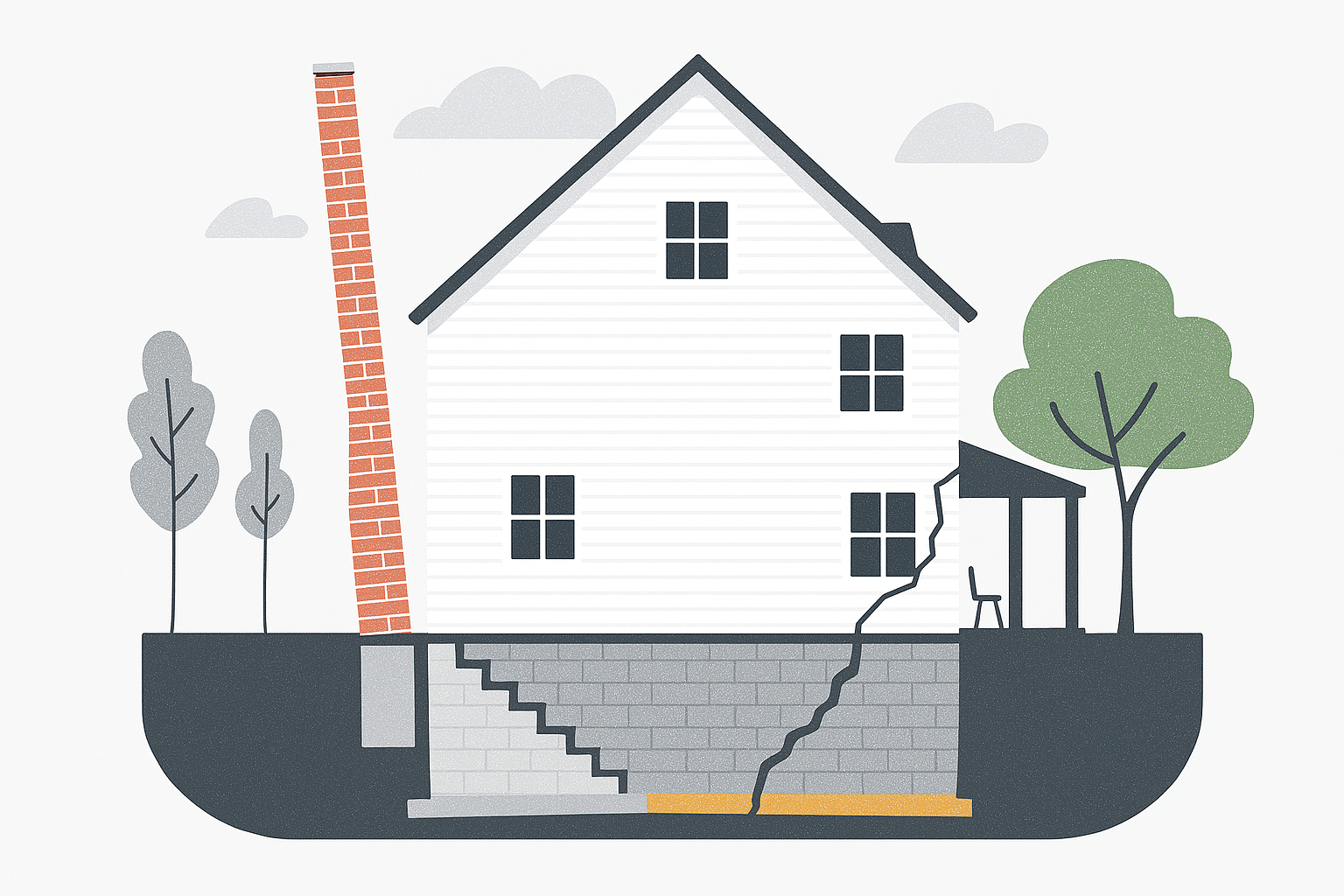
● Sagging or sloped floors → usually means joist or footing failure
● Cracks wider than 1/4 inch → structural, not cosmetic
● Bowing basement walls → lateral soil pressure, often needs wall anchors or rebuild
● Leaning chimney → shows differential settlement, usually expensive to fix
What to do:
Bring in a structural engineer, not just a home inspector. Then get 2–3 quotes from foundation repair contractors.
3. Types of Repairs That Actually Work
Helical piers, push piers, and underpinning are the gold standard when installed right.
If a seller shows proof of these, it’s often a green flag.
What to verify:
● Installation by licensed pros with permits
● Transferable warranty on the work
● Soil reports or load data if available (especially for clay or shifting soil zones)
FIELD PICK
Top DIY Structural Repair Book
📘 Renovation 5th Edition (Michael Litchfield & Chip Harley)
Covers foundation repair basics, structural systems, and when to call a pro.
4. Smart Questions to Ask Before You Buy
Don’t just ask “Is the foundation fixed?” Ask these instead:
● What was the root cause? Expansive soil? Poor drainage? Tree roots?
● How long has it been since repairs? Less than 2 years = still settling.
● Who paid for it and why? Seller cover-up or honest disclosure?
● Can I speak to the engineer or contractor who worked on it?
Pro tip: If they dodge even one of these questions, walk.
5. When to Walk Away
Sometimes, no deal is better than a bad deal.
Walk away if:
✕ The home has active movement and no stabilization
✕ Repair costs exceed 15–20% of home value
✕ No permits, documents, or warranties are provided
✕ Your lender won’t approve financing without major structural fixes
True story: One buyer got a “deal” on a $280K house…
Spent $85K fixing footings, redoing walls, and stabilizing slab. Couldn’t sell it two years later. Still regrets it.
So, you can absolutely buy a house with foundation repairs — if the work was done right, documented, and priced fairly.
But if the damage is active, undocumented, or shady? It’s your wallet on the line.
Related: How Much Does Foundation Repair Cost? | Tips to Avoid Scams
When Buying a House with Foundation Problems Makes Sense
When Buying a House with Foundation Issues Is Actually Smart
Most buyers run. Smart ones pause.
Foundation issues scare people, but in the right conditions, they can mean big upside—if you know how to play it.
How to Spot a Deal, Not a Disaster
1. You’re Getting It Way Below Market
● Look for a 25–40% discount off neighborhood comps
● Subtract estimated repairs + extra buffer and compare total to fixed-value resale
● Verify discount with local listings, not seller claims
Example:
3-bed house listed at $150K in a $240K neighborhood. $30K in repairs. Still $60K+ under market.
2. Repairs Are Manageable, Not Major
Not every crack is a disaster. Focus on:
● Hairline cracks, minor settling, or slab leveling → often under $10K
● Bowed walls or leaning chimneys → can be fixed if the structure is stable
● Get a structural engineer, not just a home inspector
FIELD PICK
Best Structural Guide for Buyers
📘 Foundations and Concrete Work (Taunton Press)
Covers crack types, footing issues, drainage fixes, and when repairs are safe.
3. You Know a Good Contractor or You’re Handy
Foundation work often leads to other upgrades:
● New floors, new drywall, drainage improvements
● Use the repair as your excuse to customize
Pro move: Bundle foundation fixes with other renovations. Save on labor overlap.
4. You’re Flipping or Holding Long-Term
● Good neighborhoods with bad houses = equity upside
● Long-term holding lets you recover costs slowly and benefit from appreciation
● Flippers: Focus on cosmetic + structural ROI
Example:
Seattle buyer spent $25K fixing bowing basement walls. Home value jumped $70K after repairs.
5. You're Using Financing That Covers Repairs
● Look into FHA 203(k) or homestyle renovation loans
● Some let you borrow against future value after repairs
● Good for first-time buyers or tight budgets
6. When to Pass, No Matter the Price
✕ Seller refuses engineer access or report
✕ Active shifting still happening
✕ Multiple failed repairs over the years
✕ House is on high-risk soil with no stabilization
Truth: Some homes are priced cheap because no one else wanted the liability.
The Hidden Aftermath: Resale Trouble and Insurance Red Flags
What No One Tells You After You Buy the House
Most buyers think the only challenge is fixing the foundation.
Wrong.
Even after repairs, you may run into headaches when selling, refinancing, or getting insured.
● Disclosure Laws: In most states, you’ll be legally required to disclose all known foundation problems, even if they’re fixed.
– This scares buyers
– It lowers offers
– And it can drag out deals for months
● Appraisal Drop: Even post-repair homes with a foundation history can appraise lower than “clean” homes. Lenders often add extra scrutiny. Expect tight inspection windows and higher standards.
● Insurance Premiums: Some insurers treat previously repaired homes as higher risk.
– You may pay more annually
– Some companies won’t even quote it
– Coverage may exclude foundation-related claims
● Buyer Distrust: Many buyers walk as soon as they hear “foundation repair,” even if the house is stable. Be ready to market harder, stage smarter, and show documentation upfront.
What to do now:
✓ Save every repair receipt, permit, photo, and engineering report
✓ Get a warranty that transfers to new owners
✓ Know your disclosure rules in your state
✓ Talk to your insurer before you buy—ask how repairs will affect future premiums
FIELD PICK
Best Book for Home Resale Prep After Structural Work
📘 Home Makeovers That Sell (Sid Davis)
Practical fixes and staging tips that help homes with history sell fast and high—even those with past repairs.
FAQ
Expert Answers You Actually Need
1. Should I buy a house with foundation problems?
Yes, if:
-
The issue is well understood (get a structural engineer, not just a home inspector)
-
You get the right discount
-
You can fix it properly with documented repair
Don’t touch it if:
✕ No repair docs
✕ Active movement
✕ Seller’s hiding details
2. How much do foundation repairs cost?
● $3K–$7K for minor leveling or crack sealing
● $10K–$30K+ for major fixes like helical piers or wall anchors
● Always get 3+ quotes and include hidden costs (floors, drainage, plumbing)
3. Can foundation issues be fully fixed?
Yes. If done right using:
-
Helical piers
-
Underpinning
-
Soil correction and drainage
-
Wall bracing
Focus: Warranty, permits, and licensed work only.
4. How can I tell if the repairs were done right?
Ask for:
-
Structural engineer report (not just a contractor invoice)
-
Warranty papers (make sure it’s transferable)
-
City permits
-
Before/after photos
5. Will lenders finance a home with foundation issues?
Only if:
-
It’s already repaired with proof
-
Or you’re using a renovation loan like FHA 203(k) or Fannie Mae Homestyle
Lenders need evidence the house won’t collapse in 5 years.
6. Can I use foundation issues to lower the price?
Absolutely. Use your engineer’s report as leverage.
● Push for a price cut
● Or ask seller to pay for repairs before closing
Tip: Don’t settle for verbal promises—get it in writing.
7. Are homes with repaired foundations safe?
Yes—if repaired properly and backed by documentation.
In some cases, post-repair homes are stronger than original builds.
8. How do I find a good foundation contractor?
Look for:
● Verified license
● Google and BBB reviews
● Projects in your area
● Willingness to give warranties
Red flag: Anyone who dodges engineer reports.
9. Can I flip a house with foundation damage?
Yes—but only if:
-
You buy it cheap
-
Repair costs are known upfront
-
You don’t over-improve beyond resale value
Tip: Stick to neighborhoods with rising comps.
10. Will past foundation repairs hurt resale?
Sometimes. Many buyers walk away just hearing the word "foundation."
To protect resale:
-
Show full repair documentation
-
Keep warranties transferable
-
Be transparent in listing
11. How do I spot foundation issues while house hunting?
Watch for:
● Cracks wider than ¼"
● Doors/windows sticking
● Sloped or bouncy floors
● Water pooling near walls
● Bowing or cracked basement walls
Then bring in a structural engineer—not just a general inspector.
12. Is it better to buy one that’s already repaired or needs fixing?
If it’s already repaired with docs and warranty—great.
If you’re handy or have a good contractor, buying pre-repair might save more.
Just never buy a mystery.
13. Are foundation repairs tax-deductible?
● Primary residence: No
● Rental/investment property: Yes, as deductible maintenance or capital improvement
Talk to a tax pro. Don’t guess.
14. How do foundation issues affect insurance?
● Unrepaired: Insurers may refuse coverage
● Repaired: You must notify insurer and show proof
Some won’t cover future damage near previously affected areas—ask first.
References
1. FHA 203(k) Rehabilitation Mortgage (U.S. HUD)
-
Program Overview & Requirements: The Federal Housing Administration (FHA), under HUD, insures renovation mortgages—including major structural work like foundation repairs. Covers purchase/refinance + repair.
-
Quick Facts:
-
Standard 203(k): Minimum $5,000 in repairs, covers major structural issues
-
Limited 203(k): Up to $35,000 for non-structural updates
-
-
Importance: Shows there’s an official path to finance foundation fixes via government-backed loans.
2. FEMA Building Codes Toolkit
-
What it is: A FEMA publication summarizing model building codes (ICC/IRC) and how local jurisdictions enforce them. Explains why and when going above code matters for safety and resilience.
-
Takeaway: Federal-level standards exist for foundation stability, soil grading, and permitting—regardless of local variations.
3. Local Building Permit Requirements
-
Case Study—Oak Creek, WI: Foundation repair permits required, even for drain tile or wall bracing. You can’t bypass inspection.
-
Similar permit systems exist in major municipalities like NYC (DOB) and San Antonio (minor building repair forms).
4. National Building Code of Canada
-
Canadian Context: NRC publishes Canada’s model Building Code (NBCC), adopted province by province—covering structural safety, foundation footing specifications, and minimum standards.
-
Use This Info: Great for referencing when speaking to Canadian buyers or analysts on foundation requirements.
5. Department of State – New York (NY)
-
Uniform Code Enforcement: NYS DOS enforces Uniform Building & Energy Conservation Codes, with NYC having additional tailored rules.
-
Benefit: Shows that foundation work always falls under official inspection frameworks—statewide uniform code across jurisdictions.