
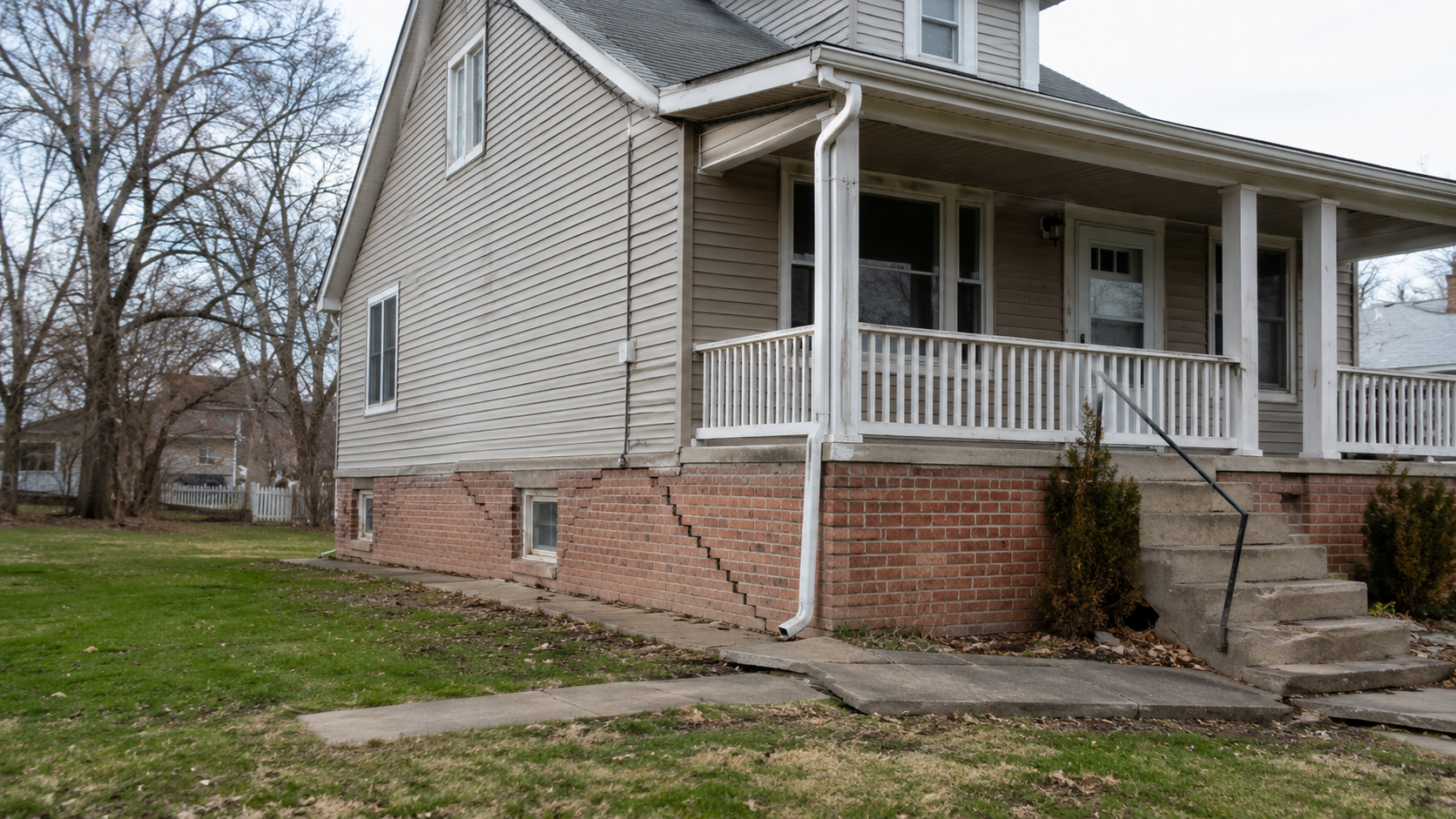
Image by ArchitectureCourses.org. Stair-step foundation cracks, uneven concrete, and porch movement can point to settlement that needs diagnosis before repair.
What Is Moving and What to Check First
A sinking foundation is not a crack problem first.
The crack is only where the house gave you a clue. The real question is what moved: the slab, the footing, the soil, one corner, one wall, a pier line, or the water path around the house. Start in the wrong place and the repair gets expensive fast.
Patch the visible line too early and you may hide the only warning sign you had.
Read This Next: Foundation Repair if you need the wider repair map before looking at settlement, lifting, or underpinning.
Start With Movement
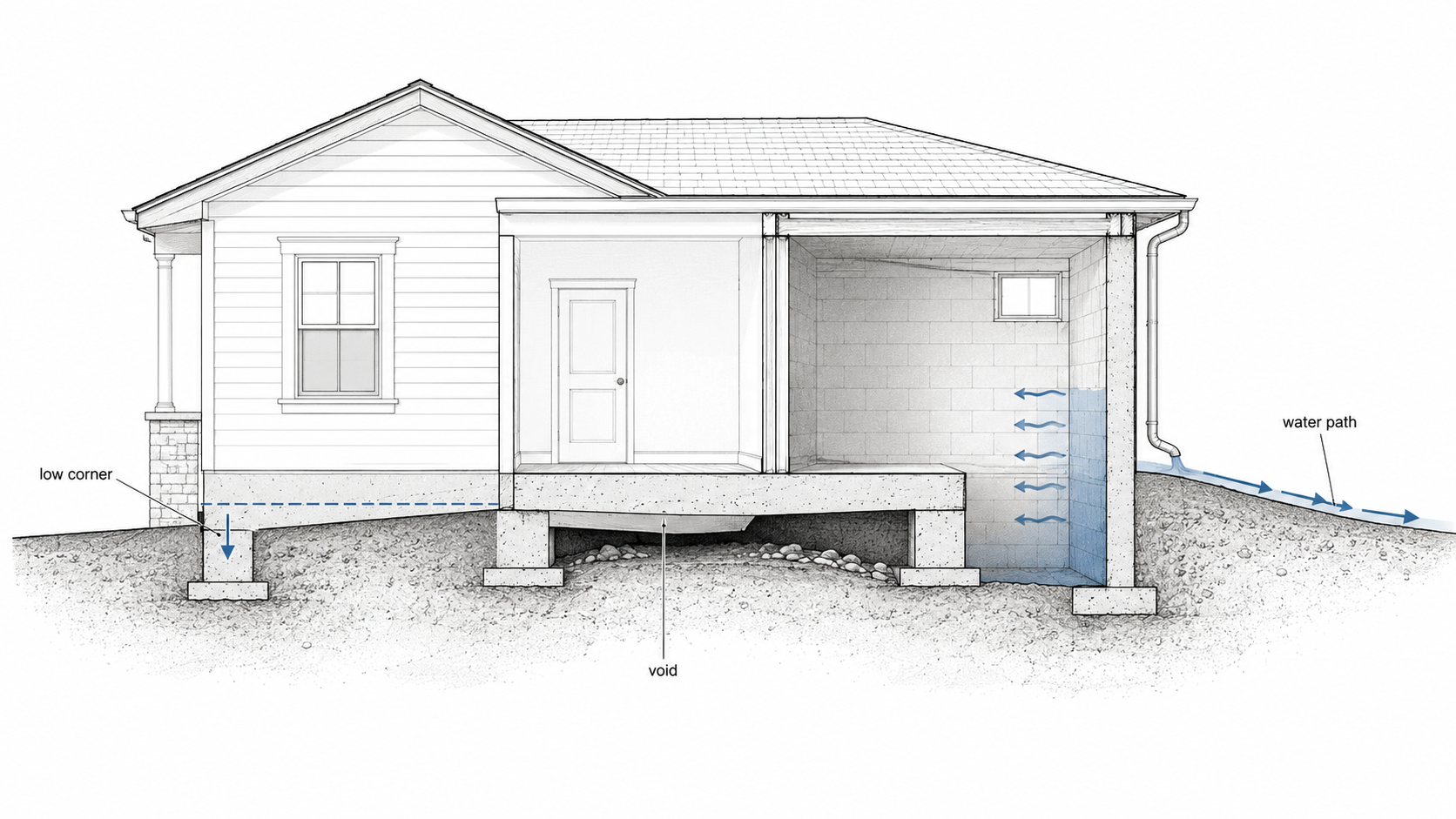
Illustration by ArchitectureCourses.org. A sinking foundation may show different clues at once: a low corner, a void below a slab, and water pressure near a basement or crawl-space wall.
| What You Notice | What It May Point To | First Check |
|---|---|---|
| One corner of the house looks lower | Localized settlement, washout, weak soil, or footing trouble | Downspouts, grading, soil softness, diagonal cracks |
| Cracks are wider at one end | Differential movement | Whether the crack is growing and whether floors slope nearby |
| Floor feels low, hollow, or dipped | Slab support loss, crawl-space support failure, or pier movement | Slab height change, crawl-space posts, joists, moisture |
| Doors stick on one side of the house | Frame movement tied to foundation shift | Door gaps, trim cracks, floor slope, nearby foundation cracks |
| Cracks reopen after repair | The source was never fixed | Water path, soil movement, support below the cracked area |
If the house is still moving, the repair is not a cosmetic job. It may still be manageable. It just needs to be diagnosed before anyone starts selling one repair method as the answer to everything.
Sinking, Settling, and Heave Are Different Problems
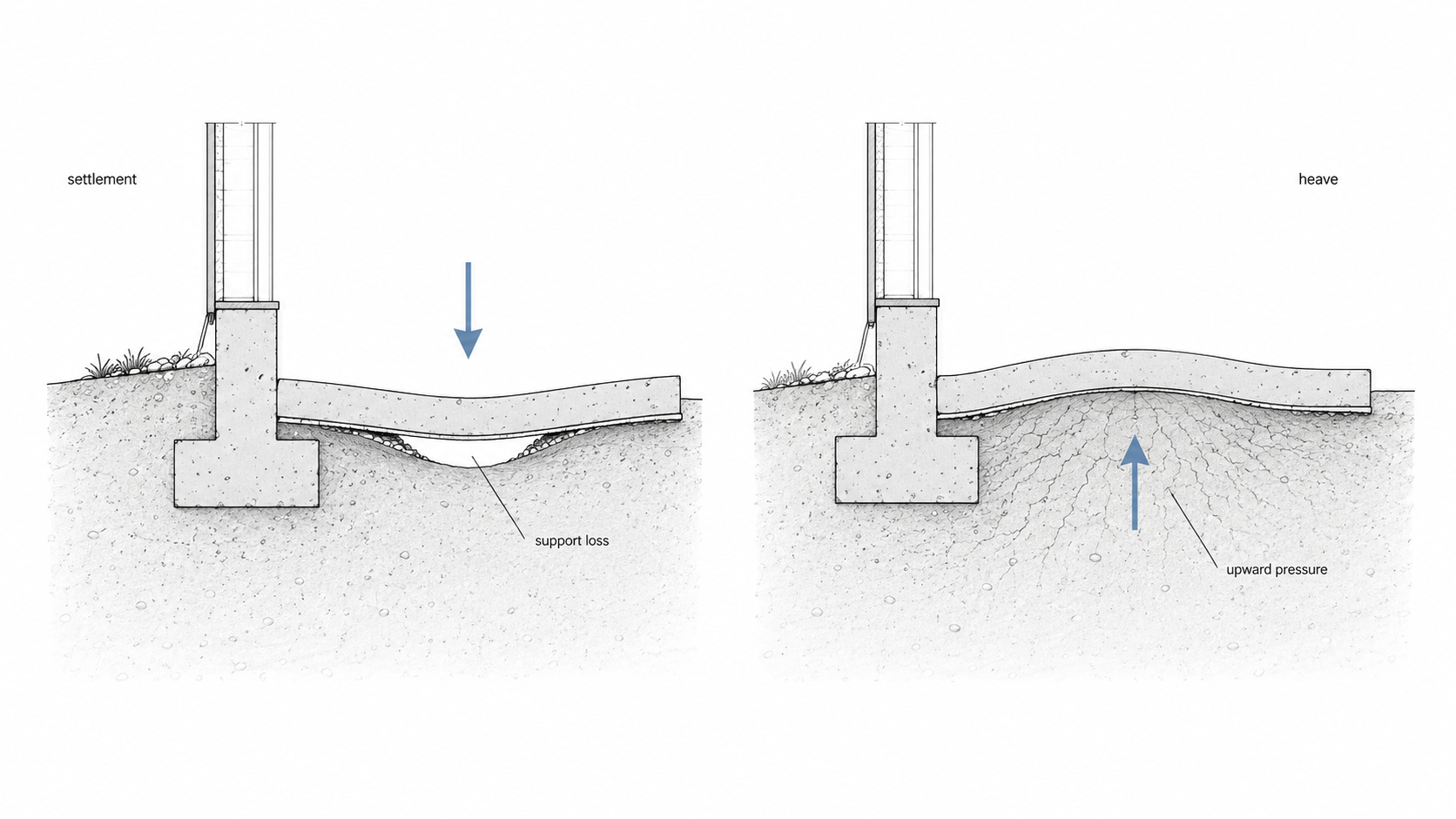
Illustration by ArchitectureCourses.org. Settlement usually means the slab or foundation is dropping because support has been lost; heave means soil pressure is pushing the slab upward.
Sinking usually means part of the structure has dropped because the support below it weakened, compressed, washed out, or was never prepared well.
Settlement can be minor and old. It can also be active and damaging. The difference is movement over time.
Heave is the opposite direction. Clay soil, frost, moisture imbalance, or poor drainage can push part of a slab or foundation upward. That still creates cracks and stuck doors, but the repair path changes. Lifting a slab that is already being pushed up is not clever. It is wasted money.
This is where a lot of foundation advice gets sloppy. A floor that looks “sunk” from inside the house might be one section dropping, or another section lifting. You need the floor pattern, the crack pattern, and the site-water pattern together.
This Part Matters: Normal Settling Cracks vs Structural Issues if the main question is whether the movement is old, normal, or still active.
The Walkaround
Do not start inside with a tube of sealant.
Start outside. Look where roof water lands. Check whether downspouts dump beside the foundation. Look for low soil near the wall, mulch piled against siding, sunken backfill, ponding after rain, or one wet corner that stays damp longer than the rest of the lot.
Then go inside.
- Mark the crack width and date it.
- Check whether one side of the crack sits higher than the other.
- Watch doors, windows, baseboards, tile lines, and floor slope near the same area.
- If there is a crawl space, look at posts, piers, beams, joist ends, moisture stains, and blocked access. A sagging floor can be a foundation issue, but it can also be a rotten sill, a weak beam, a failed pier, or a post sitting on bad support.
The walkaround is not a formal engineering report. It keeps you from paying for the wrong repair first.
Where Sinking Usually Starts
Weak or poorly compacted soil
Fill soil is a common suspect. If it was placed loosely, mixed with organic material, or never compacted properly, it can keep settling after the house is built. Concrete does not fix weak ground under it.
Water washing support away
Water is quiet until the damage gets visible. Roof runoff, bad grading, broken drains, irrigation, and plumbing leaks can soften soil, move fines, open voids, and leave part of a slab or footing with less support than it had before.
Expansive clay
Clay changes size with moisture. Wet clay can push. Dry clay can shrink and pull away. A foundation edge sitting near uneven moisture can move in a cycle: up, down, open, close, crack again.
Footings that never matched the load
A footing has one job: spread the load into soil that can carry it. If it is too shallow, too narrow, poorly reinforced, or sitting on weak bearing, the structure above starts paying for that buried decision.
Also Useful: Foundations, Soil Analysis, and Site Investigation if the soil story is still guesswork.
The House Tells on Itself
A sinking foundation rarely sends only one clue.
One diagonal crack in drywall might mean little by itself. Add a sloped floor, an exterior stair-step crack, a door that suddenly needs force, and a downspout dumping at that same corner, and the picture changes. The point is not to panic at every crack. The point is to stop isolating symptoms that belong together.
| Area | Clue | What It Can Mean |
|---|---|---|
| Exterior wall | Stair-step cracks in brick or block | Settlement stress moving through masonry joints |
| Basement wall | Horizontal crack or inward bowing | Wall thrust, soil pressure, or water pressure; not simple sinking |
| Slab floor | Offset crack or hollow-sounding area | Support loss, void, heave, or washout below |
| Interior framing | Doors rubbing, trim opening, cabinet gaps | Foundation movement reaching the frame above |
| Crawl space | Leaning posts, soft soil, wet wood, sagging beam | Support failure, moisture damage, or blocked service access hiding the real condition |
A basement wall bowing inward is not the same repair as a slab edge dropping. Do not let one word, “foundation,” flatten every problem into the same bucket.
Water Is Usually in the Argument
Water may not be the only cause. It still deserves early attention.
A house can sink because soil was weak from the beginning. It can sink because fill compressed. It can sink because roots, plumbing leaks, grading, or drainage changed the support. But if water is concentrating near the foundation, I would check that before pricing finishes, flooring, or cosmetic crack repair.
Water-driven foundation movement has a nasty habit: the first repair looks good, then the same wet corner keeps working on the same soil. The slab gets lifted and settles again. The crack gets sealed and reopens. The basement wall gets patched and stains return. That is not bad luck. That is the source still running.
Worth Knowing: Exterior Foundation Waterproofing if wet soil, damp walls, or bad runoff are part of the problem.
Slab, Crawl Space, or Basement?
The foundation type changes the repair path.
Slab-on-grade
A sinking slab may need void filling, foam lifting, mudjacking, drainage correction, plumbing repair, or in worse cases partial replacement. The hard part is telling drop from heave. A lifted slab section beside a dropped one can make the whole floor read wrong from inside the house.
One More Thing: How to Repair a Concrete Slab Foundation if the problem is clearly slab-based.
Crawl space
A sinking floor over a crawl space might not be a sinking foundation at all. It may be a rotten sill, undersized beam, failed pier, loose post, damp soil, or a support that was never bearing correctly. Repair starts below the floor, not in the room where the slope feels worst.
Related Reading: Replacing Piers Under Your House if the support points below the floor are part of the failure.
Basement foundation
A basement problem can look like sinking when the real issue is wall pressure. Horizontal cracks, inward bowing, and water staining point to lateral forces and drainage, not just vertical settlement. That repair may need wall stabilization and exterior water control before cosmetic interior work makes sense.
Repair Comes After Diagnosis
| Failure Pattern | Repair Direction | Where Money Gets Wasted |
|---|---|---|
| Small stable crack, no movement | Seal, monitor, and correct minor water paths if needed | Buying structural repair for a cosmetic crack |
| Sunken slab with voids below | Slab lifting, void fill, drainage correction | Lifting before fixing washout or plumbing leaks |
| Active settlement under a footing or load-bearing area | Underpinning, piers, engineering review | Repeated patching while the support keeps dropping |
| Crawl-space support failure | Repair piers, posts, beams, sill, moisture source | Leveling the floor without fixing rot, mold, or bad bearing below |
| Basement wall bowing | Wall bracing, anchors, drainage correction, structural review | Treating wall thrust like a simple crack repair |
One repair method cannot solve every failure mode. Piers do not fix a leaking downspout. Foam lifting does not stop expansive clay from moving. Crack injection does not rebuild lost bearing under a footing.
Where the Repair Bill Goes Wrong
The expensive move is paying for a repair before the failure is named.
A foundation company may sell piers because that is what it installs. A slab contractor may sell lifting because that is what it does. A waterproofing crew may focus on water because water is its lane. None of that makes the diagnosis complete.
The better question is blunt: what failed first?
If the answer is unknown, spend money on diagnosis before repair. That may mean elevation readings, crack monitoring, drainage review, plumbing testing, soil review, structural inspection, or opening a crawl-space access point that has been blocked for years. Blocked service access is not a small inconvenience when the only way to see the support system is through that opening.
When It Can Wait
Some cracks are old and stable. Some slopes have been there for decades. Some small slab cracks are ugly, not dangerous.
Waiting is reasonable when the crack is narrow, dry, not offset, not growing, and not tied to doors, windows, floor slope, moisture, or visible exterior movement. Mark it. Photograph it. Measure it again later.
When to Call Someone Fast
- one side of a crack is higher than the other
- a basement wall is bowing, leaning, or cracking horizontally
- doors and windows are suddenly binding near the same area
- the same crack keeps reopening after repair
Add water to any of those and the patience window gets shorter. A wet crack, a musty basement corner, or a crawl-space beam sitting over damp soil can turn a structure problem into a mold, rot, and air-quality problem too.
Cost Without Fake Precision
There is no honest single price for a sinking foundation.
A small stable crack may only need sealing and monitoring. A sunken slab section may need foam lifting or mudjacking. A footing that has lost support may need underpinning. A house that needs to be lifted, piered, drained, and repaired is not in the same pricing world.
The cost drivers are usually these:
- what moved and whether it is still moving
- how much of the structure depends on the failed area
- access, soil, water, plumbing, and engineering requirements
Before You Move On: How Much Does Foundation Repair Cost? if the next question is budget, and Foundation Lifting Costs if lifting or raising is already on the table.
Fast Answers
Is a sinking foundation always serious?
No. But active movement is serious until proven otherwise.
Can I fix a sinking foundation myself?
You can monitor a small crack. You can improve obvious drainage. You should not guess at piers, underpinning, slab lifting, or structural support. Wrong repair work can leave the house still moving and the budget already spent.
What is the first thing to check?
Water. Then movement. Then support. If roof runoff, grading, plumbing leaks, or wet soil are still active, the repair may fail even if the concrete work looks clean.
Is slab lifting the same as foundation repair?
Sometimes it is part of the repair. Sometimes it is only a leveling fix. Slab lifting fills voids and raises concrete. It does not automatically solve weak soil, broken plumbing, expansive clay, or failing footings.
Should I buy a house with a sinking foundation?
Only if the movement has been properly diagnosed, the repair matches the cause, and the documentation is clear. Fresh patching with vague answers is not comfort. It is a warning.
Do cracks mean the foundation is sinking?
Not always. Shrinkage cracks, old settlement cracks, water-pressure cracks, and structural movement cracks are different problems. The crack shape helps, but the floor, wall, soil, and water conditions decide the story.