
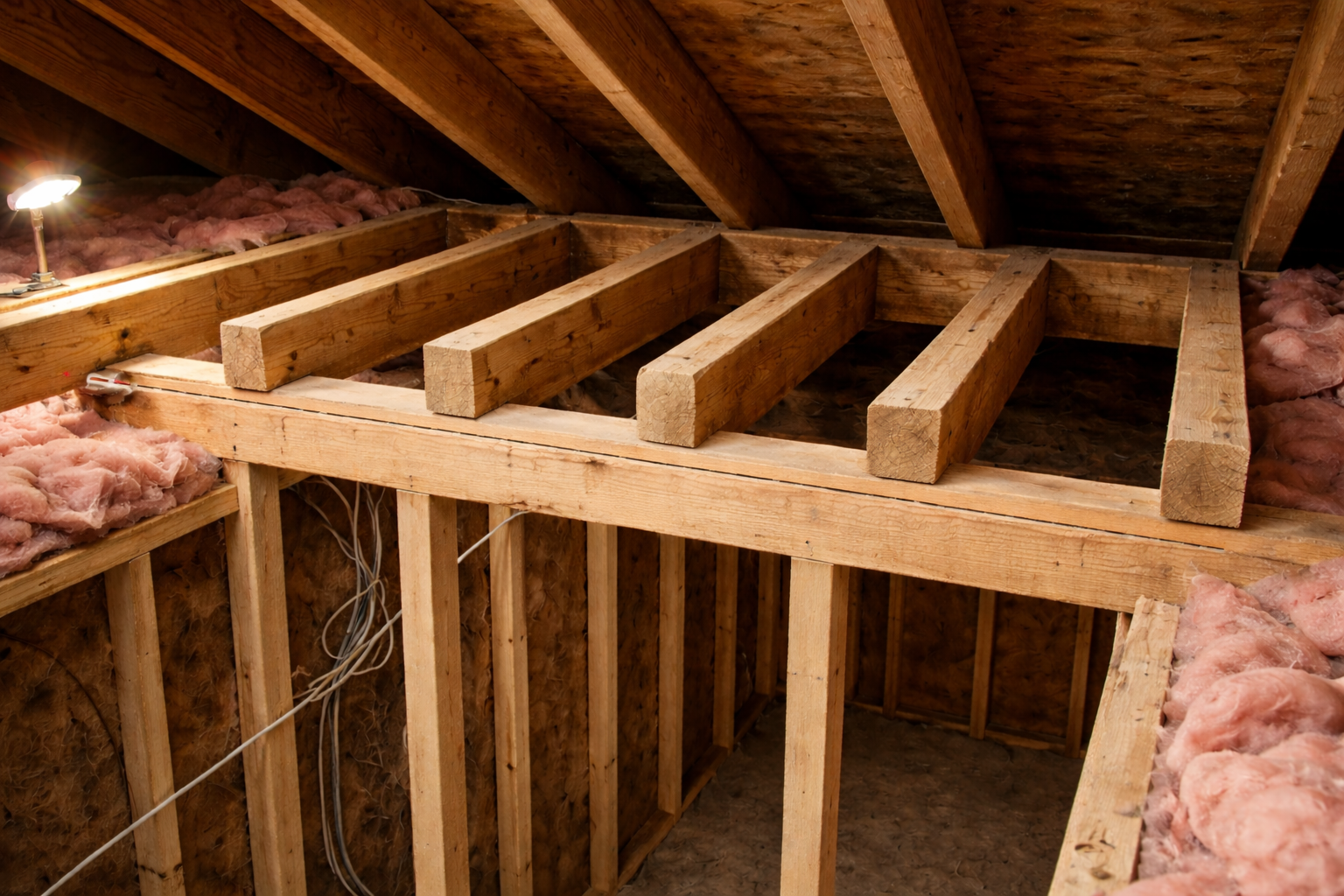
Attics are honest. Dusty, cramped, full of nails and regret — but honest. If a wall is carrying roof or ceiling load, the framing above usually leaves a footprint.
The mistake is thinking one clue is proof. “Joists run perpendicular” is a strong hint. It is not a permit.
In the attic, you’re not guessing “bearing.” You’re tracing where the load can actually land.

Why The Attic Helps

The attic lets you see the roof system (trusses or rafters), the ceiling joists (or bottom chords), and any beams or braces that need a place to die into. When a wall matters structurally, something above it typically depends on it: a joist end, a splice, a beam bearing point, a brace, or a special truss condition.
If you need the clean baseline definition before you start hunting details, read load-bearing vs. non-load-bearing walls and come back.
Find The Wall Line First

Don’t climb up and “kind of” guess where the wall sits. You’ll end up reading the wrong bay and convincing yourself of nonsense.
- Measure the wall location from a reference you can also find in the attic (exterior wall, chimney, plumbing stack, attic hatch opening).
- Mark the ceiling below with painter’s tape if it helps, then transfer that measurement into the attic.
- In the attic, verify you’re above the right line before you interpret anything.
Three Things That Count As Proof
These are the repeatable “yes/no” conditions that show up in real framing. If you can confirm one of them clearly, you’re not just collecting vibes.
1) Joists Splice Or Lap Over The Wall
This is common in older stick-framed houses and in ceiling/floor systems that use the wall as a mid-span bearing line. You’ll see joists overlapping (lapping) or splicing directly above the wall line.
- What to look for: the lap/splice sits right over the wall plate line, not “near it.”
- What fools people: random blocking, a catwalk plank, or insulation bridges that hide the actual joist ends.
- Why it matters: that wall is breaking a span. Remove it and you’ve changed the structure, even if the roof framing looks “fine.”
2) Joist Ends Bear On The Wall
If ceiling joists run perpendicular and terminate on that wall line, that’s bearing. Same idea if a header/beam above is clearly dumping load into that wall at a built-up point.
- What to look for: joist ends sitting on the top plate, or a clear bearing/blocking condition designed to transfer load into that wall line.
- Common trap: joists that look close but actually bear on an adjacent beam or a dropped girder a few feet away.
3) A Roof Member Or Brace Lands There On Purpose
This is where attic checks get real. If you see purlins, struts, braces, or a beam that needs a support point — and that support point lines up with your wall — treat it as structural until proven otherwise.
- What to look for: a beam bearing on a post/knee wall, purlin braces down to a wall line, or a special truss condition (multiple-ply “girder” truss, trusses intersecting on a carrier, concentrated bearing points).
- Common trap: assuming “trusses span exterior walls, so every interior wall is non-bearing.” Many are. Some aren’t. Special trusses and concentrated points are exactly how people get burned.
Joist Direction Helps, But It’s Not The Whole Story

Joists perpendicular to a wall often means the wall is in the load path. Joists parallel often means it isn’t. That’s the basic heuristic.
The catch: houses aren’t always “basic.” Beams can run parallel. Loads can transfer at two or three posts. Remodels introduce hidden LVLs. Truss systems create point loads that don’t care about your perpendicular/parallel shortcut.
If your attic view is limited or the ceiling is finished and complicated, this low-damage workflow is usually cleaner than guessing: how to tell if a wall is load-bearing without removing drywall.
Truss Attic Or Stick-Framed Attic?
This matters because it changes what the attic can “prove.”
| What You’re Seeing | What’s Typical | How It Changes Your Read |
|---|---|---|
| Truss Roof | Factory-built trusses spanning exterior walls; lots of webbing; bottom chord acts like the ceiling joist. | Many interior walls are partitions for roof load, but watch for special trusses and concentrated bearing points. Do not cut or modify truss members without a design. |
| Stick-Framed Roof | Rafters and ceiling joists framed on site; braces/purlins may kick down to interior lines. | Interior bearing lines are more common. Splices, laps, and brace landings are easier to spot and usually mean something. |
Non-U.S. note: framing conventions are broadly similar, but details and inspection expectations vary by jurisdiction. When in doubt, treat it as “verify locally.”
Real-House Problems That Make Attics Lie
The Remodel That Hid The Beam
A previous owner “opened it up” and boxed a beam into a clean ceiling line. The attic looks quiet. The load is still there — it’s just not visible from above. If you see patched drywall bands, soffits that don’t match, or a weird dropped bulkhead near your wall line, assume structure has been altered.
The Offset Wall
The wall below is not perfectly aligned with what’s above. People then assume it can’t be bearing. In real houses, offsets happen: framing drift, layout compromises, additions. Loads can transfer through doubled joists or short headers. If the alignment is “close but not perfect,” slow down and trace supports below too.
The HVAC / Duct Obstruction
Big ducts and air handlers love to sit exactly where you want to look. Don’t invent an answer because you can’t see the connection. If you can’t confirm the bearing condition, treat it as unknown.
If You Think It’s Bearing
If your attic check points to a bearing condition, the smartest next move is to verify that the load can travel down to something that can take it (beam, post, foundation line). In a two-story house, the second-floor system often drives the decision more than the roof.
If your project is in a two-story layout (or you have stacked walls, stairs, or a long opening nearby), use the two-story workflow here: how to tell if a wall is load-bearing in a two-story house.
FAQ
If Joists Run Parallel, Is The Wall Non-Bearing?
Often, but not guaranteed. A parallel beam can still dump load onto posts at points, and remodels can hide transfers. Treat “parallel” as a hint, not a verdict.
Do Trusses Ever Bear On Interior Walls?
Many truss roofs are designed to span exterior walls only, but special conditions exist (girder trusses, intersections, carriers, concentrated points). If you see a beefy multi-ply truss or unusual layout at your wall line, don’t assume it’s cosmetic.
What If I Can’t See Anything Because Of Insulation?
Peel back insulation carefully in a small area to check for joist laps, ends, and bearing points — then put it back where you found it. If the attic is too blocked to confirm safely, stop and switch to a low-damage interior check.
What About A Half Wall Or Pony Wall?
Half walls can still be structural if there’s a beam or brace landing on them, or if they’re part of a framed support line. Don’t assume “short wall” means “non-bearing.”
Do I Need A Permit If I Remove A Load-Bearing Wall?
In most U.S. jurisdictions, yes. Structural changes typically require permits and inspections. Requirements vary by jurisdiction, so confirm with your local building department before demo.
What’s The First Sign I Got It Wrong?
Cracks at ceiling corners, doors rubbing, new floor bounce, trim gaps opening. Sometimes immediate. Sometimes after the first seasonal movement.