

Architecture history gets flattened too easily into a list of images. Pyramids. Columns. Glass towers.
That is the shallow version.
The useful version is what each period was trying to solve: structure, light, climate, power, religion, cities, labor, and materials. Read it that way and the timeline stops feeling like trivia and starts reading like design logic.
Keep the sweep, skip the bloat. Focus on the main periods, what changed in each one, and what still carries into buildings now.
Worth Knowing: this page is the broad map. If you want a deeper read on one branch, go next to the specific pages on Art Deco Architecture, Minimalist Architecture, or the broader house-focused pages like House Styles.
Read the timeline this way
Do not study architecture history as a list of names first. Read it through the pressure each period was under.
| Period | Main Pressure | What Builders Pushed | What Still Shows Up Now |
|---|---|---|---|
| Ancient | material limits, ritual, survival, rule | mass, axial planning, early urban order | courtyards, grids, monumentality, climate logic |
| Classical | public life, empire, proportion | columns, domes, arches, civic systems | symmetry, proportion, state architecture, stadium logic |
| Medieval | defense, religion, craft, light | vaults, towers, thick walls, filtered light | façade rhythm, vertical drama, structure as expression |
| Renaissance to Baroque | power, order, display, return to antiquity | domes, symmetry, grand sequences, theater | monumental stairs, formal axes, framed views |
| Industrial 19th century | machines, cities, mass production | iron, glass, stations, factories, revived styles | large-span buildings, curtain-wall thinking, urban infrastructure |
| 20th century | speed, industry, housing, ideology | modernism, Art Deco, concrete, steel, glass | open plans, towers, modular systems, stripped form |
| Late 20th to now | digital tools, climate, branding, density | parametric form, green systems, adaptive reuse | performance-driven envelopes, prefab, mixed references |
The names matter. The dates matter. But the pressure matters more. That is what tells you why one era built domes, another stacked stone, and another wrapped towers in glass.
Ancient architecture was already solving hard problems

The ancient world did not have one architecture. It had many. Different climates, different tools, different materials, different ideas of power. But some core moves show up early and never leave.
Prehistoric and megalithic building
Stonehenge gets the attention, but the bigger lesson is simpler. Builders were already working with mass, orientation, and sequence. They knew how to make a place feel important with almost nothing except earth, stone, and position.
Egypt
Egypt sharpened monumentality. Axial planning. giant scale. walls and columns that make a body feel small. The point was not comfort. It was permanence and control. That instinct never really disappeared. You can still see it in state architecture and memorial design.
Mesopotamia
Mud brick changed the game. Cities, walls, gates, terraces, stepped forms. Less stone, more system. This is also where urban planning starts getting harder edges. Zoning. hierarchy. access. enclosure.
Indus Valley
This is one of the most useful ancient case studies and it still gets skipped too often. Grids. drainage. standardized brick. civic planning. The lesson is blunt: infrastructure is architecture too.
Ancient China
Timber framing, courtyards, axial planning, modular rhythm. Less obsession with stone permanence, more focus on order, joinery, roof form, and repeatable systems. A lot of East Asian architecture keeps building from this logic for centuries.
Pre-Columbian traditions
Mesoamerican and Andean building pushed site integration, terraces, stepped platforms, processional movement, and water control. Those are not side notes. They are big architectural ideas.
This Part Matters: the ancient world did not just invent “old forms.” It invented a lot of the planning moves later periods kept reusing: axis, hierarchy, procession, civic infrastructure, modularity, landscape integration.
Greek and Roman architecture turned building into a system
This is where architecture becomes easier to teach and easier to misuse.
Greek architecture gets reduced to columns far too often. What mattered more was order. Proportion. Repeatable systems. Public buildings made as composed, legible objects. The column orders were not decoration tacked on at the end. They were part of a whole language of spacing, weight, and hierarchy.
Roman architecture took that language and pushed it into larger space. Arches. vaults. domes. concrete. infrastructure. Baths, forums, aqueducts, amphitheaters. Rome was not just styling buildings. It was building systems for crowds, empire, and logistics.
This is why the classical period still hangs around so stubbornly. It solved problems clearly. It gave later architects a grammar they could steal, polish, flatten, parody, or revive depending on what they needed.
Government buildings still borrow from it. Museums still borrow from it. Banks still borrow from it. Stadiums still borrow from Roman logic even when they look nothing like Rome.
| Greek Move | Roman Move | Why It Still Matters |
|---|---|---|
| Order and proportion | Scale and engineering | Good buildings still need both |
| Post-and-lintel clarity | Arches, vaults, domes | Span and enclosure are still core structural questions |
| Civic form | Civic system | Public architecture still depends on movement and hierarchy |
If you only remember one thing from classical architecture, make it this: it taught later architecture how to think in systems instead of isolated objects.
Medieval architecture got more complex, not less
A lot of bad summaries treat the Middle Ages like a long dark tunnel between Rome and the Renaissance. That misses too much.
This period is full of structural experiments, regional variation, and spatial ambition.
Byzantine
Big domes over centralized plans. Thick walls giving way to interior atmosphere. Light filtered through gold, mosaic, and curved volume. The outside could stay plain while the inside carried the drama.
Romanesque
Heavy walls. round arches. barrel vaults. repeated bays. Buildings that feel grounded and almost dug into the earth. Structure leads the whole thing.
Gothic
This is not just “pointed arches and stained glass.” Gothic is a structural reorganization. Ribbed vaults, buttresses, taller walls, more light, less dead mass. It turns force paths into architecture you can see.
Islamic and Persian traditions
Pattern systems, iwans, courtyards, domes, muqarnas, tile, geometry carried across whole surfaces. The lesson here is not ornament by itself. It is order expressed through repetition, pattern, and controlled light.
South and Southeast Asia
Mughal, Indo-Islamic, Khmer, and other regional traditions pushed procession, domes, gardens, carved stone, raised plinths, and strong relationships between building and site. Angkor Wat is not just a monument. It is sequence, elevation, water, and geometry working together.
Medieval architecture did not just inherit structure. It made space feel more charged. More vertical. More ritualized. More atmospheric.
Renaissance, Baroque, and Neoclassicism made architecture more self-conscious
The Renaissance did not invent order. It returned to it on purpose.
Architects looked back to Rome, pulled out proportion, symmetry, domes, courtyards, and measured facades, then rebuilt them for a new political and cultural moment. The building starts acting more like a designed statement again. Deliberate. intellectual. composed.
Then Baroque pushes harder. Curves, stairs, domes, light, sequence, theatrical movement. This is architecture as persuasion. You do not just enter a building. You get directed through it.
Rococo softens and decorates that drama. Neoclassicism then tightens it again. Cleaner lines. stronger order. less theatrical excess. More authority.
This whole period matters because architecture becomes openly political and representational. Courts, academies, museums, and imperial projects all start using style very consciously to send signals.
That is still happening now. The difference is the signals changed.
The 19th century blew the lid off materials and style
This is where the timeline gets noisy.
Industry changes the material world. Iron. steel. larger spans. more glass. faster fabrication. rail. factories. stations. bridges. greenhouses. exhibition halls. New building types arrive fast, and old style languages get dragged into the new systems.
That is why the 19th century feels so crowded. Gothic Revival. Beaux-Arts. Victorian mixtures. Arts and Crafts. iron-and-glass engineering. civic classicism. colonial hybrids. It is not one clean story. It is many stories running at once.
One side of the century is engineering. The other is revival and display. Sometimes they sit together in one building.
This is also where the split between structure and cladding gets more obvious. Once iron and steel carry more of the load, the outer skin can start acting differently. That matters later. A lot.
Related Reading: the cleanest way to connect this to later housing is through era pages like 1920s House Styles, where industrial-era shifts finally show up in ordinary domestic form.
The 20th century did not move in one line

The easy version says the 20th century killed ornament and gave us glass boxes. That is only part of it.
The century splits.
Art Nouveau and Art Deco
Art Nouveau curves, plant forms, flowing line. Art Deco hardens it. geometry, shine, speed, control. Both are modern in their own way, but they do very different things with form.
Modernism
Bauhaus, Le Corbusier, Mies, Gropius, International Style. Strip it back. Let structure and program lead. Ornament becomes suspect. Clean lines, grids, planes, industrial materials, open planning. This is still the default grammar of a lot of construction.
Organic and regional reactions
Frank Lloyd Wright, Alvar Aalto, and others push back against the colder version of modernism. More landscape connection. More material warmth. More site response.
Brutalism and postwar systems
Concrete, repetition, civic scale, institutional ambition. Sometimes brilliant. Sometimes deadening. But never as simple as the internet meme version.
The 20th century is where architecture becomes fully global in one sense and sharply ideological in another. The same concrete frame can become a housing block, a ministry, a university, a church, or a cultural center depending on what a state, city, or architect wants it to mean.
Late 20th century to now: more tools, more choices, less agreement
Postmodernism breaks the clean certainty of modernism. History comes back, sometimes seriously, sometimes as a joke. Color comes back. Symbols come back. Then high-tech exposes systems. Deconstructivism breaks the calm grid. Digital tools start taking over the drawing table.
The current period is harder to name because it is less unified.
Some of it is parametric. Some of it is minimalist. Some of it is sustainability-first. Some of it is adaptive reuse. Some of it is developer blandness wearing green language. Some of it is genuinely new. Some of it is old ideas redrawn with better software.
That is the honest version.
The pressure now is not just style. It is carbon. cost. code. labor. supply chains. data. energy. density. maintenance. Digital tools changed form-making, but climate and economics are changing the brief underneath the form.
| Then | Now | What Changed |
|---|---|---|
| Style often led the story | Performance often leads the story | Energy, carbon, and lifecycle matter more |
| Drawing led production | Models, simulation, and fabrication data lead production | The tool chain changed |
| Regional separation was stronger | Styles circulate globally almost instantly | Cross-pollination sped up |
The important point is this: the digital era did not erase the past. It remixed it under different pressures.
What the whole timeline teaches
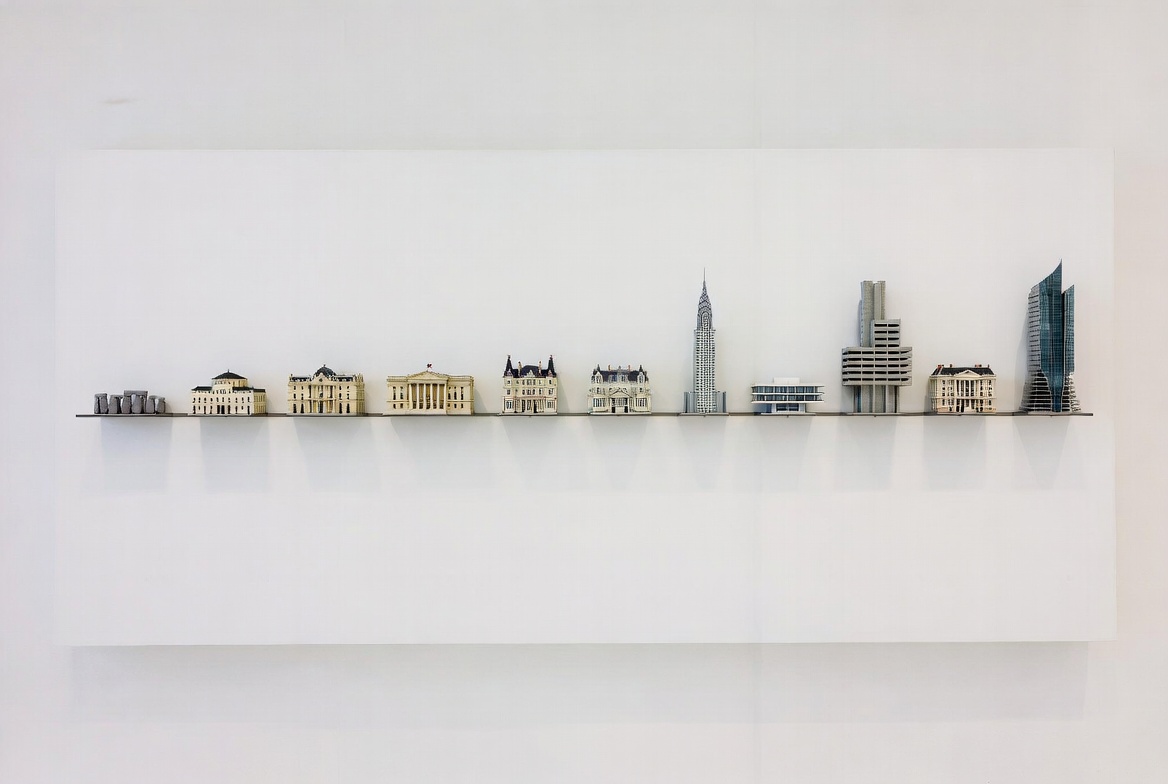
Architecture does not move in a straight line. It loops, rejects, revives, borrows, strips down, then adds back.
But it does not do that randomly.
Styles change when materials change. When labor changes. When political power changes. When cities change. When climate gets ignored for too long. When a previous solution stops working. When a culture wants to look backward. When it wants to look like the future.
That is why this timeline matters. Not because you need to memorize every sub-style. Because it helps you see that buildings are arguments made out of structure, material, and use.
Do this instead of this: study each style as a response to a problem, not as a bag of visual traits. Columns alone will not teach you much. Columns plus public life, stone logic, span limits, and civic image will.
What to skip when reading architecture history
- Do not treat style names like isolated boxes. They overlap.
- Do not reduce whole eras to decoration. Structure and labor matter more.
- Do not assume Europe is the whole story. It is not.
- Do not confuse house-style timelines with architecture timelines. They intersect, but they are not the same page.
- Do not assume “modern” means better. Every period got some things right and some things badly wrong.
FAQ
- What is the easiest way to understand architecture history? Start with the period, then ask what material, structural, political, or climate problem that period was answering.
- What are the biggest architecture periods in one line? Ancient, Classical, Medieval, Renaissance and Baroque, Industrial 19th century, Modern 20th century, then the mixed digital and climate-driven present.
- Why do older styles keep coming back? Because a lot of them solved spatial, structural, or symbolic problems clearly, so later periods keep borrowing the parts that still work.
- Is contemporary architecture one style? No. It is a messy mix of digital tools, sustainability pressure, global references, branding, and local constraints.