

Drawing of a Modern House: Step-by-Step Guide for Beginners
Your roadmap for architectural drawing sets. Understand what documents are required, what saves money, and how projects move from idea to built.
Quick Note Before We Start
This guide walks through a real step‑by‑step drawing process for a new single‑family home in LA County. Permitting rules vary, but this applies to many cities in Southern California.
W’ve fact‑checked using LA County Public Works and LA City Planning documents.
Alright, let’s get started.
How Architects Turn Ideas into Plans

Every building starts as a thought. Someone says, “I want a house with lots of light and space for family dinners.” An architect’s job is to take that fuzzy picture and make it real.
The process has clear steps:
● Listening first. Architects start by asking questions: How many people live here? What budget? Do you cook often? Do you need an office? The answers shape the design.
Example: A young couple in Toronto asked for a compact home with room for bicycles. That detail turned into a dedicated storage alcove near the entrance.
● Sketching the idea. Before computers, it was pencil on tracing paper. Today, it’s still often a quick sketch. These early drawings capture the spirit, not the detail.
Think of a rough outline of a box with windows. It’s about massing and light, not doorknob placement.
● Turning sketches into plans. Once the idea feels right, the architect drafts floor plans, elevations, and sections. This is where spaces are measured, walls are placed, and rooms take shape.
Example: A client in Los Angeles asked for “big windows.” On the plan, that meant rethinking the living room wall as a glass facade with shaded overhangs to block summer heat.
● Adding detail. Drawings evolve into construction documents. These include dimensions, materials, structural notes, and even where the electrical outlets go. At this stage, contractors can price the project.
● Checking the law. Plans must meet building codes and zoning rules. In many cities, you can’t just build a four-story house in a single-family zone. Architects adjust the design to fit the law.
● From paper to site. Builders use the drawings as a manual. A framing plan tells them how to set beams. An elevation shows the brick layout. Every drawing reduces the risk of mistakes.
The key lesson: Architects don’t “draw houses.” They translate human needs into a language that builders can follow. The sketch is imagination. The plan is instruction.
Drawing of a Modern House: Easy Plans and Sketch Ideas
From Simple Sketch to Full Blueprint
Your Project’s Blueprint: All Drawings, All Steps, Made Simple
Your Project’s Blueprint: All Drawings, All Steps, Made Simple
Architecture Basics You Need to Know: Floor Plans, Elevations, and Sections Explained
1. Pre-Design and Prep Work
Start by defining what the owner wants the house to be. Bedrooms, layout size, character, must‑have features. Then, look at how the lot limits that. Setbacks. Lot coverage. Trees. Slopes. Utilities. If there’s an HOA or hillside rules, that matters too.
Next, pull zoning info. Check how big the house can be, how tall it can go, how much parking it needs, and whether there are any special restrictions like view corridors or code overlays.
Then get a topographic and boundary survey. This becomes the base for every drawing—site plan, grading, setbacks. Don’t build on guesswork.
Finally, build your team. You need at least an architect and a structural engineer. Add a geotech specialist if the ground is tricky, a civil engineer if grading or drainage is involved, and MEP consultants if mechanical systems matter.
2. Concept Design
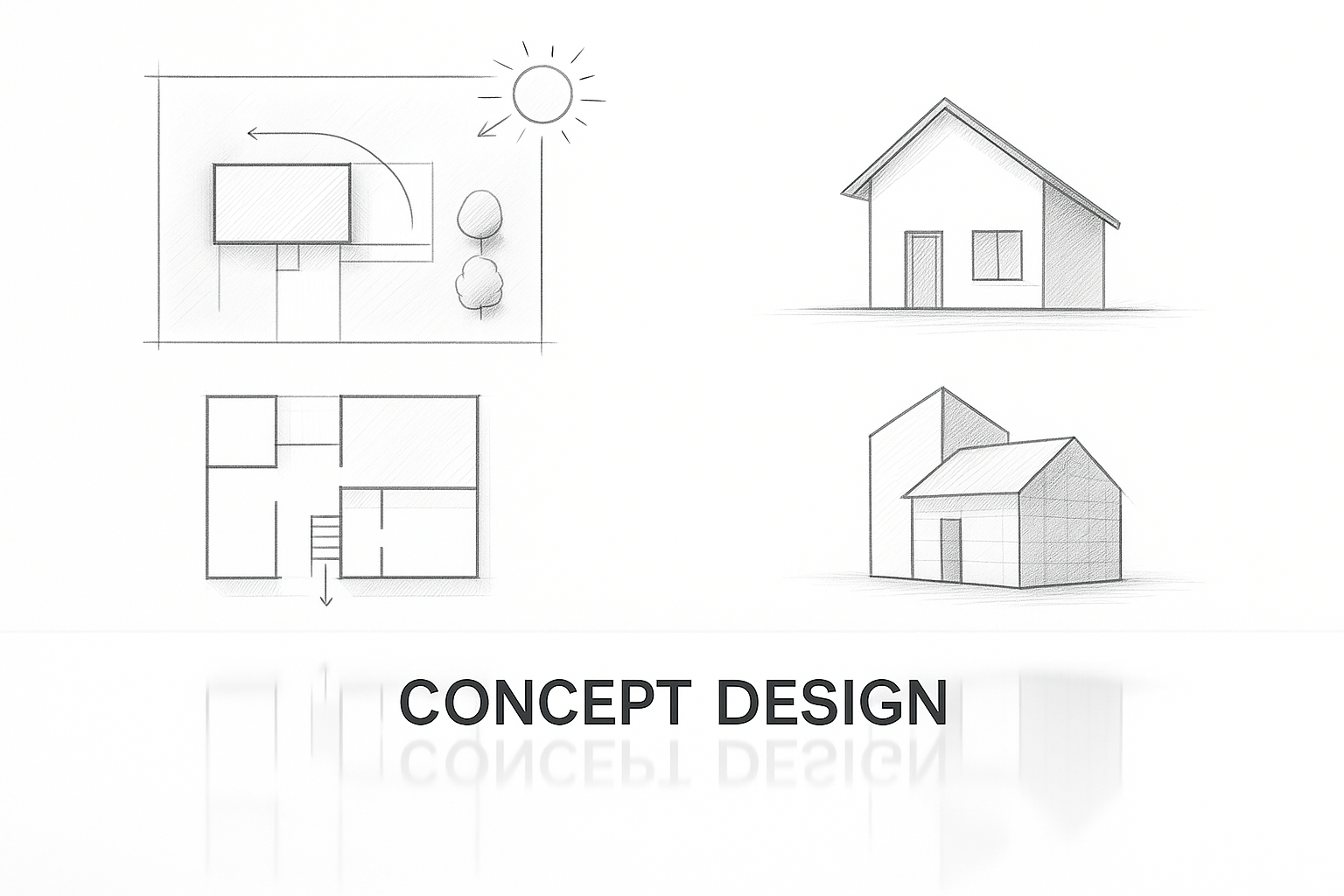
Let the design begin. Place the house onto the site. Figure out where the driveway, patio, and any utility access points will go. How does the sun move? Where are views?
Sketch rooms as simple blocks. Kitchen, living, bedrooms. Roughly place bathrooms and the laundry. Draw entries and stairs, but don’t worry about dimensions yet.
Block masses onto the site. Sketch roof ideas. Throw up a quick 3D massing or axonometric so clients understand form.
Deliverable: concept site plan, concept floor plan, basic elevation or massing views, and a one‑page design intention.
You might like: Housing Concepts Explained: From Traditional Styles to Minimalist Trends
3. Schematic Design
Now you start fleshing things out enough to build on.
Create a scaled floor plan with basic dimensions. Label rooms. Add doors and windows. Show stairs and sketch plumbing stack locations.
Overlay the survey to build a real site plan with property lines, setbacks, drive and walk locations, meter, sewer tie‑in, hydrant, and any building within 10 feet of your property line.
Draw one or two sections to show floor heights and stair compliance. These help test whether the design makes sense vertically.
Deliverable: Schematic set including site plan, floor plan, elevations, and sections. Add a short feasibility note about grading or structure.
4. Design Development
Now the house really starts taking shape.
Lock in structural logic. Set floor and roof framing, bearing walls, shear walls.
Choose wall system, windows, roof, insulation, and basic MEP layout so systems don’t clash.
Draw details of foundation, window head, roof eave, stair, or wall‑to‑substructure connections.
Deliverable: DD set—refined plans, sections, elevations, typical construction details, outline specifications.
The Complete Guide to Drawing a House That Passes Permit and Gets Built
5. Permitting Set (Minimum in LA County)
This is what gets submitted for a permit.
Format rules
Plans must be legible, scaled (1/8"‑inch minimum), and dimensioned. Use minimum 18×24" sheets (24×36" recommended). They must be signed by the preparer and stamped if required.
Required drawings
-
Site Plan: address, names, boundaries, setbacks, easements, landscaping stats, north arrow, property line spacing, projections (eaves, balconies), grading, utilities, hydrants, adjacent buildings within 10 ft.
-
Floor Plans: dimensioned, labeled rooms, doors and windows, new vs existing.
-
Elevations: show exterior views with materials, window/door openings, and key height dimensions.
-
Sections: at least two directions, showing vertical relationships.
-
Structural Plans: foundation, framing, connections, hold‑downs, site calculations.
-
Drainage Plan (if needed): slopes and drainage devices.
-
General Notes: codes, occupancy, construction type, parcel info.
-
Energy Compliance: Title 24 documentation.
-
Soils Report: if conditions require.
Optional, smart additions
-
Roof plan with drainage slopes
-
Reflected ceiling plan with lighting layout
-
Interior elevations of kitchens or bathrooms
Those cut RFIs and errors later.
See also: Architectural Drawing Basics Every Architect Must Know
6. Plan Check and Corrections
Submit two full sets plus extra if Assessor’s office needs one.
You’ll get feedback. Fix sheet numbers and mark changes clearly if possible.
Ask early about separate trade permits—electrical, plumbing, mechanical, grading, or even landscape. Utility meters may require their pre‑approval too.
Everything You Need to Draw a House That Gets Built
7. Construction Documents
Permit drawings get the go‑ahead. Construction documents show how to build.
Add full details: door/window types, cabinet layouts, finish schedules, electrical layout, interior elevations, specification notes.
Contractors request shop drawings from fabricators—steel, cabinets, trusses, glazing. You review and approve them.
Hold a pre‑construction meeting to walk through the drawings, submittals, and inspection points.
8. Inspections and Field Changes
Keep the approved set on site.
Inspectors will check: foundation, framing, electrical rough‑in, insulation, HVAC, roofing, final.
If things on site change, issue a revision or RFI. If structural details are changed, get them approved before you build them.
Track changes on your set and produce accurate as‑built drawings.
9. Project Close-Out
Clear final inspection and separate trade sign‑offs.
Provide the owner with digital PDFs and a set of as‑built drawings. Include manuals and warranties.
This saves future cost for maintenance, additions, and resale.
Reading and Creating Your First Plans
Complete Guide to Plans, Details, and Construction
Tools, Tips, and Common Mistakes
From Idea to Approved Plans: A Practical Guide to Drawing Sets
Who Does What When
How to Get From Sketch to Permit to Built: Full Drawing Guide
-
Architect: sketches, site/floor/elevation drawings, details, specs.
-
Structural Engineer: framing, foundation, lateral forces.
-
Civil Engineer: grading and drainage.
-
MEP Engineers: plumbing, HVAC, electrical (if complex).
-
Energy Specialist: Title 24 compliance.
-
Soils Engineer: foundation design if needed.
-
Landscape Architect: site planting and irrigation (if required).
Summary: Drawing Sets by Phase
Architect’s Roadmap: Every Drawing You Need, from Start to Finish
| Phase | Drawings Included |
|---|---|
| Concept | Bubble plans, massing, rough site sketch |
| Schematic | Scaled site and floor plans, elevations, two sections |
| Design Dev | Refined plans and elevations, typical details, outline specs |
| Permit | Full set: site, floor, elevation, section, structure, drainage, notes, energy, soils |
| Construction | Complete CD set, details, interiors, schedules, specs |
| Shop | Subcontractor drawings reviewed for conformance |
| As-Built | Final record set capturing field changes |
What Inspectors Really Look For
-
Consistent room labels, dimensions, schedules across sheets.
-
Accurate setbacks and property conditions on site plan.
-
Structural clarity: spans align, hold‑downs and rebar clear.
-
Energy compliance form and drainage drawn when needed.
Real-Life Tips That Prevent Delays
Always write the full scope of work on the title sheet—jurisdictions call this out.
Show heights on elevations (eave, ridge, ceiling). Soft code violations happen when heights aren’t clear.
Use one window ID (like W-01) consistently across floor plans, elevations, and schedules.
Sketch drainage early. Reviewers like it even for gently sloped yards.
Coordinate meter locations and ask your utility company about panel clearance and short-circuit requirements ahead of time.
Must-Have vs Nice-to-Have
Must-Have (for permit approval)
-
Scaled, labeled site plan
-
Full floor plans
-
Elevations and sections
-
Structural plans and calcs if needed
-
Drainage if required
-
Title 24 energy forms
-
General notes
Nice-to-Have (reduces cost and confusion on site)
-
Reflected ceiling plan
-
Roof plan with slopes
-
Interior elevations for kitchen/bath
-
Window and door schedule
-
High-quality details at key junctions
How Do You Go From Idea to Approved Plans? A Practical Guide to Drawing Sets
Architects don’t just draw pretty lines. Each sheet in a drawing set has a purpose, and it follows a sequence that takes an idea from a quick sketch to something a builder can actually use.
1. Tools you actually need
● Pencil and tracing paper for fast sketches
● CAD or BIM software like AutoCAD, Revit, or ArchiCAD for real plans
● Scale ruler and drafting templates for accuracy
● A tablet if you want to mix hand sketching with digital work
2. Tips that save time
● Start with massing and proportions before you touch detail
● Check local building codes early so you don’t waste redraws
● Keep your plans clear and easy to read
● Build a personal library of standard details (stairs, windows, doors)
3. Common mistakes beginners make
● Jumping into detail before the layout works
● Forgetting circulation paths and how people move through rooms
● Ignoring daylight, ventilation, or orientation
● Overloading designs with too many materials or clashing styles
4. The drawing set roadmap
Every real project follows a sequence. Each stage adds detail and legal weight.
-
Concept Sketches – quick diagrams to capture the idea
-
Schematic Plans – rough layouts for rooms and massing
-
Design Development – clear floor plans, sections, elevations
-
Construction Documents – dimensions, materials, structural details
-
Permit Drawings – code and compliance sheets required by law
-
Issued for Construction (IFC) – the final, stamped set contractors build from
A real example
Take a two-story house in Vancouver. The architect began with a hand sketch showing an L-shaped living area wrapped around a small garden. Later, the city required energy compliance drawings for permits, so extra sheets were added. The final IFC set had over 70 sheets, covering structure, mechanical, electrical, and finishes. That stack of drawings became the legal and practical roadmap to build the house.
Final Word
Architectural drawing sets are not just pretty pages. They’re the instructions for getting your house built right. A poor set means delays, cost overruns, and frustration.
A smart, complete set means smooth permitting, clear construction, and better outcome for the owner.
References and Sources
Los Angeles County Public Works – Building and Safety
- Residential Minimum Plan Submittal Requirements (PDF)
- Building and Safety – Permits and Plan Check
- Plan Check – General Information
- EPIC-LA Electronic Plan Submittal Portal
- Plans Retention and Records FAQ
- Electrical Plan Check Checklist (PDF)
City of Los Angeles LADBS
California Codes and Energy Compliance
- California Building Standards Commission – Title 24 Codes
- California Energy Commission – Energy Code Forms and Compliance Help
- Energy Code Support Center
- Residential Compliance Forms and Guidance
Standards and Best Practices
Books for Learning Architectural Drawing