
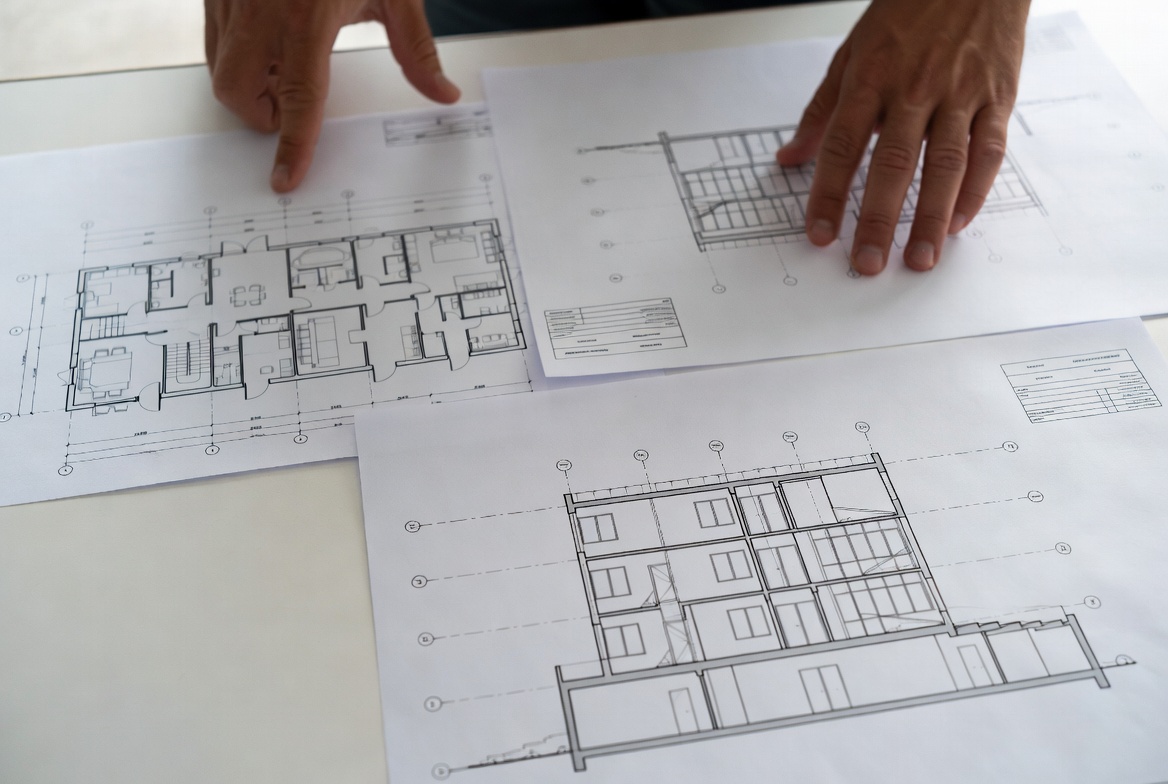
Blueprints feel unreadable the first time you open a full set.
Too many lines. Too many notes. Too many sheets that seem to be talking over each other. But the set is not random. It has an order, and once you know where to start, the drawings stop looking noisy and start telling you where the building is, how it goes together, and what each part is supposed to do.
This guide is for that first pass. How to read the main drawing types, follow plans, elevations, and sections, understand symbols and scale, and move through a set without getting lost.
What Blueprints Are
A blueprint is a technical drawing used to explain how something gets built. In house and building work, that usually means a coordinated set of drawings showing layout, dimensions, structure, materials, and systems.
Strictly speaking, the old cyanotype process is what made historic blueprints blue. Most drawings now are black or gray on white paper or digital PDF sheets. The old word stayed. People still say blueprints because everyone knows what they mean.
The important part is not the color. It is the role. A drawing set gives the project one shared language. The designer, contractor, electrician, plumber, engineer, inspector, and owner are all supposed to be looking at the same instructions.
If you are new to this world, it helps to think of blueprints as construction documents, not pictures. A floor plan is not just a sketch of rooms. An elevation is not just a front view. Each sheet has a job.
For a broader foundation in drawing language, see Architectural Drawing Basics Every Architect Must Know.
The Main Drawing Types

A lot of confusion comes from treating the whole set like one thing. It is not one thing. It is a stack of different views, and each one answers a different question.
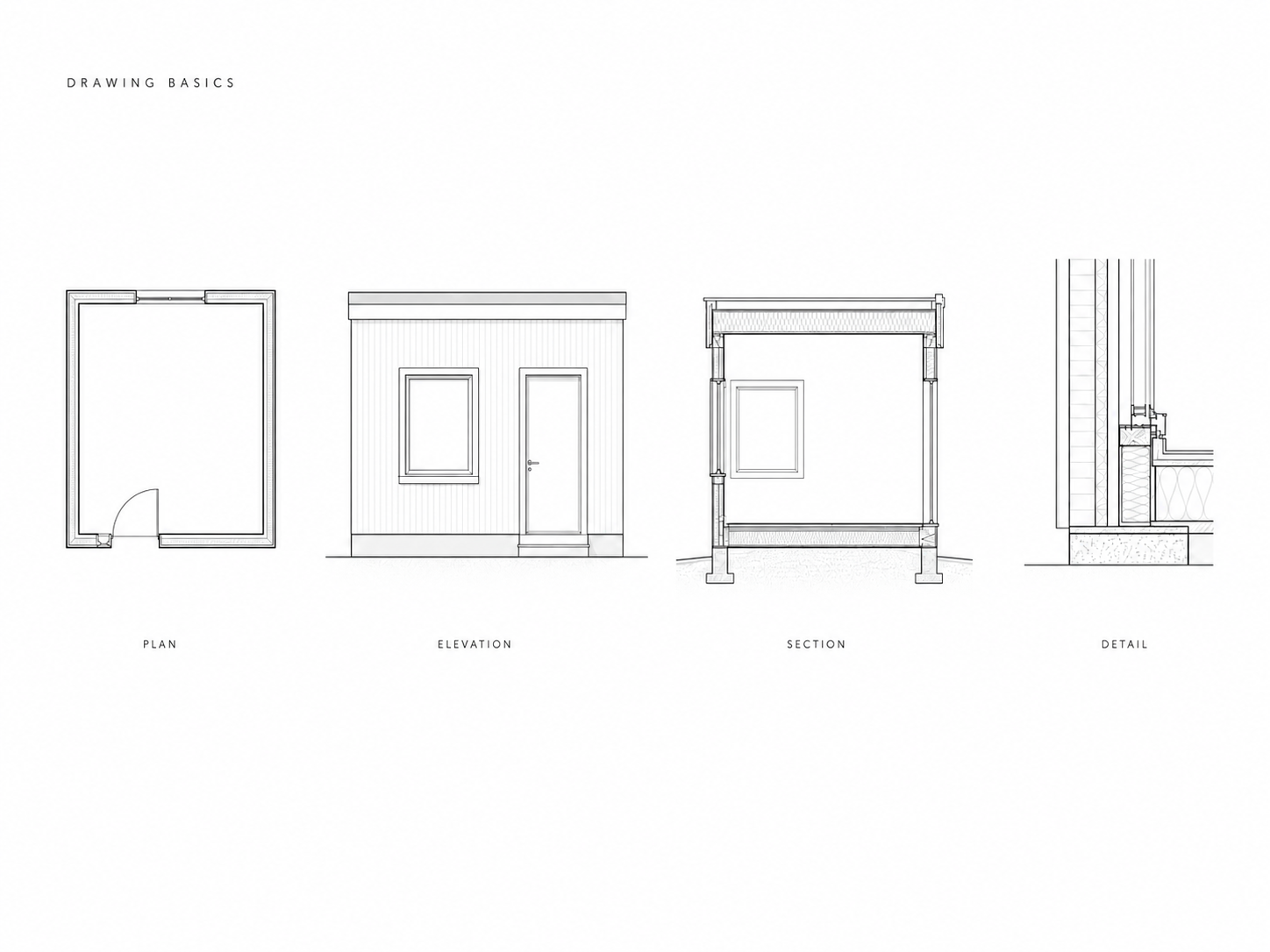
| Drawing Type | What It Tells You | What Beginners Usually Miss |
|---|---|---|
| Floor Plan | Room layout, walls, doors, windows, basic dimensions, circulation | They see the rooms but miss door swings, wall thickness, and dimension strings |
| Elevation | How one side of the building looks from the outside | They read it like a plan instead of a straight-on vertical view |
| Section | How the building is cut vertically through floors, walls, and roof | They forget the section is showing hidden construction, not just shape |
| Detail | How specific parts connect, such as roof edges, stairs, or wall assemblies | They skim it even though this is where a lot of mistakes get prevented |
| Site Plan | Where the building sits on the lot, including setbacks, driveways, grading, and utilities | They ignore the land and focus only on the building |
| Structural Drawings | Foundations, beams, columns, framing, reinforcement, load paths | They assume the architectural plan already explains how it stands |
| MEP Drawings | Mechanical, electrical, and plumbing systems | They read them too late, after mentally locking in the architecture only |
| Schedules and Notes | Door sizes, window types, finish information, fixture specifications | They look at the drawing symbol but never check the schedule it points to |
That table is the basic map. Once you know which question belongs to which drawing, the pile gets easier to handle.
If you want a parallel beginner page on drawing types, List of Architectural Drawings is the useful next stop.
Where to Start

Illustration by ArchitectureCourses.org. Main blueprint drawing types shown as a floor plan, elevation, section, and construction detail.
One of the most common beginner mistakes is opening a random sheet and trying to decode everything at once. That is the slow way.
The faster way is to read the set in layers.
- Read the title block. Check the project name, sheet title, sheet number, date, revision status, and scale.
- Find the sheet index. See how the set is organized before you study individual pages.
- Check the legend and general notes. Symbols and abbreviations are not universal enough to guess lazily.
- Start with the site plan. Understand where the building sits and how it meets the lot.
- Move to the floor plans. Build the layout in your head first.
- Then read elevations and sections. These turn the flat plan into height, volume, and assembly.
- Then details, schedules, and specs. This is where vague understanding turns into buildable information.
- Read structural and MEP drawings against the architecture. Cross-check. Do not treat them as separate universes.
That order matters. Big picture first. Tight detail second. Systems after the layout is clear.
Lines, Symbols, Notes, and Scale

Most pages only start to make sense once you stop treating every line the same.
Lines
A heavy cut line usually means the drawing is slicing through something important, like a wall in plan or a building in section. Lighter lines often show objects beyond the cut, edges, fixtures, cabinets, or annotation. Dashed lines usually mean something hidden or above. Center lines, property lines, and grid lines have their own graphic logic too.
Symbols
Doors, windows, outlets, switches, plumbing fixtures, stairs, section cuts, detail callouts, north arrows, and elevation markers all use symbols so the sheet does not need a paragraph every time. Learn the repeated ones first. Door swing. Section mark. Detail bubble. Grid. Elevation tag. You do not need to memorize everything on day one.
Notes and Callouts
A leader note tells you something the linework alone cannot. That might be a material, a fastening requirement, a reference to another sheet, or a caution that one area is existing and another is new. Beginners often read the geometry and skip the notes. That is backward. Notes are part of the instruction.
Scale
Scale is what keeps the drawing honest. A wall on paper is not the wall itself. The scale tells you how the reduced drawing relates to the built dimension. Some sheets use standard architectural scales such as 1/4 inch equals 1 foot. Others are marked NTS, which means not to scale. That warning matters. If a detail says NTS, do not measure it like a plan.
One practical example: a door tag on the plan helps you locate the door, but the schedule is what tells you whether it is 3 feet 0 inches wide, fire-rated, glazed, or solid core. The drawing shows you where it is. The dimensions and schedule tell you what it is.
For a symbol-focused companion page, go to Architectural Drawing Symbols: Complete Guide for Students and Professionals.
How to Read Floor Plans
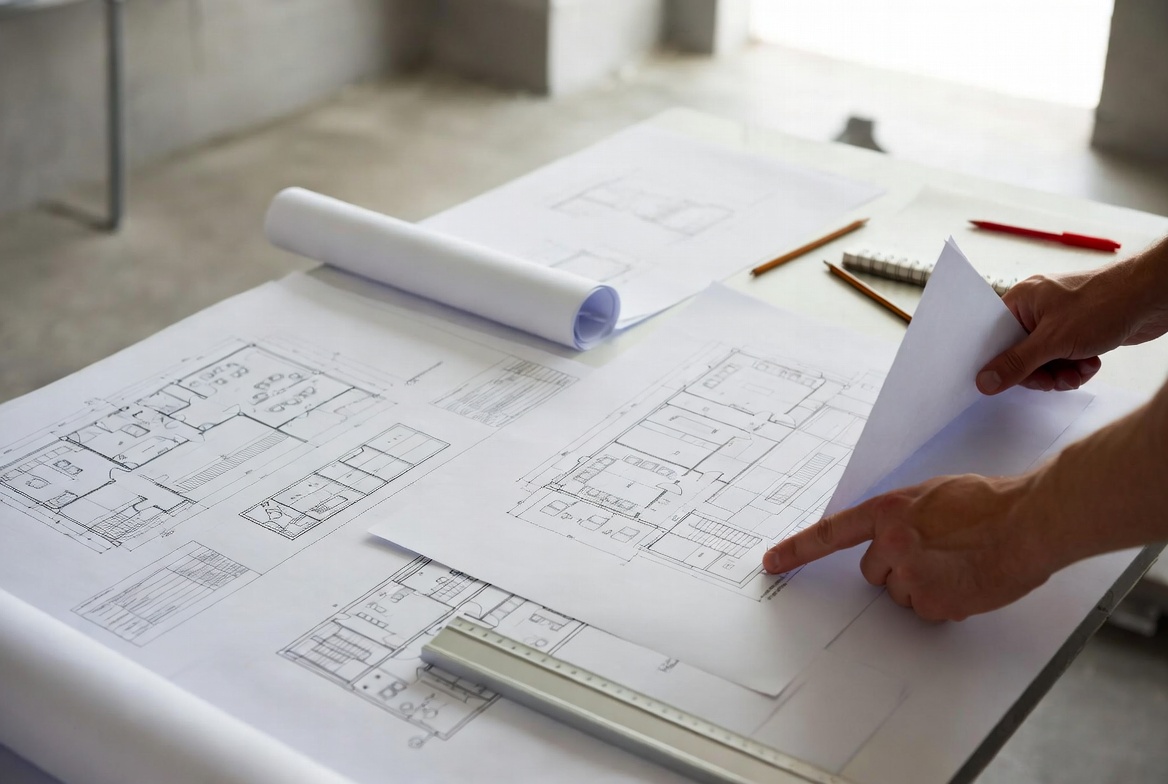
Illustration by ArchitectureCourses.org. A floor plan shows the building as a horizontal cut, making walls, rooms, doors, and movement patterns easier to read.
A floor plan is usually where beginners start, and that is fine. It is the fastest way to understand how the building is arranged.
Read the plan as a cut through the building, usually around window height. You are not floating above a dollhouse with the roof removed. You are looking at a horizontal slice. That is why door swings, wall thicknesses, windows, stairs, and built-in elements are drawn the way they are.
Start by locating the exterior walls. Then find the main entry. Then trace the circulation path through the plan. After that, check room names, major openings, stair direction, and primary dimensions.
The good beginner question is not “what room is this?” The better question is “how does someone move through this building, and what controls that movement?” Plans get clearer when you read them as use patterns, not just boxes.
Furniture shown on a plan can help too, but do not confuse furniture diagrams with the core geometry. The walls, openings, dimensions, and notes carry more weight than the couch symbol.
Elevations, Sections, and Details
This is where flat understanding becomes architectural understanding.
Elevations
Elevations show what a face of the building looks like. Window placement. Roof slope. Exterior finishes. Vertical proportions. If the floor plan tells you where the rooms sit, the elevation tells you what the building presents to the outside.
Sections
Sections show what happens when the building is cut vertically. Floor-to-floor heights. Roof build-up. Ceiling relationships. Stair geometry. Wall layers. Foundation depth. This is where hidden construction starts to show itself.
Details
Details zoom in on the exact places where general drawings stop being enough. A window head. A flashing condition. A stair connection. A roof edge. A wall-to-foundation junction. These are not optional decoration pages. They are often the difference between something that merely looks good on paper and something that can actually be built without guessing.
If you want another beginner bridge between reading and making drawings, Drawing for Architects: Complete Guide to Sketching, Plans, and Details fits well after this page.
Structural, Site, and Systems Sheets
These are the sheets beginners tend to postpone. Bad habit.
Site Plan
The site plan tells you how the project meets the land. Property lines, setbacks, grading, driveway location, utility runs, walkways, sometimes drainage. If the building exists in a legal and physical context, this sheet is part of that story.
Structural Drawings
The structural set tells you how the building stands. Footings, foundation walls, slabs, beams, columns, joists, framing, rebar, hold-downs, connection logic. The architectural sheets may show where a wall sits, but the structural sheets tell you what that wall can carry and how loads get transferred.
Mechanical, Electrical, and Plumbing
These sheets show the working guts. Electrical pages locate outlets, switches, panels, lighting, and circuits. Plumbing sheets show supply, waste, vents, and fixtures. Mechanical sheets show duct runs, equipment, grilles, diffusers, and airflow paths.
The key habit here is cross-checking. A switch needs a wall. A duct needs space. A toilet needs structure and routing. A floor plan that looks fine on its own can fall apart once the systems pages are read against it.
The Detail People Miss First
Beginners usually think blueprint reading is about recognizing symbols. It is partly that. But the bigger jump is learning to follow references between sheets.
A plan might point you to an elevation marker. The elevation might point you to a section cut. The section might point you to a detail bubble. The detail might rely on a wall type in the schedule. If you stop on the first page, you are only reading part of the instruction.
That is why experienced readers keep asking the same question: what page do I need next?
Once you start following those references instead of staring harder at one sheet, your speed goes up fast.
What People Commonly Do Wrong
- They skip the title block. Then they miss scale, revision dates, or even the sheet purpose.
- They guess symbols. Some are familiar. Some are office-specific. Guessing is slower than checking the legend.
- They measure when the drawing is marked NTS. That is how bad assumptions get made early.
- They read the architectural pages but ignore structural and MEP sheets. That works right up until the drawings clash.
- They treat one sheet as the whole truth. Real understanding comes from comparing pages, not memorizing isolated symbols.
- They skim details and schedules. That is where a lot of buildable information is hiding.
How to Practice Blueprint Reading
You do not get better by rereading definitions. You get better by handling real sets.
- Find a simple residential plan set. Start small, not with a hospital or airport.
- Read the sheet index and title blocks first.
- Trace the site plan and floor plan. Build the layout in your head.
- Match one window or one stair across plan, elevation, section, and detail.
- Check one schedule. Follow a door tag or window type from drawing to list.
- Cross-check one system. Pick electrical, plumbing, or mechanical and see how it fits the architecture.
- Repeat with another set. Repetition matters more than reading one giant page once.
If you are starting even earlier than that, Introduction to Architecture: A Beginner’s Guide to Building Design gives the broader context.
Blueprint Examples That Actually Help

A useful example is not just a pretty plan. It should help you connect views.
Take one room on a floor plan. Find that same area on an elevation. Then find the section cut that passes through it. Then read the detail callout for the wall, stair, or window assembly involved. That one chain teaches more than scrolling through ten isolated drawings.
A stair is a good example. On the floor plan it may read as a run with an arrow. On the section it becomes height, rise, headroom, and connection. In a detail, it can shrink again into tread thickness, nosing, railing attachment, or finish build-up. Same building element. Different layers of information.
Older hand-drafted drawings can help too. They often make line hierarchy and sheet intent easier to see because the graphic language is less cluttered. Modern CAD and BIM output is faster and more precise, but beginners sometimes learn faster from cleaner examples.

Best beginner exercise: pick one element and follow it across every drawing type instead of trying to understand the whole set at once.
Glossary
Open the short glossary
- Blueprint: Common term for a technical drawing or drawing set used to explain how something gets built.
- Floor Plan: A horizontal cut-through drawing showing rooms, walls, openings, and layout.
- Elevation: A straight-on vertical view of one side of a building.
- Section: A vertical cut through the building showing hidden construction and height relationships.
- Detail: A close-up drawing showing exactly how a specific part is assembled.
- Scale: The ratio between the size on paper and the real built size.
- Title Block: The information area listing sheet title, number, scale, date, and related project data.
- Schedule: A table listing repeated elements such as doors, windows, or finishes.
- Specification: Written requirements for materials, methods, and standards.
- NTS: Not to Scale. Do not measure directly from that drawing.
FAQ
What is the fastest way to start reading blueprints?
Start with the title block and sheet index, then move to the site plan and floor plans before reading elevations, sections, details, and systems sheets. Do not open a random page and hope it explains itself.
Are blueprints still used if everything is digital now?
Yes. The medium changed, but the logic did not. Most sets are now digital PDFs or CAD/BIM outputs, but people still use the word blueprints for the same general kind of drawing package.
What is the hardest part for beginners?
Usually not the symbols. It is understanding that each sheet is only part of the story and that you have to follow references between plans, elevations, sections, details, schedules, and notes.
Do I need to memorize every symbol first?
No. Learn the repeated ones first: door swing, section cut, elevation marker, detail callout, stair direction, common electrical and plumbing fixtures. Then build from there.
What is the difference between a plan and a section?
A plan is a horizontal cut through the building, usually used to show layout. A section is a vertical cut used to show height, assembly, and hidden construction.
Why do schedules matter so much?
Because the drawing symbol often points to a table that contains the actual size, type, material, or hardware information. If you skip the schedule, you often skip the real specification.
Can homeowners learn blueprint reading, or is this only for professionals?
Homeowners can absolutely learn the basics. You do not need professional drafting skill to understand layout, dimensions, notes, symbols, and the main drawing types well enough to ask better questions and avoid obvious confusion.