
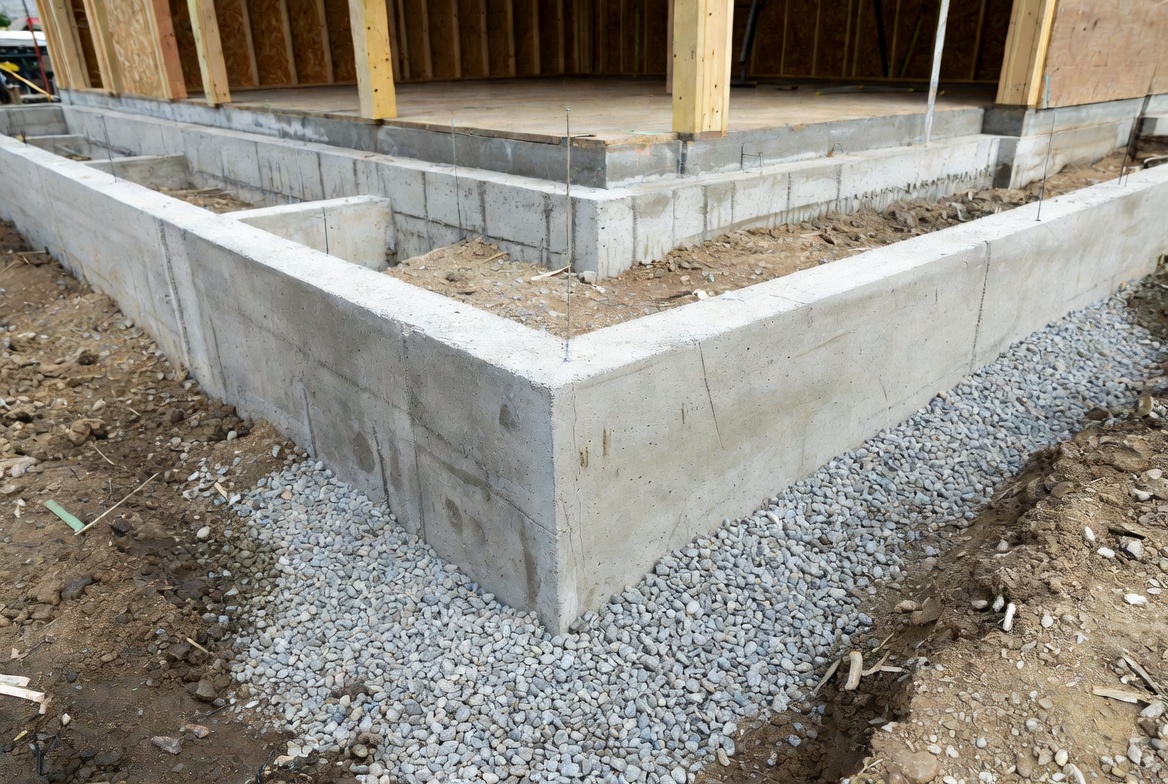
Concrete foundations carry the building, transfer load into the ground, and help keep the structure stable, level, and dry.
That is why they matter so much. The right foundation type depends on soil, water, frost, building weight, and budget. Concrete stays common because it is strong, durable, widely available, and practical for many kinds of buildings.
This guide covers the main concrete foundation types, what affects cost, how installation works, and where problems usually start.
Types of Concrete Foundations

Illustration by ArchitectureCourses.org. Diagram comparing five common foundation types: slab-on-grade, crawl space, basement, pier and beam, and raft / mat.
| Type | Where It Fits | Main Advantage | Main Trouble |
|---|---|---|---|
| Slab-on-Grade Foundation | Flat sites, simpler house plans, warmer regions, tighter budgets | Fast and efficient | Little access below the floor later |
| Crawl Space Foundation | Sites where some elevation and utility access help | Access below the floor | Moisture and air-sealing problems if handled badly |
| Basement Foundations | Cold climates, sloped lots, houses that benefit from below-grade space | Full-height usable area | Higher excavation and more water-control work |
| Pier and Beam Foundation | Uneven sites, some flood-prone sites, lighter structures | Less excavation and good access below | Point-load design and moisture control still matter |
| Raft or Mat Foundation | Weak soils, broad load-spread conditions, heavier buildings | Spreads load over a wide area | More material, more reinforcement, more engineering |
Most house projects do not need every foundation type under the sun. They need the shortlist. Slab, crawl space, basement, and sometimes pier and beam do most of the work in residential decisions.
Read this next: Types of House Foundations if you want the full side-by-side comparison first.
Footings and Piers

Technical diagram of a concrete pier showing load transfer, reinforcement, and basic geometry.
Footings and piers are not side details. They are where the load leaves the house and enters the ground.
| Element | What It Does | Common Use | What Gets Missed |
|---|---|---|---|
| Continuous strip footing | Spreads wall loads along a continuous line | Load-bearing walls | Depth, bearing width, and frost exposure |
| Pad footing | Supports a concentrated point load | Columns and posts | Settlement if soil prep is weak |
| Concrete pier | Transfers load deeper into stronger soil | Pier-and-beam systems, unstable soil | Spacing, depth, and connection detail |
| Helical or screw pile | Anchors into deeper stable strata | Weak soils, awkward sites, lighter raised structures | Load review and installation control |
This part matters: Foundation Footings if the real question is bearing, width, depth, and reinforcement at the bottom of the system.
Foundation Construction Process

Concrete foundation work in progress, with formwork, reinforcement, and fresh concrete setting the structure up for the next phase.
- Survey the building lines and verify setbacks, elevations, and layout.
- Strip organic material and excavate to stable soil.
- Prepare and compact the trench bottoms or slab base properly.
- Set formwork level and secure enough to hold the pour.
- Place reinforcement where it is supposed to work, not dropped to the bottom.
- Pour the concrete evenly and consolidate it where needed.
- Control curing, then add waterproofing, drainage, and backfill in the right order.
On paper this looks neat. On site this is where jobs start drifting. Soil stays soft. Rebar shifts. Extra water goes into the mix. Waterproofing gets damaged during backfill. The work still looks finished. Then the building starts paying for it later.

Wet concrete around steel reinforcement and formwork. If the steel is misplaced or the base below is weak, the slab still loses.
Also useful: Foundation Wall Construction if the wall sequence is the part you need next.
Waterproofing and Drainage
Water is still the main long-term problem around concrete foundations. Not concrete itself. Water around it.
Exterior waterproofing, drainage mats, perimeter drains, gutters, downspouts, and grading all belong in the same conversation. If that outside work is weak, the wall or slab edge keeps taking the hit.
- Use exterior membranes or coatings where the foundation is below grade.
- Give water a path down to perimeter drainage instead of letting it sit against the wall.
- Keep roof water away from the house. Downspouts dumping at the footing line are still one of the dumbest repeat mistakes.
- Slope grade away from the wall so the foundation is not acting like a low point.
Read this next: Exterior Foundation Waterproofing if the water side of the job is still weak.
Common Problems and Repairs
Cracks
Small shrinkage cracks can be cosmetic. Settlement cracks and horizontal wall cracks are different. Those usually point to soil movement, water pressure, weak bearing, or structural stress that did not stay under control.
Settlement and Sinking
Uneven settlement can show up as sloped floors, sticky doors, widening cracks, and wall movement. Serious cases may need underpinning, helical piers, steel piers, foam jacking, or other repair methods depending on the structure and the failure pattern.
Moisture and Leakage
Basement leaks, damp wall bases, efflorescence, and musty odor often point back to the same group of causes: weak drainage, poor waterproofing, or water collecting where it should not.
One more thing: Foundation Cracks in Houses if damage is already showing up.
Costs and Budget Pressure
Foundation cost is not just about concrete volume. These are the big cost drivers:
- soil conditions and excavation difficulty
- footing depth and reinforcement
- wall height, slab thickness, or pier depth
- waterproofing and drainage requirements
- access for crews and equipment
- local labor, material, and permit costs
| Foundation Type | Usual Cost Position | Why |
|---|---|---|
| Slab-on-grade | Lower | Less excavation and fewer vertical walls |
| Crawl space | Middle | Raised structure but not a full basement |
| Basement | Higher | More excavation, more wall, more drainage and waterproofing |
| Pier and beam | Middle to higher | Depends on spans, piers, access, and site difficulty |
| Raft or mat | Higher | More concrete, more steel, more engineering |
The cheap move that gets expensive later is usually the same one: cutting soil prep, drainage, or footing logic because it disappears once the job is done.
What Changes the Foundation Choice First
Climate
Cold climates change footing depth, frost strategy, and slab-edge decisions. Flood-prone regions may push the project toward raised systems. Hot dry regions can bring their own soil movement problems.
Soil and Load
Weak soil, fill, rock, high water tables, and heavy building loads all change the answer. The foundation should follow the site. The site should not be forced to pretend it is something else.
Budget and Long-Term Use
A basement costs more but gives usable space. A slab is simpler but gives up future access below. A crawl space can be a good middle ground or a future moisture problem depending on how it is handled. First price is not the whole story.
What Works vs What Goes Wrong
Concrete foundations do not usually fail because concrete is bad. They fail because the ground work was weak, the reinforcement was wrong, the curing was rushed, or the water details were treated like cleanup work.
| Do This | Instead Of This | Why It Matters |
|---|---|---|
| Check the soil before the footing design is locked in. | Assume every lot can take the same footing and slab approach. | Weak or expansive soil changes everything below the house. |
| Keep reinforcement where it is supposed to work. | Let rebar sit low or shift during the pour. | Steel in the wrong place does far less useful work. |
| Use the concrete mix that fits the job and climate. | Add water on site because the mix feels stiff. | Extra water makes placement easier and the finished concrete weaker. |
| Keep curing under control for the first week. | Treat a hard surface like fully cured concrete. | Concrete gains strength over time, not in one afternoon. |
| Plan drainage and waterproofing with the foundation. | Wait until water shows up and then start guessing. | Most concrete-foundation trouble starts outside the wall or below the slab. |
| Cut control joints on time and at the right depth. | Hope the slab cracks neatly on its own. | Concrete will crack somewhere. The point is to help decide where. |
What Gets Missed First
Soil Is Not Background
Too many concrete-foundation articles treat soil like a side note. It is not. Loose fill, wet trench bottoms, expansive clay, and poorly compacted base material can wreck a good foundation design before the forms are even set.
Read this next: Foundations, Soil Analysis, and Site Investigation if the site still looks like a question mark.
Reinforcement Has to Stay in Position
This is common on small jobs. The rebar or mesh technically showed up, so everyone acts like the slab is reinforced. Then the steel ends up too low, out of place, or barely tied together. That is not the same thing as a reinforced slab doing its job.
This part matters: Foundation Footings if the real problem is bearing, reinforcement, and footing layout below the wall.
Water Still Wins If the Outside Work Is Bad
Concrete is durable. It is not magic. If roof water dumps beside the house, the perimeter stays saturated, or the waterproofing is weak, the foundation keeps paying for it. That is where a lot of mystery cracks and damp-wall problems really start.
Also useful: Exterior Foundation Waterproofing if the outside water picture is still weak.
Control Joints and Curing Are Not Cosmetic Details
Concrete that dries too fast, gets loaded too soon, or never gets its joints cut properly is asking for trouble. You may not see it the same day. That does not mean the damage is not being scheduled.
What Still Matters More Than New Tech
Smart sensors, self-healing mixes, and 3D-printed concrete make good headlines. They are not the main reason most house foundations succeed or fail.
The boring things still matter more:
- soil that can support the load
- reinforcement in the right place
- a mix that fits the job
- curing that is taken seriously
- water kept away from the foundation
- joints cut where they should be
A normal concrete foundation built well will beat a fancier one built badly almost every time.
When Concrete Is Still the Right Move
There is a point where trying too hard to get clever with foundation materials turns into bad judgment.
- when the house needs a basement or a serious below-grade wall system
- when the site has real water pressure or retaining conditions
- when the local code path and labor market strongly favor concrete
- when the project needs a slab floor and a standard build sequence
- when the loads are heavy enough that lighter alternatives stop making sense
One more thing: Slab-on-Grade Foundation if the project is starting to look like a slab really is the cleaner answer, and Types of House Foundations if you still need the wider comparison.
What To Do Next
A concrete foundation can last for decades. That part is true. But it only works that way when the prep, reinforcement, curing, and water control are handled like structural work, not side tasks.
- Foundations, Soil Analysis, and Site Investigation if the site conditions are still not clear.
- Foundation Footings if the next decision is bearing, width, depth, and reinforcement.
- Exterior Foundation Waterproofing if the real problem is water around the wall, not the concrete itself.
- Foundation Cracks in Houses if the damage is already showing up.