
Full Guide to Design, Cost, Problems, and Fixes

Crawl spaces solve a real construction problem. They lift the house off the ground, give you access to plumbing and wiring, and handle uneven sites better than a simple slab in a lot of cases.
They also fail in very predictable ways. Most crawl-space trouble starts with water, wet air, bad drainage, or a ground surface that was never really controlled. The structural damage usually shows up later.
This page is the broad overview. If you are comparing foundation types, trying to understand why crawl spaces go bad, or figuring out whether you are looking at maintenance, moisture control, or a real repair job, start here.
- What a crawl space foundation is
- Where it makes sense
- How it compares with slab and basement foundations
- The problems that show up most often
- What changes the cost
- When DIY is fine and when it is not
What a Crawl Space Foundation Is
A crawl space foundation raises the house above grade and leaves a shallow space below the floor structure, usually large enough to move through on hands and knees. It is not a full basement and it is not a slab-on-grade. In most houses, that space carries some combination of plumbing, wiring, ductwork, beams, joists, and access points for future repairs.
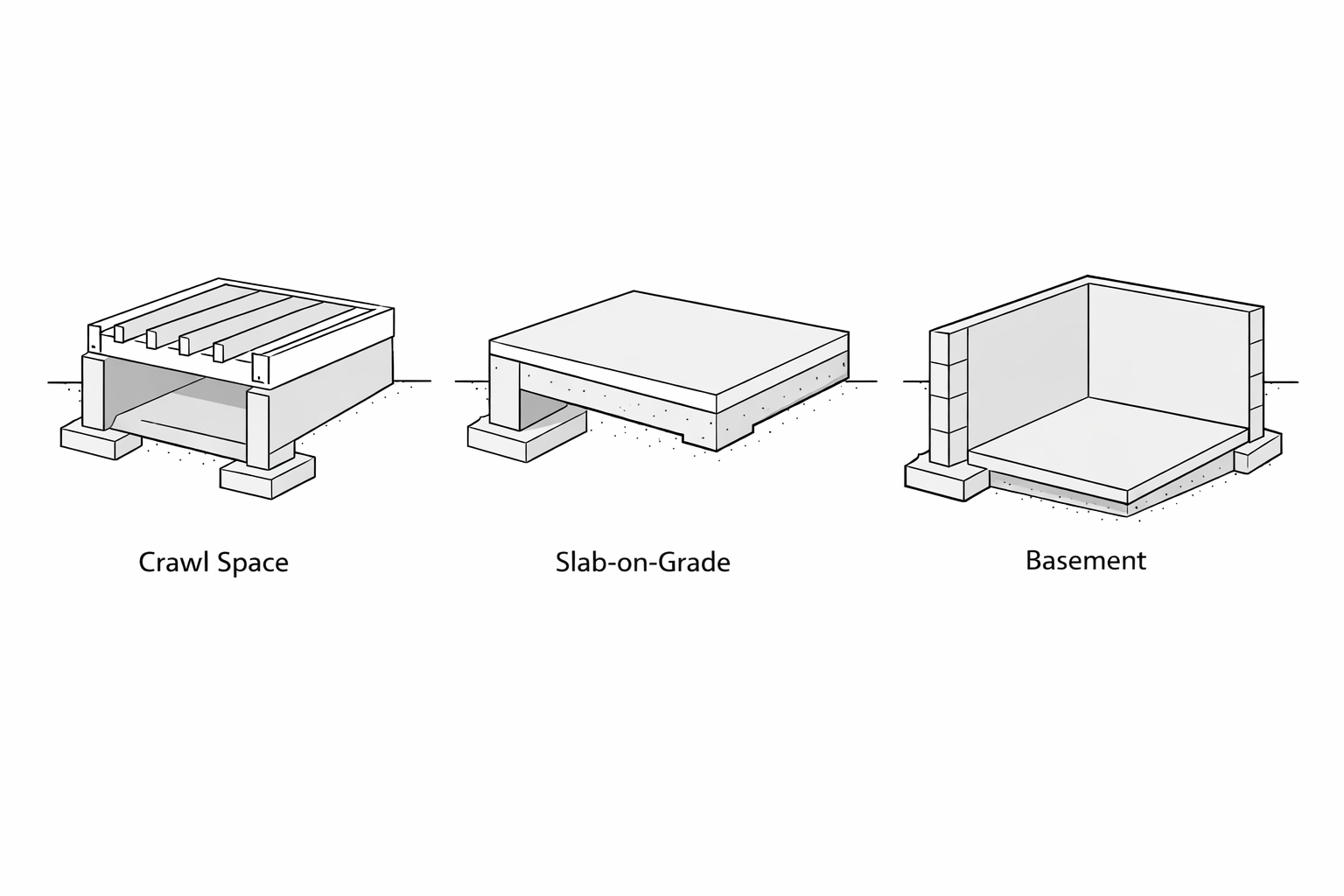
Comparison of three common residential foundation systems: crawl space, slab-on-grade, and basement. Illustration by ArchitectureCourses.org.
The main parts are usually straightforward:
- Footings that spread the load into the soil
- Foundation walls or perimeter supports that hold the house above grade
- Piers and beams that support the floor framing inside the crawl space
- Joists and subfloor that form the first-floor structure
- Access opening for inspections and repair work
For a broader look at foundation categories, see Types of House Foundations: Slab, Crawl Space, Basement, and Pier and Beam or House Foundations: What You Need to Know Before Construction.
Where Crawl Spaces Make Sense
Crawl spaces are not the default best answer everywhere. They tend to make the most sense when the site, the service access, or the local building pattern makes a raised floor more practical than a slab.
- Uneven or sloped lots where a slab would need more grading, fill, or stepped work
- Homes with a lot of underfloor services where future plumbing or wiring access matters
- Sites where getting the structure above grade helps with drainage and splash-back management
- Regions where crawl spaces are already common and contractors know the assembly well
That does not mean they are maintenance-free. A crawl space can be a very practical foundation type, but only if the moisture details are done right and kept that way.
Crawl Space vs Slab vs Basement
| Foundation Type | Usually Best When | Main Advantage | Main Trade-Off |
|---|---|---|---|
| Crawl Space | You want service access, a raised floor, or a better fit for uneven grade | Plumbing, wiring, and floor framing stay accessible | Moisture control is not optional |
| Slab-on-Grade | You want a simpler low-profile foundation on the right site | Usually less excavation and fewer underfloor voids to manage | Utility repairs are harder once the slab is down |
| Basement | You want full below-grade space and the site can support it | Adds usable floor area | Higher excavation, waterproofing, and finishing complexity |
If you are comparing these in more detail, read Slab-on-Grade Foundation: What It Is and When to Use It and Basement Foundations 101: What They Are and How They Work.
The Problems That Usually Show Up First
Most crawl-space failures are not mysterious. They usually start with a short list of predictable issues.
| Problem | What Usually Starts It | What To Check First | What Often Comes Next |
|---|---|---|---|
| Musty smell or damp air | Exposed soil, open seams, wet outside drainage, air leakage | Ground cover, standing water, runoff, humidity | Vapor barrier upgrade, drainage fixes, dehumidification |
| Sagging or bouncy floors | Rot, insect damage, overloading, failing supports, settlement | Beams, joists, piers, footings, moisture source | Structural repair after the moisture problem is controlled |
| Pests | Easy entry points, wet insulation, food sources, poor sealing | Access door, vent openings, gaps, droppings, nests | Sealing, cleanup, moisture control, pest treatment |
| Standing water | Bad grading, roof runoff, clogged drains, groundwater issues | Downspouts, slope away from the house, drain path | Exterior drainage work, interior collection, sump strategy |
| Cracks or shifting supports | Settlement, erosion, movement at piers or walls | Pattern of movement, width changes, nearby water | Monitoring, repair scope, or underpinning review |
The order matters. Do not start by shopping for a dehumidifier if bulk water is still running toward the house. Fix outside drainage first. Then deal with the ground surface, air leakage, insulation, and equipment.
Moisture Control Comes First
If a crawl space is going bad, moisture is usually the root problem or the thing making every other problem worse. Wet soil drives humidity. Humid air feeds mold. Damp framing invites decay. Then the expensive work starts.
A good crawl-space moisture plan usually starts in this order:
- Keep roof runoff and surface water away from the foundation
- Cover exposed soil properly
- Seal obvious air leaks and access points
- Choose the right insulation strategy for the assembly
- Add dehumidification or drainage equipment only where the assembly actually needs it
The detailed moisture pages belong on their own because they are now separate topics, not side notes. For the full breakdown, read Crawl Space Vapor Barriers and Vent Covers: What Works, What Backfires, Crawl Space Vapor Barrier Installation: How to Do It Right the First Time, and Crawl Space Encapsulation Done Right: Moisture First, Air Second.
Open Vents, Closed Crawl Spaces, and the Detail People Miss
This is where a lot of bad advice starts. There is no universal one-line answer for every crawl space in every climate.
Some crawl spaces are still handled as vented spaces. Others are detailed as closed or conditioned spaces. The right move depends on local code, climate, termite inspection requirements, whether combustion equipment is in the crawl space, and whether the whole assembly is being treated as a real sealed system instead of a half-finished patch job.
The mistake is mixing strategies. A crawl space with exposed soil, loose insulation, outside air leaks, and a random dehumidifier is not a system. It is just an expensive argument between moisture sources.
That is why the vent question belongs with the vapor barrier, wall insulation, air sealing, and drainage discussion, not by itself. The full vent-cover discussion is better handled here: Crawl Space Vapor Barriers and Vent Covers: What Works, What Backfires.
Structural Trouble Usually Means the Moisture Problem Has Been There a While
Once floors start feeling springy or sloped, you are not dealing with a simple housekeeping issue anymore. That usually means the crawl space has been wet long enough for wood, supports, or soil to start changing.
Common structural repair paths include:
- Joist sistering when damage is limited and the original member is still part of a workable repair
- Beam replacement or reinforcement when decay or overloading has gone too far
- Pier rebuilding or adjustment when support points have settled or shifted
- Crack repair or footing review when wall movement or soil problems are part of the story
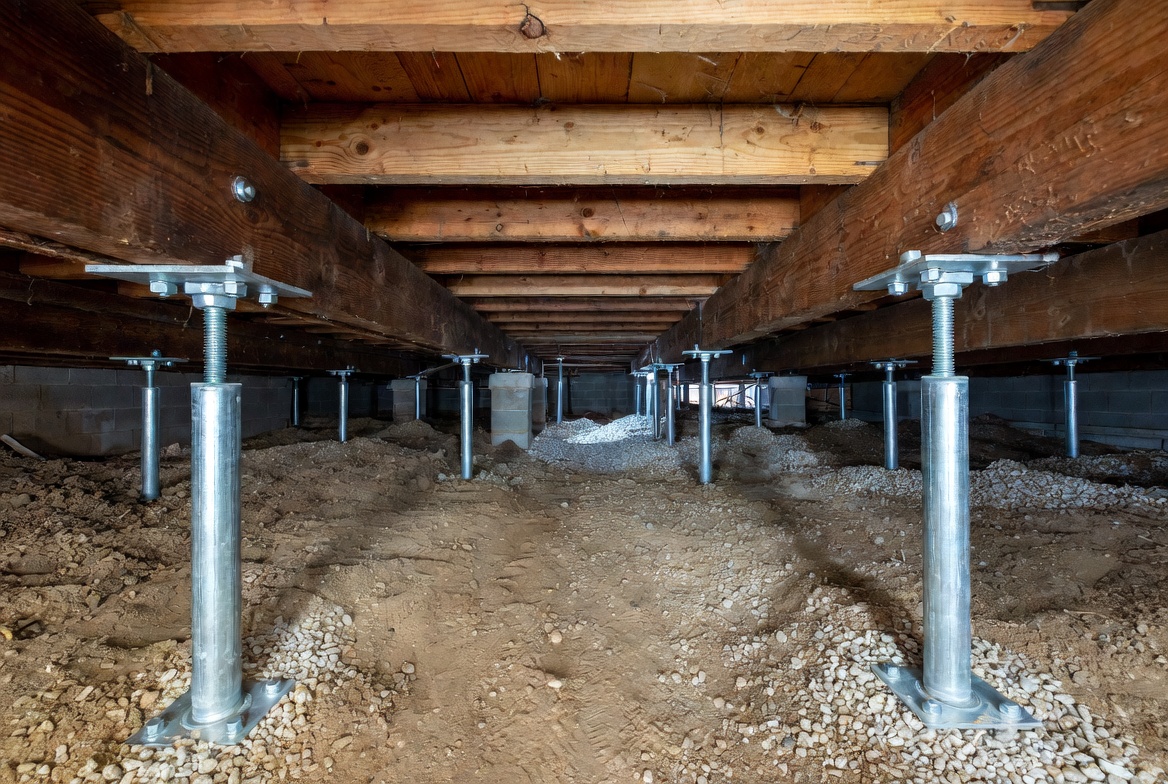
Adjustable steel support posts beneath floor framing inside a crawl space. Image by ArchitectureCourses.org.
Do not separate the structural fix from the water source. If the crawl space stays wet, the same damage comes back. For broader repair context, see Foundation Cracks in Houses: When to Worry and When to Repair and Foundation Repair 101: Signs, Fixes, and How to Save Money.
What Changes the Cost
There is no single crawl-space price that means much on its own. Cost changes fast depending on height, access, region, drainage trouble, the amount of damaged wood, and whether you are just controlling moisture or rebuilding supports.
| Scope | Usually Includes | Cost Direction |
|---|---|---|
| Basic maintenance | Inspection, minor sealing, access-door cleanup, small patch work | Low |
| Moisture-control upgrade | Ground cover work, seam sealing, drainage correction, dehumidification, vent strategy changes | Low to medium |
| Partial structural repair | Limited joist, beam, or pier work after moisture damage | Medium to high |
| Major restoration | Wide moisture damage, water-management changes, structural repairs, multiple trades | High |
What drives the price up fastest is not the label on the problem. It is access difficulty, wet conditions, how much demolition is needed, and whether the repair team has to solve both moisture and structure at the same time.
DIY vs Calling a Pro
Some crawl-space work is reasonable for a careful homeowner. Some of it is not.
Usually Fine for DIY
- Basic inspection and photo documentation
- Cleaning gutters and extending downspouts away from the house
- Replacing hatch weatherstripping
- Minor patching of an existing ground cover system that is otherwise in good shape
- Checking humidity and watching for changes over time
Better Left to a Pro
- Standing water that keeps coming back
- Rot, mold, termite damage, or widespread wet insulation
- Sagging floors, cracked supports, or shifting piers
- Major encapsulation work that changes venting, insulation, and drying strategy together
- Radon mitigation or crawl spaces with combustion equipment and air-safety concerns
Basic Maintenance and Monitoring
A lot of crawl-space problems get expensive because nobody looks at the space until the floor starts moving or the smell reaches the rooms above. A simple check routine catches problems earlier.
- Look in the crawl space at least seasonally and after heavy rain
- Watch for torn ground cover, open seams, wet insulation, staining, rust, or new standing water
- Check whether downspouts still discharge well away from the house and whether grade still falls away from the foundation
- Track humidity over time instead of guessing from smell alone
The goal is not to babysit the crawl space forever. It is to catch drainage and moisture changes before they turn into rot, mold, or structural repair.
Radon and Soil Gases
Moisture is the main crawl-space problem on a lot of houses, but it is not the only below-floor issue. In radon-prone areas, test first instead of assuming every musty or unhealthy crawl-space complaint is just humidity.
If testing shows elevated radon in a house with a dirt-floor crawl space, the fix is usually not “more venting.” The better-known approach uses a sealed ground cover with a vent pipe and fan drawing from beneath the membrane. That is a different problem from ordinary humidity control, even though the systems can overlap.
Read This Next
This part matters: if the real problem is moisture, do not stay on the overview page. Go straight to Crawl Space Vapor Barrier Installation: How to Do It Right the First Time and Crawl Space Encapsulation Done Right: Moisture First, Air Second.
Also useful: if outside water is the issue, read Exterior Foundation Waterproofing: What You Need to Know and How to Install a French Drain with a Sump Pump the Right Way.
Before you move on: if you are still comparing foundation types, go back to House Foundations: What You Need to Know Before Construction for the wider decision.
FAQ
Is a crawl space foundation bad?
No. A crawl space is not inherently a problem foundation. Most of the bad outcomes people complain about come from poor drainage, exposed soil, bad air sealing, wet insulation, or neglected repairs.
Is a crawl space better than a slab?
Sometimes. A crawl space usually wins on service access and can be a better fit on uneven grade. A slab usually wins on simplicity when the site and the house are right for it. The better choice depends on the site, the climate, and what kind of maintenance burden you are willing to carry.
Do crawl spaces always need encapsulation?
No. But they always need a moisture strategy. Some houses only need better ground cover and drainage. Others need a more complete closed-crawl-space approach. The mistake is copying a solution without looking at the whole assembly.
What is the biggest mistake people make with crawl spaces?
They treat symptoms one at a time. A dehumidifier will not fix bad grading. New joists will not stay sound if the crawl space stays wet. Pest cleanup will not hold if the entry points and moisture source stay in place.
Can a crawl space hurt indoor air quality?
It can. Damp crawl spaces, mold growth, pests, and soil gases can all affect the house above if the assembly is leaky enough. That is one reason crawl-space work should be treated as building-envelope work, not just cleanup.
Should I buy a house with crawl-space issues?
That depends on the severity and whether the problem is just moisture control or a bigger structural repair. A damp crawl space with fixable drainage is one thing. Rot, active movement, or widespread support damage is another. The inspection report matters more than the label.