
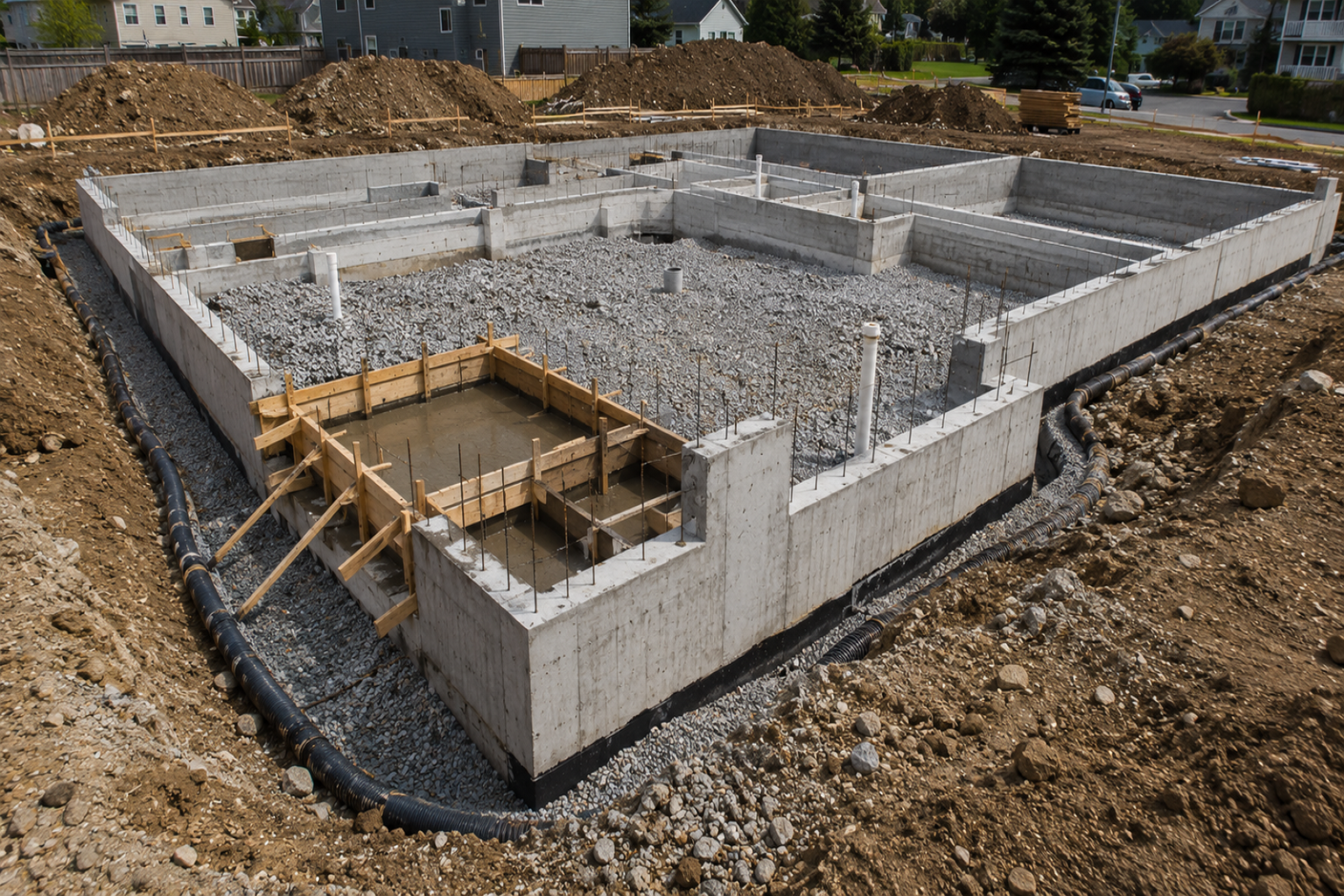
The foundation choice starts with the ground, not the house plan.
One lot may handle a slab without much trouble. Another may need a crawl space, basement, pier system, or deep foundation because of wet soil, slope, frost, weak fill, or flood risk.
Pick wrong and the cost shows up later: buried plumbing repairs, wet beams, moldy crawl spaces, basement leaks, cracked slabs, leaning piers, or a floor that keeps moving.
The right foundation is the one that fits the soil, water, climate, budget, code, and repair access for the site.
Types of house foundations at a glance
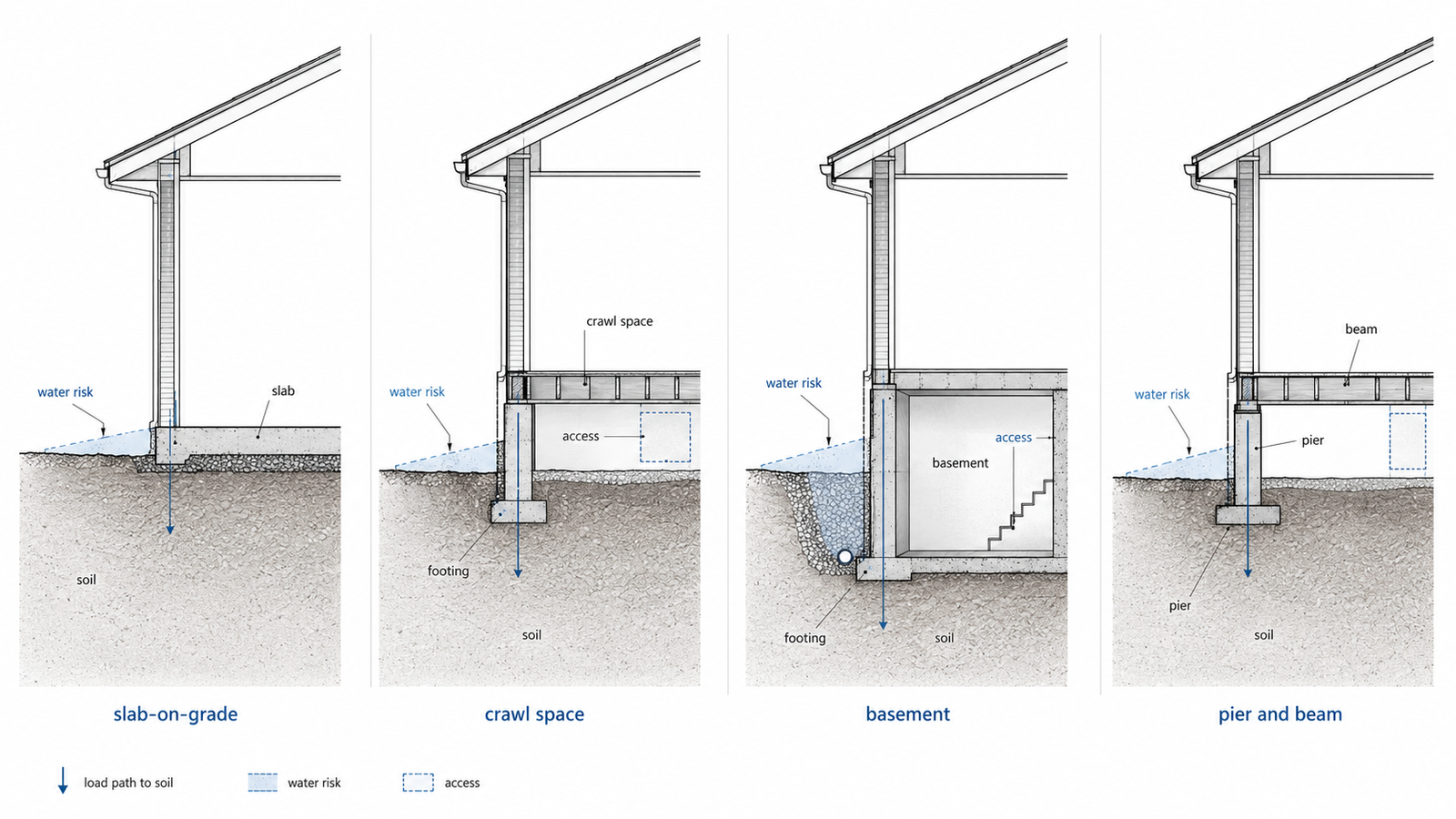
Most houses use one of five broad foundation systems: slab-on-grade, crawl space, basement, pier and beam, or deep foundations such as piles or drilled piers. There are variations inside each group, but these are the systems homeowners usually need to understand before building, buying, renovating, or repairing a house.
| Foundation type | Best known for | Main risk | Repair access |
|---|---|---|---|
| Slab-on-grade | Lower height, simpler floor system, common in warm regions | Buried plumbing, cracking, poor drainage, soil movement | Difficult once concrete is poured |
| Crawl space | Access to plumbing, wiring, ducts, and floor framing | Moisture, mold, rot, pests, sagging floors | Good if the crawl space is accessible and dry |
| Basement | Extra space, deeper foundation walls, cold-climate usefulness | Waterproofing, wall pressure, drainage failure, high excavation cost | Good from inside, but exterior repairs can be expensive |
| Pier and beam | Raised floor, access under the house, useful on some sites | Weak piers, bad shims, beam rot, uneven floors, wet crawl areas | Usually good, but structural work is still serious |
| Piles or deep foundations | Weak soil, coastal sites, flood zones, steep sites | Engineering cost, installation quality, corrosion, settlement | Difficult and specialized |
Slab-on-grade foundations
A slab-on-grade foundation is a concrete slab poured close to ground level. The slab may be thickened at the edges, reinforced, and placed over a prepared gravel base, vapor barrier, compacted fill, or insulation depending on the design and climate.
Slab foundations are common because they can be efficient to build. There is no crawl space to frame and no basement excavation. The floor structure and foundation become closely tied together.
That simplicity has a tradeoff. Plumbing lines and some utilities may be buried under or inside the slab. If a pipe leaks later, the repair can involve cutting concrete. If the soil below the slab moves, the slab can crack, settle, heave, or tilt. If drainage around the house is poor, water can undermine the edge or create moisture problems around the building.
When a slab foundation makes sense
- The site is relatively flat.
- The soil can support the slab without major movement.
- The climate does not require deep basement construction.
- The design does not need under-floor access.
- Upfront cost control matters more than future access.
What homeowners discover later
The big surprise with slab houses is not always cracking. It is access. A crawl space lets a contractor see the framing, pipes, ducts, and some support conditions. A slab hides more of that work. A simple plumbing leak or foundation movement issue can become invasive because the repair path goes through concrete.
Crawl space foundations
A crawl space foundation raises the house above the ground and leaves a shallow space below the floor. The perimeter may be made of concrete block, poured concrete, insulated concrete forms, or other approved foundation wall systems. The floor structure usually sits above the crawl space on beams, joists, or framed supports.
A crawl space can be useful because plumbing, electrical work, ducts, insulation, and structural framing are reachable. That access is valuable during repairs. It can also make future renovations easier than cutting into a slab.
The problem is moisture. A crawl space that stays damp can damage wood, insulation, ducts, and floor framing. It can also create mold, pest, odor, and air-quality concerns. A crawl space is not automatically bad. A wet, ignored crawl space is bad.
When a crawl space makes sense
- The house needs under-floor access for utilities.
- The site has enough height for useful crawl-space clearance.
- A basement is too expensive or unnecessary.
- The climate and site drainage can be managed.
- Future repair access is important.
Where crawl spaces fail
Crawl spaces fail when water and structure are treated as separate problems. A contractor may replace a damaged beam, sister joists, or add supports, but the same framing can decay again if water keeps entering the space. The foundation system has to manage load and moisture together.
For repair-side decisions, see crawl space foundation repair. If water shows up after rain, use water in a crawl space after rain before assuming the foundation itself is the only problem.
Basement foundations
A basement foundation extends deeper below grade and creates usable or semi-usable space beneath the house. In cold climates, basements are common because footings already need to reach below frost depth. If excavation is already deep, turning that depth into basement space can make sense.
Basements offer storage, mechanical space, future living area, storm shelter potential in some regions, and easier access to some building systems. They also create bigger water and wall-pressure problems.
Soil pushes laterally against basement walls. Water collects against below-grade surfaces. Drainage, waterproofing, footing drains, sump systems, grading, backfill, and exterior wall detailing matter. A basement with weak drainage can become expensive fast.
When a basement makes sense
- The climate already requires deeper footings.
- The site can be excavated safely and economically.
- Extra storage or future finished space is valuable.
- Drainage and waterproofing can be done properly.
- The water table is not too high for the design.
What makes basements expensive later
Basement repairs often cost more because the failing surface is outside the wall and below grade. Interior sealers may reduce symptoms, but exterior drainage, wall cracks, footing drains, grading, or waterproofing may still need work. If the basement is finished, water damage can also destroy flooring, drywall, trim, insulation, and stored items before the foundation problem is fully understood.
Pier and beam foundations
A pier and beam foundation supports the house with a raised floor system. Loads move from the floor framing into beams, then into piers, posts, or columns, then into pads, footings, or deeper supports below. The house is separated from the ground by a crawl space or open under-floor area.
This system can make repairs easier because the framing and supports are visible. It also makes bad repairs easier to spot. Leaning piers, stacked shims, wet beams, crushed wood, loose blocks, temporary jack posts, and uneven floors all tell a story about the load path under the house.
Pier and beam houses are common in older houses and in regions where raised floors help with access, moisture, flooding, or soil conditions. They can work well when designed and maintained properly. They can also become a repair trap when moisture, weak pads, poor shimming, and undersized supports are ignored.
When pier and beam makes sense
- The house benefits from a raised floor system.
- Under-floor access is valuable.
- The site has slope, drainage, or soil conditions that make a simple slab less ideal.
- Future repairs and utility access matter.
- The support system is properly spaced, connected, and protected from moisture.
Where pier and beam fails
Pier and beam failure usually shows up as floor movement first. Floors slope. Doors stick. Trim separates. Interior cracks appear. But the real failure may be under the house: rotted beams, weak piers, missing pads, wet soil, bad shims, termite damage, or temporary supports left as permanent repairs.
For the repair side of this topic, use pier and beam foundation repair. For the structural load-path basics that apply to piers, posts, and supports, see foundation pillar construction.
Stem wall foundations
A stem wall foundation uses a short wall between the footing and the floor or slab system. Stem walls are common with crawl spaces, raised slabs, garages, additions, and houses that need the floor lifted above surrounding grade.
The basic idea is simple: a footing spreads the load into the soil, and the stem wall carries the building load upward from that footing to the floor system or slab edge.
Stem walls are useful when the site needs height, perimeter support, or a transition between the ground and the finished floor. They also create places where cracking, water entry, poor drainage, and bad backfill can cause problems.
When a stem wall makes sense
- The house needs the finished floor raised above grade.
- The site has slope or drainage concerns.
- A crawl space or raised slab is planned.
- The foundation needs a clear perimeter wall above the footing.
What to watch for
Stem wall cracks can be cosmetic, shrinkage-related, settlement-related, or tied to soil and water pressure. The repair depends on the crack type, wall movement, drainage, reinforcement, and the condition of the footing below. A patch on the face of the wall does not fix a water or movement problem behind it.
For repair-side decisions, use stem wall foundation repair.
Basement vs crawl space vs slab
The best choice depends on what the site demands and what the owner values. A slab may be cheaper and simpler at the start, but harder to access later. A crawl space may improve access but adds moisture management. A basement may add useful space but costs more to excavate, waterproof, drain, and repair.
| Decision factor | Slab | Crawl space | Basement |
|---|---|---|---|
| Upfront cost | Often lower on suitable sites | Middle range | Usually higher |
| Utility access | Poor once buried | Good if accessible | Good from inside |
| Moisture risk | Edge, vapor, drainage, and slab cracks | Crawl-space humidity, standing water, rot | Wall leaks, hydrostatic pressure, finished-space damage |
| Repair disruption | Can require concrete cutting | Often accessible but tight and dirty | Can be accessible inside but exterior excavation may be costly |
| Extra usable space | None below the house | Usually not living space | Possible storage or finished space |
| Best fit | Flat, suitable sites with simple access needs | Sites needing raised floors or under-floor access | Cold climates, sloped lots, or owners who value lower-level space |
Deep foundations: piles, drilled piers, and caissons
Deep foundations carry loads below weak surface soils into stronger soil or rock. They may use driven piles, helical piles, drilled piers, caissons, or other engineered systems.
Most ordinary houses do not need deep foundations. They become relevant when surface soil is weak, fill is unreliable, the site is coastal or flood-prone, the slope is difficult, or the structure needs support beyond what shallow footings can provide.
Deep foundations are not a casual upgrade. They require engineering, specialized installation, and careful connection between the pile or pier and the house structure above. In coastal or flood-prone areas, foundation choice may also be shaped by flood elevation rules, scour risk, breakaway walls, and local hazard requirements.
When deep foundations make sense
- Weak surface soil cannot support ordinary shallow footings.
- The house is in a flood-prone or coastal area.
- The site has unstable fill or steep slope conditions.
- The design needs loads transferred deeper into competent soil or rock.
- A local engineer or building department requires it.
Foundation choice starts with soil
Soil is not just dirt under the house. It is part of the foundation system. Some soils drain well. Some hold water. Some compress. Some expand when wet and shrink when dry. Some sites contain fill that was not compacted well enough to support a house.
A foundation that works on one lot may be a poor choice across the street if the slope, water table, soil bearing, or fill condition changes. This is why serious foundation planning starts with site conditions, not with a generic favorite foundation type.
Soil problems can show up later as settlement, slab cracks, sticking doors, leaning piers, bowing walls, or recurring drainage problems. The repair can become much more expensive than choosing the right foundation system at the start.
Water is the second foundation decision
Every foundation has to deal with water. Slabs need vapor control, drainage, and proper base preparation. Crawl spaces need moisture control, ground coverage, drainage, and ventilation or conditioned-space decisions. Basements need waterproofing, footing drains, grading, sump planning, and wall protection. Pier and beam houses need dry support conditions and protected wood framing.
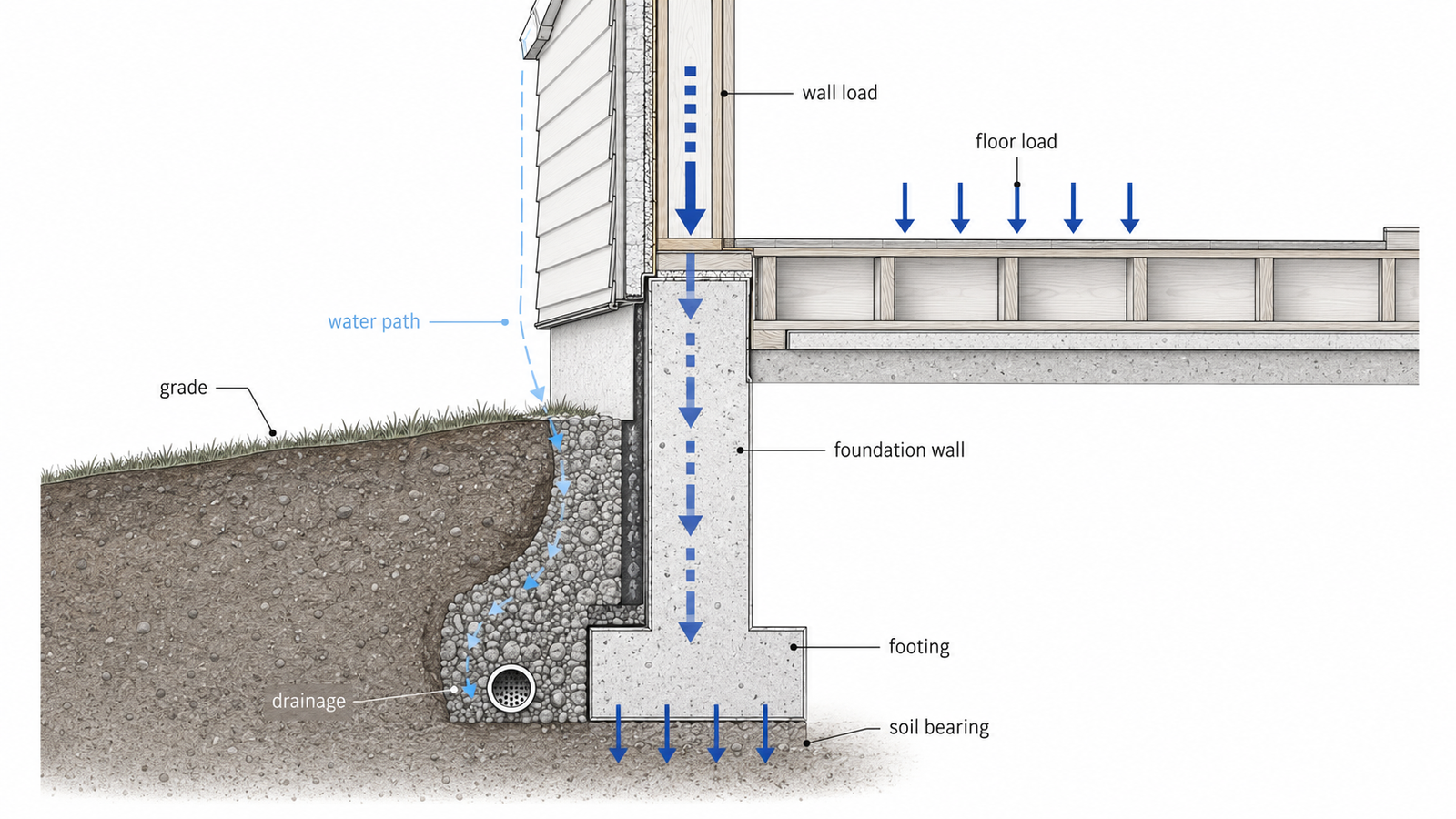
A foundation that carries the load but traps water is still a bad foundation. Water can rot framing, move soil, create mold conditions, damage insulation, undermine footings, and turn a simple repair into a structural project.
That is why the cheapest foundation bid is not always the cheapest foundation. If the bid leaves out drainage, waterproofing, vapor control, or site grading, the savings may only last until the first serious moisture problem.
Foundation choice by site condition
| Site condition | Foundation types often considered | What can go wrong |
|---|---|---|
| Flat, stable, well-drained site | Slab, crawl space, stem wall, basement depending on climate | Assuming drainage does not matter because the site looks simple |
| Cold climate with frost depth | Basement, crawl space, frost-protected shallow foundation where allowed | Shallow work that ignores frost, insulation, or local code |
| High water table | Raised slab, crawl space, pier systems, engineered alternatives | Basement water problems, damp crawl spaces, failed waterproofing |
| Sloped lot | Basement walkout, crawl space, stepped footings, piers | Bad drainage, retaining pressure, uneven bearing |
| Weak or expansive soil | Engineered slab, deep foundation, drilled piers, grade beams | Cracking, heaving, settlement, repeated repairs |
| Flood-prone area | Elevated pier, pile, or engineered raised foundation | Choosing a foundation that traps water or violates elevation requirements |
What costs more later
Most foundation cost articles focus on installation price. That is only part of the decision. The expensive part is often what the foundation makes difficult later.
- A slab can make plumbing repairs more invasive.
- A damp crawl space can lead to beam, joist, insulation, and odor problems.
- A basement can turn a drainage problem into finished-space damage.
- A pier and beam system can develop sagging floors if supports, shims, beams, or pads fail.
- A deep foundation can be expensive to engineer, install, inspect, and modify later.
Do not judge a foundation only by the first quote. Judge it by soil fit, water control, repair access, future renovation needs, and what happens when something fails.
Foundation types for additions and older houses
Additions are where foundation choices get messy. A new slab next to an old crawl space, a pier-supported addition beside a basement, or a room addition tied into an older stem wall can all create movement differences.
The new foundation has to work with the old structure. That means matching floor heights, managing drainage between old and new walls, handling different settlement patterns, and avoiding load transfer into weak framing or old masonry.
A cheap addition foundation can create expensive cracks, floor transitions, door problems, roofline movement, and water traps. The connection between old and new work matters as much as the foundation type itself.
How to choose the right foundation type
Start with the site, then the house, then the budget. Not the other way around.
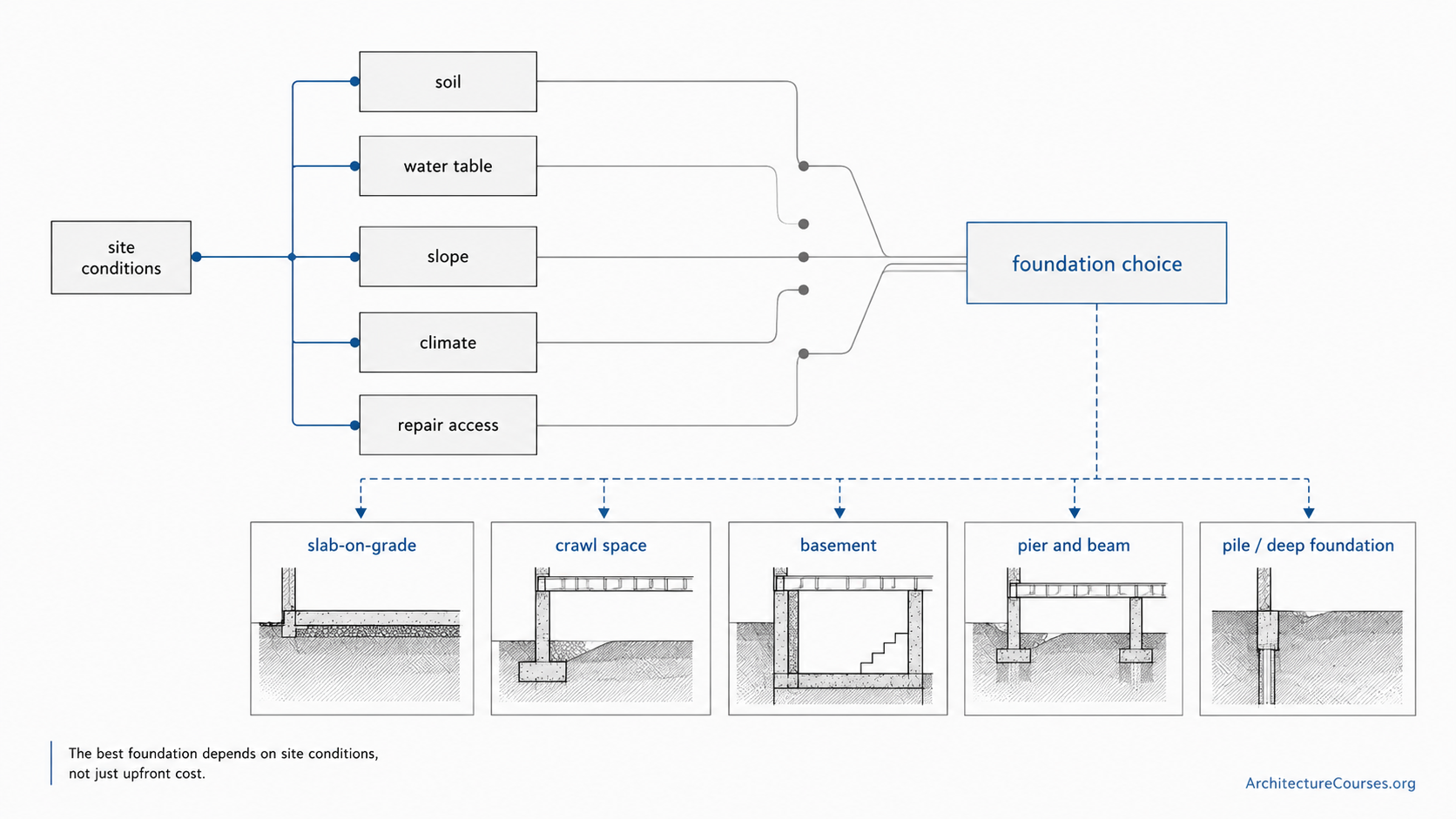
- Check soil and bearing. Weak, expansive, wet, or filled soil changes the foundation decision.
- Check water. Surface drainage, groundwater, flood risk, and roof runoff matter.
- Check frost and climate. Cold regions may require deeper or protected footing designs.
- Check slope. A sloped lot may favor a basement, crawl space, stepped footing, or pier system.
- Check access needs. Slabs hide more systems. Crawl spaces and basements provide more access.
- Check long-term repairs. The cheapest foundation may be expensive when plumbing, drainage, rot, or settlement appears.
- Check local code. Local building departments, engineers, and adopted codes control what is allowed.
The right question is not “Which foundation is best?” The better question is: “Which foundation solves this site without creating a bigger repair problem later?”
Foundation mistakes that cost the most
The worst foundation mistakes usually come from treating the foundation as a line item instead of a system.
- Choosing a slab because it is cheaper while ignoring expansive soil or future plumbing access.
- Choosing a basement without a serious drainage and waterproofing plan.
- Building a crawl space without controlling ground moisture.
- Using piers or posts without proper footing, spacing, bracing, and beam support.
- Ignoring slope and sending water toward the foundation.
- Matching a new addition foundation poorly to an old house.
- Assuming a visible crack is the whole problem.
- Skipping documentation, inspections, and local code review.
Best foundation type by goal
| Goal | Foundation type often worth considering | Important warning |
|---|---|---|
| Lowest simple build cost on a suitable site | Slab-on-grade | Do not ignore soil movement, drainage, or buried plumbing access. |
| Better utility access | Crawl space or basement | Access is only useful if the space stays dry and reachable. |
| Extra lower-level space | Basement | Waterproofing and drainage must be treated as core work, not upgrades. |
| Raised house on a tricky site | Pier and beam, crawl space, piles, or engineered piers | Support spacing, footing size, soil bearing, and lateral stability matter. |
| Flood-prone or coastal site | Elevated pile or engineered raised foundation | Local flood rules, scour, wind, corrosion, and elevation requirements control the design. |
| Older-house addition | Depends on the existing foundation | The new foundation has to work with the old house, not just meet a generic detail. |
FAQ
What are the main types of house foundations?
The main types are slab-on-grade, crawl space, basement, pier and beam, stem wall, and deep foundations such as piles or drilled piers.
Which house foundation type is best?
There is no best foundation for every house. The right choice depends on soil, water table, frost depth, slope, flood risk, budget, code, and repair access.
Is a slab foundation cheaper than a crawl space?
Often, yes, on a suitable flat site. But a slab can be harder to repair later because plumbing and utilities may be buried in or below concrete.
Is a crawl space foundation bad?
No. A dry, accessible crawl space can be useful because it gives access to framing and utilities. A damp, ignored crawl space can become expensive because moisture can damage wood, insulation, ducts, and supports.
Why are basement foundations expensive?
Basements require deeper excavation, stronger walls, drainage, waterproofing, and careful backfill. Repairs can also be expensive because problems often happen outside below grade.
When do houses need piles or deep foundations?
Deep foundations are used when shallow soil cannot support the house, when the site is coastal or flood-prone, when fill is unreliable, or when engineering requires loads to be transferred deeper into stronger soil or rock.
What foundation type is best for an addition?
It depends on the existing house, soil, floor height, drainage, and how the new foundation connects to the old one. Matching the wrong foundation system can create cracking, water traps, and uneven movement.
References
Sources used for this article
- International Code Council: 2024 International Residential Code, Chapter 4 Foundations
- U.S. Environmental Protection Agency: A Brief Guide to Mold, Moisture and Your Home
- U.S. Environmental Protection Agency: Remodeling Your Home and Indoor Air Quality
- FEMA Building Science
- USDA Natural Resources Conservation Service: Understanding Soil Risks and Hazards