
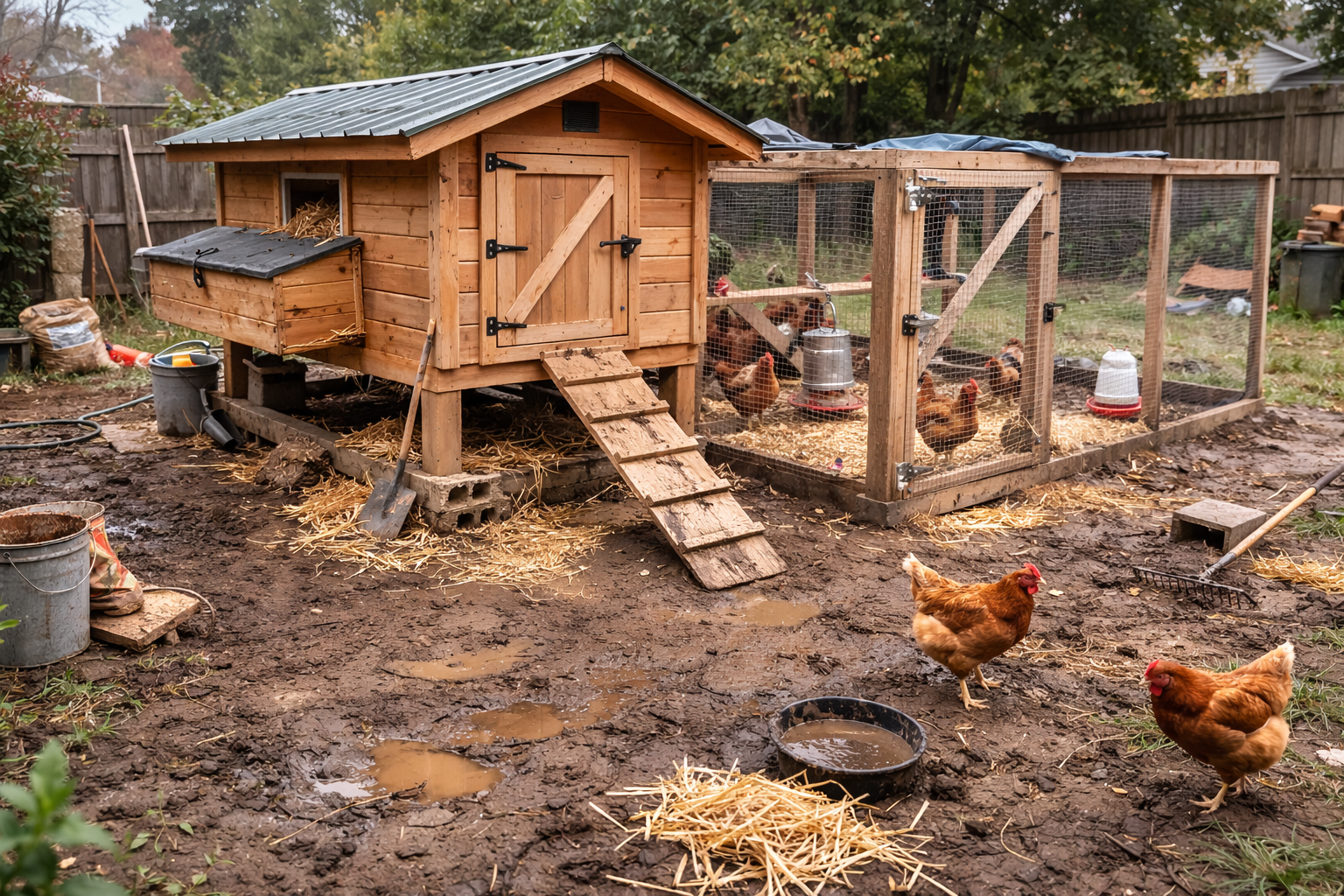
Chicken Coop FAQs: Real Answers to the Questions Everyone Asks
This isn’t a “chickens 101” lecture. It’s the stuff that comes up when you’re mid-build, it’s raining, something smells off, or you’re staring at a raccoon-proof latch wondering why raccoons have hands.
Chicken Coop Construction FAQs: Foundations, Runs, Venting, Cleaning
Planning + sizing
(the questions people argue about forever)
How big does a coop need to be for 3–6 chickens?
Big enough that the roost, nest boxes, and your cleaning path fit without gymnastics. The common “sq ft per bird” numbers are a starting point, but the real failure is crowding the roost and forcing droppings into nests. If your coop layout makes it hard to scrape, rake, or pull bedding out, it will get gross fast—even if the math says “fine.”
Do I really need a run, or can they live in the coop only?
They can survive in a coop-only setup, but it’s a tougher management job: faster mess, faster boredom, more pecking issues. If your yard is small, the run doesn’t need to be huge—but it does need a plan for mud, shade, and predator pressure.
If you’re still picking a layout, start with a simple roundup and choose the shape that fits your yard before you get fancy: chicken coop layouts that actually fit small yards.
Foundation + base
(where wet coops are born)
Does a chicken coop need a foundation?
Not always a “foundation” like a house—but it does need a base strategy. The mistake is setting wood straight on soil and hoping bedding fixes it. If water sits at the edge, the bottom plate rots, the smell shows up, and you end up rebuilding the same coop in year two.
What’s the simplest base that doesn’t turn into a swamp?
A raised coop on skids, blocks, or posts—anything that gets airflow underneath and keeps splashback off the base. If you want ground-level, then treat the footprint like a mini patio: a stable pad, drainage, and a bottom edge detail that can take wet seasons.
Can I just put the coop on pavers or gravel?
Yes—if it’s stable and drains. The key is that the coop can’t rack, sink, or twist every freeze/thaw cycle. A coop that goes out of square becomes a door that won’t latch… which becomes a predator problem.
Simple Small Chicken Coop Ideas You Can Build in a Weekend
Predator-proofing
(the stuff that fails at 2 a.m.)
Is chicken wire enough?
For keeping chickens in? Sure. For keeping predators out? Not reliably. The questions people ask online over and over are about raccoons reaching through, tearing at corners, and learning simple latches. If you’re trying to build something that lasts, treat the run like a security enclosure, not a decorative fence.
How deep do I bury wire to stop digging predators?
Depth helps, but an “apron” (wire laid outward along the ground) is often the more realistic move because it catches diggers before they get under the wall line. The important part is continuity: no gaps at corners, doors, or where the run meets the coop.
What’s the most common “I can’t believe that happened” predator mistake?
Doors and latches. People build strong walls and then install a latch a clever animal can open. If you want a simple rule: if a toddler could open it, a raccoon might eventually figure it out.
Ventilation + winter
(where people accidentally make ammonia boxes)
How do I ventilate without creating a draft on the roost?
Vent high. Drafts at roost height are the problem; airflow up near the roofline is usually the solution. If your coop smells sharp or your windows sweat, you need more air exchange—not less.
Do chickens need a heater or heat lamp in winter?
Most of the time: no. The short version from people who’ve learned the hard way is that dry + draft-controlled matters more than “warm.” Heat lamps add real fire risk, and they can create weird dependency problems if power fails during a cold snap.
My coop is cold. Should I seal every crack?
Don’t turn it into a sealed cooler. You want controlled air: venting high, wind blocked at roost height, and bedding kept dry. A “tight” coop with poor ventilation is how you get dampness, ammonia, and respiratory issues.
Run floors + mud control
(the small-yard pain point)
My run was grass. Now it’s dirt. Now it’s mud. What do people actually do?
This is one of the most common real-world questions, especially in wet climates and small yards. The consistent answers you see from experienced keepers: pick a surface you can rake, refresh, and keep draining. Many people rotate between sand, chips, straw, and deep-litter-style run management depending on season.
Sand vs. wood chips vs. “just dirt” — what’s better?
Sand can be great if it stays draining and you’re willing to sift/rake. Wood chips can be great if you can keep adding and letting it break down. “Just dirt” becomes “just mud” when the run is small and gets hammered.
Do I need to roof the whole run?
Not always. If you can only cover one zone, cover the high-traffic area near the coop door. That’s where the ground gets destroyed first.
If your main goal is “cheap but it can survive a wet spring,” skim this and steal the boring moves: cheap coop ideas that don’t backfire later.
Interior layout
(roosts, nests, cleaning access)
Where should roosts go so the coop stays clean?
The biggest rule people learn after a few months: don’t put roosts where droppings land in nests. Put roosts where you can scrape under them (poop board, tray, or a cleanable surface) and where birds aren’t sitting in a direct draft line.
How many nesting boxes do I actually need?
Fewer than people build. Too many boxes eats coop volume and makes cleaning harder. The better goal is: a few boxes that stay darker and calmer than the roost zone, with easy outside access so you’re not crawling in for eggs.
What’s the most underrated feature in a small coop?
A clean-out opening that’s actually big. Tiny coops fail because you can’t reach the corners, so the corners become the smell.
See: Skid vs Lean-to vs Hoop Chicken Shelters: What Actually Holds Up for 2–6 Chickens
Bedding + cleaning
(what people ask when the coop starts smelling)
Pine shavings, straw, sand, hemp — what do people use?
You’ll see all of them. The real deciding factor is your climate and how you clean. People in wet/cold areas obsess over “stays dry.” People in dry climates can get away with more. If your bedding stays damp, you’re going to fight ammonia no matter what it’s made of.
How often should I clean the coop?
There isn’t one schedule. A better rule: if it smells sharp, if bedding is damp, or if the roost zone is caked, it’s time. The setups that feel “easy” are the ones that make daily/weekly cleanup fast: scrape the roost zone, refresh bedding, move on with your life.
Deep litter: magic or mess?
It can work, but it’s not a free pass. It only behaves if you keep adding dry carbon (and your coop has enough ventilation that moisture doesn’t build up). If your coop is small and damp, deep litter can become deep regret.
Rodents + pests
(rats, mites, and the stuff nobody wants to talk about)
How do I stop rats from showing up?
The most common pattern: feed access. If rodents can eat nightly, they will move in. People try spices and “deterrents,” but the boring fixes show up repeatedly: store feed in sealed containers, limit overnight access, hang feeders so they can’t be reached easily, and keep spilled feed under control.
My coop is getting mites. What’s the usual first move?
Clean, inspect the cracks, and treat the coop—not just the birds. Mites love joints and crevices. If the coop interior has a lot of raw cracks, they have a lot of hiding places. Smooth, cleanable surfaces and regular inspection beat panic-spraying everything once it’s bad.
Automation + “smart coop” stuff
(what’s worth it vs. what’s a gimmick)
Are automatic coop doors worth it?
A lot of people buy them after one scare: forgetting to lock up, or hearing something outside at night. The real value is consistency—closing at dusk when you’re busy. The real risk is cheap mechanisms failing, so you still need a habit of checking function and having a manual backup plan.
Do I need cameras and sensors?
Only if they solve a real problem for you: predator pressure, travel, or just wanting to stop guessing. Cameras don’t replace good construction, but they can confirm what’s happening when something is off.
Local rules + neighbor reality
Do I need a permit for a chicken coop?
Sometimes. It depends on where you live, coop size, setbacks, and whether your jurisdiction treats it like an accessory structure. If you’re in a city or tight neighborhood, check rules early—because the “we built it already” conversation goes badly.
How do I keep neighbors from hating this?
Smell and noise are the two triggers. Smell is mostly moisture + dirty bedding + a run that turns to mud. Noise is mostly roosters (and stressed birds). Build for cleanliness, keep water managed, and don’t let feed become a rodent attraction next door.
Related resources
If you want idea roundups (not theory), start here: coop designs and layouts. If you’re trying to keep it cheap but solid, this one stays practical: budget coop builds that hold up.