

A renewable energy home can still waste money.
Solar panels do not fix a leaky house. Batteries do not fix a high electric load. Geothermal does not fix bad insulation. A shaded roof can make the whole solar plan weaker before the first panel is installed.
Start with the house. How much energy does it use? Where is it leaking? How good is the roof? Can the electrical panel handle the new equipment? What happens in winter, during outages, or after several cloudy days?
Size the system after those answers are clear. The right plan depends on the roof, shade, climate, wiring, heating load, utility rules, budget, and backup needs.
Start with the house, not the solar panels
Most renewable energy upgrades start with the exciting part: solar panels, batteries, wind turbines, geothermal loops, and backup systems. That is understandable, but it is also how people overspend.
A house with air leaks, weak attic insulation, old ducts, single-pane windows, or inefficient heating may need a much larger renewable system than the same house after basic load reduction. The equipment may still work, but the owner pays to cover waste.
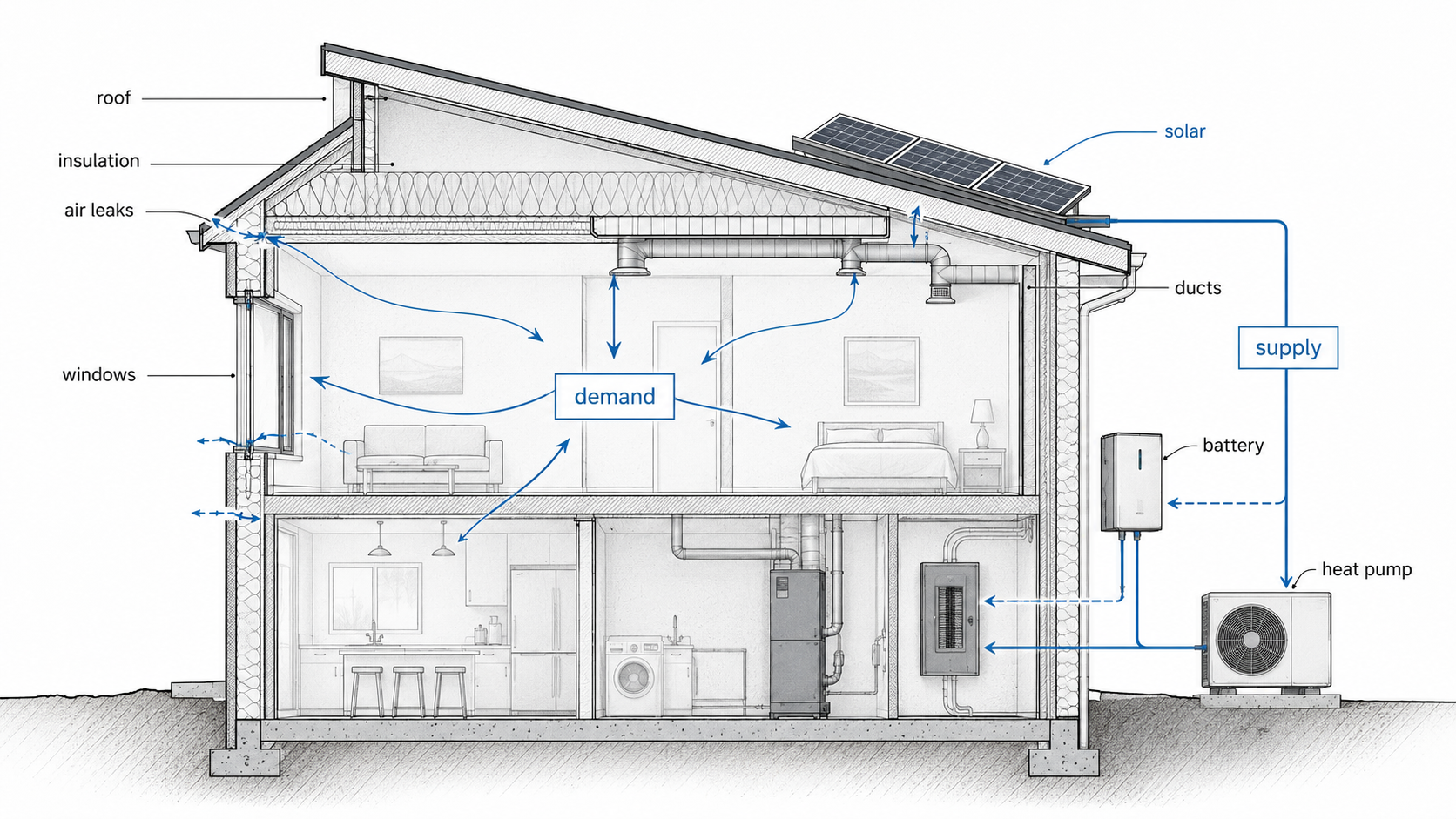
Before choosing a renewable energy system, study the house in this order:
- how much electricity the house uses now
- how much heating, cooling, hot water, cooking, laundry, and vehicle charging may move to electricity later
- whether the roof can hold solar panels for the expected service life of the system
- whether shade, chimneys, vents, dormers, trees, or roof shape will reduce solar output
- whether the electrical panel, service size, and wiring can support the new loads
- whether backup power is expected to run only essentials or the whole house
This is why sustainable design strategies still matter even when the final plan includes renewable energy equipment. A smaller, tighter, better-planned load is easier and cheaper to serve.
What a renewable energy home actually needs
A renewable energy home is not one product. It is a working system. The house needs lower demand, a suitable energy source, safe wiring, controls, storage or backup where needed, and a realistic plan for bad weather, high-use days, and maintenance.
For many homes, the right path is not “100 percent renewable” on day one. A more realistic path may be:
- reduce heating and cooling demand first
- electrify the systems that make sense, such as heating, cooling, hot water, or cooking
- install solar where roof and utility conditions support it
- add a battery only if backup power, time-of-use rates, or grid limits justify it
- study geothermal or wind only when the site truly supports them
That approach may not sound as flashy as a “fully renewable dream home,” but it is usually the better design process. It protects money, reduces surprises, and keeps the project tied to what the house can actually support.
Solar power for the house: the first system most people price
Solar is usually the first renewable energy system homeowners study because it fits many houses better than wind, biomass, or small hydro. It has no moving blades, it can use existing roof area, and it can be designed as a grid-tied system instead of a fully off-grid setup.
But solar electricity for home use depends on the roof and site more than people expect. A clean south-facing roof with little shade is different from a chopped-up roof with dormers, vents, chimneys, skylights, mature trees, and an old electrical service.
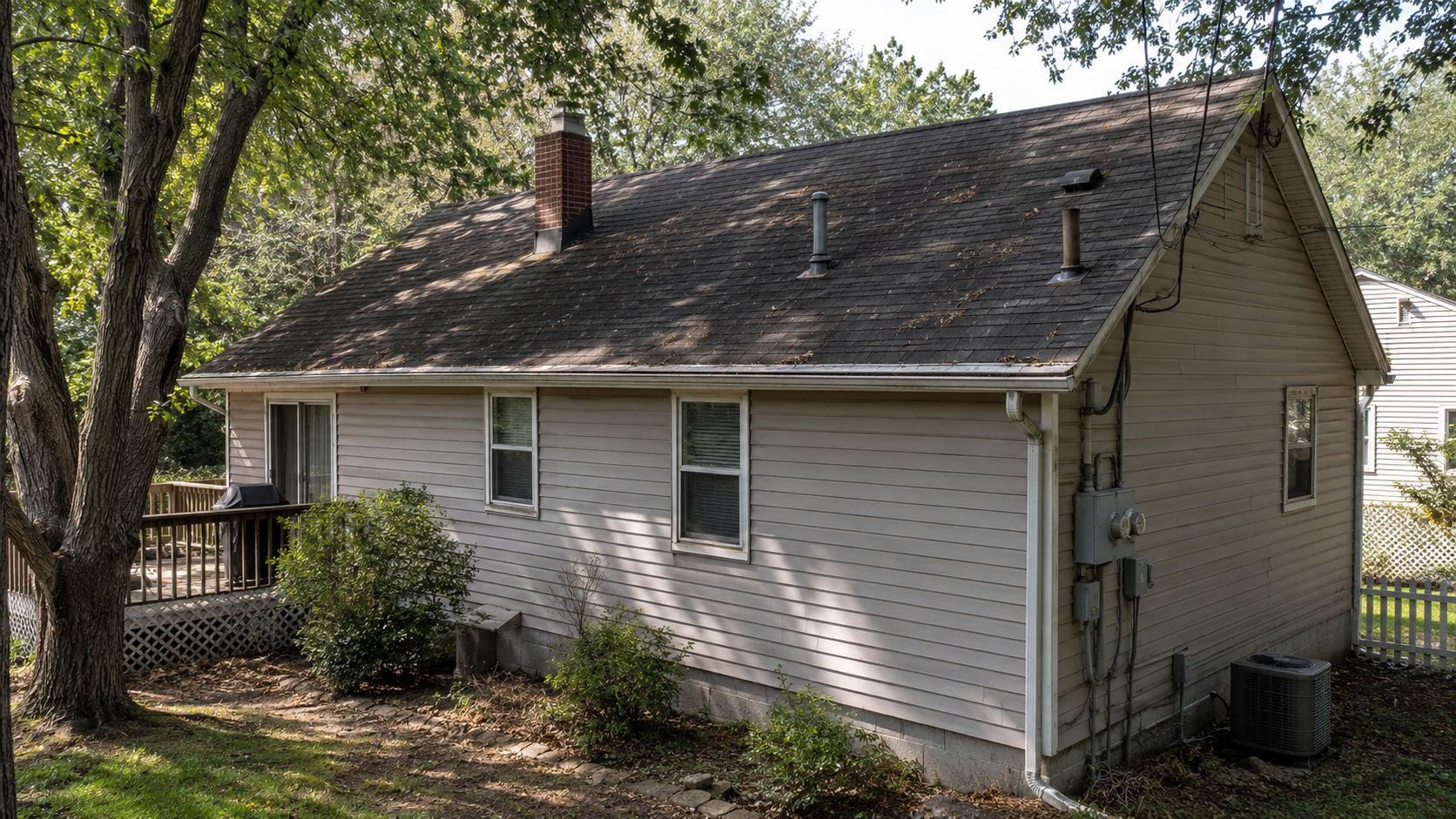
Before pricing solar power for a house, check these items:
- roof age and remaining service life
- roof plane size, slope, and direction
- shade from trees, neighboring houses, chimneys, and roof equipment
- attic or roof structure concerns
- electrical panel capacity
- inverter location and service access
- utility interconnection rules
- whether battery storage is needed or only wanted
A weak roof can turn solar into a roof-replacement project. Heavy shade can make a bigger system perform like a smaller one. A crowded service wall can make electrical work more expensive. These are not small details. They change the quote.
This page is the planning overview. A future page on solar electricity for home should handle solar sizing, panel layout, roof condition, utility approval, and installer quotes in more detail.
When wind power for homes makes sense
Wind power for homes is often more limited than people expect. It can work on the right rural, open, windy site. It is usually a poor fit for tight suburban lots, low towers, turbulent wind, strict zoning, or properties surrounded by trees and buildings.
A small wind system needs more than the idea of wind. It needs usable wind at the correct height, space for a tower, permission to install that tower, safe setbacks, utility interconnection if grid-tied, and a maintenance plan. A small turbine mounted too low or placed in turbulent air can disappoint badly.
Wind is worth studying when the property has:
- open exposure with few tall obstructions
- a local wind resource strong enough to justify the system
- room for tower setbacks and service access
- zoning rules that allow residential wind equipment
- a homeowner who accepts moving parts and maintenance
For many houses, solar plus efficiency work is a cleaner first step. Wind belongs in the plan only when the site earns it.
Geothermal energy at home: useful, expensive, and often misunderstood
Geothermal energy for a home usually means a ground-source heat pump, not a backyard power plant. It uses the more stable temperature below the surface to help heat and cool the house.
A geothermal energy home can be comfortable and efficient, but the system is not simple. The project may require drilling or trenching, enough land or access for the loop field, interior mechanical work, electrical coordination, and a contractor who knows the system well.
Geothermal makes more sense when the house has a real heating and cooling load, the site can accept the ground loop, and the owner plans to stay long enough to benefit from the investment. It can be a strong system for some homes. It is not automatically the right answer for every clean energy plan.
If the house mainly needs better insulation, duct sealing, air sealing, or a smaller air-source heat pump, jumping straight to geothermal can be an expensive detour. The heating and cooling load should be reduced before the system is sized.
For readers comparing equipment costs, your heat pump cost guide can support this section naturally.
Batteries, backup power, and the part people underestimate
Batteries are where renewable energy plans often get expensive. Homeowners may ask for “backup for the whole house” without realizing what that means during heat waves, winter storms, electric cooking, well pumps, sump pumps, EV charging, or several cloudy days.
A battery is not the same as unlimited off-grid power. It stores a limited amount of electricity. The more loads it must support, the larger and more expensive the system becomes.
Before adding battery storage, decide what the battery must actually do:
- keep lights, internet, refrigerator, and basic outlets running
- support a sump pump, well pump, or medical equipment
- run heating or cooling during an outage
- reduce peak-rate electricity use
- help an off-grid system survive several low-production days
That decision changes the design. A small backup battery for essentials is a different project from a large battery system expected to run the whole house.
Grid-tied, off-grid, or mostly renewable?
“100 percent renewable” sounds simple, but the design choices behind it are not simple.
A grid-tied renewable energy home can use solar or other systems while staying connected to the utility. That connection can help when the house needs more power than the system is producing. Depending on local rules, excess solar production may be credited, exported, limited, or handled under a specific utility program.
An off-grid solar power system for a home has a much harder job. It must cover normal daily use, bad weather, seasonal changes, battery storage, backup generation, maintenance, and emergency loads without relying on the grid. That may make sense for remote land, cabins, rural properties, or places where extending utility service is expensive. It is usually not the casual version of home solar.
A mostly renewable home is often the practical middle ground. The house reduces demand, uses solar where it works, electrifies some systems, may include battery backup for essentials, and still keeps a utility connection for reliability. That is not failure. It is often the most sensible design.
The hidden costs before the installer gives you a quote
This is the part many homeowners discover late. The renewable energy equipment may not be the first cost. The house may need preparation before the system can perform well or pass approval.
Hidden costs can include:
- roof repair or replacement before solar installation
- tree trimming or shade management
- moving roof vents or working around chimneys and skylights
- electrical panel upgrades
- service entrance or meter work
- attic air sealing and insulation before sizing heating equipment
- duct sealing, duct replacement, or switching to ductless equipment
- battery clearance, fire-safety requirements, and garage wall space
- utility approval delays
- permit drawings, engineering, or inspection corrections
- backup power expectations that require a larger system than expected
These costs do not mean renewable energy is a bad idea. They mean the project has to be scoped honestly. A quote that ignores the roof, panel, service, shade, and heating load is not a real design yet.
This is also where renewable energy solutions for buildings connect back to ordinary houses. The system has to fit the building, not the other way around.
How to choose the right renewable energy mix
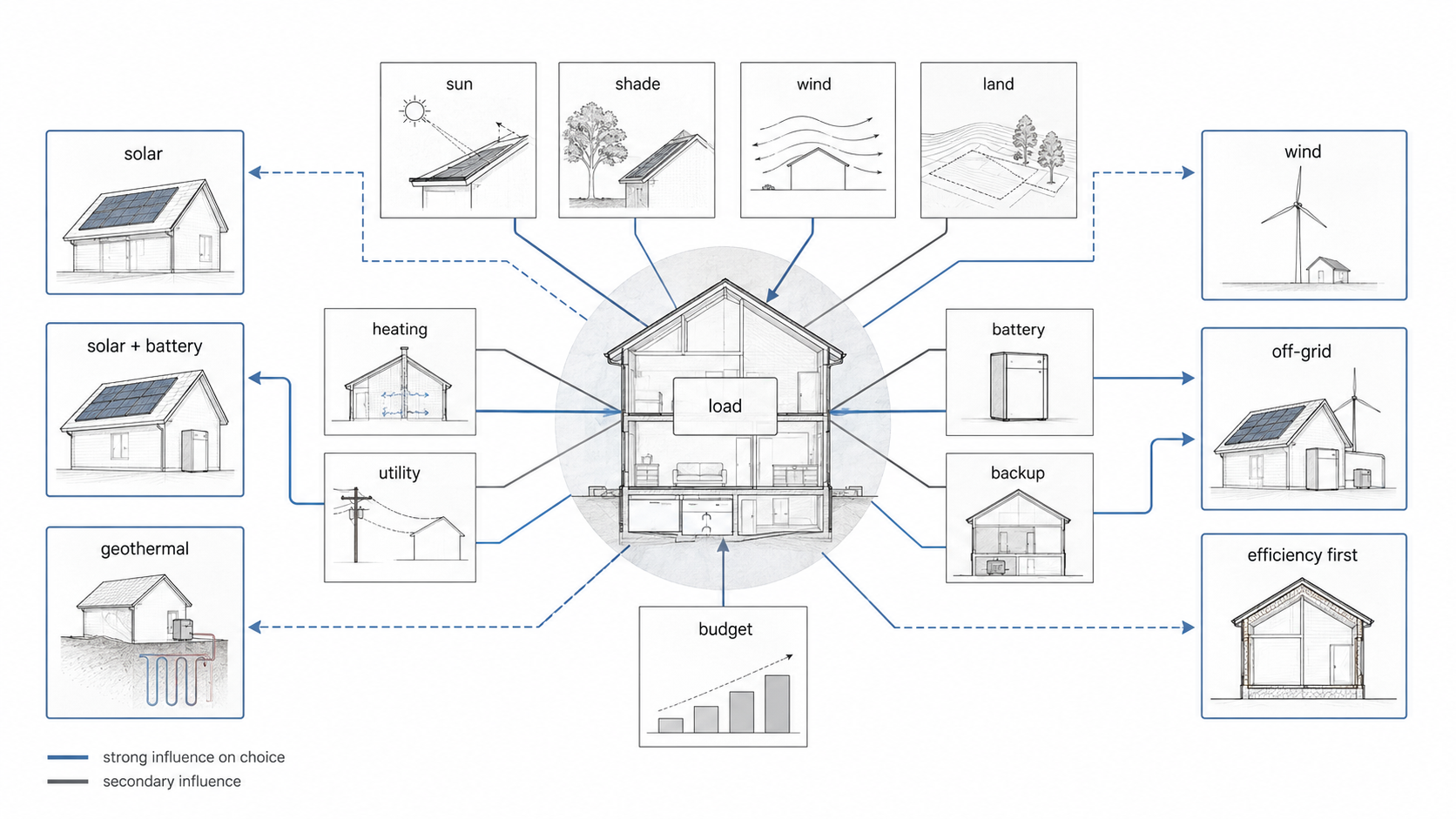
The right mix depends on the site and the load. A sunny suburban roof may point toward solar first. A rural open property may justify a wind study. A house with major heating and cooling demand may deserve a heat pump or geothermal comparison. A remote site may need off-grid solar, batteries, and backup generation from the start.
Use this order before choosing equipment:
- Reduce the load: air sealing, insulation, duct losses, efficient equipment, and smarter controls.
- Study the site: roof sun, shade, wind, land, access, and climate.
- Check the electrical system: panel, service, wiring, meter, and equipment locations.
- Decide the goal: lower bills, backup power, lower emissions, off-grid use, or a mix of those.
- Price the right system: solar, solar plus battery, heat pump, geothermal, wind, or efficiency first.
A clean energy home does not need every system. It needs the right system in the right order.
What to do before spending money
Before signing a solar, battery, wind, or geothermal contract, collect the basic information an honest designer needs.
- Gather 12 months of utility bills.
- Note future electrical loads such as heat pumps, induction cooking, EV charging, or a heat pump water heater.
- Check roof age, leaks, shade, and major obstructions.
- Photograph the electrical panel, meter, service area, attic, roof planes, and mechanical equipment.
- Ask whether the quote includes panel upgrades, permitting, utility approval, monitoring, and backup-load planning.
- Separate “lower energy bills” from “whole-house outage backup” because they are different goals.
Incentives can help, but they should not be the only reason a system is chosen. Rules change, utility programs vary, and the wrong system is still the wrong system after a rebate. Your page on solar incentives can help readers understand that part without turning this article into a tax-credit guide.
FAQ
Can a house run completely on renewable energy?
Yes, some houses can, but it depends on the site, climate, energy use, storage, utility rules, and backup plan. A sunny, efficient house with a well-sized solar and battery system is very different from a shaded, leaky house with high electric heating loads.
Should I install solar before improving insulation?
Not usually. If the house wastes heating and cooling energy, the solar system may need to be larger than necessary. Air sealing, attic insulation, duct work, and efficient equipment can reduce the load before panels are sized.
Is wind power good for suburban homes?
Usually not. Small wind needs strong usable wind, tower height, open exposure, space, and permission. Many suburban lots have too much turbulence from trees, roofs, fences, and neighboring buildings.
Is geothermal better than solar?
They do different jobs. Solar produces electricity. A geothermal heat pump handles heating and cooling. A house may use both, but geothermal should be judged by heating load, site access, installation cost, and local contractor skill.
Do batteries make a home off-grid?
Not by themselves. Batteries store limited energy. A true off-grid home needs enough generation, storage, controls, backup strategy, and load management to survive low-production days.
What is the first thing to check before a renewable energy upgrade?
Start with the load and the site. Review utility bills, roof condition, shade, heating and cooling demand, electrical service, and backup expectations before choosing equipment.
Read This Next
Start with renewable energy if you need the broad background.
Read renewable energy solutions for buildings for a more practical look at how systems fit real buildings.
For energy demand before equipment, use methods of sustainable construction.
For performance goals, read net zero architecture.
References
Sources used for this article
- National Renewable Energy Laboratory: PVWatts Calculator
- National Renewable Energy Laboratory: SAPC Best Practices in PV System Installation
- U.S. Department of Energy: Small Wind Guidebook
- U.S. Department of Energy: Geothermal Heat Pumps
- U.S. Department of Energy: Heat Pump Systems
- ENERGY STAR: Energy Efficient Products