

Net zero does not start with solar panels.
It starts with a building that needs less energy in the first place. Tight envelope. Better air sealing. Smart glazing. Real shading. Good ventilation. Efficient equipment. Controls that people can actually use.
If the building leaks air, overheats, uses too much glass, or was never commissioned well, the roof may not be able to produce enough energy to cover the damage.
Get the load down first. Size the renewable system after.
What net zero architecture means
Net zero architecture usually means a building is designed to balance what it consumes with what it produces or offsets over a defined period, often one year. The problem is that people use “net zero” to mean different things.
A net zero energy building focuses on annual energy balance. The building reduces energy demand as much as possible, then uses renewable energy to meet the remaining annual load.
A net zero operational carbon building focuses on emissions from operating the building. That includes heating, cooling, lighting, ventilation, hot water, appliances, equipment, and the energy source used to run those systems.
A net zero carbon building can go further by looking at embodied carbon too: structure, concrete, steel, insulation, glazing, finishes, replacement cycles, construction waste, and sometimes end-of-life impacts.
These are related, but they are not the same. A building can have low operating energy and still carry a heavy embodied-carbon penalty. Another building can buy clean power and still have poor envelope performance. Good net zero architecture has to be honest about the boundary being measured.
Why net zero design starts with demand, not equipment
The cheapest renewable energy system is the one that does not need to be oversized. That is why net zero design starts with energy demand.
If a building has weak insulation, leaky air barriers, thermal bridges, oversized glazing, poor solar control, inefficient lighting, and unmanaged plug loads, the renewable system has to work harder. Solar panels may hide the problem on paper, but they do not fix a bad envelope.
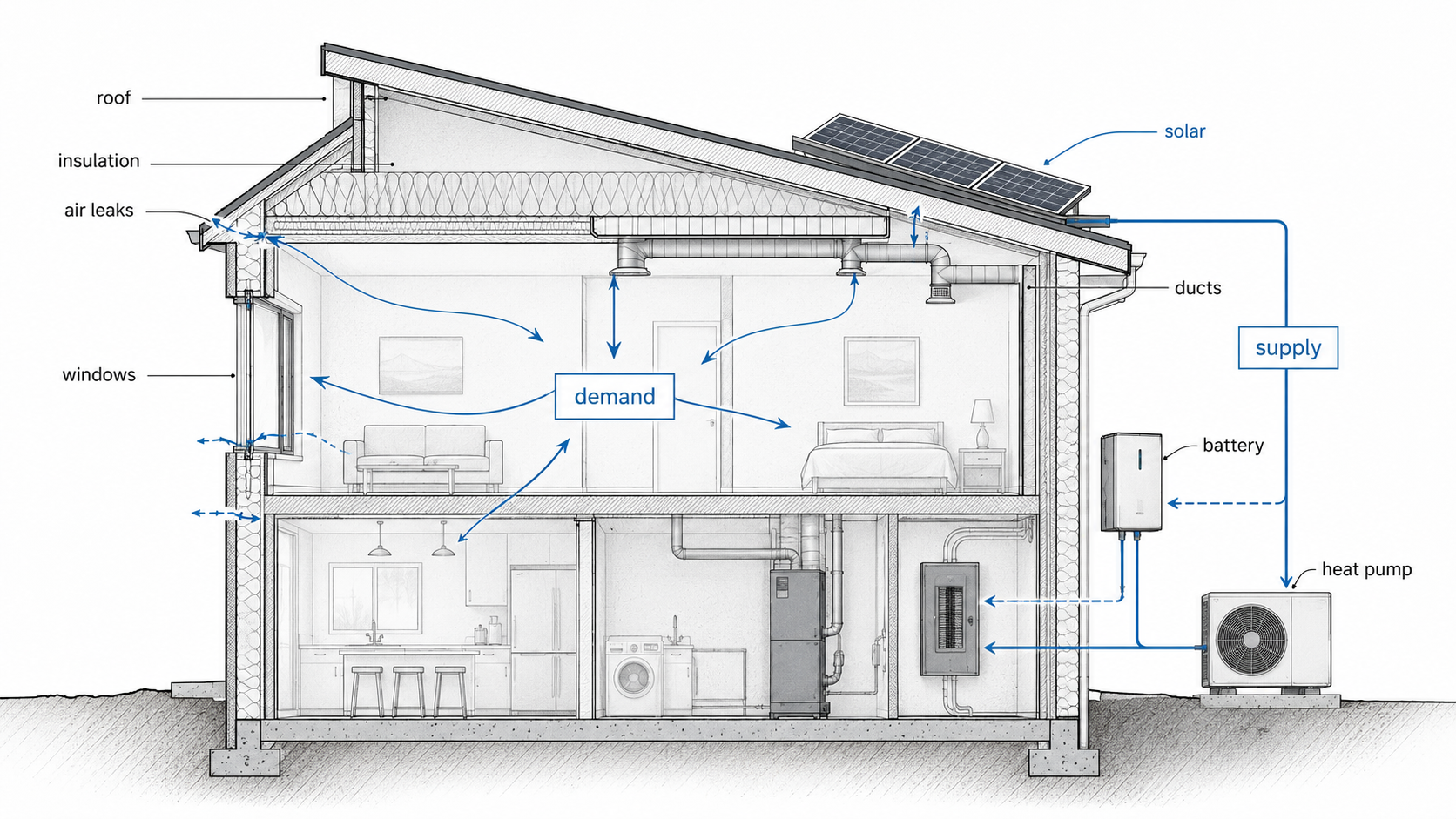
The first target is not “add renewables.” The first target is usually:
- reduce heating and cooling loads
- control air leakage
- reduce unwanted solar gain
- choose glazing that fits the climate and orientation
- reduce plug loads and lighting loads
- recover energy from ventilation where appropriate
- use efficient heating, cooling, and hot water systems
- size renewables after the reduced load is known
A net zero building is easier to achieve when the building is quiet, tight, shaded correctly, and efficient before the energy system is added.
The building envelope decides whether the math works
The envelope is where many net-zero goals succeed or fail. Walls, roof, floor, windows, doors, thermal bridges, air barriers, and moisture control decide how much heating and cooling the building will need for decades.
A high-performance envelope does not mean stuffing insulation everywhere without thinking. It means the insulation, air barrier, vapor control, flashing, drainage plane, glazing, and structural details work together.
Watch these weak points:
- window-to-wall ratio that is too high for the climate
- glass walls used for appearance without enough shading
- balconies, slab edges, steel, or concrete acting as thermal bridges
- leaky rim joists, roof-wall joints, and service penetrations
- insulation gaps around framing and mechanical chases
- vapor-control mistakes that trap moisture inside assemblies
- complex rooflines that make airtightness and solar layout harder
This is why sustainable design strategies should not be treated as decoration. Orientation, form, envelope, shade, air movement, and climate response are the base layer.
Passive design still matters
Passive design is not old-fashioned. It is one of the main reasons a net zero building can stay realistic.
A compact building form loses less energy than a complicated one. Correct orientation can reduce overheating and improve daylight. Overhangs, fins, trees, screens, and exterior shading can cut cooling demand. Thermal mass can help in some climates when it is used carefully, but it can also make problems worse if the building overheats and cannot purge heat at night.
Passive design works best when it is climate-specific. A strategy that helps in a dry, sunny climate may be useless or harmful in a humid, cold, or cloudy climate. That is why generic “net zero features” lists are weak. The same feature can be smart in one building and wasteful in another.
Mechanical systems have to match the reduced load
Once the envelope and passive strategy reduce the load, the mechanical system can be smaller and more precise. This matters because oversized systems can short-cycle, waste energy, create comfort problems, and cost more upfront.
Net zero architecture often depends on efficient all-electric systems, but the equipment still has to match the building. Heat pumps, energy recovery ventilators, dedicated outdoor air systems, heat pump water heaters, radiant systems, and smart controls all need proper design, not just good product labels.
The design team should ask:
- has the heating and cooling load been recalculated after envelope improvements?
- is ventilation delivering fresh air without wasting too much heat or cooling?
- are ducts inside conditioned space where possible?
- are controls simple enough for real occupants and facility staff?
- can the system be maintained without special access problems?
- does the system still work during shoulder seasons, part-load conditions, and extreme weather?
A building can look sustainable and still perform badly if the systems are oversized, under-commissioned, or too complicated for the people who operate them.
Where renewable energy fits
Renewable energy matters, but it should come after load reduction. Solar panels, solar canopies, façade photovoltaics, geothermal systems, district energy, wind, and off-site renewable procurement all have different limits.
In many buildings, rooftop solar is constrained by roof area, shading, roof equipment, fire access, structure, parapets, neighboring buildings, and future maintenance. A low-rise building may have enough roof area to cover much of its load. A tall building with a small roof and high energy use may not.
That is why net zero architecture is not always about producing all energy on one roof. Sometimes the honest target is net zero ready, low-energy, all-electric, or net zero operational carbon using a combination of on-site and off-site clean energy.
The right renewable strategy depends on:
- roof area and orientation
- shade and neighboring buildings
- electrical demand after efficiency work
- battery or demand-management needs
- utility rules and interconnection
- maintenance access
- whether the project is new construction or retrofit
For the broad background, use renewable energy. For practical building-level constraints, read renewable energy solutions for buildings.
Embodied carbon is the part many net-zero pages miss
Operational energy gets most of the attention because it is easier to measure after occupancy. Embodied carbon is harder, but it can change the real climate impact of the project.
Embodied carbon comes from materials and construction: concrete, steel, aluminum, insulation, glass, finishes, transportation, construction waste, replacement cycles, and demolition. A building can be efficient in operation and still carry a large carbon footprint before anyone moves in.
The practical question is not “which material sounds green?” The better question is:
- can the existing structure be reused?
- can concrete volume be reduced without compromising structure?
- can lower-carbon concrete mixes be used where appropriate?
- can structural spans, grids, and loads be simplified?
- can materials be sourced with environmental product declarations?
- can finishes be durable enough to avoid early replacement?
- can assemblies be repaired instead of demolished later?
This is where sustainable materials and materials selection should support the page. Net zero architecture is not only an energy story. It is also a materials and lifecycle story.
Net zero new construction versus retrofit
New construction gives the design team more control. Orientation, massing, structure, envelope, mechanical systems, wiring, roof layout, and renewable energy can be planned together.
Retrofit is harder because the building already has constraints. There may be old walls, weak roof assemblies, historic façades, limited mechanical shafts, occupied spaces, existing equipment, shallow ceiling cavities, or tenants who cannot leave during construction.
But retrofits are not second-class work. In many cases, the greenest move is improving an existing building instead of demolishing it and starting over. The existing structure already contains carbon, labor, materials, and land value. Throwing that away can create a bigger carbon problem than the energy upgrade solves.
For existing buildings, the net-zero path is usually phased:
- benchmark energy use
- fix obvious waste
- improve envelope and air leakage where possible
- upgrade lighting and controls
- improve ventilation and comfort
- electrify heating and hot water where practical
- add renewable energy after the load is reduced
- verify performance with real utility data
The hidden failure: net zero on paper, not in operation
The design model is not the building. A project can look net zero in drawings and miss the target after people move in.
Common reasons include:
- plug loads are higher than expected
- occupants use the building differently than the model assumed
- controls are too complicated
- ventilation runs longer than expected
- air leakage is worse than the design target
- commissioning is rushed or skipped
- renewable energy output is lower than expected
- maintenance staff override systems to stop complaints
This is why post-occupancy measurement matters. A serious net zero project needs energy modeling before construction, commissioning during construction, and monitoring after occupancy.
If the project does not measure performance after people use the building, “net zero” becomes a marketing claim instead of a result.
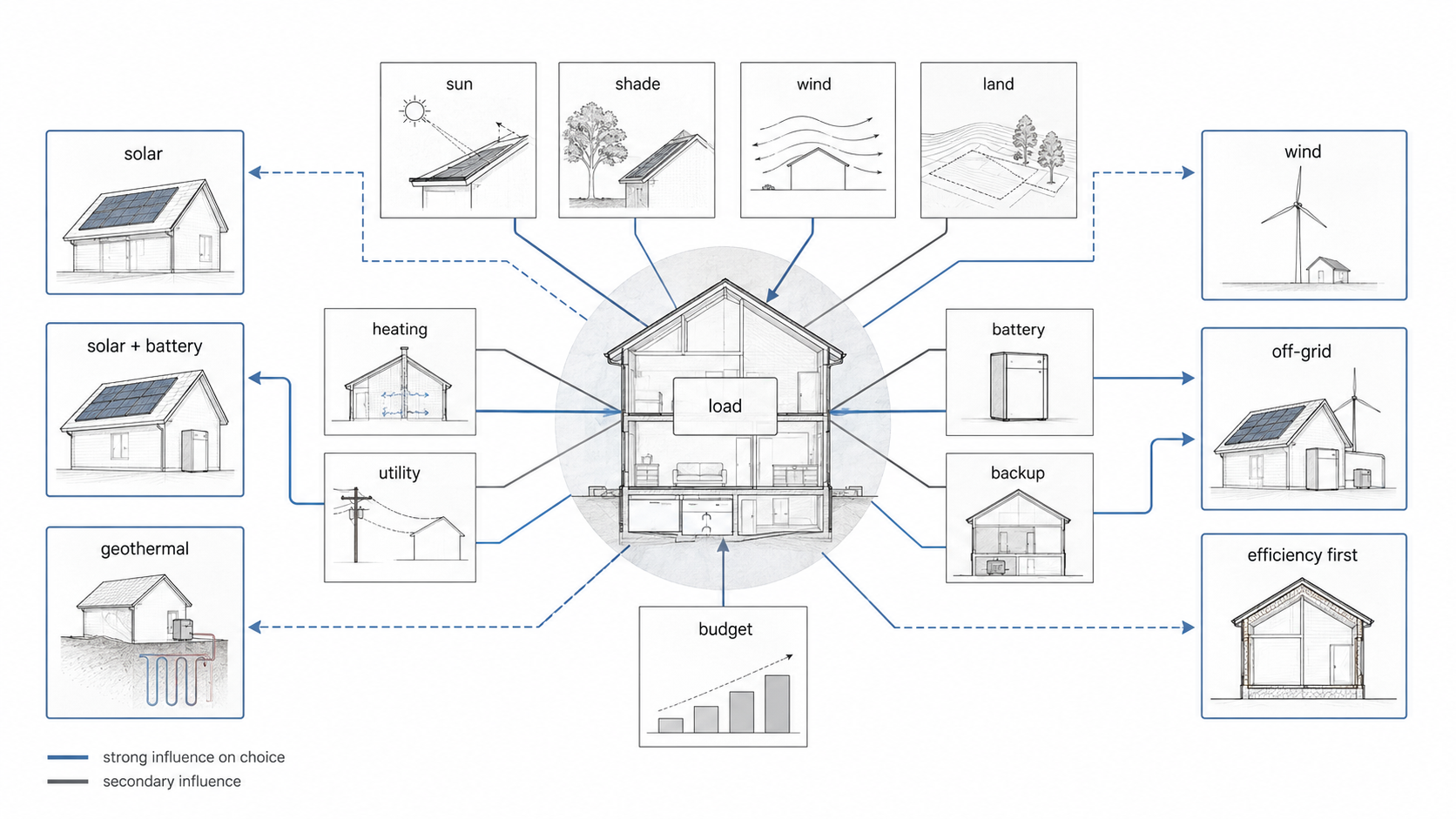
How to choose the right net zero path
The right net zero strategy depends on the building type, climate, budget, site, and owner goals. A school, house, office, apartment building, lab, warehouse, and restaurant do not have the same load profile.
Use this order:
- Define the target: net zero energy, net zero operational carbon, net zero ready, or broader net zero carbon.
- Set the boundary: building only, site, campus, portfolio, operational energy, or whole-life carbon.
- Reduce the load: envelope, shade, air sealing, lighting, plug loads, ventilation, and equipment.
- Model the building honestly: climate, occupancy, schedules, equipment, and seasonal use.
- Design efficient systems: right-sized heating, cooling, ventilation, hot water, and controls.
- Add renewable energy where the site supports it.
- Reduce embodied carbon through structure, material choices, reuse, and durability.
- Commission the building and track performance after occupancy.
That order protects the design from the biggest mistake: using renewables to cover avoidable waste.
What students and clients often misunderstand
Net zero does not mean the building has no environmental impact. It does not mean every material is clean. It does not mean the building is off-grid. It does not mean the project is automatically affordable, healthy, durable, or easy to maintain.
It means a specific performance target has been set and, ideally, verified.
A strong net zero project still has to answer normal architecture questions:
- does the building work for its users?
- is the envelope durable?
- is the structure efficient?
- can the systems be maintained?
- are materials chosen for real service life?
- does the project avoid moisture, glare, overheating, and poor indoor air?
- will the building still perform after five or ten years?
Good net zero architecture is not only about hitting a number. It is about making a building that stays useful, efficient, comfortable, and repairable.
FAQ
What does net zero mean in architecture?
It usually means a building is designed so annual energy use is balanced by renewable energy, or so operational carbon emissions are balanced or eliminated within a defined boundary. The exact meaning depends on the standard being used.
Is net zero the same as zero energy?
No. Zero energy usually focuses on annual energy balance. Net zero carbon focuses on emissions. A project can meet one target and miss another if the boundary is different.
Can an existing building become net zero?
Sometimes, but it depends on the building, climate, roof or site area, envelope condition, mechanical systems, electrical capacity, and budget. Many existing buildings should first target deep energy reduction, electrification, and net zero readiness.
Do net zero buildings need solar panels?
Many do, but not all net zero strategies depend entirely on rooftop solar. Some projects use off-site renewables, district systems, renewable procurement, or a net zero ready approach when roof area is limited.
What is the biggest mistake in net zero design?
The biggest mistake is adding renewable energy before reducing the load. A leaky, inefficient building needs more equipment, more roof area, more money, and more maintenance to reach the same target.
Is net zero architecture expensive?
It can cost more upfront, especially when the team changes structure, envelope, mechanical systems, controls, and renewable energy together. But cost depends on timing. It is usually cheaper to design performance in from the beginning than to fix a weak building later.
Does net zero include embodied carbon?
Sometimes. Many older net zero discussions focus only on operating energy. Stronger current practice also studies embodied carbon from materials, structure, construction, replacement, and demolition.
Read This Next
Start with sustainable design strategies for the design logic behind low-energy buildings.
Read renewable energy solutions for buildings to understand where solar, geothermal, and other systems fit.
For material decisions, use materials selection and sustainable materials.
References
Sources used for this article
- U.S. Department of Energy: A Common Definition for Zero Energy Buildings
- International Energy Agency: Buildings — Energy Efficiency 2025
- World Green Building Council: What is a Net Zero Carbon Building?
- World Green Building Council: Embodied Carbon
- U.S. Green Building Council: LEED Zero
- International Living Future Institute: Living Building Challenge
- International Living Future Institute: Bullitt Center Case Study