
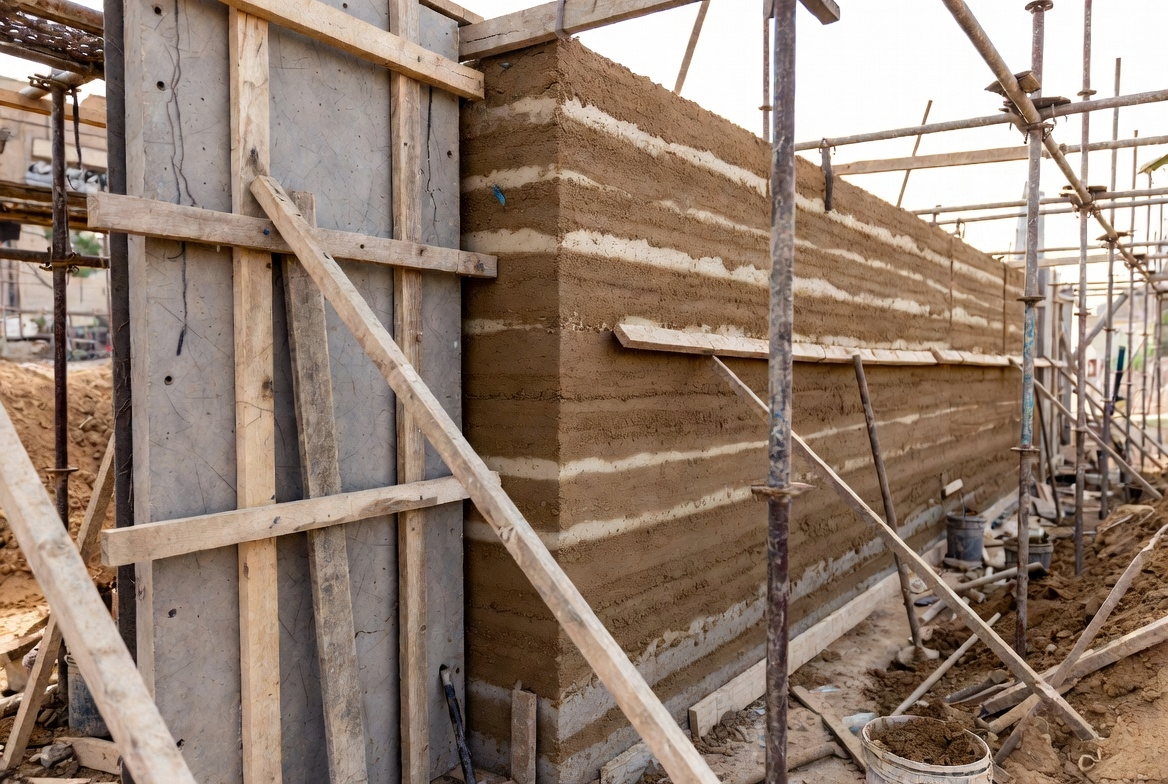
Rammed earth walls are back because they can do several jobs at once. When the mix, climate, and detailing are right, the wall can carry load, add thermal mass, finish cleanly, and give the building a material presence most standard wall systems do not.
But rammed earth is not a cheap shortcut and not a fit for every climate. Good work is engineered, tested, protected from water, and built by crews who understand the system.
The useful questions are practical: what rammed earth walls are, where the main systems split, when site-built walls make more sense than panels, how insulated systems like SIREWALL change the assembly, what drives cost, and where the method still makes sense.
If you want the broader method overview first, read Rammed Earth: An Ancient Technique for Modern Sustainable Construction. If you want the wider material context, Sustainable Building Materials: What Works and What Fails is the better zoomed-out guide.
Good Reference
The Art of Natural Building
A strong first book if you want rammed earth in the context of other earth wall systems, not in isolation.
What Is a Rammed Earth Wall?
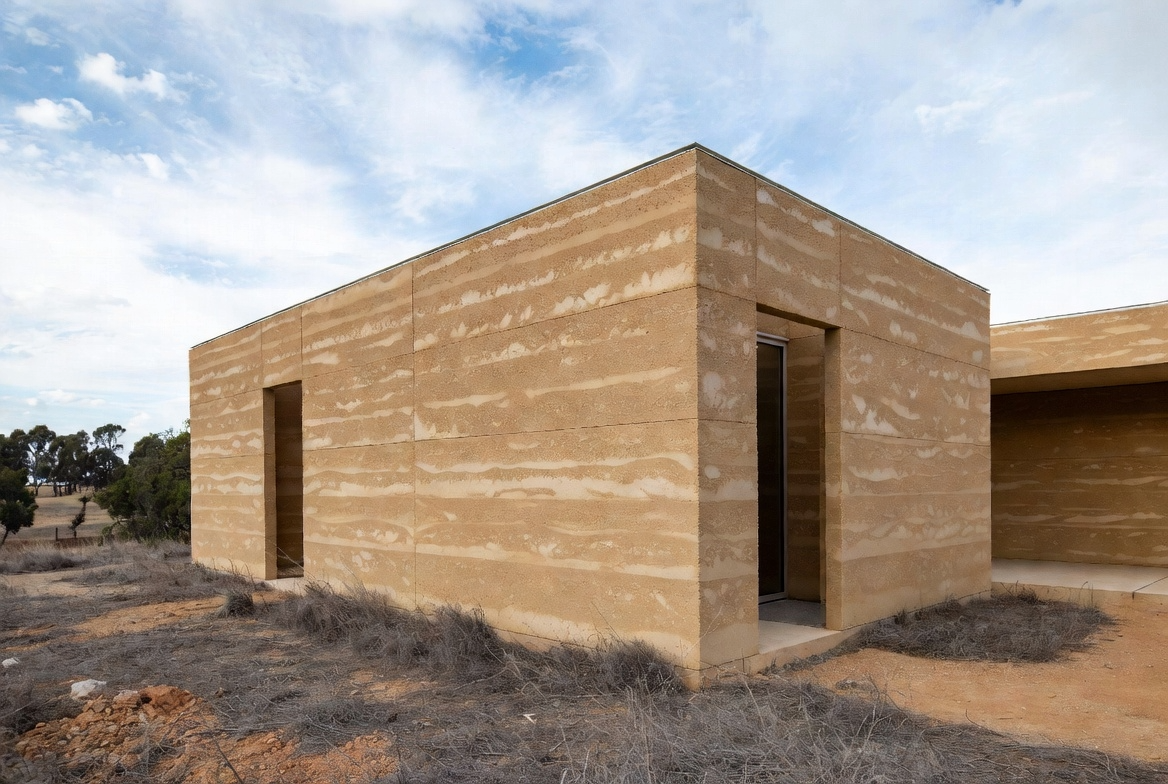
A rammed earth wall is made by placing slightly damp soil into rigid formwork in lifts, then compacting each lift until it becomes a dense monolithic wall. The mix is usually a blend of sand, gravel, fines, clay, and sometimes a stabilizer such as cement or lime.
The basic idea is old. What changed is the control. Better soil testing, better formwork, better compaction tools, and better moisture detailing moved rammed earth from folk method to engineered wall system.
That does not mean every rammed earth wall is the same. A dry-climate garden wall and a reinforced insulated structural wall are not even close to the same assembly.
- Rammed earth wall
- Earth wall
- Compacted earth wall
- Packed earth wall
- Pressed earth wall
The typo version still shows up sometimes too. Ignore “ramp earth wall.”
Types of Rammed Earth Walls

Not all rammed earth walls belong in the same cost bracket, climate, or permit path. The wall type changes everything: strength, moisture tolerance, insulation strategy, and code review.
| Wall Type | What It Is | Best Use | Main Limitation |
|---|---|---|---|
| Raw Rammed Earth | Compacted soil with no stabilizer | Interior work, dry climates, non-critical walls | Least forgiving with water and freeze-thaw |
| Stabilized Rammed Earth | Earth mix with about 5 to 10 percent lime or cement | Most structural exterior work | Higher embodied carbon than raw earth |
| Reinforced Rammed Earth | Stabilized wall with rebar or engineered reinforcement | Seismic zones, taller walls, more demanding structures | Needs engineering and tighter execution |
| Insulated Rammed Earth | Earth wythes separated by insulation or paired with insulated backup | Cold climates and stricter energy-code zones | More complexity and more money |
| Panelized / Precast Earth Systems | Factory-made panels or compressed-earth components | Repetition, cladding, faster site installation | Transport, crane work, and visible joints |
Raw rammed earth still has a place, but usually in the right climate and in the right role. It is not the wall you pick casually for exposed exterior work in a cold wet climate.
Stabilized rammed earth is where most modern permitted work lives. It is the balance point between earthen character and practical durability.
Reinforced rammed earth shows up when the wall has to do harder structural work. Taller buildings, lateral loads, retaining applications, and seismic demands all push you there.
Insulated rammed earth matters because standard rammed earth stores heat well but does not insulate well. That is the distinction people miss most often.
If you are comparing discrete units instead of monolithic wall lifts, go to Compressed Earth Blocks and Sustainability. CEB and rammed earth share soil science, but the logistics and wall behavior split fast.
Technical Reference
Rammed Earth Structures: A Code of Practice
Useful to keep nearby once the project gets structural, engineered, or permit-heavy.
Rammed Earth Panels: Faster Walls or False Shortcut?

Panel systems solve one problem and introduce three more.
Instead of compacting the wall on site, the wall is cast or pressed off-site, cured under controlled conditions, then shipped and installed by crane or lift. For some projects that is exactly the right move. For others it turns a simple wall idea into a transport and sequencing headache.
Where panels help
- Large projects with repeatable straight walls
- Sites with limited room for formwork and compaction crews
- Schedules where on-site curing delays are a serious problem
- Projects that want factory quality control
Where panels start fighting you
- Curved or highly custom geometry
- Sites where crane access is painful
- Projects where panel joints would ruin the look
- Budgets that looked fine until freight and lifting got priced honestly
For residential work, site-built rammed earth still owns the field. Panels make more sense when repetition, labor limits, or schedule pressure are driving the job.
Design Options: Curves, Cladding, and Interior Walls
Rammed earth is not stuck in thick straight rustic walls. It can go sculptural, precise, polished, or quiet depending on the formwork, aggregates, and detailing.
Curved rammed earth walls
Curves are real, but they cost. Curved formwork, more careful lift control, and a more disciplined crew all push the number up. That is why curved rammed earth usually lands in custom work, public work, or architectural statement spaces.
It is a good move when the wall is the event. It is not a good move when you are still fighting the basic budget.
Interior rammed earth walls
Interior walls are where rammed earth gets easier and often more beautiful. They do not take the same weather load, so the finish can stay raw and expressive. Compression lines, minor color shifts, and aggregate variation become part of the point.
Interior rammed earth works especially well in entry volumes, stair halls, gallery walls, and central thermal-mass spines.
Rammed earth cladding
Cladding is the answer when you want the look without forcing the whole structure to be rammed earth. Thin precast panels or site-applied earth skins can give the project the layered earthen face while the real structure sits behind it.
That is often the smarter move in urban work, insulated commercial assemblies, and projects with tighter energy-code demands.
If you are comparing rammed earth to other natural wall materials, Natural Building Materials: A Comprehensive Guide for Builders and Students is the better side-by-side read.
How Rammed Earth Walls Are Actually Built
Rammed earth is simple in concept and unforgiving in execution.
1. Soil selection
The mix is usually sand-heavy with enough fines and clay to bind under compaction. Too much silt and the wall weakens. Too much clay and shrinkage gets ugly. Organic material is a bad sign. So is guessing.
On real jobs, test batches matter. The “damp brown sugar” description is still useful in the field, but that should not be your only control method once the wall matters structurally.
2. Formwork
Good formwork does two jobs at once: it holds huge compaction pressure and it decides the final finish. Weak bracing means bowing, misalignment, or full blowout. Cheap formwork is not cheap if the wall comes out wrong.
3. Lifts and compaction
Material goes in in shallow lifts, then gets compacted until density climbs and the layer locks up. The lift schedule, moisture content, and compaction consistency matter more than the romantic version of “building with dirt” lets on.
4. Curing and protection
The wall may look finished when the forms come off. It is not done yet. It still needs curing, drying control, and protection from early weather damage.
5. DIY limits
You can DIY small rammed earth work. You should not assume that means you can casually DIY a structural house wall. Garden walls, benches, and short non-critical runs are one category. A reinforced insulated exterior wall with openings, footings, and code exposure is another.
How Rammed Earth Walls Handle Moisture, Heat, and Joints
This is the part that separates durable rammed earth from expensive sculpture that ages badly.
Moisture
Water is still the main enemy. Not all at once. Repeated wetting, trapped moisture, splash-back, capillary rise, bad flashing, and lazy top protection are what usually beat these walls up.
- Lift the wall above grade on a real plinth or base condition
- Use overhangs and caps that throw water clear
- Control splash-back at the base
- Use breathable finishes instead of trapping moisture behind plastic coatings
- Give retaining conditions proper drainage, not hope
Joints and movement
Rammed earth can crack. Hairlines are not unusual. Big uncontrolled cracking usually points to soil, moisture, reinforcement, or movement issues that should have been handled earlier.
Long wall runs need a movement strategy. Transitions to concrete, steel, timber, or glazing need honest detailing, not just sealant and optimism.
Thermal mass
Rammed earth is strong on thermal mass. It is weak on insulation. Those are different things.
That is why earthen walls can work beautifully in passive-solar and temperature-swing conditions, but still need added insulation in many climates.
Insulated Rammed Earth Walls: SIREWALL and Other Hybrid Systems

Standard rammed earth is thermal mass, not thermal blanket. That point is worth repeating because this is where a lot of glowing rammed-earth marketing goes soft.
Hybrid insulated systems solve that by separating the wall into layers: earthen mass on one or both faces, insulation in the assembly, reinforcement tying the system together.
How SIREWALL fits into the picture
SIREWALL is the best-known proprietary version in North America. The basic idea is an insulated core with structural rammed earth around it, built as a complete wall system rather than a decorative earth face attached to something else.
That matters in cold climates, strict energy-code zones, and projects that want the earthen finish without pretending thermal mass alone will carry the envelope.
| Assembly | Main Advantage | Main Trade-Off |
|---|---|---|
| Standard Rammed Earth | Mass, durability, material character | Low native R-value |
| Insulated Proprietary System | Mass plus modern thermal performance | Higher cost and more technical execution |
| Hybrid Wall with Separate Insulated Backup | More flexibility in detailing | Less pure monolithic expression |
If the project is in a real winter climate, treat insulation as part of the wall strategy from day one. Do not bolt it on mentally after you fall in love with the finish.
Exterior Applications: Retaining, Fencing, and Landscaping
Rammed earth is not just for houses. It also shows up in retaining walls, fences, garden walls, landscape edges, and freestanding site features.
But this is where people get sloppy with the term.
- Decorative landscape wall: lower structural risk, still needs good drainage and cap protection
- Fence wall: can work well if splash, top exposure, and base conditions are handled properly
- Retaining wall: much more serious; drainage, surcharge, reinforcement, and engineering matter
A retaining wall is not just a thicker fence. Once earth pressure shows up on one side, the job changes.
If the conversation is drifting toward bases, plinths, or below-grade strategy, Alternative Foundation Materials: Building Strong, Sustainable Foundations is the more relevant next read.
Cost Breakdown: What Rammed Earth Really Costs
Rammed earth is rarely the cheap option. It competes better with premium masonry, architectural concrete, and custom wall systems than with commodity wood framing.
The biggest cost drivers are simple:
- Formwork
- Labor and compaction time
- Engineering and testing
- Wall thickness
- Insulation strategy
- Openings, corners, curves, and custom geometry
| Cost Pattern | What Usually Drives It |
|---|---|
| Basic decorative / non-critical work | Short runs, simpler formwork, less structure |
| Standard structural stabilized rammed earth | Testing, formwork, labor, wall thickness, moisture detailing |
| Reinforced / insulated / proprietary systems | Engineering, reinforcement, insulation inserts, licensing or specialist crews |
| Custom architectural showpiece work | Curves, premium aggregates, panel logistics, difficult sequencing |
The cleaner way to talk about money is this: standard rammed earth often lands in premium-wall territory, and finished custom rammed-earth homes often price more like custom homes than like budget natural building.
That does not make it a bad value. It just means the payoff is usually durability, low maintenance, thermal mass, and material quality, not cheap first cost.
If you want the harder comparison against mainstream low-carbon wall options, Sustainable Concrete Alternatives is the better compare-and-contrast page.
Case Studies and Modern Examples of Rammed Earth Walls
Modern rammed earth is not fringe anymore. It shows up in houses, cultural buildings, schools, wineries, resorts, and institutional projects where the wall is expected to carry both performance and identity.
Luigi Rosselli Architects
Rosselli’s work is a good reminder that rammed earth can go soft and sculptural, not just blocky and heavy. The curved work matters because it shows what happens when formwork and finish are treated as design, not only structure.
What it proves: rammed earth can be a precision design material, not just a rustic one.
Desert and limestone mixes
Dry-climate projects often use local aggregate and lighter mineral blends to get pale, striated finishes that belong to the site rather than looking imported.
What it proves: the local aggregate palette can be part of the architecture, not just the structure.
Public and commercial work
Schools, museums, wineries, and visitor centers keep using rammed earth because it brings acoustic mass, visual identity, and a believable low-toxicity material story in one move. That is especially powerful in buildings where the wall is supposed to teach something just by standing there.
What it proves: rammed earth holds up best when the wall is expected to do cultural work as well as technical work.
Stabilized vs Insulated vs Reinforced Rammed Earth Walls
| System | Best For | Strength / Code Position | Thermal Position | Cost Position |
|---|---|---|---|---|
| Stabilized | Most structural exterior work | Strongest general-purpose starting point | Still low R-value unless paired with insulation | High |
| Insulated | Cold climates and stricter energy targets | Good when designed as full system | Best thermal performance | Highest |
| Reinforced | Seismic zones, tall walls, retaining work | Most structurally demanding use cases | Depends on insulation strategy | Higher |
Most people should not start by asking what is the “most sustainable” version. They should start by asking what the climate, code path, and structural demand really are. Then the wall type gets clearer fast.
Use This, Avoid This
| Condition | Use This | Avoid This |
|---|---|---|
| Dry climate, simple feature wall | Raw or lightly stabilized rammed earth | Overcomplicating the wall with unnecessary hybrid layers |
| Exterior structural wall in mixed weather | Stabilized rammed earth with serious moisture detailing | Raw exposed wall with weak caps, weak base, or no overhang strategy |
| Cold climate with modern energy targets | Insulated rammed earth or a hybrid insulated assembly | Pretending thermal mass alone solves insulation requirements |
| Seismic or high-demand structural work | Reinforced, engineered rammed earth | Casual DIY assumptions carried into serious structural work |
| Fast repetitive commercial work | Panelized or precast systems where logistics support them | Custom curved site-built work on a tight schedule |
What To Read Next
Also Useful: Rammed Earth if you want the broader method page before getting deeper into wall-specific decisions.
Worth Knowing: Compressed Earth Blocks and Sustainability if the project may work better with units or panelized earth components instead of monolithic walls.
This Part Matters: Natural Building Materials if rammed earth is one material option inside a bigger wall-system or low-toxicity materials decision.
FAQ
Is rammed earth structural?
Yes, when it is designed and built as a structural wall system. Standard stabilized and reinforced versions can be load-bearing. Decorative cladding versions are a different thing.
Can you DIY rammed earth walls?
You can DIY small work. You should be careful about extrapolating that into a structural house wall. Short garden walls and feature walls are one category. Engineered exterior walls with openings, insulation, and reinforcement are another.
Does rammed earth crack?
It can. Hairline cracking is not unusual. Major cracking usually points to movement, shrinkage, bad soil, bad curing, or restraint problems that should have been addressed earlier.
Can rammed earth be insulated?
Yes. In many climates, it should be. The cleaner approaches are insulated rammed-earth systems or hybrid assemblies that preserve exposed earth where it matters most.
How long does it last?
A well-detailed wall can last a very long time. The real durability question is not “is earth weak?” It is “did the project keep bulk water and rising moisture under control?”
How thick are rammed earth walls?
Structural walls are often in the 12- to 18-inch range, sometimes more once insulation or higher structural demands are added.
Is rammed earth waterproof?
No. It is not supposed to be treated like a below-grade concrete wall. It needs caps, overhangs, drainage, separation from splash-back, and honest moisture detailing.
Can it work in cold climates?
Yes, but usually not as plain uninsulated wall if you are trying to meet modern energy targets. Cold climates push the project toward insulated or hybrid assemblies.
What climates suit it best?
Hot-dry, temperate, and mixed climates tend to be the easiest fit. Wet and freeze-thaw climates raise the detailing and insulation stakes.
How does it compare with concrete?
Rammed earth usually wins on material character, low-toxicity finish, and lower embodied impact when kept sensible. Concrete still wins when below-grade work, long unsupported spans, or simpler standardized structural performance drive the decision.
Can rammed earth be used as cladding?
Yes. That is often the smarter move when you want the visual effect without forcing the whole building to behave like a monolithic earthen structure.