
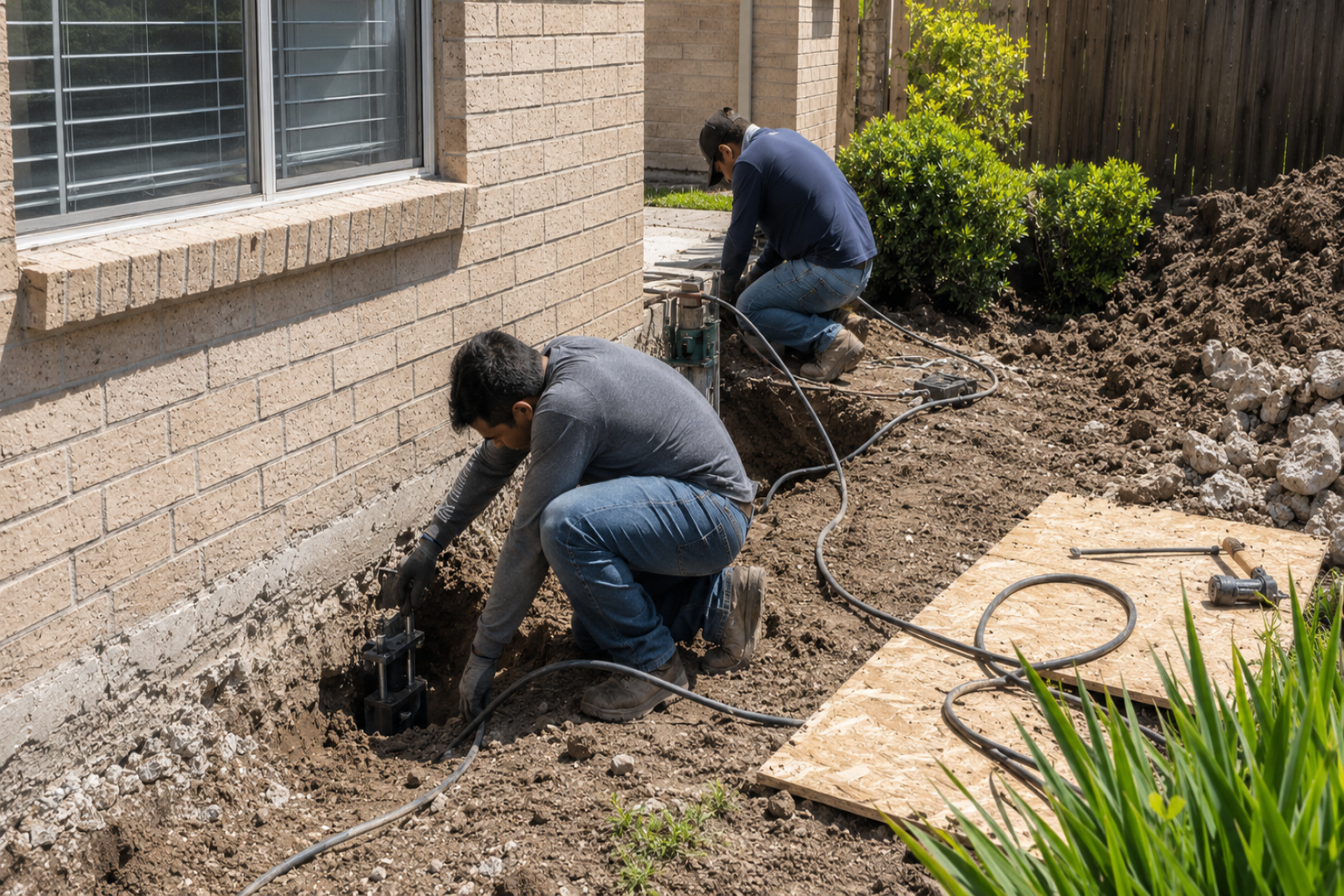


Foundation repair in Texas covers several different jobs that get quoted under one name. A quiet crack, a dropped slab corner, ten exterior piers, interior pier work through a living room floor, and a wet pier-and-beam crawl space are different projects with different budgets.
For a real structural repair in Texas, a practical starting budget is usually $5,000 to $15,000. Smaller exterior repairs can come in below that. Large underpinning jobs, interior piers, plumbing work, finish repair, drainage correction, or pier-and-beam framing work can push the total past $20,000 and sometimes past $30,000.
I have read enough Texas repair bids to stop trusting the first number quoted over the phone. The scope carries the real price: what moved, where the piers go, what gets lifted or stabilized, what gets patched, what gets excluded, and what happens if plumbing or drainage shows up in the middle of the job.
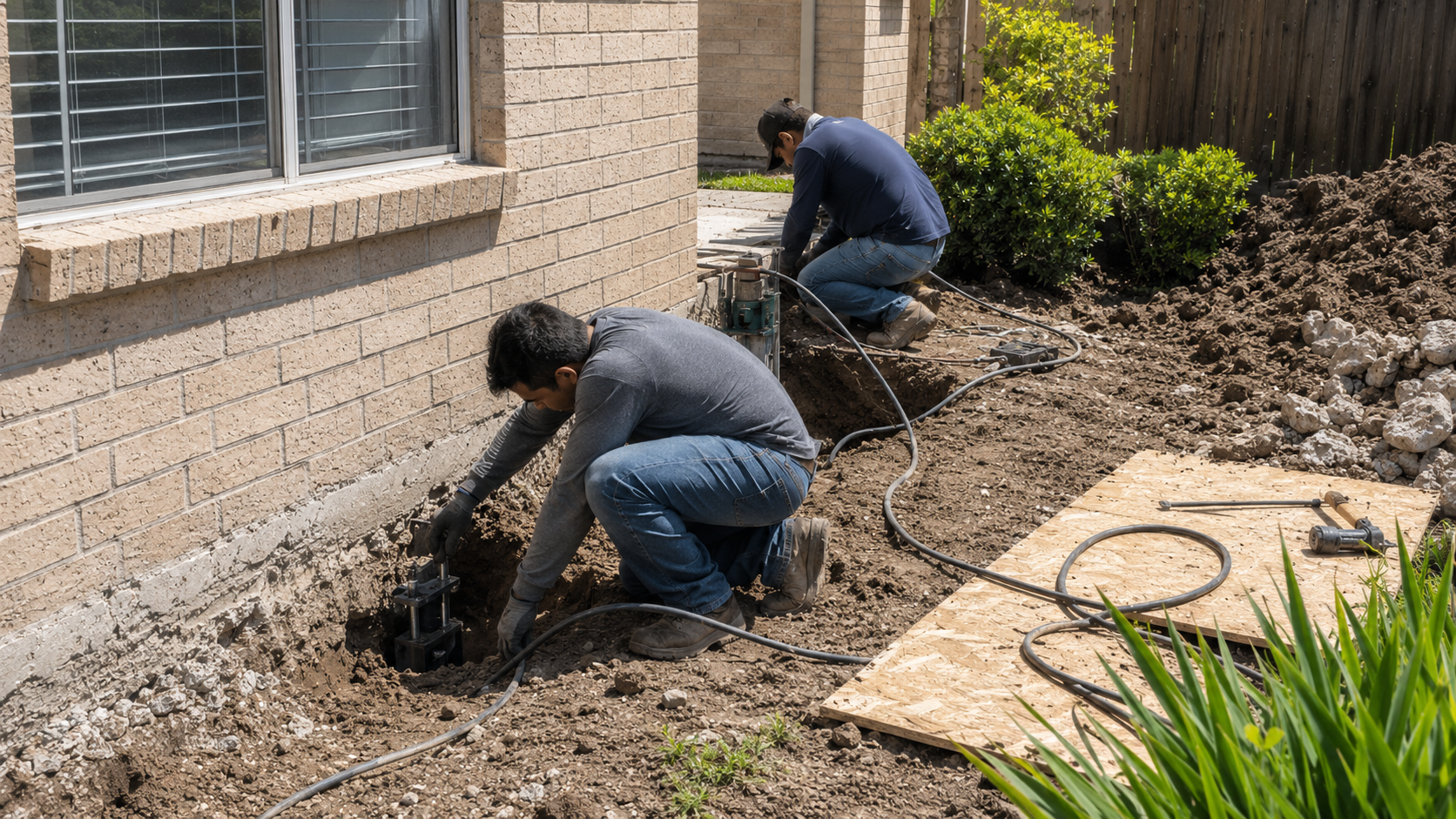
Texas Foundation Repair Cost at a Glance
| Project level | Typical Texas planning range | What the price may cover |
|---|---|---|
| Independent foundation evaluation | $500–$1,500 | Inspection by a Texas professional engineer, elevation readings, written findings, and sometimes repair recommendations |
| Minor crack or concrete work | $500–$3,000 | Limited sealing, patching, or nonstructural concrete work after the cause has been checked |
| Localized structural stabilization | $3,000–$8,000 | A small group of accessible exterior piers or correction of one limited support area |
| Typical multi-pier slab repair | $7,500–$15,000 | Several piers, excavation, lifting or stabilization, rough concrete patching, and cleanup |
| Major underpinning | $15,000–$30,000+ | Numerous piers, interior access, deeper systems, plumbing coordination, difficult access, or finish disruption |
| Minor pier-and-beam leveling | $800–$3,500 | Reshimming, adjustment, or correction of a small support problem |
| Substantial pier-and-beam repair | $6,000–$20,000+ | Multiple piers, beam or joist repair, crawl-space access, moisture damage, leveling, and drainage work |
Use those ranges as planning numbers, not fixed Texas prices. Soil, foundation type, house size, access, pier system, plumbing, permits, and finish repair can move the total fast.
If a house is showing credible movement, I would not carry the lowest number in the table. A safer early budget is often $10,000 to $15,000, because the first structural price may not include engineering, plumbing tests, drainage work, flooring, drywall, masonry, or landscaping repair.
Why the Average Price Can Mislead You
A statewide average blends too many different jobs. A small crack repair, a six-pier exterior repair, a whole-house slab underpinning, a pier-and-beam leveling job, a crawl-space framing repair, and a drainage project can all sit in the same dataset, and an average built from that mix will not predict what your repair costs.
The source also matters. Most current Texas cost data comes from foundation contractors. That does not make the data worthless. It means the numbers reflect that contractor’s service area, repair systems, customers, job mix, and definition of a booked repair.
One Dallas–Fort Worth contractor reported an average completed foundation-repair price of $5,284.92 in 2025. Another large contractor’s published 2026 Dallas average is $11,117. That does not prove one company is cheap and the other is expensive. They may be counting different jobs.
Averages work as a sanity check. The written repair scope is what you make decisions from.
Published 2026 Averages in Texas Cities
| Texas market | Published average | What the source says the number represents |
|---|---|---|
| Houston | $7,854 | Average booked residential foundation-repair work during 2026 |
| Dallas | $11,117 | Average booked foundation-repair work during 2026 |
| Austin | $13,798 | Average booked foundation-repair work during 2026 |
| Houston pier-and-beam | $10,763 | Average repair and leveling cost for pier-and-beam foundations |
| Dallas crawl-space repair | $11,885 | Average across a broad mixture of crawl-space repair work |
| Austin crawl-space repair | $16,220 | Average across a broad mixture of crawl-space repair work |
Those figures are useful because they are current and Texas-specific. They are not official city prices. They are one contractor’s booked-work averages.
Do not read too much into the city spread. Austin showing a higher average than Houston does not mean the same repair costs twice as much in Austin. The Austin average may include larger jobs, deeper systems, harder access, more crawl-space work, or a different mix of houses.
I could not find a comparable 2026 San Antonio booked-work average in the same dataset, and I am not going to invent one by averaging Austin and Houston. That would make the table cleaner and the data worse.
Texas Slab Foundation Repair Cost
Most newer Texas houses sit on slab-on-grade or stiffened slab foundations. When one area loses support or moves too far, contractors often propose piers under the affected perimeter, and sometimes under interior areas of the slab.
A limited exterior slab repair may land around $3,000 to $8,000. A more typical multi-pier repair often falls between $7,500 and $15,000. Interior piers, extensive underpinning, plumbing work, and finish disruption can push the repair beyond $20,000.
Pier count matters, but it is not the whole estimate. Two ten-pier jobs can price very differently if one is outside in open soil and the other is under a tiled kitchen floor.
Exterior piers
Exterior piers are usually easier because the crew can dig beside the slab. Even then, access can get ugly: narrow side yards, pools, patios, driveways, utilities, air-conditioning equipment, tree roots, fences, irrigation, and landscaping all change labor.
A good quote should show every proposed exterior pier on a drawing. “Repair front corner” is too vague. You need pier count, pier type, and the repair limits.
Interior piers
Interior piers are where a reasonable repair can become disruptive. Furniture has to move, flooring comes out, the slab gets cut — sometimes with hand excavation below it — and the concrete patch that follows rarely includes the finished floor, which often becomes someone else’s job.
If a quote says “concrete patch included,” ask what that means. It may not include tile, hardwood, carpet, cabinets, baseboards, paint, dust cleaning, or storage.
Pressed concrete, steel, and helical systems
Texas contractors use pressed concrete pilings, steel push piers, hybrid systems, drilled piers, and helical piers. Do not compare them by material name only.
Price alone does not sort these systems into good and bad. Depth, resistance, torque, load, connection detail, corrosion protection, access, and the repair objective all matter, and the system has to fit the soil, the house, and the engineer or contractor’s stated repair plan.
For the bigger picture of how slabs, crawl spaces, basements, and pier-and-beam foundations carry loads, see types of house foundations.
How Much Does Each Foundation Pier Cost in Texas?
A rough planning figure for a straightforward exterior foundation pier in Texas is about $700 to $1,800 per pier. Some published contractor numbers fall lower. Steel, helical, deep, heavily loaded, or difficult interior installations can cost much more.
Per-pier pricing only helps when the quote says what is included. Ask whether the price covers:
- Excavation and soil handling
- The complete pier or piling assembly
- The bracket or connection to the foundation
- Hydraulic lifting or stabilization
- Backfilling and compaction
- Rough concrete patching
- Engineering or third-party review
- Plumbing testing
- Permit fees
- Warranty registration
- Landscaping or finish restoration
A ten-pier quote at $900 per pier is not automatically a $9,000 finished project. Mobilization, interior access, engineering, plumbing tests, permits, drainage, and restoration can sit outside that math.
Also ask how change orders work. If excavation hits an obstruction, or if the pier cannot meet the contractor’s stated termination criteria, the contract should say what happens next.
Texas Pier-and-Beam Foundation Repair Cost
Pier-and-beam repair is hard to price from the outside. The symptom may be a sloping floor. The real work may be in a wet, low crawl space with failing beams, poor pads, bad drainage, or old plumbing leaks.
Minor reshimming may cost about $800 to $3,500. Repairing several piers or a defined support area may cost $3,000 to $12,000. Once the job includes deteriorated beams, damaged joists, sill work, moisture control, drainage, or widespread leveling, the total can reach $10,000 to $30,000 or more.
Published contractor data shows the spread. One company reports a 2026 Houston pier-and-beam average of $10,763. Its broader crawl-space averages are about $11,885 in Dallas and $16,220 in Austin.
The visible pier may not be the failed part
A pier-and-beam repair has to follow the full load path:
- Floor sheathing and joists carry room loads.
- Joists transfer load into beams or girders.
- Beams bear on piers, posts, or columns.
- Piers transfer load into pads or footings.
- The pads or footings bear on soil capable of supporting them.
Adding a block under a low beam can make the floor look better for a while and still leave wet soil, rotten wood, a weak pad, poor alignment, or an overloaded beam untouched.
Moisture belongs in the repair scope
In older Texas pier-and-beam houses, moisture is often part of the structural problem. Poor grading, plumbing leakage, standing water, humid crawl-space air, and wet soil can damage wood and weaken support below the piers.
Leveling the house without correcting the moisture source can produce a neat invoice and a short-lived repair. The quote should say whether drainage, damaged wood, soil bearing, ventilation, ground vapor, or plumbing was checked.
Concrete Leveling Is Not Always Foundation Repair
A dropped sidewalk, driveway panel, patio, or lightly loaded concrete slab may be raised with polyurethane injection or another concrete-leveling method. That does not mean the same method is the right answer for a structural house foundation.
Published 2026 averages for polyurethane concrete leveling were about $3,569 in Houston and $3,241 in Austin. Those numbers can include flatwork such as sidewalks and patios. They should not be presented as the cost to underpin a house.
The diagnosis has to identify what moved:
- A nonstructural concrete panel over a void
- The structural foundation supporting the house
- Soil pushing upward and causing heave
- A plumbing or drainage condition
- A framing problem above a stable foundation
Those problems can look similar from the surface and require completely different repairs.
Drainage Can Add Thousands
Foundation work and drainage work are often separate line items. Published 2026 contractor averages for drainage were about $5,276 in Dallas, $7,428 in Austin, and $7,466 in Houston.
That does not mean every foundation job needs a $7,000 drainage system. A downspout extension is not the same scope as a surface drain, French drain, sump, swale, or subsurface collection system.
Drainage work belongs in the job when the evidence supports it: roof runoff, standing water, bad grade, erosion, wet crawl-space soil, irrigation leaks, or moisture differences around the foundation.
Do not accept “Texas soil” as a complete diagnosis. Ask where the water comes from, where it goes now, how the proposed system changes that path, and where collected water will discharge legally and safely.
What Changes a Texas Foundation Quote?
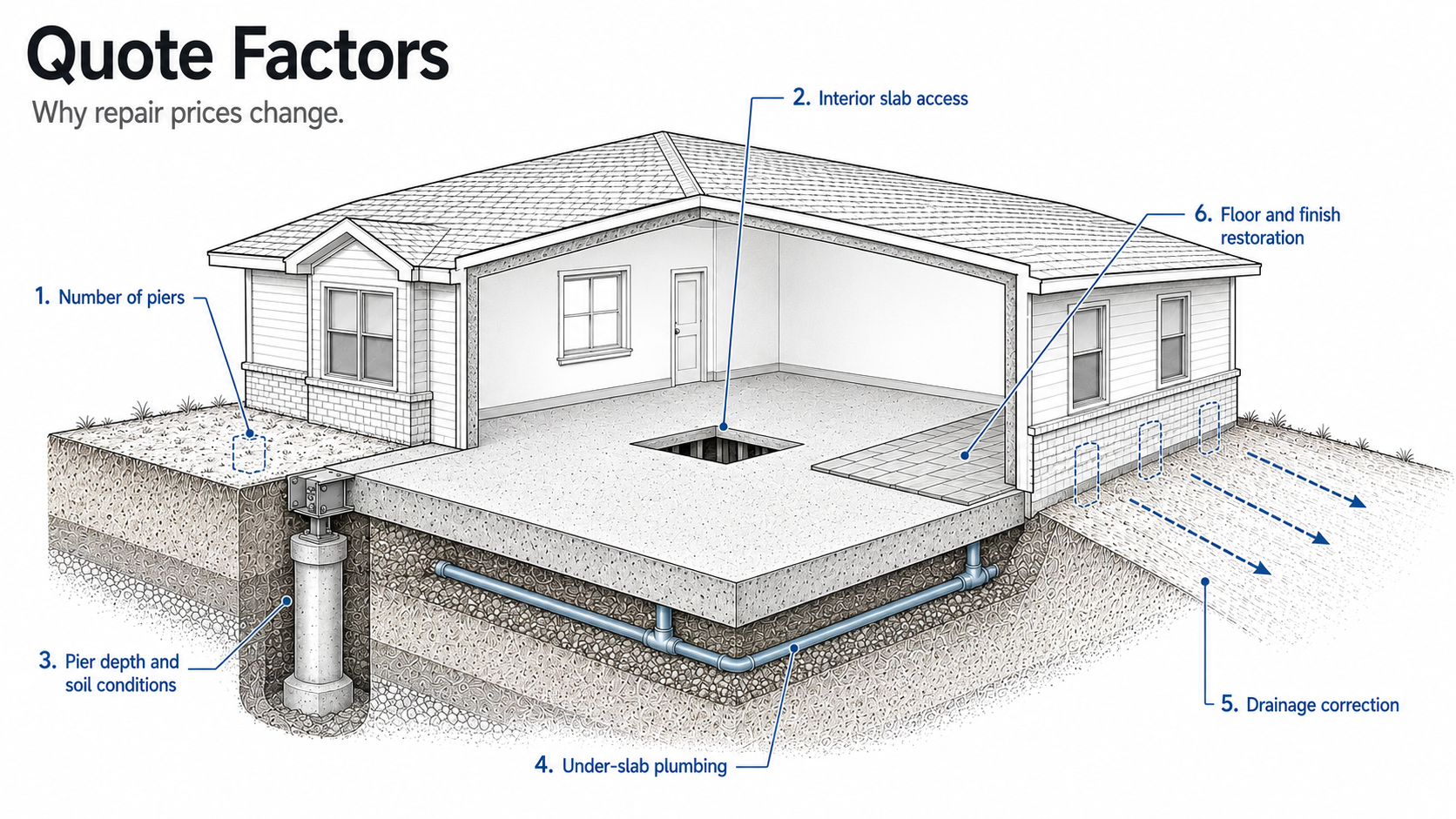
Number and location of piers
More piers usually mean more excavation, material, labor, lifting points, and cleanup. Interior piers usually cost more than accessible perimeter piers.
Stabilization versus lifting
These are different promises. Stabilization is meant to reduce future downward movement. Lifting tries to move the structure toward a different elevation.
A contractor may stabilize a foundation without closing every crack or making every floor level. Aggressive lifting can also affect plumbing, drywall, tile, doors, windows, roofing, and masonry. The contract should state the objective.
Foundation type
Slab repairs usually involve excavation and underpinning. Pier-and-beam repairs may involve crawl-space access, wood framing, pads, piers, beams, joists, moisture, pests, and soil support.
Interior access
Flooring removal, dust control, concrete cutting, hand excavation, concrete replacement, and finish restoration can materially increase the real total.
Under-slab plumbing
A leak can contribute to soil movement, and foundation movement can damage a pipe. A plumbing test before and after lifting may be recommended when slab elevations change.
Ask whether the price includes only testing or also access, tunneling, pipe replacement, backfill, concrete repair, and interior finishes.
Soil and installation depth
Texas has highly variable soils. TxDOT notes that the state has some of the most expansive soils in the country. Swelling clay can push upward; dry or poorly supported zones can contribute to settlement.
Be careful with vague promises about reaching “bedrock.” Many residential systems terminate based on resistance, torque, depth, or an engineered criterion, not visible bedrock.
Access around the house
Pools, patios, porches, driveways, fences, retaining walls, utilities, additions, air-conditioning equipment, and narrow side yards can change the installation method and labor.
Finishes and landscaping
Foundation contractors often repair the structure, not every consequence around it. Brick pointing, tile, hardwood, cabinets, drywall, paint, trim, irrigation, sod, shrubs, and patios may require separate trades.
What to Check Before You Spend Money
The costly error usually happens before any pier goes in: paying for a repair before the problem has been defined well enough to bid.
1. Find out whether the movement looks active
A crack can be old, stable, seasonal, moisture-related, or actively changing. Photograph it with a ruler, record the date, and watch whether it changes after dry or wet periods.
Monitoring is not enough when there is rapid change, significant displacement, plumbing trouble, unsafe framing, severe floor movement, or another sign that needs prompt professional review.
2. Ask for floor-elevation measurements
A sketch with relative floor elevations is more useful than a salesperson pointing at cracks. It shows the pattern and size of elevation differences across the house.
Elevation readings are still only one piece. They should be read with framing layout, foundation type, drainage, crack patterns, plumbing, construction history, and previous repairs.
3. Separate diagnosis from the repair sale when the stakes are high
A contractor can inspect the house and propose work. That is how most estimates start. For a disputed diagnosis, large interior-pier scope, unusual movement, failed previous repair, real-estate transaction, or serious structural concern, an independent Texas professional engineer can give an opinion without selling the installation.
The Texas Board of Professional Engineers and Land Surveyors has stated that an engineering opinion associated with a foundation is the practice of engineering and must be performed by a licensed professional engineer. A TREC home inspector has a different role: reporting visible conditions and an opinion of foundation performance within the state inspection standards.
4. Check for plumbing trouble
Look for unexpected water use, warm floor areas, sewer odors, slow drains, repeated stoppages, wet soil, or unexplained moisture. Do not assume every foundation problem is caused by a leak. Do not lift a slab blindly when credible plumbing symptoms are present.
5. Read the drainage around the whole house
Check roof runoff, downspouts, low spots, patios sloping toward the wall, irrigation leaks, soil pulling away from the slab, ponding, erosion, and discharge from neighboring property.
6. Review previous repair documents
Ask for old plans, pier locations, engineering letters, warranties, elevation records, invoices, plumbing tests, and transfer documents. New piers installed over an unknown old repair can create an uneven support plan.
7. Ask what happens if you wait six months
The answer should match the condition of the house. Be cautious with anyone who predicts collapse from ordinary cosmetic cracking. Be just as cautious with anyone who dismisses measurable movement without explaining why.
How the Project Gets Bigger
A foundation estimate often grows because the first price covers only the stabilization system. Everything around it appears later.
- Cracks and sticking doors lead to an evaluation.
- Elevation readings show movement across a larger area than expected.
- The repair plan adds exterior piers.
- Interior support is recommended because perimeter work will not address the pattern.
- Flooring and concrete must be opened for interior access.
- A plumbing test finds leakage or damaged piping.
- Drainage work is added to control water concentration.
- Lifting changes door alignment, drywall cracks, tile, cabinets, or masonry.
- Finish repairs begin after the structural work is complete.
This does not mean every contractor is hiding costs. Some conditions cannot be confirmed until work starts. The contract should still identify known exclusions and set unit prices or approval procedures for foreseeable changes.
Costs Commonly Missing From the First Estimate
| Additional item | Why it may be needed | Question to ask |
|---|---|---|
| Engineer’s inspection or report | Independent diagnosis, repair design, permit, or post-repair documentation | Is this included, optional, or my responsibility? |
| Plumbing testing | Checks for leakage before or after slab movement | Does the price include both pre-repair and post-repair tests? |
| Plumbing repair or tunneling | Needed when damaged piping is below the slab | Who repairs the pipe and restores the excavation? |
| Permits | Requirements vary by municipality and scope | Who confirms the requirement and pays the fee? |
| Interior flooring | Interior piers may require slab openings | Does “patching” include the finish floor? |
| Drywall and paint | Existing cracks may change during lifting | Are cosmetic repairs excluded? |
| Masonry repair | Brick and mortar may not close fully after stabilization | When should masonry be repaired? |
| Drainage correction | Water may contribute to movement or erosion | What observation supports the proposed drainage work? |
| Landscaping and irrigation | Excavation disturbs soil, plants, and lines | What will be restored at completion? |
| Storage or temporary accommodation | Interior access can disrupt occupied rooms | Can the house remain safely occupied? |
What Not to Repair Yet
Do not rush final cosmetic work before the structural scope is settled.
These often need to wait:
- Drywall cracks
- Interior paint
- Separated trim
- Sticking doors
- Cracked tile
- Open masonry joints
- Flooring over an interior pier location
- Cabinet adjustments near a moving slab
Some doors and cracks improve during lifting. Others do not. New cracks can appear as the house responds. Finish the structural work, plumbing verification, and a reasonable observation period before treating every cosmetic defect as final.
Do not leave unsafe glass, loose masonry, active leaks, or trip hazards untouched. Make temporary safety repairs where needed without hiding evidence that is still useful to the diagnosis.
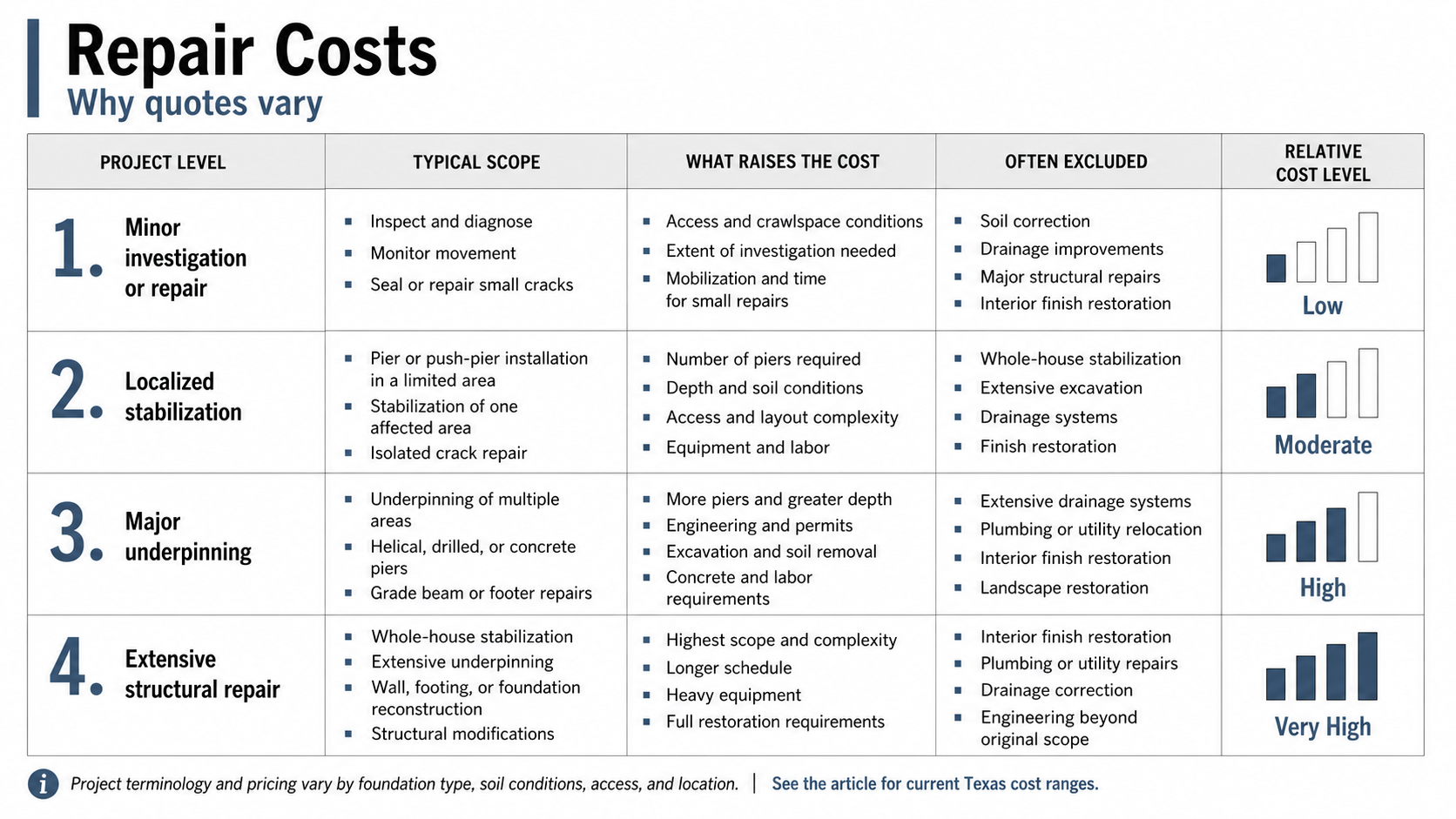
Three Realistic Levels of Texas Foundation Work
Level 1: Minimum intervention
This fits cases where the evaluation does not support immediate underpinning or where the problem is limited and nonstructural.
- Documenting and monitoring cracks
- Correcting a plumbing leak
- Improving a downspout or localized drainage problem
- Repairing an isolated concrete defect
- Getting an independent engineering opinion
- Reviewing an old repair and warranty
Minimum intervention still needs a reason, a monitoring plan, and clear triggers for another evaluation.
Level 2: Standard structural repair
This is a defined stabilization job on a limited or moderate area.
- Mapped exterior piers
- Controlled lifting or stabilization
- Minor interior access
- Pre-repair and post-repair elevation readings
- Plumbing testing where appropriate
- Rough concrete repair
- Basic site cleanup
- A written warranty
A realistic budget is often $5,000 to $15,000, depending on pier count and access.
Level 3: Full repair program
A full program coordinates several systems at once.
- Extensive perimeter and interior underpinning
- Independent engineering
- Under-slab plumbing work
- Drainage correction
- Beam and joist repair
- Concrete cutting and replacement
- Flooring and finish restoration
- Masonry work
- Documentation for resale or insurance
The structural contract may exceed $15,000 to $30,000, with restoration costs outside that figure.
How to Compare Texas Foundation Repair Quotes
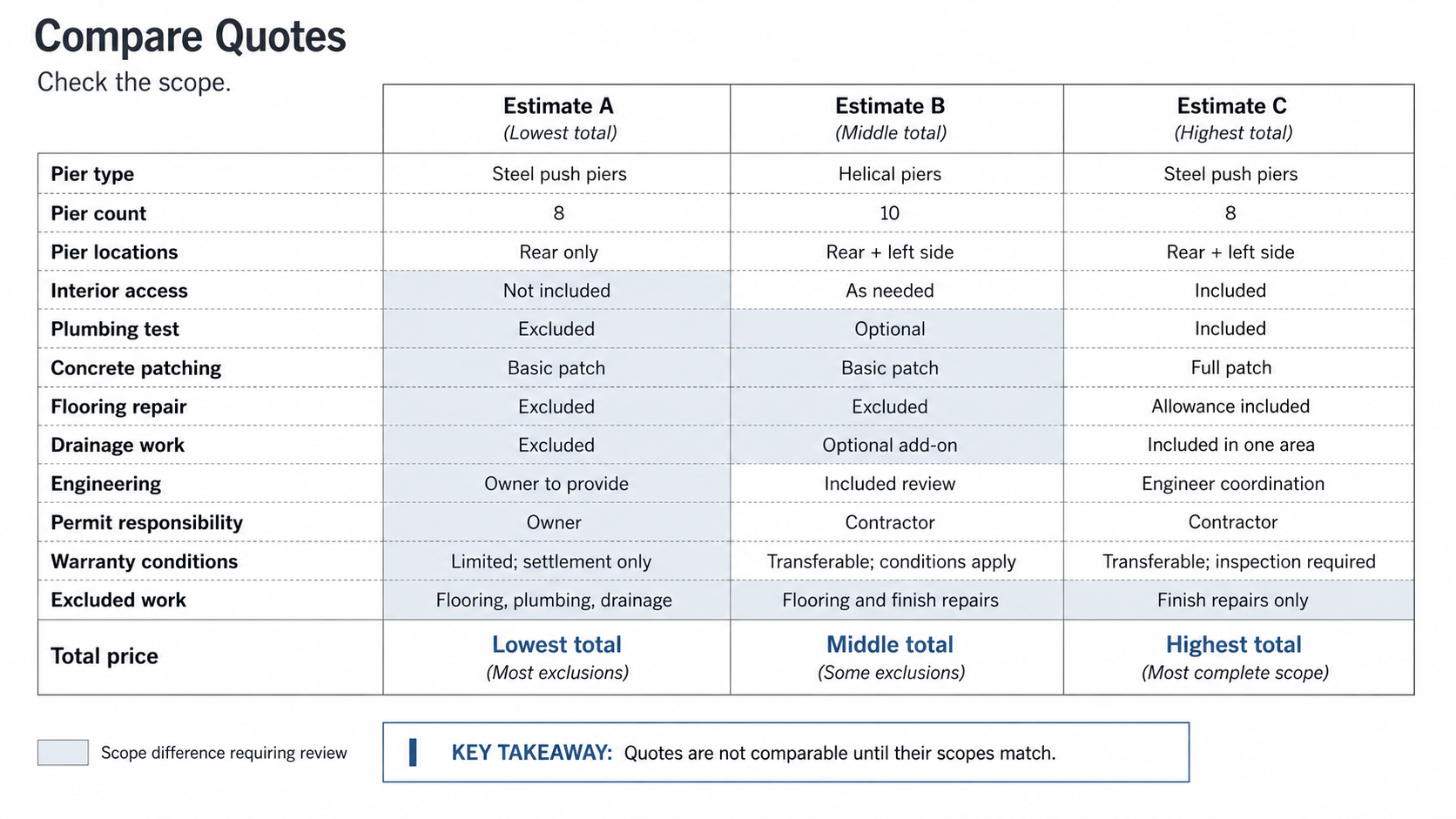
Put the estimates side by side and compare the same line items.
| Instead of this | Do this |
|---|---|
| Comparing only the bottom-line price | Compare repair area, pier count, pier type, access, and exclusions |
| Accepting “repair front of house” | Require a drawing showing every proposed support location |
| Assuming every pier does the same job | Ask how the system is installed, connected, tested, and terminated |
| Assuming lifting and stabilization are identical | Require the contractor to state the objective and realistic limits |
| Accepting “lifetime warranty” as a complete explanation | Read transfer fees, adjustment rules, exclusions, and service charges |
| Assuming concrete patch includes flooring | Ask who replaces tile, wood, carpet, cabinets, and trim |
| Hiring the cheapest quote immediately | Resolve major differences in diagnosis before choosing a contractor |
Every serious written quote should identify
- The observed problem and proposed repair area
- The number, type, and location of piers or supports
- Interior access points
- Whether the objective is stabilization, lifting, or both
- How elevations will be recorded
- How installation depth or resistance will be documented
- Whether engineering is included
- Whether permits are included
- Whether plumbing tests are included
- What concrete will be patched
- What flooring and finishes are excluded
- What landscaping will be restored
- The change-order process
- The payment schedule
- The warranty terms and transfer requirements
If one contractor recommends six piers and another recommends twenty, the next step is not choosing the lower total. Ask both companies to explain the movement pattern, the repair limits, and what they expect unsupported areas to do.
Should You Hire an Engineer Before a Foundation Contractor?
Not every Texas foundation concern needs an engineer before the first contractor visit. A contractor’s evaluation can give you measurements, a proposed scope, and a budget.
An independent Texas professional engineer becomes more useful when:
- Contractors recommend substantially different scopes
- The project includes many interior piers
- Previous repairs have failed or are undocumented
- The structure has unusual additions or framing
- Heave and settlement are difficult to separate
- Plumbing and drainage complicate the movement
- The house is being bought or sold
- A municipality, lender, insurer, or contract requires engineering documentation
- You want diagnosis separated from the repair sale
A Texas engineering foundation inspection with a written report commonly falls around $500 to $1,500. Confirm whether the fee includes elevation measurements, a sealed report, repair recommendations, plan review, contractor-bid review, and post-repair inspection.
A free contractor estimate prices a repair. An independent engineering report can define what should be repaired, and sometimes what should be left alone.
Does Texas Homeowners Insurance Cover Foundation Repair?
Do not assume routine settlement, soil movement, wear, or ordinary foundation cracking is covered. The Texas Department of Insurance notes that all-risk policies still contain exclusions and usually do not pay to repair a home’s foundation.
Coverage can change when damage comes from a specific covered event. Sudden and accidental water discharge is not the same as a long-term plumbing leak, poor drainage, drought-related soil movement, flooding, or deferred maintenance.
Before opening walls or approving major work:
- Read the policy and endorsements.
- Identify the suspected cause of loss.
- Photograph the damage.
- Keep plumbing tests and inspection reports.
- Contact the insurer or agent before destroying evidence.
- Ask for a written coverage decision.
Do not rely on a contractor’s statement that insurance “always pays” or “never pays.” Coverage depends on the policy and the cause of damage.
Foundation Repair Warranties: Read the Fine Print
Most Texas foundation companies advertise a lifetime warranty. What the warranty covers depends on the contract behind it.
Check:
- Whose lifetime the warranty covers
- Whether it transfers to a buyer
- Whether a transfer fee or deadline applies
- Whether coverage applies only to installed piers
- Whether movement between repaired areas is excluded
- Whether drainage, plumbing, trees, drought, flooding, or alterations void coverage
- Whether adjustments are free
- Whether an inspection or service-call fee applies
- Whether cosmetic damage is excluded
- What happens if the contractor closes or changes ownership
A warranty on ten piers does not necessarily cover the entire house. The drawing attached to the warranty can matter as much as the warranty title.
Regional Texas Differences That Affect Cost
Houston and the Gulf Coast
Houston foundation work may involve expansive clay, drainage, high moisture, flooding history, older pier-and-beam housing, under-slab plumbing, and regional land subsidence.
The U.S. Geological Survey explains that groundwater withdrawal has caused compaction and land subsidence in parts of the Houston–Galveston region. That does not prove a specific Houston house needs foundation repair, but it is another reason not to reduce every problem to a dry perimeter.
Dallas–Fort Worth and North Texas
North Texas repairs often involve moisture-sensitive clay and strong seasonal changes. Pier count, previous repairs, mature trees, drainage, and interior access can drive the price.
DFW also has a large foundation-repair market. That gives homeowners more contractors to compare, but company methods and recommendations can differ sharply. A detailed scope matters more than a famous brand name or a low per-pier advertisement.
Austin and Central Texas
Austin-area conditions vary with geology, slope, cut-and-fill construction, drainage paths, and the mix of slab and older pier-and-beam houses. Published 2026 averages from one contractor are higher than its Houston and Dallas figures, but the source does not show enough job detail to conclude that all Austin repairs cost more.
San Antonio
San Antonio homes can sit on varied soil and rock conditions. Access changes across the region. Some houses may need comparatively shallow work; others have fill, drainage, plumbing, or addition-related complications.
Use a San Antonio-specific inspection and quote. Do not apply an Austin average just because both cities are in Central Texas.
Texas Hill Country
Slope, rock, drainage concentration, retaining conditions, cut-and-fill pads, and additions can matter more than a statewide average. A low floor area may come from support movement, framing, fill, drainage, or construction transitions.
West Texas
Dry conditions do not eliminate foundation risk. Soil variability, irrigation patterns, plumbing leaks, poorly compacted fill, sudden-storm drainage, and construction quality still affect performance.
Frequently Asked Questions
What is the average cost of foundation repair in Texas?
For a genuine structural repair, plan around $5,000 to $15,000. Limited exterior work may cost less. Extensive underpinning, interior piers, plumbing, or pier-and-beam framing repairs can exceed $20,000 to $30,000.
How much does slab foundation repair cost in Texas?
A localized slab repair may cost about $3,000 to $8,000. A multi-pier structural repair often falls around $7,500 to $15,000. Major underpinning with interior access can exceed $20,000.
How much does pier-and-beam foundation repair cost in Texas?
Minor adjustment or reshimming may cost $800 to $3,500. Multiple support repairs may cost $3,000 to $12,000. Extensive beam, joist, moisture, and leveling work can reach $10,000 to $30,000 or more.
How much does each foundation pier cost in Texas?
A straightforward exterior pier may cost roughly $700 to $1,800. Interior access, steel or helical systems, greater depth, difficult excavation, and engineering requirements can push the per-pier cost higher.
Why do two foundation companies give completely different estimates?
They may disagree about the cause, repair area, pier system, stabilization objective, or number of supports required. Compare elevation plans and written scopes. When the difference is large, an independent engineer can help resolve the diagnosis before you sign.
Should I get an engineer’s report?
It is especially useful for large or disputed repairs, previous repair failures, unusual structures, real-estate transactions, extensive interior work, or cases where you want diagnosis separated from the contractor selling the repair.
Does a foundation crack mean I need piers?
No. Crack shape, width, displacement, moisture, location, and change over time all matter. A crack can be cosmetic, water-related, shrinkage-related, or associated with structural movement.
Will foundation repair make my house perfectly level?
Not necessarily. Some repairs are designed mainly to stabilize the structure. Lifting has practical limits and can damage finishes or plumbing when pushed too far. The written proposal should state the objective.
Can I stay in the house during foundation repair?
Many exterior-pier projects allow the house to remain occupied. Interior excavation, extensive lifting, plumbing interruptions, dust, noise, or safety conditions may make parts of the home difficult to use.
When should I repair drywall, tile, and masonry?
Complete the structural work and plumbing verification first. Let the house respond before making final cosmetic repairs, unless immediate repair is needed for safety or water control.
The Number That Matters Is the Complete Scope
A Texas foundation quote is useful only when it explains what is moving, what will be supported, how the repair will be installed, and what remains outside the price.
Start with diagnosis. Compare mapped repair plans, not sales presentations. Separate structural work from drainage, plumbing, and finish restoration. Read the warranty as a contract.
The cheapest pier price can become expensive when exclusions arrive later, and a high quote can be padded when the contractor has not shown why every support is needed. Whatever number you settle on, tie it to a mapped scope you can hold the contractor to.
Sources and data
- Olshan Foundation Solutions: Houston 2026 repair-cost data
- Olshan Foundation Solutions: Dallas 2026 repair-cost data
- Olshan Foundation Solutions: Austin 2026 repair-cost data
- Stratum Foundation Repair: Dallas–Fort Worth completed-job average
- Anchor Foundation Repair: pier-and-beam repair scopes and costs
- Texas Real Estate Commission: foundation performance reporting
- Texas Board of Professional Engineers and Land Surveyors: engineering opinions associated with foundations
- Texas Board of Professional Engineers and Land Surveyors: when a professional engineer is required
- Texas Department of Insurance: all-risk and named-peril policies
- Texas Department of Insurance: home insurance guide
- Texas Department of Transportation: expansive soils in Texas
- U.S. Geological Survey: Texas Gulf Coast groundwater and land subsidence